2000 Review and
2001 Outlook Statement
Forfás 2000 Review and 2001 Outlook Statement
______________________________________________________________________________________
Table of Contents
Page
Section 1
Overview of 2000
Economy / Employment 1
Agency Supported Firms Spending in the Economy 4
Corporation Tax Payments 5
Investment in Enterprise Development 6
Cost Per Job Sustained 7
State Expenditure on Science & Technology 7 Research & Development in the Higher Education
Sector
9
Section 2
Major Issues for 2001
Future of Enterprise Development 11
Competitiveness 13
Regulation & Competition 14
Science Foundation Ireland 15
European Research Area 16
Trade 16
Regional Development & Infrastructure 17
Electricity 18
Future Skills Needs 18
Telecommunications and e-Business 19
EMU 20
Section 3
Forfás Activities in 2000
Policy
Enterprise Development 21
Competitiveness 23
Science, Technology & Innovation 23
Trade 27
Infrastructure Priorities in the Regions 28 Regional Database of Infrastructure 29
Forfás 2000 Review and 2001 Outlook Statement
______________________________________________________________________________________
e-Business 32
Telecommunications 33
The Retail Sector 34
Coordination
Enterprise Areas Scheme 35
Ask Ireland 35
Awareness Programmes
− EMU Business Awareness Campaign
− Science, Technology & Innovation Awareness Programme
− National Skills Awareness Campaign
36 37
38
Monitoring & Review
Evaluation of the Research, Technology and Innovation (RTI) Initiative
39
Evaluation of Irish Participation in ‘Eureka’ 39
Appendix 1 Trends in Permanent Employment, 1991 – 2000 Irish and Overseas Owned Companies
Manufacturing and Internationally-Traded / Financial Services
Appendix 2 Trends in Part-Time, Temporary and Short-Term Contract Employment
Enterprise Ireland and IDA Ireland Supported Companies (1991 – 2000)
Forfás 2000 Review and 2001 Outlook Statement Overview of 2000 ______________________________________________________________________________________
O
VERVIEW OF2000
This section reviews 2000 and the main results of Forfás surveys under the following headings:
• Economy / Employment
• Agency Supported Firms Spending in the Economy • Corporation Tax Payments
• Investment in Enterprise Development • Cost Per Job Sustained
• State Expenditure on Science and Technology
• Research & Development in the Higher Education Sector
Economy / Employment Continues to Grow
GNP is estimated to have increased by 8.6 per cent1 in real terms in 2000, making it the seventh successive year of very strong economic growth. With strong growth in demand, a depreciating euro and increasing oil prices, inflation increased by more than expected in 2000. The headline Consumer Price Index rose by an estimated 5.5 per cent compared with 1.6 per cent in 1999. Exports continue to perform strongly and are estimated to exceed IR£65 (€82.5) billion for the year 2000.
Chart 1
Trends in Permanent and Temporary Employment 1991 - 2000 Manufacturing and Internationally Traded / Financial Services
193,637 11,641
193,544 12,861
195,585 15,569
201,775 20,659
211,260 23,943
222,582 22,636
237,711 27,194
250,939 29,597
264,916 31,314
286,861 30,761
0 50,000 100,000 150,000 200,000 250,000 300,000 350,000
1991 1992 1993 1994 1995 1996 1997 1998 1999 2000 Permanent Full-time Employment
Temporary Part-time Employment
Source: Forfás Annual Employment Survey
Forfás 2000 Review and 2001 Outlook Statement Overview of 2000 ______________________________________________________________________________________
Preliminary results from the Forfás Annual Employment Survey show that total employment in agency supported companies2 rose by 21,400 jobs in 2000, the highest achieved to date. This consists of a rise of 22,000 in permanent employment and a marginal reduction of 600 in temporary and part-time employment. This brings the total employed in these companies, including permanent and temporary and part-time jobs, to a record high of 317,600. The reduction in temporary and part-time employment reflects a trend by some companies to offer permanent positions to temporary workers, possibly in response to the tightening labour / skills market. The increase in employment described above takes account of job gains and job losses. Job gains in permanent full-time employment amounted to over 40,300 in 2000, the highest level achieved over the past ten years. Irish-owned companies accounted for almost 16,200 and foreign-owned companies for 24,100, of the total job gains, the highest levels recorded over the last ten years. Internationally-traded and financial services showed the biggest percentage gains, increasing by 24 per cent to a total of 60,000 jobs in 2000 following an increase of 25 per cent in 1999.
After a two year period (1998/1999) in which job losses increased by almost 50 per cent, losses declined marginally (-3.1 per cent) in 2000 to 18,400. The job losses were mainly in labour-intensive and low-margin sectors, and reinforces the point that industry must continue to take steps to improve competitiveness and to re-orientate towards higher value-added sectors in order to achieve growth.
The main factors contributing to this record performance in 2000 were:
! A very significant increase in new permanent jobs created (+ 22.4 per cent);
! A reduction in the level of job losses compared with 1998 and 1999.
Chart 2
Trends in Job Losses in Permanent Full-Time Employment
Manufacturing and Internationally Traded / Financial Services 1991 - 2000
0 5,000 10,000 15,000 20,000 25,000 30,000
1991 1992 1993 1994 1995 1996 1997 1998 1999 2000 Source: Forfás Annual Employment Survey
Forfás 2000 Review and 2001 Outlook Statement Overview of 2000 ______________________________________________________________________________________
It is an objective of industrial policy to bring about an improved regional distribution of employment. The Border, Midlands and West (BMW)3 region has tended in the past to perform less satisfactorily than the rest of the country in terms of increasing and sustaining employment in manufacturing and internationally-traded services. Chart 3 shows that the BMW region accounts for 26.3 per cent of the population (aged 15+) and 24.9 per cent of the labour force. In 1999, the region accounted for 17 per cent of gross job gains in companies under the remit of IDA Ireland and Enterprise Ireland. The latest figures for 2000 show an increase on this figure with 20.1 per cent of gross job gains located in the BMW region. This trend will be monitored closely in the future to determine the impact of policies aimed at improving the regional distribution of employment.
Chart 3
Share of Gross Job Gains in Agency Supported Companies* by Region Relative to Share of Population and Labour Force
73.7% 26.3%
75.1% 24.9%
82.6% 17.4%
79.9% 20.1%
Share of Population 2000 **
Share of Labour Force 2000 **
Share of Jobs Created in 1999
Share of Jobs Created in 2000
Border, Midland & West
Southern & Eastern Region
*Source: Forfás Annual Employment Survey (Excludes Shannon Development and Údarás na Gaeltachta)
** CSO data
3 The regional divide used is the classification used by the European Union for regional aid purposes.
Forfás 2000 Review and 2001 Outlook Statement Overview of 2000 ______________________________________________________________________________________
Agency Supported Firms Continue to Increase Their Spending in the
Economy - up over IR£2 (€2.7) billion
Results from the Forfás Irish Economy Expenditure (IEE) Survey show an increased level of spending in 1999 by companies engaged in manufacturing and internationally traded services activities, in line with the trend in recent years. Firms in these sectors spent over IR£25 (€32.1) billion in the economy in 1999, up over IR£2 (€2.7) billion (9.3 per cent) on 1998 in real terms.
This spending is contributing significantly to the high levels of growth and employment in the economy. Both Irish-owned (IR£12.7/€16.2 billion) and foreign-owned (IR£12.5/€15.9 billion) firms increased their spend on wages and salaries, Irish raw materials and Irish services in 1999.
[image:8.595.120.489.319.750.2]The fastest growing area is internationally traded services where IEEs increased by 17.8 per cent in 1999, compared with an increase of 7.8 per cent by manufacturing establishments.
Table 1
Forfás Irish Economy Expenditure Survey Results
1999 % Change
over 1998 Irish-Owned Firms IR£ M + Foreign Owned IR£ M = TOTAL
IR£ M %
Total Sales 17,009 40,624 57,633 21.9
Total Irish Economy Expenditures
12,740 12,533 25,273 9.3
Of which:
Wages & Salaries 2,981 3,349 6,330
11.8
Irish Raw Materials 6,678 4,283 10,961 10.9
Irish Services 2,048 4,045 6,093 2.8
Profits* 1,083 856 1,939 13.2
IEE % Sales 74.9 31.0 43.9 -10.2
Euro Conversion
1999 % Change
over 1999 Irish-Owned Firms € M + Foreign Owned € M = TOTAL
€ M %
Total Sales 21,597 51,582 73,179 21.9
Total Irish Economy Expenditures
16,176 15,914 32,090 9.3
Of which:
Wages & Salaries
3,785 4,252 8,037 11.8
Irish Raw Materials 8,479 5,438 13,918 10.9
Irish Services 2,600 5,136 7,736 2.8
Profits* 1,375 1,087 2,462 13.2
IEE % Sales 74.9 31.0 43.9 -10.2
Forfás 2000 Review and 2001 Outlook Statement Overview of 2000 ______________________________________________________________________________________
Substantial Rise in Corporation Tax Payments
In addition to their expenditure in the economy, manufacturing, internationally traded and financial services companies provide a very significant direct return to the exchequer by way of corporation tax payments.
• The total corporation tax take is estimated at IR£3,007 (€3,818) million in 20004. This represents a rise of 587 per cent in real terms in the period 1988 to 2000 (17.4 per cent per annum).
• Corporation tax paid at the 10% rate by manufacturing and internationally-traded and financial services companies, according to a survey by Forfás is estimated at IR£1,333 (€1,693) million in 2000, equivalent to 44 per cent of total corporation tax receipts.
• Budget 2001 continued the momentum to achieve a standard rate of corporation tax for trading income of 12.5 per cent by the year 2003. The standard rate for trading income was reduced to 20 per cent from 1 January 2001 and a rate of 12½% will apply to companies with a trading income not exceeding IR£200,000 (€253,948) from the same date. This means that only just over 13 per cent of companies liable for tax will now pay corporation tax at the standard rate. However, the figures in Chart 4 below show that lower corporation tax rates have been followed by a higher corporation tax yield.
Chart 4
Corporation Tax Payments
(Constant Prices)
* Source: Forfás Corporation Tax Survey
4 Source: End December 2000 Exchequer Returns.
0 500 1000 1500 2000 2500 3000 3500
1988 1989 1990 1991 1992 1993 1994 1995 1996 1997 1998 1999 2000 0 500 1,000 1,500 2,000 2,500 3,000 3,500 4,000
Total Corporation Tax
Manufacturing & Intn'l. Traded and Financial Services
IR£ millions euro millions
E
Forfás 2000 Review and 2001 Outlook Statement Overview of 2000 ______________________________________________________________________________________
Increased Investment in Enterprise Development
Forfás undertakes an annual analysis of State investment to promote the development of the enterprise sector and create employment in Ireland. The latest estimate indicates that:
• The gross cost of support in real terms to the enterprise sector in the form of direct expenditure (all costs of operating the development agencies, financial supports etc) was approximately IR£599.4 (€761.1) million in 1999, and is estimated at IR£669.3 (€849.9) million for 2000. This represents a rise of 59 per cent in real terms over the period 1988-2000;
• Over the same period, 1988 to 2000, growth in gross Government expenditure (current plus capital) of 86 per cent in real terms was recorded. The growth in GNP in real terms over this period was 140 per cent;
• There has been a swing from fixed-asset related supports to other forms of support such as R&D, equity investment, employment grants and supports aimed at upgrading the business capability of firms. In 1988 fixed asset supports accounted for 46.5 per cent of total direct expenditure. By 1999 the percentage had fallen to 35 per cent.
Chart 5
State Expenditure on Enterprise Development (Constant Prices)
0 100 200 300 400 500 600 700 800
1988 1989 1990 1991 1992 1993 1994 1995 1996 1997 1998 1999 2000 0 200 400 600 800 1,000
IR£ million euro million
Forfás 2000 Review and 2001 Outlook Statement Overview of 2000 ______________________________________________________________________________________
Cost Per Job Sustained
5– Lowest Level Ever Recorded
The average cost per job sustained over a seven year period in agency supported companies amounted to approximately IR£9,124 (€11,585) in 2000, the lowest level recorded. The trend is shown in Chart 6 below. This is due to a number of factors including the improved value for money approach to projects pursued by the agencies, a significant increase in the return to Enterprise Ireland from its equity shareholdings, the continued growth of internationally traded services projects where investment costs are generally lower than manufacturing projects, and the favourable economic environment for enterprise development.
Chart 6
Trends in Cost Per Job Sustained
(Constant Prices)
0 5,000 10,000 15,000 20,000 25,000 30,000
0 5,000 10,000 15,000 20,000 25,000 30,000 35,000
IR£ euro
Source: Forfás
State Expenditure on Science and Technology Increases by Twenty
Per Cent
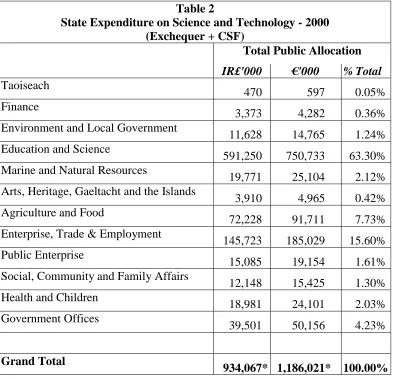
The Forfás annual publication State Expenditure on Science and Technology shows that Government allocations to scientific and technological activities in 2000 amounted to IR£1,100 (€1,397) million, an increase of IR£187.4 (€238) million or 20.5 per cent over the 1999 level.
5 Data excludes companies under the remit of Shannon Development and Údarás na Gaeltachta. The
cost per job is calculated by taking into account all direct Enterprise Ireland and IDA Ireland
Forfás 2000 Review and 2001 Outlook Statement Overview of 2000 ______________________________________________________________________________________
[image:12.595.89.484.154.534.2]All of the increase is accounted for by public funds (Exchequer + EU), which rose from IR£749 (€951) million in 1999 to an allocation of IR£934 (€1,186) million in 2000; the balance of IR£166 (€211) million arises from income earned from the activities of the departments and agencies.
Table 2
State Expenditure on Science and Technology - 2000 (Exchequer + CSF)
Total Public Allocation
IR£'000 €'000 % Total
Taoiseach
470 597 0.05%
Finance
3,373 4,282 0.36% Environment and Local Government
11,628 14,765 1.24% Education and Science
591,250 750,733 63.30% Marine and Natural Resources
19,771 25,104 2.12% Arts, Heritage, Gaeltacht and the Islands
3,910 4,965 0.42% Agriculture and Food
72,228 91,711 7.73% Enterprise, Trade & Employment
145,723 185,029 15.60% Public Enterprise
15,085 19,154 1.61% Social, Community and Family Affairs
12,148 15,425 1.30% Health and Children
18,981 24,101 2.03% Government Offices
39,501 50,156 4.23%
Grand Total
934,067* 1,186,021* 100.00%
Source: Forfás - State Expenditure on Science and Technology, 2000
* These figures do not include ‘earned income’ (such as fees for technical services) which amounted to IR£166 (€211) million in 2000. The inclusion of earned income brings the total to IR£1,100 (€1,397) million.
Research and Development
For the first time this year’s ‘State Expenditure on Science and Technology’ includes a separate volume on research and development. Altogether R&D represents about a quarter of public science and technology expenditure, and the 2000 budget allocation amounts to IR£233 (€296) million. This represents a very significant increase over the actual expenditure in 1999 of IR£148 (€188) million.
Forfás 2000 Review and 2001 Outlook Statement Overview of 2000 ______________________________________________________________________________________
its agencies might perform little or no R&D themselves while providing funding to other performers in either the public or private sectors.
In terms of public funding, the Departments and their agencies are allocating IR£233 (€296) million to R&D in 2000, up from IR£148 (€188) million in 1999. Major increases include an allocation of IR£30 (€38) million by the Department of Education & Science to the Higher Education Authority for research in the third level institutions.
The allocation for performance of R&D in 2000 is IR£53.9 (€68) million, up from IR£50.3 (€64) million last year. This figure includes IR£11.4 (€14) million which is earned income so that the public funds invested in R&D performed in the public sector amount to IR£42 million (€53 million) in 2000.
Chart 7 illustrates the trends in funding in the recent past.
Chart 7
Distribution of Government Supported S&T by Sources of Funds
(2000 prices)
Source: Forfás State Expenditure on Science & Technology, 2000
Research & Development in the Higher Education Sector Continues
to Increase
The Forfás Survey of Research in the Higher Education Sector shows that expenditure on research amounted to IR£160 (€203) million in 1998 up from IR£121 (€154) million in 1996 and IR£73 (€93) million in 1992. The sector is defined as the universities and the institutes of technology, including the Programmes in Advanced Technologies (in the universities) and the Technology Centres in the Institutes of Technology. This survey comes too early to identify changes associated with major
0 100 200 300 400 500 600 700 800 900
90 91 92 93 94 95 96 97 98 99 00
CSF Contribution Earned income Exchequer funds
IR£ millions
euro millions
1,142
889 762
635 508 381
254
Forfás 2000 Review and 2001 Outlook Statement Overview of 2000 ______________________________________________________________________________________
new funding initiatives for Irish research, namely the Programme for Research in Third Level Institutions and the Technology Foresight Fund.
Among the major findings of the survey are the following:
• Expenditure on research in the higher education sector (HERD) amounted to 0.27 per cent of GDP in 1998 (0.31 per cent of GNP), compared to the OECD average of 0.37 per cent of GDP.
• Although all fields of science experienced real increases in expenditure in the six-year period to 1998, there were significant developments in the natural sciences and the social sciences. Expenditure on research in the natural sciences increased in real terms by IR£24.1 (€30.6) million between 1992 and 1998 and social sciences research increased by IR£20.7 (€26.3) million over the six-year period.
• Research in the Institutes of Technology doubled between 1996 and 1998, to IR£10.6 (€13.5) million but still accounts for less than seven per cent of HERD.
• Total number of HE researchers (full-time equivalent) was 2,425 in 1998, or 1.5 per thousand of the labour force compared to an EU average figure of 1.8. This compares with a total of 1,886 researchers or 1.37 per thousand of labour force in 1992, and 2,066 researchers or 1.4 per thousand of labour force in 1996.
• The major source of funding for HE research is from public funding which accounts for 66 per cent of the total funding. This is made up of the research component of the block grant to the colleges for their current and capital expenditure (43 per cent of total) and direct government grants administered by various Government Departments and agencies (23 per cent of total).
• Other major sources of funding are EU programmes (16 per cent), Irish business (seven per cent) and foreign sources (three per cent). The contribution of Irish business to HE research remains around seven per cent of total funding. Internationally comparable data indicate that Ireland is slightly above average in this measure.
Chart 8
Higher Education Expenditure on Research & Development 1986 to 1998
Source: Forfás Survey of Research in the Higher Education Sector 1998
29 0.27% 0.26% 0.23% 0.17% 0.16% 0.18% 0.27% 121 160 50 37 35 73 95 160 124 47 47 59 81 102 0 20 40 60 80 100 120 140 160 180
1986 1988 1990 1992 1994 1996 1998 1998
0 20 40 60 80 100 120 140 160 180
HERD as a Percent of GDP
Forfás 2000 Review and 2001 Outlook Statement Major Issues for 2001 ______________________________________________________________________________________
M
AJORI
SSUES FOR2001
Some of the issues which will be important for economic development and therefore for Forfás in 2001 are considered in this section under the following headings:
• Future of Enterprise Development • Competitiveness
• Regulation & Competition • Science Foundation Ireland • European Research Area • Trade
• Regional Development & Infrastructure • Electricity
• Future Skills Needs
• Telecommunications & e-Business
• EMU
Future of Enterprise Development
By any standards the Irish economy has been transformed with the last six years of strong economic growth. High growth rates have reduced many of the country’s traditional economic problems, namely high unemployment, involuntary emigration, and spiralling government debt. The industrial sector has been the major driver of this recent growth by achieving sustained and significant growth in output, exports and employment at a rate well above that of any of the world’s developed economies. However, as a small, open economy, Ireland is more exposed than most economies to changes in the international environment. While the external economic environment has been relatively benign for the past decade, this cannot be assumed for the future. The degree of moderation of growth of the US economy and the extent of recovery of euro-zone economies present the most uncertainty. Growing infrastructural bottlenecks are becoming apparent within the economy. Similarly, with a slowing of the natural increase in the labour force and the reduction in the rate of unemployment, a sustained increase in net migration will be needed to meet labour and skills shortages and prevent excessive wage inflation. To date, the strength of the economy, low interest rates and the weak euro have shielded the economy from the full effects of these factors.
Forfás 2000 Review and 2001 Outlook Statement Major Issues for 2001 ______________________________________________________________________________________
introduction of the euro will also provide significant opportunities to the enterprise sector in Ireland.
While growth and employment has been strong in all regions, some regions have witnessed over-concentration of development leading to environmental degradation and higher locational costs for both businesses and workers. The successful completion of the National Spatial Strategy6, and the identification and elimination of key bottlenecks through the implementation of the National Development Plan, 2000-2006 are required to develop competitive regional-based enterprises.
The challenge for enterprise policy and the enterprise promotion agencies is to continue to adjust policies and activities to support a dynamic in the enterprise sector for self-sustaining growth in the knowledge-based global economy. As the rate of growth in labour supply slows, greater productivity will be required if moderate growth rates are to be sustained in to the future. The report Enterprise 2010 – A New Strategy for the Promotion of Enterprise in Ireland in the 21st Century, published in 2000 cover these issues in detail and is summarised later in the report under Forfás Activities in 2000.
Productivity growth (output per person employed) will have to come from both shifts in employment towards higher value added activity and from increasing the productivity of existing employees in all sectors of the economy. While employment growth will continue to be an important objective for the development agencies over the next decade, more importantly, the agencies will increasingly target a sustained increase in productivity growth in the internationally traded sector.
If the overall national target of three per cent productivity growth is to be achieved, productivity growth of approximately seven per cent per annum in the internationally-traded sector which is in line with recent performance, and productivity growth of approximately two per cent per year in local services and public administration, which is double recent performance, will be required.
The report advocates policies to ensure the enterprise sector remains the main engine of economic growth over the next decade.
To achieve this, it will be necessary to
• Acceleration of the shift towards high-growth, high-tech, high-productivity activities and a shift from production-type activities to services-type activities;
• A gradual shift in employment to higher value-added sectors;
• An increase in labour productivity in existing firms;
• A continuous upgrading of the educational skills profile of the workforce;
• A deepening of the R&D base of R&D performing firms;
• Reversing the trend of concentration of economic activities in major urban centres to achieve more balanced spatial development;
6 Work on designing the National Spatial Strategy is now well advanced. A scoping and background
Forfás 2000 Review and 2001 Outlook Statement Major Issues for 2001 ______________________________________________________________________________________
• A shift in development agency assistance from "capacity" support for employment creation and fixed asset investment to "capability" support in areas such as human resource development, R&D, marketing and market development within an overall business development framework articulated by each firm which receives Government support.
These targets can only be achieved in tandem with improvements in the overall business environment. Such improvements include:
• Undertaking a comprehensive programme of regulatory reform, especially in the areas of business services and public transport;
• Improving the funding opportunities available to SMEs and emerging high technology companies by encouraging greater competition in the banking market, and increased technology appraisal capability in the investment community;
• Maintaining continued control of Government expenditure to keep the burden of taxation as low as possible;
• Supporting a greater commitment to Research and Development and technological innovation by the enterprise sector;
• Investing in dramatically improved infrastructure, especially roads, transport systems, environmental services, broadband telecommunications, air services and energy;
• The formulation of a national spatial strategy;
• Engaging in necessary institutional reform and, in particular, in the area of the planning physical process to ensure effective implementation of infrastructure projects.
All of these activities have a potentially positive impact on the potential productivity performance of enterprise. However, effective implementation will require sustained commitment and a further significant development of the management and delivery capacity of the public administrative system in Ireland.
Competitiveness
Competitiveness between countries depends not so much on how those countries compete with each other, per se, but on how the firms located in them can compete on global markets. Thus it is a question of the economic environment of each country, the institutional and infrastructural framework that forms the basis for company-level competition. Firms require inputs of skilled workers, up-to-the-minute technology, finance and services if they are to produce their output. Also, they need to be able to act freely in a competitive market if they are to sell their output successfully. A purely free market is not the ultimate goal of competitiveness policy.
Forfás 2000 Review and 2001 Outlook Statement Major Issues for 2001 ______________________________________________________________________________________
market, while Irish enterprises depending on materials sourced from outside the euro zone have seen an increase in their costs.
The National Competitiveness Council has identified a number of competitiveness priorities. The benefit of this is to maintain a clear focus on areas in which action is required. Priorities for action are based on expert discussion and analysis and can change as need arises. Currently, the areas of skills provision, transport infrastructure (including public transport), competition and regulation (including telecoms and electricity), and the environment are among those requiring immediate attention. The National Competitiveness Council brings its influence to bear on these issues through its published recommendations and discussions with Government departments and Ministers.
The National Competitiveness Council believes that social partnership has been a factor of enormous importance in Ireland’s recent surge of economic growth, both in term of releasing productive capacity and in terms of ensuring that the fruits of economic success are distributed throughout society.
Other issues which will be focused on from competitiveness perspective in 2001 include the world of the small business, inflation, and fulfilling Ireland’s commitments under the Kyoto Protocol. The National Competitiveness Council will publish its annual international benchmarking exercise – the Annual Competitiveness Report and also the Competitiveness Challenge document, highlighting particular action which needs to be taken to maintain and enhance Ireland’s competitiveness.
Regulation and Competition
Regulatory reform has now moved high on the policy agenda of many countries. Through regulatory reform markets can be made more efficient, providing consumers with a wider choice of goods and services at a lower cost. Regulatory reform can ensure a simplified and stable environment for enterprise, enabling investment decisions to be taken with more certainty and facilitating operational decisions. Through regulatory reform, administrative procedures are simplified, and the interaction between individual businesses and Government becomes more efficient. In turn, Government policy reflects more quickly the needs of enterprise and the changing pressures of globalisation. A further important theme in regulatory reform is the need to ensure increased competition and consumer focus in industries that, because of their network nature, make market entry difficult, such as electricity, telecommunications and transport. These industries, traditionally state owned, are being privatised in Ireland, and in other countries, raising new issues for policy and the need to ensure low prices and high quality when constraints still exist on full competition. Regulatory reform also embraces the question of government itself: the ability of administrative systems to identify problems to determine policy responses, and to ensure high quality and speedy implementation.
Forfás 2000 Review and 2001 Outlook Statement Major Issues for 2001 ______________________________________________________________________________________
The Taoiseach's action programme on regulatory reform, together with the strategic management initiative in the civil service, represent significant steps forward.
Forfás has been closely involved in the development of policy in this field, and has, inter alia, developed the NCC statement on regulatory reform, published in July 2000, as well as encouraging and supporting the major initiative now underway on the part of the OECD, who are conducting a review of regulatory reform requirements in Ireland at the request of the Government. This study is expected to be completed in the first half of 2001. It will constitute a comprehensive overview of regulatory reform requirements in Ireland, and covers Government capacities, market openness, and sectoral issues, among others. Forfás work will concentrate on further investigation of issues identified and emerging from the OECD study, with a particular emphasis on sectoral issues and on issues of Government’s capacity to accommodate changing policy requirements and to implement initiatives needed in the regulatory field to ensure sustained competitiveness.
Science Foundation Ireland
In 2001 Forfás will complete the launch of Science Foundation Ireland with the appointment of the Director General and key technical and administrative staff. The momentum developed in 2000 will be further developed with the announcement of new initiatives aimed at establishing Ireland as a centre of research excellence in niche areas of Biotechnology and Information and Communications Technology (ICT).
In February 2000, in a response to the recommendations of the ICSTI Technology Foresight Report, the Government decided to establish a Foundation to administer a Technology Foresight Fund providing up to IR£560 (€711) million over the seven-year period of the National Development Plan (2000-2006). The investment would be in excellence in basic research, particularly in niche areas of ICT and Biotechnology, to drive economic competitiveness in the longer term.
Science Foundation Ireland, the National Foundation for Excellence in Scientific Research, was subsequently established under the Forfás legislation, to administer the Fund.
The momentum set by the first international Call for Proposals by SFI in 2000 will be maintained. The Call seeks to fund a small number of internationally recognised outstanding experts drawn from the Irish or international research committees. In the first quarter of 2001, the result of the Call will be decided by international peer review using postal reviews, assessment committees and finally the judgement of the Board. Following on this, there will be negotiations with the successful Principal Investigators.
Forfás 2000 Review and 2001 Outlook Statement Major Issues for 2001 ______________________________________________________________________________________
proposed must demonstrate the potential to make a major contribution in the chosen area.
In February, the first of a number of major new initiatives will be put before the two high level advisory panels one in Biotechnology and one in ICT. These draft new initiatives which have been developed in close cooperation with IDA Ireland and Enterprise Ireland will focus on developing for Ireland a reputation in basic research in selected areas of relevance to economic development.
Work on a baseline study on publicly supported research in Ireland in ICT and Biotechnology is being carried out. This will facilitate a future evaluation of the contribution made by SFI.
In excess of 80 proposals were received from researchers from Ireland and abroad. It is anticipated that the peer review process will be completed and that initial awards will be made in early 2001.
Preparations are under way, with the assistance of national and international experts, and the enterprise development agencies, for important new initiatives, which will be announced in the first quarter of 2001.
European Research Area
“Research activities at national and Union level must be better integrated and co-ordinated to make them as efficient and innovative as possible, and to ensure that Europe offers attractive prospects to its best brains.”
With these words, the Lisbon European Council of March 2000 gave the green light to a new approach - the development of a European Research Area. This approach is intended to do much more than simply allow national and Community policies run in parallel. The objective is to go beyond the present structure of '15 + 1' elements, which results in the fragmentation of Europe's research effort, to a more coherent implementation of the actions of Member States at the national level and of the European Union within the Framework Programme for Research and Development. The European Research Area is about creating a climate of top research throughout Europe based on common approaches and objectives. Ireland, as party to the Lisbon Summit Conclusions, will be involved in the development of measures to improve the mobility and training of researchers. Ireland will also be involved in the benchmarking of national research policies in relation to the following themes : human resources in RTD; public and private investment in RTD; scientific and technological productivity; impact of RTD on economic competitiveness and employment.
Trade
Forfás 2000 Review and 2001 Outlook Statement Major Issues for 2001 ______________________________________________________________________________________
Department of Enterprise, Trade and Employment, IDA and Enterprise Ireland, Forfás is planning a jointly run web-based industry consultation process to determine the priorities of Irish industry in the new round. It is planned to initiate the consultation process in February 2001 with its completion scheduled for May 2001. Other WTO-related priorities include the need to examine likely end-scenarios of the upcoming round of WTO negotiations, and to assess the implications of each scenario for industrial policy and for enterprise activities in Ireland.
The share of trade in commercial services in total global trade, as well as in Irish trade, is rising steadily. Further liberalisation of services trade, together with the proliferation of advanced information and communications technologies will likely reinforce the “internationalisation” of global service industries over the coming years. Ireland is in a strong position to tap into the growing global market in tradable services. In 2001, Forfás will examine the forces driving the internationalisation of the services sectors throughout the world, and identify the policy response required to ensure that Ireland derives the maximum benefit from this process.
Outward direct investment (ODI) is often the most efficient delivery mechanism for overseas sales of many business, professional, and technical goods and services. As the Irish economy becomes more advanced, outward direct investment flows will increase, and may eventually overtake inward direct investment flows into Ireland. It will be important to establish a process to monitor the scale and character of outward direct investment flows, and to continually monitor the impact that ODI has on the Irish economy. Other important trade-related projects for 2001 will include a study on the impact of EMU and EU Enlargement on Irish trade patterns, an assessment of the export performance of Irish indigenous industry and e-Business and trade. The International Trade and Investment Report 2001 will be published in June.
Regional Development and Infrastructure
While the provision of improved economic infrastructure will be a long-term process, there is a need to ensure that priority is given in the allocation of resources, to those projects that will overcome weaknesses in installed infrastructure that are impacting most on the competitiveness of the enterprise sector. The completion and effective utilisation of the Forfás regional database of the economic and social infrastructures in each of the key centres in the country should be a valuable resource for this work. Populating the database with information on physical and social infrastructure plus the existing enterprise base for the largest centres will enable construction of comprehensive infrastructure profiles for these locations. The completed profiles will contribute to policy formulation with respect to enterprise location, regional development, and infrastructure investment and will be inputted to the National Spatial Strategy, currently being devised by the Department of the Environment and Local Government.
Forfás 2000 Review and 2001 Outlook Statement Major Issues for 2001 ______________________________________________________________________________________
and gas infrastructure in the regions to meet the needs of enterprises are likely to take centre stage in the first half of the year.
Clearly, establishing what infrastructures are required and where, identifying priorities and encouraging appropriate investment, while co-ordinating this activity with the regional development strategies of the development agencies (IDA Ireland, Enterprise Ireland, Shannon Development and Údarás na Gaeltachta) will be a key task.
Finally, effective implementation of the National Development Plan (NDP) 2000-2006 will have a very strong influence on the provision of necessary infrastructure. Positive initiatives with respect to implementation already include the creation of a special Cabinet Sub-Committee on infrastructure and public private partnerships and the publication of best practice guidelines for project delivery. Two reports from a Cross-Departmental team which supports the Cabinet Sub-Committee has documented good progress in commencing key NDP projects. In the coming year, Forfás will monitor the implementation of the NDP and especially those projects most likely to impact on enterprise development. In addition, it will also help identify barriers to implementation and recommend appropriate solutions through its participation on relevant Committees and Working Groups and as part of its work with the Department of Enterprise, Trade and Employment and the industrial development agencies.
Electricity
Work on energy requirements of Irish business and, particularly, in the case of electricity was an important issue during 2000 and further analysis and recommendations will be a key priority in 2001. The pace and scale of expansion of the economy in recent years has reduced the size of the country’s electricity reserves and created a requirement for new power stations and expansion and improvement of the transmission and distribution infrastructure. As a result, Forfás held a series of meetings with the ESB, the Transmission System Operator (now known as EirGrid), the Department of Public Enterprise (DPE) and the development agencies to assess the implications for the enterprise sector and regional development. Accelerating the planning, upgrading and development of the transmission and distribution networks in the country, in particular in the BMW region is critical to the enterprise promotion efforts of the development agencies in the regions.
Future Skills Needs
Skills and particularly the availability of high-tech skills are being universally seen as the key drivers of growth in developed economies. The Expert Group on Future Skills Needs was established to address exactly this issue. In 2001 the areas which it will focus on will include:
• How to encourage a higher active participation of the “over 55s” in the Irish labour-force;
Forfás 2000 Review and 2001 Outlook Statement Major Issues for 2001 ______________________________________________________________________________________
• The labour demand and supply in the Construction Sector and how it can meet the objectives of the National Development Plan;
• The need for the supply of researchers to fill the R&D skill requirements both in the private and academic sectors; and
• Issues associated with the overall supply and demand within the national labour market.
The Expert Group will actively pursue the recommendations in the Second Report of the Expert Group on Future Skills Needs and the recently published reports on the In-Company Training and e-Business. As the national demographics change and the decline of entrants into the 3rd level education system begins to bite there becomes an urgent need to look at alternative sources of labour supply. The Expert Group during 2001 will focus on some of these areas including targeted immigration, "over 55's" labour force participation and drop out rates (as well as the low student participation in technical subjects) at second level. This work will be critical as the international market for skilled labour becomes increasingly competitive and the demand for skills in the Irish economy rises.
Telecommunications and e-Business
Ireland’s telecommunications infrastructure, service, and cost competitiveness has improved significantly relative to leading countries since liberalisation of the market two years ago. To continue the progress made to date, the key priorities for 2001 include:
• Strong emphasis on promotion of new technologies such as Third Generation Mobile, Digital Subscriber Line technology (DSL) and Digital TV services;
• Implementation of effective full physical unbundling of the local loop7 to drive competition in the market, further price reductions and the provision of new services (DSL);
• Acceleration of the roll-out of telecommunication infrastructure with the introduction of legislation to speed up it’s deployment, the development of a common set of local and planning authority guidelines, and funding under the National Development Plan in order to ensure the regions have the potential for e-Business development;
• The adoption of a strategic approach to the granting of Next Generation Mobile Licences to promote social inclusion and to bolster Ireland’s competitiveness in mobile commerce;
• The introduction by operators of flat-rate Internet charges for ‘always-on’ high-speed access.
The adoption of information and communication technology (ICT) and e-Business became essential for many enterprises during 2000, and their continued competitiveness in 2001 will depend on how effectively they can use these technologies to build on their existing competitive advantages. Given the dynamic nature of e-Business, Ireland must continue to achieve ambitious targets if Ireland is
7
Forfás 2000 Review and 2001 Outlook Statement Major Issues for 2001 ______________________________________________________________________________________
to meet its objectives of becoming an ‘e-Business hub’. The priorities for 2001 include:
• Encouraging the setting of clear deadlines for the implementation of e-Government policies and projects, and for progress reports to be published on a quarterly basis;
• Emphasising the need for all government procurement and forms to be capable of being completed on-line by mid-2001;
• Developing effective in-company training programs, greater emphasis on the use of ICT in second and third level education, and the wider adoption of ICT in society are necessary, if the skills shortages constraining e-Business development are to be addressed;
• Investment by enterprises in training in both technical and business skills if they are to be successful and take advantage of e-Business.
• The NCC recommended that a Cabinet Committee be appointed, supported by a high level advisor, to act as an advocate within the public administration and in society and to drive implementation of the actions required.
EMU
Forfás 2000 Review and 2001 Outlook Statement Forfás Activities in 2000 ______________________________________________________________________________________
F
ORFÁSA
CTIVITIES IN2000
The work performed by Forfás in 2000 can be classified under three headings
•
Policy
•
Coordination
•
Monitoring & Review
During the course of the year Forfás prepared policy recommendations on a diverse range of issues influencing the development of enterprise, trade, science, technology and innovation in Ireland. Some of these recommendations were formulated in partnership with other bodies established by the Government and included the Expert Group on Future Skills Needs, the Irish Council for Science, Technology & Innovation and the National Competitiveness Council for each of which Forfás provided research support and secretariat. An outline of the work is provided below.
P
OLICYForfás, as part of its 2000 Work Programme prepared policy recommendations on a variety of issues including the following:
• Enterprise Development • Competitiveness
• Science, Technology & Innovation • Trade
• Infrastructure Priorities in the Regions • Regional Database of Infrastructure • Skills
• e-Business
• Telecommunications
• Dynamics of the Retail Sector in Ireland
Enterprise Development
In January Forfás published its long-term strategy for the development of the enterprise sector, ‘Enterprise 2010 – A New Strategy for the Promotion of Enterprise in Ireland in the 21st Century’. The Report concludes that with labour force and employment growth likely to slow to two per cent per annum over the next decade, productivity growth of three per cent each year will be required to sustain a GNP growth rate of five per cent per annum to 2010.
Achieving this will require the following:
Forfás 2000 Review and 2001 Outlook Statement Forfás Activities in 2000 ______________________________________________________________________________________
• A gradual shift in employment to higher value added sectors and an increase in labour productivity in existing companies;
• A deepening of the base of companies performing research and development;
• Developing more balanced spatial and regional development;
• Greater emphasis on “capability” support in areas such as human resources development, R&D, marketing and market development.
The report notes that future public policies will need to focus on upgrading the environment for business development and on supporting productivity growth as the operating environment for the enterprise sector will change over the next decade. Tight domestic labour market conditions, reduced Structural Fund support, and increasing global competition are producing new challenges. Institutions, policies and physical infrastructure need to provide a coherent and comprehensive support framework for enterprise so as to develop a high productivity, high value added economy based on world class skills, technology and production systems.
Measures required to create the right environment for enterprise to flourish include:
• A comprehensive programme of regulatory reform, including the areas of business services and public transport;
• The funding opportunities available to small and medium sized enterprises need to be improved by encouraging greater competition in the banking market;
• Continued control of Government expenditure needs to be maintained to keep the burden of taxation as low as possible;
• Alternative forms of remuneration, such as profit sharing and share option schemes, need to be developed and more widely adopted;
• A greater commitment to research, development and technological innovation by firms must be promoted and encouraged;
• Accelerated investment in high-quality, efficient infrastructure requires to be sustained over the period of the next National Development Plan;
• Institutional reform of the planning process needs to be quickly put in place to ensure effective implementation of infrastructure projects.
Turning to the promotion of enterprise development in Ireland over the next decade, Forfás made the following recommendations:
• The national budget for expenditure on enterprise development requires to be reduced in line with EU State aid guidelines, with a reduced level of promotional activity as full-employment is achieved and with improvements in the business environment in Ireland;
• The proportion of financial support for promotional purposes allocated to improving business “capabilities” of firms in indigenous industry should be increased from 40 per cent in 1998 to 65 per cent in 2003;
• Fifty per cent of all new greenfield foreign direct investment should be located in the Objective One region to achieve a greater spatial balance;
Forfás 2000 Review and 2001 Outlook Statement Forfás Activities in 2000 ______________________________________________________________________________________
• Training expenditure for all enterprises as a proportion of labour costs needs to be increased to the best international practice of three per cent to five per cent by 2010.
Competitiveness
As Forfás acts as secretariat for the National Competitiveness Council, which reports directly to the Taoiseach, much of the work done on competitiveness has been under this heading. The 2000 editions of the Council’s flagship publications, the Annual Competitiveness Report (ACR) and The Competitiveness Challenge, were published in May. The ACR provides a statistically based view of Ireland’s competitive position relative to other countries, ranking Ireland’s performance on 160 indicators across the competitiveness priorities. The Challenge presented 31 policy recommendations designed to maintain and enhance Ireland’s internal competitiveness. The recommendations covered the areas of social partnership, people, costs, infrastructure, telecommunications and e-business, competition and regulation, science and technology, and public sector institutional capacity.
Other reports published by the Council in 2000 were as follows: Proposals on Transport Infrastructure, the Planning Process and Public Transport, which focused on tackling barriers to the implementation of projects under the National Development Plan; Statement on Telecommunications, e-Business and the Information Society, which, working from the explicit objective that Ireland should be an international hub for e-business, presented regulatory and policy actions required in the areas of telecommunications infrastructure and the full adoption of information and communication technologies by both private and public sectors; Statement on Regulatory Reform, which focused on how competitiveness potential can be released and enhanced through appropriate market regulation; and Statement on Labour Supply and Skills, which looked at means to increase labour supply, for example through increased female participation and immigration, and to enhance the skills base of the economy.
A group of six Assistant Secretaries, all advisors to the National Competitiveness Council, has been convened under the Chairmanship of the Department of the Taoiseach to monitor the implementation of Council recommendations. The other Departments represented are Finance, Enterprise, Trade & Employment, Public Enterprise, Environment & Local Government and Education & Science. The secretariat for this group is provided by Forfás.
Science, Technology and Innovation
In the area of Science, Technology and Innovation, Forfás is advised by the Irish Council for Science, Technology and Innovation (ICSTI). The major issues arising from the work of the Council during the year are as follows:
Council Task Forces
Forfás 2000 Review and 2001 Outlook Statement Forfás Activities in 2000 ______________________________________________________________________________________
priority issues, the next priority from the remaining list is agreed and a project initiated.
In the period 1999/2000 Task Forces were established to deal with the following agreed priority issues as follows:
1. Biotechnology (Rapporteur: Professor Emer Colleran, National University of Ireland, Galway, former ICSTI Member).
The objective of the work of the Biotechnology Task Force was to prepare advice for the Council on policies related to modern biotechnology issues relevant to Ireland. Biotechnology is an enabling technology with implications for many areas of business and medicine that are very important to the economic growth of the Irish economy and the wellbeing of Irish society. It is a critical technology for the future. This was highlighted in a number of the Technology Foresight Panel Reports.
The draft Report on Biotechnology prepared by the Task Force seeks to provide a scientifically credible, impartial and clear document which identified some of the main public concerns about modern biotechnology, while highlighting potential benefits and risks of its application.
This draft Report discusses these issues of public concern, including antibiotic resistance genes and virus genes in genetically modified plants, biotechnology in food production, gene therapy, biotechnology in crop production, biotechnology for bio-remediation of contaminated sites, patents and patenting and genetic testing.
The draft is currently being commented on by external experts.
2. Commercialisation of Publicly-Funded Research (Chaired by Dr. Alva DeVoy, Member of ICSTI and KBC Asset Management Ltd.).
The Commercialisation of Research Task Force will submit its report entitled
Commercialisation of Publicly-Funded Research to Council in February 2001 for ratification. The evidence is that the resources currently devoted to commercialisation of publicly-funded research are inadequate relative to the opportunities. In order to develop a positive environment for commercialisation, both a supportive framework and incentives are required.
The draft report makes recommendations aimed at improving the means, circumstances and conditions for the transfer and commercialisation of publicly-funded research activities and outcomes in higher education and public research institutions.
Forfás 2000 Review and 2001 Outlook Statement Forfás Activities in 2000 ______________________________________________________________________________________
opportunities are to be taken. There are funding issues which need to be addressed, particularly for the early stages of commercialisation.
3. Sixth EU Framework Programme of Research and Technological Development (RTD) and Demonstration: Preparation of a National Position (Chaired by Prof. Jim Browne, Member of ICSTI and Director of CIMRU, National University of Ireland, Galway)
The Office of Science and Technology asked ICSTI to assist in the preparation of a national position in respect of the Sixth EU Framework Programme of RTD. FP6 will be implemented from 2002 to 2006. Each EU Framework Programme sets out the priorities for the EU’s RTD activities usually for a period of five years. The research priorities are identified on the basis of a set of common criteria reflecting two major concerns: increasing industrial competitiveness and improving the quality of life of the EU’s citizens.
Within these objectives, the Framework Programme enables organisations in Ireland, in partnership with organisations in Europe and beyond, to compete for funding for research projects for which the main selection criterion is scientific and technical excellence.
In the development of a national position for Ireland, a number of policy issues were considered. These covered enterprise competitiveness, embedding the multi-national companies, skills shortages, exposure to intermulti-national RTD, networks of excellence, academic-industry linkages, alternative national funding mechanisms. A number of areas for action were identified. These concentrated not only on those areas of ICT and Biotechnology clearly identified by Technology Foresight Ireland as key strategic and pervasive technologies for the future, but also on many other key technologies also identified by the Foresight exercise where the development of critical mass and expertise was seen to be an essential requisite to strengthen the national RTD base and to ensure sustainable competitiveness and productivity across important economic sectors. These included RTD related to the competitiveness of materials, advanced manufacturing and services; developments in areas which will contribute to the knowledge economy and the citizen; strategic technology areas for both the chemicals and pharmaceuticals sectors; research topics within the areas of food quality, safety and regulation; the exploitation of biotechnology research in the areas of genomics, bio-materials and nano materials; key technologies towards the management of energy and protection of the environment; and the continuance of socio economic studies for the mobility of people and goods already commenced in the Fifth EU Framework Programme.
Forfás 2000 Review and 2001 Outlook Statement Forfás Activities in 2000 ______________________________________________________________________________________
4. Public Awareness of Science, Technology and Innovation (PASTI) (Chaired by Mr. Colum MacDonnell (Member of ICSTI and formerly Irish Exporters’ Association).
The PASTI Task Force was established to make recommendations on policies to improve the public perception of science, technology and innovation and to help meet the needs of industry for people with science and engineering skills. At a time when science and engineering are increasingly impacting on all aspects of life, it is important that all sections of the population should have at least a minimal appreciation of the reasons for this influence. This could help to contribute towards a better understanding of some of the science-related issues which arise from time to time.
At the request of An Tánaiste, the Task Force was asked to bring forward a proposal for the establishment of a Science Centre in Ireland. The Task Force completed this work with a report to Council in July. This proposal, which was subsequently presented to the Tánaiste, recommends that the Government establish a Science Centre in Ireland comprising one major facility in Dublin and two smaller centres, one in Galway and one in Cork.
The regional centres are recommended to be complementary facilities, reflecting their local context as well as the universal principles of scientific endeavour, and not scaled-down versions of the Dublin centre.
A recurring theme in the discussions around the public’s awareness of science and technology has been the issue of a Centre for the Teaching of Science. In considering this issue, the Task Force recognised that individual colleges have introduced programmes to address the issue of science education. With this in mind, the Task Force is in the process of undertaking a survey with a view to building a map of Ireland’s resource pool in relation to science education.
Additional Work of ICSTI
During the year, ICSTI explored ways to enhance a new alliance between the arts and the sciences. These interactions were carried out under the aegis of a Steering Group established in Spring 1999, consisting of two members nominated by the Arts Council and two members nominated by ICSTI, assisted by members of the executive of both Councils. This work is ongoing, The Arts Council was represented by Mr. Seamus O’Cinneide and Ms. Siobhán Ni Eanaigh (subsequently Ms. Jane O’Leary) and ICSTI was represented by Ms. Ann Riordan, Microsoft Ltd. and Mr. Brian Trench, Dublin City University.
Trade
Forfás 2000 Review and 2001 Outlook Statement Forfás Activities in 2000 ______________________________________________________________________________________
trade and direct investment issues. Publication of the report followed consultations with the Department of Enterprise, Trade and Employment, IDA Ireland, Enterprise Ireland and the other export promotional agencies.
A growing share of Irish trade is conducted with countries outside the Single European Market, and is therefore governed by multilateral agreements under the auspices of the World Trade Organisation (WTO). Upcoming trade negotiations at the WTO will, potentially, have a major impact on the Irish economy. Forfás continued to monitor developments at the WTO from the perspective of Irish industry. WTO position papers were presented on a number of issues, including E-Business and Trade. Forfás also continued to advise the Department of Enterprise, Trade and Employment on all WTO-related disputes that potentially affect industry in Ireland, particularly the U.S.-EU dispute over “Foreign Sales Corporations”.
Reducing Ireland’s trade dependence on traditional export markets is an important goal of Irish trade policy – a goal reflected in Forfás activities in 2000. Over the course of the year, studies were completed on Ireland’s trade and investment links with the following:
• Central and Eastern Europe
• China
• Latin America
The reports on Latin America and Central and Eastern Europe were considered by the Foreign Earnings Committee with a view to considering the appropriateness of Ireland’s existing export promotional arrangements in these regions.
Import market share is the proportion of a country’s total imports accounted for by a particular trading partner. For the trading partner in question, import market share is a good indicator of national competitiveness and demonstrates in a meaningful way the results of efficient production and trade delivery mechanisms. Specifically, import market share analysis can help explain whether a country’s export growth is the result of growing aggregate import demand among its trading partners, or improved competitiveness and export penetration in overseas markets. A Forfás study examined Ireland’s share of imports into four key markets (Germany, UK, Spain and Sweden) across six key exports sectors (Food & Live Animals, Beverages & Tobacco, Chemicals, Manufactured Goods, Machinery & Transport Equipment and Misc. Manufactured Articles). This showed that Ireland’s import market share increased significantly during the 1990s for manufactured products, particularly chemicals and office machinery, although there has been a fall in market share in some markets for more traditional exports, such as food and beverages.
Forfás 2000 Review and 2001 Outlook Statement Forfás Activities in 2000 ______________________________________________________________________________________
the Department and the development agencies. This recommended that a positive approach towards ODI be adopted in the formulation and implementation of policies and that outward investment by Irish companies be facilitated through an extension of Ireland’s network of Double Taxation Treaties as well as through non-financial assistance for ODI from the enterprise development agencies.
In mid-2000, Forfás completed a study on latest developments in the internationalisation of the Irish services industry. Following on from the Enterprise 2010 – A New Strategy for the Promotion of Enterprise in Ireland in the 21st Century
and International Services Strategy 2007 (Enterprise Ireland) reports, this study looked at the export performance of the Irish service sector and the quality and reliability of service-sector statistics. The study highlighted the growing importance of services exports to the balance of payments, and the need for more detailed statistics on trade in services.
Infrastructure Priorities in the Regions
Infrastructure has become an important focus for policy as inadequacies in the scale and quality of economic infrastructures have begun to impinge on the effective working of the economy. The pace and extent of economic growth over the last six years has seriously exceeded the capacity of most existing infrastructures and especially those related to transportation and energy. In response, the Government has committed over IR£10 (€12.7) billion in the National Development Plan (NDP) for investment in roads, public transport, environmental services and energy.
Regions and centres that do not possess an adequate volume and quality of supporting infrastructure such as roads, telecommunications, electricity, water and housing will inevitably experience difficulties in expanding their enterprise base. During 2000, Forfás continued work that examines the infrastructure priorities required for enterprise development in the regions. This involved extensive consultation with the development agencies and business representatives in the regions to identify the key investments required in their infrastructure. Access infrastructures such as roads and telecommunications which impact on the exchange of goods, services and information emerged as the major priorities for regional businesses.
Significantly, electricity also emerged as a key regional infrastructure priority. To meet growth demand, many locations and especially in the BMW region require a substantially upgraded electricity transmission infrastructure in order to support long-term enterprise development. Forfás worked with the ESB, EirGrid, the Department of Public Enterprise (DPE) and the development agencies to identify the critical issues and made recommendations for appropriate responses. The importance of electricity is also linked to the development of gas supplies and gas transmission infrastructure. Modern electricity stations use gas for power generation and so the availability of gas in the regions to support both energy producers and industry emerged as an important concern. A report on these issues was prepared and is to be submitted to Government under the auspices of the National Competitiveness Council early in 2001.
Forfás 2000 Review and 2001 Outlook Statement Forfás Activities in 2000 ______________________________________________________________________________________
comprehensive data on physical and social infrastructures in 123 centres with population greater than 1,500, to help establish their potential to support enterprise development and identify their likely long-term infrastructure requirements. To assess the capacity to support industrial development consultations were held with the development agencies resulting in the creation of profiles of the infrastructure needs of different types of enterprise projects ranging from pharmaceuticals to e-commerce. Similar profiles of the infrastructures in towns included in the database are also being constructed