'Pkft iL íso
BAP
Biotechnology
action programme
PROGRESS REPORT 1988
Volume 1 : An overview
Biotechnology
action programme
BAP
1985-89
PROGRESS REPORT 1988
Volume 1 : An overview
Edited by:
E. MAGNIEN
Commission of the European Communities
Rue de la Loi 200
B-1049 Brussels
Directorate-General 'Science, Research and Development' Directorate 'Biology'
Division 'Biotechnology'
Commission of the European Communi
EUR 11650 EN/1
M P " « J U I H U »
ies—
PAR'. j .
Published by the
COMMISSION OF THE EUROPEAN COMMUNITIES Directorate-General
Telecommunications, Information Industries and Innovation Bâtiment Jean Monnet
LUXEMBOURG
LEGAL NOTICE
Neither the Commission of the European Communities nor any person acting on behalf of the Commission is responsible for the use which might be made of
the following information
ISBN 92-825-9017-8 (volume 2) ISBN 92-825-9018-6 (volume 3) ISBN 92-825-9019-4 (volume 4)
ISBN 92-825-9020-8 (volumes 1, 2, 3, 4)
Cataloguing data can be found at the end of this publication
Luxembourg: Office for Official Publications of the European Communities, 1988
ISBN 92-825-9016-X Catalogue number: CD-NA-11650-EN-C © ECSC-EEC-EAEC, Brussels • Luxembourg, 1988
* * * * * * * * * * * * * * * * * * * * * * * * * * * * * * * * * * * * * * * * *
* * * T A B L E O F C O N T E N T S *
* * * * * * * * * * * * * * * * * * * * * * * * * * * * * * * * * * * * * * * * * * *
Page
INTRODUCTION 1
Implementation 4
Preliminary achievements 7
Managing principles and future trends 10
Tables and figures 13
COORDINATING ACTIVITIES 33
Scientific meetings 36
Visits to laboratories 59
Publications and reports 61
REPORTS BY ORGANIZERS OF MEETINGS 69
INDEXES FOR VOLUMES 2-3-4 249
Index of project leaders 251
* * * * * * * * * * * * * * * * * * * * * * * * * * * * * * * * * * * * * * * * *
* * * T A B L E O F C O N T E N T S *
* * *****************************************
Page
SCIENTIFIC REPORTS FROM PARTICIPATING LABORATORIES
VOLUME 2
Bio-informatics 2- 7
Culture collections 2-281
Bio-reactors 2-373
Protein design / macromolecular modelling 2-513
VOLUME 3
Biotechnology of industrial microorganisms 3- 5
Biotechnology of plants and associated microorganisms.. 3-231
Biotechnology of animals 3-651
VOLUME 4
Risk assessment 4- 5
I N T R O D U C T I O N
The multiannual research and training programme of the European Economic Community in the field of Biotechnology
(BAP : Biotechnology Action Programme) was adopted by Council on 12 March 1985 for the period 1985 to 1989. The programme, inherently precompetitive, is oriented towards medium and long term objectives essential for the strategic strength of European industry and European agriculture. It deals with two essential tasks, namely :
- the establishment of a supportive infrastructure for biotechnology research and development in Europe ;
- the elimination, through research and through training, of bottlenecks which prevent the exploitation by industry and agriculture of the materials and methods originating from modern biology.
The programme extends over five years, with a total budget allocation of 55 Mio ECU.
The adoption by Council on 29 June 19 88 of a programme revision further increased it resources by 20 Mio ECU and reinforced, without widening the range of activities in progress, some of its present weakest aspects, in particular the incomplete participation of Portugal and Spain who joined the Community after the expiration date of the calls for proposals.
The present progress report was prepared after the programme had been running for two and a half years. It outlines the preliminary results obtained by mid-1988 from transnational cost-shared research contracts between the Commission and associated public or private institutions from different Member States.
IMPLEMENTATION
From a total of 1,357 applications submitted in response to the calls for proposals made in 1985, 262 2-4 year shared-cost
research contracts, falling in 93 transnational joint
projects, were negotiated by the Commission services. The participating laboratories were selected on the basis of the
interest and relevance of their proposals to the objectives of
the programme, their scientific competence, the extent of industrial interest and involvement, and the provisions made
for transnational cooperation. In fact all the 93 joint
projects are transnational, involving from 2 to 7 partners from different Member States. Sixteen industrial firms are
present in these associations, while 169 other firms expressed
specific interest in one or more projects, and are now taking part in the industrial contact-groups with direct access to
all scientific events taking place during the programme.
The sector on "toxicology testing iri vitro" received a
different treatment. A special call for proposals was
launched in 1986, resulting in 158 applications out of which 16 were selected. In contrast to all other parts of BAP, this
sector had a delayed start and is given here the first
occasion to report on preliminary achievements.
The participating laboratories have been sorted out into 9
sectors of priority research, which correspond to a functional
rearrangement of the 20 specific research lines initially
composing the scope of the programme (Table 1 ) .
One of the main tasks of the Commission services, after conclusion of the contracts, was to organize the participating
laboratories into networks of small nuclei of Community
expertise. These transnational groupings provide for rapid circulation and exchange of information, data and materials,
and encourage mobility amongst research staff. Ideally, once
the competitive advantage resulting from the division of tasks and the gradual integration of work becomes established, these new transnational entities, composed of one or more research associations, evolve into real "European Laboratories Without Walls" (ELWWs), each entrusted with a specific research objective of the BAP programme. These ELWWs can undergo a very active transitory life, as demonstrated by increased scientific productivity (see below), and express a remarkable capacity to attract industrial interest.
Strikingly enough, ELWWs have no legal existence. They are entities larger than cooperation contracts, but smaller than entire Community research programmes. Their existence is the direct consequence of the programme and their vitality steadily increases during its implementation. By themselves they constitute a significant achievement of BAP.
The number of ELWWs, or of transnational groupings which tend to organise work on the same principle, approximates thirty, and increases in all sectors of the programme. The pace at which wide-ranging cooperations are established varies from case to case, and is logically higher when • contractual partners have known each other through their participation in the former Community programme (BEP : 1982-1986), or when the scientific topics considered happen to be of a more basic nature. Such differences explain why some ELWWs reached their steady state at an early stage, while others still undertake gradual integration process.
The ELWWs listed below may be considered as particularly well established :
genetic engineering of lactic acid bacteria, - cellular neuroimmunology,
automation of DNA sequencing,
computer-aided peptide and protein engineering software development,
folding, assembly, stability and genetic modification of Penicillin acylase and its precursor,
protein engineering of the Elongation factor Tu, biocatalysis by novel metal clusters,
pollen biotechnology,
molecular biology of cereal.seed protein genes, plant hormone receptors,
late symbiotic genes : improvement of Rhizobium strains. etc,
In some cases the progress in research and the economic relevance of the results obtained point towards . competitive developments. When this occurs, industrial pressure removes the laboratories out of the ELWW structure and inserts them, as a direct follow up of the Community programme, into an independent, often confidential, relationship of industrial cooperation.
This multiform transnational cooperation constitutes the basic justification for the programme. It would not have been possible without the sustained willingness to cooperate and the mutual esteem for the scientific competence of the laboratories involved. The role of Commission services there is modest, but essential. They provide a structure comparable to a marriage bureau which operates through three major mecanisms: meetings, visits to laboratories and publications. From July 87 to June 19 88, four sectoral meetings of contracting laboratories were organized, as well as forty smaller working seminars of ELWWs.
Detailed information on the activities and the results obtained by BAP contractors has been assembled and made available through a series of reports and review articles in scientific journals (cf. lists in the next section of this volume).
PRELIMINARY ACHIEVEMENTS
The programme has now reached its half-way mark.
A panel of independent experts was invited by the Commission, at the beginning of 19 88 to carry out an evaluation of its implementation mechanisms and of its early achievements. The conclusions of their analysis, both- critical and encouraging, have appeared as report no. EUR 11 833 by the Office of Official Publications of the European Communities
(Luxembourg). Commenting on both BEP and BAP, the evaluation panel • stated that "a major achievement of the research programmes, and one that is important for the future, has been to break down national frontiers between laboratories. We commend the Commission's initiative in linking groups into European Laboratories Without Walls, a useful concept that could be applied in other domains". It also noted that programmes objectives had been sometimes over-ambitious for the resources available; and thé lack of a critical mass of researchers in certain sectors was mentioned. Ambitious is the correct term, indeed, to charaterize the whole range of activities supported by the programme and reported in the following volumes. And scientific contractors themselves are not less ambitious when they embark on these many transnational ventures which are described below.
Fortunately; this Community endeavour is credited with an abundance of scientific achievements, many of them appearing already in a preliminary form at this intermediate stage of programme advancement.
-As examples of some of the results, among many others, which the reader will find across the three volumes of reports, the following recent achievements can be quickly mentioned :
- Development of a kit to distinguish between vaccinated and infected pigs (pseudo rabies). The kit is now in exploitation phase.
- Isolation, for the first time, of thermotolerant methylotrophic Bacillus species with promising biotechnological potential.
- The finding that glycolysis in yeast is unregulated and that some of the enzymes are rate-limiting.
Cloning for the very first time of a regulatory gene from cultivated higher plants by research of 2 groups supported continuously through BEP and BAP : the gene is "opaque-2" which controls zein synthesis in maize.
In the framework of a collaboration between 7 BAP Contracts, cloning (expected to be completed by the end of 1988) of the first receptor protein gene controlling auxin perception.
- Preliminary encouraging results on the ability of engineered red blood cells to produce and release antineoplastic drugs from encapsulated pro-drugs.
- for the first time at pilot plant phase, successful achievement of co-factor regeneration.
Through a more comprehensive and statistical approach, the usual indicators of transnational activity have been studied during the reporting period, resulting in a graphical assessment of programme output which is presented in a condensed form below.
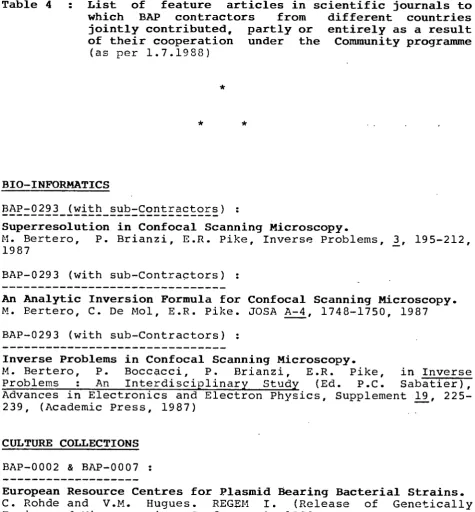
Credit must be given to several contractors for having so rapidly integrated their work that 47 joint publications have already appeared. Table 4 lists the joint publications for all sectors of the programme.
[image:20.595.76.526.135.550.2]-The exploitation of research results for the benefit of European agriculture and industry is one of the essential objectives of the BAP programme which can be achieved by giving all interested firms in the Community access to these results as they arise ; such access was systematically provided by the Commission services at all the sectoral contractors* meetings (see next section). In parallel to this effort, contractors were encouraged to protect, particularly through patenting, research results likely to lead to exploitation. A list of patents deposited to date in connection with the research under contract is provided in table 5. A review of development prospects will however not be possible before the end of the programme.
An obvious criterion of the success of the programme, however difficult to monitor, is the intensity of transational activities. Based on motivated statements requested from the contractors in their individual reports, an attempt has been made at quantifying the various types of cooperation agreements and exchanges taking place within the programme. Their frequency is reported in Figure 2.
Joint meetings rank very high, as a direct result of the coordinating activity of Commission services through sectoral meetings or working seminars of ELWWs. The exchange of materials is highly rated by the scientists as one of the easiest ways to initiate cooperation.
Joint experiments and staff exchange appeared to be more difficult to organize; nevertheless about 50 % of the participating laboratories were able to implement such activities which represent the ultimate phase .of coordination.
-MANAGING PRINCIPLES AND FUTURE TRENDS
Since February 19 85, on the eve of the adoption of BAP, the Commission services have been helped in managing the programme by the advice of the CGC-Biotechnology. This was in consequence of the decision by Council of 29 June 1984 to establish CGCs (management and coordination advisory committees) providing guidance to the Commission services on all tasks related to the preparation, implementation and evaluation of Community R & D programmes.
The services of the Commission wish to acknowledge with gratitude the help and advice v/hich they have received from the CGC "Biotechnology" at the time of the launching phase of the programme and during its early implementation.
The CGC-Biotechnology, the composition of which is presented in table 6, has a large field of responsibility since it also covers the whole range of training activities in the field of biotechnology, COST actions related to primary aquatic biomass and to plant in_ vitro culture, concertation activities for the harmonization of biotechnology-related policies, and new initiatives under the Biotechnology sub-line of the Second Framework Programme.
The committee now provides the Commission with advice in connection with the preparation of the BRIDGE programme proposal. BRIDGE, which stands for Biotechnology Research for Innovation, Development and Growth in Europe, will replace BAP after 1989.
Considering the evolution of biotechnology R & D over the last ten years, and the increasing possibility of scientific breakthroughs reaching the market place, it is now essential to extend industrial participation beyond the implementation
-phase and to associate European industry at all stages of the conception phases. An industrial advice, required throughout the entire preparatory phase of any new action, is being essentially provided through the expert assessments of IRDAC, the Industrial Research and Development Advisory Committee. This committee was created by a decision of the Commission of 29 February 1984. Having acknowledged the pervasiveness of biotechnology across many industrial sectors, and the specificity of products and production methods based on the exploitation of living matter, IRDAC has generated a working party on biotechnology, the composition of which is given is table 7. Members of the working party were selected on the basis of their industrial experince, but represent neither their employer nor their country of origin. They are consulted, as has been the CGC-Biotechnology, on the needs and opportunities for industrial R & D in this particular field. They issued in December 19 87 a report on future R & D programmes in the field of biotechnology.
F. van Hoeck, D. de Nettancourt,
Director Head of Division
Biology Biotechnology
T A B L E S
a n d
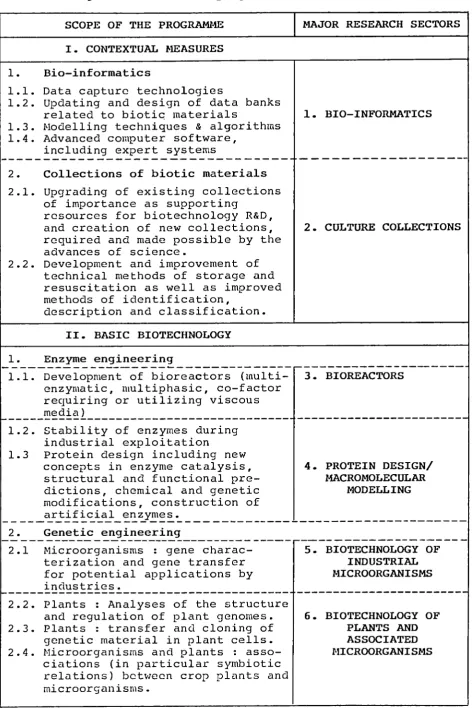
Table 1 : Organization of the programme into research sectors
SCOPE OF THE PROGRAMME MAJOR RESEARCH SECTORS
I. CONTEXTUAL MEASURES
1. Bio-informatics
1.1. Data capture technologies
1.2. Updating and design of data banks related to biotic materials
1.3. Modelling techniques & algorithms 1.4. Advanced computer software,
including expert systems
2. Collections of biotic materials
2.1. Upgrading of existing collections of importance as supporting
resources for biotechnology R&D, and creation of new collections, required and made possible by the advances of science.
2.2. Development and improvement of technical methods of storage and resuscitation as well as improved methods of identification,
description and classification.
1. BIO-INFORMATICS
2. CULTURE COLLECTIONS
II. BASIC BIOTECHNOLOGY
1. Enzyme engineering
1.1. Development of bioreactors (multi-enzymatic, multiphasic, co-factor requiring or utilizing viscous media)
1.2. Stability of enzymes during industrial exploitation
1.3 Protein design including new concepts in enzyme catalysis, structural and functional pre-dictions, chemical and genetic modifications, construction of artificial enzymes.
3. BIOREACTORS
4. PROTEIN DESIGN/ MACROMOLECULAR
MODELLING
2. Genetic engineering
2.1 Microorganisms : gene charac-terization and gene transfer for potential applications by industries.
2.2. Plants : Analyses of the structure and regulation of plant genomes. 2.3. Plants : transfer and cloning of genetic material in plant cells. 2.4. Microorganisms and plants :
asso-ciations (in particular symbiotic relations) between crop plants and microorganisms.
5. BIOTECHNOLOGY OF INDUSTRIAL MICROORGANISMS
6. BIOTECHNOLOGY OF PLANTS AND ASSOCIATED MICROORGANISMS
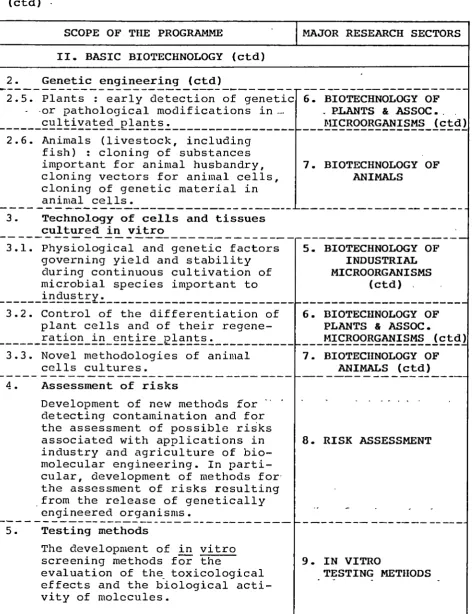
-Table 1
(ctd) Organization of the programme into research sectors
SCOPE OF TflE PROGRAMME MAJOR RESEARCH SECTORS
II. BASIC BIOTECHNOLOGY (ctd)
2. Genetic engineering (ctd)
2.5. Plants : early detection of genetic - or pathological modifications in
.-cultivated plants.
2.6. Animals (livestock, including fish) : cloning of substances important for animal husbandry, cloning vectors for animal cells, cloning of genetic material in animal cells.
6. BIOTECHNOLOGY OF . PLANTS & ASSOC.. MICROORGANISMS (ctd)
7. BIOTECHNOLOGY OF ANIMALS
3. Technology of cells and tissues cultured in vitro
3.1. Physiological and genetic factors governing yield and stability during continuous cultivation of microbial species important to industry.
3.2. Control of the differentiation of plant cells and of their regene-ration in entire plants.
3.3. Novel methodologies of animal cells cultures.
4. Assessment of risks
Development of new methods for detecting contamination and for the assessment of possible risks associated with applications in industry and agriculture of bio-molecular engineering. In parti-cular, development of methods for the assessment of risks resulting from the release of genetically engineered organisms.
5. Testing methods
The development of in vitro screening methods for the
evaluation of the toxicological effects and the biological acti-vity of molecules.
5. BIOTECHNOLOGY OF INDUSTRIAL MICROORGANISMS
(ctd)
6. BIOTECHNOLOGY OF PLANTS & ASSOC.
MICROORGANISMS (ctd) 7. BIOTECHNOLOGY OF
ANIMALS (ctd)
8. RISK ASSESSMENT
9. IN VITRO
TESTING METHODS
[image:27.595.64.537.81.695.2]Table 2 : Feature articles issued during the reporting period in each research sector of the BAP programme.
Research sector Bio-informatics Culture collections Bioreactors Protein engineering Biotechn. of iudust. microbes Biotechn. of plants & assoc. microorganisms
Biotechn. of animals
Risks assessment In vitro tests
Number of labs (1) 42 13 19 26 35 64 43 7 16 Number of articles (2) ul 3 44 76 77 171 85 9 23 Number of articles witb trans-national authorship(*) 3 2 2 7 8 19 6 0 0 (2)/(l) in 1988 1.12 0.23 2.32 2.92 2.20 2.67 1.98 1.29 1.44 (2)/(l) in 1987 0.61 0.15 1.27 1.08 1.00 1.27 0.69 0.00 —
(*) only those impljing the participation of other BAP contractors.
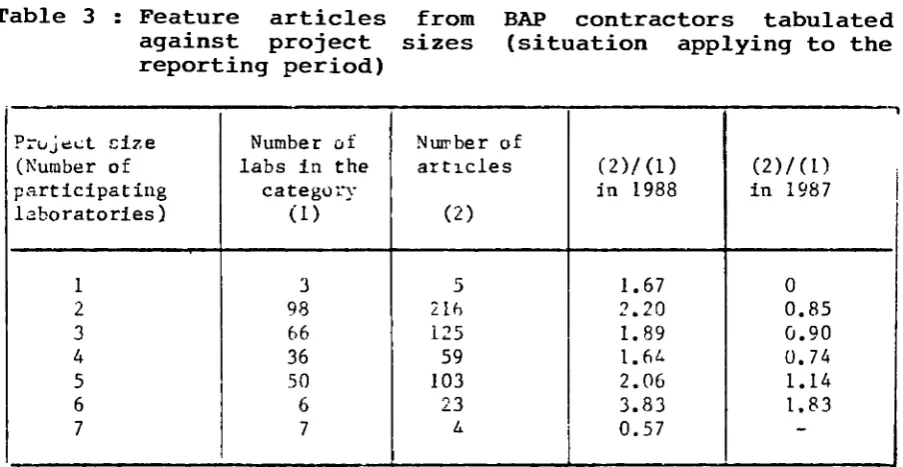
Table 3 : Feature articles from BAP contractors tabulated against project sizes (situation applying to the reporting period) Project cize (Number of participating laboratories) 1 2 3 4 5 6 7 Number of labs in the
[image:28.595.71.523.537.770.2]Table 4 : List of feature articles in scientific journals to which BAP contractors from different countries jointly contributed, partly or entirely as a result of their cooperation under the Community programme
(as per 1.7.1988)
BIO-INFORMATICS
BAP - 0293 (with sub-Contracts ) :
Superresolution in Confocal Scanning Microscopy.
M. Bertero, P. Brianzi, E.R. Pike, Inverse Problems, 3, 195-212, 1987
BAP-0293 (with sub-Contractors) :
An Analytic Inversion Formula for Confocal Scanning Microscopy.
M. Bertero, C. De Mol, E.R. Pike. JOSA A-4, 1748-1750, 1987
BAP-0293 (with sub-Contractors) :
Inverse Problems in Confocal Scanning Microscopy.
M. Bertero, P. Boccacci, P. Brianzi, E.R. Pike, in Inverse Problems : An Interdisciplinary Study (Ed. P.C. Sabatier), Advances in Electronics and Electron Physics, Supplement 19^, 225-239, (Academic Press, 1987)
CULTURE COLLECTIONS
BAP-0002 & BAP-0007 :
European Resource Centres for Plasmid Bearing Bacterial Strains.
C. Rohde and V.M. Hugues. REGEM I. (Release of Genetically Engineered Microorganisms Conference), 1988
BAP-0004, BAP-00Ö5 & BAP-0134 :
Structuring strain data for storage and retrieval of information on fungi and yeasts in MINEr the Microbial Information Network
Europe.
W. Gams, G.L. Hennebert, J.A. Stalkers, D. Janssens, Ti.A.A. Schipper, J. Smith, D. Yarrow and D.L. Hawksworth. J. Gen. Microbiol.. 1988
BIO-REACTORS
BAP-0060 & BAP-0065 :
Synthesis and application of water-soluble macromolecular redox coenzyme derivatives.
A.F. Buckman and G. Carrea. Adv. Biochem. Eng. Biotechnol., in press, 1988
BAP-0056 & BAP-0055 :
Improved metabolic properties of hexokinase overloaded human erythrocytes.
M. Magnani, L. Rossi, M. Bianchi, G.' Fornaini, V. Benatti, L. Guida, E. Zocchi and A. De Flora. Biochim. Biophys. Acta, in press, 1988
PROTEIN ENGINEERING . "' '
BAP-0 52 & BAP-02 4 6 :
Mechanism of ferritin iron uptake : activity of the H chain and deletion mapping of the ferro-oxidase.site.
S. Levi, A. Luzzago, G. Cesareni, A. Cozzi, F. Franceschinelli, A. Albertini and P. Arosio. J. Biol. Chem., in press, 1988
BAP-0066 & BAP-0058 :
Properties of a Genetically Engineered G-Domain of Elongation Factor Tu.
A. Parmeggiani, G.W.M. Swart, K.K. Mortensen, M. Jensen, B.F.C. Clark, L. Dente and R. Cortese. Proc. Natl. Acad. Sci. USA 84,
3141-3145, 1988
BAP-0066 & BAP-0058 :
Site-Directed Mutagenesis of Elongation Factor Tu.
A. Panneggiarli, E; Jacquet, M. Jensen, P.H. Anborgh, R.H. Cool, J. Jonak and G.W.M. Swart. In : Metabolism and Enzymology of Nucleic Acids Including Gene Manipulations (J. Zelinka & J. Balan, eds) p. 175-187, Vol. 6, Slovak Academy of Sciences, Bratislava, 1987
BAP-0066 & BAP-0058 :
The Polypeptide Chain Elongation Factor Tu i Charaterization of Mutants and Protein Engineering.
A. Parmeggiani, P.H. Anborgh, R.H. Cool, E. Jacquet, M. Jensen, F. Gümüsel, G. Parlato and G.W.M. Swart. In : Genetics of Translation : New Approaches (M. Bolotin-Fukuhara, & M. Picard, eds) p. 259-269, NATO ASI series, 1988
BAP-0062 & BAP-0071 :
Phospholipase A2 inhibithors : acylamino-glycero-phosphocholines derivatives.
G.H. de Haas, M.G. van Hoort, R. Dijkman and R. Verger. Biochem. J. , in press, 1988
BAP-0148 & BAP-0149 :
Secondary structure prediction : combination of three different methods.
V. Biou, J.F. Gibrat, J.M. Levin, B. Robson and J. Gamier. Protein Engineering, 2_ (3), in press, 1988
BAP-0259 & BAP-0269 :
Hydrogen production and deuteriuitf-proton exchange reactions catalyzed by Desulfovibrio Ni(II) substituted rubredoxins.
P. Saint-Martin, P.A. Lespinat, G. Fauque, Y. Berlier, J. LeGall, J.J.F. Moura, M. Teixeira, A.V. Xavier and I. Moura. Proc. Natl. Acad. Sci., in press 1988
BIOTECHNOLOGY OF INDUSTRIAL MICROORGANISMS
BAP-0061 & BAP-0026 :
Transformation of the yeast Kluyveromyces lactis by new vectors derived from the 1.6 um circular plasmid pKDl.
M. Bianchi, C. Falcone, X.J. Chen, M. Wesolowski-Louvel, L. Frontali and H. Fukuhara. Cur. Gent.. 1987
BAP-0061 & BAP-0026 :
A gene cloning system for Kluyveromyces lactis and isolation of a chromosomal gene required for killer toxin production.
X.J. Chen, M. Wesolowski-Louvel, C. Tanguy-Rougeau, H. Fukuhara, M.M. Bianchi, L. Fabiani, M. Saliona, C. Falcone and L. Frontali. J. Basic. Microbiol., in press, 1988
BAP-0061 & BAP-0026 :
New vectors for yeast transformation : replication in different yeast genera and stability in non selective media.
M.M. Bianchi, X.J. Chen, M. Wesolowski-Louvel, H. Fukuhara, C. Falcone, L. Fabiani, M. Salióla and L. Frontali. In : Physiological and Genetic Modulation of Product Formation. Dechema Monographs. Vol. 105-VCH. Verlag Gesellshaft, 1987
BAP-0 04 4 & BAP-0 04 6 :
Conjugal gene transfer in Clostridium acetobutylicum.
A. Davies, J.D. Pennock, D.R. Williams, D.F. Richars, N.P. Minton and M. Young. In : Genetics and Biotechnology of Bacilli. Academic Press. Orlando, USA, in press, 1988
BAP-0044 & BAP-0046 :
Contruction of plasmid vector systems from Clostridium acetobutylicum.
J.K. Brehm, J.D. Oultral, D.E. Thompson, T.J. Swinfield, H. Peck, M. Young and N.P. Minton. In : Genetics and Biotechnology of Bacilli. Academic Press. Orlando, USA, in press, 1988
BAP-0008 & BAP-0012 :
Cloning and characterization of the tetracycline resistance determinant of and several promoters from within the conjugative transposon Tn919.
C.J. Hill, G. Venerna, C. Daly and G.F. Fitzgerard. Appi. Environ. Microbiol., 1988
BAP-0152 & BAP-0153 :
Ethanol production by Zymomonas mobilis entrapped in alumina pellets.
A.A. Koutinas, M. Kanellaki, A. Lykourghiotis, M.A. Typas and C. Drainas. Appi. Microbiol. Biotechnol., 19 88
BAP-0039, BAP-0064 & BAP-0248 :
Transformation of Aspergillus oryzae using A. niger pyrG gene.
I.E. Mattern, S.E. Unkles, J.R. Kinghorn, P. Pouwels and C.A.M.J.J. van den Hondel. Mol. Gen. Genet., 1988
BIOTECHNOLOGY OF PLANTS AND ASSOCIATED MICROORGANISMS
Recent advances in plant electroporation.
II. Jones, M.J. Tenpelaar and M.G.K. Jones, Oxford Surveys of Molecular and Cell Biology (Ed. B.J. Miflin), OUP, 4, 347-357,
1987
BAP-0082 & BAP-0101 :
Modulation and direction of the electrofusion response in plant protoplasts.
M.J. Tempelaar, A. Duyst, S.J. de Vlas, G. Krol, C. Symmonds, M.G.K. Jones, Plant Science, 48, 99-105, 1987
BAP-0082 & BAP-0101 :
Electrofusion of nitrate reductase deficient Nicotiana plumbaginifolia mutants : studies on optimization and complementation.
S.C. de Vries, E. Jacobsen, M.G.K. Jones, A.E.H.M. Loonen, M.J. Tempelaar, J. Wybrandi and W.J. Feenstra, Plant Science, 51, 105-112, 1987
BAP-0082 & BAP-0101 :
Somatic hybridization of amino-acid analogue resistant cell lines of potato (Solanum tuberosum L.) by electrofusion.
S.C. de Vries, E. Jacobsen, M.G.K. Jones, A.E.H.M. Loonen,- M.J. Tempelaar, J. Wybrandi and W.J. Feenstra, Theor. Appi. Genet., 73, 451-458, 1987
BAP-0084 & BAP-0111 :
Direct gene transfer in protoplasts of Nicotiana plumbaginifolia. F. Sala, M.L. Marchesi, S. Castiglione, J. Paszkowsky, M. Saul, I. Potrykus and I. Negrutiu, in : Biotechnology in Agriculture and Forestry (Ed. Y.P.S. Bajaj), Springer-Verlag, New York (in press)
BAP-0092 & BAP-0093 :
Carrot somatic embryogenesis depends on the phytohormone— controlled expression of correctly glycosylated extracellular proteins.
S.C. de Vries, H. Booj, R. Janssens, R. Vogels, L. Saris, F. LoSchiavo, M. Terzi and A. van Kammen, Genes and Development, 2,
462-476, 1988
BAP-0213- & BAP-0214 :
Molecular cloning of the o2-m5 allele of Zea mays using transposon marking.
M. Motto, M. Maddaloni, G. Ponziani, M. Brembilla, R. Marotta, N. Di Fonzo, C. Soave, R. Thompson and F. Salamini, Mol. Gen. Gent., 212, 488-494, 1988
-BAP-0213 & BAP-0214 : . • ' . '
The b-32 protein from maize endosperm, an albumin regulated by the 02 locus : nucleic acid (cDNA) and amino acid sequences.
N. Di Fonzo, H. Hartings, M. Brembilla, M. Motto, C. Soave, E. Navarro, J. Palau, W. Rohde, F. Salamini, Mol. Gen. Genet., 212, 481-487, 1988
BAP-0213 & BAP-0214 :
Maize seed storage proteins : genetic structure and regulation.
N. Di Fonzo, H. Hartings, M. Maddaloni, L. Manzocchi, 'G.
Ponziani, J. Palau, F. Salamini, C. Soave, A. Spada, R. Thompson and M. Motto, Genet. Agr. (in press).
BAP-0213 & BAP-0214 :
Molecular studies of the high-lysine genes Opaque-2 and Opaque-6 in maize.
N. Di Fonzo, H. Hartings, M. Maddaloni, L. Manzocchi, G.
Ponziani, J. Palau, F. Salamini, C. Soave, R. Thompson and M.
Motto, UCLA Symposium : The molecular basis of plant development. Steamboat Springs, Co., 1988
BAP-0190 & BAP-0212 :
Characterization'and virulance properties of Erwinia chrysanthemi lipopolysaccharide-defective, phiEC2-resistant mutants.
E. Schoonejans,- D. Expert and A. Toussaint, J. Bacteriol. 169, 4011-4017, 1987
BAP-0190 & BAP-0212 :
Chromosonal mapping of ,' the pel andi cel genes in Erwinia chrysanthemi strain B 374.'
M. Piecq, F. van Gijsegem, E. Schoonjans and A. Toussaint, Molec. Microbiol. 2, 297-302, 1988
BAP-0190 & BAP-0212 :
Molecular cloning and mutagenesis in Escherichia coli of pectinase genes from Erwinia chrysanthemi'.
A.■• Kotoujansky, A. Diolez,' M. Rouve, F. Van Gijsegem, S.
Reverchon et al., Proc. 6th Int. Conf. Plant Pathogen. Bact.,
College Park, Maryland, pp. 139-151, Nijhoff/Junk, Dordrecht,
1987
BAP-0080 & BAP-0081 :
Organization and partial sequence of a DNA region of the Rhizobium leguminosarum symbiotic plasmid pRL6JI containing the genes fix ABC, nifA, nifB and a novel open reading frame.
P. Grönger, S.S. Massian, H. Reiländer, M. O'Connell, U.B.
Priefer and A. PÜhler, Nucleic Acids Research, 15, 31-49, 1987
BAP-0096 & BAP-0173 :
Regulation of nodule-specific plant genes.
E.O. Jensen, J. Stougaard, J.E. Jorgensen, N. Sandal, F.J. de Bruijn, J. Schell and K.A. Marcker, Proc. 7th Int. Cong. Nitrogen Fixation Cologne, Gustav Fisher, Stuttgart, 605-609, 1988
BAP-0096 & BAP-0173 :
Interaction of a nodule-specific trans-acting factor with distinct DNA elements in the soybeam leghaemoglobin lbc _ 5*-upstream region.
E. 0. Jensen, K.A. Marcker, J. Schell and F.J. de Bruijn, The EMBO Journal 7/5, 1265-1271, 1988
BAP-0095 & BAP-0096 :
Plastid transformation : a progress report.
M.J. Cornelissen, M. De Block, M. van Montagu, J. Leemans, P.H. Schreier and J. Schell, In : Gene Research-Plant DNA Infections Agents (Ed. T. Hohn and J. Schell), pp. 311-320, 1987
BAP-0202 & BAP-0204 :
Three-dimensional image and mitochondrial distribution in sperm cells of Euphorbia dulcis.
M. Murgia and H.J. Wilms, In : Plant sperm cells as tools for biotechnology (Ed. H.J. Wilms and C.J. Keijzer) Pudoc, Wageningen, pp. 75-79, 1988
BAP-0202 & BAP-0204 :
Confocal scanning laser microscopy of Galanthus generative cells.
H.J. Wilms, M. Murgia and E.A. van Spronsen, In : Plant sperm cells tools for biotechnology (Ed. H.J. Wilms and C.J. Keijzer) Pudoc, Wageningen, pp. 35-39, 1988
BIOTECHNOLOGY OF ANIMALS
BAP-0156 & BAP-0114 :
Analysis of the Structural Polypeptides of a Porcine Group C Rotavirus.
M. Bremont, J. Cohen and M.A. McCrae. Journal of Virology 62, 21183-2185, 1988
BAP-0115 & BAP-0116 :
Cis - and Trans-acting elements responsible for the cell specific expression of the human al-antitrypsin gene.
V. De Simone, G. Ciliberto, E. Hardon, G. Palla, L. Lundberg and R. Cortese. EMBO J. 6, 2759-2766, 1987
BAP-0115 & BAP-0116 :
Recombinant Interleukin 6 Regulates the Transcriptional Activation of a Set of Human Acute Phase Genes.
G. Morrone, G. Ciliberto, S. Oliviero, R. Arcone, L. Dente, J. Content and R. Cortese. J. Biol. Chem, in press
BAP-0115 & BAP-0116 :
The human al-antitrypsin gene is transcribed from two different promoters in macrophages and hepatocytes.
E. Perlino, R. Cortese and G. Ciliberto. EMBO J. 6, 2767-2771, 1987
BAP-0123 & BAP-0157 :
Immunity conferred to mice by anti-LPS monoclonal antibodies in murine Brucellosis.
J.N. Limet, A.M. Plommet, G. Dubray and M. Plommet. Ann. Immunol. Inst. Pasteur, 138, 417-424, 1987
BAP-0131 & BAP-0146 :
Genetic analysis of the role of toxins and protein A in the pathogenosis of Staphylococcus aureus infections. Properties of an unexpressed alpha-toxin locus from a clinical isolate. T.J. Foster, M. O'Reilly, A.H. Patel, P. Nowlan, J. Bramley, in Bacterial Protein Toxins (Ed. F. Fehrenbach), Gustav Fischer, Stuttgart, New York, 1988
T a b l e 5 : L i s t o f p a t e n t s d e p o s i t e d i n c o n n e c t i o n w i t h t h e BAP programme b e f o r e t h e 1 s t J u l y 1 9 8 8 ( w i t h i n b r a c k e t s i s t h e name o f t h e p r o j e c t l e a d e r i n v o l v e d , who i s n o t n e c e s s a r i l y t h e f i r s t a u t h o r o f t h e p a t e n t ) .
Sampling of material (M.S. Beck) Monofilament sampling (M.S. Beck) R e s i l i e n t s t r i p (M.S. Beck)
Editeur de séquences biologiques (the ID e d i t o r ) ( J . F . S a l l a n t i n )
PDOS:the emulation of DOS for the communication board ( J . F . S a l l a n t i n )
PC DRA : the 3D editor (J.F. S a l l a t i n )
Tool Box Crim (graphic t o o l box) (J.F. S a l l a n t i n )
GOR I I I , Homologue, Bit pattern, Combine : Programmes ( J . Garnier)
Process for the production of N substituted NAD, NADP or FAD
(A.F. Bückmann)
Procédé de dosage des l i p a s e s (R. Verger)
Lipases e t e x t r a i t s l i p a s i q u e s , l e u r procédé de p r é p a r a t i o n e t l e u r
a p p l i c a t i o n , notamment en thérapeutique (R. Verger)
V i t a l gene and enzyme - two patents (M. Gasson)
Vecteurs de clonage e t d'expression comportant l e génome du v i r u s de
l ' é r y t h r o b l a s t o s e a v i a i r e ou l e génome du v i r u s h e l p e r RAV-1
(V.M. Nigon)
Inhibiteur de la synthèse protéique, procédé d ' i s o l e m e n t , u t i l i s a t i o n
e t composition pharmaceutique en contenant (F. Stirpe)
Inmunotoxines, procédé de p r é p a r a t i o n et compositions pharmaceutiques
en contenant (F. Stirpe)
Table 6 : Members of the Advisory Committee for the Management and Coordination of the Biotechnology Action Programme.
BELGIQUE - BELGIE
M. Bienfet
J. de Brabandère (**) A.M. Prieels (+)
(G. Thiers)
BUNDESREPUBLIK DEUTSCHLAND
N. Binder (+) H. Klein (*) R. Wandel
(E. Warmuth)
DANMARK
P.O. Larsen (+) K.A. Marcker (****) I. Petersen
ELLINIKI DIMOKRATIA
C.E. Sekeris
A.L. Stavropoulos (+) A.S. Tsaftaris (**)
ESPANA
A. Albert (**)
R. Revilla Pedreira (**)
FRANCE
P. Douzou (+) M. Lelong
P. Printz (*) (G. Pelsy) (+)
COMMISSION :
IRELAND
E.P. Cunningham (+) B. Finucane (**)(+) B. McSweeney (+) J. O'Grady (****) J. Ryan (****)
ITALIA A. Albertini M. Moretti (M. Lener) (G. Magni) LUXEMBOURG F. Arendt A. Betz NEDERLAND
H.J. Grande (+) B.A. Heide (***) . M.C.F, van den Bosch
R.R. van der Meer (<) (E. Veitkamp)
PORTUGAL
F..J.A, Carvalho Guerra A. Xavier (**)
UNITED KINGDOM
R.H. Aram (+) D.A. Jonas (+) D.G. Lindsay (***) A.F. Lott (*)
(F.P. Woodford) (+) (H. Pickles) (****) F. Van Hoeck
D. de Nettancourt
(**)
(*) from 1985 (**) from 1986 (***) from 1987 (****) from 1988
(<) Chairman ( ) Substitutes
(+) resigned
-Table 7 : Members in 1988 of the Biotechnology Working Party of IRDAC.
K. R. Dr G. Dr D. A. M. Dr B. R. N. B. M. W. Baker Brown . Castell Delheye . Dornauer Gunary Herrero (* ) Hilmer Nielsen . Hirsinger Jarry Jeambourquin Kossen Le Buanec Le Hodey Leuchtenberger P. B. G. M. M. K. J. V. E. A. M. R. J. D. Mangold McSweeney Mignoni Miller Nomine Powell P. Raynaud Rubio Shejbal Stavropoulos
A. van Damme
R. van der Meer
E. Veldhuijzen van Zanten
von Wettstein
(*) Chairman of the working party
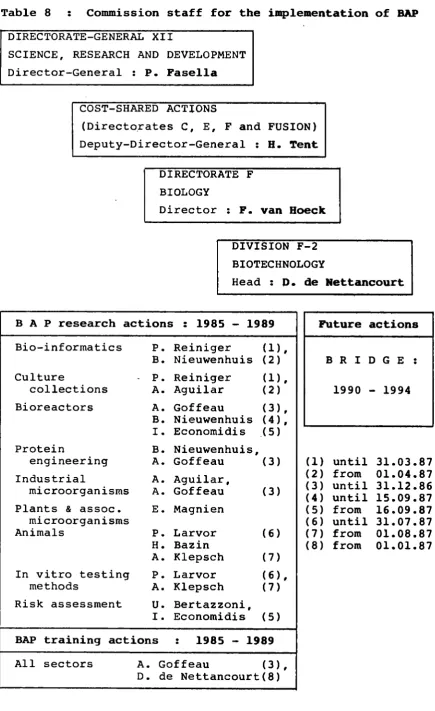
[image:39.595.94.503.149.575.2]Table 8 Commission staff for the implementation of BAP
DIRECTORATE-GENERAL XII
SCIENCE, RESEARCH AND DEVELOPMENT Director-General : P. Fasella
COST-SHARED ACTIONS
(Directorates C, E, F and FUSION) Deputy-Director-General : H. Tent
DIRECTORATE F BIOLOGY
Director : F. van Hoeck
DIVISION F-2 BIOTECHNOLOGY
Head : P. de Nettancourt
B A P research actions : 1985 - 1989
Bio-informatics Culture collections Bioreactors Protein engineering Industrial microorganisms Plants & assoc.
microorganisms Animals
In vitro testing methods Risk assessment -P. B. P. A. A. B. I. B. A. A. A. E. P. H. A. P. A. U. I.
BAP training actions
All sectors A
D Reiniger Nieuwenhuis Reiniger Aguilar Goffeau Nieuwenhuis Economidis Nieuwenhuis Goffeau Aguilar, Goffeau Magnien Larvor Bazin Klepsch Larvor Klepsch Bertazzoni, Economidis
(D,
(2) (1), (2) (3), (4). (5) f (3) (3) (6) (7) (6), (7) (5): 1985 - 1989
. Goffeau (3).
. de Nettancourt(8)
Future actions
B R I D G E :
1 9 9 0 - 1994
ro IO
-Nuci.Acids Res. (24 art.)
-EMBO Journal (IB art.)
-Molec.Gen.Genet. (16 art.)
-Eur.J.Biochem. (14 art.)
-Plant Sciences (13 art.)
-J.Bacteriol. (12 art.)
-Plant Mol.Biol. (11 art.)
-Appi.Environ.Microbiol. (10 art.)
-Gene (9 art.)
-Thear ..Appi .Genet. (8 art.)
-Current Genet. (8 art.)
-FEMS Microbiol.Lett. (8 art.)
-An.N.Y.Acad.Sc. (8 art.)
-Planta'(6 art.)
-Proc.Natl.Acad.Sci.USA (6 art.)
-J.Mol.Biol. (5 art.)
-359 other articles in
many different journals
R i g . 2 : F r e q u e n c y d i s t n i o u t i o n . p e n n e s e a n c h s e c t o n . o f l a b o r a t o r i i c o m m i t t e d t o o n e o n a n o t h e n - f o n m o-f c o o p e n a t i o i
l_a D o n a t o n i e s i n v o l v e d i n t h e i n d i c a t e d - f o n m o-f c o o p e n a t i o n
(?6 o-f t o t a l n u m b e n ) "
o
lOO-i
80-
60-
40-
2
0-D
U o i n t m e e t i n g s
I x c h a n g e o - f m a t e n i a l
E x c h a n g e o - f s t a -f -f
+
J o i n t i x p e n i m e n t :
9 S e c t o n n u m o e n
1 — B l o — i n - f o n m a t i c s
2 — C u l t u n e c o l l e c t i o n s 3 — B i o n e a c t o n s
-4 — P n o t e i n e n g i n e e n i n g
5 — B i o t e c h . o f i n d <_i s t . m i c n o o n g .
6 — B i o t e c h , o-f p l a n t s
a n d a s s o c i a t e d m i c n o o n g
"7 — B i o t e c h n o 1 o g y oT a n i m a l :
B — R i s R a s s e s s m e n t
F " i g . 3 : S c i e n t i f i c p r o d u c t i v i t y a n d c o o p e r a t i o i
p r o -f i 1es w i t h i n g r o u p s o r c o n t r a c t o n s
o-f 3 s u c c e s s i v e g e n e n a t i o n s
1 s t g e n e r a t i o n c o n t r a c t o n s j o i n e d t h e C o m m u n i t y
p r o g r a m m e s w i t h B E R ( 1 9 B 2 - 1 9 B 6 ) . T h e y l o g i c a l l y
y i e l d m o r e o u t p u t p r e s e n t l y i n B A P a n d D a s e
c o o p e r a t i o n m o r e o n p r a c t i c a l e x c h a n g e s .
2 n d / 3
s u c c e
p r e f e
r e s
r d g e n e r a t i o n c o n t r a c t o r s a r r i v e d w i t h t w o
s s l v e r o u n d s o f B A P p r o p o s a l s a n d t e n d t o
r m e e t i n g s d e ror e i n t e g r a t i n g - f u r t h e r
» e a r c h w o r k .
F R E Q U E N C Y (»O P E R
A V E R A G E C O N T R A C T O R O F :
P u b i i c a t l o n s
[
« J o i n t p u b l i c a t i o n s
=
□
D
E x c h a n g e s o r sta rr
D
D
D
E x c h a n g e s o r m a t e r i a l
. J o i n t e x p e r i m e n t s
D
D
ü
« J o i n t m e e t i n g s
(*e) r o r t h e
p e r i o d
r e p o r t i n g 3 2 1
r d n d s t
g e n e r a t i o n¡
Scientific m e e t i n g s , v i s i t s to contracting l a b o r a t o r i e s , publication of reports and surveys have been the three main a c t i o n s on which the c o o r d i n a t i n g activity by the services of the Commission has . b e e n based during the initial implementa-t i o n of implementa-the Bioimplementa-technology A c implementa-t i o n P r o g r a m m e .
Meetings were organized on the site of participating laboratories on d i f f e r e n t o c c a s i o n s , to allow the constitution or the r e i n f o r c e m e n t of study groups working on a list of priority t o p i c s .
V i s i t s to laboratories w e r e carried, out throughout the reporting period, w i t h the aim to f a c i l i t a t e , whenever requested, the administrative -. steps of contract implementation and to c o n t r i b u t e to the establishment of a network of individual scientists willing to increase their involvement, in c o o p e r a t i v e research..
Publications in scientific journals constitute the normal and most efficient way for the dissemination of results obtained in the. 'framework of the p r o g r a m m e (see r e f e r e n c e s at the end of each individual report presented in V o l u m e 2) ; in addition, the services of t h e C o m m i s s i o n i n i t i a t e , whenever u s e f u l , surveys of activities and of specific results which characterize o n e ' or several research areas in the C o m m u n i t y . They, also circulate reports or analyses p r e p a r e d on their request by selected c o n t r a c t a n t s to cover activities carried out within particular g r o u p s .
Scientific meetings
Four sectoral meetings were organized to'bring together all contractants, connected with a particular research sector of BAP. In addition, 40 meetings were convened upon specific requests : in the latter cases, the objectives of the meetings were to strengthen transnational cooperation and integrate further the work of ELWWs (European Laboratories Without Walls), or to provoke cross-fertilization between remote contracting groups which considered that the confrontation of their scientific ideas and of their particular skills would be a mutual benefit. These other meetings were convened in smaller configurations, adapted to the detailed discussion of very specific needs : they are more of the spontaneous type.
Finally, the Commission services also organized several
exploratory meetings of experts for the assessment of new promising areas of R&D. Sixteen such meetings took placé during the reporting period. They included the participation of BAP contractors and of scientists outside the programme as well as of experts nominated by the CGC Biotechnology and by the Commission, and of representatives from industrial organizations or learned societies. The. conclusions of these brainstorming activities have been reported to the Commission and can: be made, available upon' request. . The corresponding reports are listed with all publications appearing in the last section of this chapter on coordinating activities.
SECTORAL MEETINGS
SALAMANCA, 25-28 October 1987
55 participants from 10 countries and the Commission.
Subject :
Genetic engineering for animal husbandry.
Local organizer :
E. Vinuela, Centro de Biologia Molecular (CSIC-UAM), Madrid (Spain).
Dimension and structure :
34 individual presentations including 3 invited lectures, one working group session.
Objectives :
First meeting whereby contractants from 34 laboratories working under the sector "Genetic engineering for animal husbandry" could convene and disseminate their preliminary results. During the meeting, there v/as a working session to discuss future programmes
(BRIDGE).
BAYREUTH, 26-28 October 1987
52 participants from 12 countries and the Commission.
Subject :
Risk assessment for the release of genetically manipulated microorganisms.
Local organizer :
Prof. W. Klingmüller, University of Bayreuth (Germany)
Dimension and structure :
22 lectures of invited speakers and BAP contractors.
Objectives :
First meeting of BAP contractors working in the sector of risk assessment. The meeting was open to participants of many other European laboratories (including non-EC members) active in the same field. Various research approaches were discussed and different views were expressed about the important problem of safety evaluation in biotechnology.
-DOURDAN, 25-27 February 1980
31 participants from 11 countries and the Commission. 11 industrial representatives from different firms.
Subject :
Biotechnology of Gram-positive industrial microorganisms.
Local organizer :
S.D. Ehrlich, Institut Jacques Monod, Paris (France).
Dimension and structure :
23 oral presentations, one round-table discussion on future trends and industrial involvement within the framework of BRIDGE, and a presentation by DG XII Commission staff.
Objectives :
To encourage groups towards a stronger collaboration in the framework of ELWW (European Laboratories Without Walls) and to allow opinions and suggestions to be exchanged with industrial partners.
A report' on the round-table is inserted with reports by organizers of meetings in the following section.
BAD IRSEE, 30 March - 1 April 1988
68 participants from 13 countries, including 3 industrial firms, and the Commission.
Subject :
In vitro evaluation of the toxicity and pharmacological activity of molecules.
Local organizer :
T. Krieg, Ludwig-Haximillians-Universität München (Germany)
Dimension and structure :
3 invited lectures, 16 oral communications, 17 posters on display, one round-table and a working group session.
Objectives :
2. SPONTANEOUS MEETINGS
Due to the usually informal approach to the organization of spontaneous meetings, some have also taken place with little information passed to the Commission. The description below does not therefore include all events having occurred in the framwork of BAP, but only a list of well documented examples.
Many of the well documented spontaneous meetings took place in European Laboratories Without Walls (ELWWs). The participants in ELWWs usually convened in turn at the site of each associated laboratory to review the progress of research and to plan future experiments jointly. Depending on the number of partners and the type of cooperation established between them, spontaneous meetings of ELWWs were trimestrial, semestrial or annual.
In contrast with other spontaneous meetings organized upon specific requests justified by their conveners, the periodic seminars of ELWWs led, in particular, to written up-to-date conclusions on on-going activities. Summaries of these conclusions appear in the next section of the volume with reports by organizers of meetings.
Spontaneous meetings are normally supported with travel funds raised from the BAP budget. But in the case of ELWWs, an extra-support is only provided once for the initial integration of work to be promoted. On other occasions, meetings of ELWWs are financed from the contract money perceived by each participating laboratory.
BRUSSELS, 14-15 January 1987
7 participants from 2 countries.
Subject :
Spontaneous discussion on cloning in Pseudomonas.
Local organizer :
J. Davison, ICP, Brussels (Belgium)
Dimension and structure :
Discussion of mutual results and of the work of a visiting scientist from Groningen. Institute seminar by M. Kok.
Objectives :
Development of mutual interests and ideas. Exchange of materials and techniques.
PARIS, 7-9 February 1987
14 participants from 3 countries.
Subject :
Analysis of replication and stability functions of plasmids in B. subtilis.
Local organizer :
S.D. Ehrlich, Université Paris-VII (France)
Dimension and structure :
Presentations by the two collaborating groups and common discussions including the invited speakers.
Objectives :
Discussing the joint research programme.
BAARN, 19 May 1987 BRÜSSELS, 11 June 1987 KEW, 21 September 1987 BRAUNSCHWEIG, 25 January 1988
KEW, 30 April 1988
Common subject :
Implementation of MINE.
Local organizers :
The meetings were locally organised respectively by M.A.A. Schipper ; J. de Brabandere ; D.L. Hawksworth ; D. Claus and D.L. Hawksworth.
Dimension and structure :
All the MINE general meetings, except the one on 30 April 1988, were attended by 3-5 scientists from each node of MINE. Representatives from the Working Party on Culture Collections attended the meetings in Brussels, Kew (September) and Braunschweig. Representatives from culture collections from Canada, Sweden and Israel participated in some of the meetings.
Objectives :
Development and implementation of the MINE project. In addition to the general MINE meetings, a number of specialised meetings took place :
Computer expert meetings
BAARN, 21 May 1987 (NL) KEW, 3 August 19 87 (UK)
Format meetings :
5 (2 for bacteria and 3 for fungi/yeast).
MINE-MiCIS-CEC meeting : 22 September 1987, London.
Computer expert meeting : (MINE, MiCIS, MSDN, CEC) December 10, 1987, Brussels (Belgium).
-ORSAY, 7 - 1 2 July 1987
17 participants from 4 countries.
Subject :
EC-CECAM Workshop on Force-fields for computer simulations on macromolecules.
Local organizer :
S. Wodak, ULB, Brussels (Belgium)
Dimension and structure :
Oral presentations, round-table discussions, benchmark calculations.
Objectives :
A collaborative effort between European and US scientists for improving force-fields, to standardise simulation procedures and to discuss recent developments.
VAALS, 15 - 17 July 1987
10 participants from 4 countries.
Subject :
Computer modelling and control of bioreactors and fermentors.
Local organizer :
Dr. J. Thio, DSM/Stamicarbon (The Netherlands)
Dimension and structure :
Opening lecture on the activities of DSM in biotechnology. Presentations by the four project leaders and discussions. Demonstration of GIDS (Graphic Interactive Dynamic Simulation) a computer based simulation system.
Objectives :
Review of the progress made by each group, discussion on the necessary relationships with industry, establishment of future plans.
TUTZING, 22 July 1987
18 participants from 2 countries.
Subject :
Folding, assembly, stability and genetic modification of penicillin acylase and its precursors.
Local organizer :
G. Schumacher, Boehringer Mannheim, Tutzing (D)
Dimension and structure :
Working group session.'
Objectives :
Discussion on research progress, organization of the collaborative programme of the four laboratories, planning of future research.
GHENT, 24 August 1987
4 participants from 2 countries.
Subject :
Transformation of fungi.
Local organizer :
W. Fiers, L.M.B. Ghent (Belgium)
Dimension and structure :
Presentation of results obtained so far by each laboratory and a
general discussion.
Objectives :
Coordination of the research efforts, and development of protocols for efficient transformation in A_^ niger and A. oryzae. Delineation of priorities in both laboratories.
ROMA, 15-16 September 1987
15 participants from 4 countries.
Subject :
Hairy root and plant cell differentiation.
Local organizer :
P. Costantino, University of Roma "La Sapienza" (Italy)
Dimension and structure :
First day : presentations by each participating group of the latest achievements in the field ;
Second day : discussions on the prospects of hairy root research and definition of collaborations.
Objectives :
Setting up of a new ELWW, partly anchored in the BAP programme and including contributors from other non-contracting institutions.
NORWICH, 18 September 1987
15 participants from 5 countries.
Subject :
Mitochondrial molecular genetics in relation to crop improvement.
Local organizer :
D.R. Davies, John Innes Institute, Norwich (united Kingdom)
Dimension and structure :
Three sessions of oral presentations by the participating groups on structure/function of the mitochondrial genome, mitochondrial transformation and organelle transfer.
Objectives :
Enlargement of the ELWW, initially with 5 partners, to 2 new laboratories with expertise in the development of transformation vectors. Activation of transnational exchanges.
GHENT, 25-29 September 1987
4 participants from 2 countries.
Subject :
Regulatory elements for heterologous gene expression.
Local organizer :
W. Fiers, L.M.B. Ghent (Belgium)
Dimension and structure :
Round-table discussions.
Objectives :
Coordination of research in both laboratories. Discuss the participation of Dr. Unkles and Dr. Campbell in Ghent to sequence the Nia-regulatory (promoter) region.
DUBLIN. 15-16 October 1987
11 participants from 4 countries.
Subject :
Symbiotic genes in Rhizobium : construction of improved strains.
Local organizer :
M. O'Connell, NIHE, Dublin (Ireland)
Dimension and structure :
Small-scale working seminar of those scientists working on the project. Presentations from the 4 participating groups followed by an extensive round-table discussion.
Objectives :
Second periodic meeting of the ELWW. New cooperation agreements established, and industrial contacts explored.
ORSAY, 19-23 October 1987
2 5 participants from 6 countries.
Subject :
EC-CECAM Workshop on Electrostatics in recognition processes between biological macromolecules.
Local organizer :
E. Westhof, IMBC-CNRS, Strasbourg (France).
Dimension and structure :
Oral presentations, round-table discussions, informal exchange.
Objectives :
A collaborative effort of European and US scientists to describe new methods for the calculation of the electrostatic field around proteins and to discuss new approaches in this area.
SALAMANCA, 1-5 November 1987
104 participants from 13 countries and the services of the Commission.
Subject :
African Swine Fever and pig immunology.
Local organizer :
E. Vinuela, Centro de Biologia Molecular (CSIC-UAM), Madrid (Spain)
Dimension and structure :
8 sessions with 38 communications, 70 posters and 1 panel discussion.
Objectives :
Meeting on pig immunology with emphasis on African Swine Fever reviewing the current research efforts and discussing future research activities.
COPENHAGEN, 5 November 1987
7 participants from 3 countries.
Subject :
Embryogenesis in plant tissue culture.
Local organizer :
P. Olesen, De Danske Sukkerfabrikker, Copenhagen (Denmark)
Dimension and structure :
5 oral presentations and discussion.
Objectives :
Bringing together 4 research contracts that were initially negotiated in isolation and could be cross-fertilizing.
HAREN, 6-7 November 1987
19 scientists from 6 countries.
Subject :
Crop improvement through cell biotechnology.
Local organizer :
M.J. Tempelaar, University of Groningen (The Netherlands)
Dimension and structure :
11 oral presentations, with repeated discussion times.
Objectives :
Enlargement of the ELWW (originally with 6 participating laboratories) to 2 new groups contributing work on cereals more particularly.
VILLEURBANNE. 12-13 November 1987
2 participants from the Belgian laboratory and all French research staff.
Subject :
Molecular biology of plant pathogenic and plant beneficial bacteria.
Local organizer :
J.M. Robert-Baudouy, INSA, Villeurbanne (France).
Dimension and structure :
Working group sessions, plus Institute seminars by F. Brunei and J. Davison. Development of mutual interests and ideas of possible future collaboration. Exchanges of materials and techniques, discussions.
Objectives :
Discussion on the molecular mechanisms of plant pathogenesis and on the antagonism between phytopathogens and plant beneficial bacteria.
DUBLIN, 14-17 November 1987
10 participants from 2 countries.
Subject :
Replication functions of B^ subtilis plasmids.
Local organizer :
K. Devine and D. McConnell, Trinity College, Dublin (Ireland)
Dimension and structure :
Presentations by the two collaborating groups and common discussions.
Objectives :
Discussion on research progress, planning of future research.
-MANCHESTER, 28 November - 2 December 1987
12 participants from 2 countries.
Subject :
Automation in DNA sequencing.
Local organizer :
J.W Martin, UMIST, Manchester (United Kingdom)
Dimension and structure :
Working group session.
Objectives :
Discussions on research progress, coordination of activities of the four centres involved.
LONDON, 13 December 1987
2 participants from 2 countries.
Subject :
Genetic regulation of yeast glycolysis
Local organizer :
B.S. Hartley, Imperial College, London (United Kingdom)
Dimension and structure :
Working sessions.
Objectives :
Review of progress and strategy for joint project.
-MONTPELLIER, 28-29 January 1988
14 participants from 7 countries.
Subject :
Expression of cereal seed protein genes.
Local organizer :
P. Joudrier, INRA, Montpellier (France)
Dimension and structure :
12 oral presentations to cover planned activities of contributing laboratories, 10 reports on achievements in 4 major cereals, followed by a general discussion to assess needs and opportunities for closer work integration in Europe.
Objectives :
The launching of a ELWW on the molecular biology of seed proteins.
LYON, 1-2 February 1988
17 participants from 3 countries.
Subject :
Pollen biotechnology.
Local organizer :
C. Dumas, CNRS/University of Lyon (France)
Dimension and structure :
Review of data produced in 1987 (10 presentations), planning of scientific exchanges six months ahead.
Objectives :
To activate further the life of this ELWW, newly established in BAP.
RHENEN, 28 February - 1 March 1988
16 participants from 4 countries and the services of the Commission.
Subject :
Genetic engineering of foot-and-mouth disease virus antigen.
Dimension and structure :
21 short communications with discussion.
Objectives :
Discussion of different research strategies and organisation of collaboration between the different groups.
COPENHAGEN, 24-25 March 1988
22 participants from 8 countries, including 2 industrial firms.
Subject :
Fundamental aspects of plant cell regeneration.
Local organizers :
S. de Vries, The Agricultural University, Wageningen (The
Netherlands) P. Olesen, De Danske Sukkerfabrikker, Copenhagen (Denmark)
Dimension and structure :
8 scientific reports, a round-table discussion, a concluding session with the view of industry and future-oriented talks.
Objectives :
To set up a new ELWW on plant cell regeneration, where industry expects more coordinated work. To identify gaps in basic knowledge which should be addressed in priority.
LONDON, 24-25 March 1988
8 participants from 2 countries.
Subject :
Electrophoresis of proteins : data capture, analysis and construction of databanks.
Local organizer :
L.R. Hill, NCTC, London (United Kingdom)
Dimension and structure :
Working group session.
Objectives :
Discussion on research progress, organization of the collaborative programme of the four laboratories, planning of future research.
ATHENS, 25-26 March 1988
9 participants from 3 countries.
Subject :
Bioconversion of hydrophilic and hydrophobic compounds by enzyme systems.
Local organizer :
Dr. F. Kolisis, The National Hellenic Research Foundation, Athens (Greece)
Dimension and structure :
Progress reports and discussions by the three collaborating groups.
Objectives :
Organization of collaborative work and common assessments on opportunities for an enlargement of this area of activity.
BAD HONNEF, 11-14 April 1988
33 participants from 4 countries, including 2 industrial firms.
Subject :
Plant hormone receptors.
Local organizer :
D. Klämbt, University of Bonn (D)
Dimension and structure :
Oral presentations from all 5 groups in the same ELWW and from a guest scientist. Discussion with all contributors and the industrial representatives.
Objectives :
To review progress at cloning genes for plant hormone receptors. To rationalize cooperation during the coming year. This was the first meeting of a newly created ELWW.
COVENTRY, 14-16 April 1988
27 participants from 3 countries, including 2 industrial representatives.
Subject :
Molecular biology of phytopathogenic Erwiniae.
Local organizer :
G.P.C Salmond, University of Warwick (United Kingdom).
Dimension and structure :
Nineteen oral presentations falling under the areas of plant pathogenesis, protein targetting and industrial production. Detailed discussions on further collaborations.
Objectives :
Semestrial meeting for the 5 participating groups in this ELWW. Exchange of materials, joint assessment of data. Definition of a common strategy to organize the involvement of interested companies.
BRUSSELS, 19 - 20 May 1988
18 participants from 6 countries and the services of the Commission.
Subject :
Mammalian minichromosomes and linear vectors.
Local organizer :
J. Rommelaere, Université? Libre de Bruxelles (Belgium)
Dimension and structure :
1 invited lecture, oral presentations by all participating groups, workshop and a site visit at Solvay.
Objectives :
To share expertise and material from different model systems and to discuss future cooperation.
SIENA, 27 - 28 May 1988
2 2 participants from 6 countries, including 4 industrial firms.
Subject :
Pollen biotechnology.
Local organizer :
M. Cresti, University of Siena (I)
Dimension and structure :
6 oral presentations to cover the work of 3 laboratories in the same ELWW and of 2 guest scientists. A poster session and a final discussion have been foreseen as well.
Objectives :
Planning of future work, with the possible participation of Spanish and Portuguese laboratories and in the light of industrial needs. This was the fourth meeting of the ELWW.
-ERICE, 29 May - 7 June 1988
3 Greek, 2 Portuguese and 1 Spanish scientists sponsored by BAP.
Subject :
Crystallography of molecular biology.
Local organizer :
W. Hoi, University of Groningen (The Netherlands).
Dimension and structure :
Lectures, poster sessions, round-table discussions.
Objectives :
A course for young scientists from all over the world (total number of participants being 210 from 36 countries) to acquire knowledge in this area. Financial contribution from the Commission was furthermore for travel expenses of