Proceedings of the 55th Annual Meeting of the Association for Computational Linguistics (Short Papers), pages 85–91 Vancouver, Canada, July 30 - August 4, 2017. c2017 Association for Computational Linguistics
Proceedings of the 55th Annual Meeting of the Association for Computational Linguistics (Short Papers), pages 85–91 Vancouver, Canada, July 30 - August 4, 2017. c2017 Association for Computational Linguistics
Exploring Neural Text Simplification Models
Sergiu Nisioi1,3,∗ Sanja ˇStajner2,∗ Simone Paolo Ponzetto2 Liviu P. Dinu1
1Human Language Technologies Research Center, University of Bucharest, Romania
2Data and Web Science Group, University of Mannheim, Germany
3Oracle Corporation, Romania
{sergiu.nisioi,ldinu}@fmi.unibuc.ro {sanja,simone}@informatik.uni-mannheim.de
Abstract
We present the first attempt at using se-quence to sese-quence neural networks to model text simplification (TS). Unlike the previously proposed automated TS sys-tems, our neural text simplification (NTS) systems are able to simultaneously per-form lexical simplification and content re-duction. An extensive human evaluation of the output has shown that NTS systems achieve almost perfect grammaticality and meaning preservation of output sentences and higher level of simplification than the state-of-the-art automated TS systems.
1 Introduction
Neural sequence to sequence models have been successfully used in many applications (Graves, 2012), from speech and signal processing to text processing or dialogue systems (Serban et al., 2015). Neural machine translation (Cho et al., 2014; Bahdanau et al., 2014) is a particular type of sequence to sequence model that recently at-tracted a lot of attention from industry (Wu et al., 2016) and academia, especially due to the capa-bility to obtain state-of-the-art results for various translation tasks (Bojar et al., 2016). Unlike classi-cal statisticlassi-cal machine translation (SMT) systems (Koehn, 2010), neural networks are being trained end-to-end, without the need to have external de-coders, language models or phrase tables. The ar-chitectures are relatively simpler and more flexi-ble, making possible the use of character models (Luong and Manning, 2016) or even training mul-tilingual systems in one go (Firat et al., 2016).
Automated text simplification (ATS) systems are meant to transform original texts into
differ-∗
∗Both authors have contributed equally to this work
ent (simpler) variants which would be understood by wider audiences and more successfully pro-cessed by various NLP tools. In the last sev-eral years, great attention has been given to ad-dressing ATS as a monolingual machine transla-tion problem translating from ‘original’ to ‘sim-ple’ sentences. So far, attempts were made at stan-dard phrase-based SMT (PBSMT) models (Spe-cia, 2010; ˇStajner et al., 2015), PBSMT mod-els with added phrasal deletion rules (Coster and Kauchak, 2011) or reranking of the n-best
out-puts according to their dissimilarity to the output (Wubben et al., 2012), tree-based translation mod-els (Zhu et al., 2010; Paetzold and Specia, 2013), and syntax-based MT with specially designed tun-ing function (Xu et al., 2016). Recently, lexi-cal simplification (LS) was addressed by unsuper-vised approaches leveraging word-embeddings, with reported good success (Glavaˇs and ˇStajner, 2015; Paetzold and Specia, 2016).
To the best of our knowledge, our work is the first to address the applicability of neural sequence to sequence models for ATS. We make use of the recent advances in neural machine translation (NMT) and adapt the existing architectures for our specific task. We also perform an extensive human evaluation to directly compare our systems with the current state-of-the-art (supervised) MT-based and unsupervised lexical simplification systems.
2 Neural Text Simplification (NTS)
We use the OpenNMT framework (Klein et al., 2017) to train and build our architecture with two LSTM layers (Hochreiter and Schmidhuber, 1997), hidden states of size 500 and 500 hidden units, and a 0.3 dropout probability (Srivastava et al., 2014). The vocabulary size is set to 50,000 and we train the model for 15 epochs with plain SGD optimizer, and after epoch 8 we halve the
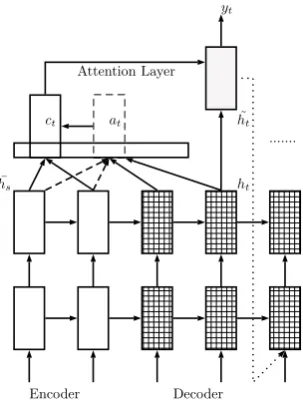
learning rate. At the end of each epoch we save the current state of the model and predict the perplex-ity values of the models on the development set. We employ early-stopping and select the model re-sulted from the epoch with the best perplexity to avoid over-fitting. The parameters are initialized over uniform distribution with support [-0.1, 0.1]. Additionally, for the decoder we employ global at-tention in combination with input feeding as de-scribed by Luong et al. (2015). The architecture1 is depicted in Figure 1, with the input feeding ap-proach represented only for the last hidden state of the decoder.
Attention Layer
ct
Encoder Decoder
ht
˜
ht yt
[image:2.595.106.258.245.447.2]at
...
¯
hs
Figure 1: Architecture of the neural simplification model with global attention and input feeding.
For the attention layer, we compute a context vectorctby using the information provided from
the hidden states of the source sentence and by computing a weighted average with the alignment weightsat. The new hidden state is obtained
us-ing a concatenation of the previous hidden state and the context vector:
˜
ht= tanhW[ct;ht]
The global alignment weights at are being
com-puted with a softmax function over the general scoring method for attention:
at(s) =
exphTtWash¯s
P
s0exphTtWas0h¯s0
Input feeding is a process that sends the pre-vious hidden state obtained using the alignment
1The architecture configurations, data, and the pre-trained models are released inhttps://github.com/ senisioi/NeuralTextSimplification
method, to the input at the next step, presumably making the model keep track of anterior align-ment decisions. Luong et al. (2015) showed this approach can increase the evaluation scores for neural machine translation, while in our case, for monolingual data, we believe it can be helpful to create better alignments. Our approach does not involve the use of character-based models (Sen-nrich et al., 2015; Luong and Manning, 2016) to handle out of vocabulary words and entities. In-stead, we make use of alignment probabilities be-tween the predictions and the original sentences to retrieve the original words.
2.1 Word2vec Embeddings
Furthermore, we are interested to explore whether large scale pre-trained embeddings can improve text simplification models. Kauchak (2013) indi-cates that combining normal data with simplified data can increase the performance of ATS systems. Therefore, we construct a secondary model (NTS-w2v) using a combination of pre-trained word2vec from Google News corpus (Mikolov et al., 2013a) of size 300 and locally trained embeddings of size 200. To ensure good representations of low-frequency words, we use word2vec ( ˇReh˚uˇrek and Sojka, 2010; Mikolov et al., 2013b) to train skip-gram with hierarchical softmax and we set a win-dow of 10 words.
Following Garten et al. (2015) who showed that simple concatenation can improve the word rep-resentations, we construct two different sets of embeddings for the encoder and for the decoder. The former are constructed using the word2vec trained on the original English texts combined with Google News and the later (decoder) embed-dings are built from word2vec trained on the sim-plified version of the training data combined with Google News. To merge the local and global em-beddings, we concatenate the representations for each word in the vocabulary, thus obtaining a new representation of size 500. If a word is missing in the global embeddings, we replace it with a sam-ple from a Gaussian distribution with mean 0 and standard deviation of 0.9. The remaining param-eters are left unchanged from the previous model description.
2.2 Prediction Ranking
described previously (NTS and NTS-w2v). Beam search works by generating the firstkhypotheses
at each step ordered by the log-likelihood of the target sentence given the input sentence. By de-fault, we use a beam size of 5 and take the first hy-pothesis, but we also observe that higher beam size and lower-ranked hypotheses can generate good simplification results. Therefore, we generate the first two candidate hypotheses for each beam size from 5 to 12. We then attempt to find the best beam size and hypothesis based on two metrics: the traditional MT-evaluation metric, BLEU (Pa-pineni et al., 2002; Bird et al., 2009) with NIST smoothing (Bird et al., 2009), and SARI (Xu et al., 2016), a recent text-simplification metric.
2.3 Dataset
To train our models, we use the publicly avail-able dataset provided by Hwang et al. (2015) based on manual and automatic alignments be-tween standard English Wikipedia and Simple En-glish Wikipedia (EW–SEW). We discard the un-categorized matches, and use only good matches
and partial matches which were above the 0.45
threshold (Hwang et al., 2015), totaling to 280K aligned sentences (around 150K full matches and 130K partial matches). It is one of the largest freely available resources for text simplification, and unlike the previously used EW–SEW cor-pus2 (Kauchak, 2013), which only contains full
matches(167K pairs), the newer dataset also
con-tains partial matches. Therefore, it is not only larger, but it also allows for learning sentence shortening (dropping irrelevant parts) transforma-tions (see Table 3, Appendix A).
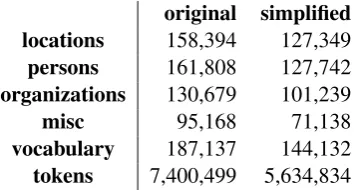
original simplified locations 158,394 127,349 persons 161,808 127,742 organizations 130,679 101,239
misc 95,168 71,138
[image:3.595.93.271.551.646.2]vocabulary 187,137 144,132 tokens 7,400,499 5,634,834 Table 1: The number of tokens and entities in the corpus.
We use the Stanford NER system (Finkel et al., 2005) to get an approximate number of locations, persons, organizations and miscellaneous entities
2http://www.cs.pomona.edu/˜dkauchak/
simplification/
in the corpus. A brief analysis of the vocabulary is rendered in Table 1.
The dataset we use contains an abundant amount of named entities and consequently a large amount of low frequency words, but the majority of entities are not part of the model’s 50,000 words vocabulary due to their small frequency. These words are replaced with ’UNK’ symbols during training. At prediction time, we replace the un-known words with the highest probability score from the attention layer. We believe it is impor-tant to ensure that the models learn good word representations, either during the model training or through word2vec, in order to accurately create alignments between source and target sentences.
Given that in TS there is not only one best simplification, and that the quality of simplifi-cations in Simple English Wikipedia has been disputed before (Amancio and Specia, 2014; Xu et al., 2015), for tuning and testing we use the dataset previously released by Xu et al. (2016), which contains 2000 sentences for tuning and 359 for testing, each with eight simplification variants obtained by eight Amazon Mechanical Turkers.3 The tune subset is also used as reference corpus in combination with BLEU and SARI to select the best beam size and hypothesis for prediction reranking.
3 Evaluation
For the first 70 original sentences of the Xuet al.’s (2016) test set4 we perform three types of human evaluation to assess the output of our best sys-tems and three ATS syssys-tems of different architec-tures: (1) the PBSMT system with reranking of
n-best outputs (Wubben et al., 2012), which
rep-resent the best PBSMT approach to ATS, trained and tuned over the same datasets as our systems; (2) the state-of-the-art SBMT system (Xu et al., 2016) with modified tuning function (using SARI) and using PPDB paraphrase database (Ganitke-vitch et al., 2013);5and (3) one of the state-of-the-art unsupervised lexical simplification (LS) sys-tems that leverages word-embeddings (Glavaˇs and
3None of the 359 test sentences was present in the datasets we used for training and tuning.
4https://github.com/cocoxu/
simplification/
ˇStajner, 2015).6
We evaluate the output of all systems using three types of human evaluation.
Correctness and Number of Changes. First, we count the total number of changes made by each system (Total), counting the change of a whole phrase (e.g. “become defunct” → “was
dissolved”) as one change. Those changes that
preserve the original meaning and grammatical-ity of the sentence (assessed by two native English speakers) and, at the same time, make the sentence easier to understand (assessed by two non-native fluent English speakers) are marked asCorrect. In the case of content reduction, we instructed the annotators to count the deletion of each array of consecutive words as one change and consider the meaning unchanged if the main information of the sentence was retained and unchanged. The sen-tences for which the two annotators did not agree were given to a third annotator to obtain the ma-jority vote.
Grammaticality and Meaning Preservation. Second, three native English speakers rate the grammaticality (G) and meaning preservation (M) of each (whole) sentence with at least one change on a 1–5 Likert scale (1 – very bad; 5 – very good). The obtained inter-annotator agreement (quadratic Cohens kappa) was 0.78 for G and 0.63 for M.
Simplicity of sentences. Third, the three non-native fluent English speakers were shown origi-nal (reference) sentences and target (output) sen-tences, one pair at the time, and asked whether the target sentence is: +2 – much simpler; +1 – some-what simpler; 0 – equally difficult; -1 – somesome-what more difficult; -2 – much more difficult, than the reference sentence. The obtained inter-annotator agreement (quadratic Cohens kappa) was 0.66.
While the correctness of changes takes into ac-count the influence of each individual change on grammaticality, meaning and simplicity of a sen-tence, theScores (G and M)andRank (S)take into account the mutual influence of all changes within a sentence.
4 Results and Discussion
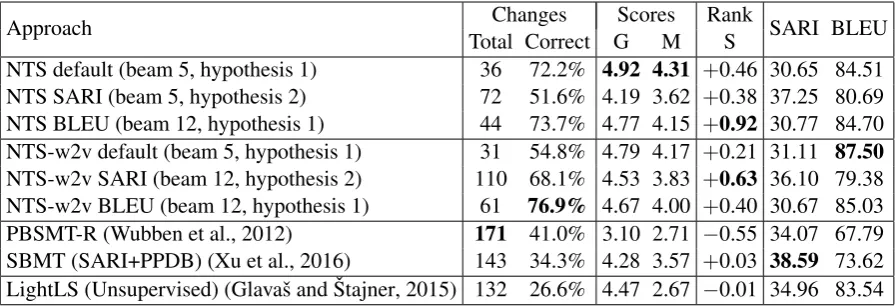
The results of the human evaluation (Table 2) re-vealed that all NTS models achieve higher per-centage of correct changes and more simplified output than any of the state-of-the-art ATS systems
6For the LightLS system (Glavaˇs and ˇStajner, 2015) we use the output of the original system provided by the authors.
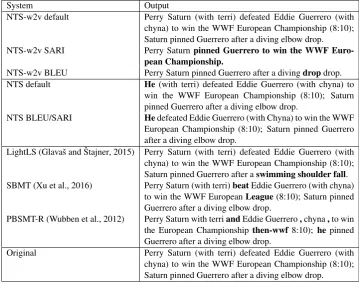
with different architectures (PBSMT-R, SBMT, and LightLS). We also notice that the best models according to BLEU are obtained with hypothesis 1 and the maximum beam size for both models, while the SARI re-ranker prefers hypothesis 2 and beam size 5 for the first NTS and the maximum beam size for the custom word embeddings model. The NTS with custom word2vec embeddings ranked with the text simplification specific met-ric (SARI) obtained the highest total number of changes among the neural systems, one of the highest percentage of correct changes, the second highest simplicity score, and solid grammaticality and meaning preservation scores. An example of the output of different systems is presented in Ta-ble 4 (Appendix A).
The use of different metrics for ranking the NTS predictions optimizes the output towards different evaluation objectives: SARI leads to the highest number of total changes, BLEU to the highest per-centage of correct changes, and the default beam scores to the best grammaticality (G) and meaning preservation (M). In addition, custom composed global and local word embeddings in combination with SARI metric improve the default translation system, given the joint scores for each evaluation criterion.
Here is important to note that for ATS sys-tems, the precision of the system (correctness of changes, grammaticality, meaning preservation, and simplicity of the output) is more important than the recall (the total number of changes made). The low recall would just leave the sentences sim-ilar to their originals thus not improving much the understanding or reading speed of the target users, or not improving much the NLP systems in which they are used as a processing step. A low pre-cision, on the other hand, would make texts even more difficult to read and understand, and would worsen the performances of the NLP systems in which ATS is used as a pre-processing step.
5 Conclusions
We presented a first attempt at modelling sentence simplification with a neural sequence to sequence model. Our extensive human evaluation showed that our NTS systems, if the output is ranked with the right metric, can significantly7 outperform the best phrase-based and syntax-based MT ap-proaches, and unsupervised lexical ATS approach,
Approach Total Correct GChanges ScoresM RankS SARI BLEU NTS default (beam 5, hypothesis 1) 36 72.2% 4.92 4.31 +0.46 30.65 84.51
NTS SARI (beam 5, hypothesis 2) 72 51.6% 4.19 3.62 +0.38 37.25 80.69
NTS BLEU (beam 12, hypothesis 1) 44 73.7% 4.77 4.15 +0.92 30.77 84.70
NTS-w2v default (beam 5, hypothesis 1) 31 54.8% 4.79 4.17 +0.21 31.11 87.50
NTS-w2v SARI (beam 12, hypothesis 2) 110 68.1% 4.53 3.83 +0.63 36.10 79.38
NTS-w2v BLEU (beam 12, hypothesis 1) 61 76.9% 4.67 4.00 +0.40 30.67 85.03
[image:5.595.75.523.62.215.2]PBSMT-R (Wubben et al., 2012) 171 41.0% 3.10 2.71 −0.55 34.07 67.79 SBMT (SARI+PPDB) (Xu et al., 2016) 143 34.3% 4.28 3.57 +0.03 38.59 73.62 LightLS (Unsupervised) (Glavaˇs and ˇStajner, 2015) 132 26.6% 4.47 2.67 −0.01 34.96 83.54
Table 2: Human evaluation results (the highest scores by each evaluation criterion are shown in bold).
by grammaticality, meaning preservation and sim-plicity of the output sentences, the percentage of correct transformations, while at the same time achieving more than 1.5 changes per sentence, on average. Furthermore, we discovered that NTS systems are capable of correctly performing sig-nificant content reduction, thus being the only TS models proposed so far which can jointly perform lexical simplification and content reduction.
Acknowledgments
This work has been partially supported by a grant of the Romanian National Authority for Scientific Research and Innovation, CNCS/CCCDI UEFIS-CDI, project number PN-III-P2-2.1-53BG/2016, within PNCDI III, and by the SFB 884 on the Po-litical Economy of Reforms at the University of Mannheim (project C4), funded by the German Research Foundation (DFG).
References
Marcelo Adriano Amancio and Lucia Specia. 2014. An Analysis of Crowdsourced Text Simplifications . In
Proceedings of the 3rd Workshop on Predicting and Improving Text Readability for Target Reader Popu-lations (PITR). pages 123–130.
Dzmitry Bahdanau, Kyunghyun Cho, and Yoshua Bengio. 2014. Neural machine translation by jointly learning to align and translate. CoRR
abs/1409.0473. http://arxiv.org/abs/1409.0473. Steven Bird, Ewan Klein, and Edward Loper. 2009.
Natural language processing with Python: analyz-ing text with the natural language toolkit. ” O’Reilly Media, Inc.”.
Ondˇrej Bojar, Rajen Chatterjee, Christian Federmann, Yvette Graham, Barry Haddow, Matthias Huck, Antonio Jimeno Yepes, Philipp Koehn, Varvara
Logacheva, Christof Monz, Matteo Negri, Aure-lie Neveol, Mariana Neves, Martin Popel, Matt Post, Raphael Rubino, Carolina Scarton, Lucia Spe-cia, Marco Turchi, Karin Verspoor, and Marcos Zampieri. 2016. Findings of the 2016 conference on machine translation. InProceedings of the First Conference on Machine Translation. Association for Computational Linguistics, pages 131–198.
Kyunghyun Cho, Bart van Merrienboer, C¸aglar G¨ulc¸ehre, Dzmitry Bahdanau, Fethi Bougares, Hol-ger Schwenk, and Yoshua Bengio. 2014. Learning phrase representations using RNN encoder-decoder for statistical machine translation. InProceedings of the 2014 Conference on Empirical Methods in Nat-ural Language Processing. pages 1724–1734. William Coster and David Kauchak. 2011. Simple
En-glish Wikipedia: a new text simplification task. In
Proceedings of ACL&HLT. pages 665–669. Jenny Rose Finkel, Trond Grenager, and Christopher
Manning. 2005. Incorporating non-local informa-tion into informainforma-tion extracinforma-tion systems by gibbs sampling. InProceedings of the 43rd annual meet-ing on association for computational lmeet-inguistics. As-sociation for Computational Linguistics, pages 363– 370.
Orhan Firat, KyungHyun Cho, and Yoshua Ben-gio. 2016. Multi-way, multilingual neural ma-chine translation with a shared attention mechanism.
CoRRabs/1601.01073.
Juri Ganitkevitch, Benjamin Van Durme, and Chris Callison-Burch. 2013. PPDB: The Paraphrase Database. In Proceedings of NAACL-HLT. pages 758–764.
Justin Garten, Kenji Sagae, Volkan Ustun, and Morteza Dehghani. 2015. Combining distributed vector rep-resentations for words. InProceedings of NAACL-HLT. pages 95–101.
Alex Graves. 2012.Supervised sequence labelling with recurrent neural networks, volume 385. Springer.
Sepp Hochreiter and J¨urgen Schmidhuber. 1997. Long short-term memory. Neural Computation
9(8):1735–1780.
William Hwang, Hannaneh Hajishirzi, Mari Ostendorf, and Wei Wu. 2015. Aligning Sentences from Stan-dard Wikipedia to Simple Wikipedia. In Proceed-ings of NAACL&HLT. pages 211–217.
David Kauchak. 2013. Improving text simplification language modeling using unsimplified text data. In
Proceedings of the 51st Annual Meeting of the As-sociation for Computational Linguistics (Volume 1: Long Papers). ACL, pages 1537–1546.
G. Klein, Y. Kim, Y. Deng, J. Senellart, and A. M. Rush. 2017. OpenNMT: Open-Source Toolkit for Neural Machine Translation.ArXiv e-prints.
Philipp Koehn. 2010. Statistical machine translation.
Minh-Thang Luong and Christopher D Manning. 2016. Achieving open vocabulary neural machine trans-lation with hybrid word-character models. arXiv preprint arXiv:1604.00788.
Thang Luong, Hieu Pham, and Christopher D. Man-ning. 2015. Effective approaches to attention-based neural machine translation. InEMNLP. The Asso-ciation for Computational Linguistics, pages 1412– 1421.
Tomas Mikolov, Kai Chen, Greg Corrado, and Jeffrey Dean. 2013a. Efficient estimation of word represen-tations in vector space. InProceedings of Workshop at International Conference on Learning Represen-tations.
Tomas Mikolov, Ilya Sutskever, Kai Chen, Greg S Cor-rado, and Jeff Dean. 2013b. Distributed representa-tions of words and phrases and their compositional-ity. InAdvances in neural information processing systems. pages 3111–3119.
Gustavo Henrique Paetzold and Lucia Specia. 2013. Text simplification as tree transduction. In Proceed-ings of the 9th Brazilian Symposium in Information and Human Language Technology. pages 116–125.
Gustavo Henrique Paetzold and Lucia Specia. 2016. Unsupervised lexical simplification for non-native speakers. InProceedings of the 30th AAAI.
Kishore Papineni, Salim Roukos, Todd Ward, and Wei-Jing Zhu. 2002. BLEU: a method for automatic evaluation of machine translation. In Proceedings of ACL.
Radim ˇReh˚uˇrek and Petr Sojka. 2010. Software Frame-work for Topic Modelling with Large Corpora. In
Proceedings of the LREC 2010 Workshop on New Challenges for NLP Frameworks. ELRA, Valletta, Malta, pages 45–50.
Rico Sennrich, Barry Haddow, and Alexandra Birch. 2015. Neural machine translation of rare words with subword units. arXiv preprint arXiv:1508.07909.
Iulian V Serban, Alessandro Sordoni, Yoshua Bengio, Aaron Courville, and Joelle Pineau. 2015. Build-ing end-to-end dialogue systems usBuild-ing generative hi-erarchical neural network models. arXiv preprint arXiv:1507.04808.
Lucia Specia. 2010. Translating from complex to sim-plified sentences. In Proceedings of the 9th inter-national conference on Computational Processing of the Portuguese Language (PROPOR). Springer Berlin Heidelberg, volume 6001 ofLecture Notes in Computer Science, pages 30–39.
Nitish Srivastava, Geoffrey E Hinton, Alex Krizhevsky, Ilya Sutskever, and Ruslan Salakhutdinov. 2014. Dropout: a simple way to prevent neural networks from overfitting. Journal of Machine Learning Re-search15(1):1929–1958.
Sanja ˇStajner, Hannah Bechara, and Horacio Saggion. 2015. A Deeper Exploration of the Standard PB-SMT Approach to Text Simplification and its Eval-uation. InProceedings of ACL&IJCNLP (Volume 2: Short Papers). pages 823–828.
Yonghui Wu, Mike Schuster, Zhifeng Chen, Quoc V Le, Mohammad Norouzi, Wolfgang Macherey, Maxim Krikun, Yuan Cao, Qin Gao, Klaus Macherey, et al. 2016. Google’s neural ma-chine translation system: Bridging the gap between human and machine translation. arXiv preprint arXiv:1609.08144.
Sander Wubben, Antal van den Bosch, and Emiel Krahmer. 2012. Sentence simplification by mono-lingual machine translation. InProceedings of the 50th Annual Meeting of the Association for Com-putational Linguistics (ACL): Long Papers - Volume 1. Association for Computational Linguistics, pages 1015–1024.
Wei Xu, Chris Callison-Burch, and Courtney Napoles. 2015. Problems in Current Text Simplification Re-search: New Data Can Help. Transactions of the Association for Computational Linguistics (TACL)
3:283–297.
Wei Xu, Courtney Napoles, Ellie Pavlick, Quanze Chen, and Chris Callison-Burch. 2016. Optimizing statistical machine translation for text simplification.
Transactions of the Association for Computational Linguistics4:401–415.
A Appendix - Data Sample and System Output
Match Transformation Sentence pair Full syntactic simplification;
reorder-ing of sentence constituents
“During the 13th century, gingerbread was brought to Swe-den by German immigrants.” and “German immigrants brought it to Sweden during the 13th century.”
Full lexical paraphrasing “During the 13th century, gingerbread was brought to Swe-den by German immigrants.” and “German immigrants brought it to Sweden during the 13th century.”
Partial strong paraphrasing “Gingerbread foods vary, ranging from a soft, moist loaf cake to something close to a ginger biscuit.” and “Ginger-bread is a word which describes different sweet food prod-ucts from soft cakes to a ginger biscuit.”
Partial adding explanations “Humidity is the amount of water vapor in the air.” and “Humidity (adjective: humid) refers to water vapor in the air, but not to liquid droplets in fog, clouds, or rain.” Partial sentence compression; dropping
[image:7.595.104.491.95.301.2]irrelevant information “Falaj irrigation is an ancient system dating back thousandsof years and is used widely in Oman, the UAE, China, Iran and other countries.” and “The ancient falaj system of irri-gation is still in use in some areas.”
Table 3: Examples of full and partial matches from the EW–SEW dataset (Hwang et al., 2015).
System Output
NTS-w2v default Perry Saturn (with terri) defeated Eddie Guerrero (with chyna) to win the WWF European Championship (8:10); Saturn pinned Guerrero after a diving elbow drop. NTS-w2v SARI Perry Saturnpinned Guerrero to win the WWF
Euro-pean Championship.
NTS-w2v BLEU Perry Saturn pinned Guerrero after a divingdropdrop. NTS default He (with terri) defeated Eddie Guerrero (with chyna) to
win the WWF European Championship (8:10); Saturn pinned Guerrero after a diving elbow drop.
NTS BLEU/SARI Hedefeated Eddie Guerrero (with Chyna) to win the WWF European Championship (8:10); Saturn pinned Guerrero after a diving elbow drop.
LightLS (Glavaˇs and ˇStajner, 2015) Perry Saturn (with terri) defeated Eddie Guerrero (with chyna) to win the WWF European Championship (8:10); Saturn pinned Guerrero after aswimming shoulder fall. SBMT (Xu et al., 2016) Perry Saturn (with terri)beatEddie Guerrero (with chyna)
to win the WWF EuropeanLeague(8:10); Saturn pinned Guerrero after a diving elbow drop.
PBSMT-R (Wubben et al., 2012) Perry Saturn with terriandEddie Guerrero,chyna,to win the European Championship then-wwf8:10); he pinned Guerrero after a diving elbow drop.
[image:7.595.118.478.333.615.2]