• No results found

supplementation effects

N/A
N/A
Protected

Academic year: 2020

Share "supplementation effects"

Copied!
9
0
0

Loading.... (view fulltext now)

Full text

(1)

J. Range Manage.

55: 327-335 July 2002

Early weaning and length of supplementation effects on beef calves

A.J. PORDOMINGO

Author is Research Scientist of National Institute of Agricultural Research, INTA Anguil, CC. 11, Anguil (6326), La Pampa, Argentina.

Abstract

Early weaning of calves can improve reproduction of beef cows, and would be of no detriment to calf growth if the diet is adequate. Digestible energy intake could be limiting, however, when calves are weaned on forage. Performance of calves weaned at 70 days (early weaning) and 172 days (normally weaning) of age were compared. Calves from 2 locations in Argentina, Anguil, and Chacharramendi, were distributed in 14 groups and half were weaned. Early-weaned calves were pen fed a 50% con- centrate-50% alfalfa hay diet for 12 days, followed by grazing on alfalfa for 150 days. During the first 90 days on pasture, early- weaned calves were group supplemented (1.2 % body weight (BW, DM basis). Calves from Anguil did not differ (P = 0.068) in average daily gain (ADG). In contrast, early-weaned calves from Chacharramendi gained faster than normally-weaned calves (P <

0.01). In a second experiment, 108 calves were classified into 3 age groups on day 0 of trial (AGE1 = 109 ± 2.2 days of age, AGE2 = 91 ± 1.6 days of age and AGE3 = 75 ± 3.8 days of age).

Two thirds of the calves were weaned (early-weaned calves) the same day and the remaining third was returned to their dams (normally-weaned calves). Two feeding treatments were imposed on the early-weaned calves: S15 = supplement during the first 15 days on pasture (1% body weight, DM basis), and S45 = supple- ment during the first 45 days. Early-weaned calves grazed on an alfalfa pasture for 136 days. Calves from the normally-weaned group remained with their mothers until weaning onto pasture on day 87 of the study. Normally-weaned calves were the heaviest (P < 0.05) at the end of trial. Differences in body weight between early weaning ages increased as the supplementation period decreased. Calves that were weaned at 75 days of age and fed supplement for only 15 days had the lowest (P < 0.05) overall ADG and final body weight. Overall results suggested that early weaning favors reproduction of thin cows, and early-weaned calves can be placed on good-quality pasture with no detriment of growth if energy supplement is provided.

Key Words: Calf growth, calf diet, calf supplementation, beef cattle

Resumen

El destete precoz mejora la eficiencia reproductiva del rodeo y no serfa detrimental del crecimiento del ternero si la dieta es adecuada. Sin embargo, cuando los terneros son destetados a forraje, el consumo de energia digestible podria ser limitante del crecimiento. En este estudio se comparo la performance de terneros destetados a los 70 dias (destete precoz) o a los 172 dias de vida (destete normal). Terneros provenientes de 2 localidades de la provincia de La Pampa en Argentina, Anguil y Chacharramendi, fueron distribuidos en 14 grupos y la mitad se destetaron. Los terneros destetados precozmente fueron alimen- tados a corral con una dieta 50% concentrado -50% heno de alfalfa durante 12 dias y pasaron luego a pastorear alfalfa por 150 dias mas. Durante los primeros 90 dias sobre la pastura, recibieron un suplemento en grupo (1,2% de peso vivo en base seca). Los terneros provenientes de Anguil no difirieron (P = 0.06) en aumento de peso (ADP). En contraste, los terneros provenientes de Chacharramendi destetados precozmente aumentaron a un ritmo mayor (P < 0,01) que los destetados nor- malmente. En un segundo experimento, 108 terneros fueron clasificados en 3 grupos de edad el dia 0 del ensayo (EDAD1 = 109 ± 2,2 dias, EDAD2 = 91 ± 1,6 dias y EDAD3 = 75 ± 3.8 dias).

Dos tratamientos de suplementacion fueron impuestos sobre los terneros destetados precozmente: 515 = suplementacion durante 15 dias sobre pastura (1% del peso vivo en base seca) y 545 = suplementacion durante 45 dias. Los terneros de destete precoz pastorearon sobre alfalfa durante 136 dias. Los terneros del grupo de destete normal se mantuvieron con sus madres hasty el

dia 87 del ensayo, momento en el que fueron destetados y trasladados a una pastura de alfalfa (sin suplementacion). Los terneros destetados normalmente fueron los mas pesados al finalizar el experimento. las diferencias de peso entre edades al momento del destete precoz se incrementaron con el periodo de suplementacion. Los terneros que fueron destetados a los 75 dias de vida y suplementados por solo 15 dias tuvieron los menores (P

< 0,05) aumentos de peso y pesos mas bajos al finalizar el ensayo.

Los resultados de ambas experiencias sugirieron que el destete precoz favorece la reproduccion de vacas delgadas y que los terneros destetados precozmente no sufririan un retraso de su crecimiento si se ofrece un forraje de alta calidad y se provee un suplemento energetico.

This research was funded by National Institute of Agricultural Research. INTA Anguil, La Pampa. Author wishes to thank Carlos Urquiza and his personnel for assistance during field data collection. Appreciation is also extended to Associate Editor Dr. Elaine Grings for her invaluable assistance in reviewing and editing this manuscript.

Manuscript accepted 15 Sept. 01.

Early weaning of calves can improve reproduction rates of thin cows (Laster et al. 1973, Lusby and Wetteman 1980, Lusby and Parra 1981, Lusby et al. 1981, 1990, Peterson et al. 1987), and allow for increases in stocking rate (Monje et al. 1978, Hofer et al. 1984, Kugler et al. 1997b). Lusby and Wetteman (1980), and Gill et al. (1993) demonstrated that weaning as early as 55 days

JOURNAL OF RANGE MANAGEMENT 55(4) July 327

(2)

of age is not detrimental to calf growth.

Moreover, early-weaned calves on a high- concentrate diet can gain weight faster than normally weaned calves before wean- ing (Myers et al. 1999a, 1999b) or even on a finishing program after weaning (Fluharty et al. 2000). Most of this work, however, was done using feedlot diets fol- lowed by a feedlot program. Little

research has been done with early-weaned calves and high forage diets. The greater the roughage content of the early-weaned calf diet, the lower total energy intake and rate of gain. Hofer et al. (1984) and Monje et al. (1993) showed that early-weaned calves should be placed on good quality pasture and provided supplemental energy if good gains are desired. This research was conducted: a) to evaluate performance of early-weaned calves on pasture with limited amounts of supplementation, and b) to study the interaction between age at weaning and supplementation period on average daily gain of calves. The impact of early weaning on body condition score changes of the dams grazing rangeland at 2 locations was also evaluated.

Materials and Methods

Experiment 1

Performance of early-weaned calves weaned at 70 days of age was compared with calves weaned at the normal age of 180 days. Additionally, the impact of early weaning on cow body condition score was evaluated. This trial started on the second week of December and took place during the spring of 1995, and summer and fall of 1996, at INTA (National Institute for Agriculture Research) Anguil Experiment Station. Calves came from of 2 different locations: Anguil, located in the sub- humid temperate area of central Argentina (Latitude 36° 30' S Longitude 63° 59W, and 165 m above sea level

;

mean annual rainfall = 608 ± 154 mm, Roberto et al.

1996), and Chacharramendi, located in the semiarid temperate area of the country (Latitude 37° 22' S Longitude 65° 49' W and 242 m above sea level; mean annual rainfall = 465±143 mm, Roberto et al.

1996).

Medium-frame 5-to-7-year old Angus cows that had calved within a 14-day peri- od, were selected from the herds at Anguil and Chacharramendi. Seventy-two cows were selected at Anguil and 96 cows at Chacharramendi. At both locations, cows grazed on native grassland with no supple- mental feed. At about 70 days of age (day

0 of trial: Anguil calves = 70.3 ± 2.82, Chacharramendi calves = 70.4 ± 2.73 days of age), all calves were weighed and assigned to groups of 12 calves each, with 6 groups in Anguil and 8 groups in Chacharramendi. Groups were made as homogeneous as possible in weight and age of calves within location. Age and body condition of cows were also account- ed for in making groups as homogeneous as possible prior to final allocation of calves to treatments. Groups were consid- ered experimental units and were then assigned to either early weaning or nor- mally-weaning treatments at each location.

Body condition of cows was recorded by individual palpation and observation, according to the 9-point body-condition score (BCS) scale:

1

= severely emaciated to 9 = very obese. At both locations, cows BCS were determined on days -63, -33, 0, 42, 72, and 102 of the trial at both loca- tions. Day -63 was day 7 of the calving.

period. At the time about 60% of the cows had given birth. Cows were exposed to Angus bulls (3 and 4 bulls for Anguil and Chacharramendi, respectively) during an 84-day period beginning on day 3 of the trial. Cows were pregnancy checked by rectal palpation 75 days after the end of breeding.

To evaluate diet quality at the 2 loca- tions, fecal samples were collected from 20 cows at random from each herd at the same time of body condition scoring from October to March. Immediately after col- lection, samples were dried at 60° C for 48 hours and ground in a Wiley mill to pass a 1-mm screen. Similar aliquots in weight from each fecal sample were taken and composited into a pooled sample for each location and sampling time. Micro-histo- logical analysis was performed on the pooled sample to determine botanical composition and relative proportions of main species and species classes. Samples

were prepared for reading following the methodology described by Holechek et al.

(1982) and botanical composition was estimated according to Sparks and Malechek (1968). Frequency of occur- rence of each species was converted to rel- ative density and used to calculate propor- tions in the diet (Holechek and Gross 1982). Species classes were identified as cool-season perennial grasses, warm-sea- son perennial grasses, shrubs, forbs and annual grasses. About a week after each fecal collection, hand-clipped samples were collected of species that contributed more than 5 % to the pooled sample or were the single contributor to a forage class. Prior to hand-clipping, observations on plant parts harvested by the cows were made to sample similar fractions. The col- lected material was oven dried at 60° C for 48 hours, ground in a Wiley mill (1-mm screen) and stored for later chemical analysis. Analyses performed were crude protein (CP = Kjeldahl N * 6.25) (AOAC 1990), lignin (Goering and Van Soest 1970) and in vitro DM digestibility

(IVDMD) (Tilley and Terry 1963).

Calves assigned to the normally-weaning treatment were returned to their dams on day 0. Calves assigned to the early wean- ing treatment were assembled in a drylot in Anguil and had ad libitum access to a 50%

concentrate - 50% alfalfa hay diet for 12 days (Table 1). The diet was formulated according to previous research (Hofer et al.

1984, Monje et al. 1993) to meet require- ments of young calves for an ADG of 500 g, and to stimulate rumen development.

After this period, calves were placed on alfalfa pasture at Anguil and limit fed a supplemental feed. A 40-ha alfalfa pasture was divided into 14 paddocks with electric fences, one for each group. Paddocks were allotted randomly to early-weaned and nor- mally-weaned groups from each location.

After the 12-day pen feeding period, early-

Table 1. Composition of feed and forages provided to early-weaned calves.

Experiment

1

CP1 NDF ADF forage

(%) (%) (%) kg DM

1)

DM ha

1)

Concentrate feed 18.2 15.0

Alfalfa hay 17.5 50.3

Mixed supplement3 18.0 19.2 Alfalfa pasture

December 1995 17.8

January 1996 15.1 55.1

February 1996 16.6 52.0

1CP = crude protein (Kjeldhal N

*

6.25), NDF = Neutral detergent fiber, ADF = Acid detergent fiber, ME = Metabolizable energy (NRC 1996). All nutrients are expressed on DM basis.

ZCommercial feed based on: oat grain, sorghum grain, corn, sunflower meal and soybean meal, mineral salt, Ca and P 3 rganic sources, and a vitamin- micro mineral premix.

Mixed feed composition: 40% oats, 40% corn, 18% soybean meal,

1

% vitamin-mineral premix.

(3)

weaned calves were placed in their cone- sponding alfalfa pasture until the end of trial (day 162).

Early-weaned calves were supplemented daily during the first 90 days on pasture.

Supplement was offered at 1.2% of aver- age body weight on DM basis within group. Supplement quantity was adjusted every 15 days based on actual BW or cal- culated BW assuming an ADG of 500 g.

For the first 10 days on pasture, the sup- plement was the same as that fed in drylot.

Afterwards, a concentrate mixture based on oat grain, corn and soybean meal was fed (Table 1). The supplement was offered once daily at 1100 hours. A mixture of 50% salt and 50% bone meal was present in feeders at all times.

Calves on the normally-weaning treat- ment were weaned on day 102 of trial (172 ± 2.73 days of age), which also coin- cided with the last day of supplementation of early-weaned calves. Normally weaned calves were placed on pasture in assigned paddocks, which had been grazed by non- experimental steers to remove accumulat- ed mature forage and promote growth of high-quality forage, similar to forage being grazed by early-weaned calves.

Groups grazed simultaneously for an addi- tional 60-day period.

All calves were weighed at the begin- ning of the experiment and on days 42, 72, 102, 132, and 162 of trial, equivalent to days 30, 60, 90, 120, and 150 on pasture for early-weaned calves. First body weight measurements were taken 5 hours after weaning, but all other BW were recorded after a 17-hour fast without access to feed and water.

Beginning on day 10 of the study, for- age DM availability of alfalfa was deter- mined every 30 days. Five 1-m2 quadrants per paddock were hand-clipped to a 5-cm height and weighed to determine yield.

One sub-sample was taken to determine DM (AOAC 1990), while another was reserved for chemical analysis. Samples of feed offered in pens during the 12-day pen

Experiment 2

This trial took place at INTA Anguil Experiment Station. The objective of the study was to determine the effects of age at early weaning and length of supplemen- tation period on calf performance. One hundred and eight medium-frame Angus calves (70 to 105 days of age) were classi- fied into 3 age groups on day 0 of trial.

Age groups were defined as: AGE1= 111 + 2.2 days of age (oldest), AGE2 = 91 ± 1.6 days of age (intermediate), and AGE3

= 75 ± 3.8 days of age (youngest). Two thirds of the calves from each age group were weaned(early-weaned calves) the same day and the remaining third was returned to the dams for later weaning (normally-weaned calves). After a pen- feeding period of 12 days, early-weaned calves grazed on an alfalfa pasture for 136 days. Two supplementation periods were imposed on the early-weaned calves: 515

= supplement during the first 15 days on pasture (1% of body weight, DM basis), and 545 = supplement during the first 45 days on pasture. Supplementation of 515 and 545 calves were concluded on day 27 and 57, respectively.

Calves from the normally-weaned group, remained with their mothers on native rangeland until weaning onto pas- ture on day 87 of the study. At that time, age groups averaged 196, 178, and 162 days of age for age groups, AGE1, AGE2 and AGE3, respectively. Comparisons of performance of calves weaned at less than 100 days of age with calves weaned at ages ranging from 5 to 7 months were of interest for inferences to an ample array of cow-calf programs common in our region.

The design assumed supplementation periods (515 and 545) and nursing as 3

feeding alternatives crossed by 3 age groups. The combination of 3 age groups x 3 feeding alternatives resulted in 9 treat- ments with 12 calves each. Calves within each treatment were blocked by weight at

initiation of the experiment in 3 weight groups, with 4 calves each. These groups were defined as experimental units.

Early-weaned calves were fed a diet of 50% chopped alfalfa hay and 50% concen- trate for 12 days (Table 2), followed by grazing of alfalfa pasture for 136 days with supplementation according to treat- ments. A 40-ha pasture was divided in 27 paddocks (1.45 ha each). Paddocks were assigned randomly to each experimental unit. Supplemental feed (Table 2) was the same concentrate as in pens, offered at 1%

of BW (on DM basis) daily at 1100 hours, calculated on the group BW average.

Immediately after weaning, normally- weaned calves were distributed in the pre- viously assigned weight block within age group and moved to the corresponding alfalfa paddock. Paddocks had been grazed by non-experimental steers before arrival of calves to remove accumulated mature forage, encourage regrowth and maintain forage quality. Calves from nor- mally-weaned group remained on pasture for 49 days (day 148 of trial - end of the study), and received no supplemental feed at any time.

All calves were weighed and weights recorded on days 0, 27, 57, 87, 117, and 148 of trial, comprising 5 periods.

Procedures for animal weighing, and alfal- fa pasture and feed sampling were the same as described in Experiment 1.

Statistical Analysis

Data of each experiment were statisti- cally analyzed using GLM procedures of SAS (1991) for repeated measures ANOVA. Calf group served as experimen- tal units in each trial. Factor means were separated using LSD (predicted difference method, SAS 1991) when significant (P <

0.05) F tests were observed. Body weight and ADG of Experiment

1

were analyzed under a randomized complete block design, with weaning treatment as main feeding period was taken every 4 days and Table 2. Composition of feed and forages provided to early-weaned calves.

samples of the supplement offered on pas- ture were taken every 15 days. These sam- ples were oven dried at 60° C to determine DM content and kept for later chemical analysis. Forage samples from each pad- dock were composited within sampling period. Composites were analyzed for CP (AOAC 1990), neutral detergent fiber (NDF) (Robertson and Van Soest 1981), and acid detergent fiber (ADF) (Goering and Van Soest 1970) and in vitro DM digestibility (IVDMD) (Tilley and Terry 1963). Metabolizable energy (ME) was calculated from IVDMD estimates (NRC

1996)

Experiment 2

CP' NDF ADF

kg DM"')

Concentrate feed 18.2 15.0

Alfalfa hay 17.2 48.2

Alfalfa pasture

December 1996 18.2

January 1997 16.1 55.0

February 1997 16.3 47.3

March 1997 17.8 43.1

CP = crude protein, NDF = Neutral detergent fiber, ADF = Acid detergent fiber, ME = calculated metabolizable energy NRC 1996). All nutrients are expressed on DM basis.

Commercial feed based on: oat grain, sorghum grain, corn, sunflower meal and soybean meal. Included also: mineral salt, Ca and P organic sources, and a vitamin- micro mineral premix.

JOURNAL OF RANGE MANAGEMENT 55(4) July 329

(4)

effect, location, and period in the sub-plot (repeated measures factor). Treatment effect, treatment x location, calf

group(treatment), period, treatment x peri- od and the 3-way interaction (treatment x location x period) were included in the model. One-way ANOVA was performed by location and period if an interaction weaning treatment x location x period was noted (P < 0.05). Effects of diet shifts were also assessed by ANOVA of period

effect using GLM procedure of SAS (1991). The model included period, calf group(period), location and period x loca- tion. If an interaction of period by location was detected (P < 0.05), interaction means were reported.

Experiment 2 was designed as a com- pletely randomized design with a 3 x 3 factorial arrangement of treatments (AGE x FA) in the main plot and period in the sub-plot (repeated measures). Factors AGE, FA and the AGE x FA interaction, period, and the 3-way interaction (FA x AGE x Period) were included in the model. Period effects were analyzed with- in FA by ANOVA with GLM of SAS with a completely randomized design.

Interaction means were reported if a meaningful interaction was detected (P <

0.05).

Results and Discussion

Experiment 1

At initiation of the experiment, age of cows was very similar between treatments within location (Anguil = 5.96 ± 0.745 years, (P = 0.875); Chacharramendi = 6.01

± 0.736 years; P = 0.890). Body condition of cows was also similar (Anguil = 5.42 ± 0.576, P = 0.710; Chacharramendi = 3.85

± 0.405, P = 0.6154). Calf body weight did not differ either (Anguil = 77.1 ± 0.11 kg, P = 0.492; Chacharramendi = 77.6 ± 0.12 kg, P = 0.766) among weaning treat- ments within location at day 0.

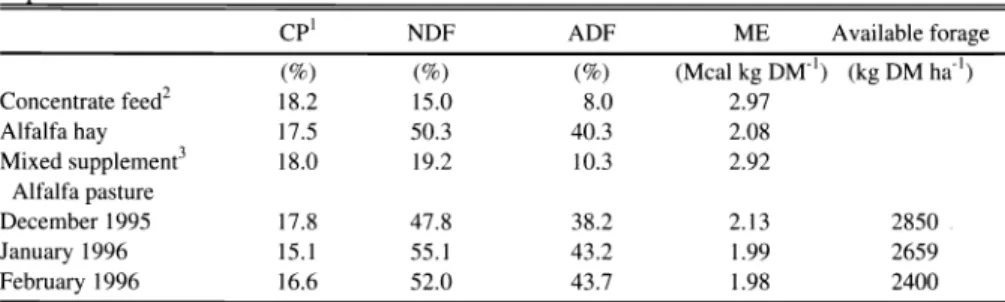
Supply of alfalfa forage was adequate to ensure that both forage quality and quanti- ty did not restrict calf growth (Table 1). A significant interaction (P < 0.01) was detected between location and weaning treatment for calf performance, therefore, weaning effects are reported by location (Tables 3 and 4). Performance of early- weaned calves from Anguil and Chacharramendi herd was similar (P = 0.89) from day 10 to day 102 of trial when the supplementation was being fed on pas- ture (Table 3).

Table 3. Average daily gain (g animal'') of Angus calves weaned at 70 (EW) or 172 (NW) days of age from 2 locations'.

Day of trial EW calves' NW

Animal-' ---

---Anguil---

0 to 42 cnnbA cnnbA

42 to 72 592bA 601bA

72 to 102 632A 657cA

l02 to 132 528aA 389aB

132 to 162 527aA 616''

SE3 7.9 18.6

O

to 102 607A 613A

102 to 162 527A 502B

O

to 162 577A 572A

Chacharramendi ---

O

to 42 592bA 371bB

42 to 72 602bA 364bB

72 to 102 632A 337aB

102 to 132 54

aA

336aB

132 to 162 540aA

477cB

SE 7.6 7.1

O

to 102 607A 359E

102 to 162 540A 4078

O

to 162 582A 377E

treatment x location x period interaction was detected (P < 0.001); therefore treatment means are reported by loca- tion and period.

3SE = Standard error for weaning effect within period and location.

SE = Standard error for period effect within weaning treatment and location.

ABMeans in columns within weaning treatment and location with different lowercase superscripts differ (P < 0.05).

Means in rows with different uppercase superscript differ (P < 0.05).

Anguil

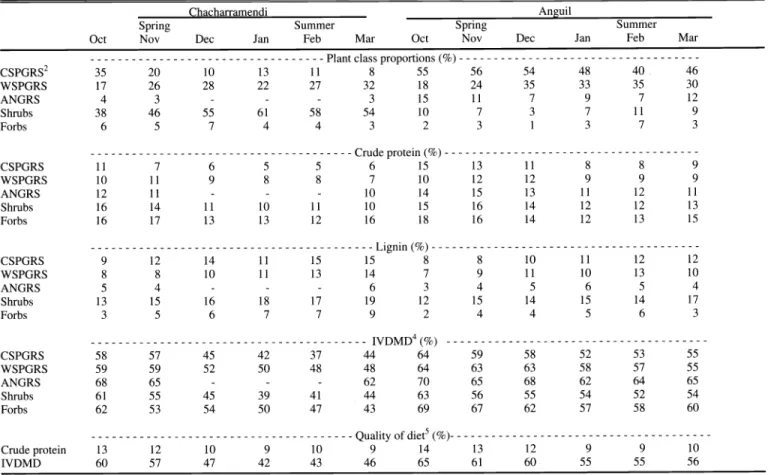
Cows from Anguil were in good body condition at early weaning time and remained in good condition until all calves were weaned (Table 5). However, differ- ences in BCS in favor of cows from the early weaning treatment were noted (P <

0.05) as time progressed. Pregnancy rate was 97% and 92% for cows from early weaning and normal weaning treatments, respectively. Table 6 shows composition and quality of the plant classes that com-

prised the diet of Anguil cows during spring and summer. Most of the native forage available was perennial grasses.

Crude protein and IVDMD data indicated that quality would have not been a limiting factor for milk production and body con- dition retention on the cows, and it did not imposed major restrictions to the calves' forage intake.

No differences between treatments were detected (P = 0.33) in ADG of calves for the first 102 days of trial (Table 3).

Table 4. Live weight (kg) of calves weaned at 70 (EW) or 172 (NW) days of age from 2 locations'.

Day of trial EW NW SE2

---(kg)--- ---Anguil---

0 77.1 77.2

42 102.2 101.9

72 120.2 120.4

102 139.0 139.7

132 154.8 151.4**

162 170.6 169.8

Chacharramendi ---

0 77.6 77.7

42 102.5 93.2**

72 120.6 104.2**

102 139.5 114.3**

132 155.7 124.4**

162 171.9 138.7**

IA treatment x location x period interaction was detected (P < 0.001); therefore treatment means are reported by loca- tion and period

ZSE = Standard error

** Means in rows differ (P < 0.01).

(5)

Table 5. Body condition scores (BCS)1 of cows with calves weaned at 70 (EW) or 172 (NW) days of age at 2 locations, Anguil and Chacharramendi.

Day after Day of calving trial3

EW NW SE2

---Anguil---

1

-63 5.67

30 -33 5.53

63 0 5.42

105 42 5.47

135 72 5.58a

165 102 5.61a

---Chacharramendi---

1
-63 5.07

30 -33 4.89

63 0 4.40

105 42 3.83

135 72 4.52a

165 102 5.05a

Body condition score: 1= severely emaciated, 2= emaciated, 3 = very thin, 4= thin, 5 = moderate, 6 = good, 7 = very ood, 8 = obese, 9 = very obese.

SE = Standard error

3Day 0 of trial were dates December 4th and 5th for locations Anguil and Chacharramendi, respectively.

Means in rows with different superscript differ (P < 0.05).

Likewise, calf treatment groups from Anguil did not differ (P = 0.48) in BW at day 0 or days 42, 72, and 102 (Table 4).

On day 102, supplemental feeding of early-weaned calves was concluded and normally-weaned calves were weaned.

Comparisons across periods within wean- ing treatment indicated that diet switch resulted in reduction (P < 0.01) of gain for the following 30-day period in both groups (Table 3). Feeding normally-weaned calves after weaning on alfalfa forage without supplemental feed, had a greater depressive effect (P = 0.016) on ADG than supplement elimination for early-weaned calves grazed on the same forage.

Normally-weaned calves appeared to express compensatory growth the follow- ing 30 days, showing greater (P = 0.015) ADG than early-weaned calves. Overall, performance of early-weaned and normal- ly-weaned calves was similar (P = 0.168).

Chacharramendi

Weaning treatment groups from Chacharramendi were similar (P = 0.77) in average body weight of calves at early weaning time (Table 4). Early-weaned calves, however, gained more (P < 0.01) than normally-weaned calves over the study (Table 3). At normal weaning time (day 102 of trial; 172 days of age), early- weaned calves averaged 25 kg heavier than normally-weaned calves (Table 4). The ADG of early-weaned calves was almost twice (P < 0.01) that of normally-weaned calves during this period (Table 3).

The area suffered a 5-month drought during spring and summer. Although spring is statistically the rainy season (54%

of the annual rainfall) (Roberto et al.

1996), Spring 1995 was unusually dry. The accumulated rainfall at the ranch for Spring 1995 and Summer 1996 was 58%

(202 mm) of the 80-year average (345 mm;

Roberto et al. 1996). The Chacharramendi cow herd lost 0.7 units of body condition (from 5.1 ± 0.2 to 4.4 ± 0.56) from calving to day 0 of trial (Table 5). Early weaning allowed the cows to recuperate body con- dition during summer. Cows that remained with their calves continued to lose condi- tion up to weaning (day 165 after calving).

Pregnancy results reflected the body condi- tion differences (91% and 44% for cows on early weaning and normal weaning treatments, respectively.)

Although not measured directly, a

reduced forage availability and quality would have restricted milk production and calf's feed intake, which would have been detrimental for calf growth. Microhisto- logy on fecal samples from parturition to the normal weaning time pointed out an increased presence of shrubs in the diet during the late spring and summer months (Table 6), which could indicate a sizable reduction of grass availability. Although shrubs provided a greater proportion of crude protein than perennial grasses, lignin content also increased and digestibility decreased. Compared with the diet of the herd at Anguil, the cow herd at Chacharramendi had a lower quality for- age available from calving and throughout the study.

Normally-weaned calves from Cha- charramendi suffered a diet adjustment effect as did normally-weaned calves from Anguil during the 30-day period after

weaning. Gains of early-weaned calves did not improve in this period compared with the previous one (Table 3). This group expressed some compensatory growth in the last 30-day period of the study, but not as great as in Anguil. This

increase did not compensate for the reduced rate of growth that took place up to weaning. Over the study, ADG of early- weaned calves was 54% greater than gain of normally-weaned calves (Table 3). At the end of trial, early-weaned calves were 33.2 kg heavier (P < 0.01) than normally- weaned ones (Table 4).

Results from our study would indicate that early-weaned calves grazing good quality pastures and supplemented for a 90-day period would grow at a rate similar to normally-weaned calves if cows can maintain good body condition through lac- tation. Moreover, ADG of early-weaned calves could be superior to ADG of nor- mally-weaned calves if cows were under nutritional stress. Fernandez and Zuccari (1996), in a similar environment and weaning program, reported no differences in weight gain of Angus calves weaned from first calf heifers at 60 days of age and supplemented on pasture during 60 days, compared with calves weaned at 6 months of age. Daily gains reported were 679 g animal' for early-weaned vs 670 g animal' for normally-weaned calves. In a

similar study, Fernandez et al. (1997) reported ADG of 646 and 644 g animal"' for early-weaned and normally-weaned calves.

In Oklahoma, Lusby and Wettemann (1980) reported similar rates of growth up to 7 months of age for normally-weaned calves and calves weaned at 56 kg body weight (6 to 8 weeks of age). Drylot-fed early-weaned calves gained weight at a rate of 667 g day'.

In a more restrictive environment than ours (Province of Rio Negro, Argentina) and a similar feeding program, Kugler et al. (1997a) reported greater ADG for 69- day old early-weaned calves compared with normally-weaned calves (745 vs 580 g animal'). After weaning, the early- weaned calf group was supplemented dur- ing 60 days on pasture. In contrast, Sciotti et al. (1996) reported lower ADG for early-weaned calves supplemented for 30 days on pasture compared with normally- weaned calves (578 vs 635 g animal"').

Working in a more humid area of Argentina, Hidalgo et al. (1996) reported better performance of normally-weaned calves than early-weaned calves (900 vs 493 g day-').

JOURNAL OF RANGE MANAGEMENT 55(4) July 331

(6)

Table 6 . Botanical composition!, and quality of forage classes and estimated diet of beef cows at 2 locations.

Chacharramendi Anguil

Spring Summer Spring Summer

Oct Nov Dec Jan Feb Mar Oct Nov Dec Jan Feb Mar

--- Plantclass proportions (%)---

CSPGRS2 35 20 10 13 11 8 55 56 54 48 40. 46

WSPGRS 17 26 28 22 27 32 18 24 35 33 35 30

ANGRS 4 3 - - - 3 15 11 7 9 7 12

Shrubs 38 46 55 61 58 54 10 7 3 7 11 9

Forbs 6 5 7 4 4 3 2 3

1

3 7 3

--- Crudeprotein(%)---

CSPGRS 11 7 6 5 5 6 15 13

11

8 8 9

WSPGRS 10 11 9 8 8 7 10 12 12 9 9 9

ANGRS 12 11 - - - 10 14 15 13 11 12 11

Shrubs 16 14

11

10

11

10

15

16 14 12 12 13

Forbs 16 17 13 13 12 16 18 16 14 12 13 15

--- Lignin(%)---

CSPGRS 9 12 14 11 15 15 8 8 10 11 12 12

WSPGRS 8 8 10 11 13 14 7 9 11 10 13 10

ANGRS 5 4 - - - 6 3 4 5 6 5 4

Shrubs 13 15 16 18 17 19 12 15 14 15 14 17

Forbs 3 5 6 7 7 9 2 4 4 5 6 3

CSPGRS 58 57 45 42 37 44 64 59 58 52 53 55

WSPGRS 59 59 52 50 48 48 64 63 63 58 57 55

ANGRS 68 65 - - - 62 70 65 68 62 64 65

Shrubs 61 55 45 39 41 44 63 56 55 54 52 54

Forbs 62 53 54 50 47 43 69 67 62 57 58 60

--- Qualityof diets(%)---

Crude protein 13 12 10 9 10 9 14 13 12 9 9 10

IVDMD 60 57 47 42 43 46 65 61 60 55 55 56

Estimated by microhistology of fecal samples

3CSPGRS = Cool-season perennial grasses; WSPGRS = Warm-season perennial grasses; ANGRS = Annual grasses Kjeldahl N x 6.25

51n vitro dry matter digestibility

Calculated from class proportion and quality data

Experiment 2

Available biomass in alfalfa pastures was greater than 2200 kg DM ha"1 throughout the 148-day study period and calf intake should not have been restricted.

Table 2 shows nutrient composition of feeds and forage used in the study. The normally-weaned calves were heaviest (P

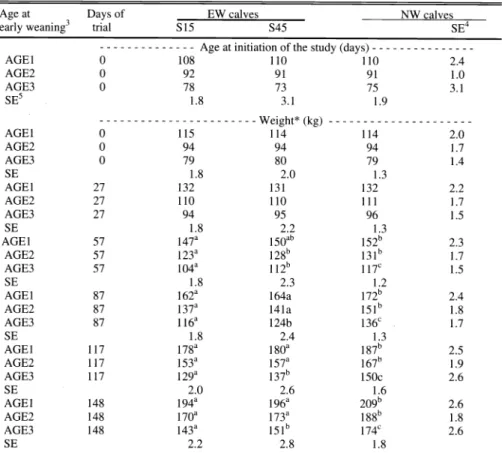
< 0.01) at the end of trial, compared with early-weaned ones, within age groups (Table 7), and differences increased as age at weaning decreased. Calves from the normal weaning treatment were 15 and 13 kg heavier in the oldest group (AGE 1), 18 and 15 kg in the intermediate (AGE2), and 31 and 23 kg in the youngest (AGE3), compared with the 15-day supplemented and 45-day supplemented early-weaned calves, respectively. Within the normal weaning treatment, a decrease in ADG with decreasing age was detected (P <

0.05) in period

1

(Table 8). Gains, howev- er, did not differ (P > 0.28) between age groups in periods 2 and 3. Despite the cited initial effect, ADG of all age groups of normally-weaned calves did not differ

(P > 0.43) over the pre-weaning period (accumulated periods 1, 2, and 3).

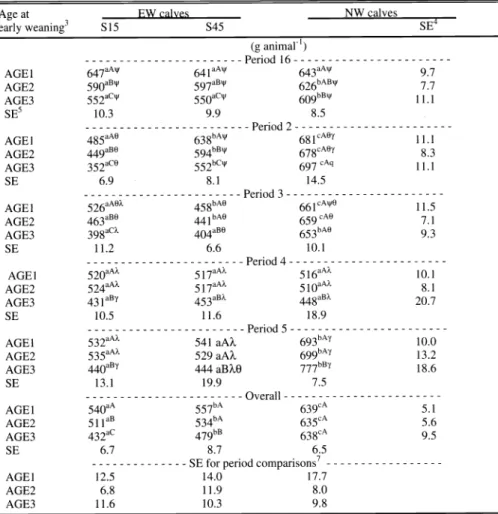
Before normal weaning time, ADG was usually greater (P < 0.01) in normally- weaned calves compared to early-weaned calves, within each period and age group (Table 8). Differences became larger as days progressed and early-weaned calves were deprived of supplemental feed (peri- ods 1, 2, and 3). During the 30-day period after weaning (period 4), normally-weaned calves showed lower (P < 0.01) ADG, compared with the previous period. In this period, the youngest group of normally- weaned calves had lower (P < 0.05) ADG than the oldest and the intermediate age group, possibly showing a detrimental effect of weaning 162-day old calves onto a 100% pasture diet. Average daily gain of normally-weaned calves within age group in period 4 did not differ (P > 0.28) from gain of 15-day supplemented and 45-day supplemented early-weaned calves.

Thirty days later (period 5), normally- weaned calves showed increased (P <

0.05) ADG compared with earlier periods.

Moreover, the youngest group had greater (P < 0.05) ADG, compared with the other 2, and the greatest ADG of the study, like- ly expressing compensatory growth.

Likewise, ADG of these calves was greater (P < 0.01) than ADG of early- weaned calves within all age groups in this period. Over the study, no differences (P = 0.58) in ADG were detected between age groups for normally-weaned calves.

Age at early weaning date (day 0 of trial) correlated highly with body weight (r

= 0.97). The youngest calves were 16 days younger and 15 kg lighter than those in the intermediate group. In turn, the intermedi- ate group was 18 days younger and 20 kg lighter than the oldest. Body weight differ- ences among age groups noted at early weaning time remained significant (P <

0.05) for each sampling period and across the study. Within the supplementation treatments of early-weaned calves, the heaviest calves at early weaning time were also the heaviest at the end of trial (P <

0.05). The shortest supplementation period

magnified ADG differences due to age.

(7)

Table 7. Weight of Angus calves early weaned (EW) at 3 different ages and supplemented on pas- ture for 15 (S15) or 45 (S45) days, compared with weight of calves of corresponding ages at early

weaning time and normally weaned (NW)1'2.

Age at Days of EW calves calves

early weaning3 trial S15

Age at initiation of the study(days)---

AGE1 0 108

AGE2 0 92

AGE3 0 78

SEs 1.8 3.1

AGE1 0 115

AGE2 0 94

AGE3 0 79

SE 1.8 2.0

AGE1 27 132

AGE2 27 110

AGE3 27 94

SE 1.8 2.2

AGE1 57 147a

AGE2 57 123a

AGE3 57 104a

SE 1.8 2.3

AGE1 87 162a

AGE2 87 137a

AGE3 87 116a

SE 1.8 2.4

AGE1 117 178a

AGE2 117 153a

AGE3 117 129a

SE 2.0 2.6

AGE

1

148 194a

AGE2 148 170a

AGE3 148 143a

b

SE 2.2 2.8

1Calves of the NW treatment were kept with the dams until day 87 of trial; NW calves reached the ages 196, 178, and 162 days, for AGE1, AGE2 and AGE3, respectively.

2A weaning treatment x age group x period interaction was detected (P < 0.001); therefore, interaction means are report- ed.

3Age groups at early weaning date. AGE1=111 ± 2.2 days of age; AGE2 = 91 ± 1.6 days of age, and AGE3 = 75 ± 3.8 days of age.

SE = Standard error for diet effect.

SSE = Standard error for age group effect.

Weight differences between age groups within period and diet treatment are all significant (P < 0.05).

abcMeans in rows with different superscripts differ (P < 0.05).

Feeding supplement for only 15 days detrimentally affected the youngest group at early weaning. After 148 days, the 15- day and 45-day supplemented calves from the oldest early-weaned group (AGE 1) were 23 and 24 kg heavier (P < 0.05) than calves from corresponding groups of the

intermediate age at early weaning (AGE2). No supplementation effect was detected (P > 0.34) within these 2 age groups. Differences, however, between the oldest (AGE 1) and youngest (AGE3) calves were greater (P < 0.05) in the 15- day than in the 45-day supplementation treatment (52 and 45 kg, respectively).

Body weight and ADG did not differ (P

> 0.26) between supplementation treatments imposed on early-weaned calves within each age group for period 1. For early- weaned calves, period

1

consisted of 12 days on pen-fed diet plus 15 days on pasture with supplemental feed. Differences in

ADG were not expected because diets were the same for all early-weaned calves dur- ing the pen feeding period and the first 15 days on pasture. After day 15 on pasture, early-weaned calves of the 15-day supple- mentation treatment received no supple- mental feed. During the following period, (period 2) all age groups of this treatment (S15 calves) showed lower (P < 0.05) ADG compared with period 1. Group AGE3 x S

1

S reached the lowest rate of gain of this trial in this period. The switch of diet to 100% forage may explain this effect. During the same period, 45-day supplemented early-weaned calves (S45) maintained similar (P > 0.25) ADG to period 1. This response would be expected because diet did not change in this treat- ment. Consequently, ADG of 15-day sup- plemented early-weaned calves were lower (P < 0.05) than gains of 45-day sup- plemented early-weaned calves. Body

weight differences, however, between sup- plementation treatments were not detected yet (P > 0.34) for the oldest calves. Forty

five-day supplemented early-weaned

calves were 5 and 8 kg heavier (P < 0.05) than 15-day supplemented early-weaned calves in the intermediate and youngest groups, respectively (Table 7).

After 30 days on forage diet (period 3), the oldest and intermediate age groups of 15-day supplemented early-weaned calves maintained (P > 0.24) ADG compared with period 2. The youngest group (AGE3) increased (P < 0.05) ADG during this period. In the same period, supple- mental feeding of calves in the 45-day supplementation treatment (S45) was stopped, and ADG of this treatment

decreased (P < 0.05) compared with peri- od 2. The switch of diets may have been the main factor responsible for this ADG depression. During this period, ADG of 15-day supplemented early-weaned calves from the oldest and intermediate age groups were greater (P < 0.05) than ADG of 45-day supplemented calves (Table 8).

On day 87, body weights for calves from the 15 and 45-day supplementation treat- ments within the oldest and the intermedi- ate age groups, did not differ (P > 0.17), but weights between supplementation treatments were different (P < 0.05) for the youngest group.

In period 4, ADG of 45-day supple- mented early-weaned calves of all age groups and 15-day supplemented early- weaned calves from the intermediate and the youngest groups increased (P < 0.05), compared to gains achieved in period 3.

Both supplementation treatments (S 15 and S45) had similar (P > 0.15) ADG within age groups during this period. Similarly, a month later (period 5) no differences were detected (P > 0.43) between supplementa- tion treatments of early-weaned calves within age group. Over the 148-day peri- od, no differences in BW were detected (P

> 0.22) between supplementation treat- ments for the oldest and the intermediate age groups (Table 7). Differences, howev- er, were evident in the youngest group (P

<0.01).

Overall ADG increased (P < 0.05) with weaning age within the 15-day supple- mentation treatment for early-weaned calves. A similar trend was noted for the 45-day supplementation treatment, although no differences in overall ADG were detected (P = 0.16) between the old- est and the intermediate (111 and 91 days of age at weaning) groups in this treat- ment. Gain increased (P < 0.05) also with length of supplementation period within

JOURNAL OF RANGE MANAGEMENT 55(4) July 333

(8)

Table 8. Average daily gain (ADG, g animal') of Angus calves early weaned (EW) at 3 different ages and supplemented on pasture for 15 (S15) or 45 (S45) days, compared with ADG of calves normally weaned (NW)l.

Age at EW calves NW calves

early weaning3 S l5 S45

(g animal')

--- Periodl6---

AGE1 647aAi 641aAW

AGE2 590aBv 597aBW

AGES 552aCi` 550aCv

SE5 10.3 9.9

AGE! 485aAe 638bAijj cAer

AGE2 449aBe 594bBW

AGE3 352aCa 552bCij`

cAq

SE 6.9 8.1

AGE! 526aAO? 458bAe

AGE2 463aBe 441bAe

cAe

AGE3 398aCX 404aBe

SE 11.2 6.6

AGE1 520aAX 517aAX

AGE2 524aAX 517aA?.

AGE3 431aBy 453aBX

SE 10.5 11.6

AGEI 532aAX 541 aAA.

AGE2 535aAX 529 aAX

AGE3 440aBy 444 aBX6

SE 13.1 19.9

Overall ---

AGE1 540aA 557bA

AGE2 511aB 534bA

AGE3 432aC 479bB

SE 6.7 8.7

---SE for periodcomparisons7 ---

AGE1 12.5 14.0

AGE2 6.8 11.9

AGE3 11.6 10.3

C

laC

vesof the NW treatment were kept with the dams until day 87 of trial. Normally weaned calves were 196,178, and 162 days of age for groups AGE!, AGE2 and AGE3, respectively, at weaning.

3A weaning treatment x age group x period interaction was detected (P < 0.001); therefore, interactive means are reported.

Age groups at early-weaning date (day 0 of trial): AGE1=111 ± 2.2 days of age; AGE2 = 91 ± 1.6 days of age, and AGE3 = 75 ± 3.8 days of age.

4SE = Standard error for diet effect.

5SE = Standard error for age group effect.

Period 1= ADG between day 0 and 27 of trial, Period 2 = between day 27 and 57; Period 3 = between day 57 and 87;

Period 4 = between day 87 and 117; Period 5 = between day 117 and 148.

7SE = Standard error for period effect within age group and diet.

ABRow means with different lowercase superscripts differ (P < 0.05).

Column means within period with different uppercase superscripts differ (P < 0.05).

yq'gColumn means within age group across periods with different superscripts differ (P < 0.05).

and across weaning ages. Within early weaning treatments, calves weaned at the youngest age (75 days of age) were the group most affected by the diets imposed, and those in this age group receiving sup- plement for only 15 days experienced the lowest overall rate of growth.

Reports on compared performance of early-weaned calves exposed to limited supplementation programs are scarce.

Early weaning on a 100% forage diet com- pared to a 1.1 kg day

l

animal' of supple- mental feed was reported by Simeone et al. (1997). Supplemented early-weaned calves gained 310 g day' more than non- supplemented ones.

Conclusions

Our study provides evidence that early weaning at 2 to 3 months of age, with proper feeding, is a feasible technique to reduce herd requirements without affect- ing calf performance. Moreover, in cases of feed restrictions for the cows and calves, it could favor not only the cow, but

also the calf.

Low-cost feeding programs can success- fully be implemented, however, calf requirements should not be underestimat- ed. Results from this study indicate that 70 to 80 day-old weaned calves would be the

most affected under feeding programs that use a supplementation period on pasture shorter than 45 days.

Shortening of supplementation period on pasture to 15 days after weaning can have negative effects on performance. The effect, however, would be less dramatic if calves are 90-day old or older at weaning time. If calves are younger, supplementa- tion during at least 45 days may be neces- sary to achieve an acceptable rate of growth. More research is needed to devel- op improved options that combine ade- quate calf growth and reduced costs with- out compromising future calf perfor- mance. Questions such as calf age and weight, forage quality, and supplement level interactions remain to be addressed in future research on early weaning.

Literature Cited

AOAC. 1990. Official methods of Analysis (15`h

Ed.). Assoc. of Official Analytical Chem., Washington, DC.

Fernandez, G.D. and A.E. Zucari. 1996.

Efecto del destete precoz sobre la perfor- mance reproductiva en vaquillonas de primera paricion. Rev. Arg. Prod. Anim.

16(1):49.

Fernandez, G.D., A.E. Zucari, and E.L.

Anton. 1997. Efecto de la edad del destete sobre la performance de vacas de refugo y ternero. Rev. Arg. Prod. Anim. 17(1):279.

Fluharty, F.L., S.C. Loerch, T.B. Turner, S.J. Moeller, and G.D. Lowe. 2000. Effects of weaning age and diet on growth and car- cass characteristics in steers. J. Anim. Sci.

78:1759-1767.

Gill, D.R., F. N. Owens, M.C. King, and H.G. Dolezal. 1993. Body composition of grazing or feedlot steers differing in age and background. Okla. Agr. Exp. Sta. Res. Rep.

pp. 993:185-190.

Goering, H.K. and P.J. Van Soest. 1970.

Forage fiber analyses (apparatus, reagents, procedures, and some applications). Agr.

Handb. 379. ARS, USDA, Washington, D.C.

Hidalgo, L.G., S. Callejas, M.A. Cauhepe, and M.J. Otero. 1996. Efecto del destete precoz sobre la condicion corporal y la prenez en vacas multiparas. Rev. Arg. Prod.

Anim. 16(1):36.

Hofer, C.C., J.J. Bruno, and A.R. Monje.

1984. Comportamiento de terneros desteta- dos a los 60 dias de edad. Manejo del destete y metdo de crianza. EEA INTA C. Del Uruguay. Prod. Anim. Inf. Tec. 1:126-132.

Holechek, J.L. and B.D. Gross. 1982.

Evaluation of diet selection in ruminants.

Functional Ecol. 2:15-22.

Holechek, J.L., M. Vavra, and R. D. Pieper.

1982. Botanical determination of range her- bivore diets: a review. J. Range Manage.

35:309-315.

(9)

Kugler, N.M., H. Giorgetti, G. Cecchi, G.

Rodriguez, y 0. Montenegro. 1997a.

Modulos de cria: Destete precoz vs conven- cional. Jornadas de cria en campos de monte.

EEA Valle Inferior de Rio Negro, IDEVI- INTA p. 52-53.

Kugler, N.M., H. Giorgetti, G. Cecchi, G.

Rodriguez, y 0. Montenegro. 1997b.

Destete precoz e incremento en la carga ani- mal. 1. Efecto sobre los vientres. Rev. Arg.

Prod. Anim. 17(1):269.

Laster, D.B., H.A. Climp, and K.E. Gregory.

1973. Effects of early weaning on paspartum reproduction of cows. J. Anim. Sci.

36:734-740.

Lusby, K.S. and A.A. Parra.1981. Effects of early weaning on calf performance and on reproduction in mature cows. Okla. Agr.

Exp. Sta. Rep. MP 108:64-68.

Lusby, K.S. and R.P. Wettemann. 1980.

Effects of early weaning calves from first calf heifers on calf and heifer performance.

Okla. Agr. Exp. Sta. Res. Rep. MP 107:55-58.

Lusby, K.S., R.P. Wettemann, and E.J.

Turman. 1981. Effects of early weaning calves from first-calf heifers on calf and heifer performance. J. Anim. Sci. 53:1193- 1197.

Lusby, K.S., D.R. Gill, D.M. Anderson, T.L.

Gardner, and H.G. Dolezal. 1990. Limit feeding vs full feeding high concentrate diets to early-weaned calves- effects on perfor- mance to slaughter. Okla. Agr. Exp. Sta. Res.

Rep. MP 129:128-134.

Monje, A.R., C.C. Hofer, and I.O. Galli.

1978. Destete precoz y creep-feeding. Efecto sobre la receptividad. AAPA Prod. Anim.

6:391-396.

Monje, A.R., C.C. Hofer, and I.O. Galli.

1993. Destete precoz: Efecto sobre los vien- tres, manejo de los terneros e impacto de la tecnica sobre los sistemas de produccion.

Memorias. Jornada de difusion tecnica:

Destete precoz en cria vacuna. EEA INTA C.

Del Uruguay. pp.13-38.

Myers, S.E., D.B. Faulkner, F.A. Ireland, and, D.F. Parrett. 1999a. Comparison of three weaning ages on cow-calf performance and steer carcass traits. J. Anim. Sci.

77:323-329.

Myers, S.E., D.B. Faulkner, F.A. Ireland, L.L. Berger, and D.F. Parrett. 1999b.

Production systems comparing early weaning to normal weaning with or without creep feeding for beef steers. J. Anim. Sci.

77:300-310.

National Research Council. 1996. Nutrient requirements of beef cattle. Seventh Revised Ed. Washington D.C.: National Academy Press.

Peterson, O.W., T.B. Turner, K.M. Irvin, M.

E. Davis, H. W. Newland, and W. R.

Harvey. 1987. Cow and calf performance and economic considerations of early wean- ing of fall-born beef calves. J. Anim. Sci.

64:15-22.

Roberto, Z.E., G. Casagrande, and E.F.

Viglizzo, 1996. Lluvias en la pampa central.

Tendencias y variaciones del siglo. Cambio climatico y agricultura sustentable en la region pampeana. Ed. INTA PEI 2:3-25.

Robertson, J.B. and P.J. Van Soest. 1981.

The detergent system analysis and its appli- cations to human foods: In: W.P.T. James and 0. Theander (Ed.) The Analysis of Dietary Fiber. pp 123-158. Marcell Dekker, New York.

SAS. 1991. Statistics Analysis System User's Guide. SAS Institute Inc. Cary. N.C.

Sciotti, A.E., J. Carrillo, L.M. Melucci and A. Cano.1996. Efecto del destete precoz en vacas primiparas y de ultima paricion sobre los pesos y ganancias de peso de los terneros y sus madres. Rev. Arg. Prod. Anim.

16(1):30.

Simeone, A., A.I. Trujillo, G. Cordoba, J.

Gil, M. Rodriguez, A. Bejerez, R.

Zanoniani, F. Baccino, and M. Umpierrez.

1997. Efecto del destete precoz y de dos sis- temas de alimentacion post-destete sobre la ganancia de peso de terneros Hereford hasta los 15 meses de edad. Rev. Arg. Prod. Anim.

17(1):58.

Sparks, D.R. And J.C. Malechek. 1968.

Estimating percentage dry weight in diets using a microscopic technique. J. Range Manage. 21:264-265.

Tilley, J.M.A. and R.A. Terry. 1963. A two- stage technique for in vitro digestion of for- age crops. J. Brit. Grassl. Soc. 18:104.

JOURNAL OF RANGE MANAGEMENT 55(4) July 335

Figure

Table  1.  Composition of feed and forages provided  to early-weaned  calves.
Table  4.  Live weight  (kg) of calves weaned at  70  (EW)  or  172 (NW)  days  of age from  2  locations'
Table  5.  Body condition scores  (BCS)1  of  cows  with calves weaned  at  70  (EW)  or  172  (NW)  days  of  age  at  2  locations, Anguil and Chacharramendi
Table  6  .  Botanical composition!,  and quality of forage classes  and estimated diet of beef  cows  at  2  locations
+3

References

Related documents

Users will see this option in their Autodesk software product, as well as on the Subscription Center sign-in page, and on various Autodesk web sites.

In this paper we have previewed FlexiView: a novel visualization technique which aims at enabling requirements engineers to work with multiple interconnected

Percentage of infective larvae identified from control, copper oxide wire particle COWP and CuSO4 group fecal cultures of naturally infected lambs.. Concentrations of copper in

According to Godwin-Jones (2006), the advantages of using blogs as a writing tool are: encourages feedback and represents both writing and reading activity; critical analysis

To compute the Eulerian control forces, the surface of the control mesh for each timestep is rasterized onto the simulation grid and its velocities (computed using finite

Telmatobius ventriflavum is readily distinguished from all other central Peruvian Andean species ( T. intermedius by the absence of premaxillary and maxillary teeth. Furthermore,

O God of unchangeable power and eternal light: Look favorably on your whole Church, that wonderful and sacred mystery; by the effectual working of your providence, carry out

Si aftësi sipërmarrëse mund të përmendim: • aftësi menaxhuese - aftësia për të menaxhuar me sukses kohën dhe njerëzit veten dhe të tjerët; • aftësi komunikimi; •