4033
Towards Language Agnostic Universal Representations
Armen Aghajanyan∗
Facebook / Seattle, WA
Xia Song and Saurabh Tiwary Microsoft / Bellevue, WA
{xiaso, satiwary}@microsoft.com
Abstract
When a bilingual student learns to solve word problems in math, we expect the student to be able to solve these problem in both lan-guages the student is fluent in, even if the math lessons were only taught in one language. However, current representations in machine learning are language dependent. In this work, we present a method to decouple the language from the problem by learning language ag-nostic representations and therefore allowing training a model in one language and apply-ing to a different one in a zero shot fashion. We learn these representations by taking in-spiration from linguistics, specifically the Uni-versal Grammar hypothesis and learn univer-sal latent representations that are language ag-nostic (Chomsky,2014;Montague,1970). We demonstrate the capabilities of these represen-tations by showing that models trained on a single language using language agnostic rep-resentations achieve very similar accuracies in other languages.
1 Introduction
Anecdotally speaking, fluent bilingual speakers rarely face trouble translating a task learned in one language to another. For example, a bilingual speaker who is taught a math problem in English will trivially generalize to other known languages. Furthermore there is a large collection of evidence in linguistics arguing that although separate lexi-cons exist in multilingual speakers the core repre-sentations of concepts and theories are shared in memory (Altarriba, 1992; Mitchel, 2005; Bentin et al.,1985). The fundamental question we’re in-terested in answering is on the learnability of these shared representations within a statistical frame-work.
We approached this problem from a linguis-tics perspective. Languages have vastly varying
syntactic features and rules. Linguistic Relativ-itystudies the impact of these syntactic variations on the formations of concepts and theories (Au,
1983). Within this framework of study, the two schools of thoughts are linguistic determinism and weak linguistic influence. Linguistic determinism
argues that language entirely forms the range of cognitive processes, including the creation of var-ious concepts, but is generally agreed to be false (Hoijer, 1954; Au, 1983). Although there exists some weak linguistic influence, it is by no means fundamental (Ahearn,2016). The superfluous na-ture of syntactic variations across languages brings forward the argument of principles and param-eters (PnP) which hypothesizes the existence of a small distributed parameter representation that captures the syntactic variance between languages denoted by parameters (e.g. first or head-final syntax), as well as common principles shared across all languages (Culicover, 1997). Univer-sal Grammar(UG) is the study of principles and the parameters that are universal across languages (Montague,1970).
The ability to learn these universalities would allow us to learn representations of language that are fundamentally agnostic of the specific lan-guage itself. Doing so would allow us to learn a task in one language and reap the benefits of all other languages without needing multilingual datasets. We take inspiration from the UG hy-pothesis and learn latent representations that are language agnostic which allow us to solve down-stream problems in new languages without the need of any language-specific training data. We do not make any claims about the Universal Grammar hypothesis, but simply take inspiration from it.
4034 2 Related Work
Our work attempts to unite universal (task agnos-tic) representations with multilingual (language agnostic) representations (Peters et al.,2018; Mc-Cann et al., 2017). The recent trend in univer-sal representations has been moving away from context-less unsupervised word embeddings to context-rich representations. Deep contextualized word representations (ELMo) trains an unsuper-vised language model on a large corpus of data and applies it to a large set of auxiliary tasks ( Pe-ters et al., 2018). These unsupervised represen-tations boosted the performance of models on a wide array of tasks. Along the same lines ( Mc-Cann et al.,2017) showed the power of using la-tent representations of translation models as fea-tures across other non-translation tasks. In gen-eral, initializing models with pre-trained language models shows promise against the standard ini-tialization with word embeddings. Even further, (Radford et al.,2017) show that an unsupervised language model trained on a large corpus will con-tain a neuron that strongly correlates with senti-ment without ever training on a sentisenti-ment task im-plying that unsupervised language models maybe picking up informative and structured signals.
In the field of multilingual representations, a fair bit of work has been done on multilingual word embeddings. (Ammar et al.,2016) explored the possibility of training massive amounts of word embeddings utilizing either parallel data or bilingual dictionaries via the SkipGram paradigm. Later on an unsupervised approach to multilin-gual word representations was proposed by (Chen and Cardie, 2018) which utilized an adversarial training regimen to place word embeddings into a shared latent space. Although word embeddings show great utility, they fall behind methods which exploit sentence structure as well as words. Less work has been done on multilingual sentence rep-resentations. Most notably both (Schwenk and Douze,2017) and (Artetxe et al.,2017) propose a way to learn multilingual sentence representation through a translation task.
We train downstream models using language agnostic universal representations on a set of tasks and show the ability for the downstream models to generalize to languages that we did not train on.
3 Optimization Problem
Statistical language models approximate the prob-ability distribution of a series of words by predict-ing the next word given a sequence of previous words.
p(w0, ..., wn) =
n Y
i=1
p(wi |w0, ..., wi−1)
wherewi are indices representing words in an ar-bitrary vocabulary.
Learning grammar is equivalent to language modeling, as the support ofpwill represent the set of all grammatically correct sentences. Further-more, letjα represent a particular language. Let
pjα(·) represent the language model for the jα
th
language andwjα represents a word from thej
αth language. Letkjαrepresent a distributed
represen-tation of a specific language along the lines of the PnP argument (Culicover,1997). UG, through the lens of statistical language modeling, hypothesizes the existence of a factorization ofpjα(·)
contain-ing a language agnostic segment. The factoriza-tion used throughout this paper is the following (◦
denotes function composition):
b=u◦ejα(w
jα
0 , ..., w
jα
i ) (1)
pjα(wi |w0, ..., wi−1) =e
−1
jα ◦h(b, kjα) (2)
s.t. d(p(b|jα)||p(b|jβ))≤ǫ (3)
The distribution matching constraint d, insures that the representations across languages are com-mon as hypothesized by the UG argument.
Function ejα : N
i → Ri×d
is a language spe-cific function which takes an ordered set of in-tegers representing tokens (token meaning wjα
i ) and outputs a vector of size dper token. Func-tion u : Ri×d
→ Ri×d
takes the language spe-cific representation and attempts to embed into a language agnostic representation. Function h : (Ri×d
,Rf) → Ri×d
takes the universal represen-tation as well as a distributed represenrepresen-tation of the language of sizef and returns a language specific decoded representation. e−1
jα maps our decoded
representation back to the token space.
For the purposes of distribution matching we utilize the GAN framework. Following recent suc-cesses we use Wasserstein-1 as our distance func-tiond(Arjovsky et al.,2017).
4036 4.2 Training
We trained UG-WGAN with a variety of lan-guages depending on the downstream task. For each language we utilized the respective Wikipedia dump. From the wikipedia dump we extract all pages using the wiki2text∗
utility and build language specific vocabularies consisting of 16k BPE tokens (Sennrich et al., 2015). During each batch we uniform sample random documents from our set of languages which are approximately the same length, therefore a batch will be mixed with respect to language. We train our language model via BPTT where the truncation length pro-gressively grows from 15 to 50 throughout train-ing. The critic is updated10times for every update of the language model. We trained each language model for 14 days on a NVidia Titan X. For each language model we would do a sweep overλ, but in general we have found thatλ= 0.1works suf-ficiently well for minimizing both perplexity and Wasserstein distance.
4.3 Exploration
A couple of interesting questions arise from the described training procedure. Is the distribu-tion matching constraint necessary or will simple joint language model training exhibit the proper-ties we’re interested in? Can this optimization process fundamentally learn individual languages grammar while being constrained by a universal channel? What commonalities between languages can we learn and are they informative enough to be exploited?
We can test out the usefulness of the distribution matching constraint by running an ablation study on theλhyper-parameter. We trained UG-WGAN on English, Spanish and Arabic wikidumps fol-lowing the procedure described above. We kept all the hyper-parameters consistent apart for aug-mentingλfrom 0 to 10. The results are shown in Figure2. Without any weight on the distribution matching term the critic trivially learns to sepa-rate the various languages and no further training reduces the wasserstein distance. The joint lan-guage model internally learns individual lanlan-guage models who are partitioned in the latent space. We can see this by running a t-SNE plot on the univer-sal (u(·)) representation of our model and seeing existence of clusters of the same language as we did in Figure 3 (Maaten and Hinton, 2008). An
∗https://github.com/rspeer/wiki2text
universal model satisfying the distribution match-ing constrain would mix all languages uniformly within it’s latent space.
To test the universality of UG-WGAN represen-tations we will apply them to a set of orthogonal NLP tasks. We will leave the discussion on the learnability of grammar to the Discussion section of this paper.
5 Experiments
By introducing a universal channel in our lan-guage model we reduced a representations depen-dence on a single language. Therefore we can uti-lize an arbitrary set of languages in training an auxiliary task over UG encodings. For example we can train a downstream model only on one lan-guages data and transfer the model trivially to any other language that UG-WGAN was trained on.
5.1 Sentiment Analysis
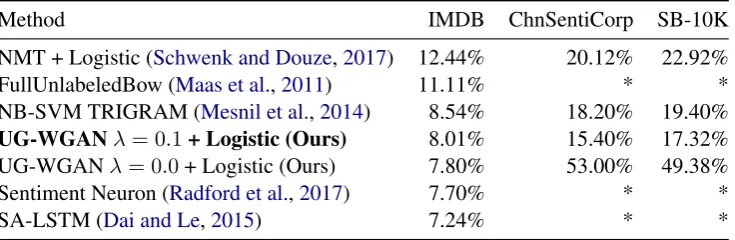
To test the universality of UG-WGAN representa-tion we first trained UG-WGAN in English, Chi-nese and German following the procedure de-scribed in Section 4. The embedding size of the table was300 and the internal LSTM hidden size was 512. A dropout rate of 0.1 was used and trained with the ADAM optimization method (Kingma and Ba,2014). Since we are interested in the zero-shot capabilities of our representation, we trained our sentiment analysis model only on the English IMDB Large Movie Review dataset and tested it on the Chinese ChnSentiCorp dataset and German SB-10K (Maas et al.,2011;Tan and Zhang,2008). We binarize the label’s for all the datasets.
Our sentiment analysis model ran a bi-directional LSTM on top of fixed UG representa-tions from where we took the last hidden state and computed a logistic regression. This was trained using standard SGD with momentum.
We also compare against encodings learned as a by-product of multi-encoder and decoder neu-ral machine translation as a baseline (Klein et al.,
4038
Method IMDB ChnSentiCorp SB-10K
NMT + Logistic (Schwenk and Douze,2017) 12.44% 20.12% 22.92%
FullUnlabeledBow (Maas et al.,2011) 11.11% * *
NB-SVM TRIGRAM (Mesnil et al.,2014) 8.54% 18.20% 19.40%
UG-WGANλ= 0.1+ Logistic (Ours) 8.01% 15.40% 17.32%
UG-WGANλ= 0.0+ Logistic (Ours) 7.80% 53.00% 49.38%
Sentiment Neuron (Radford et al.,2017) 7.70% * *
SA-LSTM (Dai and Le,2015) 7.24% * *
Table 1: Zero-shot capability of UG and OpenNMT representation from English training. For all other methods we trained on the available training data. Table shows error of sentiment model.
Method sNLI(en) sNLI (ru)
Densely-Connected Recurrent and Co-Attentive Network Ensemble (Kim et al.,
2018)
9.90% *
UG-WGAN (λ= 0.1) + Densely-Connected Recurrent and Co-Attentive
Net-work (Kim et al.,2018)
12.25% 21.00%
UG-WGAN (λ= 0.1) + Multiway Attention Network (Tan et al.,2018) 21.50% 34.25%
UG-WGAN (λ= 0.0) + Multiway Attention Network (Tan et al.,2018) 13.50% 65.25%
UG-WGAN (λ= 0.0) + Densely-Connected Recurrent and Co-Attentive Network
(Kim et al.,2018)
11.50% 68.25%
[image:6.595.117.485.63.183.2]Unlexicalized features + Unigram + Bigram features (Bowman et al.,2015) 21.80% 55.00%
Table 2: Error in terms of accuracy for the following methods. ForUnlexicalized features + Unigram + Bigram featureswe trained on 200 out of the 400 Russian samples and tested on the other 200 as a baseline.
showed the best perplexity. The NLI specific model was the Densely-Connected Recurrent and Co-Attentive Network.
Looking at Figure 4 we see that increasing λ
doesn’t seem to have a significant impact on the generalization gap but has a large impact on test error. Our hypothesis is that a largeλdoesn’t pro-vide the model with enough freedom to learn use-ful representations since the optimizations focus would largely be on minimizing the Wasserstein distance, while a small λ permits this freedom. One reason we might be seeing this generaliza-tion gap might be due to the way we satisfy the Lipschitz constraint. It’s been shown that there are better constraints than clipping parameters to a compact space such as a gradient penalty ( Gul-rajani et al.,2017). This is a future direction that can be explored.
6 Discussion
Universal Grammar also comments on the learn-ability of grammar, stating that statistical infor-mation alone is not enough to learn grammar and some form of native language faculty must exist, sometimes titled the poverty of stimulus (POS) argument (Chomsky, 2010;Lewis and El-man,2001). The goal of our paper is not to make
a statement on the Universal Grammar hypothesis. But from a machine learning perspective, we’re in-terested in extracting informative features. That being said it is of interest to what extent language models capture grammar and furthermore the ex-tent to which models trained with our objective learn grammar.
con-4040
λ= 0.0 λ= 0.1
en earth’s oxide is a monopoly that occurs towing of the carbon-booed trunks, resulting in a beam containing of oxygen through the soil, salt, warm waters, and the different proteins.
the practice of epimatic behaviours may be required in many ways of all non-traditional entities.
the groove and the products are numeric because they are called ”pressibility” (ms) nutrients contain-ing specific different principles that are available from the root of their family, including a wide va-riety of molecular and biochemical elements.
a state line is a self-government environment for sta-tistical cooperation, which is affected by the monks of canada, the east midland of the united kingdom.
however, compared to the listing of special defini-tions, it has evolved to be congruent with structural introductions, allowing to form the chemical form.
the vernacular concept of physical law is not as an objection (the whis) but as a universal school.
es la revista m´as reciente vari´o el manuscrito original-mente por primera vez en la revista publicada en 1994.
en el municipio real se localiza al mar del norte y su entorno en escaj´ar´ıos alto, con mayor variedad de c´ıclica poblaci´on en forma de cerca de 1070 km2.
de hecho la primera canci´on de ”blebe cantas”, pahka zanjiwtryinvined cot de entre clases de fan´aticas, apareci´o en el ornit´ologo sello triusion, jr., en la famosa publicaci´on playboy de john allen.
fue el ´ultimo habitantes de suecia, con tres hijos, atasaurus y aminkinano (nuestra).
The names of large predators in charlesosaurus in-clude bird turtles hibernated by aerial fighters and ignored fish.
[image:8.595.72.488.62.338.2]jaime en veracruz fue llamado papa del conde mayor de valdechio, hijo de diego de z´u˜niga.
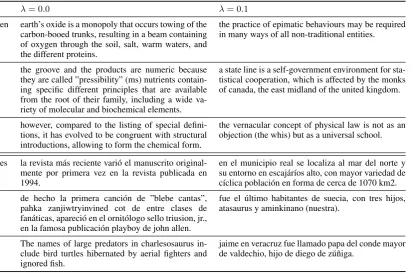
Table 3: Example of samples from UG-WGAN withλ= 0.0andλ= 0.1
References
Laura M Ahearn. 2016. Living language: An intro-duction to linguistic anthropology, volume 2. John Wiley & Sons.
Jeanette Altarriba. 1992. The representation of trans-lation equivalents in bilingual memory. Cognitive processing in bilinguals, 83:157–174.
Waleed Ammar, George Mulcaire, Yulia Tsvetkov, Guillaume Lample, Chris Dyer, and Noah A Smith. 2016. Massively multilingual word embeddings. arXiv preprint arXiv:1602.01925.
Martin Arjovsky, Soumith Chintala, and L´eon Bot-tou. 2017. Wasserstein gan. arXiv preprint arXiv:1701.07875.
Mikel Artetxe, Gorka Labaka, Eneko Agirre, and Kyunghyun Cho. 2017. Unsupervised neural ma-chine translation. arXiv preprint arXiv:1710.11041.
Terry Kit-Fong Au. 1983. Chinese and english counter-factuals: the sapir-whorf hypothesis revisited. Cog-nition, 15(1-3):155–187.
Shlomo Bentin, Gregory McCarthy, and Charles C Wood. 1985. Event-related potentials, lexical deci-sion and semantic priming. Electroencephalogra-phy and clinical NeuroElectroencephalogra-physiology, 60(4):343–355.
Samuel R Bowman, Gabor Angeli, Christopher Potts, and Christopher D Manning. 2015. A large anno-tated corpus for learning natural language inference. arXiv preprint arXiv:1508.05326.
Danqi Chen, Adam Fisch, Jason Weston, and An-toine Bordes. 2017. Reading wikipedia to an-swer open-domain questions. arXiv preprint arXiv:1704.00051.
Xilun Chen and Claire Cardie. 2018. Unsupervised multilingual word embeddings. arXiv preprint arXiv:1808.08933.
Noam Chomsky. 2010. Poverty of stimulus: Unfin-ished business. Transcript of a presentation given at Johannes-Gutenberg University, Mainz.
Noam Chomsky. 2014. Aspects of the Theory of Syn-tax, volume 11. MIT press.
Peter W Culicover. 1997. Principles and parameters: An introduction to syntactic theory. Oxford Univer-sity Press.
Andrew M Dai and Quoc V Le. 2015. Semi-supervised sequence learning. InAdvances in neural informa-tion processing systems, pages 3079–3087.
Yarin Gal and Zoubin Ghahramani. 2016. A theoret-ically grounded application of dropout in recurrent neural networks. InAdvances in neural information processing systems, pages 1019–1027.
in Neural Information Processing Systems, pages 5767–5777.
James Higginbotham. 1987. The autonomy of syntax and semantics.
Sepp Hochreiter and J¨urgen Schmidhuber. 1997. Long short-term memory. Neural computation, 9(8):1735–1780.
Harry Hoijer. 1954. The sapir-whorf hypothesis. Lan-guage in culture, pages 92–105.
Sergey Ioffe and Christian Szegedy. 2015. Batch nor-malization: Accelerating deep network training by reducing internal covariate shift. arXiv preprint arXiv:1502.03167.
Seonhoon Kim, Jin-Hyuk Hong, Inho Kang, and No-jun Kwak. 2018. Semantic sentence matching with densely-connected recurrent and co-attentive infor-mation. arXiv preprint arXiv:1805.11360.
Diederik P Kingma and Jimmy Ba. 2014. Adam: A method for stochastic optimization. arXiv preprint arXiv:1412.6980.
Guillaume Klein, Yoon Kim, Yuntian Deng, Jean Senellart, and Alexander M. Rush. 2017. Open-NMT: Open-source toolkit for neural machine trans-lation. InProc. ACL.
John D Lewis and Jeffrey L Elman. 2001. Learnability and the statistical structure of language: Poverty of stimulus arguments revisited. InProceedings of the 26th Annual Conference on Language Development.
Andrew L. Maas, Raymond E. Daly, Peter T. Pham, Dan Huang, Andrew Y. Ng, and Christopher Potts. 2011. Learning word vectors for sentiment analy-sis. InProceedings of the 49th Annual Meeting of the Association for Computational Linguistics: Hu-man Language Technologies, pages 142–150, Port-land, Oregon, USA. Association for Computational Linguistics.
Laurens van der Maaten and Geoffrey Hinton. 2008. Visualizing data using t-sne. Journal of machine learning research, 9(Nov):2579–2605.
Bryan McCann, James Bradbury, Caiming Xiong, and Richard Socher. 2017. Learned in translation: Con-textualized word vectors. InAdvances in Neural In-formation Processing Systems, pages 6294–6305.
Gr´egoire Mesnil, Tomas Mikolov, Marc’Aurelio Ran-zato, and Yoshua Bengio. 2014. Ensemble of generative and discriminative techniques for senti-ment analysis of movie reviews. arXiv preprint arXiv:1412.5335.
Aaron Mitchel. 2005. Do bilinguals access a shared or separate conceptual store? creating false memories in a mixed-language paradigm.
Richard Montague. 1970. Universal grammar. Theo-ria, 36(3):373–398.
Matthew E. Peters, Mark Neumann, Mohit Iyyer, Matt Gardner, Christopher Clark, Kenton Lee, and Luke Zettlemoyer. 2018. Deep contextualized word rep-resentations.CoRR, abs/1802.05365.
Alec Radford, Rafal Jozefowicz, and Ilya Sutskever. 2017. Learning to generate reviews and discovering sentiment. arXiv preprint arXiv:1704.01444.
Holger Schwenk and Matthijs Douze. 2017. Learn-ing joint multilLearn-ingual sentence representations with neural machine translation. arXiv preprint arXiv:1704.04154.
Rico Sennrich, Barry Haddow, and Alexandra Birch. 2015. Neural machine translation of rare words with subword units. arXiv preprint arXiv:1508.07909.
Nitish Srivastava, Geoffrey Hinton, Alex Krizhevsky, Ilya Sutskever, and Ruslan Salakhutdinov. 2014. Dropout: a simple way to prevent neural networks from overfitting. The Journal of Machine Learning Research, 15(1):1929–1958.
Chuanqi Tan, Furu Wei, Wenhui Wang, Weifeng Lv, and Ming Zhou. 2018. Multiway attention networks for modeling sentence pairs. InIJCAI, pages 4411– 4417.
Songbo Tan and Jin Zhang. 2008. An empirical study of sentiment analysis for chinese documents.Expert Systems with applications, 34(4):2622–2629.