178
Augmenting a German Morphological Database by Data-Intense Methods
Petra Steiner
Friedrich-Schiller-Universit¨at Jena Jena, Germany
Abstract
This paper deals with the automatic en-hancement of a new German morphological database. While there are some databases for flat word segmentation, this is the first avail-able resource which can be directly used for deep parsing of German words. We combine the entries of this morphological database with the morphological tools SMOR and More-morph and a context-based evaluation method which builds on a large Wikipedia corpus. We describe the state of the art and the essential characteristics of the database and the context method. The approach is tested on an inflight magazine of Lufthansa. We derive over 5,000 new instances of complex words. The cover-age for the lemma types reaches up to over 99 percent. The precision of new found complex splits and monomorphemes is between 0.93 and 0.99.
1 Introduction
German is a language with complex processes of word formation, of which the most common are compounding and derivation. Segmentation and analysis of the resulting word forms are challeng-ing as spellchalleng-ing conventions do not permit spaces as indicators for boundaries of constituents as in
(1).
(1) Verkehrsamt ‘tourist office’
For long orthographical word forms, many combi-natorially possible analyses exist, though usually only one of them has a conventionalized meaning (see Figure1). For instance, forVerkehrsamt ‘traf-fic of‘traf-fice, tourist of‘traf-fice’, word segmentation tools can yield the wrong split containing one with the smaller number of word tokens Verkehr ‘traffic’ andSamt‘velvet’.
In this case, there is a linking element within the word form which could be wrongly
interpre-Verkehrsamt
N
Verkehr ‘traffic’
x
s ‘filler letters’
N
Amt ‘office’
]Verkehrsamt
N
Verkehr ‘traffic’
N
[image:1.595.327.503.222.390.2]Samt ‘velvet’ .
Figure 1: Ambiguous analysis ofVerkehrsamt‘tourist office’
tated as part of a morph. Such elements function as morphophonological structure markers.1
German compounds can consist of derivatives, or compounds can be subject to further derivation. In(1), Verkehr is the result of a conversion pro-cess fromverkehren‘to run, to fly’, which again consists of a prefix and a verb stem (see Figure2). On each level of morphological segmentation, the number of possible analyses is 2n. This number can be reduced by excluding implausible construc-tions such as suffixes at the beginning of a con-struct. On the other hand, it has to be multiplied by the number of homonyms for the segmented forms. Therefore, automatic segmentations with more than ten possible analyses for one word are no rare case.
However, finding the correct segmentations and morphological structures is essential for terminologies and translation (memory) tools, information retrieval, and as input for
tex-1By some approaches, such linking elements are
Verkehrsamt
N
Verkehr ‘traffic’
V
verkehren ‘to run/to fly’
x
ver ‘prefix’
V
kehren ‘to turn’
x
s ‘filler letters’
N
[image:2.595.78.287.64.281.2]Amt ‘office’
Figure 2: Complex analysis ofVerkehrsamt‘tourist of-fice’
tual analyses. Deep parsing of complex mor-phological structures produces disambiguation such as (Fremde|n|verkehr)|s|amt ‘tourism of-fice’ instead of the tautological interpretation
]Fremde|n|(Verkehr|s|amt) ‘foreigner tourist
of-fice’.2 Such analyses can help improving the qual-ity of translation and retrieval tasks.
Moreover, counts of morphs, and morphologi-cal structures are useful for inducing hypotheses about statistical tendencies and quantitative laws, e.g. Menzerath’s law (Cramer,2005) or the Prin-ciple of Early Immediate Constituents (Hoffmann,
1999), which has not yet been corroborated for the word level by statistical tests.
In this paper, we will apply a hybrid approach for finding the correct splits of words and aug-menting a morphological database. In Section 2, we provide a concise overview of previous work in word segmentation and word parsing for Ger-man. In Section 3, we introduce two linguistic tools we will be using later. SMOR is a well-known morphological tool. We describe how we modified its lexicon and exploited and changed its internal results by the add-on module More-morph. Section 4 introduces our morphological database which was built on the basis of the lin-guistic databases CELEX and GermaNet. Sec-tion 5 describes the data-intense procedures for the morphological analyses and supervised database
2The complete structure of Fremdenverkehrsamt ‘tourism
traffic office, tourist office’ is represented in Figure4.
enhancements. In Section 6, we test our method on a corpus of an inflight journal. Finally, we dis-cuss our results and give an outlook for future de-velopments.
2 Related Work
The first developments in morphological seg-mentation tools for German date back to the Nineties. Most of them are based on finite state machines. Gertwol (Haapalainen and Majorin,
1995), MORPH (Hanrieder,1996), Morphy ( Lez-ius, 1996; Lezius et al., 1998) and later SMOR (Schmid et al., 2004) and TAGH (Geyken and Hanneforth,2006) generate morphological analy-ses for complex German words, yielding results for derivatives and compounds. All these analyses are flat word splittings and often include dozens of segmentation versions.
There are different ways to tackle such kind of ambiguity, most of which are applied merely to compounds and yield flat segmentations of the im-mediate constituent level.
Cap (2014) andKoehn and Knight(2003) use ranking scores, such as the geometric mean, for the different morphological analyses and then choose the segmentation with the highest ranking. Another approach consists in exploitation the sequence of letters, e.g. by pattern matching with tokens (Henrich and Hinrichs,2011, 422) or lem-mas (Weller-Di Marco, 2017). Ziering and van der Plas(2016) use normalization methods which are combined with ranking by the geometric mean.
Ma et al.(2016) apply Conditional Random Fields modeling for letter sequences.Daiber et al.(2015) extract candidates of compound splits by string comparisons with corpus data.
Recent approaches exploit semantic informa-tion for the ranking of compound splittings.Riedl and Biemann (2016) utilize look-ups of similar terms inside a distributional thesaurus. Their rank-ing score is a modification of the geometric mean.
Ziering et al. (2016) use the cosine as a mea-sure for semantic similarity between compounds and their hypothetical constituents and combine these similarity values by computing the geomet-ric means and other scores for each produced split. The scores are then used as factors to be multiplied by the scores of former splits.
consisting of three lexemes. Their distributional semantic modelling often fails to find the correct binary split if the head is too ambiguous to corre-late strongly with the first part. But in general, using the semantic context is a sensitive disam-biguation method.Ziering and van der Plas(2016) develop a splitter which makes use of normaliza-tion methods and can be used recursively by re-analyzing the results of splits. Their evaluation is based on the binary compounds of GermaNet (Hamp and Feldweg,1997;Henrich and Hinrichs,
2011).
W¨urzner and Hanneforth (2013) use a proba-bilistic context free grammar for full morpholog-ical parsing, but restrict their approach to deriva-tional adjectives.
Most these approaches build upon corpus data. OnlyHenrich and Hinrichs(2011) enrich the out-put of morphological segmentation with informa-tion from the annotated compounds of GermaNet to disambiguate such structures. This can in a fur-ther step yield hierarchical structures but presup-poses that the entries for the components exist in-side the database.Steiner and Ruppenhofer(2018) build on this idea to derive more complex morpho-logical structures from lexical resources. In5, we come back to this and will exploit their resource.
3 SMOR: A Morphological Tool for
German and its Add-On Moremorph
3.1 SMOR
SMOR is a widely used morphological segmenta-tion tool (e.g. Cap (2014),Henrich and Hinrichs
(2011), Steiner and Ruppenhofer (2015),Ziering et al. (2016)). It is based on two-level morphol-ogy (Koskenniemi, 1984) and implemented as a set of finite-state transducers. For German, a large set of lexicons is available. These lexicons con-tain information about inflection, parts of speech and classes of word formation, e.g. abbreviations and truncations. The tag set used is compatible with the STTS (Stuttgart T¨ubingen tag set,Schiller et al.(1995)).
SMOR produces different levels of granular-ity and different representation formats with dif-ferent transducers and options. Example (2) and
(3) show two simplified outputs of fine-grained analyses forVerkehrsamt‘traffic office, tourist of-fice’ andFremdenverkehrsamt ‘foreign-traffic of-fice, tourist office’. For the sake of simplicity, we removed case and number.
(2) Verkehr<NN>Samt<+NN> Verkehr<NN>Amt<+NN>
ver<VPREF>kehren<V>Samt<+NN>
(3) Fremdenverkehr<NN>Samt<+NN> Fremdenverkehr<NN>Amt<+NN> Fremd<Adj>verkehr<NN>Samt<+NN> Fremd<Adj>verkehr<NN>Amt<+NN> Fremd<Adj>ver<VPREF>kehren<V> Samt<+NN>
In (2), the word form Verkehrsamt ‘tourist of-fice’ is analyzed in three different ways, of which two show the erroneous interpretation of the string
samt ‘velvet’ as a noun. (3) shows the same er-ror in three of its five segmentations. The cate-gories consist of parts of speech (<NN>, <V>) for free morphs and the position of bound mor-phemes (e.g.<VPREF>for ‘verbal prefix’).
3.2 Moremorph
While SMOR is a reliable foundation for the anal-ysis of word forms which have not been found be-fore, it comes with some small drawbacks. More-morph aims at improving and adjusting the output of SMOR.
As can be seen from the second line of(2), the SMOR output does not indicate if there are filler letters (or interfixes) inside a word.
However, the information exists inherently in intermediate SMOR output which can be reana-lyzed by Moremorph. Therefore, filler letters (FL) can be marked as in(4):
(4) Verkehr s Amt NN FL NN<NN>
This annotation shows the morphs on the lexical level, their classes with filler letters, and finally the part of speech of the word form in angle brackets.
(5)presents the Moremorph representation of(3). In the last three analyses, there is one tag more than the number of splits due to the noun conver-sion offremd‘foreign’ toFremde‘foreigner’.
(5) a. Fremdenverkehrsamt Fremdenverkehr Samt NN NN<NN>
c. Fremdenverkehrsamt fremd en Verkehr Samt
ADJ NNSUFF FL NN NN<NN>
d. Fremdenverkehrsamt fremd en Verkehr s amt
ADJ NNSUFF FL NN FL NN<NN>
e. Fremdenverkehrsamt fremd en ver kehr Samt
ADJ NNSUFF FL VPREF V NN <NN>
Moremorphs uses SMOR lexicons which we adapted to the current task. The original version of the names lexicon comprised 14,998 entries, the final extended version 16,718 entries. During the project, the lexicon was constantly extended and cleaned and its entries were revised. The final ver-sion used for the current work comprises 42,205 entries. Many changes of the rule sets were made in cooperation with Helmut Schmid according to our suggestions. For example, we changed the sets of characters or added adverbs as possible tag class for numbers. Other changes include the derivation of adjectives from names of location. Some of the finite-state transducers had to be changed for this.
We also standardized inconsistent analyses for orthographical variants with and without hyphen-ations and added some more special characters to the inventory of word structuring means.
This leads to consistent analyses for ortho-graphical variants such as in(6). Also word forms with some other special characters not covered by SMOR can be processed now, as in(7).
(6) a. Flughafen K¨oln-Bonn ‘Airport Cologne-Bonn’
b. Flughafen K¨oln/Bonn ‘Airport Cologne/Bonn’.
(7) ”Team Lufthansa”-Partner
(8)shows the output for(6-b)with the structuring character tagged as HYPHEN.
(8) K¨oln/Bonn K¨oln / Bonn
NPROP HYPHEN NPROP<NPROP>
4 A Lexical Database with Deep-Level Morphological Information
While most morphological analyzers build on the results of word splitters, we decided to take up a hybrid approach which combines the reliable en-tries of a morphological database with the aug-mented and further processed analyses of SMOR and Moremorph. Here, also another morphologi-cal tool could be chosen.
The German morphological tree database ex-tracts its entries from a. the refurbished CELEX database (Baayen et al., 1995; Steiner, 2016) for German morphology (Burnage, 1995; Gulik-ers et al., 1995) and b. the compound analyses from the GermaNet database (Hamp and Feldweg,
1997;Henrich and Hinrichs,2011;Steiner,2017). For both preprocessed datasets, the derivation of complex structures was performed recursively, by combining the GermaNet analyses with the analy-ses from CELEX.
The tree building tool provides different pa-rameters for the analysis. We chose to enrich the data with information on diachronic derivation and permitted a depth of six levels for the mor-phological analyses. (9) shows the morpholog-ical structures for (9-a) Verkehrsamt ‘tourist of-fice’, (9-b) Verkehrsanlage ‘traffic facility’, and
(9-c) Verkehrsbehinderung ‘traffic obstruction’.
(9-b) comprises diachronic derivational informa-tion, showing the nounAnlage‘facility/lay out’ as derived from the verbanlegen‘lay out’.
(9) a. Verkehrsamt (*Verkehr*
(*verkehren* ver|
kehren))| s|
Amt
b. Verkehrsanlage (*Verkehr*
(*verkehren* ver|
kehren))| s|
(*Anlage* (*anlegen*
c. Verkehrsbehinderung (*Verkehr*
(*verkehren* ver|
kehren))| s|
(*Behinderung* (*behindern*
be| hindern)| ung)
The number of entries for this databases of the morphological trees amounts to 101,588. In addi-tion, we extracted 6,339 types of monomorphemes from the refurbished German CELEX database.
5 Combining Morphological Databases
with a Segmenter
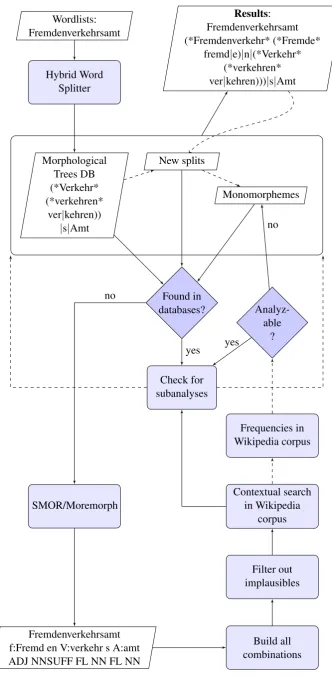
In the following, we combine the morphologi-cal database with a morphologimorphologi-cal segmenter and a contextual evaluation process. If the database look-up fails, the time-consuming word splitting and evaluation is started. Then the output of More-morph is analyzed by a contextual method by ex-ploiting a very large corpus. If this fails, frequen-cies counts of a very large corpus is the back-off strategy. The new analyses are added to a set of new splits.
At the end of each word analysis, all subparts of the word are being searched within the database and the newsplit set. This leads to incrementally more fine-grained entries.
Figure 3 presents an overview. It shows two databases of morphological trees: the German morphological tree database and a incremental database for all newly found morphological analy-ses. Furthermore, it comprises a set of monomor-phemes.
5.1 Basic Look-Up
As shown in Figure3, a look-up finds the respec-tive tree or the simplex form for the word within the lexicons. Before this is added to the results, all of its subparts are being looked up within the databases and the new splits. These subanalyses are being integrated to its new analysis. Old en-tries within the lexical databases are being substi-tuted for the new ones.
5.2 Finding Splits
If neither an entry inside the tree lexicons nor in the list of monomorphemes can be found, the Moremorph analyses are taken as the start for the further analysis. For each analysis, e.g. the five different ones of example(5), every possible com-bination of subtrees has to build. Some of them can be filtered out, because they are linguistically implausible, e.g. when a hypothetical subpart fin-ishes with a prefix.
All plausible combinations of strings and tags undergo a contextual analysis, if occurrences for all subparts can be found within at least one text of the large corpus. Otherwise, a procedure of using the overall document frequencies together with a back-off strategy will be invoked.
5.2.1 Morphological Segmentation based on Contextual Information
For (unknown) compounds, we presuppose that each component can be found within the same close environments. Therefore, the frequencies of components in texts should be much lower for er-roneous splits than the frequencies for correct seg-mentations.
We chose a large set of texts for the retrieval: the freely available and annotated German Wikipedia Korpus of 2015 (Margaretha and L¨ungen,2014).3 We restricted ourselves to the 1.8 million texts subcorpus of the articles. The corpus was to-kenized by a modified version of the tool from
Dipper(2016) and lemmatized by the TreeTagger (Schmid, 1999). Text indices were built both for tokenized and lemmatized forms. For each text, all frequencies of lemmas and tokens were stored. For each morphological split of a word formwf
(spwf,n), the intersection of all texts comprising
the word formwf and their hypothetical compo-nentscwf,sp,1..nis retrieved from the text indices.
For every texttwhich includes all components for the word form wf (cwf,sp,1...cwf,sp,n) of a
mor-phological split, the document frequencies (df) of the components are being retrieved and added to the sum of text frequencies score (Stf). For every hypothetical analysis, the highest value is chosen and the morphological analysis with this score is stored (Equation1).
3see http://www1.ids-mannheim.de/kl/projekte/korpora/
Wordlists: Fremdenverkehrsamt
Hybrid Word Splitter
Morphological Trees DB (*Verkehr* (*verkehren*
ver|kehren)) |s|Amt
New splits
Monomorphemes
Found in databases?
Check for subanalyses
yes
SMOR/Moremorph
Fremdenverkehrsamt f:Fremd en V:verkehr s A:amt ADJ NNSUFF FL NN FL NN
no
Build all combinations
Filter out implausibles Contextual search
in Wikipedia corpus Frequencies in Wikipedia corpus
Analyz-able
? no
yes
Results: Fremdenverkehrsamt (*Fremdenverkehr* (*Fremde*
[image:6.595.131.464.57.736.2]fremd|e)|n|(*Verkehr* (*verkehren* ver|kehren)))|s|Amt
Best−Stfwf,sp,t= max
1,t
cwf,sp,n X
cwf,sp,1
df1,n (1)
Finally, for every hypothetical analysis, the high-est value is chosen and the morphological analysis with this score is processed and stored.
5.2.2 Morphological Segmentation based on Document Frequencies
In case that no text can be found which includes the word form wf and the components of any of the hypothetical analyses, the corpus itself is considered as a textual enviroment in the widest sense. For each split, the sum of frequencies are being calculated. The hypothetical analysis with the highest value is chosen and the morphological analysis with this score is processed for the stor-age. In all other cases, the analysis will yield the hypothetical analysis of a monomorpheme.
5.3 Substitution of Analyses
Whenever an analysis by theBest−Stfscore or another look-up has been found, the analyses for its immediate constituents are being searched in the databases. By this, the lexicons can be incre-mentally enlarged and enriched. Figure 4 shows an example from our test corpus, which we used for the evaluation in Section6.
The results are added to a database of new splits and can be added to the previous database after an evaluation.
6 Evaluation
6.1 Data
For testing the performance, we use Korpus Magazin Lufthansa Bordbuch (MLD) which is part of the DeReKo-2016-I (Institut f¨ur Deutsche Sprache, 2016) corpus4. It is an in-flight maga-zine with articles on traveling, consumption and aviation. For the tokenization, we enlarged and costumized the tokenizer by Dipper (2016) for our purposes. Multi-word units were automati-cally identified based on the multi-word dataset which we had augmented before. The resulting data comprises 276 texts with 5,202 paragraphs,
4See Kupietz et al. (2010) and
http://www1.ids-mannheim.de/kl/projekte/korpora/archiv/mld.html for further information.
16,046 sentences and 260,114 tokens. The num-ber of word-form types is 38,337. We are analyz-ing the lemmatized version of this corpus which was produced by the TreeTagger (Schmid,1999), it comprises 27,902 lemma types.
6.2 Results
6.2.1 Coverage
15,622 lemma types can be found within the database. 12,280 lemma types are not covered by the databases, so they were re-analyzed by SMOR/Moremorph. We manually checked the re-sults for the first 1,000 lemma types which could not be found in the database. Very often, these are derivatives, rare or nounce words, proper names or words containing proper names as in(10).
(10) a. ordnend ‘ordering, regulatory’ b. Paris-Erfahrung ‘Paris experience’ c. Winterspaß ‘winter fun’
The details of the check against the German tree database are included in Table1, with a coverage of 55.99% for the lemma types. This direct lookup saves a lot of computational effort. According to the quality of the database which is based on Ger-maNet and CELEX, the recall is extremely close to these numbers.
The remaining 44.01% of all lemma types were evaluated in the following way: We checked ev-ery split of the first thousand analyzed words. For ambiguous analyses, we accepted those which in-cluded a monomorphemic and a correct deriva-tional analysis, as in(11), with(11-a)showing the segmentation of verb stem and derivational suffix.
(11) a. ordnend ordn end V PPres ADJ-SUFF<ADJ>
b. ordnend ordnend V<V>
If one or more splits were erroneous, as in(12-a), the analysis was rejected.
(12) a. Winterspaß Winter spaß NN NN <NN>‘winter fun’
b. ]Winterspaß Winter s paß NN FL NN <NN> ‘winter|s, filler letter| pass/passport’
Fremdenverkehrsamt
Fremdenverkehr ‘tourism’
Fremde ‘foreigner’
fremd ‘foreign’
e ‘suffix’
n ‘interfix’
Verkehr ‘traffic’
verkehren ‘to run/to fly’
ver ‘prefix’
kehren ‘to turn’
s ‘interfix’
Amt ‘office’ SMOR/Moremorph
[image:8.595.84.520.62.340.2]German trees analysis
Figure 4: Database look-up and SMOR/Moremorph: Morphological analysis ofFremdenverkehrsamt‘tourist of-fice’
types were re-analysed as hypothetical monomor-phemes during the further analysis. Often, these were names of airplane types or similar expres-sions. Therefore, the number of analyzed lemma types (27,902) corresponds to a full coverage. SMOR/Moremorph on its own was able to pro-cess 13,461 lemmas, the rest was classified as un-known. This good coverage is a direct result of the adjustment of the lexicons, which we described in
3.2, especially concerning the names lexicons.
lemma types
corpus size
MLD corpus 27,902 260,114
lemma types
coverage
Tree DB + monomorphs
15,622 55.99%
+ SMOR & Moremorphs
27,902 100%
Table 1: Coverage of DBs and SMOR analyses
6.2.2 Precision
The complete analyses of the hybrid morpho-logical parsing yield 5,307 entries in the news-plit database and 5,973 new entries inside the monomorphemes. We analyzed the first 1,000 en-tries of the newly found splits and the first 2,000 entries within the monomorpheme set. Of the first set, we found 65 wrongly or imperfectly analyzed word forms. Most of them are three-part com-pounds such as (13) whose correct components were not found within a text. The morphemes were identified, but the ambiguity could not be re-solved.
(13) (Berg|Regen|Wald) ‘mountain rain for-est’
Another error are wrong analyses of derivative nouns which starts with a verb particle such as
(14-a), which is a derivative form ofanfahren‘to approach’ (14-b) and not a compound of an ‘at, to’ andFahrt‘ride’. There is a systematic mistake here which is caused by the high frequency of the first part which is usually a homograph of a prepo-sition.
[image:8.595.83.279.561.716.2]The set of monomorphs comprise many new com-plex numbers and proper names. All of them were correctly included. Only three assignments are questionable. However, as these are proper names such as Anneliese which consists of two proper names Annaand Liese, and/or the analy-sis in CELEX was monomorphemous too (as for
Allerheiligen‘All Saints’), the quality is very high. Therefore, the precision can be considered as high for this test corpus: 0.935 for new splits and 0.998 for newly found monomorphs.
6.3 Discussion
The results for the first hybrid deep-level morphol-ogy analyzer are promising. However, the errors concerning verb particles are systematic. They can be explained by the high frequency of verb particles in texts, which are often homographs of a preposition. For future research, we plan an adjustment by a factor which takes into account the relationship between word length in characters and word frequency as observed by Zipf and oth-ers (Pr¨un,2005). K¨ohler(1986) derives this rela-tionship by a synergetic model. He corroborates the functional connection between the frequency classes of words and their average length. A mea-sure directly derived from this function would pe-nalize word segmentations with small morphemes and assign more weight to longer (and rare) com-ponents.
7 Conclusion and Outlook
This paper demonstrates how updating and ex-ploiting linguistic databases for morphological analyses can be performed. By simple look-up, we reached a coverage of 56% of lemma types. As both underlying databases, CELEX and Ger-maNet, were manually revised, we can speak of very reliable analyses. The remaining unanalyzed words can be mostly covered by a conventional word segmenter after adjusting its lexicons. These analyses have a flat structure and undergo a proce-dure of constructing all combinations of possible analyses and a context-based search for the hypo-thetical constituents in a large corpus. The results for the lemma types are very promising: Over 99% of all words were covered by the combined mor-phological analyses.
New morphological analyses from the tree-building process can be added to the German tree database after a process of careful evaluation and
selection.
The direction of the future research is therefore straightforward: it will lead towards creating com-plex analyses out of existing ones and augmenting the lexical databases.
8 Acknowledgement
Work for this publication was partially supported by the German Research Foundation (DFG) under grant RU 1873/2-1. I would like to thank the re-viewers for their valuable feedback and my col-league Josef Ruppenhofer for making this work possible.
References
Harald Baayen, Richard Piepenbrock, and L´eon Gulik-ers. 1995. The CELEX lexical database (CD-ROM).
Gavin Burnage. 1995. CELEX: A Guide for Users. In Harald Baayen, Richard Piepenbrock, and L´eon Gu-likers, editors, The CELEX Lexical Database (CD-ROM). Linguistic Data Consortium, Philadelphia, PA.
Fabienne Cap. 2014. Morphological processing of compounds for statistical machine translation. Ph.D. thesis, Universit¨at Stuttgart.
Irene M. Cramer. 2005. Das Menzerathsche Gesetz (Menzerath’s law). In Reinhard K¨ohler, Gabriel Alt-mann, and Ra˘ımond Genrikhovich Piotrovski˘ı, edi-tors,Quantitative Linguistik / Quantitative Linguis-tics - Ein internationales Handbuch / An Interna-tional Handbook, pages 659–687. M. de Gruyter.
Joachim Daiber, Lautaro Quiroz, Roger Wechsler, and Stella Frank. 2015. Splitting compounds by seman-tic analogy. InProceedings of the 1st Deep Ma-chine Translation Workshop, pages 20–28. ´UFAL MFF UK.
Stefanie Dipper. 2016. Tokenizer for German.
Alexander Geyken and Thomas Hanneforth. 2006.
TAGH: A Complete Morphology for German based on Weighted Finite State Automata. InFinite State Methods and Natural Language Processing. 5th International Workshop, FSMNLP 2005, Helsinki, Finland, September 1-2, 2005. Revised Papers, vol-ume 4002, pages 55–66. Springer.
L´eon Gulikers, Gilbert Rattink, and Richard Piepen-brock. 1995. German Linguistic Guide. In Harald Baayen, Richard Piepenbrock, and L´eon Gulikers, editors, The CELEX Lexical Database (CD-ROM). Linguistic Data Consortium, Philadelphia, PA.
Deutsche. InProceedings of the 10th Nordic Con-ference on Computational Linguistics, Helsinki, Fin-land.
Birgit Hamp and Helmut Feldweg. 1997. GermaNet -a Lexic-al-Sem-antic Net for Germ-an. InProceedings of ACL Workshop Automatic Information Extraction and Building of Lexical Semantic Resources for NLP Applications, pages 9–15.
Gerhard Hanrieder. 1996. MORPH - Ein modu-lares und robustes Morphologieprogramm f¨ur das Deutsche in Common Lisp. In Roland Hauser, ed-itor, Linguistische Verifikation Dokumentation zur Ersten Morpholymics 1994, pages 53–66. Niemeyer, T¨ubingen.
Verena Henrich and Erhard Hinrichs. 2011. Determin-ing Immediate Constituents of Compounds in Ger-maNet. In Proceedings of the International Con-ference Recent Advances in Natural Language Pro-cessing 2011, pages 420–426. Association for Com-putational Linguistics.
Christiane Hoffmann. 1999.Word order and the Princi-ple of ”Early Immediate Constituents” (EIC). Jour-nal of Quantitative Linguistics, 6(2):108–116.
Institut f¨ur Deutsche Sprache. 2016. Deutsches Referenzkorpus / Archiv der Korpora geschriebener
Gegenwartssprache 2016-I (Release from
31.03.2016).
Philipp Koehn and Kevin Knight. 2003. Empirical methods for compound splitting. InProceedings of the Tenth Conference of the European Chapter of the Association for Computational Linguistics-Volume 1, pages 187–193. Association for Computational Linguistics.
R. K¨ohler. 1986. Zur linguistischen Synergetik: Struk-tur und Dynamik der Lexik, volume 31 of Quantita-tive linguistics. Brockmeyer.
Kimmo Koskenniemi. 1984. A general computational model for word-form recognition and production. In
Proceedings of the 10th International Conference on Computational linguistics, pages 178–181. Associa-tion for ComputaAssocia-tional Linguistics.
Marc Kupietz, Cyril Belica, Holger Keibel, and An-dreas Witt. 2010. The German reference corpus DeReKo: A primordial sample for linguistic re-search. InProceedings of the Seventh International Conference on Language Resources and Evaluation (LREC’10), pages 1848–1854, Valletta, Malta. Eu-ropean Language Resources Association (ELRA).
Wolfgang Lezius. 1996. Morphologiesystem Morphy. InLinguistische Verifikation. Dokumentation zur er-sten Morpholympics 1994, pages 25–35. Niemeyer.
Wolfgang Lezius, Reinhard Rapp, and Manfred Wet-tler. 1998. A freely available morphological ana-lyzer, disambiguator and context sensitive lemma-tizer for German. In36th Annual Meeting of the
As-sociation for Computational Linguistics and 17th In-ternational Conference on Computational Linguis-tics, COLING-ACL ’98, August 10-14, 1998, Uni-versit´e de Montr´eal, Montr´eal, Quebec, Canada. Proceedings of the Conference., pages 743–748.
Jianqiang Ma, Verena Henrich, and Erhard Hinrichs. 2016. Letter Sequence Labeling for Compound Splitting. In Proceedings of the 14th SIGMOR-PHON Workshop on Computational Research in Phonetics, Phonology, and Morphology, pages 76– 81, Berlin, Germany. Association for Computational Linguistics.
Eliza Margaretha and Harald L¨ungen. 2014. Building linguistic corpora from wikipedia articles and dis-cussions.JLCL, 29(2):59–82.
Claudia Pr¨un. 2005. Das Werk von G. K. Zipf (The work of G. K. Zipf). In Reinhard K¨ohler, Gabriel Altmann, and Rajmund G. Piotrowski, ed-itors,Quantitative Linguistik / Quantitative Linguis-tics - Ein internationales Handbuch / An Interna-tional Handbook, pages 142–152. DeGruyter.
Martin Riedl and Chris Biemann. 2016. Unsupervised Compound Splitting With Distributional Semantics Rivals Supervised Methods. InProceedings of the Conference of the North American Chapter of the Association for Computational Linguistics: Human Language Technologies (NAACL-HLT 2016), pages 617–622. Association for Computational Linguis-tics.
Anne Schiller, Simone Teufel, Christine St¨ockert, and Christine Thielen. 1995. Vorl¨aufige Guidelines f¨ur das Tagging deutscher Textcorpora mit STTS. Technical report, Universit¨at Stuttgart, Institut f¨ur maschinelle Sprachverarbeitung, and Seminar f¨ur Sprachwissenschaft, Universit¨at T¨ubingen.
Helmut Schmid. 1999. Improvements in Part-of-Speech Tagging with an Application to German. In Susan Armstrong, Kenneth Church, Pierre Isabelle, Sandra Manzi, Evelyne Tzoukermann, and David Yarowsky, editors, Natural Language Processing Using Very Large Corpora, pages 13–25. Springer Netherlands, Dordrecht.
Helmut Schmid, Arne Fitschen, and Ulrich Heid. 2004. SMOR: A German computational morphol-ogy covering derivation, composition and inflec-tion. In Proceedings of the Fourth International Conference on Language Resources and Evaluation (LREC’04). European Language Resources Associ-ation (ELRA).
Petra Steiner. 2017.Merging the trees. building a mor-phological treebank for German from two resources. In Proceedings of the 16th International Workshop on Treebanks and Linguistic Theories, January 23– 24, 2018, TLT’16, pages 146–160, Prague, Czech Republic.
Petra Steiner and Josef Ruppenhofer. 2015. Growing trees from morphs: Towards data-driven morpho-logical parsing. InProceedings of the International Conference of the German Society for Computa-tional Linguistics and Language Technology, GSCL 2015, University of Duisburg-Essen, Germany, 30th September - 2nd October 2015, pages 49–57.
Petra Steiner and Josef Ruppenhofer. 2018. Building a Morphological Treebank for German from a Lin-guistic Database. In Proceedings of the Eleventh International Conference on Language Resources and Evaluation (LREC 2018), pages 3882 – 3889, Miyazaki, Japan. European Language Resources Association (ELRA).
Marion Weller-Di Marco. 2017. Simple Compound Splitting for German. In Proceedings of the 13th Workshop on Multiword Expressions (MWE 2017), pages 161–166, Valencia, Spain. Association for Computational Linguistics.
Kay-Michael W¨urzner and Thomas Hanneforth. 2013.
Parsing morphologically complex words. In Pro-ceedings of the 11th International Conference on Fi-nite State Methods and Natural Language Process-ing, FSMNLP 2013, St. Andrews, Scotland, UK, July 15-17, 2013, pages 39–43.
Patrick Ziering, Stefan M¨uller, and Lonneke van der Plas. 2016. Top a splitter: Using distributional se-mantics for improving compound splitting. In Pro-ceedings of the 12th Workshop on Multiword Ex-pressions, pages 50–55, Berlin, Germany. Associa-tion for ComputaAssocia-tional Linguistics.
Patrick Ziering and Lonneke van der Plas. 2016.