199
The MADAR Shared Task
on Arabic Fine-Grained Dialect Identification
Houda Bouamor, Sabit Hassan, Nizar Habash† Carnegie Mellon University in Qatar, Qatar
†New York University Abu Dhabi, UAE
{hbouamor,sabith}@qatar.cmu.edu [email protected]
Abstract
In this paper, we present the results and find-ings of the MADAR Shared Task on Ara-bic Fine-Grained Dialect Identification. This shared task was organized as part of The Fourth Arabic Natural Language Process-ing Workshop, collocated with ACL 2019. The shared task includes two subtasks: the MADAR Travel Domain Dialect Identification subtask (Subtask 1) and the MADAR Twit-ter User Dialect Identification subtask (Sub-task 2). This shared (Sub-task is the first to target a large set of dialect labels at the city and coun-try levels. The data for the shared task was cre-ated or collected under the Multi-Arabic Di-alect Applications and Resources (MADAR) project. A total of 21 teams from 15 countries participated in the shared task.
1 Introduction
Arabic has a number of diverse dialects from across different regions of the Arab World. Al-though primarily spoken, written dialectal Arabic has been increasingly used on social media. Auto-matic dialect identification is helpful for tasks such as sentiment analysis (Al-Twairesh et al., 2016), author profiling (Sadat et al.,2014), and machine translation (Salloum et al., 2014). Most previ-ous work, shared tasks, and evaluation campaigns on Arabic dialect identification were limited in terms of dialectal variety targeting coarse-grained regional dialect classes (around five) plus Mod-ern Standard Arabic (MSA) (Zaidan and Callison-Burch, 2013; Elfardy and Diab, 2013; Darwish et al.,2014;Malmasi et al.,2016;Zampieri et al.,
2017; El-Haj et al., 2018). There are of course some recent noteworthy exceptions (Bouamor et al.,2018;Zaghouani and Charfi, 2018; Abdul-Mageed et al.,2018).
In this paper, we present the results and find-ings of the MADAR Shared Task on Arabic
Fine-Grained Dialect Identification. The shared task was organized as part of the Fourth Arabic Natural Language Processing Workshop (WANLP), collo-cated with ACL 2019.1 This shared task is the first to target a large set of dialect labels at the city and country levels. The data for the shared task was created under the Multi-Arabic Dialect Applica-tions and Resources (MADAR) project.2
The shared task featured two subtasks. First is the MADAR Travel Domain Dialect Identifica-tion subtask (Subtask 1), which targeted 25 spe-cific cities in the Arab World. And second is the MADAR Twitter User Dialect Identification (Sub-task 2), which targeted 21 Arab countries. All of the datasets created for this shared task will be made publicly available to support further research on Arabic dialect modeling.3
A total of 21 teams from 15 countries in four continents submitted runs across the two sub-tasks and contributed 17 system description pa-pers. All system description papers are included in the WANLP workshop proceedings and cited in this report. The large number of teams and sub-mitted systems suggests that such shared tasks on Arabic NLP can indeed generate significant inter-est in the research community within and outside of the Arab World.
Next, Section 2 describes the shared task sub-tasks. Section 3 provides a description of the datasets used in the shared task, including the newly created MADAR Twitter Corpus. Section4
presents the teams that participated in each subtask with a high-level description of the approaches they adopted. Section 5 discusses the results of the competition. Finally, Section6concludes this report and discusses some future directions.
1http://wanlp2019.arabic-nlp.net 2
2 Task Description
The MADAR Shared Task included two subtasks: the MADAR Travel Domain Dialect Identification subtask, and the MADAR Twitter User Dialect Identification subtask.
2.1 Subtask 1: MADAR Travel Domain Dialect Identification
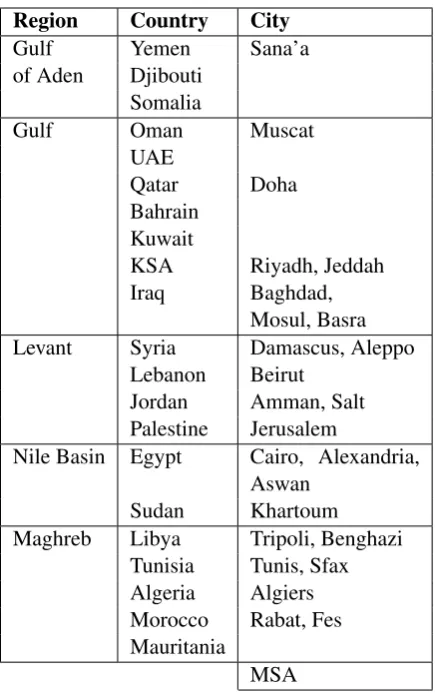
The goal of this subtask is to classify written Ara-bic sentences into one of 26 labels representing the specific city dialect of the sentences, or MSA. The participants were provided with a dataset from the MADAR corpus (Bouamor et al., 2018), a large-scale collection of parallel sentences in the travel domain covering the dialects of 25 cities from the Arab World in addition to MSA (Table 1 shows the list of cities). This fine-grained dialect iden-tification task was first explored inSalameh et al.
(2018), where the authors introduced a system that can identify the exact city with an averaged macro F1 score of 67.9%. The participants in this sub-task received the same training, development and test sets used in (Salameh et al.,2018). More de-tails about this dataset are given in Section3.
2.2 Subtask-2: MADAR Twitter User Dialect Identification
The goal of this subtask is to classify Twitter user profiles into one of 21 labels representing 21 Arab countries, using only the Twitter user tweets. The Twitter user profiles as well as the tweets are part of the MADAR Twitter Corpus, which was cre-ated specifically for this shared task. More details about this dataset are given in Section3.
2.3 Restrictions and Evaluation Metrics
We provided the participants with a set of restric-tions for building their systems to ensure a com-mon experimental setup.
Subtask 1 Restrictions Participants were asked not to use any external manually labeled datasets. However, the use of publicly available unlabelled data was allowed. Participants were not allowed to use the development set for training.
Subtask 2 Restrictions First, participants were asked to only use the text of the tweets and the spe-cific information about the tweets provided in the shared task (see Section 3.2). Additional tweets, external manually labelled data sets, or any meta information about the Twitter user or the tweets
Region Country City Gulf Yemen Sana’a of Aden Djibouti
Somalia
Gulf Oman Muscat
UAE
Qatar Doha Bahrain
Kuwait
KSA Riyadh, Jeddah Iraq Baghdad,
Mosul, Basra Levant Syria Damascus, Aleppo
Lebanon Beirut Jordan Amman, Salt Palestine Jerusalem
Nile Basin Egypt Cairo, Alexandria, Aswan
Sudan Khartoum Maghreb Libya Tripoli, Benghazi
Tunisia Tunis, Sfax Algeria Algiers Morocco Rabat, Fes Mauritania
[image:2.595.308.526.59.406.2]MSA
Table 1: The list of the regions, countries, and cities covered in Subtask 1 (City column) and Subtask 2 (Country column).
(e.g., geo-location data) were not allowed. Sec-ond, participants were instructed not to include the MADAR Twitter Corpus development set in train-ing. However, any publicly available unlabelled data could be used.
Evaluation Metrics Participating systems are ranked based on the macro-averaged F1 scores ob-tained on blind test sets (official metric). We also report performance in terms of macro-averaged precision, macro-averaged recall and accuracy at different levels: region (Accregion), country
(Acccountry) and city (Acccity). Accuracy at
3 Shared Task Data
Next, we discuss the corpora used for the subtasks.
3.1 The MADAR Travel Domain Corpus
In Subtask 1, we use a large-scale collection of parallel sentences covering the dialects of 25 Arab cities (Table1), in addition to English, French and MSA (Bouamor et al.,2018). This resource was a commissioned translation of the Basic Travel-ing Expression Corpus (BTEC) (Takezawa et al.,
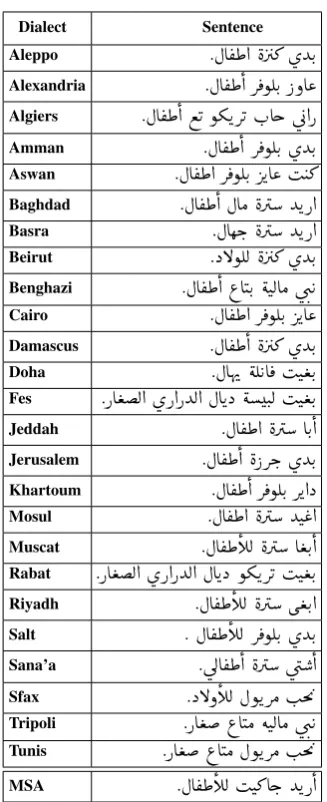
2007) sentences from English and French to the different dialects. It includes two corpora. The first consists of 2,000 sentences translated into 25 Arab city dialects in parallel. We refer to it as Cor-pus 26 (25 cities plus MSA). The second corCor-pus has 10,000 additional sentences (non-overlapping with the 2,000 sentences) from the BTEC cor-pus translated to the dialects of only five selected cities: Beirut, Cairo, Doha, Tunis and Rabat. We refer to it as Corpus 6 (5 cities plus MSA). An example of a 27-way parallel sentence (25 cities plus MSA and English) extracted from Corpus 26 is given in Table2. The train-dev-test splits of the corpora are shown in Table 3. Corpus 6 test set was not included in the shared task.4
3.2 The MADAR Twitter Corpus
For Subtask 2, we created a new dataset, the MADAR Twitter Corpus, containing 2,980 Twit-ter user profiles from 21 different countries.
Corpus collection Inspired by the work of
Mubarak and Darwish (2014) we collected a set of Twitter user profiles that reflects the way users from different regions in the Arab World tweet. Unlike previous work (Zaghouani and Charfi,
2018), we do not search Twitter based on spe-cific dialectal keywords. Rather, we search for tweets that contain a set of 25 seed hashtags corre-sponding to the 22 states of the Arab League (e.g., #Algeria, #Egypt, #Kuwait, etc.), in addition to the hashtags: ”#ArabWorld”, ”#ArabLeague” and ”#Arab”. We collected an equal number of pro-files (175 * 25 = 4,375) from the search results of each of the hashtags. The profiles were all man-ually labeled by a team of three annotators. For each labeled user profile, only the first 100 avail-able tweets at collection time are kept.
4In (Salameh et al.,2018), the Corpus 6 test set
corre-sponds to the 2,000 sentences from Corpus 26 corresponding to the Corpus 6’s five cities and MSA.
Dialect Sentence Aleppo . ÈA®£@ è Q» øYK.
Alexandria . ÈA®£@ Q¯ñÊK. PðA«
Algiers . ÈA®£@ ©K ñºKQK H.Ag ú
G@P
Amman . ÈA®£@ Q¯ñÊK. øYK. Aswan . ÈA®£@ Q¯ñÊK. QKA« I J»
Baghdad . ÈA®£@ ÈAÓ èQ YKP@ Basra . ÈAêk. èQ YKP@ Beirut . XBñÊË è Q» øYK.
Benghazi . ÈA®£@ ¨AJK.
éJËAÓ úæ. K
Cairo . ÈA®£@ Q¯ñÊK. QKA«
Damascus . ÈA®£@ è Q» øYK. Doha . ÈAîE éÊ KA¯ IJ ªK. Fes .PA ªË@ øP@PYË@ ÈAKX éJ.Ë IJ ªK.
Jeddah . ÈA®£@ èQ AK.@
Jerusalem . ÈA®£@ è PQk. øYK.
Khartoum . ÈA®£@ Q¯ñÊK. QK@X Mosul . ÈA®£@ èQ YJ«@
Muscat . ÈA®£CË èQ A ªK.@ Rabat .PA ªË@ øP@PYË@ ÈAKX ñºKQK IJ ªK.
Riyadh . ÈA®£CË èQ ù ªK.@
Salt . ÈA®£CË Q ¯ñÊK. øYK.
Sana’a . ú
ÍA®£
@ èQ úæ @
Sfax . XBðCË ÈñKQÓ I.m '
Tripoli .PA ª ¨AJÓ éJËAÓ úæ. K Tunis .PA ª ¨AJÓ ÈñKQÓ I.m '
[image:3.595.335.499.57.459.2]MSA . ÈA®£CË IJ» Ag. YKP@
Table 2: An example from Corpus 26 for the English sentence ‘I’d like a children’s sweater.’
Sentences * Variant Total Corpus 6 train 9,000 * 6 54,000
Corpus 6 dev 1,000 * 6 6,000
Corpus 26 train 1,600 * 26 41,600
Corpus 26 dev 200 * 26 5,200
Corpus 26 test 200 * 26 5,200
Table 3: Distribution of the train, dev and test sets pro-vided for Subtask 1.
[image:3.595.317.519.513.588.2]DrBehbehaniAM Kuwait
QKñK á @X ZAJ.£
B@
Ë
àñËñ®Kð
DrBehbehaniAM Kuwait.
IJ.ªK H.C¾Ë@ Bð , I ®¯ð éÊ ¯A®Ë@ B
DrBehbehaniAM KuwaitI
. Ê
®Ë@ áÓ
éÓA
K.B@ ZAÓ
áJ.J¢ËAK. B@ JÊK AÓ ZAÓ QKñJË@ Ðñ¯ úΫ Pñ JËAÓ
HederAshraf Egypt
A JJ«AJK. øX B ð
@ I
. j
K
¬YêË@ . QKA« ñë AÓ ø P I.Jm.' úÎë
B@ ú
¯ àñk. I.Jm.' QKA« úÍ@
HederAshraf EgyptøðCK.
àAJÊÓ øPðYË@ . èX àñm.Ì'A« Ik. ùë ú æªK
HederAshraf Egyptá¢Ê ¯ PQj Jë A J K@ IAg A K@ éJË èY» ¨ñ ñÖÏ@ Q.ºÓ I K@ ¬PA« Ó éêêêêêêêêêë
samykhalildz Algeria
.. Y
®J
K Q
« ¼@P
C«
èQº
¯ ÑêÊJ¢«@
samykhalildz Algeria
éKXñªË@ ú
¯ QK@ Qm.Ì'@
èC AêÖÞ @ iJ. AJÖÞ P H.Q
ªÖÏ@ èC
samykhalildz Algeria
.
éÖÞAªË@ áKA¿ñ»
éJ
¯ ú
¯ AÒî DÓ àñºK Y
[image:4.595.85.513.62.198.2]¯
èYJÊK. áÓ ú
GC
¯@ I
.
KA K : HAJ.KQå
Table 4: Three examples from the MADAR Twitter Corpus.
user geopolitical identity with the assumption that such identity could be expressed either explicitly through the location indicated in the Twitter bio section, or implicitly through dialectal and MSA usage in the tweets. Annotators were instructed not to rely only on the location provided by the user, and were invited to use all the extra-linguistic information available in the profile such as images, proclamations of loyalty and pride, etc. They were also allowed to check other sources such as corre-sponding Facebook profiles, if available, to con-firm the user’s country. Profiles may be marked as Non Person, Non Arab or too hard to guess. To measure inter-annotator agreement, a common set of 150 profiles were labeled by all annotators. They obtained an average Cohen Kappa score of 80.16%, which shows substantial agreement.
We discarded all profiles that became unavail-able after the collection step, as well as profiles marked as Non Person, Non Arab or too hard to guess. Our final data set contained 2,980 country-labeled profiles. Three examples from the MADAR Twitter Corpus are shown in Table4.
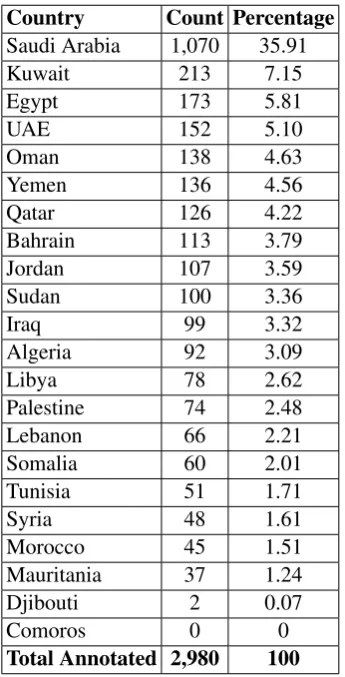
The distribution of the Twitter profiles by coun-try is given in Table5. The majority of the users obtained were from Saudi Arabia, representing 35.91% of the total profiles. Since there were zero Twitter user profiles from the Comoros in our dataset, we exclude it from the shared subtask.
Dataset splits and additional features We split the Twitter corpus into train, dev and test sets. The split distribution is given in Table6. Partici-pants were provided with the pointers to the tweets together with automatically detected language by Twitter, as well as the 26 confidence scores of the
Salameh et al.(2018) system for the 26-way clas-sification task applied per tweet.
Country Count Percentage Saudi Arabia 1,070 35.91
Kuwait 213 7.15
Egypt 173 5.81
UAE 152 5.10
Oman 138 4.63
Yemen 136 4.56
Qatar 126 4.22
Bahrain 113 3.79
Jordan 107 3.59
Sudan 100 3.36
Iraq 99 3.32
Algeria 92 3.09
Libya 78 2.62
Palestine 74 2.48
Lebanon 66 2.21
Somalia 60 2.01
Tunisia 51 1.71
Syria 48 1.61
Morocco 45 1.51
Mauritania 37 1.24
Djibouti 2 0.07
Comoros 0 0
[image:4.595.331.504.243.582.2]Total Annotated 2,980 100
Table 5: Distribution of the tweet Profiles by country label in the MADAR Twitter Corpus.
Users Tweets Twitter Corpus train 2,180 217,592 Twitter Corpus dev 300 29,869 Twitter Corpus test 500 49,962
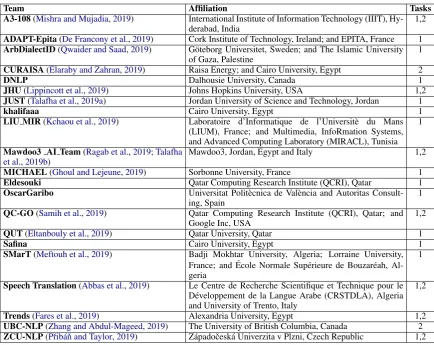
[image:4.595.326.507.642.698.2]Team Affiliation Tasks A3-108(Mishra and Mujadia,2019) International Institute of Information Technology (IIIT),
Hy-derabad, India
1,2
ADAPT-Epita(De Francony et al.,2019) Cork Institute of Technology, Ireland; and EPITA, France 1
ArbDialectID(Qwaider and Saad,2019) G¨oteborg Universitet, Sweden; and The Islamic University of Gaza, Palestine
1
CURAISA(Elaraby and Zahran,2019) Raisa Energy; and Cairo University, Egypt 2
DNLP Dalhousie University, Canada 1
JHU(Lippincott et al.,2019) Johns Hopkins University, USA 1,2
JUST(Talafha et al.,2019a) Jordan University of Science and Technology, Jordan 1
khalifaaa Cairo University, Egypt 1
LIU MIR(Kchaou et al.,2019) Laboratoire d’Informatique de l’Universit`e du Mans
(LIUM), France; and Multimedia, InfoRmation Systems, and Advanced Computing Laboratory (MIRACL), Tunisia
1
Mawdoo3 AI Team(Ragab et al.,2019;Talafha et al.,2019b)
Mawdoo3, Jordan, Egypt and Italy 1,2
MICHAEL(Ghoul and Lejeune,2019) Sorbonne University, France 1
Eldesouki Qatar Computing Research Institute (QCRI), Qatar 1
OscarGaribo Universitat Polit`ecnica de Val`encia and Autoritas
Consult-ing, Spain
1
QC-GO(Samih et al.,2019) Qatar Computing Research Institute (QCRI), Qatar; and
Google Inc, USA
1,2
QUT(Eltanbouly et al.,2019) Qatar University, Qatar 1
Safina Cairo University, Egypt 1
SMarT(Meftouh et al.,2019) Badji Mokhtar University, Algeria; Lorraine University,
France; and ´Ecole Normale Sup´erieure de Bouzar´eah, Al-geria
1
Speech Translation(Abbas et al.,2019) Le Centre de Recherche Scientifique et Technique pour le D´eveloppement de la Langue Arabe (CRSTDLA), Algeria and University of Trento, Italy
1,2
Trends(Fares et al.,2019) Alexandria University, Egypt 1,2
UBC-NLP(Zhang and Abdul-Mageed,2019) The University of British Columbia, Canada 2
[image:5.595.81.516.59.404.2]ZCU-NLP(Pˇrib´aˇn and Taylor,2019) Z´apadoˇcesk´a Univerzita v Plzni, Czech Republic 1,2
Table 7: List of the 21 teams that participated in Subtasks 1 and 2 of the MADAR Shared Task.
4 Participants and Systems
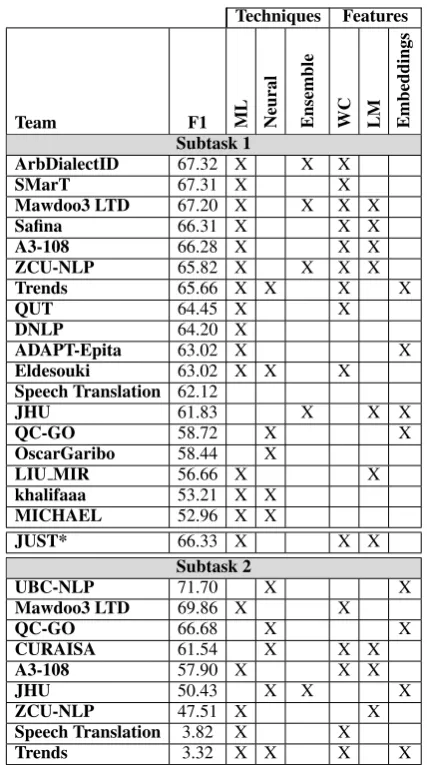
A total of 21 teams from 15 countries in four continents participated in the shared task. Ta-ble7presents the names of participating teams and their affiliations. 19 teams participated in Subtask 1; and 9 in Subtask 2. The submitted systems included a diverse set of approaches that incor-porated machine learning, ensemble learning and deep learning frameworks, and exploited a vari-ous range of features. Table8summarizes the ap-proaches adopted by each team for the two sub-tasks. In the table, ML refers to any non-neural machine learning technique such as multinomial naive Bayes (MNB) and support vector machines (SVM). Neural refers to any neural network based model such as bidirectional long short-term mem-ory (BiLSTM), or convolutional neural network (CNN). In terms of features, word and character ngram features (in Table 8 as WC), sometimes weighted with TFIDF, were among the most com-monly used features. Language-model based fea-tures (in Table 8as LM) were also used a lot. A
few participants used pre-trained embeddings. All details about the different systems submitted could be found in the papers cited in Table7.
5 Results and Discussion
5.1 Subtask 1 Results
Techniques Features
Team F1 ML Neural Ensemble WC LM Embeddings
Subtask 1
ArbDialectID 67.32 X X X
SMarT 67.31 X X
Mawdoo3 LTD 67.20 X X X X
Safina 66.31 X X X
A3-108 66.28 X X X
ZCU-NLP 65.82 X X X X
Trends 65.66 X X X X
QUT 64.45 X X
DNLP 64.20 X
ADAPT-Epita 63.02 X X
Eldesouki 63.02 X X X
Speech Translation 62.12
JHU 61.83 X X X
QC-GO 58.72 X X
OscarGaribo 58.44 X
LIU MIR 56.66 X X
khalifaaa 53.21 X X
MICHAEL 52.96 X X
JUST* 66.33 X X X
Subtask 2
UBC-NLP 71.70 X X
Mawdoo3 LTD 69.86 X X
QC-GO 66.68 X X
CURAISA 61.54 X X X
A3-108 57.90 X X X
JHU 50.43 X X X
ZCU-NLP 47.51 X X
Speech Translation 3.82 X X
[image:6.595.74.288.60.443.2]Trends 3.32 X X X X
Table 8: Approaches (techniques and features) adopted by the participating teams in Subtasks 1 and 2. ML refers to any non-neural machine learning technique such as MNB, SVM, etc. Neural refers to any neural network based model such as BILSTM, CNN, GRUs, etc. LM refers to language-model based features. WC corresponds to word and character features.
of the competing systems overcame the previously publishedSalameh et al.(2018) result.
5.2 Subtask 2 Results
Table 10 presents the results for Subtask 2. The last three rows are for three baselines. First is a maximum likelihood estimate (MLE) baseline, which was to always select Saudi Arabia (the ma-jority class). Second is the state-of-the-art sys-tem setup ofSalameh et al.(2018) trained on the MADAR Twitter Corpus data. And third is the baseline system fromZaidan and Callison-Burch
(2013) using character 5-gram LM models. The winning system is UBC-NLP beating the next sys-tem by almost 2% points. The best performer in
this subtask used a neural model (See Table8).
Unavailable Tweets One of the concerns with any Twitter-based evaluation is that some of the tweets and Twitter users included in the manu-ally annotated training, development and test data sets become unavailable at the time of the shared task. In our shared task, the percentage of miss-ing tweets from train and development immedi-ately after the conclusion of the shared task was 12.7%, which is basically the upper limit on availability. The corresponding number for un-available Twitter users was 7.6%. The range of percentages of unavailable tweets as reported by some of the participating teams is between 6.0% and 11.3%. However, there seems to be no sig-nificant effect on the systems performance, as the correlation between the percentage of unavailable tweets and performance rank is -62%. The range in percentages of unavailable tweets for the test set is much smaller (11.5% to 12.1%) since all the teams received the test set at the same time and much later after the training and development data release.
6 Conclusion and Outlook
In this paper, we described the framework and the results of the MADAR Shared Task on Ara-bic Fine-Grained Dialect Identification. In addi-tion to making a previously collected city-level dataset publicly available, we also introduced a new country-level dataset built specifically for this shared task. The unexpected large number of par-ticipants is an indication that there is a lot of inter-est in working on Arabic and Arabic dialects. We plan to run similar shared tasks in the near future, possibly with more naturally occurring (as op-posed to commissioned) datasets. We also plan to coordinate with the VarDial Arabic Dialect Iden-tification organizers to explore ways of leveraging the resources created in both competitions.
Acknowledgments
Team F1 Precision Recall Acccity Acccountry Accregion ArbDialectID 67.32 (1) 67.60 (2) 67.29 (2) 67.29 (2) 75.23 (2) 84.42 (5)
SMarT 67.31 (2) 67.73 (1) 67.33 (1) 67.33 (1) 75.69 (1) 85.13 (1) Mawdoo3 LTD 67.20 (3) 67.53 (3) 67.08 (3) 67.08 (3) 75.19 (3) 84.75 (2)
Safina 66.31 (4) 66.68 (4) 66.48 (4) 66.48 (4) 75.02 (5) 84.48 (4)
A3-108 66.28 (5) 66.56 (5) 66.31 (5) 66.31 (5) 75.15 (4) 84.62 (3)
ZCU-NLP 65.82 (6) 66.45 (6) 65.85 (6) 65.85 (6) 74.27 (6) 84.10 (6)
Trends 65.66 (7) 65.79 (7) 65.75 (7) 65.75 (7) 74.08 (7) 83.46 (7)
QUT 64.45 (8) 64.99 (8) 64.58 (8) 64.58 (8) 73.29 (8) 83.02 (8)
DNLP 64.20 (9) 64.72 (9) 63.98 (9) 63.98 (9) 72.27 (9) 82.52 (10)
ADAPT-Epita 63.02 (10) 63.43 (11) 63.08 (10) 63.08 (10) 72.15 (10) 82.56 (9)
Eldesouki 63.02 (11) 63.53 (10) 63.06 (11) 63.06 (11) 71.96 (11) 82.23 (11)
Speech Translation 62.12 (12) 63.13 (13) 62.17 (12) 62.17 (12) 71.23 (12) 81.71 (13)
JHU 61.83 (13) 62.06 (14) 61.90 (13) 61.90 (13) 71.06 (13) 81.88 (12)
QC-GO 58.72 (14) 59.77 (15) 59.12 (14) 59.12 (14) 69.29 (14) 81.29 (14)
OscarGaribo 58.44 (15) 58.58 (16) 58.52 (15) 58.52 (15) 67.67 (15) 79.31 (15)
LIU MIR 56.66 (16) 57.06 (17) 56.52 (16) 56.52 (16) 67.62 (16) 78.77 (16)
khalifaaa 53.21 (17) 63.14 (12) 53.37 (17) 53.37 (17) 64.71 (17) 78.19 (17)
MICHAEL 52.96 (18) 53.38 (18) 53.25 (18) 53.25 (18) 62.29 (18) 73.90 (18)
JUST* 66.33 (19) 66.56 (19) 66.42 (19) 66.42 (19) 74.71 (19) 84.54 (19)
Salameh et al (2018) 67.89 68.41 67.75 67.75 76.44 85.96
[image:7.595.100.503.59.338.2]Character 5-gram LM 64.74 65.01 64.75 64.75 73.65 83.40
Table 9: Results for Subtask 1. Numbers in parentheses are the ranks. The table is sorted on the macro F1 score, the official metric,. The JUST system result was updated after the shared task as their official submission was corrupted. The last two rows are for baselines ((Salameh et al.,2018) and (Zaidan and Callison-Burch,2013)).
Team F1 Precision Recall Acccountry Accregion UBC-NLP 71.70 (1) 82.59 (3) 65.63 (1) 77.40 (1) 88.40 (1) Mawdoo3 LTD 69.86 (2) 78.51 (4) 65.20 (2) 76.20 (2) 87.60 (2)
QC-GO 66.68 (3) 82.91 (2) 59.36 (4) 70.60 (4) 80.60 (5)
CURAISA 61.54 (4) 67.27 (7) 60.32 (3) 72.60 (3) 83.40 (3)
A3-108 57.90 (5) 83.37 (1) 47.73 (5) 67.20 (5) 81.60 (4)
JHU 50.43 (6) 70.45 (6) 43.18 (6) 62.20 (6) 77.80 (6)
ZCU-NLP 47.51 (7) 74.16 (5) 38.88 (7) 59.00 (7) 72.80 (7)
Speech Translation 3.82 (8) 5.22 (9) 5.37 (8) 5.00 (9) 31.80 (9)
Trends 3.32 (9) 6.82 (8) 4.97 (9) 33.00 (8) 61.40 (8)
MLE - KSA 2.64 1.79 5.00 35.80 64.20
Salameh et al (2018) 13.08 41.91 11.15 42.20 66.80
Character 5gram LM model 50.31 66.15 43.90 65.80 79.20
Table 10: Results for Subtask 2. Numbers in parentheses are the ranks. The table is sorted on the macro F1 score, the official metric. The last three rows are for baselines.
References
Mourad Abbas, Mohamed Lichouri, and Abded Al-hakim Freihat. 2019. ST MADAR 2019 Shared Task: Arabic Fine-Grained Dialect Identification. In Proceedings of the Fourth Arabic Natural Lan-guage Processing Workshop (WANLP 2019), Flo-rence, Italy.
Muhammad Abdul-Mageed, Hassan Alhuzali, and Mo-hamed Elaraby. 2018. You tweet what you speak: A city-level dataset of Arabic dialects. In Proceed-ings of the 11th Language Resources and Evaluation
Conference, Miyazaki, Japan. European Language Resource Association.
Nora Al-Twairesh, Hend Al-Khalifa, and Abdulmalik AlSalman. 2016. AraSenTi: Large-Scale Twitter-Specific Arabic Sentiment Lexicons. In Proceed-ings of the Conference of the Association for Com-putational Linguistics (ACL), Berlin, Germany.
[image:7.595.116.487.394.563.2]Proceedings of the Language Resources and Eval-uation Conference (LREC), Miyazaki, Japan.
Kareem Darwish, Hassan Sajjad, and Hamdy Mubarak. 2014. Verifiably Effective Arabic Dialect Identifi-cation. In Proceedings of the Conference on Em-pirical Methods in Natural Language Processing (EMNLP), Doha, Qatar.
Ga¨el De Francony, Victor Guichard, Praveen Joshi, Haithem Afli, and Abdessalam Bouchekif. 2019. Hierarchical Deep Learning for Arabic Dialect Iden-tification. InProceedings of the Fourth Arabic Natu-ral Language Processing Workshop (WANLP 2019), Florence, Italy.
Mahmoud El-Haj, Paul Rayson, and Mariam Aboelezz. 2018. Arabic Dialect Identification in the Context of Bivalency and Code-Switching. In Proceedings of the Language Resources and Evaluation Conference (LREC), Miyazaki, Japan.
Mohamed Elaraby and Ahmed Zahran. 2019. A Char-acter Level Convolutional Bilstm for Arabic Dialect Identification. InProceedings of the Fourth Arabic Natural Language Processing Workshop (WANLP 2019), Florence, Italy.
Heba Elfardy and Mona Diab. 2013. Sentence Level Dialect Identification in Arabic. In Proceedings of the Conference of the Association for Computational Linguistics (ACL), Sofia, Bulgaria.
Sohaila Eltanbouly, May Bashendy, and Tamer El-sayed. 2019. Simple but not Na¨ıve: Fine-Grained Arabic Dialect Identification using only N-Grams. In Proceedings of the Fourth Arabic Natural Lan-guage Processing Workshop (WANLP 2019), Flo-rence, Italy.
Youssef Fares, Zeyad El-Zanaty, Kareem Abdel-Salam, Muhammed Ezzeldin, Aliaa Mohamed, Karim El-Awaad, and Marwan Torki. 2019. Arabic Dialect Identification with Deep learning and Hybrid Fre-quency Based Features. In Proceedings of the Fourth Arabic Natural Language Processing Work-shop (WANLP 2019), Florence, Italy.
Dhaou Ghoul and Ga¨el Lejeune. 2019. MICHAEL: Mining Character-level Patterns for Arabic Dialect Identification (MADAR Challenge). InProceedings of the Fourth Arabic Natural Language Processing Workshop (WANLP 2019), Florence, Italy.
Sam´eh Kchaou, Fethi Bougares, and Lamia Hadrich-Belguith. 2019. LIUM-MIRACL Participation in the MADAR Arabic Dialect Identification Shared Task. In Proceedings of the Fourth Arabic Natu-ral Language Processing Workshop (WANLP 2019), Florence, Italy.
Tom Lippincott, Pamela Shapiro, Kevin Duh, and Paul McNamee. 2019. JHU System Description for the MADAR Arabic Dialect Identification Shared Task. In Proceedings of the Fourth Arabic Natural Lan-guage Processing Workshop (WANLP 2019), Flo-rence, Italy.
Shervin Malmasi, Marcos Zampieri, Nikola Ljubeˇsi´c, Preslav Nakov, Ahmed Ali, and J¨org Tiedemann. 2016. Discriminating between Similar Languages and Arabic Dialect Identification: A Report on the Third DSL Shared Task. In Proceedings of the Workshop on NLP for Similar Languages, Varieties and Dialects (VarDial), Osaka, Japan.
Karima Meftouh, Karima Abidi, Salima Harrat, and Kamel Smaili. 2019. The SMarT Classifier for Ara-bic Fine-Grained Dialect Identification. In Proceed-ings of the Fourth Arabic Natural Language Pro-cessing Workshop (WANLP 2019), Florence, Italy.
Pruthwik Mishra and Vandan Mujadia. 2019. Arabic Dialect Identification for Travel and Twitter Text. In Proceedings of the Fourth Arabic Natural Lan-guage Processing Workshop (WANLP 2019), Flo-rence, Italy.
Hamdy Mubarak and Kareem Darwish. 2014. Using Twitter to collect a multi-dialectal corpus of Arabic. InProceedings of the Workshop for Arabic Natural Language Processing (WANLP), Doha, Qatar.
Pavel Pˇrib´aˇn and Stephen Taylor. 2019. ZCU-NLP at MADAR 2019: Recognizing Arabic Dialects. In Proceedings of the Fourth Arabic Natural Lan-guage Processing Workshop (WANLP 2019), Flo-rence, Italy.
Chatrine Qwaider and Motaz Saad. 2019. ArbDialec-tID at MADAR Shared Task 1: Language Mod-elling and Ensemble Learning for Fine Grained Ara-bic Dialect Identification. In Proceedings of the Fourth Arabic Natural Language Processing Work-shop (WANLP 2019), Florence, Italy.
Ahmad Ragab, Haitham Seelawi, Mostafa Samir, Ab-delrahman Mattar, Hesham Al-Bataineh, Moham-mad Zaghloul, AhMoham-mad Mustafa, Bashar Talafha, Abed Alhakim Freihat, and Hussein T. Al-Natsheh. 2019. Mawdoo3 AI at MADAR Shared Task: Ara-bic Fine-Grained Dialect Identification with Ensem-ble Learning. InProceedings of the Fourth Arabic Natural Language Processing Workshop (WANLP 2019), Florence, Italy.
Fatiha Sadat, Farnazeh Kazemi, and Atefeh Farzindar. 2014. Automatic Identification of Arabic Dialects in Social Media. In Proceedings of the Workshop on Natural Language Processing for Social Media (SocialNLP), pages 22–27, Dublin, Ireland.
Mohammad Salameh, Houda Bouamor, and Nizar Habash. 2018. Fine-grained Arabic dialect identi-fication. InProceedings of the International Con-ference on Computational Linguistics (COLING), pages 1332–1344, Santa Fe, New Mexico, USA.
Younes Samih, Hamdy Mubarak, Ahmed Abdelali, Mohammed Attia, Mohamed Eldesouki, and Ka-reem Darwish. 2019. QC-GO Submission for MADAR Shared Task: Arabic Fine-Grained Dialect Identification . InProceedings of the Fourth Arabic Natural Language Processing Workshop (WANLP 2019), Florence, Italy.
Toshiyuki Takezawa, Genichiro Kikui, Masahide Mizushima, and Eiichiro Sumita. 2007. Multi-lingual Spoken Language Corpus Development for Communication Research. Computational Linguis-tics and Chinese Language Processing, 12(3):303– 324.
Bashar Talafha, Ali Fadel, Mahmoud Al-Ayyoub, Yaser Jaraweh, Mohammad Al-Smadi, and Patrick Juola. 2019a. Team JUST at the MADAR Shared Task on Arabic Fine-Grained Dialect Identification . In Proceedings of the Fourth Arabic Natural Lan-guage Processing Workshop (WANLP 2019), Flo-rence, Italy.
Bashar Talafha, Wael Farhan, Ahmed Altakrouri, and Al-Natsheh Hussein. 2019b. Mawdoo3 AI at MADAR Shared Task: Arabic Tweet Dialect Identi-fication. InProceedings of the Fourth Arabic Natu-ral Language Processing Workshop (WANLP 2019), Florence, Italy.
Wajdi Zaghouani and Anis Charfi. 2018. ArapTweet: A Large Multi-Dialect Twitter Corpus for Gender, Age and Language Variety Identification. In Pro-ceedings of the Language Resources and Evaluation Conference (LREC), Miyazaki, Japan.
Omar Zaidan and Chris Callison-Burch. 2013. Arabic dialect identification. Computational Linguistics.
Marcos Zampieri, Shervin Malmasi, Nikola Ljubeˇsi´c, Preslav Nakov, Ahmed Ali, J¨org Tiedemann, Yves Scherrer, and No¨emi Aepli. 2017. Findings of the VarDial Evaluation Campaign 2017. InProceedings of the Workshop on NLP for Similar Languages, Va-rieties and Dialects (VarDial), Valencia, Spain.