Jointly optimizing word representations for lexical and sentential tasks
with the C-PHRASE model
Nghia The Pham Germ´an Kruszewski Angeliki Lazaridou Marco Baroni Center for Mind/Brain Sciences
University of Trento
{thenghia.pham|german.kruszewski|angeliki.lazaridou|marco.baroni}@unitn.it
Abstract
We introduce C-PHRASE, a distributional semantic model that learns word repre-sentations by optimizing context predic-tion for phrases at all levels in a syntactic tree, from single words to full sentences. C-PHRASE outperforms the state-of-the-art C-BOW model on a variety of lexical tasks. Moreover, since C-PHRASE word vectors are induced through a composi-tional learning objective (modeling the contexts of words combined into phrases), when they are summed, they produce sen-tence representations that rival those gen-erated byad-hoccompositional models.
1 Introduction
Distributional semantic models, that induce vector-based meaning representations from pat-terns of co-occurrence of words in corpora, have proven very successful at modeling many lexical relations, such as synonymy, co-hyponomy and analogy (Mikolov et al., 2013c; Turney and Pan-tel, 2010). The recent evaluation of Baroni et al. (2014b) suggests that the C-BOW model intro-duced by Mikolov et al. (2013a) is, consistently, the best across many tasks.1
Interestingly, C-BOW vectors are estimated with a simple compositional approach: The weights of adjacent words are jointly optimized so that their sum will predict the distribution of their contexts. This is reminiscent of how the parame-ters of some compositionaldistributional
seman-1We refer here not only to the results reported in Baroni et al. (2014b), but also to the more exten-sive evaluation that Baroni and colleagues present in the companion website (http://clic.cimec.unitn. it/composes/semantic-vectors.html). The ex-periments there suggest that only the Glove vectors of Pen-nington et al. (2014) are competitive with C-BOW, and only when trained on a corpus several orders of magnitude larger than the one used for C-BOW.
tic models are estimated by optimizing the pre-diction of the contexts in which phrases occur in corpora (Baroni and Zamparelli, 2010; Guevara, 2010; Dinu et al., 2013). However, these compo-sitional approaches assume that word vectors have already been constructed, and contextual evidence is only used to induce optimal combination rules to derive representations of phrases and sentences. In this paper, we follow through on this observa-tion to propose the new C-PHRASE model. Sim-ilarly to C-BOW, C-PHRASE learns word resentations by optimizing their joint context pre-diction. However, unlike in flat, window-based C-BOW, C-PHRASE groups words according to their syntactic structure, and it simultaneously op-timizes context-predictions at different levels of the syntactic hierarchy. For example, given train-ing sentence“A sad dog is howling in the park”, C-PHRASE will optimize context prediction for
dog, sad dog, a sad dog, a sad dog is howling, etc., but not, for example, forhowling in, as these two words do not form a syntactic constituent by themselves.
C-PHRASE word representations outperform C-BOW on several word-level benchmarks. In ad-dition, because they are estimated in a composi-tional way, C-PHRASE word vectors, when com-bined through simple addition, produce sentence representations that are better than those obtained when adding other kinds of vectors, and competi-tive againstad-hoccompositional methods on var-ious sentence meaning benchmarks.
2 The C-PHRASE model
We start with a brief overview of the models pro-posed by Mikolov et al. (2013a), as C-PHRASE builds on them. The Skip-gram model derives the vector of a target word by setting its weights to predict the words surrounding it in the corpus.
More specifically, the objective function is:
1
T T
X
t=1
X
−c≤j≤c,j6=0
logp(wt+j|wt) (1)
where the word sequence w1, w2, ..., wT is the
training corpus and c is the size of the window around the target wordwt, consisting of the
con-text wordswt+j that must be predicted by the
in-duced vector representation for the target.
While Skip-gram learns each word represen-tation separately, the C-BOW model takes their combination into account. More precisely, it tries to predict a context word from the combination of the previous and following words, where the com-bination method is vector addition. The objective function is:
1
T T
X
t=1
logp(wt|wt−c..wt−1, wt+1..wt+c) (2)
While other distributional models consider se-quences of words jointly ascontextwhen estimat-ing the parameters for a sestimat-ingle word (Agirre et al., 2009; Melamud et al., 2014), C-BOW is unique in that it estimates the weights of a sequence of words jointly, based on their shared context. In this respect, C-BOW extends the distributional hy-pothesis (Harris, 1954) that words with similar context distributions should have similar meanings to longer sequences. However, the word combi-nations of C-BOW are not natural linguistic con-stituents, but arbitrary n-grams (e.g., sequences of 5 words with a gap in the middle). Moreover, the model does not attempt to capture thehierarchical
nature of syntactic phrasing, such thatbig brown dogis a meaningful phrase, but so are its children
brown doganddog.
C-PHRASE aims at capturing the same intu-ition that word combinations with similar con-text distributions will have similar meaning, but it applies it to syntactically motivated, potentially nested phrases. More precisely, we estimate word vectors such that they and their summed combi-nations are able to predict the contexts of words, phrases and sentences. The model is formalized as follows. We start from a parsed text corpus
T, composed of constituentsC[wl,· · ·, wr], where wl,· · ·, wr are the words spanned by the
con-stituent, located in positions lto r in the corpus. We minimize an objective function analogous to
equations (1) and (2), but instead of just using in-dividual words or bags of words to predict context, we use summed vector representations of well-formed constituents at all levels in the syntactic tree to predict the context of these constituents. There are similarities with both CBOW and Skip-gram. At the leaf nodes, C-PHRASE acts like Skip-gram, whereas at higher node in the parse tree, it behaves like CBOW model. Concretely, we try to predict the words located within a window
cCfrom every constituent in the parse tree.2 In
or-der to do so, we learn vector representations for wordsvwby maximizing the sum of the log
prob-abilities of the words in the context window of the well-formed constituents with stochastic gradient descent:
X
C[wl,···,wr]∈T
X
1≤j≤cC
logp(wl−j|C[wl,· · · , wr])
+ logp(wr+j|C[wl,· · · , wr])
(3)
withptheoretically defined as:
p(wO|C[wl,· · · , wr])
= exp
v0> wO
Pr
i=lvwi
r−l+1
PW
w=1exp
v0> w
Pr
i=lvwi
r−l+1
where W is the size of the vocabulary,v0 andv
denote output (context) and input vectors, respec-tively, and we take the input vectors to represent the words. In practice, since the normalization constant for the above probability is expensive to compute, we follow Mikolov et al. (2013b) and use negative sampling.
We let the context window size cC vary as a
function of the height of the constituent in the syntactic tree. The height h(C) of a constituent is given by the maximum number of intermedi-ate nodes separating it from any of the words it dominates (such thath = 0for words,h = 1for two-word phrases, etc.). Then, for a constituent of heighth(C), C-PHRASE considerscC = c1 +
h(C)c2context words to its left and right (the
non-negative integersc1andc2are hyperparameters of
the model; withc2 = 0, context becomes constant
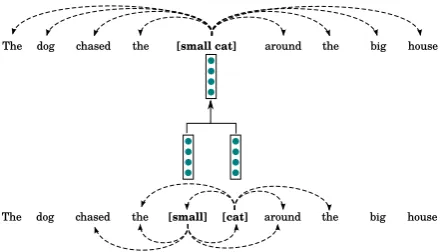
Figure 1: C-PHRASE context prediction objec-tive for the phrasesmall catand its children. The phrase vector is obtained by summing the word vectors. The predicted window is wider for the higher constituent (the phrase).
across heights). The intuition for enlarging the window proportionally to height is that, for shorter phrases, narrower contexts are likely to be most in-formative (e.g., a modifying adjective for a noun), whereas for longer phrases and sentences it might be better to focus on broader “topical” information spread across larger windows (paragraphs contain-ing sentences about weather might also contain the wordsrainandsun, but without any tendency for these words to be perfectly adjacent to the target sentences).
Figure 1 illustrates the prediction objective for a two-word phrase and its children. Since all constituents (except the topmost) form parts of larger constituents, their representations will be learned both from the objective of predicting their own contexts, and from error propagation from the same objective applied higher in the tree. As a side effect, words, being lower in the syntactic tree, will have their vectors updated more often, and thus might have a greater impact on the learned pa-rameters. This is another reason for varying win-dow size with height, so that the latter effect will be counter-balanced by higher constituents having larger context windows to predict.
For lexical tasks, we directly use the vectors induced by C-PHRASE as word representations. For sentential tasks, we simply add the vectors of the words in a sentence to obtain its representation, exploiting the fact that C-PHRASE was trained to predict phrase contexts from the additive combi-nation of their elements.
Joint optimization of word and phrase vectors The C-PHRASE hierarchical learning objective
can capture, in parallel, generalizations about the contexts of words and phrases at different levels of complexity. This results, as we will see, in bet-ter word vectors, presumably because C-PHRASE is trained to predict how the contexts of a word change based on its phrasal collocates (cup will have very different contexts inworld cupvs. cof-fee cup). At the same time, because the vectors are optimized based on their occurrence in phrases of different syntactic complexity, they produce good sentence representations when they are combined. To the best of our knowledge, C-PHRASE is the first model that is jointly optimized for lexical and compositional tasks. C-BOW uses shallow com-position information to learn word vectors. Con-versely, some compositional models –e.g., Kalch-brenner et al. (2014), Socher et al. (2013)– in-duce word representations, that are only optimized for a compositional task and are not tested at the lexical level. Somewhat relatedly to what we do, Hill et al. (2014) evaluated representations learned in a sentence translation task on word-level benchmarks. Somea priori justification for treating word and sentence learning as joint prob-lems comes from human language acquisition, as it is obvious that children learn word and phrase meanings in parallel and interactively, not sequen-tially (Tomasello, 2003).
Lapata, 2010),3 but C-PHRASE is both more
ef-fective in compositional tasks (see evaluation be-low), and it has the further advantage that it learns its own word vectors, thus reducing the number of arbitrary choices to be made in modeling.
Supervision Unlike many recent composition models (Kalchbrenner and Blunsom, 2013; Kalch-brenner et al., 2014; Socher et al., 2012; Socher et al., 2013, among others), the context-prediction objective of C-PHRASE does not require anno-tated data, and it is meant to provide general-purpose representations that can serve in differ-ent tasks. C-PHRASE vectors can also be used as initialization parameters for fully supervised, task-specific systems. Alternatively, the current unsupervised objective could be combined with task-specific supervised objectives to fine-tune C-PHRASE to specific purposes.
Sensitivity to syntactic structure During train-ing, C-PHRASE is sensitive to syntactic structure. To cite an extreme example, boy flowers will be joined in a context-predicting phrase in“these are considered [boy flowers]”, but not in “he gave [the boy] [flowers]”. A more common case is that of determiners, that will only occur in phrases that also contain the following word, but not nec-essarily the preceding one. Sentence composi-tion at test time, on the other hand, is additive, and thus syntax-insensitive. Still, the vectors be-ing combined will reflect syntactic generalizations learned in training. Even if C-PHRASE produces the same representation forred+carandcar+red, this representation combines aredvector that, dur-ing traindur-ing, has often occurred in the modifier position of adjective-noun phrases, whereas car
will have often occurred in the corresponding head position. So, presumably, the red+car=car+red
vector will encode the adjective-noun asymmetry induced in learning. While the model won’t be able to distinguish the rare cases in whichcar red
is genuinely used as a phrase, in realistic scenar-ios this won’t be a problem, because onlyred car
will be encountered. In this respect, the successes and failures of C-PHRASE can tell us to what ex-tent word order information is truly distinctive in practice, and to what extent it can instead be re-constructed from the typical role that words play in sentences.
3We do not report results for component-wise multiplica-tive in our evaluation because it performed much worse than addition in all the tasks.
Comparison with traditional syntax-sensitive word representations Syntax has often been exploited in distributional semantics for a richer characterization of context. By relying on a syn-tactic parse of the input corpus, a distributional model can take more informative contexts such as subject-of-eat vs. object-of-eat into account (Baroni and Lenci, 2010; Curran and Moens, 2002; Grefenstette, 1994; Erk and Pad´o, 2008; Levy and Goldberg, 2014a; Pad´o and Lapata, 2007; Rothenh¨ausler and Sch¨utze, 2009). In this approach, syntactic information serves to select and/or enrich the contexts that are used to build representations of target units. On the other hand, we use syntax to determine the target units that we build representations for (in the sense that we jointly learn representations of their constituents). The focus is thus on unrelated aspects of model in-duction, and we could indeed use syntax-mediated contexts together with our phrasing strategy. Cur-rently, given eat (red apples), we treat eat as window-based context ofred apples, but we could also take the context to beobject-of-eat.
3 Evaluation 3.1 Data sets
et al. (2014b), with the C-BOW model. We fur-ther consider the classic data set of Rubenstein and Goodenough (1965) (rg), consisting of 65 noun pairs. We report the state-of-the-art from Hassan and Mihalcea (2011), which exploited Wikipedia’s linking structure.
Concept categorization Systems are asked to group a set of nominal concepts into broader cate-gories (e.g. arthritisandanthraxintoillness; ba-nanaandgrapeinto fruit). As in previous work, we treat this as an unsupervised clustering task. We feed the similarity matrix produced by a model for all concepts in a test set to the CLUTO toolkit (Karypis, 2003), that clusters them intongroups, where n is the number of categories. We use standard CLUTO parameters from the literature, and quantify performance by cluster purity with respect to the gold categories. The Almuhareb-Poesio benchmark (Almuhareb, 2006) (ap) con-sists of 402 concepts belonging to 21 categories. A distributional model based on carefully chosen syntactic relations achieved top ap performance (Rothenh¨ausler and Sch¨utze, 2009). The ESSLLI 2008 data set (Baroni et al., 2008) (esslli) consists of 6 categories and 42 concepts. State of the art was achieved by Katrenko and Adriaans (2008) by using full-Web queries and manually crafted pat-terns.
Semantic analogy The last lexical task we pick is analogy (an), introduced in Mikolov et al. (2013c). We focus on their semantic challenge, containing about 9K questions. In each question, the system is given a pair exemplifying a relation (man/king) and a test word (woman); it is then asked to find the word (queen) that instantiates the same relation with the test word as that of the ex-ample pair. Mikolov et al. (2013c) subtract the vector of the first word in a pair from the sec-ond, add the vector of the test word and look for the nearest neighbor of the resulting vector (e.g., find the word whose vector is closest to king -man + wo-man). We follow the method introduced by Levy and Goldberg (2014b), which returns the wordxmaximizing cos(king,xcos()×cos(man,xwoman,x) ). This method yields better results for all models. Per-formance is measured by accuracy in retrieving the correct answer (in our search space of 180K words). The current state of the art on the seman-tic part and on the whole data set was reached by Pennington et al. (2014), who trained their word
representations on a huge corpus consisting of 42B words.
Sentential semantic relatedness Similarly to word relatedness, composed sentence representa-tions can be evaluated against benchmarks where humans provided relatedness/similarity scores for sentence pairs (sentences with high scores, such as
“A person in a black jacket is doing tricks on a mo-torbike”/“A man in a black jacket is doing tricks on a motorbike” from the SICK data-set, tend to be near-paraphrases). Following previous work on these data sets, Pearson correlation is our figure of merit, and we report it between human scores and sentence vector cosine similarities computed by the models. SICK (Marelli et al., 2014) (sick-r) was created specifically for the purpose of evalu-ating compositional models, focusing on linguistic phenomena such as lexical variation and word or-der. Here we report performance of the systems on the test part of the data set, which contains 5K sentence pairs. The top performance (from the SICK SemEval shared task) was reached by Zhao et al. (2014) using a heterogeneous set of features that include WordNet and extra training corpora. Agirre et al. (2012) and Agirre et al. (2013) cre-ated two collections of sentential similarities con-sisting of subsets coming from different sources. From these, we pick the Microsoft Research video description dataset (msrvid), where near para-phrases are descriptions of the same short video, and the OnWN 2012 (onwn1) and OnWN 2013 (onwn2) data sets (each of these sets contains 750 pairs). The latter are quite different from other sentence relatedness benchmarks, since they com-pare definitions for the same or different words taken from WordNet and OntoNotes: these glosses often are syntactic fragments (“cause something to pass or lead somewhere”), rather than full sen-tences. We report top performance on these tasks from the respective shared challenges, as sum-marized by Agirre et al. (2012) and Agirre et al. (2013). Again, the top systems use feature-rich, supervised methods relying on distributional sim-ilarity as well as other sources, such as WordNet and named entity recognizers.
entailment task (sick-e) (Marelli et al., 2014). All SICK sentence pairs are labeled as ENTAIL-ING (“Two teams are competing in a football match”/”Two groups of people are playing foot-ball”), CONTRADICTING (“The brown horse is near a red barrel at the rodeo”/“The brown horse is far from a red barrel at the rodeo”) or NEU-TRAL (“A man in a black jacket is doing tricks on a motorbike”/”A person is riding the bicycle on one wheel”). For each model, we train a simple SVM classifier based on 2 features: cosine simi-larity between the two sentence vectors, as given by the models, and whether the sentence pair con-tains a negation word (the latter has been shown to be a very informative feature for SICK entail-ment). The current state-of-the-art is reached by Lai and Hockenmaier (2014), using a much richer set of features, that include WordNet, the denota-tion graph of Young et al. (2014) and extra training data from other resources.
Sentiment analysis Finally, as sentiment analy-sis has emerged as a popular area of application for compositional models, we test our methods on the Stanford Sentiment Treebank (Socher et al., 2013) (sst), consisting of 11,855 sentences from movie reviews, using the coarse annotation into 2 sentiment degrees (negative/positive). We fol-low the official split into train (8,544), develop-ment (1,101) and test (2,210) parts. We train an SVM classifier on the training set, using the sen-tence vectors composed by a model as features, and report accuracy on the test set. State of the art is obtained by Le and Mikolov (2014) with the Paragraph Vector approach we describe below.
3.2 Model implementation
The source corpus we use to build the lex-ical vectors is created by concatenating three sources: ukWaC,4 a mid-2009 dump of the
En-glish Wikipedia5and the British National Corpus6
(about 2.8B words in total). We build vectors for the 180K words occurring at least 100 times in the corpus. Since our training procedure requires parsed trees, we parse the corpus using the Stan-ford parser (Klein and Manning, 2003).
C-PHRASE has two hyperparameters (see Sec-tion 2 above), namely basic window size (c1) and
height-dependent window enlargement factor (c2). 4http://wacky.sslmit.unibo.it
5http://en.wikipedia.org 6http://www.natcorp.ox.ac.uk
Moreover, following Mikolov et al. (2013b), dur-ing traindur-ing we sub-sample less informative, very frequent words: this option is controlled by a pa-rametert, resulting in aggressive subsampling of words with relative frequency above it. We tune on MEN-train, obtaining c1 = 5, c2 = 2 and
t = 10−5. As already mentioned, sentence
vec-tors are built by summing the vecvec-tors of the words in them.
In lexical tasks, we compare our model to the best C-BOW model from Baroni et al. (2014b),7
and to a Skip-gram model built using the same hy-perparameters as C-PHRASE (that also led to the best MEN-train results for Skip-gram).
In sentential tasks, we compare our model against adding the best C-BOW vectors pre-trained by Baroni and colleagues,8and adding our
Skip-gram vectors. We compare the additive ap-proaches to two sophisticated composition mod-els. The first is the Practical Lexical Function (PLF) model of Paperno et al. (2014). This is a linguistically motivated model in the tradition of the “functional composition” approaches of Co-ecke et al. (2010) and Baroni et al. (2014a), and the only model in this line of research that has been shown to empirically scale up to real-life sen-tence challenges. In short, in the PLF model all words are represented by vectors. Words acting as argument-taking functions (such as verbs or ad-jectives) are also associated to one matrix for each argument they take (e.g., each transitive verb has a subject and an object matrix). Vector represen-tations of arguments are recursively multiplied by function matrices, following the syntactic tree up to the top node. The final sentence representa-tion is obtained by summing all the resulting vec-tors. The PLF approach requires syntactic parsing both in training and in testing and, more cumber-somely, to train a separate matrix for each argu-ment slot of each function word (the training ob-jective is again a context-predicting one). Here, we report PLF results on msrvid and onwn2 from Paperno et al. (2014), noting that they also used two simple but precious cues (word overlap and sentence length) we do not adopt here. We used their pre-trained vectors and matrices also for the SICK challenges, while the number of new
ma-7For fairness, we report their results when all tasks were evaluated with the same set of parameters, tuned on rg: this is row 8 of their Table 2.
8http://clic.cimec.unitn.it/composes/
trices to estimate made it too time-consuming to implement this model in the onwn1 and sst tasks.
Finally, we test the Paragraph Vector (PV) ap-proach recently proposed by Le and Mikolov (2014). Under PV, sentence representations are learned by predicting the words that occur in them. This unsupervised method has been shown by the authors to outperform much more sophisti-cated, supervised neural-network-based composi-tion models on the sst task. We use our own imple-mentation for this approach. Unlike in the original experiments, we found the PV-DBOW variant of PV to consistently outperform PV-DM, and so we report results obtained with the former.
Note that PV-DBOW aims mainly at providing representations for sentences, not words. When we do not need to induce vectors for sentences in the training corpus, i.e., only train to learn single words’ representations and the softmax weights, PV-DBOW essentially reduces to Skip-gram. Therefore, we produce the PV-DBOW vec-tors for the sentences in the evaluation data sets using the softmax weights learned by Skip-gram. However, it is not clear that, if we were to train PV-DBOW jointly for words and sentences, we would get word vectors as good as those that Skip-gram induces.
4 Results
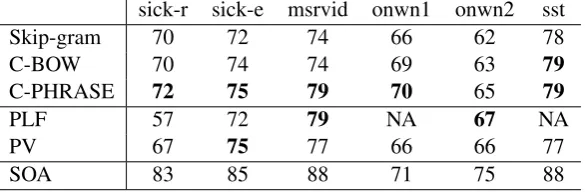
The results on the lexical tasks reported in Table 1 prove that C-PHRASE is providing excellent word representations, (nearly) as good or better than the C-BOW vectors of Baroni and colleagues in all cases, except for ap. Whenever C-PHRASE is not close to the state of the art results, the latter relied on richer knowledge sources and/or much larger corpora (ap, esslli, an).
Turning to the sentential tasks (Table 2), we first remark that using high-quality word vectors (such as C-BOW) and summing them leads to good re-sults in all tasks, competitive with those obtained with more sophisticated composition models. This confirms the observation made by Blacoe and La-pata (2012) that simple-minded composition mod-els are not necessarily worse than advanced ap-proaches. Still, C-PHRASE is consistently better than C-BOW in all tasks, except sst, where the two models reach the same performance level.
C-PHRASE is outperforming PV on all tasks except sick-e, where the two models have the same performance, and onwn2, where PV is slightly
better. C-PHRASE is outperforming PLF by a large margin on the SICK sets, whereas the two models are equal on msrvid, and PLF better on onwn2. Recall, however, that on the latter two benchmarks PLF used extra word overlap and stence length features, so the comparison is not en-tirely fair.
The fact that state-of-the-art performance is well above our models is not surprising, since the SOA systems are invariably based on a wealth of knowledge sources, and highly optimized for a task. To put some of our results in a broader perspective, C-PHRASE’s sick-r performance is 1% better than the median result of systems that participated in the SICK SemEval challenge, and comparable to that of Beltagy et al. (2014), who entered the competition with a system combining distributional semantics with a supervised proba-bilistic soft logic system. For sick-e (the entail-ment task), C-PHRASE’s performance is less than one point below the median of the SemEval sys-tems, and slightly above that of the Stanford sub-mission, that used a recursive neural network with a tensor layer.
Finally, the performance of all our models, in-cluding PV, on sst is remarkably lower than the state-of-the-art performance of PV as reported by Le and Mikolov (2014). We believe that the crucial difference is that these authors estimated PV vectorsspecifically on the sentiment treebank training data, thus buildingad-hocvectors encod-ing the semantics of movie reviews. We leave it to further research to ascertain whether we could better fine-tune our models to sst by including the sentiment treebank training phrases in our source corpus.
Comparing vector lengths of BOW and C-PHRASE We gather some insight into how the C-PHRASE objective might adjust word represen-tations for composition with respect to C-BOW by looking at how the length of word vectors changes across the two models.9While this is a very coarse
measure, if a word vector is much longer/shorter (relative to the length of other word vectors of the same model) for C-PHRASE vs. C-BOW, it means that, when sentences are composed by addition, the effect of the word on the resulting sentence representation will be stronger/weaker.
men wss wsr rg ap esslli an Skip-gram 78 77 66 80 65 82 63
C-BOW 80 78 68 83 71 77 68
C-PHRASE 79 79 70 83 65 84 69
[image:8.595.172.430.64.131.2]SOA 80 80 70 86 79 91 82
Table 1: Lexical task performance. See Section 3.1 for figures of merit (all in percentage form) and state-of-the-art references. C-BOW results (tuned on rg) are taken from Baroni et al. 2014b.
sick-r sick-e msrvid onwn1 onwn2 sst
Skip-gram 70 72 74 66 62 78
C-BOW 70 74 74 69 63 79
C-PHRASE 72 75 79 70 65 79
PLF 57 72 79 NA 67 NA
PV 67 75 77 66 66 77
SOA 83 85 88 71 75 88
Table 2: Sentential task performance. See Section 3.1 for figures of merit (all in percentage form) and state-of-the-art references. The PLF results on msrvid and onwn2 are taken from Paperno et al. 2014.
The relative-length-difference test returns the following words as the ones that are most severely de-emphasized by PHRASE compared to C-BOW: be, that, an, not, they, he, who, when, well, have. Clearly, C-PHRASE is weighting down grammatical terms that tend to be context-agnostic, and will be accompanied, in phrases, by more context-informative content words. Indeed, the list of terms that are instead emphasized by C-PHRASE include such content-rich, monose-mous words asgnawing, smackdown, demograph-ics. This is confirmed by a POS-level analysis that indicates that the categories that are, on av-erage, most de-emphasized by C-PHRASE are: determiners, modals, pronouns, prepositions and (more surprisingly) proper nouns. The ones that are, in relative terms, more emphasized are: -ing
verb forms, plural and singular nouns, adjectives and their superlatives. While this reliance on con-tent words to the detriment of grammatical terms is not always good for sentential tasks (“not al-ways good”means something very different from
“always good”!), the convincing comparative per-formance of C-PHRASE in such tasks suggests that the semantic effect of grammatical terms is in any case beyond the scope of current corpus-based models, and often not crucial to attain com-petitive results on typical benchmarks (think, e.g., of how little modals, one of the categories that C-PHRASE downplays the most, will matter when detecting paraphrases that are based on picture de-scriptions).
We also applied the length difference test to words in specific categories, finding similar pat-terns. For example, looking at -ly adverbs only, those that are de-emphasized the most by C-PHRASE are recently, eventually, originally, no-tablyandcurrently– all adverbs denoting tempo-ral factors or speaker attitude. On the other hand, the ones that C-PHRASE lengthens the most, rel-ative to C-BOW, are clinically, divinely, ecolog-ically, noisily and theatrically: all adverbs with more specific, content-word-like meanings, that are better captured by distributional methods, and are likely to have a bigger impact on tasks such as paraphrasing or entailment.
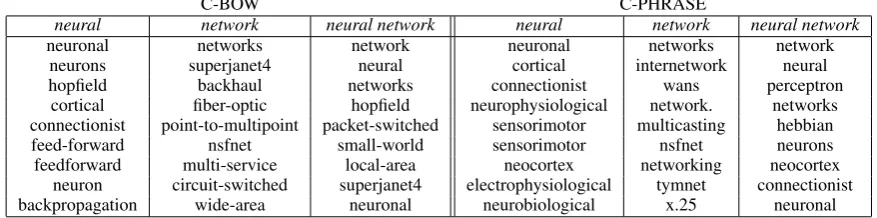
Effects of joint optimization at word and phrase levels As we have argued before, C-PHRASE is able to obtain good word representa-tions presumably because it learns to predict how the context of a word changes in the presence of different collocates. To gain further insight into this claim, we looked at the nearest neighbours of some example terms, likeneural, networkand
neural network(the latter, composed by addition) both in C-PHRASE and C-BOW. The results for this particular example can be appreciated in Ta-ble 3.
[image:8.595.154.447.179.275.2]C-C-BOW C-PHRASE
neural network neural network neural network neural network
neuronal networks network neuronal networks network
neurons superjanet4 neural cortical internetwork neural
hopfield backhaul networks connectionist wans perceptron
cortical fiber-optic hopfield neurophysiological network. networks connectionist point-to-multipoint packet-switched sensorimotor multicasting hebbian
feed-forward nsfnet small-world sensorimotor nsfnet neurons
[image:9.595.78.517.65.174.2]feedforward multi-service local-area neocortex networking neocortex neuron circuit-switched superjanet4 electrophysiological tymnet connectionist backpropagation wide-area neuronal neurobiological x.25 neuronal Table 3: Nearest neighbours ofneural,networkandneural networkboth for C-BOW and C-PHRASE
BOW contains neighbours that fit well with neu-ral network, likehopfield,connectionistand feed-forward. Conversely, neural network has neigh-bours that correspond to network like local-area
and packet-switched. In contrast, C-PHRASE neighbours for neural are mostly related to the
brainsense of the word, e.g.,cortical, neurophys-iological, etc. (with the only exception of connec-tionist). The first neighbour ofneural network, ex-cluding its own component words, quite sensibly, isperceptron.
5 Conclusion
We introduced C-PHRASE, a distributional se-mantic model that is trained on the task of pre-dicting the contexts surrounding phrases at all lev-els of a hierarchical sentence parse, from single words to full sentences. Consequently, word vec-tors are induced by taking into account not only their contexts, but also how co-occurrence with other words within a syntactic constituent is af-fecting these contexts.
C-PHRASE vectors outperform state-of-the-art C-BOW vectors in a wide range of lexical tasks. Moreover, because of the way they are induced, when C-PHRASE vectors are summed, they pro-duce sentence representations that are as good or better than those obtained with sophisticated com-position methods.
C-PHRASE is a very parsimonious approach: The only major resource required, compared to a completely knowledge-free, unsupervised method, is an automated parse of the training cor-pus (but no syntactic labels are required, nor pars-ing at test time). C-PHRASE has only 3 hyperpa-rameters and no composition-specific parameter to tune and store.
Having established a strong empirical baseline with this parsimonious approach, in future re-search we want to investigate the impact of
possi-ble extensions on both lexical and sentential tasks. When combining the vectors, either for induction or composition, we will try replacing plain addi-tion with other operaaddi-tions, starting with something as simple as learning scalar weights for different words in a phrase (Mitchell and Lapata, 2010). We also intend to explore more systematic ways to incorporate supervised signals into learning, to fine-tune C-PHRASE vectors to specific tasks.
On the testing side, we are fascinated by the good performance of additive models, that (at test time, at least) do not take word order nor syntactic structure into account. We plan to perform a sys-tematic analysis of both existing benchmarks and natural corpus data, both to assess the actual im-pact that such factors have on the aspects of mean-ing we are interested in (take two sentences in an entailment relation: how often does shuffling the words in them make it impossible to detect entail-ment?), and to construct new benchmarks that are more challenging for additive methods.
The C-PHRASE vectors described in this paper are made publicly available at: http://clic. cimec.unitn.it/composes/.
Acknowledgments
We thank Gemma Boleda and the anonymous re-viewers for useful comments. We acknowledge ERC 2011 Starting Independent Research Grant n. 283554 (COMPOSES).
References
Eneko Agirre, Enrique Alfonseca, Keith Hall, Jana Kravalova, Marius Pas¸ca, and Aitor Soroa. 2009. A study on similarity and relatedness using distribu-tional and WordNet-based approaches. In Proceed-ings of HLT-NAACL, pages 19–27, Boulder, CO.
pilot on semantic textual similarity. InProceedings of *SEM, pages 385–393, Montreal, Canada.
Eneko Agirre, Daniel Cer, Mona Diab, Aitor Gonzalez-Agirre, and Weiwei Guo. 2013. *SEM 2013 shared task: Semantic Textual Similarity. InProceedings of *SEM, pages 32–43, Atlanta, GA.
Abdulrahman Almuhareb. 2006. Attributes in Lexical Acquisition. Phd thesis, University of Essex.
Marco Baroni and Alessandro Lenci. 2010. Dis-tributional Memory: A general framework for corpus-based semantics. Computational Linguis-tics, 36(4):673–721.
Marco Baroni and Roberto Zamparelli. 2010. Nouns are vectors, adjectives are matrices: Representing adjective-noun constructions in semantic space. In
Proceedings of EMNLP, pages 1183–1193, Boston, MA.
Marco Baroni, Stefan Evert, and Alessandro Lenci, ed-itors. 2008. Bridging the Gap between Semantic Theory and Computational Simulations: Proceed-ings of the ESSLLI Workshop on Distributional Lex-ical Semantic. FOLLI, Hamburg.
Marco Baroni, Raffaella Bernardi, and Roberto Zam-parelli. 2014a. Frege in space: A program for compositional distributional semantics. Linguistic Issues in Language Technology, 9(6):5–110.
Marco Baroni, Georgiana Dinu, and Germ´an Kruszewski. 2014b. Don’t count, predict! a systematic comparison of context-counting vs. context-predicting semantic vectors. InProceedings of ACL, pages 238–247, Baltimore, MD.
Islam Beltagy, Stephen Roller, Gemma Boleda, Katrin Erk, and Raymond Mooney. 2014. UTexas: Nat-ural language semantics using distributional seman-tics and probabilistic logic. In Proceedings of Se-mEval, pages 796–801, Dublin, Ireland, August.
William Blacoe and Mirella Lapata. 2012. A com-parison of vector-based representations for seman-tic composition. InProceedings of EMNLP, pages 546–556, Jeju Island, Korea.
Elia Bruni, Nam Khanh Tran, and Marco Baroni. 2014. Multimodal distributional semantics. Journal of Ar-tificial Intelligence Research, 49:1–47.
Bob Coecke, Mehrnoosh Sadrzadeh, and Stephen Clark. 2010. Mathematical foundations for a com-positional distributional model of meaning. Linguis-tic Analysis, 36:345–384.
James Curran and Marc Moens. 2002. Improvements in automatic thesaurus extraction. InProceedings of the ACL Workshop on Unsupervised Lexical Acqui-sition, pages 59–66, Philadelphia, PA.
Ido Dagan, Bill Dolan, Bernardo Magnini, and Dan Roth. 2009. Recognizing textual entailment: ratio-nale, evaluation and approaches. Natural Language Engineering, 15:459–476.
Georgiana Dinu, Nghia The Pham, and Marco Baroni. 2013. General estimation and evaluation of com-positional distributional semantic models. In Pro-ceedings of ACL Workshop on Continuous Vector Space Models and their Compositionality, pages 50– 58, Sofia, Bulgaria.
Katrin Erk and Sebastian Pad´o. 2008. A structured vector space model for word meaning in context. In
Proceedings of EMNLP, pages 897–906, Honolulu, HI.
Lev Finkelstein, Evgeniy Gabrilovich, Yossi Matias, Ehud Rivlin, Zach Solan, Gadi Wolfman, and Ey-tan Ruppin. 2002. Placing search in context: The concept revisited. ACM Transactions on Informa-tion Systems, 20(1):116–131.
Gregory Grefenstette. 1994. Explorations in Auto-matic Thesaurus Discovery. Kluwer, Boston, MA. Emiliano Guevara. 2010. A regression model of
adjective-noun compositionality in distributional se-mantics. In Proceedings of the EMNLP GEMS Workshop, pages 33–37, Uppsala, Sweden.
Zellig Harris. 1954. Distributional structure. Word, 10(2-3):1456–1162.
Samer Hassan and Rada Mihalcea. 2011. Semantic relatedness using salient semantic analysis. In Pro-ceedings of AAAI, pages 884–889, San Francisco, CA.
Felix Hill, KyungHyun Cho, S´ebastien Jean, Col-ine Devin, and Yoshua Bengio. 2014. Not all neural embeddings are born equal. In
Proceedings of the NIPS Learning Semantics Workshop, Montreal, Canada. Published on-line: https://sites.google.com/site/ learningsemantics2014/.
Nal Kalchbrenner and Phil Blunsom. 2013. Recurrent convolutional neural networks for discourse com-positionality. In Proceedings of ACL Workshop on Continuous Vector Space Models and their Compo-sitionality, pages 119–126, Sofia, Bulgaria.
Nal Kalchbrenner, Edward Grefenstette, and Phil Blun-som. 2014. A convolutional neural network for modelling sentences. InProceedings of ACL, pages 655–665, Baltimore, MD.
George Karypis. 2003. CLUTO: A clustering toolkit. Technical Report 02-017, University of Minnesota Department of Computer Science.
Dan Klein and Christopher Manning. 2003. Accurate unlexicalized parsing. InProceedings of ACL, pages 423–430, Sapporo, Japan.
Alice Lai and Julia Hockenmaier. 2014. Illinois-lh: A denotational and distributional approach to seman-tics. InProceedings of the 8th International Work-shop on Semantic Evaluation (SemEval 2014), pages 329–334, Dublin, Ireland, August. Association for Computational Linguistics and Dublin City Univer-sity.
Quoc V Le and Tomas Mikolov. 2014. Distributed representations of sentences and documents. arXiv preprint arXiv:1405.4053.
Omer Levy and Yoav Goldberg. 2014a. Dependency-based word embeddings. In Proceedings of ACL (Volume 2: Short Papers), pages 302–308, Balti-more, Maryland.
Omer Levy and Yoav Goldberg. 2014b. Linguistic reg-ularities in sparse and explicit word representations. InProceedings of CoNLL, pages 171–180, Ann Ar-bor, MI.
Marco Marelli, Luisa Bentivogli, Marco Baroni, Raf-faella Bernardi, Stefano Menini, and Roberto Zam-parelli. 2014. SemEval-2014 Task 1: Evaluation of compositional distributional semantic models on full sentences through semantic relatedness and tex-tual entailment. InProceedings of SemEval, pages 1–8, Dublin, Ireland.
Oren Melamud, Ido Dagan, Jacob Goldberger, Idan Szpektor, and Deniz Yuret. 2014. Probabilistic modeling of joint-context in distributional similar-ity. InProceedings of CoNLL, pages 181–190, Ann Arbor, MI.
Tomas Mikolov, Kai Chen, Greg Corrado, and Jeffrey Dean. 2013a. Efficient estimation of word represen-tations in vector space. http://arxiv.org/ abs/1301.3781/.
Tomas Mikolov, Ilya Sutskever, Kai Chen, Greg Cor-rado, and Jeff Dean. 2013b. Distributed representa-tions of words and phrases and their compositional-ity. InProceedings of NIPS, pages 3111–3119, Lake Tahoe, NV.
Tomas Mikolov, Wen-tau Yih, and Geoffrey Zweig. 2013c. Linguistic regularities in continuous space word representations. In Proceedings of NAACL, pages 746–751, Atlanta, Georgia.
Jeff Mitchell and Mirella Lapata. 2010. Composition in distributional models of semantics. Cognitive Sci-ence, 34(8):1388–1429.
Sebastian Pad´o and Mirella Lapata. 2007. Dependency-based construction of semantic space models. Computational Linguistics, 33(2):161–199.
Denis Paperno, Nghia The Pham, and Marco Baroni. 2014. A practical and linguistically-motivated ap-proach to compositional distributional semantics. In
Proceedings of ACL, pages 90–99, Baltimore, MD. Jeffrey Pennington, Richard Socher, and Christopher
Manning. 2014. Glove: Global vectors for word representation. In Proceedings of EMNLP, pages 1532–1543, Doha, Qatar.
Klaus Rothenh¨ausler and Hinrich Sch¨utze. 2009. Unsupervised classification with dependency based word spaces. In Proceedings of the EACL GEMS Workshop, pages 17–24, Athens, Greece.
Herbert Rubenstein and John Goodenough. 1965. Contextual correlates of synonymy. Communica-tions of the ACM, 8(10):627–633.
Richard Socher, Brody Huval, Christopher Manning, and Andrew Ng. 2012. Semantic compositionality through recursive matrix-vector spaces. In Proceed-ings of EMNLP, pages 1201–1211, Jeju Island, Ko-rea.
Richard Socher, Alex Perelygin, Jean Wu, Jason Chuang, Christopher Manning, Andrew Ng, and Christopher Potts. 2013. Recursive deep models for semantic compositionality over a sentiment tree-bank. InProceedings of EMNLP, pages 1631–1642, Seattle, WA.
Michael Tomasello. 2003. Constructing a Language: A Usage-Based Theory of Language Acquisition. Harvard University Press, Cambridge, MA.
Peter Turney and Patrick Pantel. 2010. From fre-quency to meaning: Vector space models of se-mantics. Journal of Artificial Intelligence Research, 37:141–188.
Peter Young, Alice Lai, Micah Hodosh, and Julia Hockenmaier. 2014. From image descriptions to visual denotations: New similarity metrics for se-mantic inference over event descriptions. Transac-tions of the Association for Computational Linguis-tics, 2:67–78.