How Well Do Distributional Models Capture
Different Types of Semantic Knowledge?
Dana Rubinstein Effi Levi Roy Schwartz Ari Rappoport Institute of Computer Science, The Hebrew University
{drubin80,efle,roys02,arir}@cs.huji.ac.il
Abstract
In recent years, distributional models (DMs) have shown great success in repre-senting lexical semantics. In this work we show that the extent to which DMs rep-resent semantic knowledge is highly de-pendent on the type of knowledge. We pose the task of predicting properties of concrete nouns in a supervised setting, and compare between learning taxonomic properties (e.g., animacy) and attributive properties (e.g., size, color). We employ four state-of-the-art DMs as sources of feature representation for this task, and show that they all yield poor results when tested on attributive properties, achieving no more than an average F-score of 0.37 in the binary property prediction task, com-pared to 0.73 on taxonomic properties. Our results suggest that the distributional hypothesis may not be equally applicable to all types of semantic information. 1 Introduction
The Distributional Hypothesis states that the meaning of words can be inferred from their lin-guistic environment (Harris, 1954). This hypothe-sis lies at the heart of distributional models (DMs), which approximate the meaning of words by con-sidering the statistics of their co-occurrence with other words in the lexicon.
DMs have shown impressive results in many semantic tasks, such as predicting the similarity of two words, grouping words into semantic cat-egories, and solving analogy questions (see Ba-roni et al. (2014) for a recent survey). They are also used as a source of semantic information by many downstream applications, including syntac-tic parsing (Socher et al., 2013), image annotation (Klein et al., 2014), and semantic frame identifica-tion (Hermann et al., 2014).
However, the empirical success of DMs may not be uniform across the full range of semantic knowledge. It has been argued that DMs can never grasp the full meaning of words, as many aspects of meaning are grounded in the physical world (Andrews et al., 2009). This claim relies chiefly on cognitive theory (Louwerse, 2011), and is some-what supported in empirical findings (Baroni and Lenci, 2008; Andrews et al., 2009). Moreover, a recent study by (Hill et al., 2014) has shown that DMs may not model word similarity as well as previously believed.
In this work, we seek to further study the capa-bilities of DMs in capturing semantic information. For our purposes, we assume that the meaning of a word referring to aconcrete object (henceforth
concept) is comprised of a list of properties (Ba-roni and Lenci, 2008). For example, the mean-ing of the conceptan appleis comprised of such properties asred, round, edible, a fruit, etc. We distinguish betweentaxonomicproperties (Wu and Barsalou, 2001; McRae et al., 2005), which de-fine the conceptual category that a concept belongs to (e.g. an apple is a fruit), and all other types of properties (henceforth referred to asattributive
properties). In this paper we employ DMs in the task of learning properties of concepts, and show a very large discrepancy in performance between learning taxonomic and attributive properties.
Several previous works addressed semantic property learning, but mostly in terms of automati-cally extracting salient properties of concepts from raw text (Almuhareb and Poesio, 2005; Barbu, 2008; Baroni and Lenci, 2008; Devereux et al., 2009; Baroni et al., 2010; Kelly, 2013). Baroni and Lenci (2008) is the only work we are aware of that addressed different property types, while utilizing a DM for property extraction. However, their approach is simple, and includes defining the properties of a concept to be the 10 neighboring words of that concept in the DM space.
In order to determine to what extent proper-ties of concepts are captured by DMs, we define the following task. The goal is to predict, for a given concept, whether it holds a specific prop-erty or not (e.g., whether or not the concept ele-phantis consideredlarge) . We model this task as a learning problem, in which concepts have a fea-ture representation based on a state-of-the-art DM. A property-predictor is then trained to predict, for any given concept, whether the property applies to it or not (in a binary classification setup), or the strength of affiliation between the property and the concept (in a regression setup). By evaluating the performance of these predictors, we assess the de-gree to which the property is captured by the DM. We experiment with four state-of-the-art DMs (Baroni and Lenci, 2010; Mikolov et al., 2013; Levy and Goldberg, 2014; Pennington et al., 2014). Our results show that all DMs, quite suc-cessful in many semantic tasks, fail when it comes to predicting attributive properties of concepts. For example, in the classification task, the best performing DM achieves an averaged F-score of only 0.37, contrasted with an average F-score of 0.73 achieved by the same model for taxonomic properties. This result, which may be attributed to an essential difference between taxonomic and attributive properties, demonstrates possible limi-tations of the distributional hypothesis, at least in terms of the information captured by current state-of-the-art DMs.
2 Learning Semantic Properties of Concepts
The goal of this paper is to gain better understand-ing of the type of information DMs encode. We do so by evaluating the performance of a predictor trained on a DM-based representation to learn a semantic property. In this section, we describe the proposed learning task, the dataset and the DMs which serve as feature representations.
2.1 Task Description
We model the problem of learning a single seman-tic property both as a binary classification problem and as a regression problem. The binary setup is simpler, however it may be argued that a regres-sion setup is more appropriate, since the nature of the affiliation between a concept and its properties is not necessarily binary.
Binary Classification. For each property p, we take concepts for which p applies to be positive instances, and concepts for which it does not as negative instances. For example, the propertyis loud is positive for a trumpet but negative for a mouse. Let X denote the domain of concepts, and Yp = {±1} denote the binary label space. Then for each property p we learn a predictor hp : ψ(X) → Yp, whereψ(X) ⊆ Rn is a map-ping from the concept domain to some DM space.
Regression. Here we consider the saliency of a property for a concept and regard it as a real-valued measure. For example, white is a salient property ofswan, a less salient property ofhouse, and not a property at all ofhammer. The formal definitions are the same as in the binary classifica-tion setup, except that hereYp=R.
2.2 The Data
We use the McRae Feature Norms dataset (McRae et al., 2005). This data was collected in a set of ex-periments, where participants were presented with concepts (concrete nouns only) and were asked to write down properties that describe them. This re-sulted in a matrix of 541 concepts and 2,526 prop-erties, where each (concept, property) entry holds the number of participants who elicited the prop-erty for the concept. This dataset has been widely used in the past as a proxy to the human percep-tual representation of concrete objects (Baroni and Lenci, 2008; Barbu, 2008; Devereux et al., 2009; Johns and Jones, 2012).
In the binary classification setting, for each property, we take all concepts for which this prop-erty was elicited (by any number of participants)1
to be positive, and all other concepts to be nega-tive. In the regression setting, we take the[0, 1]-scaled number of participants who elicited each property for a concept to be the real-valued mea-sure of its saliency for that concept.
2.3 Distributional Models
We experiment with four state-of-the-art DMs as feature representations for the concept domain. The models differ with respect to their method of generation (neural network or transformed co-occurrence counts) and their consideration of
lin-1Due to a pre-defined threshold applied by McRae et al.
guistic information (using plain text only, mor-phology, syntax or pattern information).
word2vec. word2vec (w2v, Mikolov et al. (2013)) is a neural network model which imple-ments a language model objective. It has reached state-of-the-art results for word similarity, catego-rization and analogy tasks (Baroni et al., 2014). We use the off-the-shelf 300-dimensional version trained on a corpus of 100B tokens.2
GloVe. GloVe (gv, Pennington et al. (2014)) is a log bilinear regression model. The authors report state-of-the-art results in word similarity, seman-tic analogies and NER tasks. We use the off-the-shelf 300-dimensional version trained on a corpus of 840B tokens.3
Distributional Memory. The Distributional Memory model (dm, Baroni and Lenci (2010)) is a co-occurrence based DM, which admits morpho-logical, structural and pattern information. The authors have shown that it is highly competitive with state-of-the-art co-occurrence models in a range of semantic tasks. We use the off-the-shelf 5K-dimensional version trained on 3B tokens.4
Dependency word2vec. The dependency word2vec model (dep, Levy and Goldberg (2014)) is a variation of the word2vec model, which takes into account the dependency links between words. The authors have shown that it accurately models word similarity. We use the off-the-shelf 300-dimensional version trained on Wikipedia.5
2.4 Experimental Setup
In our experiments, we consider properties which have at least 25 positive instances in the dataset. We then discard attributive properties that clearly correspond to a taxonomic property. For exam-ple, the propertyhas feathersis no different from thebirdcategory, or the propertylives in wateris identical to thefishcategory. The final list consists of 7 taxonomic and 13 attributive properties.6
For each property, we learn both a linear SVM classifier in the binary setup, and a linear SVM re-gressor in the regression setup. For both setups we
2code.google.com/p/word2vec/ 3nlp.stanford.edu/projects/glove/ 4clic.cimec.unitn.it/dm/
5levyomer.wordpress.com/2014/04/25/
dependency-based-word-embeddings/
6The average number of positive instances per property is
42 for taxonomic properties and 61 for attributive properties.
use the lib-svm package (Chang and Lin, 2011)7
and follow a 5-fold cross-validation protocol. In the binary setup, we report F-scores only, as accuracy measures tend to be misleading due to an unbalanced label distribution. In the regression setup, we report Pearson’s correlation scores be-tween predicted values and gold standard values.
2.5 Results
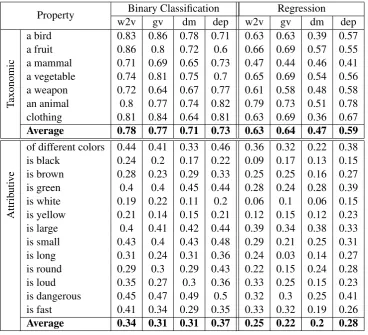
Table 1 shows our results in the binary setup (left side) and in the regression setup (right side) for all models. We display average scores separately for taxonomic and attributive properties.
The results for the binary setup show a rather low performance on learning attributive proper-ties, attaining an average F-score of no more than 0.37 (depmodel). This is emphasized when com-pared to the average performance on taxonomic properties, which is 0.73 for dep, and can be as high as 0.78 (w2v). The regression setup shows a similar trend; the average correlation for attribu-tive properties is at most 0.28 (dep), compared to 0.59 for taxonomic properties.
While linear Support Vectors are a well-established method for classification and regres-sion, we have attempted the same experiments with several other methods, including K-Nearest-Neighbors and Decision Trees for classification, and simple Least Squares for regression. In all cases, the results were found to be inferior to the ones obtained by the Support Vectors, while main-taining the discrepancy in performance between taxonomic and attributive property learning.
3 Discussion
Our results show that there is a great difference between the performance of DMs when used to predict taxonomic and attributive properties. Con-cretely, four state-of-the-art DMs fail to predict at-tributive properties, implying that even if the prop-erty information is indicated in text, it is signaled very weakly, at least by means of linguistic regu-larities captured by current, state-of-the-art DMs.
Our findings are in line with previous work, such as (Baroni and Lenci, 2008), who demon-strated that taxonomic properties are more dom-inant in text compared to attributive properties. This suggests that the distributional hypothesis may not be equally applicable to all types of se-mantic information, and in particular, it may be
Property w2vBinary Classificationgv dm dep w2v Regressiongv dm dep
Taxonomic
a bird 0.83 0.86 0.78 0.71 0.63 0.63 0.39 0.57 a fruit 0.86 0.8 0.72 0.6 0.66 0.69 0.57 0.55 a mammal 0.71 0.69 0.65 0.73 0.47 0.44 0.46 0.41 a vegetable 0.74 0.81 0.75 0.7 0.65 0.69 0.54 0.56 a weapon 0.72 0.64 0.67 0.77 0.61 0.58 0.48 0.58 an animal 0.8 0.77 0.74 0.82 0.79 0.73 0.51 0.78 clothing 0.81 0.84 0.64 0.81 0.63 0.69 0.36 0.67
Average 0.78 0.77 0.71 0.73 0.63 0.64 0.47 0.59
Attrib
uti
ve
of different colors 0.44 0.41 0.33 0.46 0.36 0.32 0.22 0.38 is black 0.24 0.2 0.17 0.22 0.09 0.17 0.13 0.15 is brown 0.28 0.23 0.29 0.33 0.25 0.25 0.16 0.27 is green 0.4 0.4 0.45 0.44 0.28 0.24 0.28 0.39 is white 0.19 0.22 0.11 0.2 0.06 0.1 0.06 0.15 is yellow 0.21 0.14 0.15 0.21 0.12 0.15 0.12 0.23 is large 0.4 0.41 0.42 0.44 0.39 0.34 0.38 0.33 is small 0.43 0.4 0.43 0.48 0.29 0.21 0.25 0.31 is long 0.31 0.24 0.31 0.36 0.24 0.03 0.14 0.27 is round 0.29 0.3 0.29 0.43 0.22 0.15 0.24 0.28 is loud 0.35 0.27 0.3 0.36 0.33 0.25 0.15 0.23 is dangerous 0.45 0.47 0.49 0.5 0.32 0.3 0.25 0.41 is fast 0.41 0.34 0.29 0.35 0.33 0.32 0.19 0.26
[image:4.595.116.485.61.396.2]Average 0.34 0.31 0.31 0.37 0.25 0.22 0.2 0.28
Table 1: Results for the Property Learning Task. On the left: F-scores for the binary classification task. On the right: Pearson correlation scores for the regression task.
limited with respect to attributive properties. An interesting observation is found in the rela-tive success of DMs in predicting taxonomic prop-erties. This result, in line with past research, e.g. (Schwartz et al., 2014), may be explained by considering taxonomic properties as a rich ag-gregate of attributive properties (Baroni and Lenci, 2010). For example, animals usually have legs and mouths, they make sounds, they can be killed, etc. This is contrasted with attributive properties such asis white, whose members do not have much in common, other than the property itself. We there-fore hypothesize that although attributive proper-ties may be signaled very weakly in text, as our results indicate, their accumulation is sufficient to distinguish concepts that share most of them from concepts that do not.
To demonstrate this, we turned back to the McRae dataset. For each property, we observed the vector of its values across all concepts in the dataset. We then found its 5 nearest neighbors in terms of correlation, and computed the average correlation with these neighbors, denotedc. Next,
we compared the averagedcvalue for taxonomic properties with that of attributive properties. Taxo-nomic properties show an averagecvalue of 0.62, compared to 0.32 only for attributive properties. This supports our hypothesis that members of tax-onomic properties are similar to each other in var-ious aspects, while members of attributive proper-ties are much less so. This finding may provide a partial explanation as to why taxonomic proper-ties are more easily learned compared to attribu-tive properties, as demonstrated in this paper.
or size, and more abstract properties such as dan-gerousorcute.
Acknowledgments
We would like to thank Roi Reichart for his care-ful reading and helpcare-ful comments. This research was funded (in part) by the Intel Collaborative Research Institute for Computational Intelligence (ICRI-CI).
References
Abdulrahman Almuhareb and Massimo Poesio. 2005. Concept learning and categorization from the web. InProc. of CogSci.
Mark Andrews, Gabriella Vigliocco, and David Vin-son. 2009. Integrating experiential and distribu-tional data to learn semantic representations. Psy-chological review, 116(3):463.
Eduard Barbu. 2008. Combining methods to learn feature-norm-like concept descriptions. In Proceed-ings of the ESSLLI Workshop on Distributional Lex-ical Semantics, pages 9–16.
Marco Baroni and Alessandro Lenci. 2008. Concepts and properties in word spaces. Italian Journal of Linguistics, 20(1):55–88.
Marco Baroni and Alessandro Lenci. 2010. Dis-tributional memory: A general framework for corpus-based semantics. Computational Linguis-tics, 36(4):673–721.
Marco Baroni, Brian Murphy, Eduard Barbu, and Mas-simo Poesio. 2010. Strudel: A corpus-based seman-tic model based on properties and types. Cognitive Science, 34(2):222–254.
Marco Baroni, Georgiana Dinu, and Germ´an Kruszewski. 2014. Dont count, predict! a systematic comparison of context-counting vs. context-predicting semantic vectors. InProceedings of the 52nd Annual Meeting of the Association for Computational Linguistics, volume 1, pages 238–247.
Chih-Chung Chang and Chih-Jen Lin. 2011. LIB-SVM: A library for support vector machines. ACM Transactions on Intelligent Systems and Technol-ogy, 2:27:1–27:27. Software available athttp://
www.csie.ntu.edu.tw/˜cjlin/libsvm.
Barry Devereux, Nicholas Pilkington, Thierry Poibeau, and Anna Korhonen. 2009. Towards unrestricted, large-scale acquisition of feature-based conceptual representations from corpus data. Research on Lan-guage and Computation, 7(2-4):137–170.
Zellig S Harris. 1954. Distributional structure. Word.
Karl Moritz Hermann, Dipanjan Das, Jason Weston, and Kuzman Ganchev. 2014. Semantic frame iden-tification with distributed word representations. In Proceedings of ACL.
Felix Hill, Roi Reichart, and Anna Korhonen. 2014. Simlex-999: Evaluating semantic models with (genuine) similarity estimation. arXiv preprint arXiv:1408.3456.
Brendan T Johns and Michael N Jones. 2012. Per-ceptual inference through global lexical similarity. Topics in Cognitive Science, 4(1):103–120.
Colin Kelly. 2013. Automatic extraction of property norm-like data from large text corpora.
Benjamin Klein, Guy Lev, Gil Sadeh, and Lior Wolf. 2014. Fisher vectors derived from hybrid gaussian-laplacian mixture models for image annotation. arXiv preprint arXiv:1411.7399.
Omer Levy and Yoav Goldberg. 2014. Dependen-cybased word embeddings. In Proceedings of the 52nd Annual Meeting of the Association for Compu-tational Linguistics, volume 2, pages 302–308. Max M Louwerse. 2011. Symbol interdependency in
symbolic and embodied cognition.Topics in Cogni-tive Science, 3(2):273–302.
Ken McRae, George S Cree, Mark S Seidenberg, and Chris McNorgan. 2005. Semantic feature produc-tion norms for a large set of living and nonliving things. Behavior research methods, 37(4):547–559. Tomas Mikolov, Ilya Sutskever, Kai Chen, Greg S Cor-rado, and Jeff Dean. 2013. Distributed representa-tions of words and phrases and their compositional-ity. InAdvances in Neural Information Processing Systems, pages 3111–3119.
Jeffrey Pennington, Richard Socher, and Christo-pher D. Manning. 2014. Glove: Global vectors for word representation. InProc. of EMNLP.
Roy Schwartz, Roi Reichart, and Ari Rappoport. 2014. Minimally supervised classification to semantic cat-egories using automatically acquired symmetric pat-terns. InProceedings of COLING 2014, the 25th In-ternational Conference on Computational Linguis-tics: Technical Papers, pages 1612–1623, Dublin, Ireland, August. Dublin City University and Associ-ation for ComputAssoci-ational Linguistics.
Richard Socher, John Bauer, Christopher D Manning, and Andrew Y Ng. 2013. Parsing with composi-tional vector grammars. In In Proceedings of the ACL conference. Citeseer.