Munich Personal RePEc Archive
Time preference and savoring – how to
exploit the Loewenstein contradiction
Mann, Konstantin A.
11 February 2018
Online at
https://mpra.ub.uni-muenchen.de/84500/
Time preference and savoring – how to exploit the
Loewenstein contradiction
______________________________________________________________
Konstantin Mann, Linsebühlstraße 77, 9000 St. Gallen,
Mobile: +41 78 732 79 96, [email protected]
St. Gallen 2018
Abstract
The goal of this paper is to demonstrate and analyze the contradiction between the model of
time preference and the concept of savoring and thereupon outline product categories that particularly apply to each one of the preceding models. Both concepts are discussed and exemplified in order to depict the contradiction. Subsequently, the terms utilitarian and hedonic
goods are introduced in order to outline useful patterns for the correct assignment of goods to each model. The definition of utilitarian goods is applied to Maslow’s hierarchy of needs to show that they do particularly react to the model of time preference. Afterwards, existing knowledge about the concept of savoring is used in order to show the correlation between
hedonic goods and the concept of savoring. Finally, the paper shows that companies can benefit from this categorization by either reacting to given distribution structures in terms of marketing or by identifying to which extent a certain product is perceived as utilitarian or hedonic good
Table of Content
1 Introduction ... 1
2 The concept of time preference ... 2
3 The concept of savoring and Loewenstein’s kiss ... 3
4 Contradictory Issues ... 4
5 Utilitarian and hedonic goods ... 6
5.1 Connecting the models ... 7
5.2 Business strategies ... 8
6 Conclusion ... 8
References: ... 10
1
1 Introduction
The time preference model has been dominant and compelling for the past decades of economic debate (Van Der Pol & Cairns, 2000, p. 171). It describes the “rate at which the utility of a good dissipates solely from delaying consumption, or impatience” (Atmadja, Sills, Pattanayak, Yang, & Patil, 2017, p. 231).
George Loewenstein (1987), however, was one of the first to point out exceptions from this theory in his article “Anticipation and the Valuation of Delayed Consumption” and even defended the concept of negative time preference or savoring by naming an intuitive example:
This pattern is often observed among children at Hallowe'en when some trick-or-treaters collect then hoard their candy rather than consuming it. Apparently the pleasure derived from savouring future consumption of the candy in some cases outweighs what can be obtained from immediate consumption. (p. 678)
Unlike the model of time preference, the concept of savoring displays the increased customer benefit through anticipation of an imminent good (Bryant, 1989, p. 175). In other words, it describes the positive effect customers can already derive from looking forward to something. Consequently, the two concepts confront each other as they link active waiting to contradicting emotions of the consumer.
By means of a meta-analysis, this paper aims to outline explanatory patterns to face the contradiction that emerges from Loewenstein’s insight. To achieve this, in the first two chapters the models of each time preference and savoring will be looked at closely to show what exactly the contradictory issues are. Thereupon, the focus will be on product categories that react to each one of the preceding models in particular. In order to outline them, the terms “hedonic” and “utilitarian” goods (Dhar & Wertenbroch, 2000) will be introduced, exemplified and serve as criteria for the assignment of products into the categories.
2
2 The concept of time preference
Individuals constantly make decisions about their consumption behavior. Those decisions “involve whether they take gains (…) now or at some later time(s).” (Doyle, 2012, p. 116). The basic concept of time preference implies that individuals prefer the consumption of goods now
over future consumption. In the strict sense, it can be described as the “exchange ratio between future and current welfare.” (Hermann & Musshoff, 2016, p. 16)
In Fishburn and Rubinstein’s (1982) basic presentation of the concept, the simple question is asked whether the reader would prefer $1000 today, or $2000 in one year (p. 677). What seems rather trivial at first sight is actually of more importance than one might suggest. For some, the answer to the question would obviously be “in one year”. In this case, the additional amount of $1000 would seem to supersede the burden of waiting for one year. However, one could go on and ask if the answer would still be the same if, instead of $2000, only $1500 will be paid off in one year. Perhaps, at this point there might already be a considerable share of individuals that would prefer the smaller amount now instead of receiving $500 more in one year. Those individuals have, according to the model, a higher time preference in comparison to those who would still wait one year to receive the full amount of $1500. As a matter of fact, the amount of money that is, in this example, needed to compensate for the one year delay is very individual. The amount will, however, most probably not fall below $0, or in other words: Most people will not prefer less money in one year than more money now. This is why some sources use the extended term positive time preference.
This concept emerged at the beginning of the 20th century and was, for a certain period of time, still a rather general and vague idea that included a variety of possible motives (Frederick, Loewenstein, & O’Donoghue, 2002, p. 355). Nonetheless, the concept quickly developed into a dominant and widely used model in the research field of intertemporal choice. Especially in “theories of savings and investment, economic growth, interest rate determination and asset pricing” (Becker & Mulligan, 1997, p. 729)time preference is of substantial importance.
3
In 1937, Paul Samuelson introduced the discounted utility (DU) model that is based on the assumptions of time preference and assumes that all motives that may affect intertemporal choice can be “condensed into a single parameter – the discount rate” (Frederick et al., 2002, p. 351). In fact, along with the model of positive time preference, the validity of the DU model is a key assumption in standard economic analysis (Loewenstein & Prelec, 1991, p. 347). Therefore, when talking about time preference it has become typical also to talk about the
discount rate (Warner & Pleeter, 2001).
3 The concept of savoring and Loewenstein’s kiss
“If for example you come at four o’clock in the afternoon, I shall start feeling happy at three o’clock. As the time passes, I shall feel happier and happier.” —Antoine de Saint-Exupéry, The Little Prince
The above passage from The Little Prince nicely illustrates the core principle of savoring.
Savoring can be defined as the benefit individuals can derive from the anticipation of future
gains (Loewenstein, 1987, p. 667; Dixon, Victorino, Kwortnik, & Verma, 2017, p. 948).
Jeremy Bentham (1789) was one of the first to point out the importance of anticipation
(Baucells & Bellezza, 2016, p. 729). He recognized that, besides the actual consumption of
goods, anticipation could be a significant source of pleasure. Interestingly, even though the
concept was first mentioned this early, there has been limited research in this field (Chun, 2009,
p. 2).
There are many situations in everyday life in which one can potentially savor future events. The
most frequent example in the research field of intertemporal choice, however, is the anticipation
of holidays. A study on happiness on vacation revealed that, in fact, vacationers were happier
before their holidays than afterwards (Nawijn, 2011, p. 559). Consequently, the pleasure that
individuals derive from the anticipation of their imminent vacation must somewhat supersede
the benefit the vacation generates once it is over.
4
order to obtain different hypothetical amenities at different times. They could choose between obtaining the amenity; (1) immediately; (2) in twenty-four hours; (3) in three days; (4) in one year; (5) in ten years.
One of the presented scenarios to be considered was to receive a kiss from the undergraduates’ favorite movie star. Although the study does not deliver absolute numbers, one can see remarkable tendencies. Compared to the undergraduates’ immediate willingness to pay, they were willing to pay approximately 55% more to receive the kiss in twenty-four hours. In order to receive the kiss in three days, the undergraduates stated that they were willing to pay about 75% more.
Interestingly, when the time of anticipation exceeded a certain point, the students’ willingness to pay started to decrease again. In order to receive the kiss in one year, the students were only willing to pay about 25% more. The relative value placed on receiving the kiss in ten years was almost minus 50%. Nevertheless, the survey impressively displays the economic capacity of the concept of savoring.
4 Contradictory Issues
As shown previously, the concept of time preference implies that consumers’ perceived utility
u of consumption C at the time t must be bigger than the perceived utility of consumption at a later date t+1. The mathematical relation between utility and time can be depicted in form of the following assumption:
Atime preference: uC(t) > uC(t+1)
5
Asavoring: uC(t) < uC(t+1) for all t < (T – 1)
The postponement of consumption, if Atime preference holds true, would necessarily lead to a decrease in perceived utility. Yet if Asavoring holds true – until t < (T – 1) – the postponement of consumption would lead to an increase in perceived utility. As one can easily conclude, the two assumptions contradict each other in many cases, even though the concepts of time preference
and savoring have been widely used in economics, psychology, marketing and decision analysis (Chun, 2009, p. 2). Loewenstein (1987) was among the first to point out this contradiction.
However, one cannot derive direct insights concerning the validity of each model. There are three possibilities:
(1) none of the models is correct; (2) only one model is correct;
(3) both models are correct under specific circumstances.
Even though (1) and (2) would be the most simple and convenient interpretations, they cannot be correct as there are examples of both models in everyday life (see example Chapter 2 and the “kiss study” in Chapter 4). It follows that (3) is correct but that both models must be limited to some extent. But what is this limitation and when should which model be applied?
Firstly, it could be argued that the correct application of each model is completely individual. One individual, for example, might be very impatient leading to a higher personal time preference. Or one individual might be especially capable of deriving pleasure from future gains leading to a higher personal rate of savoring. This interpretation might seem very convincing, and it even might be adequate. Yet it is of little use for businesses, as they cannot evaluate each customer’s impatience or capability of savoring.
6
of savoring. Although this approach might seem compelling, it is again of limited use for businesses, as it does not define which products generally react to which assumption.
5 Utilitarian and hedonic goods
As shown in Chapter 4, there are different intuitive approaches towards the application of both
time preference and savoring. However, they fail to provide any patterns that can help to define the range and applicability of each model. Therefore, this chapter will analyze to which extent the categorization into “utilitarian” and “hedonic” goods can help to better understand certain regularities.
When individuals make decisions about their consumption behavior, they include – consciously or not – tradeoffs between utilitarian and hedonic goods (Dhar & Wertenbroch, 2000, p. 60). As the field of intertemporal choice is particularly analyzing consumption behavior, it might be beneficial to analyze what these tradeoffs imply.
Broadly, utilitarian goods encompass all entities of consumption that are “primarily instrumental and functional” (Dhar & Wertenbroch, 2000, p. 60) meaning that the consumption of these goods satisfies a certain need of the consumer. Common examples are staple foods like rice or milk, microwaves and medicine.
On the other hand, hedonic goods can be described as goods whose consumption leads to experiential gratification (Okada, 2005). Consumption is typically guided by “emotional wants rather than functional needs” (Khan, Dhar, & Wertenbroch, 2005, p. 1). In other words, hedonic goods are entities of consumption that are pleasurable and emotive (Batra & Ahtola, 1991, p. 161).
Sometimes, however, the transition from utilitarian to hedonic is fluent and can even strongly depend on each individual (Khan et at., 2005, p. 4). What is a necessity for one individual might be pure pleasure for the other. The differentiation becomes even more difficult when goods contain both utilitarian as hedonic features. A car, to name a common example, can be both a
7
5.1 Connecting the models
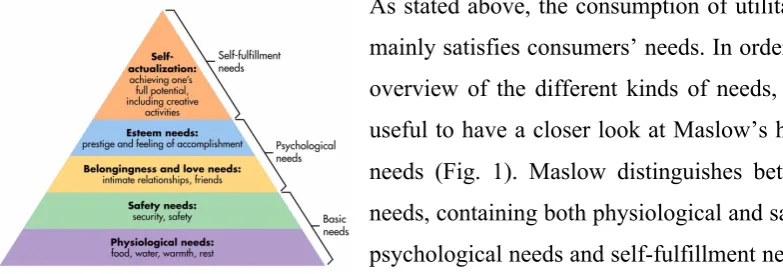
As stated above, the consumption of utilitarian goods mainly satisfies consumers’ needs. In order to gain an overview of the different kinds of needs, it could be useful to have a closer look at Maslow’s hierarchy of needs (Fig. 1). Maslow distinguishes between basic needs, containing both physiological and safety needs, psychological needs and self-fulfillment needs leaving aside all types of consumption that satisfy wants rather than needs.
There is no doubt that basic needs do not have a high anticipatory potential. On the contrary: It seems reasonable to cover the needs for water supply or medication as soon as possible. The same pattern applies to psychological needs. It could be argued that needs like love or belongingness entail a higher utility through fulfillment than from anticipation. Lastly, even the need for self-actualization is unlikely to generate utility through postponement and therefore entails a high rate of time preference.
One can observe that all types of Maslow’s needs entail a high, or at least positive time preference. Supposed Maslow’s hierarchy of needs covers all types of needs, it can be concluded that the model of time preference applies to any kind of consumption satisfying needs and consequently to utilitarian goods. Interestingly, as shown in Chapter 2, money entails a positive rate of time preference. Following the conclusion above, money must be perceived as a mainly utilitarian item.
On the other hand, Jevons (1905) recognized that anticipal pleasure, and therefore the rate of
savoring, depends on the extent to which consumers expect to derive pleasure from future consumption of a certain good (p. 64). As hedonic goods were described as pleasurable and emotive (Batra & Ahtola, 1991, p. 161) they are in most cases able to build this expectation. Consequently, the consumption of hedonic goods must react to the assumption of anticipal pleasure or savoring and therefore entail a negative time preference.
[image:11.595.77.469.138.275.2]8
5.2 Business strategies
There are several insights following these conclusions that can be useful for business. First of all, goods produced only after being ordered, like tailored suits or books on demand, require several stopovers or preparations in order to reach the customer. If the management recognizes this early, they can design their marketing tools in a way that makes the products perceivable as hedonic goods so that customers can better savor consumption.
Furthermore, businesses must identify to which extent their products are perceived as hedonic
or utilitarian goods. By doing that, they can estimate whether it might be beneficial to postpone or speed-up delivery of certain products in order to create customer benefit by either meeting customers’ positive or negative time preference. As shown in Chapter 3, this can have impacts on the perceived utility of the customer without necessarily increasing any costs for companies.
As shown above, however, the differentiation between utilitarian to hedonic goods is not always evident as the transition can be fluent. In these cases, a distinct, objective assignment is not possible. Consequently, it can be difficult for companies to evaluate consumer perception of their products and thus their time preference.
6 Conclusion
The concepts of time preference and savoring seemingly contradict each other, as they link the postponement of consumption to opposing emotions of the consumer. Even though both concepts entail considerable economic potential, there has been little research in order to explain and, more importantly, internalize this contradiction.
9
There are two basic strategies for management that follow this categorization. Firstly, the company can identify to which extent a particular product is perceived as hedonic or as
utilitarian good and thereupon postpone or speed-up delivery. This process can lead to considerable increases in customer benefit. Secondly, marketing can react to prerequisites in the company’s distribution structure. If a certain product requires time in order to be delivered, marketing tools can be shaped in a way that makes the product perceivable as a hedonic good.
10
References
:
1. Atmadja, S. S., Sills, E. O., Pattanayak, S. K., Yang, J.C., & Patil, S. (2017). Explaining environmental health behaviors: evidence from rural India on the influence of discount rates. Environment and Development Economics, 22(3), 229–248.
2. Batra, R., & Ahtola, O. T. (1991). Measuring the hedonic and utilitarian sources of consumer attitudes. Marketing letters, 2(2), 159-170
3. Baucells, M., & Bellezza, S. (2016). Temporal profiles of instant utility during anticipation, event, and recall. Management Science, 63(3), 729-748.
4. Becker, G. S., & Mulligan, C. B. (1997). The endogenous determination of time preference. The Quarterly Journal of Economics, 112(3), 729-758.
5. Bentham, J. (1789). The Principles of Morals and Legislation. Clarendon.
6. Bryant, F. (1989). A Four-Factor Model of Perceived Control: Avoiding, Coping, Obtaining, and Savoring. Journal of Personality, 57(4), 773-797.
7. Chun, H. E. (2009). Savoring future experiences: Antecedents and effects on evaluations of consumption experiences. University of Southern California.
8. Doyle, J. R. (2012). Survey of time preference, delay discounting models. Judgment and Decision Making, 8(2), 116–135.
9. Dhar, R., & Wertenbroch, K. (2000) Consumer Choice Between Hedonic and Utilitarian Goods. Journal of Marketing Research, 37(1), 60-71.
10.Dixon, M. J., Victorino, L., Kwortnik, R. J., & Verma, R. (2017). Surprise,
Anticipation, and Sequence Effects in the Design of Experiential Services. Production
and Operations Management, 26(5), 945-960.
11
12.Frederick, S., Loewenstein, G., & O’Donoghue, T. (2002). Time Discounting and Time Preference: A Critical Review. Journal Of Economic Literature, (2), 351-401.
13.Hermann, D., & Musshoff, O. (2016). Measuring time preferences: Comparing methods and evaluating the magnitude effect. Journal of Behavioral and Experimental
Economics, 65, 16-26.
14.Jevons, W. S. (1905). The principles of economics: A fragment of a treatise on the industrial mechanism of society and other papers. London: Macmillan and Company,
limited.
15.Khan, U., Dhar, R. & Wertenbroch, K. (2005). A behavioral decision theory perspective on hedonic and utilitarian choice. Inside consumption: Frontiers of research on
consumer motives, goals, and desires, 1, 144-165.
16.Loewenstein, G. (1987). Anticipation and the valuation of delayed consumption. The Economic Journal, 97(387), 666-684.
17.Loewenstein, G., & Prelec, D. (1991). Negative time preference. The American Economic Review, 81(2), 347-352.
18.Nawijn, J. (2011). Determinants of daily happiness on vacation. Journal of Travel Research, 50(5), 559-566.
19.Okada, E. M. (2005). Justification effects on consumer choice of hedonic and utilitarian goods. Journal of Marketing Research, 42(1), 43-53.
20.Van Der Pol, M. M., & Cairns, J. A. (2000), Negative and zero time preference for health. Health Economics, 9(2), 171–175.