187
Learning Distributional Token Representations from Visual Features
Samuel Broscheit Rainer Gemulla Margret Keuper University of Mannheim, Mannheim, Germany
{lastname}@informatik.uni-mannheim.de
Abstract
In this study, we compare token repre-sentations constructed from visual features (i.e., pixels) with standard lookup-based embeddings. Our goal is to gain insight about the challenges of encoding a text representation from low-level features, e.g. from characters or pixels. We fo-cus on Chinese, which—as a logographic language—has properties that make a rep-resentation via visual features challenging and interesting. To train and evaluate dif-ferent models for the token representation, we chose the task of character-based neu-ral machine translation (NMT) from Chi-nese to English. We found that a token representation computed only from visual features can achieve competitive results to lookup embeddings. However, we also show different strengths and weaknesses in the models’ performance in a part-of-speech tagging task and also a semantic similarity task. In summary, we show that it is possible to achieve atext representa-tion only from pixels. We hope that this is a useful stepping stone for future stud-ies that exclusively rely on visual input, or aim at exploiting visual features of written language.
1 Introduction
Language representation beyond the word level can be advantageous for words from the tail of the distribution, as has been shown in recent neural approaches for various tasks (Sch¨utze,2017;Kim et al.,2016;Lee et al.,2017;Wu et al.,2016; Sen-nrich et al., 2016). In these approaches, a neu-ral model represents an input text based on its se-quence of characters or charactern-grams (instead
of its words). This helps the model to handle out-of-vocabulary tokens and avoids the need of text segmentation or tokenization, which remains an unsolved problem for many languages. For some applications, e.g. language processing for social media, models should be able to capture the cre-ative use of language. However, a disadvantage is that we loose the certainty of a known vocab-ulary. Also, regarding computational complexity, there is a trade-off between the memory that is re-quired for large embedding lookup tables and the additional computational cost that is required to compose representations from low-level features.
In contrast to the characters of languages based on the Latin alphabet, the Chinese written lan-guage is defined over a set of≈ 8000characters that already carry meaning. The characters can either appear in a traditional or simplified form, and many share visual components that can in-dicate a related meaning. Thus, it is reasonable to hypothesize that encoding Chinese characters directly from their visual components might im-prove their token representation in a neural net-work model.
In recent studies, Liu et al. (2017) evaluated character encodings from visual features by clas-sifying Wikipedia titles into 12 categories and Su and Lee (2017) evaluated such encodings by measuring correlation with human similarity judg-ments. Both studies found that using character en-codings from visual input did not outperform or were equal to lookup-based embeddings. No sup-port for the hypothesis above is thus provided.
trans-lation (NMT) for training and evaluation. We ar-gue that NMT requires the token representation to serve as a reliable syntactic and semantic signal. (ii) Prior work reported evaluations for one archi-tecture to encode the visual features. In this paper, we evaluate different settings and argue for archi-tecture choices that performed well in our experi-ments. (iii) We provide evidence for the possibil-ity to compute token representations from visual features that perform on-par with lookup-based embeddings in NMT. (iv) Finally, we revisit two of the tasks from prior work that use visual fea-tures: measuring correlation with semantic simi-larity judgments by humans as well as joint seg-mentation and part-of-speech tagging. We use the best models from the NMT evaluation in these two tasks. For semantic similarity, we find that token representation from pixels are clearly beneficial for unseen characters, while a lookup embedding performs better for seen characters. For joint seg-mentation and part-of-speech tagging we find no clear difference between lookup embeddings and character representation from pixels.
2 Related Work
We start by summarizing prior work, in which to-ken representations were obtained from bitmaps of Chinese characters.
Su and Lee (2017) propose several embedding models for Chinese, including one from visual fea-tures. For the evaluation they create a dataset with Chinese word pairs in traditional Chinese. In their evaluation, they measure the correlation of the co-sine similarity of embedded word pairs against hu-man similarity judgments for those word pairs. In their experiments, they found that the representa-tion from visual features was not competitive to an embedding lookup model, but a combination of lookup embeddings with visual features was. For their model, they train a 5-layer CNN auto-encoder on bitmaps of Chinese characters. The auto-encoder character representation is fed into two GRU layers and two fully connected layers with ELU activation to encode the characters into a word. The model was trained to predict the Skip-Gram objective (Mikolov et al.,2013) or the Glove objective (Pennington et al.,2014).
Liu et al. (2017) evaluate the classification of Chinese Wikipedia titles into 12 categories. They found that the representation from visual features representations was not competitive to embedding
lookup models. They did find, however, that a combination of lookup-based embeddings and vi-sual features can be beneficial. Their character encoder is a convolutional neural network (CNN). The CNN consists of 3 convolutional layers with max-pooling followed by a fully connected trans-formation layer with ReLU activation. The char-acter encodings are fed as input to a recurrent neu-ral network (RNN) that encodes the Wikipedia ti-tle. Both, character encoder and classifier were trained jointly.
Costa-juss`a et al. (2017) investigate the neural machine translation from Chinese to Spanish. To investigate the helpfulness of visual features they augmented lookup embeddings by concatenating the corresponding bitmap features of the charac-ters. They showed that this approach improved the performance of both, their character-based and their word-based NMT system. They did not study the exclusive use of visual features.
Shao et al. (2017) investigate joint part-of-speech tagging and segmentation for Chinese. In contrast to the studies mentioned above, they found that the inclusion of visual features did not help. However, in their study, the CNN encoder was not pre-trained and only a small amount of training data was available, which may explain this finding. In their approach, they augmented character andn-gram embeddings with visual fea-tures. The model is a 2-layer CNN with max-pooling and a consecutive fully-connected trans-formation layer. They concatenated the CNN-based character embeddings to the lookup embed-dings and fed them to a BI-LSTM-CRF.
Other related approaches with regards to en-coding symbols from visual features are: Deng et al. (2017) proposed to translate from images to a markup language; e.g.; images of mathemat-ical expressions to LATEX code. While their
Model transformation activation transformation activation
CNN+FC+ReLU CNN(484→F), BN+ReLU FC(F →512) BN+ReLU
CNN+SM+FC CNN(484→F) Softmax FC(F →512)
CNN+ReLU CNN(484→512) BN+ReLU
FC 1L FC(484→512)
FC 2L FC(484→512) BN+ReLU FC(512→512)
Table 1: Character encoder architectures. Abbreviations: FC = fully connected, SM = softmax, BN = Batchnorm (Ioffe and Szegedy,2015),F = CNN output size (see Table2).
in out kernel stride
(0): Conv2d 1 32 (3, 3) (1, 1) (1): ReLU
(2): MaxPool2d (2, 2) (2, 2) (3): Conv2d 32 32 (3, 3) (1, 1) (4): ReLU
[image:3.595.106.492.77.169.2](5): MaxPool2d (2, 2) (2, 2) (6): Conv2d 32 F (4, 4) (1, 1)
Table 2: Configuration of the CNN layers. F is the CNN output feature size and takes values in
[256,512,1024,2048,4096].
3 Character Encoding
In this section, we first describe how a tokenized text is mapped to vector representations of its to-kens. Then, we describe the character encoders that we have evaluated.
3.1 Preliminaries
Neural approaches that compute a function from text input commonly map each token ti (e.g., a
word) from the input textT to a dense vector rep-resentationti ∈ Rd via some function D(ti) → ti. Lookup-based models associate each token
of a fixed vocabulary V with its own dense rep-resentation (embedding). In particular, lookup-based models use (or learn) an embedding matrix
E ∈ Rn×d, where n = |V|. The j-th row ofE
holds the embedding of thej-th token in the vo-cabulary. ThusD(ti) = eTjE, wherej is the
to-ken number of toto-ken ti in V and ej denotes the j-th standard basis vector.
If we represent each character from its visual features—i.e., the pixels of its bitmap image—, we compute the embedding instead of performing a lookup in an embedding matrix. In particular,
D(ti) computes a dense representation of token
ti from its pixelsp(ti) via a character encoderC.
Therefore, there is no fixed vocabulary of tokens any more. We haveD(ti) =C(p(ti)).
3.2 Character Encoders
As discussed in Section 2, most of the prior re-lated work—except Costa-juss`a et al. (2017)— used CNNs to learn position-invariant features of the character image. In Table2, we report the con-figuration of the convolutional layers that was used in our models. All studies report different numbers of layers and different numbers of CNN features, therefore, we vary the CNN feature size F as a hyper-parameter. In Table1 we report the char-acter encoder architectures, that roughly cover the architectures from previous work. After the CNN, Liu et al.(2017) and Shao et al.(2017) use fully connected layers (CNN+FC+ReLU), while Su and Lee(2017) directly feed the CNN features into a recurrent neural network encoder (CNN+ReLU). We also consider a similar setup as Costa-juss`a et al. (2017) by including two settings with one or two fully connected layers, (FC 1LandFC 2L). In addition to previous work, we also evaluated a model architecture that computes a softmax acti-vation over the image features (CNN+SM+FC). Our hypothesis is that the sparse activation from the softmax may act like a soft lookup (in an
F×512embedding matrix).
4 Experimental Study
4.1 Character Images
We convert each character from the source vocab-ulary into a 22 ×22 binary representation of its glyph.1 This was the lowest resolution that did not collapse nearby strokes into indistinguishable clusters.
4.2 Experiments for Machine Translation
For the machine translation experiments, we trained a NMT model to translate from Chinese to English. In the following sections, we describe the model, the data and the training settings, followed by the results.
NMT Model We used a standard sequence-to-sequence model with a recurrent encoder and attention-based decoder (Luong et al.,2015). This architecture does not represent the state of the art in neural machine translation. However, due to its wide adoption in empirical research, there is broad knowledge about suitable hyper-parameters, which makes it a preferred choice for our study.
The coarse architecture of this model can be de-scribed by an encoderencand a decoderdec. The encoder enc is a function that takes a tokenized text T in a source vocabulary as input and com-putes a representation that is the input for the sub-sequent decoder. The decoderdecthen creates a sequence of tokens in the target vocabulary. The final output isdec(enc(T)).
The input of the encoderencis first transformed to a dense vector representation, i.e., each input to-ken is transformed by functionD of Section3.1. In the following experiments, we evaluate differ-ent choices forD.
Data For training the translation model, we used a subset of the available data from the WMT 2017 Workshop on Machine Translation (Bojar et al., 2017),2, namely the News Commentary v12 cor-pus as well as Casia2015andNeu2017 from the CWMT Corpus. Overall, these datasets yielded 3,277,330 sentences. For development and eval-uation, we used WMT 2017 dev and test data, re-spectively.
Training For Chinese, we use characters as input. For English, we use byte pair encod-ing (Sennrich et al., 2016) with ≈32,000
sym-1
We use ImageMagick’s convert command together with the open source font NotoSansCJK-Regular.
2See http://www.statmt.org/wmt17/
translation-task.html
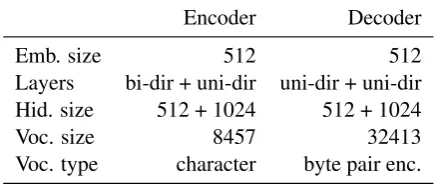
Encoder Decoder
Emb. size 512 512
Layers bi-dir + uni-dir uni-dir + uni-dir Hid. size 512 + 1024 512 + 1024
Voc. size 8457 32413
Voc. type character byte pair enc.
Table 3: Hyperparameters of the sequence-to-sequence model for the NMT task.
bols. We implemented the model in PyTorch (Version 0.3.1) (Paszke et al., 2017). The recur-rent neural networks in the encoder and decoder are LSTMs (Hochreiter and Schmidhuber,1997). Table 3 summarizes the hyper-parameters of the NMT model.
For training, we used Adam (Kingma and Ba, 2014) with the standard parameters of PyTorch. We used a learning rate of10−3for 4 epochs, then we halved the learning rate every epoch until we reached10−5. For regularization, we used dropout with probability0.2in both encoder and decoder RNNs. We pretrained the decoder for 20 epochs to a perplexity of 108.21 on the validation data. This did result in: faster convergence, improved fluency of translations, and less variance of eval-uation results. We trained all the models for 10 epochs. We selected the models by the best batch-based approximate BLEU score on the develop-ment set. This worked slightly better than select-ing them by the best perplexity. We perform trans-lation via beam search with a beam-size of 10 and length normalization of0.9.
We trained the NMT models with each of the character encoders of Table 1 as well as with lookup-based embeddings (EMB) as a baseline.
Results Table 4 summarizes the results of the machine translation experiments. We include the result from a WMT 2017 system to give context for the expected BLEU score in this task. This result is from a baseline NMT system for Chi-nese to English (Wang et al.,2017), which is most comparable to our approach (i.e., no reranking, no ensembles, no special treatment of names and numbers). However, a crucial difference is that the WMT 2017 system uses pre-segmented text, which yields a vocabulary size of 300k on the
2We use the BLEU implementation sacrebleu,
https://github.com/awslabs/sockeye/tree/
[image:4.595.307.526.64.156.2]Model F BLEU
EMB - 16.63
CNN+FC+ReLU 256 16.34
512 16.33
1024 16.60
2048 16.40
4096 16.20
CNN+SM+FC 512 15.85
1024 15.49
2048 15.36
4096 16.03
CNN+ReLU 512 16.22
FC 1L 512 15.75
FC 2L 512 16.32
[image:5.595.72.291.63.301.2]Word-segmented - 19.4
Table 4: BLEU scores for translation zh-en on the WMT17 test data. Result for a word-segmented baseline model reported byWang et al.(2017).
Model full low mid high
EMB 16.63 15.60 17.17 16.03 CNN+SM+FC 16.03 13.91 16.86 15.41 CNN+FC+R 16.60 14.47 17.11 16.91
FC 2L 16.32 15.10 17.20 16.37
Table 5: BLEU scores on the WMT17 test data for sentence buckets with low, medium and high frequency characters.
source side, while our system is character-based. Our results indicate that using only one fully connected transformation layerFC 1Lfor charac-ter encoding is possible but does not yield compa-rable results to the best-performing convolutional architectures. However, theFC 2Lcomes close to the CNN models. Note thatCNN+SM+FC 4096 needs a larger number of CNN features to perform comparable toCNN+FC+ReLU 1024. In terms of BLEU score, the best character encoders perform equal to a standard lookup embedding.
To gain insight into the differences between the models, we split the test data into three buck-ets. Each sentence is scored with1/nPn
i=1#ti,
where#ti is the training data frequency of
char-acterti. We partition the test data into alowand
highbucket with the sentences scored in the lower and upper quartile, respectively, and amidbucket with the remaining 2nd and 3rd quartile. Table5
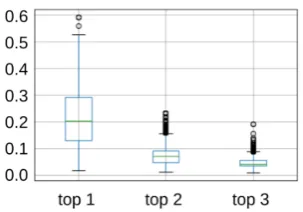
Figure 1: Distributions of the top-3 softmax acti-vation magnitudes per character.
shows the results per bucket forCNN+FC+ReLU 1024,CNN+SM+FC 4096, FC 2LandEMB. In-terestingly, the CNN+FC+ReLU 1024 and EMB perform differently well in the frequency buck-ets. The CNN+FC+ReLU 1024 model, sur-prisingly, performs better than EMB for high-frequency characters, while this is inversed for the low-frequency characters.
For the CNN+SM+FC encoders, our hypothe-sis was that the sparse activation of the softmax could act like a soft lookup function; i.e., it selects only few rows for the subsequent fully connected layer. We measured the top-3 softmax activation magnitudes per character from a random sample of 350 sentences from the training data (a total of 11234 words). As shown in Figure1, the activa-tions are indeed spiked, which supports our hy-pothesis. However, in our evaluation, we found no advantage overCNN+FC+ReLUencoders.
4.3 Experiments for Joint Part-of-Speech Tagging and Segmentation
In the translation experiment we evaluated the to-ken representations for a syntactic and semantic signal. In this experiment, we want to investigate themorpho-syntacticinformation in the represen-tations. To evaluate this, we employ the task of joint part-of-speech tagging and segmentation.
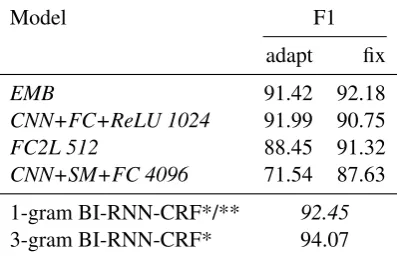
[image:5.595.339.491.65.171.2]Model F1
adapt fix
EMB 91.42 92.18
CNN+FC+ReLU 1024 91.99 90.75
FC2L 512 88.45 91.32
CNN+SM+FC 4096 71.54 87.63
[image:6.595.82.281.64.193.2]1-gram BI-RNN-CRF*/** 92.45 3-gram BI-RNN-CRF* 94.07
Table 6: Results for joint segmentation and POS tagging on the test set of CTB-5.0. (*) 1-gram and 3-gram BI-RNN-CRF reported byShao et al. (2017), (**) the 1-gram BI-RNN-CRF result was reported on the development set.
Data The Chinese Treebank 5.0 (Xue et al., 2005) has joint annotations for word segmenta-tion and part-of-speech tags. The commonly used cross validation split was reported by Jiang et al. (2008). Instead of the BIES tagging scheme (be-gin, inside, end, single), we used the BI scheme, which worked better for our models.
Training We use the parameters from the EMB, CNN+FC+ReLU 1024, FC2L 512 and CNN+SM+FC 4096 of the NMT task. We either adjust these parameters during training (adapt) or keep them fixed (fix). For training, we used Ada-grad (Duchi et al., 2010) with an initial learning rate of 0.1, and dropout for regularization with probability0.1for the encoder and0.5for the out-put classifier. We trained the models for 50 epochs and selected the model with the best accuracy on the development set.
Results Our results reported in Table 6 are av-eraged over two distinct runs each. For compari-son, we show results reported for the 1-gram and 3-gram lookup model of Shao et al.(2017). Our models correspond to the 1-gram model, as they are character-based. We find no clear difference between lookup-based and the best character en-coder models. Interestingly,CNN+SM+FC 4096 (softmax) is the weakest model. The sparseness in the in the signal apparently removes syntactic information. Comparing theadaptand thefix set-ting, we see that adapting the character encoder during training is —in most cases— not helpful. This is most likely due to the small amount of training data.
4.4 Experiments for Word Similarity
In our final experiment, we evaluated the repre-sentation of semantic information. The task is to compute a similarity score for pairs of words. The evaluation is the Spearman’s correlation be-tween the scores and numerical similarity judg-ments by humans. The words in this data set are translated into traditional Chinese. The training data from the NMT task is mostly from news and web sources, which is why our vocabulary con-tains many but not all Chinese characters. The characters in the modern simplified Chinese some-times can be visually similar to their predecessors in traditional Chinese, i.e. they share visual com-ponents with a related meaning. Therefore, we can also evaluate the capability of the models to gen-eralize to unseen characters.
Data and Experimental Setup For the exper-iments we use the WordSim-240, WordSim-296 and SimLex-999 datasets provided and described by Su and Lee (2017). Due to the use of tradi-tional Chinese we are missing at least one char-acter in 430 out of 1536 test examples. On aver-age, we are missing 1.1 characters per word, where each word has in average 2.13 characters. We split the data into word pairs in which all characters are completely covered (seen words), and into word pairs where at least one character is not seen ( un-seen words). We evaluate unseen words in two settings: either we remove the unseen characters (seen chars) or not (all chars).
We did not train any model for this experiments. Most of the words in the dataset are composed of multiple characters, therefore, we average the out-put of the character encoder into a single word-vector. Subsequently, we compute the cosine sim-ilarity between these vectors of word pairs.
Model WordSim-240 WordSim-297 SimLex-999
Words seen unseen seen unseen seen unseen
Characters all seen all seen all seen
EMB 0.33 n/a 0.06 0.47 n/a 0.15 0.32 n/a 0.32
CNN+SM+FC 4096 0.09 0.11 0.07 0.22 0.23 0.16 0.25 0.29 0.26 CNN+FC+R 1024 0.24 0.17 0.07 0.35 0.28 0.25 0.26 0.30 0.25
FC 2L 512 0.21 0.26 0.15 0.36 0.29 0.30 0.33 0.28 0.19
SG-EMB 0.59 n/a n/a 0.59 n/a n/a 0.36 n/a n/a
[image:7.595.100.500.63.212.2]SG-CNN 0.34 n/a n/a 0.36 n/a n/a 0.24 n/a n/a
Table 7: Results for semantic similarity on the WordSim-240, WordSim-296 and SimLex-999 data. Lookup SkipGram (SG-EMB) and SkipGram char. encoder (SG-CNN) reported bySu and Lee(2017).
5 Conclusion
We have shown that it is possible to compute use-ful text representations from visual features, i.e., pixels of Chinese characters. We used neural ma-chine translation as a framework for training and evaluating token representations. In the NMT ex-periment, we found that representations from vi-sual features are competitive to lookup embed-dings in a standard NMT model. In contrast to our expectations, the visual features outperform lookup embeddings on high-frequency characters, but are weaker in low-frequency characters. We conjecture that one of the reasons is that shared visual features between characters can have re-lated meanings or rere-lated syntactic functions, but also the opposite can be true. For example, 沐 is the reflexive verb of ”washing” and it contains the phonetic component 木, which can also mean ”tree”. Therefore, the visual information for rare characters introduces probably as many difficul-ties as it can be helpful.
We performed additional experiments akin to prior studies and could show that the advantage of a representation by visual features is the ability to generalize to unseen Chinese characters. Also, we could show that joint part-of-speech tagging and segmentation achieved similar results with repre-sentation from visual features.
With regard to the character encoder architec-ture, we find only a slight advantage of using CNNs to simply using two fully connected lay-ers in the NMT experiment, while 2 fully con-nected layers outperform CNNs in the similarity experiment. Whether or not there is an advantage could only be answered by an exhaustive hyper-parameter search.
Future work is to explore how we can create a model that can distinguish helpful from unhelpful visual information for rare characters.
References
Ondrej Bojar, Christian Buck, Rajen Chatterjee, Chris-tian Federmann, Yvette Graham, Barry Haddow, Matthias Huck, Antonio Jimeno-Yepes, Philipp Koehn, and Julia Kreutzer, editors. 2017. Proceed-ings of the Second Conference on Machine Transla-tion, Copenhagen, Denmark, September 7-8, 2017, WMT 2017.
Marta R. Costa-juss`a, David Ald´on, and Jos´e A. R. Fonollosa. 2017. Chinese–Spanish neural ma-chine translation enhanced with character and word bitmap fonts. Machine Translation, 31(1):35–47.
Yuntian Deng, Anssi Kanervisto, Jeffrey Ling, and Alexander M. Rush. 2017. Image-to-Markup Gen-eration with Coarse-to-Fine Attention. In Proceed-ings of the 34th International Conference on Ma-chine Learning, Sydney, NSW, Australia, 6-11 Au-gust 2017, ICML 2017, pages 980–989.
John Duchi, Elad Hazan, and Yoram Singer. 2010.
Adaptive Subgradient Methods for Online Learn-ing and Stochastic Optimization. Technical Re-port UCB/EECS-2010-24, EECS Department, Uni-versity of California, Berkeley.
Desmond Elliott, Stella Frank, Lo¨ıc Barrault, Fethi Bougares, and Lucia Specia. 2017. Findings of the Second Shared Task on Multimodal Machine Translation and Multilingual Image Description. In
Proceedings of the Second Conference on Machine Translation, Volume 2: Shared Task Papers, Copen-hagen, Denmark, September 7-8, 2017, WMT 2017, pages 215–233, Copenhagen, Denmark.
Sepp Hochreiter and J¨urgen Schmidhuber. 1997.
Sergey Ioffe and Christian Szegedy. 2015. Batch Nor-malization: Accelerating Deep Network Training by Reducing Internal Covariate Shift. In Proceed-ings of the 32nd International Conference on Ma-chine Learning, Lille, France, 6-11 July 2015, ICML 2015, pages 448–456.
Wenbin Jiang, Liang Huang, Qun Liu, and Yajuan L¨u. 2008. A Cascaded Linear Model for Joint Chinese Word Segmentation and Part-of-Speech Tagging. In
Proceedings of the 46th Annual Meeting of the Asso-ciation for Computational Linguistics, June 15-20, 2008, Columbus, Ohio, USA, ACL 2008, pages 897– 904.
Yoon Kim, Yacine Jernite, David Sontag, and Alexan-der M. Rush. 2016. Character-aware Neural Lan-guage Models. InProceedings of the Thirtieth AAAI Conference on Artificial Intelligence, AAAI 2016, pages 2741–2749, Phoenix, Arizona. AAAI Press.
Diederik P. Kingma and Jimmy Ba. 2014. Adam: A Method for Stochastic Optimization. CoRR, abs/1412.6980.
Jason Lee, Kyunghyun Cho, and Thomas Hofmann. 2017. Fully Character-Level Neural Machine Trans-lation without Explicit Segmentation.TACL, 5:365– 378.
Frederick Liu, Han Lu, Chieh Lo, and Graham Neu-big. 2017. Learning Character-level Composition-ality with Visual Features. In Proceedings of the 55th Annual Meeting of the Association for Computational Linguistics, Vancouver, Canada, July 30 -August 4, Volume 1: Long Papers, ACL 2017, Van-couver, Canada.
Thang Luong, Hieu Pham, and Christopher D. Man-ning. 2015. Effective Approaches to Attention-based Neural Machine Translation. In Proceed-ings of the 2015 Conference on Empirical Methods in Natural Language Processing, Lisbon, Portugal, September 17-21, 2015, EMNLP 2015, pages 1412– 1421.
Tomas Mikolov, Ilya Sutskever, Kai Chen, Gregory S. Corrado, and Jeffrey Dean. 2013. Distributed Rep-resentations of Words and Phrases and their Com-positionality. In Advances in Neural Information Processing Systems 26: 27th Annual Conference on Neural Information Processing Systems 2013. Pro-ceedings of a meeting held December 5-8, 2013, Lake Tahoe, Nevada, United States., NIPS 2013, pages 3111–3119.
Adam Paszke, Sam Gross, Soumith Chintala, Gre-gory Chanan, Edward Yang, Zachary DeVito, Zem-ing Lin, Alban Desmaison, Luca Antiga, and Adam Lerer. 2017. Automatic differentiation in PyTorch.
Jeffrey Pennington, Richard Socher, and Christo-pher D. Manning. 2014. GloVe: Global Vectors for Word Representation. In Proceedings of the 2014 Conference on Empirical Methods in Natural
Language Processing, October 25-29, 2014, Doha, Qatar, EMNLP 2014, pages 1532–1543.
Hinrich Sch¨utze. 2017. Nonsymbolic Text Representa-tion. In Proceedings of the 15th Conference of the European Chapter of the Association for Computa-tional Linguistics: Volume 1, Long Papers, EACL 2017, pages 785–796.
Rico Sennrich, Barry Haddow, and Alexandra Birch. 2016. Neural Machine Translation of Rare Words with Subword Units. InProceedings of the 54th An-nual Meeting of the Association for Computational Linguistics, August 7-12, 2016, Berlin, Germany, Volume 1: Long Papers, ACL 2016.
Yan Shao, Christian Hardmeier, J¨org Tiedemann, and Joakim Nivre. 2017. Character-based Joint Segmen-tation and POS Tagging for Chinese using Bidirec-tional RNN-CRF. InProceedings of the Eighth In-ternational Joint Conference on Natural Language Processing, Taipei, Taiwan, November 27 - Decem-ber 1, 2017 - Volume 1: Long Papers, IJCNLP 2017, pages 173–183.
Emma Strubell, Patrick Verga, David Belanger, and Andrew McCallum. 2017. Fast and Accurate Entity Recognition with Iterated Dilated Convolutions. In
Proceedings of the 2017 Conference on Empirical Methods in Natural Language Processing, Copen-hagen, Denmark, September 9-11, 2017, EMNLP 2017, pages 2670–2680.
Tzu-ray Su and Hung-yi Lee. 2017. Learning Chinese Word Representations From Glyphs Of Characters. InProceedings of the 2017 Conference on Empirical Methods in Natural Language Processing, Copen-hagen, Denmark, September 9-11, 2017, EMNLP 2017, pages 264–273, Copenhagen, Denmark.
Yuguang Wang, Shanbo Cheng, Liyang Jiang, Jia-jun Yang, Wei Chen, Muze Li, Lin Shi, Yanfeng Wang, and Hongtao Yang. 2017. Sogou Neural Ma-chine Translation Systems for WMT17. In Proceed-ings of the Second Conference on Machine Trans-lation, WMT 2017, pages 410–415, Copenhagen, Denmark.
Yonghui Wu, Mike Schuster, Zhifeng Chen, Quoc V. Le, Mohammad Norouzi, Wolfgang Macherey, Maxim Krikun, Yuan Cao, Qin Gao, Klaus Macherey, Jeff Klingner, Apurva Shah, Melvin Johnson, Xiaobing Liu, Lukasz Kaiser, Stephan Gouws, Yoshikiyo Kato, Taku Kudo, Hideto Kazawa, Keith Stevens, George Kurian, Nishant Patil, Wei Wang, Cliff Young, Jason Smith, Jason Riesa, Alex Rudnick, Oriol Vinyals, Greg Corrado, Macduff Hughes, and Jeffrey Dean. 2016. Google’s Neural Machine Translation System: Bridging the Gap between Human and Machine Translation.
CoRR, abs/1609.08144.
![Table 2: Configuration of the CNN layers. F isthe CNN output feature size and takes values in[256, 512, 1024, 2048, 4096].](https://thumb-us.123doks.com/thumbv2/123dok_us/183694.516767/3.595.106.492.77.169/table-conguration-layers-isthe-output-feature-takes-values.webp)