attr2vec: Jointly Learning Word and Contextual Attribute Embeddings
with Factorization Machines
Fabio Petroni
Thomson Reuters
Corporate Research & Development 30 South Colonnade, London, UK
Vassilis Plachouras∗
1 Rathbone Square, London, UK
Timothy Nugent
Thomson Reuters
Corporate Research & Development 30 South Colonnade, London, UK
Jochen L. Leidner
Thomson Reuters
Corporate Research & Development 30 South Colonnade, London, UK
Abstract
The widespread use of word embeddings is associated with the recent successes of many natural language processing (NLP) systems. The key approach of popular models such as word2vec and GloVe is to learn dense vec-tor representations from the context of words. More recently, other approaches have been proposed that incorporate different types of contextual information, including topics, de-pendency relations, n-grams, and sentiment. However, these models typically integrate only limited additional contextual information, and
often inad hocways.
In this work, we introduce attr2vec, a novel framework for jointly learning embeddings for words and contextual attributes based on fac-torization machines. We perform experiments with different types of contextual information. Our experimental results on a text classifica-tion task demonstrate that using attr2vec to jointly learn embeddings for words and Part-of-Speech (POS) tags improves results com-pared to learning the embeddings indepen-dently. Moreover, we use attr2vec to train dependency-based embeddings and we show that they exhibit higher similarity between functionally related words compared to tradi-tional approaches.
1 Introduction
Neural network-based methods have been suc-cessful in advancing the state-of-the-art in a wide range of NLP tasks, such as depen-dency parsing (Chen and Manning, 2014), sen-tence classification (Kim, 2014), machine trans-lation (Sutskever et al., 2014; Luong and Man-ning, 2016), and information retrieval (Zhang
∗work conducted whilst the author was at Thomson
Reuters.
et al., 2017). In all these approaches, vecto-rial distributed word representations, known as
word embeddings, have become a fundamental building block. The use of word embeddings is considered a “secret sauce” for contributing to the success of many of these algorithms in re-cent years (Luong et al., 2013). Popular mod-els for learning such word embeddings include word2vec (Mikolov et al.,2013a,b,c), GloVe ( Pen-nington et al., 2014) and fastText (Bojanowski et al.,2017;Joulin et al.,2017).
The main idea behind these techniques is to rep-resent a word by means of its context. The most popular forms of context are neighboring words in a window of text (Mikolov et al.,2013b; Penning-ton et al., 2014), though examples of additional contextual information might also include docu-ment topics (Li et al., 2016), dependency rela-tions (Levy and Goldberg,2014), morphemes ( Lu-ong et al., 2013), n-grams (Bojanowski et al., 2017), and sentiment (Tang et al.,2014). The em-bedding idea was originally devised to help over-come problems associated with the high dimen-sionality of sparse vector representations of words, particularly in the case of neural network model-ing, though embeddings have since been used in a variety of machine learning approaches.
However, existing models generally exploit just a small portion of the available contextual infor-mation, and they tend to do so in ad hoc ways. The main purpose of context in these models is to shape the word vector space (that is, to asso-ciate a representation to the word), but contex-tual information is not usually represented in this space. For instance, Li and Jurafsky(2015) used document topics to derive multiple vectors for the same word, each capturing a different sense, but
their method does not represent topics in the vec-tor space, that is, it does not generate topic vecvec-tors. Such contextual representations, jointly learned with the word representations, could potentially be useful for multiple tasks. For instance, pre-trained contextual vectors could be used as additional fea-tures, together with pre-trained word vectors, to improve the performance of existing models.
In this paper, we propose attr2vec, a novel framework for learning word embedding models that jointly associate distributed representations with words and with generic contextual attributes. attr2vec is inspired by the GloVe approach of Pen-nington et al.(2014) and can mimic it when no ad-ditional contextual attribute is considered. In con-trast with GloVe, attr2vec uses Factorization Ma-chines (FMs) (Rendle et al.,2011;Rendle,2012). FMs are a generalization of matrix factorization approaches, such as GloVe, and can combine dif-ferent generic feature types, even when the input data is sparse. Moreover, FMs do not consider in-put features as independent but model their inter-action by factorizing their latent representation in pairwise fashion.
Here, we conduct an experimental study to assess whether the proposed embedding model can lead to better performance for a text clas-sification task on the Reuters-21578 dataset, us-ing trained vectors as input to a convolutional neural network. The results show that jointly learned word and Part-of-Speech (POS) embed-dings with attr2vec can achieve higher F1 and pre-cision scores compared to embeddings learned in-dependently. Moreover, we use attr2vec to train dependency-based word embeddings and show, using the publicly availableWordSim353 dataset, that such embeddings yield more functional sim-ilarities than embeddings trained using a linear bag-of-word approach (such as GloVe). We also performed a qualitative analysis that provides in-sights on how contextual attributes affects the dis-tribution of words in the vector space.
Summing up, the main contributions of our work are the following:
• we extend the GloVe model to consider ad-ditional contextual information. To the best of our knowledge, this is the first work to present a general model able to jointly train dense vector representations for word and multiple arbitrary contextual attributes;
• we define a novel loss function based on
fac-torization machines to jointly learn word and contextual attribute embeddings;
• we show how to model the input data and
compute co-occurrence statistics using either a linear bag-of-word approach or syntactic dependency relations.
We provide the source code for the attr2vec model at https://github.com/ thomsonreuters/attr2vec.
The remainder of this paper is organized as fol-lows. Section 2 provides an overview of related work and Section3introduces the attr2vec model. In Section4, we present the experimental results, and close this paper with some concluding re-marks in Section5.
2 Related Work
We have already introduced some of the main re-lated approaches including word2vec and GloVe. Essentially, the GloVe model (Pennington et al., 2014) derives word representations by factorizing the word co-occurrence count matrix. The skip-gram and continuous bag-of-words (CBOW) mod-els of Mikolov et al. (2013a), instead, build the vector space by trying to predict a word given its neighbouring words. Mnih and Kavukcuoglu (2013) proposed a closely related model that works in the opposite way, trying to predict neigh-bouring words given a word. Facebook’s fast-Text model (Bojanowski et al.,2017;Joulin et al., 2017) augments word embeddings with subword-level information using character n-grams. Other examples of word embedding models include the work of Levy et al. (2014), where an explicit word vector space representation is derived using a PPMI metric, and WordRank ofJi et al.(2016), which learns word representations by adopting a ranking-based loss function. However, none of these models includes any contextual information beyond the neighbouring words.
(2016) combine word embedding and topic mod-eling to jointly learn a representation for topics and words. In addition, several works in recent years focused on learning separate embeddings for multiple senses of a word (Neelakantan et al., 2015;Iacobacci et al.,2015;Pilehvar and Collier, 2016). However, all these techniques target a par-ticular type of context. Our attr2vec model dif-fers in that it can jointly represent generic con-textual attributes and words in the embedding model. To do so, it makes use of factorization machines (Rendle, 2012), which have been suc-cessfully used to exploit contextual information in relation extraction tasks (Petroni et al.,2015) and recommender systems (Rendle et al.,2011)
It is well known that contextual information can improve performance of a wide range of NLP tasks, such as machine translation (Koehn and Hoang, 2007; Garc´ıa-Mart´ınez et al., 2017), named entity typing (Corro et al.,2015) or senti-ment analysis (Weichselbraun et al.,2013). In ad-dition, (Melamud et al.,2016) observed that dif-ferent contextual attributes work well for differ-ent tasks and that simple concatenation of embed-dings, learned independently with different mod-els, can yield further performance gains. Our attr2vec model can jointly learn embeddings for words and contextual attributes, and we show (see Section4) that using such jointly learned embed-dings yields to better performance on a text classi-fication task compared to embeddings learned in-dependently.
3 The attr2vec model
This section presents the attr2vec model. We first describe how we model the input data in terms of a feature matrix and a target vector (Section 3.1) and then how to factorize those using a factoriza-tion machines-based formulafactoriza-tion (Secfactoriza-tion3.3) to obtain word and contextual attribute embeddings.
3.1 Modeling input data
We consider as input a large corpus of text. Let the vocabulary of considered words be denoted by
W ={w1, ..., w|W|}and the set of all contextual
variables denoted byC = {c1, ..., c|C|}. We
de-noteV =W ∪C the set of all considered words
and contextual variables. In the rest of the paper we will refer to the elements of V as variables. We model the input data in terms of a target vector
Y ∈Rmand feature matrixX∈Rm×n, in which
each rowxi ∈ Rncorresponds to a feature vector
and there are as many columns as the number of variables (i.e.,|V| = n). We group columns
ac-cording to the type of the variables; e.g., there are word columns and a group of columns for each type of contextual information considered. Each target valueyi∈Y represents the number of times
the feature vectorxi has been observed in the
in-put (i.e., the co-occurrence count). We consider a two-fold way to compute the co-occurrence count of a feature vectorxi: (1)linear bag-of-wordsand
(2)dependency-based.
Linear Bag-of-Words The approach used in Pennington et al. (2014) is to compute the co-occurrence count using a linear bag-of-words as-sumption. The idea is to use a window of size
k around the target wordw, and considering the k words before and thek words after wto
com-pute co-occurrence statistics1. Note that a small
window size may miss some information, while a large window size might result in the algorithm capturing accidental pairs. A decay factor is com-monly used to weight the contribution of an obser-vation to the total co-occurrence count according to the distance to the target word. Here we con-sider a fractional decay, where the importance of a word is assumed to be inversely proportional to its distance from the target word.
To build the feature matrix X we set the
val-ues of the variables associated with the words pair and with each contextual variable observed in cor-respondence with that pair to 1. Note that there could be multiple rows inXreferring to the same pair of words but associated with different contex-tual variables. When contexcontex-tual variables can as-sume multiple values for a single observation (e.g., a document with multiple topics) we evenly dis-tribute the unitary weight across all variables (e.g., across all document topics). The target values rep-resent the number of times the corresponding com-bination of features (i.e., the pair of word and the contextual variables) has been observed in the in-put corpus, weighting each contribution with the fractional decay factor described above.
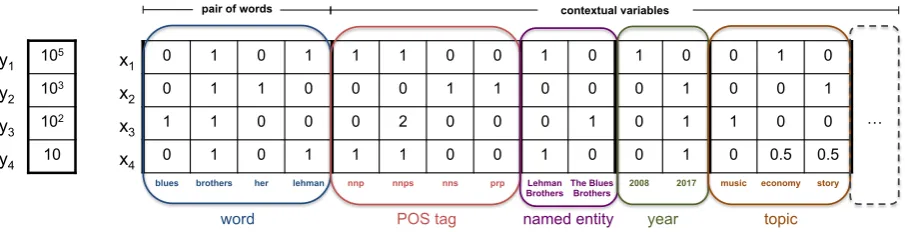
An example is shown in Figure 1. The first row in the figure corresponds to the observation of the pair of words brothers and lehman in a text window, with POS tags nnp and nnps, re-spectively, referring to the named entity Lehman
0 1 0 1 1 1 0 0 1 0 1 0 0 1 0
0 1 1 0 0 0 1 1 0 0 0 1 0 0 1
1 1 0 0 0 2 0 0 0 1 0 1 1 0 0
0 1 0 1 1 1 0 0 1 0 0 1 0 0.5 0.5
blues brothers her lehman nnp nnps nns prp Lehman
Brothers The Blues Brothers 2008 2017 music economy story
word POS tag named entity year topic x1
x2
x3
x4
…
105
103
102
10 y1 y2
y3
y4
[image:4.595.73.526.61.177.2]contextual variables pair of words
Figure 1: Example for representing input data with attr2vec using a linear window of text approach to compute
co-occurrence count. Rows inX andY are aligned: the rowyi ∈ Y (a scalar) correspond to the rowxi ∈X (a
feature vector);yirepresents the frequency of the particular combination of variables described byxiin the corpus.
Brothers, from documents published in 2008
with topic economy. Such a combination of features (i.e., brothers-lehman-nnp-nnps-Lehman Brothers-2008-economyhas been observed in the input105 times (i.e., y = 105). The fourth row of Figure1conveys the information that the same pair of words (i.e.,brothers-lehman) has been also observed 10 times in the input associated with dif-ferent contextual information, in particular in doc-uments published in 2017with multi-topic econ-omy and story. When contextual information is not considered (i.e., c = ∅) y is equal to the co-occurrence count of the pair of words, as in Pen-nington et al.(2014).
Dependency-Based Our attr2vec model can learn dependency-based embedding as well. In or-der to do so we adopted a similar strategy ofLevy and Goldberg (2014). The main idea is to parse each sentence in the input corpus and to use the de-pendency tree to derive the co-occurrence count. In particular, for a target word w with modifiers m1, ..., moand a headh, we considered the
depen-dency labels (m1, lbl1), ...,(mo, lblo),(h, lbl−h1),
where lbl is the type of the dependency relation
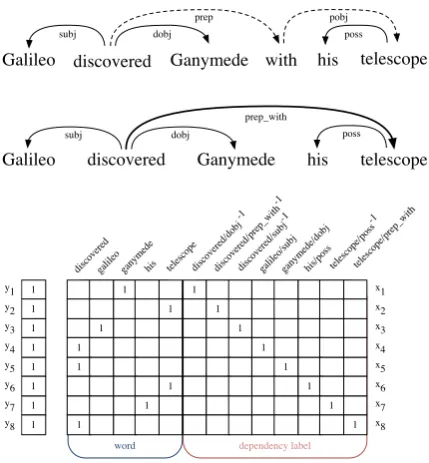
between the head and the modifier and lbl−1 is used to mark the inverse relation. Moreover, edges that include a preposition are “collapsed” by con-necting the head and the object of the proposition, and subsuming the preposition itself into the de-pendency label (see the example in the top part of Figure2).
The feature matrix X in this case consists of
two group of columns, one for the words and one for dependency labels, plus one group of columns for each additional contextual information con-sidered. The co-occurrence count is driven by the dependency tree: each target value represents
the number of times the corresponding word and dependency label (and all considered additional contextual information) appear in the dependency trees representing the sentences in the input cor-pus.
An example is shown in Figure 2. The first row in the matrix corresponds to the observation of the wordganymedeconnected to the word dis-covered through the inverse relation dobj in the
dependency tree (i.e., discovered/dobj−1). No-tice that using this approach it is possible to cap-ture relevant relations between words “far apart” in the text including long-distance dependencies (e.g.,telescopeis not in the window of text around
discoveredfork= 3), and also filter out
acciden-tal neighbouring words (e.g.,hisis in the window of text of discovered fork = 3). An additional
advantage of this approach with respect to a linear bag-of-words solution is that each observation is typed, indicating, for instance, that Ganymedeis the object ofdiscoveredandGalileois the subject.
3.2 GloVe factorization model
Before introducing the attr2vec model we briefly describe the GloVe factorization approach ( Pen-nington et al., 2014). In particular, GloVe em-ploys a matrix factorization model using as input the word-word co-occurrence count. In our exam-ple of Figure1this corresponds to considering in input just the first group of columns (i.e., the pair of words).
his
Galileo discovered Ganymede with telescope dobj
subj
prep pobj
poss
Galileo discovered Ganymede his telescope prep_with dobj subj poss galil eo ganym ede
telesc ope disc overe d/subj -1 galil eo/subj
telesc ope/pre p_w ith disc overe d/pre p_w ith -1 ganym ede/dobj discove
red/ dobj
-1
telesc ope/pos s -1 his/pos s disc overe d his 1 1 1 1 1 1 1 1 1 1 1 1 1 1 1 1
[image:5.595.73.288.60.292.2]word dependency label 1 1 1 1 1 1 1 1 y1 y2 y3 y4 y5 y6 y7 y8 x1 x2 x3 x4 x5 x6 x7 x8
Figure 2: Example for representing input data with attr2vec using a dependency-based approach to
com-pute co-occurrence count. Top: preposition relations
are collapsed into single arcs, making telescope a
di-rect modifier of discovered.Bottom:the attr2vec data
matrix. Note that theY vector contains all1’s since
it refer to the modeling of a single sentence; in a real
scenario, each rowyiof vectorY will contain a higher
value (the frequency count ofxiin the corpus)
squares objective function:
J =
N X
k=1
f(yk)
s(xk)−log(yk)
2
(1)
where xk = (wi, wj) refers to the k-th pair of
words in input with co-occurrence count yk, and
s(x) is the score associated with the pair, com-puted as follows:
s(x) =bwi+bwj+f
T
wifwj (2)
wherebwiandbwjare the biases, andfwiandfwj
are the latent factor vectors associated withwiand
wj, respectively.
The functionf(y)is used to reduce the impor-tance of pairs of words that co-occur rarely, and is defined as follows:
f(y) =
(
(y/ymax)α ify < ymax
1 otherwise (3)
where ymax and α are hyperparameters of the
model.
3.3 attr2vec factorization model
The model we propose, attr2vec, employs a trix factorization model based on factorization ma-chines. In particular, we associate with each vari-ablev ∈V abias termbv ∈Rand alatent factor
vector fv ∈ Rd, where the dimensionality d of
the latent factor space is a hyperparameter of the model. For each input feature vectorx ∈ X, we
denote byxv the value of variablev ∈ V in the
corresponding row of the features data matrix. We employ a weighted least squares model that is based of the formulation of Pennington et al. (2014) (Equation1). In contrast to GloVe, we de-fine a novel scores(x)that takes into account both words and contextual attributes, computed as fol-lows:
s(x) =X
v∈V
xvbv+
X
v1∈V
X
v2∈V\{v1}
xv1xv2f
T
v1fv2 (4)
Here, the bias terms bv model the
contribu-tion of each individual variable to the final score, whereas the latent factor vectors fv model the contribution of all pairwise interactions between variables. Rendle (2012) has shown that score computation is fast, sinces(x)can be computed in time linear to both the number of nonzero entries in x and the dimensionality d. Each latent
fac-tor vecfac-tor can be interpreted as a low-dimensional representation of the corresponding variable, both for variables that refer to words and for variables that refer to contextual information. Note that, when contextual information is not considered the formulation of our factorization model is equiva-lent to the formulation ofPennington et al.(2014). The model parametersΘ ={bv,fv|v∈V}are
estimated by minimizingJ, for instance, through
stochastic gradient descent. Each fv can be in-terpret as a dense vector representation of variable
v∈V.
4 Experiments
We conducted an experimental study on real-world data to compare our attr2vec model with other state-of-the-art approaches.
4.1 Dataset and Baseline
embedding input logistic regression convolutional neural network static non-static
random w~r 70.5(69.3) 75.7(77.5) 74.4(76.2)
random w~r_p~r 74.0(73.9) 77.9(79.7) 77.8(79.8)
GloVe w~i 77.5(77.5) 79.7(81.5) 82.7(84.3)
GloVe w~i_p~r 80.2(85.4) 82.5(84.1) 84.5(86.1)
GloVe w~i_p~i 79.3(83.3) 84.3(85.8) 84.9(86.4)
attr2vec w~j 77.5(77.3) 80.6(82.3) 82.8(84.5)
[image:6.595.101.495.60.186.2]attr2vec w~j_p~j 80.1(83.1) 84.9(86.1) 85.5(86.8)
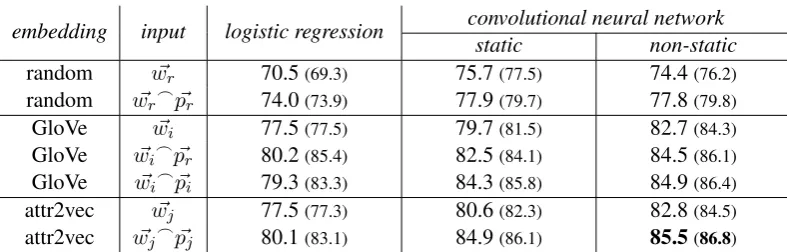
Table 1: Average F1 score (and precision in parentheses) for topic prediction on theReuters-21578dataset.w~_~p
indicates the concatenation of word and POS tag vectors.w~rrefer to randomly initialized word vectors andp~rto
randomly initialized POS tag vector. w~iandp~irespectively refer to vectors independently trained with the GloVe
model for words and POS tags;w~jandp~jrespectively refer to vectors jointly trained with attr2vec for words and
POS tags.
first applied a heuristic filtering approach to ex-clude non-textual documents, resulting in a col-lection of∼8M news articles (∼3B tokens). We
then performed tokenization, part-of-speech tag-ging, and syntactic dependency parsing on the corpus using NLP4J2 (Choi et al., 2015; Choi, 2016). The POS tagger achieves an accuracy score of 97.64% (Choi, 2016), the dependency parser achieve a label accuracy score of 94.94% (Choi et al., 2015). As a baseline we considered 200-dimensional GloVe vectors trained on the corpus using the code and hyperparameters ofPennington et al.(2014). In particular, we usedymax = 100
andα= 3/4for all our experiments.
4.2 Topic Classification Experiment
Experimental Setup For this experiment we trained 200-dimensional attr2vec vectors using part-of-speech tags as additional contextual infor-mation and a linear bag-of-words approach - i.e., each row in the feature matrix consists of a pair of words and the corresponding pair of POS tags (see the first two groups of columns for the exam-ple in Figure1). We used the same hyperparam-eters as in GloVe. To make a fair comparison we trained two independent GloVe models, one to ob-tain word vectors (w~i) and one to obtain POS tag
vectors (p~i). The latter model is trained by
sub-stituting each word in the corpus with the corre-sponding POS tag. Note that our attr2vec model can jointly learn a representation for both words (w~j) and POS tags (p~j). As a baseline we also
considered randomly initialized vectors for words (w~r) and POS tags (p~r). To train attr2vec we
2https://emorynlp.github.io/nlp4j
used a modified version3 of tffm (Trofimov and Novikov,2016), an open-source TensorFlow im-plementation of Factorization Machines.
To evaluate the performance of the attr2vec model, we used the trained vectors as input for a convolutional neural network (CNN). We used the CNN architecture described by Kim (2014), in particular a modified version of the Tensor-Flow implementation in Britz (2015), where we add support for pre-trained embeddings. As hy-perparameters, we used a batch size of128 train-ing samples, no dropout, one layer, filter windows of3,4,5with100feature maps each. We trained using the Adam optimizer and a learning rate of 0.001and let the models train for100epochs (an epoch is an iteration over all the training points). We executed three independent runs for each ex-periment and we report averaged results.
As a benchmark we used the following text clas-sification task: predict all the topic codes asso-ciated with an article using the first τ tokens in
the article. We used theReuters-215784 dataset.
This corpus contains10788news documents clas-sified into90topics. We used the provided train-ing/test split. For each document, we considered the firstτ = 250tokens as input text for the CNN. Note that, in contrast to other previous work (Li et al., 2016), we consider all topics and formu-late a multi-label classification problem. For each test article we computed precision, recall and F1 score comparing the actual topic codes and those predicted by the CNN. As evaluation metrics we used the average F1 score and the average
preci-3Source code available at https://github.com/
thomsonreuters/attr2vec
sion across all test articles.
We trained multiple CNN models, using either word vectors (w~) or the concatenation of word
and POS tag vectors (w~_~p) as inputs, and
keep-ing these vectorsstatic throughout training or al-lowing the CNN to update them via backpropaga-tion (non-static). We also considered logistic re-gression as baseline method, using averaged vec-tors calculated over the input text as features, as in Zhang and Wallace(2015). As this is a multilabel task, we used the one-vs-all formulation of logis-tic regression, which attempts to fit one classifier per class with each class being fitted against all other classes. L1 regularization was applied with a weight of0.005.
Results Table1reports the result of our experi-ments. Each entry shows the average F1 score and the average precision in parentheses.
First note that the CNN model consistently out-performs logistic regression for all considered set-tings. The CNN performance improves if it re-ceives as input pre-trained vectors as opposed to random ones, consistently with other works (Kim, 2014). The performance is comparable when GloVe or attr2vec word vectors are used as input.
The key advantage of our attr2vec model over GloVe is demonstrated when additional contex-tual information is considered in the CNN model. The performance of the CNN model improves if POS vectors are considered together with GloVe word vectors in input, both when such POS vec-tors are randomly initialized (w~i_p~r) and
inde-pendently trained with the GloVe model (w~i_p~i).
However, the best performance is achieved when word and POS tags vectors are jointly trained with our attr2vec model (w~j_p~j).
[image:7.595.316.506.78.223.2]Note that the aim of the paper was not to show that POS tags help for text classification tasks (to that end, an exhaustive exploration of the parame-ter space would have been needed); instead, the goal of this work is to introduce a new embed-ding model that jointly learns a representation for words and POS tags, capturing the interaction be-tween them, and to show that such representation is beneficial for a CNN with respect to embed-dings learned in an independent fashion, given the same network settings. Standard embedding mod-els (like GloVe), in fact, can capture either the interactions between words or between POS tags in an independent fashion. Our attr2vec model, in addition, captures the cross-interaction between
Figure 3: Recall-precision curve when attempting to rank the similar words above the related ones on the
WordSim353dataset.
words and contextual attributes, jointly learning their representation, and our results suggest that this additional information is beneficial for the performance of the CNN model. Moreover, note that our attr2vec algorithm, unlike GloVe, can han-dle generic contextual information.
4.3 Word Similarity Experiment
In our second experiment we wanted to ad-dress if our attr2vec model was able to produce dependency-based embeddings that exhibit more functional similarity than GloVe embeddings (that usually yield broad topical similarities). To this end, we trained200-dimensional attr2vec vectors using a dependency-based approach - i.e, each row in the feature matrix consist of a word and a de-pendency label (see the example in Figure2).
Our evaluation closely follows the one inLevy and Goldberg (2014). In particular, we used theWordSim353 dataset (Finkelstein et al.,2001; Agirre et al., 2009) containing pairs of similar words that reflect either relatedness(topical sim-ilarity) or similarity (functional similarity) rela-tions. The pairs are ranked according to the co-sine similarity between the corresponding word vectors. The idea is that a model that focuses on functional similarity should rank similar pairs in the dataset above the related ones. For instance, such a model should rank the pairmoney-currency
(i.e., functionally similar words) above the pair
re-latednessone.
Figure 3 reports the result of the experiment. The attr2vec curve (orange solid line) is higher than the GloVe one (blue dashed line) and the area under the cuve is larger (0.74with respect to 0.57), suggesting that attr2vec yields more
func-tional similarities with respect to GloVe. Note that a similar behaviour has been observed in Levy and Goldberg(2014) for context-predictive mod-els (i.e., the skip-gram model with negative sam-pling). To the best of our knowledge, attr2vec is the first model that incorporates syntactic depen-dency relations in a co-occurrence counts based model (such as GloVe). Moreover, attr2vec is a general model that can handle additional arbitrary contextual information.
4.4 Qualitative Evaluation
Our final evaluation is qualitative. We trained 200-dimensional attr2vec embeddings using news topics as additional contextual information and a linear bag-of-words approach - i.e., each row in the feature matrix consists of a pair of words and the topic of the news article where such pair has been observed (see the first and the last group of columns for the example in Figure1). In particu-lar, we used the same collection of∼8Mnews ar-ticles presented in Section4.1and we considered the following two article topics: general news sto-ries (G) and sport news (SP O).
Figure 4 shows a two-dimensional projection of the200-dimensional vector space where words and topics representations lie, obtained using the
t-SNE5 visualisation technique (Maaten and Hin-ton, 2008). Here the two topic points (Gon the
left andSP O on the right of the figure) seem to
metaphorically act as “magnets”, modifying the space and forming two clusters of words. The left cluster around the representation of topic G
in-cludes general words not related to sports such as “mars”, “sound”, “warranty”, “finance”, “train”, while the right cluster around the representation of topic SP O contains words related to sports such as “football”, “coach”, “game”, “stadium”, “cricket”. Words that are related with both gen-eral news stories and sport news lie somewhere in the middle between these two clusters. Exam-ples of such words include “penalties”, “transfer”, “medical”, “goal”, “supporters”. Note that there are other attractive and repulsive forces in the
vec-5We used the TensorBoard implementation oft-SNE.
Figure 4: Two-dimensional projection of the 200
-dimensional vector space, that contains representations
of both words and topics, using t-SNE. In particular,
we considered two topics: general news stories (G) and
sport news (SP O).
tor space driven by word similarity, and that a two-dimensional representation is only able to capture a small portion of all relations that take place in the higher dimensional space.
5 Conclusions
In this paper, we proposed attr2vec, a novel em-bedding model that can jointly learn a distributed representation for words and contextual attributes. Our model is general and can handle multiple ar-bitrary contextual information simultaneously. To do so, we defined a novel loss function based on factorization machines. Moreover, attr2vec can mimic existing word embedding algorithms when no additional contextual information is consid-ered. In particular, GloVe is a special case of our model.
We have presented an experimental study where we considered POS tags as additional contextual information, and fed a convolutional neural net-work (CNN) with both word and POS tag vectors. The results suggest that the CNN prediction per-formance improves when word and context vec-tors are jointly learned by our attr2vec model. In addition, we described how to train dependency-based attr2vec embeddings and showed that they produce different kinds of similarities. We also provided some insights into how the vector space is affected by contextual attributes, which seem to act like “magnets” that attract or repulse words, that are themselves subject to attractive or repul-sive forces driven by similarity.
[image:8.595.308.526.62.208.2]in-creased, and the computational cost is increased compared to a model that does not use contex-tual information. Each additional attribute may furthermore introduce its own noise (component-specific errors) into the process. Nevertheless, the overall improvement can help in tasks where qual-ity is of the utmost importance and high-qualqual-ity annotation components are available.
In future work, we aim to investigate the effect of adding different contextual information, and we plan to test the resulting models in various appli-cations.
References
Eneko Agirre, Enrique Alfonseca, Keith Hall, Jana Kravalova, Marius Pas¸ca, and Aitor Soroa. 2009. A study on similarity and relatedness using
distribu-tional and WordNet-based approaches. In
Proceed-ings of Human Language Technologies: The 2009 Annual Conference of the North American Chapter of the Association for Computational Linguistics.
Parminder Bhatia, Robert Guthrie, and Jacob Eisen-stein. 2016. Morphological Priors for
Probabilis-tic Neural Word Embeddings. InProceedings of the
2016 Conference on Empirical Methods in Natural Language Processing.
Piotr Bojanowski, Edouard Grave, Armand Joulin, and Tomas Mikolov. 2017. Enriching Word Vectors with
Subword Information. Transactions of the
Associa-tion for ComputaAssocia-tional Linguistics5:135–146.
Denny Britz. 2015. Implementing a CNN
for Text Classification in Tensorflow.
https://github.com/dennybritz/
cnn-text-classification-tf.
Danqi Chen and Christopher D. Manning. 2014. A Fast and Accurate Dependency Parser using Neural
Net-works. InProceedings of the 2014 Conference on
Empirical Methods in Natural Language Process-ing.
Jinho D Choi. 2016. Dynamic Feature Induction: The
Last Gist to the State-of-the-Art. InProceedings of
the 2016 Conference of the North American Chap-ter of the Association for Computational Linguistics: Human Language Technologies.
Jinho D Choi, Joel Tetreault, and Amanda Stent. 2015. It depends: Dependency parser comparison using a
web-based evaluation tool. In Proceedings of the
53rd Annual Meeting of the Association for Compu-tational Linguistics and the 7th International Joint Conference on Natural Language Processing.
Luciano del Corro, Abdalghani Abujabal, Rainer
Gemulla, and Gerhard Weikum. 2015. Finet:
Context-aware fine-grained named entity typing. In
Proceedings of the 2015 Conference on Empirical Methods in Natural Language Processing.
Ryan Cotterell and Hinrich Sch¨utze. 2015.
Morpho-logical Word-Embeddings. In Proceedings of the
2015 Conference of the North American Chapter of the Association for Computational Linguistics: Hu-man Language Technologies.
Lev Finkelstein, Evgeniy Gabrilovich, Yossi Matias, Ehud Rivlin, Zach Solan, Gadi Wolfman, and Ey-tan Ruppin. 2001. Placing search in context: The
concept revisited. InProceedings of the 10th
inter-national conference on World Wide Web.
Mercedes Garc´ıa-Mart´ınez, Lo¨ıc Barrault, and Fethi Bougares. 2017. Neural Machine Translation by
Generating Multiple Linguistic Factors. In
Inter-national Conference on Statistical Language and Speech Processing.
Ignacio Iacobacci, Mohammad Taher Pilehvar, and
Roberto Navigli. 2015. SensEmbed: Learning
Sense Embeddings for Word and Relational
Simi-larity. InProceedings of the 53rd Annual Meeting of
the Association for Computational Linguistics and the 7th International Joint Conference on Natural Language Processing.
Shihao Ji, Hyokun Yun, Pinar Yanardag, Shin Mat-sushima, and SVN Vishwanathan. 2016. Wordrank:
Learning word embeddings via robust ranking.
Pro-ceedings of the 2016 Conference on Empirical Meth-ods in Natural Language Processing.
Armand Joulin, Edouard Grave, Piotr Bojanowski, and Tomas Mikolov. 2017. Bag of Tricks for Efficient
Text Classification. InProceedings of the 15th
Con-ference of the European Chapter of the Association for Computational Linguistics.
Yoon Kim. 2014. Convolutional Neural Networks for
Sentence Classification. InProceedings of the 2014
Conference on Empirical Methods in Natural Lan-guage Processing.
Philipp Koehn and Hieu Hoang. 2007. Factored
Trans-lation Models. In Proceedings of the 2007 joint
conference on empirical methods in natural guage processing and computational natural lan-guage learning.
Omer Levy and Yoav Goldberg. 2014.
Dependency-Based Word Embeddings. In Proceedings of the
52nd Annual Meeting of the Association for Com-putational Linguistics.
Omer Levy, Yoav Goldberg, and Israel Ramat-Gan. 2014. Linguistic Regularities in Sparse and
Ex-plicit Word Representations. InProceedings of the
eighteenth conference on computational natural lan-guage learning.
Shaohua Li, Tat-Seng Chua, Jun Zhu, and Chunyan Miao. 2016. Generative Topic Embedding: a
Con-tinuous Representation of Documents. In
Proceed-ings of the 54th Annual Meeting of the Association for Computational Linguistics.
Minh-Thang Luong and Christopher D. Manning. 2016. Achieving Open Vocabulary Neural Machine Translation with Hybrid Word-Character Models. In
Proceedings of the 54th Annual Meeting of the As-sociation for Computational Linguistics.
Thang Luong, Richard Socher, and Christopher D Manning. 2013. Better Word Representations with Recursive Neural Networks for Morphology. In
Proceedings of the Seventeenth Conference on Com-putational Natural Language Learning.
Laurens van der Maaten and Geoffrey Hinton. 2008.
Visualizing data using t-SNE. Journal of Machine
Learning Research9(Nov):2579–2605.
Oren Melamud, David McClosky, Siddharth Patward-han, and Mohit Bansal. 2016. The Role of Context Types and Dimensionality in Learning Word
Em-beddings. InProceedings of The 15th Annual
Con-ference of the North American Chapter of the Asso-ciation for Computational Linguistics: Human Lan-guage Technologies.
Tomas Mikolov, Kai Chen, Greg Corrado, and Jeffrey Dean. 2013a. Efficient Estimation of Word
Repre-sentations in Vector Space. ICLR Workshop.
Tomas Mikolov, Ilya Sutskever, Kai Chen, Greg S Cor-rado, and Jeff Dean. 2013b. Distributed Representa-tions of Words and Phrases and their
Composition-ality. InAdvances in neural information processing
systems. pages 3111–3119.
Tomas Mikolov, Wen-tau Yih, and Geoffrey Zweig. 2013c. Linguistic Regularities in Continuous Space
Word Representations. InProceedings of the 2013
Conference of the North American Chapter of the Association for Computational Linguistics: Human Language Technologies.
Andriy Mnih and Koray Kavukcuoglu. 2013. Learning word embeddings efficiently with noise-contrastive
estimation. InAdvances in Neural Information
Pro-cessing Systems. pages 2265–2273.
Arvind Neelakantan, Jeevan Shankar, Alexandre Pas-sos, and Andrew McCallum. 2015. Efficient Non-parametric Estimation of Multiple Embeddings per
Word in Vector Space. Proceedings of the 2014
Conference on Empirical Methods in Natural Lan-guage Processing.
Jeffrey Pennington, Richard Socher, and Christopher D Manning. 2014. GloVe: Global Vectors for Word
Representation. In Proceedings of the 2014
Con-ference on Empirical Methods in Natural Language Processing.
Fabio Petroni, Luciano Del Corro, and Rainer Gemulla. 2015. CORE: Context-Aware Open Relation
Ex-traction with Factorization Machines. In
Proceed-ings of the 2015 Conference on Empirical Methods in Natural Language Processing.
Mohammad Taher Pilehvar and Nigel Collier. 2016.
De-Conflated Semantic Representations.
Proceed-ings of the 2016 Conference on Empirical Methods in Natural Language Processing.
Steffen Rendle. 2012. Factorization Machines with
libFM. ACM Transactions on Intelligent Systems
and Technology (TIST)3(3):57:1–57:22.
Steffen Rendle, Zeno Gantner, Christoph
Freuden-thaler, and Lars Schmidt-Thieme. 2011. Fast
Context-aware Recommendations with
Factoriza-tion Machines. In Proceedings of the 34th
inter-national ACM SIGIR Conference on Research and development in Information Retrieval.
Ilya Sutskever, Oriol Vinyals, and Quoc V. Le. 2014. Sequence to Sequence Learning with Neural
Net-works. In Proceedings of the 27th International
Conference on Neural Information Processing Sys-tems.
Duyu Tang, Furu Wei, Nan Yang, Ming Zhou, Ting Liu, and Bing Qin. 2014. Learning Sentiment-Specific Word Embedding for Twitter Sentiment
Classification. InProceedings of the 52nd Annual
Meeting of the Association for Computational Lin-guistics.
Mikhail Trofimov and Alexander Novikov. 2016. tffm: TensorFlow implementation of an arbitrary
or-der Factorization Machine. https://github.
com/geffy/tffm.
Albert Weichselbraun, Stefan Gindl, and Arno Scharl. 2013. Extracting and Grounding Context-Aware
Sentiment Lexicons. IEEE Intelligent Systems
28(2):39–46.
John Wieting, Mohit Bansal, Kevin Gimpel, and Karen Livescu. 2016. Charagram: Embedding Words and
Sentences via Character n-grams. InProceedings of
the 2014 Conference on Empirical Methods in Nat-ural Language Processing.
Ye Zhang, Md Mustafizur Rahman, Alex Braylan, Brandon Dang, Heng-Lu Chang, Henna Kim, Quin-ten McNamara, Aaron Angert, Edward Banner, Vivek Khetan, Tyler McDonnell, An Thanh Nguyen, Dan Xu, Byron C. Wallace, and Matthew Lease. 2017. Neural Information Retrieval: A Literature
Review.arXiv preprint arXiv:1611.06792v3.
Ye Zhang and Byron Wallace. 2015. A Sensitivity Analysis of (and Practitioners’ Guide to) Convolu-tional Neural Networks for Sentence Classification.