Probabilistic CFG with latent annotations
Takuya Matsuzaki Yusuke Miyao Jun’ichi Tsujii Graduate School of Information Science and Technology, University of Tokyo
Hongo 7-3-1, Bunkyo-ku, Tokyo 113-0033
CREST, JST(Japan Science and Technology Agency) Honcho 4-1-8, Kawaguchi-shi, Saitama 332-0012
matuzaki, yusuke, tsujii @is.s.u-tokyo.ac.jp
Abstract
This paper defines a generative probabilis-tic model of parse trees, which we call PCFG-LA. This model is an extension of PCFG in which non-terminal symbols are augmented with latent variables. Fine-grained CFG rules are automatically in-duced from a parsed corpus by training a PCFG-LA model using an EM-algorithm. Because exact parsing with a PCFG-LA is NP-hard, several approximations are de-scribed and empirically compared. In ex-periments using the Penn WSJ corpus, our automatically trained model gave a per-formance of 86.6% (F , sentences 40 words), which is comparable to that of an unlexicalized PCFG parser created using extensive manual feature selection.
1 Introduction
Variants of PCFGs form the basis of several broad-coverage and high-precision parsers (Collins, 1999; Charniak, 1999; Klein and Manning, 2003). In those parsers, the strong conditional independence as-sumption made in vanilla treebank PCFGs is weak-ened by annotating non-terminal symbols with many ‘features’ (Goodman, 1997; Johnson, 1998). Exam-ples of such features are head words of constituents, labels of ancestor and sibling nodes, and subcatego-rization frames of lexical heads. Effective features and their good combinations are normally explored using trial-and-error.
This paper defines a generative model of parse trees that we call PCFG with latent annotations (PCFG-LA). This model is an extension of PCFG models in which non-terminal symbols are anno-tated with latent variables. The latent variables work just like the features attached to non-terminal sym-bols. A fine-grained PCFG is automatically induced from parsed corpora by training a PCFG-LA model using an EM-algorithm, which replaces the manual feature selection used in previous research.
The main focus of this paper is to examine the effectiveness of the automatically trained models in parsing. Because exact inference with a PCFG-LA, i.e., selection of the most probable parse, is NP-hard, we are forced to use some approximation of it. We empirically compared three different approximation methods. One of the three methods gives a perfor-mance of 86.6% (F , sentences 40 words) on the standard test set of the Penn WSJ corpus.
Utsuro et al. (1996) proposed a method that auto-matically selects a proper level of generalization of non-terminal symbols of a PCFG, but they did not report the results of parsing with the obtained PCFG. Henderson’s parsing model (Henderson, 2003) has a similar motivation as ours in that a derivation history of a parse tree is compactly represented by induced hidden variables (hidden layer activation of a neu-ral network), although the details of his approach is quite different from ours.
2 Probabilistic model
PCFG-LA is a generative probabilistic model of parse trees. In this model, an observed parse tree is considered as an incomplete data, and the
: :
the
cat
!"#
!$%
grinned
the
cat
!
!
[image:2.612.79.290.54.129.2]grinned
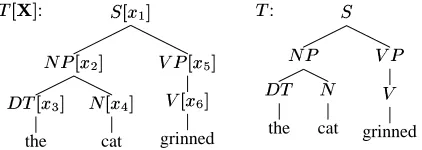
Figure 1: Tree with latent annotations&(')+* (com-plete data) and observed tree& (incomplete data).
sponding complete data is a tree with latent
annota-tions. Each non-terminal node in the complete data
is labeled with a complete symbol of the form,-'./*, where , is the non-terminal symbol of the corre-sponding node in the observed tree and. is a latent
annotation symbol, which is an element of a fixed
set0 .
A complete/incomplete tree pair of the sentence, “the cat grinned,” is shown in Figure 2. The com-plete parse tree, &(')+* (left), is generated through a process just like the one in ordinary PCFGs, but the non-terminal symbols in the CFG rules are anno-tated with latent symbols,)2143.
65 .87
5:9:9:9<;. Thus, the probability of the complete tree (&(')+*) is
=
3>&-')?*;
1A@"3CB$'.DE*;FHG 3CB'.IE*KJML
=
'. 7 *N
=
'.POK*;
FQG 3RL
=
'.P7K*KJMST&-'.8UK*VLW'.YXK*;
FQG 3RS?&('.PUK*KJ[Z]\8^ ;F_G 3RL`'.8X<*KJMa<bcZ ;
FQG 3CN
=
'.
O
*KJdNe'.8fg* ;FHG
3CNe'.PfK*KJihcjkClmlD^6n ;g5
where@"3CB'. *; denotes the probability of an occur-rence of the symbol B$'. * at a root node and G 3j ; denotes the probability of a CFG rulej . The proba-bility of the observed tree=
3>& ; is obtained by sum-ming =
3>&(')+*
; for all the assignments to latent an-notation symbols,) :
=
3>& ; 1po
q
Ers
o
q
trs_u:u:u
o
q
% rs
=
3>&(')+*;g9 (1)
Using dynamic programming, the theoretical bound of the time complexity of the summation in Eq. 1 is reduced to be proportional to the number of non-terminal nodes in a parse tree. However, the cal-culation at nodel still has a cost that exponentially grows with the number ofl ’s daughters because we must sum up the probabilities of v0wvyx{z
combina-tions of latent annotation symbols for a node with
n daughters. We thus took a kind of transforma-tion/detransformation approach, in which a tree is binarized before parameter estimation and restored to its original form after parsing. The details of the binarization are explained in Section 4.
Using syntactically annotated corpora as training data, we can estimate the parameters of a PCFG-LA model using an EM algorithm. The algorithm is a special variant of the inside-outside algorithm of Pereira and Schabes (1992). Several recent work also use similar estimation algorithm as ours, i.e, inside-outside re-estimation on parse trees (Chiang and Bikel, 2002; Shen, 2004).
The rest of this section precisely defines PCFG-LA models and briefly explains the estimation algo-rithm. The derivation of the estimation algorithm is largely omitted; see Pereira and Schabes (1992) for details.
2.1 Model definition
We define a PCFG-LA | as a tuple | 1
}
L~t
5
L
5
0
5t-5
@
5EG, where
L
~{ a set of observable non-terminal symbols
L a set of terminal symbols
0 a set of latent annotation symbols
a set of observable CFG rules
@"3R,('.Y* ; the probability of the occurrence of a complete symbol,('.Y* at a root node
G 3j ; the probability of a rulej '0*9 We use , 5te5:9:9:9 for non-terminal symbols in
L~t; :5 7 5:9:9:9 for terminal symbols in L( ; and . 5EP5:9:9:9 for latent annotation symbols in 0 .
L~t<'0* denotes the set of complete non-terminal symbols, i.e.,L(~{<'0*I1,('.Y*v,dL~{ 5 .0 . Note that latent annotation symbols are not attached to terminal symbols.
In the above definition, is a set of CFG rules of observable (i.e., not annotated) symbols. For simplicity of discussion, we assume that is a CNF grammar, but extending to the general case is straightforward. '0* is the set of CFG rules of complete symbols, such as N+'./*J grinned or
B$'.Y*KJML
=
' *N
=
'*. More precisely,
'0*P1i 3R,('.Y*mJ
;
v3R,HJ[
;
-
.0
We assume that non-terminal nodes in a parse tree
& are indexed by integers k1 5:9:9:95E , starting from the root node. A complete tree is denoted by
&(')+*, where ) 1 3. 65:9:9:95 .Y¡ ; d0
¡
is a vec-tor of latent annotation symbols and.m¢ is the latent annotation symbol attached to thek-th non-terminal node.
We do not assume any structured parametrizations in G and
@ ; that is, each
G
3j
;
3j£
'0_* ; and @"3R,-'./* ; 3R,-'./*_L ~{ '0*; is itself a parameter to be tuned. Therefore, an annotation symbol, say,. , gen-erally does not express any commonalities among the complete non-terminals annotated by. , such as
,-'./* 5t './* 5 ^6Za .
The probability of a complete parse tree &-')?* is defined as
=
3>&(')+*; 1A@"3R, '. *; ¤
¥
r¦¨§ ©ªY«
G 3j ;g5 (2)
where , '. * is the label of the root node of &(')+* and S(¬D®Q¯ denotes the multiset of annotated CFG rules used in the generation of&(')+*. We have the probability of an observable tree& by marginalizing out the latent annotation symbols in&(')+*:
=
3>&
;
1
o
°
rs ±
@"3R,'.IE* ; ¤
¥
r¦¨§ ©ª/«
G
3j
;g5 (3)
where is the number of non-terminal nodes in& .
2.2 Forward-backward probability
The sum in Eq. 3 can be calculated using a dynamic programming algorithm analogous to the forward al-gorithm for HMMs. For a sentence 7 9:9:9 $² and its parse tree & , backward probabilities ³
¢
¬
3.
;
are recursively computed for the k-th non-terminal node and for each .A´0 . In the definition below,
L ¢ L~t denotes the non-terminal label of thek-th node.
µ
If nodek is a pre-terminal node above a termi-nal symbol¶ , then³
¢
¬
3. ; 1 G 3RL ¢ './*·J ¶ ; .
µ
Otherwise, let ¸ and ¹ be the two daughter nodes ofk. Then
³
¢
¬
3. ; 1 o q{º6»q¼
rs
G 3RL ¢ './*KJL¶ '.¶K*VL(½'.P½6*;
F ³
¶
¬
3.¶ ; ³
½
¬
3.P½ ;g9
Using backward probabilities, 3>& ; is calculated as
=
3>& ; 1¿¾
q
rs
@"3RL '. *; ³
¬
3. K;. We define forward probabilitiesÀ
¢
¬
3. ;, which are used in the estimation described below, as follows:
µ
If node k is the root node (i.e., k = 1), then
À
¢
¬
3. ; 1A@"3RL ¢ '.Y*; .
µ
If node k has a right sibling ¹ , let ¸ be the mother node ofk. Then
À
¢
¬ 3. ; 1 o q{º<»q¼
rs
G 3RL¶c'.Á¶K*KJML ¢ '.Y*VL½Á'.8½*;
F À
¶
¬
3.¶ ; ³
½
¬
3.P½ ;g9
µ
If node k has a left sibling, À
¢
¬
3. ; is defined analogously.
2.3 Estimation
We now derive the EM algorithm for PCFG-LA, which estimates the parametersÂ13G"5 @ ; . LetÃ[1
:& 65 &·7 5:9:9:9 be the training set of parse trees and
L
¢
5:9:9:95 L
¢
¡Ä be the labels of non-terminal nodes in &·¢. Like the derivations of the EM algorithms for other latent variable models, the update formulas for the parameters, which update the parameters from to ÂÅ1Æ3G Å5 @·Å;, are obtained by constrained opti-mization ofÇT3R Åv ; , which is defined as
ÇT3RÂ
Å
v ; 1 o
¬
Ä
rÉÈ
o
®
Ä
rs ±
Ä
=Ê
3R) ¢ v& ¢;ËÍÌÎ =Ê]Ï
3>& ¢ ') ¢*;g5
where =Ê
and =Ê Ï
denote probabilities under  and
 Å, and
=
3R)v& ; is the conditional probability of la-tent annotation symbols given an observed tree & , i.e., =
3R)v& ; 1
=
3>&-')?*;EÐ
=
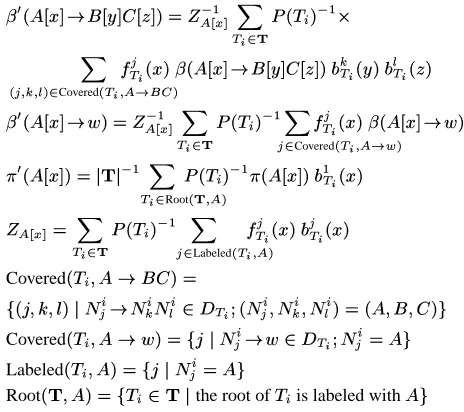
3>& ; . Using the La-grange multiplier method and arranging the re-sults using the backward and forward probabilities, we obtain the update formulas in Figure 2.
3 Parsing with PCFG-LA
In theory, we can use PCFG-LAs to parse a given sentence by selecting the most probable parse:
&·ÑÓÒ]ÔÕ¨1AÖ× ÎØ
ÖÉÙ
¬
rÚ¨ÛÝÜmÞ
=
3>&-v
;
1AÖ× ÎØ
ÖÉÙ
¬
rÚ¨ÛßÜ·Þ
=
3>&
;g5 (4)
where àT3 ; denotes the set of possible parses for
á Ïâäã
Éæåçè6ßéêgßëì_íQî
ï ©ð]«Dñ §tòCógô â Ä ëæî <õ ñ ö
ºæ÷¼ ÷øyù
ó Coveredö § ò ÷ ï ú"û ü ù ý º § ò â ë á âäã
Éæåçþè:ßéêgßëÿ
¼ § ò â èÉëÿ ø § ò â ê<ë á Ïâäã ÉæåëÁì_íQî ï ©ð]«Dñ § òógô
â Ä ëæî ñ º ó Covered ö §{ò ÷ ïcú ù ý º § ò â ë á âäã Éæåë Ï>âäã
ë/ìî
ñ
§ òó Root
ö
ô
÷ï ù
â Ä ëæî âäã Éßëÿ §tò â ë í ï ©ð]« ì ñ § ò óKô â Ä ë î ñ º ó Labeled ö § ò ÷ï ù
ý º § ò â ëÁÿ º § ò â ë Covered â Ä ã åiçéQë/ì â ëK Ä º å Ä ¼ Ä ø § ò â Ä º Ä ¼ Ä ø ë/ì âäã ç éQë Covered â Ä ã åë/ì { Ä º å § ò Ä º ì ã Labeled â Ä ã ë/ì K Ä º ì ã Root â ã ë/ì Ä
the root of
Ä is labeled with
ã
[image:4.612.69.301.65.271.2]
Figure 2: Parameter update formulas.
for PCFGs using dynamic programming algorithms, the sum-of-products form of
=
3>& ; in PCFG-LA models (see Eq. 2 and Eq. 3) makes it difficult to apply such techniques to solve Eq. 4.
Actually, the optimization problem in Eq. 4 is NP-hard for general PCFG-LA models. Although we omit the details, we can prove the NP-hardness by observing that a stochastic tree substitution grammar (STSG) can be represented by a PCFG-LA model in a similar way to one described by Goodman (1996a), and then using the NP-hardness of STSG parsing (Sima´an, 2002).
The difficulty of the exact optimization in Eq. 4 forces us to use some approximations of it. The rest of this section describes three different approxima-tions, which are empirically compared in the next section. The first method simply limits the number of candidate parse trees compared in Eq. 4; we first create N-best parses using a PCFG and then, within the N-best parses, select the one with the highest probability in terms of the PCFG-LA. The other two methods are a little more complicated, and we ex-plain them in separate subsections.
3.1 Approximation by Viterbi complete trees
The second approximation method selects the best
complete tree& Å') Å*, that is,
&
Å
')
Å
*·1 Ö× ÎØ ÖÉÙ
¬ rÚ¨ÛÝÜmÞ » ® rs ª =
3>&(')+*;g9 (5)
We call& ÅÓ')+ÅÝ* a Viterbi complete tree. Such a tree can be obtained in T3tvv
U
; time by regarding the PCFG-LA as a PCFG with annotated symbols.1
The observable part of the Viterbi complete tree &þÅÓ')eÅß* (i.e., & Å) does not necessarily coin-cide with the best observable tree &¨ÑÓÒ]ÔCÕ in Eq. 4. However, if &mÑÓÒ]ÔÕ has some ‘dominant’ assign-ment to its latent annotation symbols such that =
3>&mÑÓÒ]ÔCÕt'* ;
=
3>&mÑÓÒÔÕ
; , then
=
3>& Å ;!
=
3>&mÑÓÒÔÕ ; because
=
3>&mÑÓÒ]ÔCÕt'_*;
=
3>&þÅÓ')eÅÝ*; and
=
3>& Å') Å*;
=
3>& Å;, and thus & Å and &mÑÓÒ]ÔÕ are al-most equally ‘good’ in terms of their marginal prob-abilities.
3.2 Viterbi parse in approximate distribution
In the third method, we approximate the true dis-tribution=
3>&-v ; by a cruder distribution ÇT3>&v ;, and then find the tree with the highest Ç?3>&-v ; in polynomial time. We first create a packed repre-sentation of àT3 ; for a given sentence .
2 Then,
the approximate distribution ÇT3>&v ; is created us-ing the packed forest, and the parameters inÇT3>&-v ; are adjusted so that ÇT3>&-v ; approximates
=
3>&-v ; as closely as possible. The form of ÇT3>&v ; is that of a product of the parameters, just like the form of a PCFG model, and it enables us to use a Viterbi al-gorithm to select the tree with the highestÇT3>&v
; . A packed forest is defined as a tuple
}"
5$#É . The first component,
"
, is a multiset of chart items of the form 3R,
5
³
5
^
;. A chart item 3R, 5 ³ 5 ^ ; " indicates that there exists a parse tree inà3 ; that contains a constituent with the non-terminal label, that spans
1For efficiency, we did not actually parse sentences with
%&
but selected a Viterbi complete tree from a packed rep-resentation of candidate parses in the experiments in Section 4.
2
In practice, fully constructing a packed representation of
'
â
ë
has an unrealistically high cost for most input sentences. Alternatively, we can use a packed representation of a subset of
'
â
ë
, which can be obtained by parsing with beam
thresh-olding, for instance. An approximate distribution(
â
)ë
on such subsets can be derived in almost the same way as one for
the full'
â
ë
, but the conditional distribution,
â
* ë
ç
é
D
+
é
ç
D
+
I
,ì
-
-#
-% -
ì
âäã /0 1
ë
-
ì
â
ç
/0 2
ë
-
ì
â
ç
23 1
ë
,
- Dì
â
é
/4 / ë -#Dì
â
526 2 ë
-%
ì
â
+
17 1
ë
8
â
- ëYì
â
- -%të
â
- - ë
8
â
-EëYì
â
- -#Eë 8
â
-të/ì
â
-#
-% ë
8
â
të/ì
9 8
â
-#]ëYì
D. 8
â
-% ë/ì
[image:5.612.101.268.55.188.2]
I$
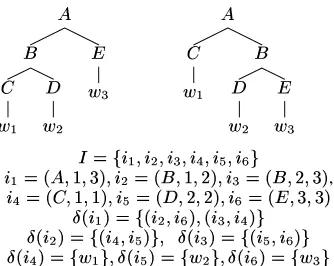
Figure 3: Two parse trees and packed representation of them.
from the³ -th to^ -th word in . The second compo-nent,# , is a function on
"
that represents dominance relations among the chart items in
"
; # 3k ; is a set of possible daughters ofk ifk is not a pre-terminal node, and # 3k ; 126þ½ ifk is a pre-terminal node above
½ . Two parse trees for a sentence 1 7KU and a packed representation of them are shown in Figure 3.
We require that each tree&Mà3 ; has a unique representation as a set of connected chart items in
"
. A packed representation satisfying the uniqueness condition is created using the CKY algorithm with the observable grammar , for instance.
The approximate distribution,ÇT3>&-v ;, is defined as a PCFG, whose CFG rules
Ü
is defined as
Ü
1 3kJ :
;
vIk-
"
:
#
3k
;
. We use ;3j
;
to denote the rule probability of rule j
Ü
and
;
¥
3k ; to denote the probability with which k-
"
is generated as a root node. We defineÇ?3>&-v ; as
ÇT3>&-v ; 1<;
¥
3k K;
¡
¤
½6=
;3k½ J>:½ ;g5
where the set of connected items 6k 65:9:9:95
kC¡@?
"
is the unique representation of& .
To measure the closeness of approximation by
ÇT3>&v ; , we use the ‘inclusive’ KL-divergence, AB
3
=
vÍvÇ ; (Frey et al., 2000):
AB
3
=
vÍvÇ
;
1
o
¬
rÚ¨ÛÝÜmÞ
=
3>&v ;ËÍÌÎ
=
3>&-v ;
ÇT3>&-v ;
9
Minimizing AB
3
=
vÍvÇ ; under the normalization
constraints on; ¥ and
; yields closed form solutions for;
¥ and
; , as shown in Figure 4.
=
inand
=
outin Figure 4 are similar to ordinary in-side/outside probabilities. We define
=
inas follows:
µ
If k1 3R, 5 ¹ 5 ¹ ;
"
is a pre-terminal node aboveþ½ , then
=
in3kg'.Y*
;
1
G
3R,-'./*IJ½ ; .
µ
Otherwise,
=
in3kg'.Y*; 1 o
¶ ½ rDC{Û
¢
Þ
o
E»F rs
G 3R,-'./*KJ ¶' *½'*;
F
=
in3͸8' *;
=
in3Ó¹m'*;g5
where ¶ and½ denote non-terminal symbols of chart items¸ and¹ .
The outside probability,=
out, is calculated using
=
in and PCFG-LA parameters along the packed struc-ture, like the outside probabilities for PCFGs.
Once we have computed;3kmJG: ; and ;
¥
3k ;, the parse tree& that maximizes ÇT3>&-v
; is found using a Viterbi algorithm, as in PCFG parsing.
Several parsing algorithms that also use inside-outside calculation on packed chart have been pro-posed (Goodman, 1996b; Sima´an, 2003; Clark and Curran, 2004). Those algorithms optimize some evaluation metric of parse trees other than the pos-terior probability
=
3>&-v ; , e.g., (expected) labeled constituent recall or (expected) recall rate of depen-dency relations contained in a parse. It is in contrast with our approach where (approximated) posterior probability is optimized.
4 Experiments
We conducted four sets of experiments. In the first set of experiments, the degree of dependency of trained models on initialization was examined be-cause EM-style algorithms yield different results with different initial values of parameters. In the second set of experiments, we examined the rela-tionship between model types and their parsing per-formances. In the third set of experiments, we com-pared the three parsing methods described in the pre-vious section. Finally, we show the result of a pars-ing experiment uspars-ing the standard test set.
H
If
,
is not a pre-terminal node, for eachI
ì
8
-ë
, let ç
, andé
be non-terminal symbols of
, and
. Then,
J
â
-å
I
ëìLK ðKóNM
KPO ó6M
KRQ ó6M
out
â
Éßë
á
âäã
æåçè:éêgßëR in
â
è6ßëR in
â
ê{ë
K
ðKó6M
out
â
-tëR in
â
-EÉßë S
H
If
,
is a pre-terminal node above word ¼
, thenJ
â
-å
¼
ë/ì / .
H
If
,
is a root node, let
ã
be the non-terminal symbol of
-. ThenJ.T
â
-ë/ì
/
â
ë
ñ
ðKó6M
âäã ÉßëR
in
â
Éßë
[image:6.612.315.538.203.254.2].
Figure 4: Optimal parameters of approximate distributionÇ .
U
[image:6.612.330.540.290.498.2]VXW VZY [ \ZW \]Y
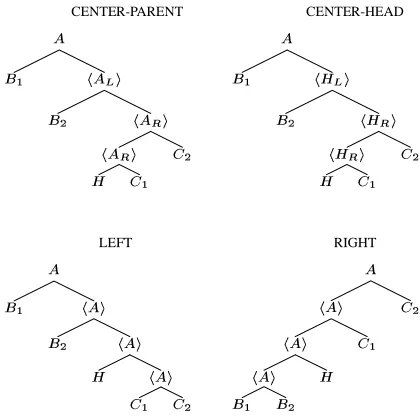
Figure 5: Original subtree.
of increase in the likelihood of the heldout data be-came lower than a certain threshold. Section 22 was used as test data in all parsing experiments except in the final one, in which section 23 was used. We stripped off all function tags and eliminated empty nodes in the training and heldout data, but any other pre-processing, such as comma raising or base-NP marking (Collins, 1999), was not done except for binarizations.
4.1 Dependency on initial values
To see the degree of dependency of trained mod-els on initializations, four instances of the same model were trained with different initial values of parameters.3The model used in this experiment was created byCENTER-PARENTbinarization and v0wv was set to 16. Table 1 lists training/heldout data log-likelihood per sentence (LL) for the four instances and their parsing performances on the test set (sec-tion 22). The parsing performances were obtained using the approximate distribution method in Sec-tion 3.2. Different initial values were shown to affect the results of training to some extent (Table 1).
3
The initial value for an annotated rule probability,
á
âäã
É å çè6ßéêgßë
, was created by randomly multiplying the maximum likelihood estimation of the corresponding PCFG
rule probability,
âäã
åiçéQë
, as follows:
á
âäã
Éåiçè:éêgßëYì_íQî
ï^._
âäã
åiçéQë
where` is a random number that is uniformly distributed in
badcfe4g 17
cfe0g
1
andí
ï
is a normalization constant.
1 2 3 4 averagehji
training LL -115 -114 -115 -114 -114h 0.41
heldout LL -114 -115 -115 -114 -114h 0.29
LR 86.7 86.3 86.3 87.0 86.6h 0.27
LP 86.2 85.6 85.5 86.6 86.0h 0.48
Table 1: Dependency on initial values.
CENTER-PARENT CENTER-HEAD
U
V W kUmlDn
VZY kUmopn
k
Umopn
[ \ZW \qY
U
V W k[ lrn
VZY k[ o]n
k[ opn
[ \ZW \qY
LEFT RIGHT
U
VXW k Umn
VZY k Umn
[ k
Umn
\ W \ Y
U
k
Umn
k
Umn
k
Umn
V W V Y
[
\ZW \qY
Figure 6: Four types of binarization (H: head daugh-ter).
4.2 Model types and parsing performance
We compared four types of binarization. The orig-inal form is depicted in Figure 5 and the results are shown in Figure 6. In the first two methods, called
72 74 76 78 80 82 84 86
10000 100000 1e+06 1e+07 1e+08
F1
# of parameters CENTER-PARENT
[image:7.612.74.297.58.215.2]CENTER-HEAD RIGHT LEFT
Figure 7: Model size vs. parsing performance.
The relationships between the number of param-eters in the models and their parsing performances are shown in Figure 7. Note that models created using different binarization methods have different numbers of parameters for the same v0wv. The pars-ing performances were measured uspars-ing F scores of the parse trees that were obtained by re-ranking of 1000-best parses by a PCFG.
We can see that the parsing performance gets bet-ter as the model size increases. We can also see that models of roughly the same size yield similar perfor-mances regardless of the binarization scheme used for them, except the models created usingLEFT bi-narization with small numbers of parameters (v0Wvc1
ands ). Taking into account the dependency on ini-tial values at the level shown in the previous exper-iment, we cannot say that any single model is supe-rior to the other models when the sizes of the models are large enough.
The results shown in Figure 7 suggest that we could further improve parsing performance by in-creasing the model size. However, both the memory size and the training time are more than linear inv0wv, and the training time for the largest (v0wv1[3w ) mod-els was about 15 hours for the modmod-els created us-ingCENTER-PARENT,CENTER-HEAD, andLEFT
and about 20 hours for the model created using
RIGHT. To deal with larger (e.g., v0wv = 32 or 64) models, we therefore need to use a model search that reduces the number of parameters while maintaining the model’s performance, and an approximation dur-ing traindur-ing to reduce the traindur-ing time.
84 84.5 85 85.5 86 86.5
0 1 2 3 4 5 6 7 8 9 10
F1
[image:7.612.316.532.59.214.2]parsing time (sec) N-best re-ranking Viterbi complete tree approximate distribution
Figure 8: Comparison of parsing methods.
4.3 Comparison of parsing methods
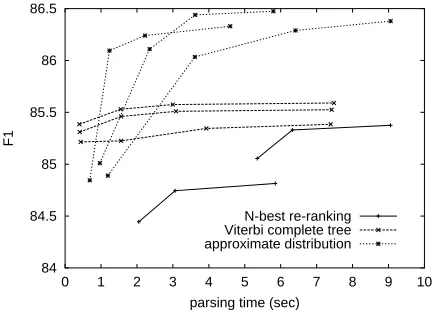
The relationships between the average parse time and parsing performance using the three parsing methods described in Section 3 are shown in Fig-ure 8. A model created using CENTER-PARENT
withv0Wvc1[3w was used throughout this experiment. The data points were made by varying config-urable parameters of each method, which control the number of candidate parses. To create the candi-date parses, we first parsed input sentences using a PCFG4, using beam thresholding with beam width
x
. The data points on a line in the figure were cre-ated by varying x
with other parameters fixed. The first method re-ranked theL -best parses enumerated from the chart after the PCFG parsing. The two lines for the first method in the figure correspond to L = 100 and L = 300. In the second and the third methods, we removed all the dominance relations among chart items that did not contribute to any parses whose PCFG-scores were higher thany
=
max, where
=
max is the PCFG-score of the best parse in the chart. The parses remaining in the chart were the candidate parses for the second and the third meth-ods. The different lines for the second and the third methods correspond to different values ofy .
The third method outperforms the other two meth-ods unless the parse time is very limited (i.e., z 1
4
40 words LR LP CB 0 CB
This paper 86.7 86.6 1.19 61.1
Klein and Manning (2003) 85.7 86.9 1.10 60.3
Collins (1999) 88.5 88.7 0.92 66.7
Charniak (1999) 90.1 90.1 0.74 70.1
{
100 words LR LP CB 0 CB
This paper 86.0 86.1 1.39 58.3
Klein and Manning (2003) 85.1 86.3 1.31 57.2
Collins (1999) 88.1 88.3 1.06 64.0
[image:8.612.74.299.53.164.2]Charniak (1999) 89.6 89.5 0.88 67.6
Table 2: Comparison with other parsers.
sec is required), as shown in the figure. The superi-ority of the third method over the first method seems to stem from the difference in the number of can-didate parses from which the outputs are selected.5 The superiority of the third method over the second method is a natural consequence of the consistent use of
=
3>& ; both in the estimation (as the objective function) and in the parsing (as the score of a parse).
4.4 Comparison with related work
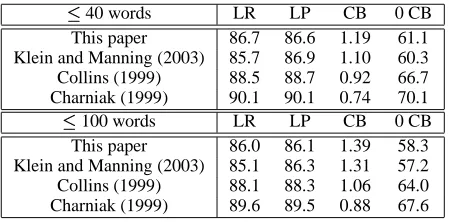
Parsing performance on section 23 of the WSJ cor-pus using a PCFG-LA model is shown in Table 2. We used the instance of the four compared in the second experiment that gave the best results on the development set. Several previously reported results on the same test set are also listed in Table 2.
Our result is lower than the state-of-the-art lex-icalized PCFG parsers (Collins, 1999; Charniak, 1999), but comparable to the unlexicalized PCFG parser of Klein and Manning (2003). Klein and Manning’s PCFG is annotated by many linguisti-cally motivated features that they found using ex-tensive manual feature selection. In contrast, our method induces all parameters automatically, except that manually written head-rules are used in bina-rization. Thus, our method can extract a consider-able amount of hidden regularity from parsed cor-pora. However, our result is worse than the lexical-ized parsers despite the fact that our model has ac-cess to words in the sentences. It suggests that cer-tain types of information used in those lexicalized
5
Actually, the number of parses contained in the packed for-est is more than 1 million for over half of the tfor-est sentences
when| =
/u}
î
and`
ì
/u}
î
, while the number of parses for which the first method can compute the exact probability in a comparable time (around 4 sec) is only about 300.
parsers are hard to be learned by our approach.
References
Eugene Charniak. 1999. A maximum-entropy-inspired parser. Technical Report CS-99-12.
David Chiang and Daniel M. Bikel. 2002. Recovering latent information in treebanks. In Proc. COLING, pages 183–189.
Stephen Clark and James R. Curran. 2004. Parsing the wsj using ccg and log-linear models. In Proc. ACL, pages 104–111.
Michael Collins. 1999. Head-Driven Statistical Models
for Natural Language Parsing. Ph.D. thesis,
Univer-sity of Pennsylvania.
Brendan J. Frey, Relu Patrascu, Tommi Jaakkola, and Jodi Moran. 2000. Sequentially fitting “inclusive” trees for inference in noisy-OR networks. In Proc.
NIPS, pages 493–499.
Joshua Goodman. 1996a. Efficient algorithms for pars-ing the DOP model. In Proc. EMNLP, pages 143–152.
Joshua Goodman. 1996b. Parsing algorithms and metric. In Proc. ACL, pages 177–183.
Joshua Goodman. 1997. Probabilistic feature grammars. In Proc. IWPT.
James Henderson. 2003. Inducing history representa-tions for broad coverage statistical parsing. In Proc.
HLT-NAACL, pages 103–110.
Mark Johnson. 1998. PCFG models of
linguis-tic tree representations. Computational Linguistics,
24(4):613–632.
Dan Klein and Christopher D. Manning. 2003. Accurate unlexicalized parsing. In Proc. ACL, pages 423–430.
Fernando Pereira and Yves Schabes. 1992.
Inside-outside reestimation from partially bracketed corpora. In Proc. ACL, pages 128–135.
Libin Shen. 2004. Nondeterministic LTAG derivation tree extraction. In Proc. TAG+7, pages 199–203.
Khalil Sima´an. 2002. Computational complexity of
probabilistic disambiguation. Grammars, 5(2):125– 151.
Khalil Sima´an. 2003. On maximizing metrics for syn-tactic disambiguation. In Proc. IWPT.
Takehito Utsuro, Syuuji Kodama, and Yuji Matsumoto.
1996. Generalization/specialization of context free
grammars based-on entropy of non-terminals. In Proc.