How Are Spelling Errors Generated and Corrected? A Study of Corrected
and Uncorrected Spelling Errors Using Keystroke Logs
Yukino Baba
The University of Tokyo
Hisami Suzuki
Microsoft Research
Abstract
This paper presents a comparative study of spelling errors that are corrected as you type, vs. those that remain uncorrected. First, we generate naturally occurring online error correction data by logging users’ keystrokes, and by automatically deriving pre- and post-correction strings from them. We then per-form an analysis of this data against the errors that remain in the final text as well as across languages. Our analysis shows a clear distinc-tion between the types of errors that are gen-erated and those that remain uncorrected, as well as across languages.
1 Introduction
When we type text using a keyboard, we generate many spelling errors, both typographical (caused by the keyboard layout and hand/finger movement) and cognitive (caused by phonetic or orthographic sim-ilarity) (Kukich, 1992). When the errors are caught during typing, they are corrected on the fly, but un-noticed errors will persist in the final text. Previ-ous research on spelling correction has focused on the latter type (which we calluncorrected errors), presumably because the errors that are corrected on the spot (referred to here as corrected errors) are not recoded in the form of a text. However, study-ing corrected errors is important for at least three reasons. First, such data encapsulates the spelling mistake and correction by the author, in contrast to the case of uncorrected errors in which the in-tended correction is typically assigned by a third person (an annotator), or by an automatic method (Whitelaw et al., 2009; Aramaki et al., 2010)1. Sec-ondly, data on corrected errors will enable us to build a spelling correction application that targets correc-tion on the fly, which directly reduces the number of keystrokes in typing. This is crucial for languages that use transliteration-based text input methods, such as Chinese and Japanese, where a spelling error in the input Roman keystroke sequence will prevent
1Using web search query logs is one notable exception,
which only targets spelling errors in search queries (Gao et al., 2010)
Keystroke
missspell misspell
Pre-correction strings Post-correction strings
m - i - s - s - s - p - BACKSPACE - BACKSPACE - p - e - l - l
Figure 1: Example of keystroke
the correct candidate words from appearing in the list of candidates in their native scripts, thereby pre-venting them from being entered altogether. Finally, we can collect a large amount of spelling errors and their corrections by logging keystrokes and extract-ing the pre- and post-correction strextract-ings from them. By learning the characteristics of corrected and un-corrected errors, we can expect to use the data for improving the correction of the errors that persisted in the final text as well.
In this paper, we collect naturally occurring spelling error data that are corrected by the users online from keystroke logs, through the crowd-sourcing infrastructure of Amazon’s Mechanical Turk (MTurk). As detailed in Section 3, we dis-play images to the worker of MTurk, and collect the descriptions of these images, while logging their keystrokes including the usage of backspace keys, via a crowd-based text input service. We collected logs for two typologically different languages, En-glish and Japanese. An example of a log along with the extracted pre- and post-correction strings is shown in Figure 1. We then performed two com-parative analyses: corrected vs. uncorrected errors in English (Section 4.3), and English vs. Japanese corrected errors (Section 4.4). Finally, we remark on an additional cause of spelling errors observed in all the data we analyzed (Section 4.5).
2 Related Work
Studies on spelling error generation mechanisms are found in earlier work such as Cooper (1983). In particular, Grudin (1983) offers a detailed study of the errors generated in the transcription typing sce-nario, where the subjects are asked to transcribe a text without correcting the errors they make. In a more recent work, Aramaki et al. (2010) automati-cally extracted error-correction candidate pairs from Twitter data based on the assumption that these pairs
fall within a small edit distance, and that the errors are not in the dictionary and substantially less fre-quent than the correctly spelled counterpart. They then studied the effect of five factors that cause er-rors by building a classifier that uses the features as-sociated with these classes and running ablation ex-periments. They claim that finger movements cause the spelling errors to be generated, but the uncor-rected errors are characterized by visual factors such as the visual similarity of confused letters. Their ex-periments however target only the persisted errors, and their claim is not based on the comparison of generated and persisted errors.
Outside of English, Zheng et al. (2011) analyzed the keystroke log of a commercial text input system for Simplified Chinese, and compared the error pat-terns in Chinese with those in English. Their use of the keystroke log is different from ours in that they did not directly log the input in pinyin (Romanized Chinese by which native characters are input), but the input pinyin sequences are recovered from the Chinese words in the native script (hanzi) after the character conversion has already applied.
3 Keystroke Data Collection
Amazon’s Mechanical Turk (MTurk) is a web ser-vice that enables crowdsourcing of tasks that are dif-ficult for computers to solve, and has become an im-portant infrastructure for gathering data and annota-tion for NLP research in recent years (Snow et al. 2008). To the extent of our knowledge, our work is the first to use this infrastructure to gather user keystroke data.
3.1 Task design
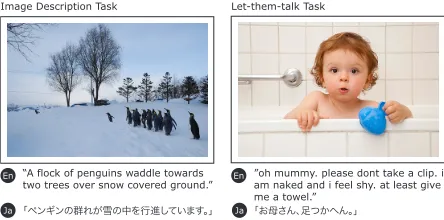
In order to collect naturally occurring keystrokes, we have designed two types of tasks, both of which consist of writing something about images. In one task type, we asked the workers to write a short description of images (image description task); in the other, the workers were presented with im-ages of a person or an animal, and were asked to guess and type what she/he was saying (let-them-talk task). Using images as triggers for typing keeps the underlying motivation of keystroke collection hidden from the workers, simultaneously allowing language-independent data collection. For the im-age triggers, we used photos from the Flickr’s Your Best Shot 2009/2010 groups . Examples of the tasks and collected text are given in Figure 2.
「ペンギンの群れが雪の中を行進しています。」 「お母さん、足つかへん。」
Image Description Task Let-them-talk Task
”oh mummy. please dont take a clip. i am naked and i feel shy. at least give me a towel.”
En “A flock of penguins waddle towards
two trees over snow covered ground.”
Ja
En
[image:2.612.308.530.65.175.2]Ja
Figure 2: Examples of tasks and collected text (Translated text: “A flock of penguines are marching in the snow.” and “Mummy, my feet can’t touch the bottom.”)
3.2 Task interface
For logging the keystrokes including the use of backspaces, we designed an original interface for the text boxes in the MTurk task. In order to simplify the interpretation of the log, we disabled the cursor movements and text highlighting via a mouse or the arrow keys in the text box; the workers are therefore forced to use the backspace key to make corrections. In Japanese, many commercially available text in-put methods (IMEs) have an auto-complete feature which prevents us from collecting all keystrokes for inputting a word. We therefore used an in-house IME that has disabled this feature to collect logs. This IME is hosted as a web service, and keystroke logs are also collected through the service. For En-glish, we used the service for log collection only.
4 Keystroke Log Analysis
4.1 Data
We used both keystroke-derived and previously available error data for our analysis.
Keystroke-derived error pairs for English and
Japanese (en keystroke, ja keystroke): from the
raw keystroke logs collected using the method de-scribed in Section 3, we extracted only those words that included a use of the backspace key. We then recovered the strings before and after correction by the following steps (Cf. Figure 1):
• To recover the post-correction string, we
deleted the same number of characters preced-ing a sequence of backspace keys.
• To recover the pre-correction string, we
com-pared the prefix of the backspace usage (misssp in Figure 1) with the substrings after error correction (miss, missp, · · ·,
(in this case,misssp is an error formissp, so the pre-correction string ismissspell). We then lower-cased the pairs and extracted only those within the edit distance of 2. The resulting data which we used for our analysis consists of 44,104 pairs in English and 4,808 pairs in Japanese2.
Common English errors (en common):
follow-ing previous work (Zheng et al., 2011), we ob-tained word pairs from Wikipedia3and SpellGood4. We lower-cased the entries from these sources, re-moved the duplicates and the pairs that included non-Roman alphabet characters, and extracted only those pairs within the edit distance of 2. This left us with 10,608 pairs.
4.2 Factors that affect errors
Spelling errors have traditionally been classified into four descriptive types: Deletion, Insertion, Substitu-tion and TransposiSubstitu-tion (Damerau, 1964). For each of these types, we investigated the potential causes of error generation and correction, following previ-ous work (Aramaki et al., 2010; Zheng et al., 2011). Physical factors: (1) motor control of hands and fin-gers; (2) distance between the keys; Visual factors: (3) visual similarity of characters; (4) position in a word; (5) same character repetition; Phonologi-cal factors: (6) phonologiPhonologi-cal similarity of charac-ters/words.
In what follows, our discussion is based on the frequency ratio of particular error types, where the frequency ratio refers to the number of cases in spelling errors divided by the total number of cases in all data. For example, the frequency ratio of con-sonant deletion is calculated by dividing the number of missing consonants in errors by the total number of consonants.
4.3 Corrected vs. uncorrected errors in English
In this subsection, we compare corrected and uncor-rected errors of English, trying to uncover what fac-tors facilitate the error correction.
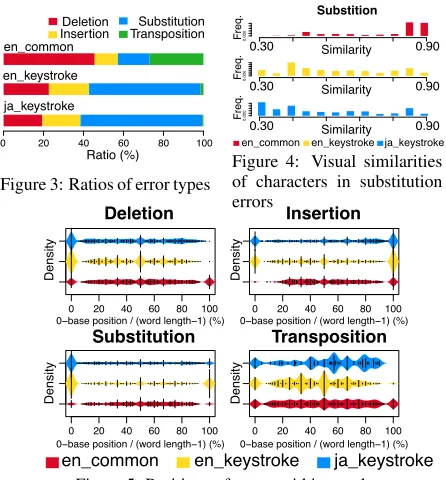
Error types (Figure 3) Errors inen keystrokeare
dominated by Substitution, while Deletion errors are the most common in en common, indicating that
2The data is available for research purposes underhttp:
//research.microsoft.com/research/downloads/ details/4eb8d4a0-9c4e-4891-8846-7437d9dbd869/ details.aspx
3http://en.wikipedia.org/wiki/Wikipedia:
Lists of common misspellings/For machines
4http://www.spellgood.net/sitemap.html
ja_keystroke en_keystroke en_common
Deletion
Insertion TranspositionSubstitution
Ratio (%)
0 20 40 60 80 100
Figure 3: Ratios of error types
Substition
Similarity Freq.0.000
Similarity Freq.0.000
Similarity Freq.0.000
0.30 0.90
0.30 0.90
0.30 0.90
en_keystroke ja_keystroke en_common
Figure 4: Visual similarities of characters in substitution errors
0 20 40 60 80 100
Deletion
0−base position / (word length−1) (%)
Density
0 20 40 60 80 100
Insertion
0−base position / (word length−1) (%)
Density
0 20 40 60 80 100
Substitution
0−base position / (word length−1) (%)
Density
0 20 40 60 80 100
Transposition
0−base position / (word length−1) (%)
Density
en_keystroke ja_keystroke
[image:3.612.308.531.64.304.2]en_common
Figure 5: Positions of errors within words
Substitution mistakes are easy to catch, while Dele-tion mistakes tend to escape our attenDele-tion. Zheng et al. (2011) reports that their pinyin correction er-rors are dominated by Deletion, which suggests that their log does in fact reflect the characteristics of cor-rected errors.
Position of error within a word (Figure 5) In
en keystroke, Deletion errors at the word-initial po-sition are the most common, while Insertion and Substitution errors tend to occur both at the be-ginning and the end of a word. In contrast, in
en common, all error types are more prone to
oc-cur word-medially. This means that errors at word edges are corrected more often than the word-internal errors, which can be attributed to cognitive effect known as the bathtub effect (Aitchison, 1994), which states that we memorize words at the periph-ery most effectively in English.
Effect of character repetition (Figure 6)
Dele-tion errors where characters are repeated, as in
tomorow→tomorrow, is observed significantly more frequently than in a non-repeating context in
en common, but no such difference is observed in
en keystroke, showing that visually conspicuous er-rors tend to be corrected.
Visual similarity in Substitution errors (Figure 4) We computed the visual similarity of characters by
2×(the area of overlap between character A and B)/
follow-Not Repeated / Repeated
Deletion
Ratio of Freq.
0.0
0.4
0.8
en_keystroke ja_keystroke
en_common
Figure 6: Effect of character repetition in Deletion
0.0
0.4
0.8
en_keystroke ja_keystroke
en_common
Diff=2 / Diff=1 Transposition
[image:4.612.331.509.65.131.2]Ratio of Freq.
Figure 7: Difference of posi-tions within words in Trans-position
Vowel / Consonant Insertion
Inserted Character
0.0
0.4
0.8
C−>C C−>V V−>C V−>V
Substitution
Substituted Character −> Correct Character en_keystroke ja_keystroke en_common
Freq./max(Freq.) 0.0
0.4
0.8
Ratio of Freq.
Figure 8: Consonants/vowels in Insertion and Substitution
ing Aramaki et al. (2010)5. Figure 4 shows that in
en common, Substitution errors of visually similar
characters (e.g., yoqa→yoga) are in fact very common, while in en keystroke, no such tendency is observed.
Phonological similarity in Substitution errors
(Figure 8) In en keystroke, there is no notable
difference in consonant-to-consonant (C→C) and vowel-to-vowel (V→V) errors, but in en common, V→V errors are overwhelmingly more com-mon, suggesting that C→C can easily be no-ticed (e.g.,eazy→easy) while V→V errors (e.g.,
visable→visible) are not. This tendency is consistent with the previous work on the cognitive distinction between consonants and vowels in En-glish: consonants carry more lexical information than vowels (Nespor et al., 2003), a claim also supported by distributional evidence (Tanaka-Ishii, 2008). It may also be attributed to the fact that En-glish vowel quality is not always reflected by the on-thography in the straightforward maner.
Summarizing, we have observed both visual and phonological factors affect the correction of errors. Aramaki et al. (2010)’s experiments did not show that C/V distinction affect the errors, while our data shows that it does in the correction of errors.
4.4 Errors in English vs. Japanese
From Figure 3, we can see that the general error pattern is very similar between en keystroke and
ja keystroke. Looking into the details, we
discov-ered some characteristic errors in Japanese, which are phonologically and orthographically motivated.
Syllable-based transposition errors (Figure 7)
When comparing the transposition errors by their
5We calculated the area using the Courier New font which
we used in our task interface.
Appeared Before To Appear
Substitution
Substituted Character
Freq. / max(Freq.) 0.0
0.4
0.8
Not Appeared Before Not to Appear
en_keystroke ja_keystroke en_common
Figure 9: Look-ahead and Look-behind in Substitution
distance, 1 being a transposition of adjacent char-acters and 2 a transposition skipping a character, the instances inen keystrokeare mostly of distance of 1, while inja keystroke, the distance of 2 also occurs commonly (e.g.,kotoro→tokoro). This is inter-esting, because the Japanese writing system called kana is a syllabary system, and our data suggests that users may be typing a kana character (typically CV) as a unit. Furthermore, 73% of these errors share the vowel of the transposed syllables, which may be serving as a strong condition for this type of error.
Errors in consonants/vowels (Figure 8) Errors
in ja keystroke are characterized by a smaller
ra-tio of inserra-tion errors of vowels relative to conso-nants, and by a relatively smaller ratio of V→V sub-stitution errors. Both point to the relative robust-ness of inputting vowels as opposed to consonants in Japanese. Unlike English, Japanese only has five vowels whose pronunciations are transparently car-ried by the orthography; they are therefore expected to be less prone to cognitive errors.
4.5 Look-ahead and look-behind errors
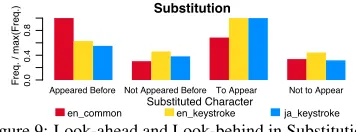
In Substitution errors for all data we analyzed, sub-stituting for the character that appeared before, or are to appear in the word was common (Figure 9). In particular, in en keystrokeand ja keystroke, look-ahead errors are much more common than non-look-ahead errors. Grudin (1983) reports cases of permutation (e.g., gib→big) but our data in-cludes non-permutation look-ahead errors such as
puclic→publicandotigaga→otibaga.
5 Conclusion
We have presented our collection methodology and analysis of error correction logs across error types (corrected vs. uncorrected) and languages (English and Japanese). Our next step is to utilize the col-lected data and analysis results to build online and offline spelling correction models.
Acknowledgments
[image:4.612.69.292.67.232.2]References
Aitchison, J. 1994.Words in the Mind. Blackwell.
Aramaki, E., R. Uno and M. Oka. 2010. TYPO Writer:
ヒトはどのように打ち間違えるのか?(TYPO
Writer: how do humans make typos?). InProceedings
of the 16th Annual Meeting of the Natural Language Society (in Japanese).
Cooper, W. E. (ed.) 1983. Cognitive Aspects of Skilled
Typewriting. Springer-Verlag.
Damerau, F. 1964. A technique for computer detection
and correction of spelling errors. Communications of
the ACM 7(3): 659-664.
Gao, J., X. Li, D. Micol, C. Quirk and X. Sun. 2010. A large scale ranker-based system for search query
spelling correction. InProceedings of COLING.
Grudin, J. T. 1983. Error patterns in novice and skilled transcription typing. In Cooper, W.E. (ed.),Cognitive Aspects of Skilled Typewriting. Springer-Verlag. Kukich, K. 1992. Techniques for automatically
correct-ing words in text. InACM Computing Surveys, 24(4).
Nespor, M., M. Pe˜na, and J. Mehler. 2003. On the differ-ent roles of vowels and consonants in speech
process-ing and language acquisition. Lingue e Linguaggio,
pp. 221―247.
Snow, R., B. O’Connor, D. Jurafsky, and A. Ng. 2008. Cheap and fast – but is it good?: evaluating non-expert annotations for natural language tasks. InProceedings of EMNLP.
Tanaka-Ishii, K. 2008. 単語に内在する情報量の偏在
(On the uneven distribution of information in words). InProceedings of the 14th Annual Meeting of the Nat-ural Language Society (in Japanese).
Whitelaw, Casey, Ben Hutchinson, Grace Y. Chung, and Gerard Ellis. 2009. Using the web for language
in-dependent spellchecking and autocorrection. In
Pro-ceedings of ACL.
Zheng, Y., L. Xie, Z. Liu, M. Sun. Y. Zhang and L. Ru 2011. Why press backspace? Understanding user
in-put behaviors in Chinese pinyin inin-put method. In