Minimum-SER linear-combiner decision feedback
equaliser
S.Chen and B.Mulgrew
Abstract: The paper considers the conventional decision feedback equaliser (DFE) that employs a linear combination of the channel observations and past decisions. An expression of the symbol error rate (SER) is derived for the linear-combiner DFE with the general M-PAM constellation by utilising a geometric translation property of decision feedback. A method is developed to optimise the coefficients of the linear-combiner DFE to achieve the minimum-SER (MSER) solution. The performance of this MSER linear-combiner DFE is superior to the usual minimum mean square error (MMSE) solution.
1 . Introduction
Equalisation is a powerful technique for combating distor- tion and interference in communication links [ I , 21 and high-density data storage systems [3, 41. The conventional DFE, in particular, is widely used in practice as it provides a good balance between performance and complexity. The conventional DFE [l] is based on a symbol-decision struc- ture that employs a linear combination of the channel observations and past decisions. We will refer to this DFE as the linear-combiner DFE to distinguish it from other DFE structures that use nonlinear combinations of the channel observations and past decisions [5-lo]. The Wiener or MMSE solution [1 11 is often said to provide the optimal solution for the linear-combiner DFE. However, the MMSE solution is not the MSER solution, the SER being the ultimate performance criterion of equalisation.
It is known that decision feedback in a DFE performs a space translation [6, 121. Previous study [13, 141 has further developed this geometric translation property and derived the explicit recursive formula for performing the space translation. In the translated observation space, a DFE is reduced to a transversal equaliser and, furthermore, the subsets of the translated channel states related to different decisions are always linearly separable. In the asymptotic case of large signal to noise ratio (SNR), the hyperplanes of the Wiener decision boundary are orthogonal to the last axis of the translated observation space [14], which clearly illustrates why the MMSE solution does not achieve the full performance potential of the linear-combiner DFE structure.
A new contribution of this paper is the derivation of an SER expression of the linear-combiner DFE for the general M-PAM constellation by using the geometric translation
0 IEE, 1999
IEE Proceedhgs online no. 19990772
DOL 10. 1049/ipcom: 19990772
Paper fmt received 23rd July 1998 and in revised form 25th March 1999 S . Chen is with the Communications Group, Department of Electronics & Computer Science, University of Southampton, Highfield, Southampton SO17 lBJ, UK
B. Mulgrew is with the Department of Electronics and Electrical Enginering, University of Edinburgh, King's Buildmgs, Edinburgh EH9 3JL, UK
approach. This allows an algorithm to be developed to obtain the MSER solution by minimising this SER crite- rion. Simulation results show that the MSER solution can offer a substantial SER reduction over the MMSE solution. A drawback of the MSER linear-combiner DFE is that the computational complexity increases significantly for high order signalling, compared with the MMSE solu- tion.
In a recent work [15], an approximate MSER solution of the linear equaliser was derived for the special case of equalisable channels. Equalisability corresponds to the lin- ear separability of channel states related to the different decisions. It is well known that linear separability is not guaranteed when a linear equaliser is used [16]. In contrast,
our MSER solution is exact and is not restricted to equalis- able channels, as the decision feedback always makes chan- nel states linearly separable. For the linear equaliser with equalisable channels, our solution is also valid. The approach of [15], however, does have an advantage that it can be implemented adaptively.
We will assume that the channel and the symbol constel- lation are real-valued. For the complex-valued channel and modulation schemes, the results of this study are still valid. Specifically, the channel is modelled as a finite impulse response filter with an additive noise source, and the received signal at sample k is
n,-1
r ( k ) = ~ ( k )
+
e ( k ) =C
a , s ( k -i)
+
e ( k ) (1) where U(k) denotes the noiseless channel observation; i z , is the channel length and U, are the channel tap weights; the Gaussian white noise e(k) has a zero mean and varianceE[$(k)] =
02,
and the symbol sequence {s(k)} is independ- ently identically distributed and has an M-PAM constella- tion defined by the setThe SNR of the system is defined as t=0
s , = 2 i - M - l 1 5 a s M ( 2 )
% - - l
SNR = E[F2(k)]/E[e2(k)] = 0;
(c
a:)
/
0,"2=0
(3) where q2 = E[&k)] is the symbol variance.
I 341
2
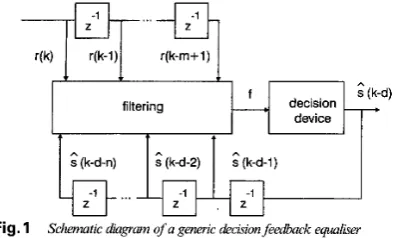
The generic DFE, depicted in Fig. 1, uses the information present in the channel observation vector
Space translation and linear separability
r ( k ) = [ r ( k ) . . . r ( k -
m
+
l)IT(4)
and the past detected symbol vector
& ( k ) = [ . ? ( k - d - 1 ) . . . . ? ( k - d - n ) l T (5)
to produce an estimate J^(k -
d)
of s(k -d).
The integers d,m and n will be referred to as the decision delay, the feed- forward and feedback orders, respectively. Without loss of generality, d = n, - 1, m = It, and n = nu - I wdl be used, as
t h ~ s choice of the DFE structure parameters is sufficient to guarantee the linear separability of the subsets of the chan- nel states related to the different decisions (see lemma 1 in this Section).
filtering r(k)
I
r(k-l)l r(k-m+l)1
;
(k-d)decision device
i
t t 1 -
I
I
g(k-d-n)I
g(k-d-2)I
;(k-d-I)I
Fig. 1 Schematic a’mgrm of a generk deckwn@e&k equalker
Applying the channel model, eqn. 1, to each element of the observation vector, eqn. 4, yields
where e(k) = [e@) ... e(k - m
+
1)]*, s(k) = [sfT(k)sbT(k)]* withr ( k ) = F s ( k )
+
e ( k ) (6)Sf(k) = [ s ( k ) . * . s ( k - d ) ] T
s b ( k ) = [ s ( k - d - l ) . ’ . s ( k - d - n ) l T (7)
and the rn x (d
+ 1 +
n) matrix F has the formF = [ P I F 2 1 ( 8 )
with the m x (d
+
1) matrix Fl and m x n matrix F2 defined...
by
1”
u1 una1
and
r o
0. . .
01
respectively. Under the assumption of correct decision feed- back, that is, $&) = s&),
r ( k ) = F l s f ( k )
+
F2.%(k)+
e ( k ) (11) Thus the decision feedback translates the original space v(k) into a new space ~’(k):(12)
n
r ’ ( k ) = r ( k ) - F&(k)
348
This property was recogmsed in [6, 121. Previous research [13, 141 further pointed out that the elements of r’(k) can be computed recursively according to:
~ ’ ( k - i) = z - l r ’ ( k - i
+
1) - ~ , ~ ~ - i b ( k - d - 1)i
= m - 1,...,
2 , l r ’ ( k ) =r ( k )
where z-l is interpreted as the unit delay operator.
t(k-I) r’(k-2) t(k-m+l)
filtering
decision device
s (k-d) S (k-d-I)
Fig. 2 Schenzatic diagram of trmlated deckwn feedback equaliser
Based on this interpretation of decision feedback, an alternative DFE structure is depicted in Fig. 2. Since a DFE is reduced to a transversal equaliser in the translated space, properties of the DFE can be studied more easily in the translated space. We have the following result of linear separability for the DFE.
Lemma
I:
Let the Nf = Md+’ sequences or states of sf(k) besfj, 1 s j s
Nf
The set of noiseless channel states in the translated space is defined byA
R’ = { T ; = F i ~ f , j , 1
5 j
5
N f } (14) This set can be partitioned into A4 subsets conditioned on s(k - d) = si, 1 s i s M ,e
{ T i E R’ls(k - d ) = Si} 1I
iI
M(15)
Idi), 1 s i s M , are linearly separable.
The proof of t h s lemma can be found in [14]. Lemma 1 shows that the mapping Fl: r’ = Fpf maps linearly separ- able sets in the sf space onto linearly separable sets in the v‘-space. This is in contrast to the case of an equaliser with- out decision feedback, where the mapping F: Y = Fs maps a large space s onto a smaller space Y. States which are line- arly separable in the s-space will not necessanly be linearly separable in the u-space (see Appendix of [16]). Notice that we do not specify how r(k) and s^&) are combined here and, therefore, the results are valid for any DFE. It should be emphasised that, even though
R@,
1 s i s M , are linearly separable, the optimal decision boundary will generally be nonlinear (the Bayesian DFE[q).
However, linear separa- bility of the channel states related to the dfierent decisions is a highly desirable property to have because equalisation performance in this case is generally much better than that of the nonlinear separable case.A simple example taken from [14] is used to illustrate the space translation property of decision feedback. Consider the two-tap channel
a = [UO u1IT = [0.5 1.OIT with 2-PAM symbols (16)
[image:2.613.95.294.219.338.2]and the DFE with d = 1, m = 2 and n = 1. The set of 8-channel states in the original observation space u(k) is
depicted in Fig. 3. The decision feedback s(k - 2) corre- sponds to a space translation, the effect of whch is illus- trated in Fig. 3. It can be seen that decision feedback effectively ‘merges’ channel states, and t h s simpMies the decision process. This space translation property was adopted in [17] to derive a concise version of the Bayesian DFE. Iltis [lS] has developed an importance sampling tech- nique for evaluating the performance of the Bayesian equaliser, valid only for the case of linearly separable chan- nel states. Lemma 1 shows that this importance sampling technique can readily be applied to evaluate the perform- ance of the Bayesian DFE [Note 11.
2
-2
, ..
1 .
~(k-2) = 1
translated
0
~ ( k - 2 ) =-I
-2 -1 0 1 2
r(k) + r‘(k)
Fig.3
for channel Illustrutwn a = [0.5 1.01 of e p t with of U 2-PAM o!eckwnfeedbak s(k conrtellutwn - 2) on channel states
3 Linear-combiner DFE
The linear-combiner DFE is based on a linear filtering of
v(k) and i b ( k ) given by
f ( T ( k ) , g b ( k ) ) = WT,(k)
+
bT&,(k) (17)where
w = [WO ’ * ’ W m - 1 I T
b = [bl
.
. . b,IT (18)are the coefficients of the feedfonvard and feedback filters, respectively. Since the linear-combiner DFE is a special case of the generic DFE depicted in Fig. 1, by performing the translation eqn. 12, it is reduced to the equivalent lin- ear equaliser:
The decision boundary of t h s equivalent equaliser consists of M - 1 parallel hyperplanes defined by: {U’: wTv’ =
2i
-M } , 1 s i s M - 1. These hyperplanes can always be designed properly to separate the M subsets of the trans- lated channel states R(n, 1 s i 5 M . One of the hyperplanes,
{Y’: wTr’ = 0}, passes through the origin of the r’(k)-space. Obviously, there must exist an MSER solution wopr for the structure in eqn. 19. The usual MMSE linear-combiner DFE, however, is not this MSER solution.
3.1
MMSE linear-combiner DFE
The Wiener solution for the linear-combiner DFE is well known (e.g. [Ill). Let fi and
8
be the MMSE solutions ofw and b. It can readily be shown that
f ’ ( T ’ ( k ) ) = W T T ’ ( k ) (19)
[:
I
=[-&I
Note 1: CHEN, S.: ‘Importance sampling simulation for evaluating the lower-
bound BER of the Bayesian DFE‘, submitted to IEEE Trm. Comnnm., 1998 IEE Proc.-Commun., Vol. 146, No. 6, December 1999
with
y q =
Eap-+:tn:h(ll
O < q < r n - l(24) and s(q) is the discrete Dirac delta function.
Since
fiTF2 =-bT, we have
GT‘r(k)
+
L T S b ( k ) = h T ‘ r ’ ( k ) (25) It merely confirms the space translation nature of decision feedback. Thus, when examining the MMSE linear-com- biner DFE, we can simply study the feedforward part of the solution. In the asymptotic case of SNR-
03, we have the following result for fi.Lemma 2: In the noise-free case,
W Z
[
0 0 . . . 0‘IT
a0 (26)
This result can be derived by setting 0,‘-+ 0 in eqn. 20, but an alternative proof is given in [14]. In the limit case of
SNR
-
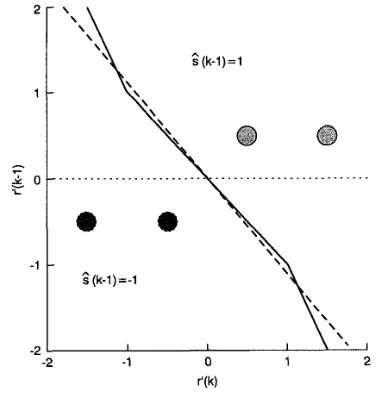
a, the hyperplanes of the MMSE solution are always orthogonal to the last axis of the v’(k)-space, which cannot be the optimal solution of eqn. 19 for any channel. Consider the example given in Fig. 3. The decision bound- ary of the Wiener solution for S N R -+ 60 is depicted in [image:3.616.316.511.481.678.2]Fig. 4. The best possible h e a r decision boundary can eas- ily be constructed for this example, which is very different from the MMSE solution. The true optimal Bayesian deci- sion boundary in the asymptotic case is also illustrated in Fig. 4.
G(k-l)=l
s (k-I)=-1
‘I
A\ \
-2 I I I I
-2 -1 0 1 2
r’ (k)
Fi . 4 Asymptotic decirion b o d r k s corresponding to h g e SNRfor chun- ne?a = [0,5 I.0IT with a 2-PAM constellation mddec&-wnfeedback
~ optimal Bayesian
_ _ _ best h e a r approximation
_ _ _ _ Wiener solution
When the noise is added, the hyperplanes of the MMSE linear decision boundary will rotate and are no longer orthogonal to the axis u'(k -
4.
Consider the example of Fig. 4 again. When SNR-
0, the Wiener decision bound- ary will rotate towards the line with a slope -2 ($;idGI = 2), and there is no difference between the MMSE and MSER solutions. However, for meaningful SNRs, the difference between the MMSE decision boundary and the best linear boundary can be large. For example, given SNR = 15dB, the Wiener decision boundary is the line with a slope of -0.28, but the best linear decision boundary obtained by minimising the SER has a slope of -1.03. In general the MMSE solution is different from the MSER solution, and searching for the latter is worthwhile at least for certain channels.3.2
MSER
linear-combinerDFE
For the given channel model a = [a0 ... aiTc,-l]T and the noise variance
02,
the following lemma shows how to compute the SER of the linear-combiner DFE.Lemma 3: Let 1 = MI2
+
1. The SER P d w ) of the linear- combiner DFE, with the weight vector w subject to the constraintm-1
i=O is given by
where
00
1
Q ( x ) =
/
- exp(-g)
dx
(30)G
2
- v)Twl
llwll (31)
2
P3,1
+
P A 2 = -llwll P3J =
and v can be any point in the hyperplane wTr' = 0. Since this hyperplane passes through the origin of the r'(k) space, we can always choose v = 0.
The derivation of this SER expression is given in the Appendix (Section 7.1). R(0 is the subset of channel states related to s(k -
d)
= sI = 1, and the number of states in R(0 is NfIM = M ' l u - l . Obviously, the MMSE solution does notminimise
PAW).
Notice that the elements of w are not line- arly independent. The constraint eqn. 27 is introduced to express the SER neatly in the form of eqn. 28, and it does not change the SER. It is worth pointing out that the low noise Wiener solution, eqn. 26, satisfies the constraint eqn. 27. The following algorithm can be employed to obtain the optimal weight vector wept for the MSER linear- combiner DFE.Algorithm:
Step 1. Use a channel estimator to obtain a channel model and an estimate of the noise variance.
Step 2. Compute the subset of translated channel states R(0 and use the low noise Wiener solution, eqn. 26, as the ini- tial value of w.
350
Step 3. Solve the optimisation problem,
m i n P E ( w ) , subject to wTareV = 1 ( 3 2 )
W to obtain a wept.
In the above algorithm, only step 1 involves channel observations. Once estimates of the channel model and noise variance are obtained, the optimisation eqn. 32 is car- ried out without involving any channel observation. This off-line optimisation problem can be solved, for example, using the augmented Lagrangian method [19], and an algo- rithm is given in the Appendix (Section 7.2). Computa- tional complexity of this MSER linear-combiner DFE is much more than that of the standard MMSE linear-com- biner DFE. However, the performance gain can justify the increase in computation. Some of the channel states r20 are far away from the decision hyperplanes and contribute little to the SER. Computational requirements can be reduced by neglecting these states from the optimisation procedure with little performance degradation. For example, consider the case of Fig. 4. By just using the single state at (0.5, 0.5) in the optimisation, little performance degradation will occur, compared with using the full subset
R(*)
of the two states.4 Numerical examples
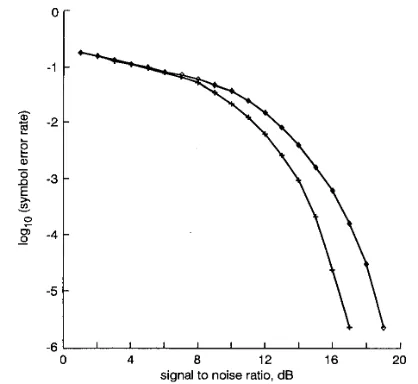
Three examples were used to compare the MSER and MMSE solutions of the linear-combiner DFE. The optimal weight vector wept for the linear-combiner DFE was obtained using the algorithm described in the preceding Section. All the SERs were evaluated with detected sym-
bols being fed back. The first example was the two-tap channel with 2-PAM symbols defined in eqn. 16. Fig. 5
compares the SERs of the MSER linear-combiner DFE with those of the MMSE linear-combiner DFE for a range of SNR conditions. For t h s example, the MSER linear- combiner DFE is superior and, at the SER of lo4, it has an SNR gain of -2dB over the Wiener solution.
-1 -
8
-2 -L
-
2 -3
E 2
z
g -4
-
-
- -
-5
-
-6 I I I I I I I I I I
0 4 a 12 16 20
signal to noise ratio, dB Fi .5
bo
f
with detected symbols t%g,fed buckMMSEIMSER: MMSWMSER linear-combiner DFEs
-0- MMSE
-f- MSER
P e f o m c e corn misonfor c h w l a = [ O S I.OIT (Md2-PAMsyn-
The second example was a 5-tap channel with the 2- PAM constellation:
a = [0.227 0.466 0.688 0.466 0.227IT
with 2-PAM symbols ( 3 3 )
[image:4.612.331.540.423.615.2]The structure of the DFE was chosen to be d =
4,
rn = 5and n = 4. The SERs of the MSER and MMSE linear- combiner DFEs with detected symbols being fed back are plotted in Fig. 6, where it can be seen that the performance of the MSER linear-combiner DFE is sigmfkantly better than that of the MMSE solution. At the SER of lo4, the MSER solution has an SNR gain of -1 dB over the MMSE solution.
-1
h
2 -2
E
e
b 0 -3 n
L
-
5
1z
8 -4
-
-5
.
’
’
’
’
-6 I I
8 10 12 14 16 18 20 22
signal to noise ratio, dB
Fig.6
O.227lT mud 2-PAM syinhof
\th
kected syinhols beingfed buckMMSWMSER: MMSEiMSER linear-combiner DFEs -0- MMSE
-+-
MSERPerjormunce coin atison or clumnel a = 10.227 0.466 0.658 0.466
The third example was a 3-tap channel with the 4-PAM constellation:
a = [0.3482 0.8704 0.3482IT
with 4-PAM symbols (34)
The structural parameters of the DFE were set to d = 2, rn
= 3 and n = 2. The SERs of the MSER and MMSE linear- combiner DFEs with detected symbols being fed back are depicted in Fig. 7. Again, the MSER solution is superior and has an SNR gain over 1dB at the SER of l p , com- pared with the MMSE solution.
-
16 18 20 22 24 26 282 . 7 Peflomuuiw cornpurison jbr c l m l a = (0.3482 0.8704 0.3482IT signal to noise ratio, dB
C P A M symbols with rktecied synrbols bemg fed buck
MMSEJMSER: MMSUMSER linear-combiner DFEs -0- MMSE
-+- MSER
IEE Proc.-Commun., Vol. 146, No. 6, Deceniher 1999
5 Conclusions
We have derived an SER expression of the linear-combiner DFE for the general M-PAM constellation. This is made possible by utilising a geometric translation property of the decision feedback in the DFE structure. Basically, the deci- sion feedback performs a space translation that maps the DFE onto an equivalent transversal equaliser in the trans- lated observation space and, furthermore, the subsets of translated channel states corresponding to the different decisions are always linearly separable. In particular, viewed from the translated observation space, the linear- combiner DFE is reduced to a linear equaliser and, moreo- ver, the hyperplanes of the Wiener solution under very low noise conditions are orthogonal to the last axis of the trans- lated space. This shows that the MMSE solution does not achieve the full performance potential of the linear-com- biner DFE structure. An algorithm is proposed to obtain the MSER solution by minimising the SER criterion. Numerical examples have been included to illustrate the better performance of the MSER linear-combiner DFE over the MMSE solution for certain channels. A drawback of this MSER solution is a significant increase in computa- tional complexity compared with the Wiener solution.
The algorithm presented in this paper for obtaining the MSER solution is an off-line algorithm. For communica- tion links, practical application of this algorithm is limited to the initial set-up of the DFE. This MSER linear-com- biner DFE in its present form is more suited for data stor- age systems, as in many commercial disk drives the equalisers are trained at the factory floor and then are ‘frozen’ before shipping. Ongoing research will investigate how to implement this MSER linear-combiner DFE adap- tively, so that it can be applied to fast time-varying channels.
6
1
2
3
4
5
6
7
8
9
References
QURESHI, S.U.H.: ‘Adaptive equalization’, Proc. IEEE, 1985, 73,
(9), pp. 1349-1387
PROAKIS, J.G.: ‘Digital commnnications’ (McGraw-Hill, New York, 1995, 3rd edn.)
MOON, J.: ‘The role of SP in data-storage systems’, IEEE Signul Process. Mug., 1998, 15, (4), pp. 54-72
PROAKIS, J.G.: ‘Equalization techniques for high-density magnetic recording’, IEEE Signul Process. Mag., 1998, 15, (4), pp. 72-82
SIU, S., GIBSON, G.J., and COWAN, C.F.N.: ‘Decision feedback equalisation using neural network structures and performance compar- ison with the standard architecture’, IEE Proc. I, Cotnmzm. Speech Vis., 1990, 137, (4), pp. 221-225
WILLIAMSON, D., KENNEDY, R.A., and PULFORD, G.W.: Block decision feedback equalization’, IEEE Truns. Comtmm, 1992, 40, (2), pp. 255-264
CHEN, S., MULGREW, B., and McLAUGHLN, S.: ‘Adaptive Bayesian equaliser with decision feedback’, IEEE Truns. Signal Proc- ess., 1993, 41, (9), pp. 2918-2927
CHEN, S., McLAUGHLIN, S., and MULGREW, B.: ‘Complex-val- ued radial basis function network, Part 11: application to digital com- munications channel equalisation’, EURASIP Signul Procem. J., 1994,
36, pp. 175-188
CHEN, S., McLAUGHLIN, S., MULGREW, B., and GRANT, P.M.: ‘Adaptive Bayesian decision feedback equaliser for dispersive mobile radio channels’, IEEE Truns. Conlmun., 1995, 43, (5), pp. 1937-1 946
I O CHA, I., and KASSAM, S.A.: ‘Channel equalization using adaptive complex radial basis function networks’, IEEE J. Se/. Areus Commun.,
1995, 13, (l), pp. 122-131
11 CIOFFI, J.M., DUDEVOIR, G.P., EYUBOGLU, M.V., and FOR- NEY, G.D.: ‘MMSE decision-feedback equalizers and coding - part
1: equalization results’, IEEE Trcins. Coniinun., 1995, 43, (lo), pp. 2582-2594
12 CLARK, A.P., LEE, L.H., and MARSHALL, R.S.: ‘Developments of the conventional non-linear equaliser’, IEE Proc F, Commun. Rudur Signul Process., 1982, 129, (2), pp. 85-94
13 CHEN, S . , CHNG, E.S., MULGREW, B., and GIBSON, G.: ‘Mini- mum-BER linear-combiner D F E . Proceedings of ICC‘96, Dallas, TX,
1996, Vol. 2, pp. 1173-1177
14 CHEN, S., MULGREW, B., CHNG, E.S., and GIBSON, G.: 'Space translation properties and the minimum-BER linearcombiner D F E ,
IEE Proc. Commun.. 1998, 145, (5), pp. 316-322
15 YEH, C.C., and BARRY, J.R.: 'Approximate minimum bit-error rate equalization for pulse-amplitude and quadrature-amplitude modula- tion'. Proceedings of lCC'98, Atlanta, USA, 1998, Vol. 1, pp. 16-20 16 GIBSON, G.J., SIU, S., and COWAN, C.F.N.: 'The application of
nonlinear structures to the reconstruction of binary signals', IEEE Trans. Signal Process., 1991, 39, (8), pp. 1877-1884
17 CHEN, S., McLAUGHLIN, S., MULGREW, B., and GRANT,
P.M.: 'Bayesian decision feedback equaliser for overcoming co-channel interference', IEE Proc. Commun., 1996, 143, (4), pp. 219-225 18 ILTIS, R.A.: 'A randomized bias technique for the importance sam-
pling simulation of Bayesian equalizers', IEEE Tram Commun., 1995, 43, (2/3/4), pp. 1107-1 115
19 BAZARAA, M.S., SHERALI, H.D., and S H E W , C.M.: 'Nonlin- ear programming: Theory and algorithms (John Wdey, New York, 1993)
7 Appendixes
7.
I
Derivation ofSER
expressionConsider the hear-combiner DFE, eqn. 19. The M - 1 hyperplanes {U': wTv' = 2i - M } , 1 s i s M - 1, partition the m-dimensional v'-space into M regions:
z(2)
i2
{r' :8(5
- d ) = Si} 15
i
5
M
( 3 5 )The SER
of
the linear-combiner DFE is a function of w and can be expressed asM
3 r ' 3 Z ( * )
where p,'(v'lv,(n) is the probability density function of
v'(k)
conditional on the received channel state being v-3, f i ( l 1 is
the a priori probability of P,@ and 3 denotes 'not in'. Taking into account the fact of symmetry and equiproba- ble states, eqn. 36 is reduced to
t=1 r ( t ) E R ( % )
(36)
where
p,
(
r ( 4
)
n
-/
prl( T ' I T ~ ~ ) )
dr' (38)r ' 3 2 ( ' )
is the conditional error probability when the received chan- nel state is vj'" E R(Q.
I
'0'Fig. 8 Computation of conditionul error probability
Consider the subset of channel states R(o, where 1 = MI2
+
1. RO is separated from other subsets by two hyperplanes wTv' = 0 and wTv' = 2. Referring to Fig. 8, an orthogonal transformation x =Lv'
can be constructed whch rotates the bases so that one of the transformed bases, say xo, is parallel to w, the normal of the decision hyperplanes. Since352
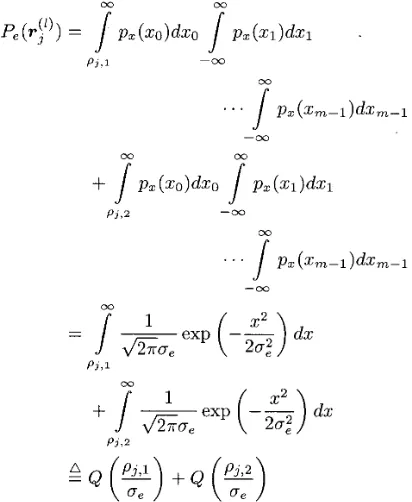
LLT = I and the whte noise e(k) has a Gaussian distribu- tion, the conditional error probability Pe(r)o) can be com- puted as
00 00
P,(r:l))
=/
pz(zo)dzo/
P z ( z l ) d z l+
/
pz(z0)dzo/
P z ( z l ) d z lP3,I -00
. . .
7
pz ( z m - 1 )dxm-l -0000 03
P 3 > 2 -00
00
00
-
-
/
&exp(-z)
dx
20:
P 3 > 1
00
1 exp
(-5)
2a,2dx
P 3 . 2
Q
(
F)
+
Q(
F)
(39) where pj,l and pj,2 are the Euclidean distances between
vjo
and the hyperplanes wTv' = 0 and wTv' = 2, respectively. It can easily be seen that
I(?-?)
- Z))TwI (40) 2llwll Pj,l
+
P j , 2 = -l l 4 l
P j , l =and v can be any point in the hyperplane wTr' = 0.
R('+') is a translation of R(Q:
From eqns. 9, 14 and 15, it is obvious that the subset
R(Z+l) =
di)
+
( s z + 1 - Si)[U,,-l.
f * U l U O ] T= R(i)
+
2arev (41) where urev = [ana-l...
alaolT. Notice that the elements of ware linearly dependent. Specfiically, if we impose the follow- ing constraint:
m - 1
i=O
the (i
+
1)th hyperplane is the translation of the ith hyper- plane by the amount 2urev. As illustrated in Fig. 8, it becomes evident thatand
(44)
Thus the SER of the linear-combiner DFE is given by
PE
('UI)(45)
[image:6.613.335.541.80.331.2]The feedforward weights of the equaliser are subject to the constraint eqn. 42.
7.2 Algorithm for solving the optimisation problem
Define the augmented Lagrangian function
~ E ( w ? A ? = p E ( w )
+
A ( W T a r e u - 1)+
CL(wTa,ev - (46)The following algorithm [19] can be used to solve the opti- misation problem, eqn. 32.
Initialisation. Choose A, p > 0 and w(0); give a termination scalar E > 0; set t = 1.
Loop. Solve the unconstrained optimisation problem
w(t) = min W PE(w,
A,
p ) (47)If ~wT(t)ur,, - 11 < E : goto stop;
goto Loop;
2p(Wqt)u,,, - l), t = t
+
1, goto Loop.Else if $vT(t)ure,, - 11 > 0.251wT(t - I)ure, - 11 : p = 1O.Op,
Else if IwT(t)u,,,, - 11 I 0.251wT(t ~ l)ure, - 11 :
A
= A+
Stop. w(t) is the solution.
The unconstrained optimisation problem, eqn. 47, is solved using a simplified conjugate gradient method. For convenience, drop A and p in
BE,
and define the gradient vector= VPE(w)+Aa,e,+2p(wTa,e, - 1 ) a r e v
(48)
Initialisation. Choose a small step size a > 0 and a termina- tion scalar
p
> 0; given w(1) and d(1) = -VPE(w(1)); s e t j = 1.Loop. If IlVPE(w(j)>ll <
p
: goto stop.WO'
+
1) = W O ]+
CY&),@ =
ll~~~~(i+1))112~11~~Ei~03)112
d(j
+
1) = @@j] - Vpdwg'+
1 ) ) , j = J+
I , goto Loop.The derivatives of P d w ) with respect to wj, 0 5 i 5 m ~ 1,
Stop. wfj] is the solution.
are
a p E ('U))
d W i
(49)
with
(50)
and
(51) where I = MI2
+
1, s a ( . ) is the signum function, v, and r,;,(o are the ith elements of v and r>o, respectively, v is any point in the hyperplane wTiJ = 0, and pJ,l and pJ,2 are defined ineqn. 31.