Feasibility of Bioleaching in Removing Metals (Al, Ni, V and Mo)
from as Received Raw Petroleum Spent Re
fi
nery Catalyst:
A Comparative Study on Leaching Yields, Risk Assessment Code
and Reduced Partition Index
Ashish Pathak
1, Haragobinda Srichandan
1,2and Dong-Jin Kim
1,+1Mineral Resource Research Division, Korea Institute of Geoscience and Mineral Resources (KIGAM),
Gwahang-no 124, Yuseong-gu, Daejeon, 305-350, South Korea
2Nano Engineering Division, School of Engineering, Chungnam National University, Daejeon, 305-764, South Korea
This study investigates the effectiveness of bioleaching in recovery of metals (Al, Ni, V and Mo) from raw petroleum refinery spent catalyst usingAcidithiobacillus ferrooxidans(At. ferrooxidans) andAcidithiobacillus thiooxidans(At. thiooxidans). It was found that bioleaching with
At. ferrooxidansorAt. thiooxidansresulted in higher leaching yields of Ni (55.858.6%) and V (33.033.4%) as compared to Al (9.310%) and Mo (3.95.8%). After 168 h of bioleaching with eitherAt. ferrooxidansorAt. thiooxidans, the remaining metals in the bioleached spent catalyst samples were present in stable forms (oxidizable and residual fractions). Bioleaching also led to increase in the reduced partition index of all the metals in the bioleached residues (Ni: 0.630.65, Al: 0.98, V: 0.900.91, Mo: 0.800.83) as compared to feed spent catalyst (Ni: 0.14, Mo: 0.63, V: 0.70, Al: 0.94). The low‘risk assessment code’(RAC) values of the bioleached residues as compared to feed spent catalyst indicated that bioleached residues posed low or no risk to the environment. The results of the present study suggested that the bioleaching with eitherAt. ferrooxidansorAt. thiooxidansis effective in leaching of Ni and V, whereas leaching of Mo and Al requires further treatment.
[doi:10.2320/matertrans.M2015104]
(Received March 16, 2015; Accepted May 13, 2015; Published July 25, 2015)
Keywords: Acidithiobacilli, bioleaching, metals, spent catalyst
1. Introduction
Spent catalyst is considered as a hazardous waste, the disposal of which is a serious environmental concern for the petroleum refiners. Spent catalyst is known to contain a variety of metals such as Al, Co, Mo, Ni, and V. These metals are valuable commodities and hence spent catalyst has the potential to serve as a secondary source of these metals.1)One way of managing the spent catalysts in a meaningful way is to develop the recycling processes which enable recovery of these metals through economically and environmentally sustainable techniques. The recovery of these metals from spent catalyst will boost the resource recovery and ensure the safe disposal of spent catalyst in landfill. Conventionally, metal removal/recovery from spent catalyst has been achieved using hydrometallurgical and pyrometallurgical processes. Hydrometallurgical processes mainly involve high concentrations of acid and base for dissolving the metals from spent catalyst.2,3) However, the use of high concen-tration of chemicals and their downstream processing is still a bottleneck for applying the process on a larger scale. Similarly, pyrometallurgical processes have also been tested to recover the metals from the spent catalyst, but high energy consumption and emission of toxic gases into the atmosphere hindered their wide applicability.4) In lieu of above, an efficient and eco-friendly biological leaching process has recently been emerged for recovery of metals from spent catalyst. Bioleaching is based on the metabolic activity of various chemoautotrophic bacteria and fungi which produce inorganic and organic acids as lixiviants. The chief chemo-autotrophic bacteria used in bioleaching of spent refinery
catalyst areAcidithiobacillus ferrooxidans (At. ferrooxidans)
and Acidithiobacillus thiooxidans (At. thiooxidans), whereas widely used fungi is Aspergilus niger.5,6) Bacteria such as At. ferrooxidans has the unique ability to oxidize ferrous sulfate and sulfur as energy sources, whereasAt. thiooxidans
can only oxidize sulfur. During bioleaching,At. ferrooxidans
andAt. thiooxidansoxidize ferrous sulfate and sulfur to ferric iron and sulfuric acid, respectively:
2FeSO4þH2SO4þ1=2 O2
!At:ferrooxidans Fe2ðSO4Þ3þH2O ð1Þ
SþH2Oþ1:5 O2
!At:ferrooxidans=At:thiooxidans H2SO4 ð2Þ The generated ferric iron and sulfuric acid then act as lixiviant that solubilize metal sulfides (MeS) and oxides (MeO) during the bioleaching as per reactions (eq. (3)(5)):
Fe2ðSO4Þ3þMeSþH2Oþ3=2O2 !Me2þþSO
4þ2FeSO4þH2SO4 ð3Þ
H2SO4þMeS!MeSO4þH2S ð4Þ
H2SO4þMeO!MeSO4þH2O ð5Þ
Where Me is a metal (Ni, V, Mo and Al).
carbonaceous deposits and to make spent catalyst conducive for bioleaching.9)In these reported studies, pretreatment was performed either washing with an organic solvent such as acetone or by decoking/roasting the sample in a furnace at high temperature (> 500°C). It is worthy to note that the pretreatment of spent catalyst prior to bioleaching enhances the process cost. Further, the organic solvent such as acetone can have potentially adverse health effects as a result of unsafe disposal. On the other hand, roasting or decoking is highly energy intensive and also emit harmful gases into the atmosphere. Therefore, it is worth examining the possibility of conducting bioleaching with untreated as received raw petroleum refinery spent catalyst. The use of raw spent catalyst is expected to make bioleaching process cost effective and eco-friendly. Ironically, no study in the literature has been reported the feasibility of conducting bioleaching with raw spent catalyst. The present study investigated this important aspect and reports for the first time the effectiveness ofAt. ferrooxidansandAt. thiooxidans
in leaching of metals from raw spent catalyst. The study involves a comparative analysis of the leaching yields using these two bacteria in baffled stirred reactors. In addition, fractionation of the metals in feed and bioleached spent catalyst has been discussed. The suitability of bioleached spent catalysts for land disposal has been evaluated using risk assessment code (RAC) and reduced partition index (IR).
2. Materials and Methods
2.1 Spent refinery catalyst sample and characterization The raw spent catalyst used in the present study was procured from a petroleum refinery operating in South Korea. The raw spent catalyst (hereafter‘spent catalyst’) was covered with characteristics oily coating and was in the form of granular solid (20005000 µm). For estimation of metals (Ni, Al, Mo, and V), a known quantity of spent catalyst sample wasfirst digested with aqua regia (HCl+HNO3). Thefiltered digested was then subjected to induced couple plasma optical emission spectroscopy (PerkinElmer Optima 8000; Waltham, MA, USA). The sulfur and carbon content of the sample was analyzed with a LECO CS-600 analyzer. The chemical states of the metal compounds in the raw spent catalyst was examined using X-ray photoelectron spectroscopy (XPS; Thermo Scientific model-Sigma probe; Indianapolis, IN, USA) at a beam voltage of 15 kV and a beam current of 6.7 mA. Monochromatized Al K¡ X-ray (1486.71 eV) was allowed to fall at 30° on a powdered sample placed on a carbon tape. The electrons emitted from the sample were detected by a detector placed at an angle of 40°.
2.2 Microorganisms and growth media
The microorganisms used in the present study was pure culture of At. ferrooxidans and At. thiooxidans. These microorganisms were obtained from the culture collection center of Korea Research Institute of Bioscience and Biotechnology (KRIBB). At. ferrooxidans was grown in IEM nutrient medium containing 20 g/L of FeSO4·7H2O as an energy source.10)After complete oxidation of ferrous into ferric by At. ferrooxidans, the growth medium was passed through a membranefilter to separate the microbial cells. A
portion of these filtered cells were transferred to fresh IEM medium under similar operating conditions for further sub-culturing.
At. thiooxidans was grown in 0 K medium (9 K medium without 9 g of Fe2+) supplemented with 1%sulfur. The initial pH of the medium was 3.3. During the growth of At. thiooxidans, the sulfur was oxidized into sulfuric acid and pH of the growth medium decreased from 3.3 to 1.0. The log phase bacterial cells were separated using a 0.45 µm membrane filter. A portion of these filtered cells were transferred to fresh 0 K medium for further sub-culturing.
2.3 Bioleaching experiments
All the experiments were carried out in 2500 mL borosilicate baffled stirred reactors having 1000 mL of working volume. Three different types of experiments were conducted namely, abiotic (acid) leaching using sulfuric acid, bioleaching with At. ferrooxidans and bioleaching with
At. thiooxidans. In the case of abiotic leaching, spent catalyst (1% w/v) was added to the 1000 mL of distilled water acidified (pH 1.1) with commercial sulfuric acid. In the case of bioleaching with At. ferrooxidans, two-step bioleaching was performed. In thefirst step,At. ferrooxidanscells were suspended in 1000 mL fresh IEM medium, supplemented with 1% S0(w/v) and 4 g/L Fe2+ at initial pH 1.68. In this step,At. ferrooxidansoxidized all Fe2+to Fe3+and sulfur to sulfuric acid which decreased the pH of medium to 1.1. After completion of first step, the acidic medium was filtered to remove the suspended sulfur particles. In the second step, the raw spent catalyst was (1% w/v) added to this filtered medium having lixiviant and bacterial cells at initial pH 1.1. In the case of two-step bioleaching with At. thiooxidans, bacterial cells were first suspended in fresh 1000 mL 0 K medium supplemented with 1% (w/v) S0at initial pH 3.3« 0.05 (first step). During this step At. thiooxidans oxidized the sulfur into sulfuric acid and pH of the medium decreased to 1.1. This acidic medium was filtered through Whatman
filter No. 42 to remove the suspended sulfur particles. In the second step, the spent catalyst was (1% w/v) added to this
filtered acidic medium having lixiviant and bacterial cells. All the experiments were performed under following operating conditions: initial pH, 1.1«0.05; stirring speed, 280 rpm; temp, 35°C; working volume, 1000 mL. The aerobic condition in the reactor was maintained by sparging the continuous air at aflow rate of 1 litre per minute. During the course of the experiment, the changes in pH, redox potential and metal solubilization were monitored over a period of 168 h, and samples were withdrawn every 24 h. The samples were filtered through Whatman No. 42 filter and
filtrate was analyzed for the metal content using ICP-OES. The leaching yield of a particular metal was calculated based on both the metal content of the feed spent catalyst and the leach liquor. During experiments, pH was measured using an Orion portable pH meter whereas redox potential (ORP) was measured using a platinum electrode with an Ag/AgCl reference electrode.
2.4 Sequential extraction study
spent catalyst. The presence of different binding forms of the metals (Al, Ni, V and Mo) in the feed raw spent catalyst, bioleached residues and abiotic leaching residue was evaluated using widely used sequential extraction procedure developed by Bureau of Community Reference (BCR).11) BCR process has been successfully applied in our earlier studies using pretreated spent catalyst.9,12) BCR process classifies the metals in 4 broad binding forms/fractions namely exchangeable (F1), reducible (F2), oxidizable (F3) and residual fraction (F4). The detailed information about the BCR scheme has been provided in our earlier study conducted with pretreated spent refinery catalyst.12)
2.5 Reduced partition index (IR) and risk assessment code (RAC)
To describe the environmental risk of disposal of spent catalyst, two widely used parameters reduced partition index (IR), and the risk assessment code (RAC) were studied. The IR is a widely used parameter to quantitatively describe the relative binding intensity of a particular metal and also enables comparison of the binding intensities of different metals in a matrix.13) The IR uses the results of sequential extraction to describe the relative binding intensity of metals and is defined as:
IR¼
Xk
i¼1 i2Fi=k2
Where: i is the index number of the extraction step, progressing from 1 (for the weakest) to the strongest fraction (in the BCR procedure,k=4), andFiis the percentage of a particular metal present in fractioni.
Similarly, RAC represents the ratio of the amount of metal in the F1 fraction to the total concentration of a particular metal. The RAC is directly related to metal mobility and can be expressed as follow:
RAC¼Cm=Ctotal100
Where: Cmis the metal concentration in F1 fraction,Ctotalis the total concentration of a particular metal in spent catalyst.
3. Results and Discussion
3.1 Spent catalyst characterization
The carbon and sulfur analysis of the feed spent catalyst suggested that a significant amount of carbon (22.80%) along with sulfur (3.83%) was present in the spent catalyst. It is a know phenomenon that during hydroprocessing of feed petroleum, catalyst surface get covered by deposition of carbon and sulfur. The elemental analysis of spent catalyst confirmed the presence of 2.70% Ni, 15.31% Al, 2.34%Mo and 8.76%V.
3.2 XPS analysis
The XPS spectrum for the Ni, V, Mo and Al has been presented in the Fig. 1. The presence of these metals was identified based on their binding energies (eV). In the feed spent catalyst, the analysis of Ni2p spectra confirmed the presence of Ni as NiO (855.4 eV) and Ni2O3 (856 eV). Al was mostly to be present as oxide in the form of Al2O3(73.4 74 eV). On the other hand, Mo was found in the form of
oxides and sulfide. The 3d5/2 spectra confirmed the presence of Mo as MoO3 (232.6 and 236.3 eV) and Mo4O11 (232 233 eV), whereas 3d3/2 spectra assured the presence of MoS2 (232.94 eV). The V2p spectra confirmed the presence of V as V2O5at binding energy of 517 eV.
3.3 Changes in pH and leaching yields of metals during bioleaching and abiotic leaching
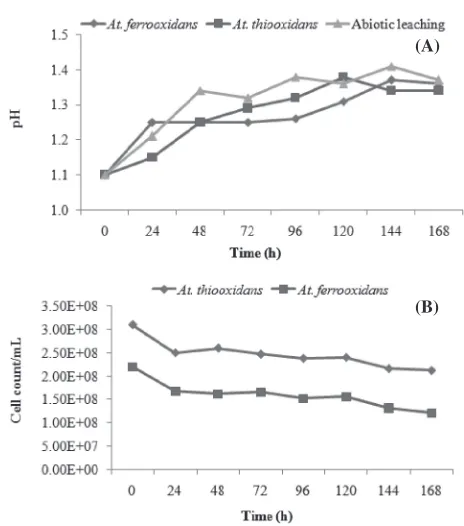
During bioleaching and abiotic leaching (Fig. 2(A)), there was an increase in medium pH due to the acid consuming properties of the spent catalyst. In the reactor operating withAt. ferrooxidans, the pH was found to increase from an initial value of 1.1 to 1.3 within first 24 h of bioleaching, after which it increased marginally to 1.4 till the end of bioleaching (168 h). A similar increase in pH was also observed in the reactor operated with At. thiooxidans where
final pH increased from 1.1 to 1.3. During abiotic leaching,
final pH was also increased from 1.1 to 1.4. The increase in pH during bioleaching and abiotic leaching can be explained on the basis of acid consumption by metallic oxides and sulfides present in the feed spent catalyst. During bioleaching metal oxides reacted with acid and solubilized as metal sulfates as per the below equation:
MeOþH2SO4!MeSO4þH2O ð6Þ
where Me represents Ni, Al, Mo and V and their solubiliza-tion can be explained as follows:
NiOþH2SO4!NiSO4þH2O ð7Þ
Al2O3þ3H2SO4 !Al2ðSO4Þ3þ3H2O ð8Þ
MoO3þH2SO4!MoO2SO4þH2O ð9Þ
V2O3þH2SO4þO2! ðVO2Þ2SO4þH2O ð10Þ During the reaction, the acid consumed by metal oxides increases the pH of the medium in all reactors. The increase in medium pH during bioleaching of spent catalyst has been reported in our previous studies.9,12)
The changes in planktonic cell count during bioleaching with At. ferrooxidansand At. thiooxidans are represented in Fig. 2(B). At the start of bioleaching experiment (0th day), the cell counts in the reactor having At. ferrooxidans and
At. thiooxidans was 2.2©108cells/mL and 3.1©108cells/ mL, respectively. After adding the spent catalyst sample; the planktonic cell counts were found to decrease in both the reactors. After 24 h of bioleaching, the planktonic cell counts in the reactor having At. ferrooxidans and At. thiooxidans
were decreased to 1.7©108cells/mL and 2.5©108cells/ mL, respectively. This initial decrease in cell count might be due to the attachment of bacterial cells to spent catalyst surface. Moreover, toxic metals or organic compounds leached into the leachate as a result of bioleaching may have exerted the toxicity to microorganisms. After initial decrease, there was a gradual decrease in the planktonic cell population in both the reactors till the end of experiment. At the end of bioleaching experiment, the planktonic cell counts in the reactor having At. ferrooxidans and At. thiooxidans were 1.2©108cells/mL and 2.1©108cells/mL, respectively.
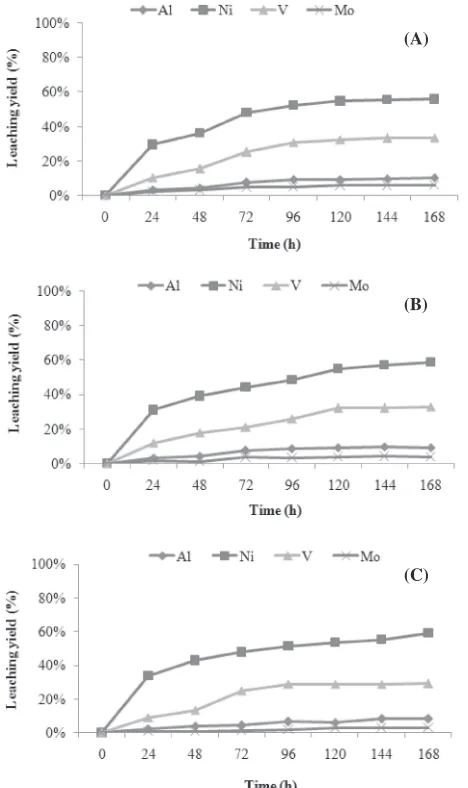
of metals during bioleaching with At. ferrooxidans, At. thiooxidans and abiotic leaching with sulfuric acid has been presented in Fig. 3(A), Fig. 3(B) and Fig. 3(C) respectively.
During bioleaching with At. ferrooxidans (Fig. 3(A)), the leaching of Al was found to be extremely low and only 3.4% of the Al was leach out in thefirst 24 h. After initial slow rate, the leaching of Al increased gradually and about 10%of the Al was leached at the end of bioleaching. Similarly, during bioleaching with At. thiooxidans(Fig. 3(B)), about 9.3% of Al was leach out from the spent catalyst after 168 h of bioleaching. The leaching yield of Al (10.4%) was found to be similar during abiotic leaching (Fig. 3(C)). The low solubility of the Al during bioleaching and abiotic leaching can be explained on the basis of its high presence in the F4 fraction (Fig. 4(A)). As per BCR scheme metals retained in the residual fraction are highly stable and do not solubilized under normal acidic environment. Moreover, Al is generally exist as Alumina (Al2O3) in the spent catalyst. Alumina has properties such as high hardness, high melting (2,072°C), and boiling points (2,977°C), unique crystal lattice structure and low solubility in water. This makes it a suitable candidate as a supporting material for a catalyst, but refractory to leaching in acid or alkali. The low leaching yield of Al during bioleaching was also reported in our earlier studies conducted with pretreated spent catalyst.9)
Contrary to Al, higher leaching of the Ni was observed and about 29.2% of the Ni was leached withinfirst 24 h of the bioleaching with At. ferrooxidans. The leaching yield of Ni increased gradually and about 55.8% of the Ni was solubilized after 168 h of bioleaching. In the reactor operating with At. thiooxidans, a similarly leaching yield of Ni was
(A)
(B)
Fig. 2 Changes in (A) pH (B) planktonic cell count with time during bioleaching.
[image:4.595.89.508.71.413.2] [image:4.595.51.283.447.710.2]observed (58.6%) at the end of bioleaching. During abiotic leaching, a similar trend in leaching of Ni was observed and about 58.9%of the Ni was leached at the end of experiment. Among all the metals, the leaching yields of Ni were found to be highest in all reactors which suggested that Ni was readily soluble under acidic conditions. The higher presence of Ni in the F1 and F2 fractions explains its high leaching yields in all three reactors. Moreover, the speciation study of Ni has suggested that it is readily soluble under the Eh-pH conditions of the present investigation and existed as soluble NiOH+3in the solution. This confirmed the higher yield of Ni in the present study.9)
The leaching of V during bioleaching and abiotic leaching was less compared to Ni but higher than that of Al and Mo. During bioleaching withAt. ferrooxidans, only 10.4% of V was leached within first 24 h after which a gradual increase in the leaching yield of V was observed. At the end of bioleaching, about 33.4% of V was leached from the spent catalyst. A similar trend in leaching of V was observed while bioleaching with At. thiooxidans where about 33% V was leached. In abiotic leaching, about 31.8%of V was leached. The comparatively low leaching of V compared to Ni might
be due to its higher presence in the F3 and F4 fractions. The higher presence in F3 fraction suggested that longer acidic and oxidizing conditions would be required to solubilize V.
Among all the metals, lowest leaching yields were observed for Mo. During bioleaching with At. ferrooxidans
only 1.5% of Mo was leached infirst 24 h which increased gradually and reached a maximum of 5.8% at the end of 168 h of bioleaching. Similarly only 3.9%of Mo was leached from the spent catalyst at the end of bioleaching with
At. thiooxidans. The leaching yield of Mo during abiotic leaching was similar (3.7%). The lower leaching of Mo
(A)
(B)
(C)
Fig. 3 Leaching yields of Al, Ni, V and Mo during (A) bioleaching with
At. ferrooxidans(B) bioleaching withAt. thiooxidans(C) abiotic leaching.
(A)
(B)
(C)
(D)
[image:5.595.308.542.65.580.2] [image:5.595.53.287.69.463.2]compared to the Ni and V can be explained on the basis of its dominant presence in the F3 and F4 fractions. Moreover, the speciation study reported in the literature has also shown that Mo poses low solubility in weekly acidic solution. It has been reported that Mo existed as insoluble MoO3·H2O in the acidic conditions of bioleaching and hence a low leaching of Mo was observed during bioleaching in the present study.9) Further, the F1+F2 fraction of Mo (4%) was low as compared to the F1+F2 fraction of V (11%). The lower leaching yield of Mo was also reported in earlier bioleaching studies conducted with pretreated spent catalyst.5,9)
From the results, it can be concluded that bioleaching was efficient in removing the metals form the spent catalyst. Two-step bioleaching either with At. ferrooxidans or
At. thiooxidans resulted in similar leaching yields of metals. In all reactors, Ni yield was highest, whereas leaching yield of Mo was lowest. It was found that about 9.310.1% Al, 55.858.6% Ni, 33.033.4% V and 3.95.8% Mo were leached from the spent catalyst at the end of bioleaching usingAt. ferrooxidansandAt. thiooxidans. Results have also suggested that the leaching yields of Al and Mo were significantly low as compared to Ni and V. These low leaching yields of Al and Mo is not feasible for applying the bioleaching process on industrial scale. Therefore, a two-stage process needs to be tested for extracting the remaining Mo and Al from the spent catalyst. Our previous studies with pretreated spent catalyst (acetone washed/decoked) have suggested that it is possible to operate different two-stage processes such as bioleaching-bioleaching, bioleaching-alkali leaching etc., for enhance recovery of metals from spent catalyst.9)Using these two-stage processes almost completes leaching of Ni, V and Mo can be achieved. Therefore, future studies should be aimed to develop two stage sequential bioleaching processes capable of treating the raw (as received) spent catalyst. Results also suggested that microbial produced acid/lixiviants were equally effective in leaching of metals as compared to commercial sulfuric acid (abiotic) leaching. The role of bacteria therefore in the present study is attributed to the production of acid which is pre-requisite to provide Eh-pH conditions suitable for leaching of metals.
3.4 Binding forms of the metals
The different binding forms of metals (Al, Mo, Ni, and V) present in the feed spent catalyst are shown in Fig. 4(A). The different binding forms indicate the fraction to which a particular metal is present in the feed spent catalyst. The results suggested that about 89% of the Al was extracted in the F4 fraction of the feed spent catalyst. As per the BCR scheme, the F4 fraction represents the most stable fraction of the metals. The metals present in this fraction are tightly bound in crystal lattice of the mineral structures and are considered highly stable. Under natural environmental conditions, metals bound in F4 fraction are difficult to release into the environment and exhibit low or no bioavailability. Our previous studies conducted with pre-treated spent catalyst also confirmed that Al is strongly bound to the F4 fraction.9)
In comparison with Al, a significantly higher concentration of Ni was bound in F1 (31%) and F2 fraction (20%). These two fractions constituted about 51% of the total Ni in the
spent catalyst. The higher amount of Ni in these two fractions suggested that the potential mobility of Ni is high and it will exhibit high bioavailability compared to other metals. As per BCR extraction scheme, the metals extracted in the exchangeable and reducible fractions are easily affected by changes in the ionic composition of medium. The metals extracted in these two fractions are known to adsorbed weakly on the surface and hence exhibit high mobility and bioavailability in the environment. The tendency of Ni to associate with more mobile fractions has been reported in our earlier study with pretreated spent catalyst.12)
V was mostly distributed in the F3 fraction (49%), followed by F4 fraction (40%). The association of V in F1 fraction was almost negligible (2%). The higher presence of V in the F3 fraction indicates that V is bound with the organic matter of the feed spent catalyst. The association of V with organic matter in other matrix such as spent catalyst, soil and sediment has been previously reported.12,14,15)
Among all the metals, the highest concentration of F3 fraction was observed in Mo (76%). The next higher fraction of Mo was F4 fraction (20%). The higher presence of Mo in F3 fraction also suggested that under highly oxidizing environment it may release from the spent catalyst. The dominance of Mo in F3 fraction can be attributed to high affinity of this metal to organic matter that was also confirmed in our previous study conducted with acetone washed pretreated spent catalyst.12) The results of the fractionation study indicated that the metals present in the feed spent catalyst (Ni, V, Mo and Al) exhibited different binding forms. Most of the Al was extracted in the F4 fraction, whereas Ni was existed mainly in the F1 and F3 fraction. Mo was present mainly in the F3 fraction, whereas V was present majorly in F3 and F4 fraction.
The results also indicate that although bioleaching was efficient in leaching of metals, a significant quantity of these metals still remained in the bioleach spent catalyst samples treated with At. ferrooxidansand At. thiooxidans. A similar observation was also made with abiotic leaching. Moreover, bioleaching process significantly affected the distribution of the metals present in the bioleach spent catalyst samples. It was found that due to the acidic and oxidizing conditions of bioleaching, most of the labile fractions (F1 and F2) of the metals in the feed spent catalyst were solubilized. This caused a decrease in the mass of treated residue which in-turn increased the amount of F3 and F4 fraction and hence the metals remained in the bioleach spent catalyst samples were found to be present mostly in stable fractions (F3 and F4). There was not much difference in the percentage fractions of the spent catalyst samples bioleached either with
with At. ferrooxidans and At. thiooxidans, respectively as compared to feed spent catalyst (4%). A similar increase in the F4 fraction (26.0%) of Ni was observed in the sample leached with abiotic leaching. Due to bioleaching, there was a significant decrease in the F1 fraction of Ni in the bioleached spent catalyst samples as compared to the feed spent catalyst (31%). The F1 fraction of Ni decreased to 4.2% and 5.4% in the samples bioleached with At. ferrooxidans
and At. thiooxidans, respectively. A similar decrease in the F1 fraction (5.0%) of Ni was also observed during abiotic leaching. Similarly, the F2 fraction of Ni also decreased to 6.7% and 3.1% in the samples bioleached with At. ferrooxidansandAt. thiooxidans, respectively. In the sample leached with abiotic leaching, the F2 fraction was found to decreases to 4.7%.
In the case of V also, a significant increase in the F4 fraction was observed in the bioleached and abiotic leached samples as compared to the feed spent catalyst (40%). The F4 concentration of V increased significantly to 82.8% and 81.3% in the samples bioleached with At. ferrooxidansand
At. thiooxidans, respectively. The F4 fraction of V in the leached sample obtained after abiotic leaching was found to be 79.7%. Similarly, the F4 fraction of Mo was found to increased to 55.6% and 63.1% in the samples bioleached with At. ferrooxidans and At. thiooxidans, respectively as compared to the feed spent catalyst (20%). A similar increase in the F4 fraction (61.6%) was also observed in the sample leaching with abiotic leaching.
Overall, the following trend in F4 fraction of Al (96.6%)> V (82.8%)>Mo (55.6%)>Ni (30.7%) was observed in the spent catalyst sample bioleached with At. ferrooxidans. Similarly, in the spent catalyst bioleached with At. thioox-idans, about 96.8% Al, 81.3% V, 63.1% Mo and 23.1% Ni was existed in F4 fraction. The F4 fraction for Al (95.8%), Ni (26.0%), V (79.7%) and Mo (61.6%) in the leached residue obtained after abiotic leaching was found similar to that of bioleaching. The increase in the F4 fraction in the treated residues as a result of bioleaching was also reported in our previous study conducted with acetone washed spent catalyst.12)
3.5 Risk assessment code (RAC)
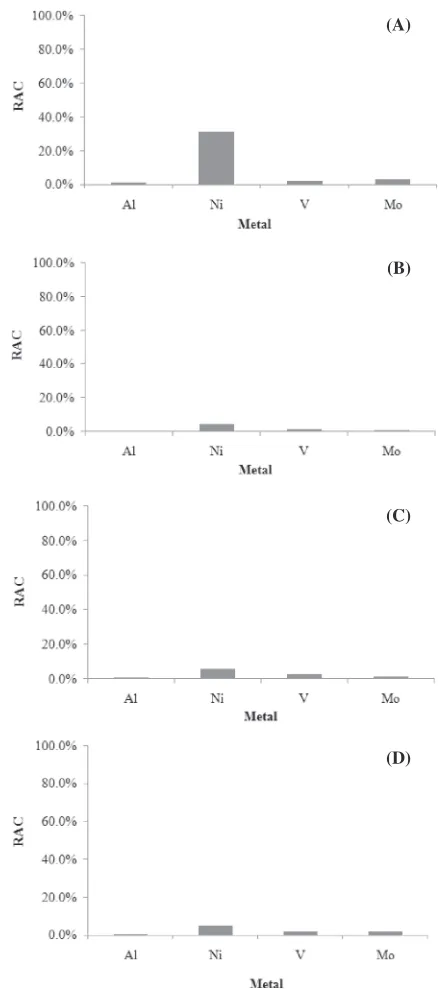
RAC is a widely accepted tool to assess the bioavailability of metals in a variety of solids matrixes. It is based on the percentage of metals in the F1 fraction which represents the exchangeable/bioavailable fraction. As the bioavailable fraction is composed of weakly adsorbed metals that can be equilibrated with the aqueous phase, this process is very important. According to the RAC guideline, any metal with less than 1%of its total content in the bioavailable fraction is considered safe for the environment and poses no risk. As per F1 fraction content, for a given metal the RAC can be postulated on the scale of 1% to 100%: <1% (no risk), 110% (low risk), 1130% (medium risk), 3150% (high risk), and>50%(very high risk).16)In the present study, the environmental risk of raw spent catalyst based on the RAC for Al, Mo and V was found to be low (Fig. 5(A)). On the contrary, the RAC value for Ni was 31%which exhibit high risk. This suggested that the efforts are needed to remove Ni from the spent catalyst.
Result suggested that due to bioleaching there was redistribution among the fractions of metals in the bioleached spent catalyst samples. In the bioleached spent catalyst samples, a significant decrease in the RAC value of Ni was observed and it decreased to low risk category in both the samples bioleached either with At. ferrooxidans (Fig. 5(B)) or At. thiooxidans (Fig. 5(C)). Due to bioleaching, the F1 fraction was leached which subsequently decreased the RAC values in spent catalyst samples bioleached by At. ferroox-idans (4.2%) and At. thiooxidans(5.4%). Due to the acidic conditions, a significant reduction was also observed in F1 fraction (5.0%) of the residue obtained after abiotic leaching (Fig. 5(D)). This led to a decrease RAC value for Ni in this residue. There was no significant change in RAC values of
(A)
(B)
(C)
(D)
[image:7.595.315.534.66.563.2]Al, V and Mo in treated samples (bioleached/leached) as these metal had low F1 fraction at the start of the experiment. In the samples bioleached with At. ferrooxidans, the Al and Mo were found to be in no risk category, whereas Ni and V were present in low risk category. In the spent catalyst sample bioleached withAt. thiooxidans, the Al was found in no risk category, whereas Ni, V and Mo were in low risk category. Similarly, in the sample leached with abiotic leaching, the Al existed in no risk category, whereas Ni, V and Mo were in low risk category.
3.6 Reduced partition index (IR)
As per the BCR procedure, the minimum possible value of
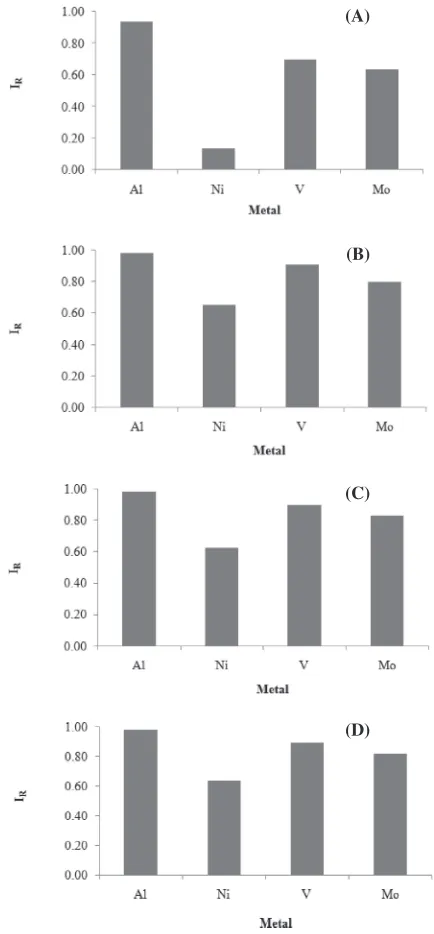
IR can be 0.06 when the metal percentage in F1 fraction is 100%. An IR value close to minimum (0.06) reflect the pattern in which the metal is weakly bonded to the matrix and is highly mobile (i.e. mostly in the F1 fraction). On the contrary, the maximum IR value (1) is obtained when the metal percentage in F4 fraction is 100%. A value close to the maximum (1.0) indicates that the metal is strongly bonded to the solid matrix and is highly stable. The values ofIRfor the each metal in feed spent catalyst are illustrated in Fig. 6(A). The results indicate that the relative binding intensity of metals differed in the feed spent catalyst sample. The lowest
IR value (0.14) was noted for Ni, indicating its high bioavailability, because it had the highest percentage in the F1 fraction, and the lowest in the F4 fraction. In comparison to Ni, higher binding intensities were obtained for Mo (0.63) and V (0.70) as both these metals were present predominantly in the F3 and F4 fractions. Among all metals, Al had the highest binding intensity (0.94), because it was present predominantly in the F4 fraction. As a result of bioleaching, there was change in the binding intensities of metals in the bioleached spent catalyst samples. Similar changes in the binding intensities were also observed in the abiotic leached spent catalyst sample. These changes in IR values for individual metals were caused by their redistribution among labile and stable fractions during bioleaching. By examining the values of theIR, it can be concluded that the influence on metal stability varied in the bioleached spent catalyst samples. In the spent catalyst samples bioleached either with
At. ferrooxidans(Fig. 6(B)) orAt. thiooxidans(Fig. 6(C)), Ni stability increased significantly due to its redistribution into the F3 and F4 fractions. The IRvalues of Ni were found to increased from 0.14 in feed spent catalyst to 0.65 and 0.63 in the spent catalyst samples bioleached with At. ferrooxidans
andAt. thiooxidansrespectively. A similar increase in theIR value of Ni (0.64) was also observed in the leached sample obtained after abiotic leaching.
Similar to Ni, a marginal increase in theIRvalues for Al was observed in the spent catalyst samples either bioleached with At. ferrooxidans (0.98) and At. thiooxidans (0.98) or leached with abiotic leaching (0.98). This comparatively low increase in theIRvalues of Al was due to the fact that theIR value of Al was already very high (0.94) in the feed spent catalyst. TheIRvalues also increased for Mo and V due to the transformation of F3 fractions into F4 fraction. This was likely as during bioleaching/abiotic leaching, some of the organics were solubilized due to acidic and oxidizing condition and metal associated with this fraction was exposed
and bounded to the matrix. This caused a slight increase in F4 fraction and IR in both the bioleached samples and sample obtained after abiotic leaching.
4. Conclusion
The results of the present suggest that it is possible to remove the metals from raw spent catalyst using two-step bioleaching. Bioleaching with either At. ferrooxidans or
At. thiooxidans led to similar leaching yields than that was observed with abiotic leaching. During bioleaching, the leaching yields of Ni and V were high, whereas Mo and Al were low. The differences in leaching yields were due to the presence of metals in different fractions in the feed spent catalyst. After bioleaching metals were found to be present mostly in stable fractions in the bioleached spent catalyst
(A)
(B)
(C)
(D)
Fig. 6 IRvalues for Al, Ni, V and Mo in (A) feed spent catalyst (B)
[image:8.595.317.534.68.535.2]samples. Bioleaching also enhanced the binding intensities of metals in the bioleached samples and bioleached spent catalyst samples poses no harm to the environment due to disposal.
Acknowledgement
This study was supported by Leading Foreign Research Institute Recruitment Program through the National Research Foundation of Korea (NRF) funded by the Ministry of Science, ICT, and Future Planning (2015).
REFERENCES
1) M. Li, Y. Shao and S. Xu: Energy Edu. Sci. Technol. Part A32(2014) 10151021.
2) S. Huang, Z. Zhao, X. Chen and F. Li:Int. J. Ref. Met. Hard Mater.46
(2014) 109116.
3) A. Ognyanova, A. T. Ozturk, I. D. Michelis, F. Ferella, G. Taglieri, A. Akcil and F. Veglio:Hydrometallurgy10(2009) 2028.
4) H. Al-Sheeha, M. Marafi, V. Raghavan and M. S. Rana: Ind. Eng.
Chem. Res.52(2013) 1279412801.
5) D. Pradhan, D. Mishra, D. J. Kim, J. G. Ahan and G. R. Chaudhury:
J. Hazard. Mater.175(2010) 267273.
6) R. M. Gholami, S. M. Borghei and S. M. Mousavi:Hydrometallurgy
106(2011) 2631.
7) H. Srichandan, A. Pathak, D. J. Kim and S. W. Lee:J. Env. Sci. Health Part A49(2014) 17401753.
8) F. Z. Noori, H. B. Nematdoust, G. Amoabediny, S. M. Mousavi and T. M. Amouei: Int. J. Env. Res.8(2014) 621634.
9) H. Srichandan, A. Pathak, S. Singh, K. Blight, D. J. Kim and S. W. Lee:
Hydrometallurgy150(2014) 130143.
10) K. R. Blight and D. E. Ralph:Hydrometallurgy73(2004) 325334.
11) A. M. Ure, P. H. Quevauviller, H. Muntau and B. Griepink:Int. J. Environ. Analyt Chem.51(1993) 135151.
12) A. Pathak, H. Srichandan and D. J. Kim: Wat. Air. Soil. Pollut.225 1893(2014) 110.
13) P. Miretzky, M. R. Avendaño, C. Munoz and A. Carrillo-Chavez:
J. Soil. Sediment.11(2011) 619627.
14) A. U. Belazi, C. Davisdon, G. E. Keating and D. L. John:J. Anal. At. Spectrom.3(1995) 233240.
15) J. Poledniok and F. Buhl:Talanta59(2003) 18.