Punjabi Machine Transliteration
M. G. Abbas Malik
Department of Linguistics
Denis Diderot, University of Paris 7
Paris, France
Abstract
Machine Transliteration is to transcribe a word written in a script with approximate phonetic equivalence in another lan-guage. It is useful for machine transla-tion, cross-lingual information retrieval, multilingual text and speech processing. Punjabi Machine Transliteration (PMT) is a special case of machine translitera-tion and is a process of converting a word from Shahmukhi (based on Arabic script) to Gurmukhi (derivation of Landa, Shardha and Takri, old scripts of Indian subcontinent), two scripts of Punjabi, ir-respective of the type of word.
The Punjabi Machine Transliteration System uses transliteration rules (charac-ter mappings and dependency rules) for transliteration of Shahmukhi words into Gurmukhi. The PMT system can translit-erate every word written in Shahmukhi.
1
Introduction
Punjabi is the mother tongue of more than 110 million people of Pakistan (66 million), India (44 million) and many millions in America, Canada and Europe. It has been written in two mutually incomprehensible scripts Shahmukhi and Gur-mukhi for centuries. Punjabis from Pakistan are unable to comprehend Punjabi written in Gur-mukhi and Punjabis from India are unable to comprehend Punjabi written in Shahmukhi. In contrast, they do not have any problem to under-stand the verbal expression of each other. Pun-jabi Machine Transliteration (PMT) system is an effort to bridge the written communication gap between the two scripts for the benefit of the mil-lions of Punjabis around the globe.
Transliteration refers to phonetic translation across two languages with different writing sys-tems (Knight & Graehl, 1998), such as Arabic to English (Nasreen & Leah, 2003). Most prior work has been done for Machine Translation (MT) (Knight & Leah, 97; Paola & Sanjeev, 2003; Knight & Stall, 1998) from English to other major languages of the world like Arabic, Chinese, etc. for cross-lingual information re-trieval (Pirkola et al, 2003), for the development of multilingual resources (Yan et al, 2003; Kang & Kim, 2000) and for the development of cross-lingual applications.
PMT is a special kind of machine translitera-tion. It converts a Shahmukhi word into a Gur-mukhi word irrespective of the type constraints of the word. It not only preserves the phonetics of the transliterated word but in contrast to usual transliteration, also preserves the meaning.
Two scripts are discussed and compared. Based on this comparison and analysis, character mappings between Shahmukhi and Gurmukhi are drawn and transliteration rules are discussed. Finally, architecture and process of the PMT sys-tem are discussed. When it is applied to Punjabi Unicode encoded text especially designed for testing, the results were complied and analyzed. PMT system will provide basis for Cross-Scriptural Information Retrieval (CSIR) and Cross-Scriptural Application Development (CSAD).
2
Punjabi Machine Transliteration
According to Paola (2003), “When writing a for-eign name in one’s native language, one tries to preserve the way it sounds, i.e. one uses an or-thographic representation which, when read aloud by the native speaker of the language, sounds as it would when spoken by a speaker of the foreign language – a process referred to as Transliteration”. Usually, transliteration is re-ferred to phonetic translation of a word of some
specific type (proper nouns, technical terms, etc) across languages with different writing systems. Native speakers may not understand the meaning of transliterated word.
PMT is a special type of Machine Translitera-tion in which a word is transliterated across two different writing systems used for the same lan-guage. It is independent of the type constraint of the word. It preserves both the phonetics as well as the meaning of transliterated word.
3
Scripts of Punjabi
3.1 Shahmukhi
Shahmukhi derives its character set form the Arabic alphabet. It is a right-to-left script and the shape assumed by a character in a word is con-text sensitive, i.e. the shape of a character is dif-ferent depending whether the position of the character is at the beginning, in the middle or at the end of the word. Normally, it is written in Nastalique, a highly complex writing system that is cursive and context-sensitive. A sentence illus-trating Shahmukhi is given below:
X}Z Ìáâ
â
y6– ÌÐâ<
ڻ
6– ~@ð Ì
Ì
6= P
It has 49 consonants, 16 diacritical marks and 16 vowels, etc. (Malik 2005)
3.2 Gurmukhi
Gurmukhi derives its character set from old scripts of the Indian Sub-continent i.e. Landa (script of North West), Sharda (script of Kash-mir) and Takri (script of western Himalaya). It is a left-to-right syllabic script. A sentence illustrat-ing Gurmukhi is given below:
ਪੰਜਾਬੀ
ਮੇਰੀ
ਮਾਣ
ਜੋਗੀ
ਮ
ਬੋਲੀ
ਏ
.
It has 38 consonants, 10 vowels characters, 9 vowel symbols, 2 symbols for nasal sounds and 1 symbol that duplicates the sound of a consonant. (Bhatia 2003, Malik 2005)
4
Analysis and PMT Rules
Punjabi is written in two completely different scripts. One script is right-to-left and the other is left-to-right. One is Arabic based cursive and the other is syllabic. But both of them represent the phonetic repository of Punjabi. These phonetic sounds are used to determine the relation be-tween the characters of two scripts. On the basis of this idea, character mappings are determined.
For the analysis and comparison, both scripts are subdivided into different group on the basis
of types of characters e.g. consonants, vowels, diacritical marks, etc.
4.1 Consonant Mapping
Consonants can be further subdivided into two groups:
Aspirated Consonants: There are sixteen as-pirated consonants in Punjabi (Malik, 2005). Ten of these aspirated consonants (JJ[bʰ], JJ[pʰ], JJ[ṱʰ], JJ[ʈʰ], bY[ʤʰ], bb[ʧʰ], |e[ḓʰ], |e[ɖʰ], ÏÏ[kʰ], ÏÏ[gʰ]) are very frequently used in Punjabi as compared to the remaining six aspirates (|g[rʰ], |h[ɽʰ], Ïà[lʰ], Jb[mʰ], JJ[nʰ], |z[vʰ]). In Shahmukhi, aspirated consonants are represented by the combination of a consonant (to be aspi-rated) and HEH-DOACHASHMEE (|). For example [ [b] + | [h] = JJ [bʰ] and ` [ʤ] + | [h] = Yb [ʤʰ].
In Gurmukhi, each frequently used aspirated-consonant is represented by a unique character. But, less frequent aspirated consonants are repre-sented by the combination of a consonant (to be aspirated) and sub-joined PAIREEN HAAHAA e.g. ਲ[l] + ◌੍ + ਹ[h] = ਲ(Ïà) [lʰ] and ਵ[v] + ◌੍
+ ਹ [h] = ਵ (|z) [vʰ], where ◌੍ is the sub-joiner. The sub-joiner character (◌੍) tells that the follow-ing ਹ [h] is going to change the shape of PAIREEN HAAHHA.
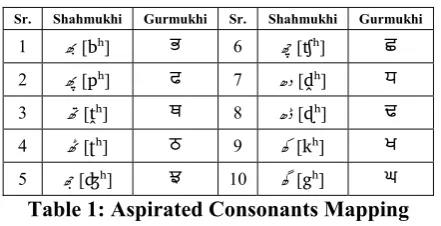
The mapping of ten frequently used aspirated consonants is given in Table 1.
Sr. Shahmukhi Gurmukhi Sr. Shahmukhi Gurmukhi
1 JJ [bʰ] ਭ 6 bb [ʧʰ] ਛ
[image:2.595.306.527.536.649.2]2 JJ [pʰ] ਫ 7 |e [ḓʰ] ਧ 3 JJ [ṱʰ] ਥ 8 |e [ɖʰ] ਢ 4 JJ [ʈʰ] ਠ 9 ÏÏ [kʰ] ਖ 5 bY [ʤʰ] ਝ 10 ÏÏ [gʰ] ਘ Table 1: Aspirated Consonants Mapping
The mapping for the remaining six aspirates is covered under non-aspirated consonants.
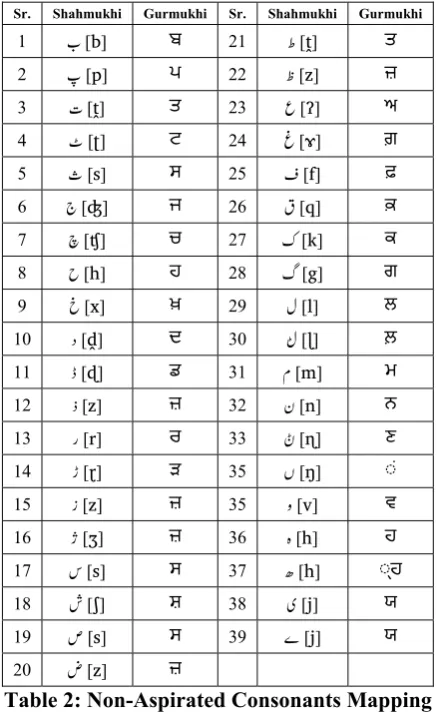
(_), Seen (k) and Sad (m) represent [s] and [s] has one equivalent in Gurmukhi i.e. Sassaa (ਸ). Similarly other characters like ਅ [a], ਤ [ṱ], ਹ [h] and ਜ਼ [z] have multiple equivalents in Shah-mukhi. Non-aspirated consonants mapping is given in Table 2.
Sr. Shahmukhi Gurmukhi Sr. Shahmukhi Gurmukhi
1 [ [b] ਬ 21 o [ṱ] ਤ
2 \ [p] ਪ 22 p [z] ਜ਼
3 ] [ṱ] ਤ 23 q [ʔ] ਅ
4 ^ [ʈ] ਟ 24 r [ɤ] ਗ਼
5 _ [s] ਸ 25 s [f] ਫ਼ 6 ` [ʤ] ਜ 26 t [q]
7 a [ʧ] ਚ 27 u [k] ਕ
8 b [h] ਹ 28 v [g] ਗ 9 c [x] ਖ਼ 29 w [l] ਲ
10 e [ḓ] ਦ 30 wؕ [ɭ] ਲ਼ 11 e [ɖ] ਡ 31 x [m] ਮ
12 f [z] ਜ਼ 32 y [n] ਨ 13 g [r] ਰ 33 ڻ [ɳ] ਣ 14 h [ɽ] ੜ 35 y [ŋ] ◌ਂ
15 i [z] ਜ਼ 35 z [v] ਵ
16 j [ʒ] ਜ਼ 36 { [h] ਹ
17 k [s] ਸ 37 | [h] ◌੍ਹ
18 l [ʃ] ਸ਼ 38 ~ [j] ਯ
[image:3.595.71.290.180.542.2]19 m [s] ਸ 39 } [j] ਯ 20 n [z] ਜ਼
Table 2: Non-Aspirated Consonants Mapping
4.2 Vowel Mapping
Punjabi contains ten vowels. In Shahmukhi, these vowels are represented with help of four long vowels (Alef Madda (W), Alef (Z), Vav (z) and Choti Yeh (~)) and three short vowels (Arabic Fatha – Zabar (F◌), Arabic Damma – Pesh (E◌) and Arabic Kasra – Zer (G◌)). Note that the last two long vowels are also used as consonants.
Hamza (Y) is a special character and always comes between two vowel sounds as a place holder. For example, in õGõ66W [ɑsɑɪʃ] (comfort), Hamza (Y) is separating two vowel sounds Alef (Z) and Zer (G◌), in zW [ɑo] (come), Hamza (Y) is separating two vowel sounds Alef Madda (W) [ɑ] and Vav (z) [o], etc. In the first example õGõ66W [ɑsɑɪʃ] (comfort), Hamza (Y) is separating two vowel sounds Alef (Z) and Zer (G◌), but normally Zer (G◌) is dropped by common people. So Hamza (Y) is mapped on ਇ [ɪ] when it is followed by a consonant.
In Gurmukhi, vowels are represented by ten independent vowel characters (ਅ, ਆ, ਇ, ਈ, ਉ,
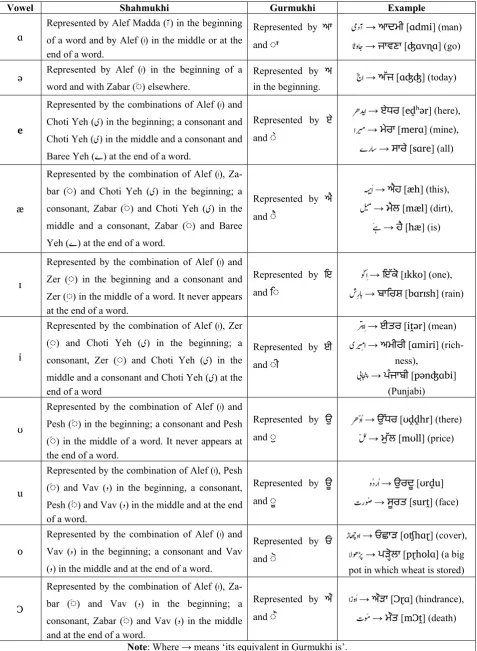
ਊ, ਏ, ਐ, ਓ, ਔ) and nine dependent vowel signs (◌ਾ, ਿ◌, ◌ੀ, ◌ੁ, ◌ੂ, ◌ੇ, ◌ੈ, ◌ੋ, ◌ੌ). When a vowel sound comes at the start of a word or is inde-pendent of some consonant in the middle or end of a word, independent vowels are used; other-wise dependent vowel signs are used. The analy-sis of vowels is shown in Table 4 and the vowel mapping is given in Table 3.
Sr. Shahmukhi Gurmukhi Sr. Shahmukhi Gurmukhi
1 FZ [ə] ਅ 11 Z[ə] ਅ,◌ਾ 2 ﺁ[ɑ] ਆ 12 G◌ [ɪ] ਿ◌ 3 GZ [ɪ] ਇ 13 ﯼ G◌ [i] ◌ੀ 4 ﯼِا [i] ਈ 14 E◌ [ʊ] ◌ੁ 5 EZ [ʊ] ਉ 15 zE◌ [u] ◌ੂ 6 zEZ [u] ਊ 16 } [e] ◌ੇ
7 }Z [e] ਏ 17 }F◌ [æ] ◌ੈ 8 }FZ [æ] ਐ 18 z [o] ◌ੋ 9 zZ [o] ਓ 19 Fz [Ɔ] ◌ੌ
[image:3.595.71.289.181.536.2]Vowel Shahmukhi Gurmukhi Example
ɑ
Represented by Alef Madda (W) in the beginning
of a word and by Alef (Z) in the middle or at the
end of a word.
Represented by ਆ
and ◌ਾ
ÌòeW→ਆਦਮੀ [ɑdmi] (man)
66z6 →ਜਾਵਣਾ [ʤɑvɳɑ] (go)
ə Represented by Alef (Z) in the beginning of a
word and with Zabar (F◌) elsewhere.
Represented by ਅ
in the beginning. H`Z→ਅੱਜ [ɑʤʤ] (today)
e
Represented by the combinations of Alef (Z) and
Choti Yeh (~) in the beginning; a consonant and
Choti Yeh (~) in the middle and a consonant and
Baree Yeh (}) at the end of a word.
Represented by ਏ
and ◌ੇ
uOääZ→ਏਧਰ [eḓʰər] (here),
Z@ð→ਮੇਰਾ [merɑ] (mine),
}g66→ਸਾਰੇ [sɑre] (all)
æ
Represented by the combination of Alef (Z),
Za-bar (F◌) and Choti Yeh (~) in the beginning; a
consonant, Zabar (F◌) and Choti Yeh (~) in the
middle and a consonant, Zabar (F◌) and Baree
Yeh (}) at the end of a word.
Represented by ਐ
and ◌ੈ
E}FZ→ਐਹ [æh] (this),
I‚Fr→ਮੈਲ [mæl] (dirt),
Fì→ਹੈ [hæ] (is)
ɪ
Represented by the combination of Alef (Z) and
Zer (G◌) in the beginning and a consonant and
Zer (G◌) in the middle of a word. It never appears
at the end of a word.
Represented by ਇ
and ਿ◌
âH§GZ→ਇੱਕੋ [ɪkko] (one), lGg66→ਬਾਿਰਸ਼ [bɑrɪsh] (rain)
i
Represented by the combination of Alef (Z), Zer
(G◌) and Choti Yeh (~) in the beginning; a
consonant, Zer (G◌) and Choti Yeh (~) in the
middle and a consonant and Choti Yeh (~) at the
end of a word
Represented by ਈ
and ◌ੀ
@ GZ→ਈਤਰ [iṱər] (mean)
~@GðZ→ਅਮੀਰੀ [ɑmiri] (rich-ness),
ÌÌ6= P→ਪੰਜਾਬੀ [pənʤɑbi] (Punjabi)
ʊ
Represented by the combination of Alef (Z) and
Pesh (E◌) in the beginning; a consonant and Pesh
(E◌) in the middle of a word. It never appears at
the end of a word.
Represented by ਉ
and ◌ੁ
uOHeEZ→ ਧਰ [ʊḓḓhr] (there) HIEï→ਮੁੱਲ [mʊll] (price)
u
Represented by the combination of Alef (Z), Pesh
(E◌) and Vav (z) in the beginning, a consonant,
Pesh (E◌) and Vav (z) in the middle and at the end
of a word.
Represented by ਊ
and ◌ੂ
zEegEZ→ਉਰਦੂ [ʊrḓu] ]gâEß→ਸੂਰਤ [surṱ] (face)
o
Represented by the combination of Alef (Z) and
Vav (z) in the beginning; a consonant and Vav
(z) in the middle and at the end of a word.
Represented by ਓ
and ◌ੋ
h6JzZ→ਓਛਾੜ [oʧhɑɽ] (cover),
iâðww→ਪੜੋਲਾ [pɽholɑ] (a big pot in which wheat is stored)
Ɔ
Represented by the combination of Alef (Z),
Za-bar (F◌) and Vav (z) in the beginning; a
consonant, Zabar (F◌) and Vav (z) in the middle
and at the end of a word.
Represented by ਔ
and ◌ੌ
ZhzFZ→ਔੜਾ [Ɔɽɑ] (hindrance),
]âFñ→ਮੌਤ [mƆṱ] (death)
[image:4.595.60.538.81.733.2]Note: Where → means ‘its equivalent in Gurmukhi is’.
4.3 Sub-Joins (PAIREEN) of Gurmukhi
There are three PAIREEN (sub-joins) in Gur-mukhi, “Haahaa”, “Vaavaa” and “Raaraa” shown in Table 5. For PMT, if HEH-DOACHASHMEE (|) does come after the less frequently used aspirated consonants then it is transliterated into PAIREEN Haahaa. Other PAIREENS are very rare in their usage and are used only in Sanskrit loan words. In present day writings, PAIREEN Vaavaa and Raaraa are being replaced by normal Vaavaa (ਵ) and Raaraa(ਰ) respectively.
Sr. PAIREEN Shahmukhi Gurmukhi English
1 H JHçEo ਬੁੱਲ Lips
2 R 6–gäs" ਚੰਦਮਾ Moon
3 Í y6˜ FâÎ ਸੈਮਾਨ respect
Self-Table 5: Sub-joins (PAIREEN) of Gurmukhi
4.4 Diacritical Marks
Both in Shahmukhi and Gurmukhi, diacritical marks (dependent vowel signs in Gurmukhi) are the back bone of the vowel system and are very important for the correct pronunciation and un-derstanding the meaning of a word. There are sixteen diacritical marks in Shahmukhi and nine dependent vowel sings in Gurmukhi (Malik, 2005). The mapping of diacritical marks is given in Table 6.
Sr. Shahmukhi Gurmukhi Sr. Shahmukhi Gurmukhi
1 F◌ [ə] --- 9 F◌[ɪn] ਿ◌ਨ
2 G◌ [ɪ] ਿ◌ 10 H◌ ◌ੱ
3 E◌[ʊ] ◌ੁ 11 W◌ ---
4 ؕ --- 12 Y◌ ---
5 F◌[ən] ਨ 13 Y◌ ---
6 E◌[ʊn] ◌ੂਨ 14 G◌ ---
7 E◌ --- 15 ---
8 --- 16 G◌[ɑ] ◌ਾ
Table 6: Diacritical Mapping
Diacritical marks in Shahmukhi are very im-portant for the correct pronunciation and under-standing the meaning of a word. But they are sparingly used in writing by common people. In the normal text of Shahmukhi books, newspa-pers, and magazines etc. one will not find the diacritical marks. The pronunciation of a word and its meaning would be comprehended with the help of the context in which it is used.
For example,
E}
FZ
u
uu
~
w
w
~hâ
a
}Z
X
@ð
~
~hâ
a
}Z w
i
X
In the first sentence, the word ~hâa is pronounced as [ʧɔɽi] and it conveys the meaning of ‘wide’. In the second sentence, the word ~hâa is pro-nounced as [ʧuɽi] and it conveys the meaning of ‘bangle’. There should be Zabar (F◌) after Cheh (a) and Pesh (E◌) after Cheh (a) in the first and second words respectively, to remove the ambi-guities.
It is clear from the above example that dia-critical marks are essential for removing ambi-guities, natural language processing and speech synthesis.
4.5 Other Symbols
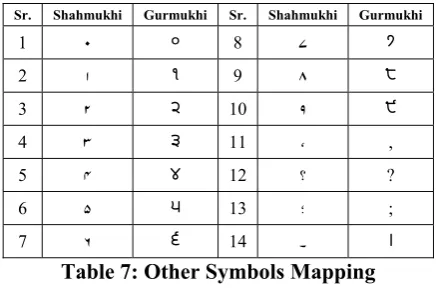
Punctuation marks in Gurmukhi are the same as in English, except the full stop. DANDA (।) and double DANDA (॥) of Devanagri script are used for the full stop instead. In case of Shahmukhi, these are same as in Arabic. The mapping of dig-its and punctuation marks is given in Table 7.
Sr. Shahmukhi Gurmukhi Sr. Shahmukhi Gurmukhi
1 0 ੦ 8 7 ੭
2 1 ੧ 9 8 ੮
3 2 ੨ 10 9 ੯
4 3 ੩ 11 Ô ,
5 4 ੪ 12 ? ?
6 5 ੫ 13 ; ;
[image:5.595.306.525.435.585.2]7 6 ੬ 14 X ।
Table 7: Other Symbols Mapping
4.6 Dependency Rules
Character mappings alone are not sufficient for PMT. They require certain dependency or con-textual rules for producing correct transliteration. The basic idea behind these rules is the same as that of the character mappings. These rules in-clude rules for aspirated consonants, non-aspirated consonants, Alef (Z), Alef Madda (W), Vav (z), Choti Yeh (~) etc. Only some of these rules are discussed here due to space limitations.
[image:5.595.72.291.467.630.2]Gurmukhi consonants e.g. k → ਸ [s]. Any dia-critical mark except Shadda (H◌) is ignored at this point and is treated in rules for vowels or in rules for diacritical marks. In Shahmukhi, Shadda (H◌) is placed after the consonant but in Gurmukhi, its equivalent Addak (◌ੱ) is placed before the con-sonant e.g. \ + H◌ → ◌ੱਪ [pp]. Both Shadda (H◌) and Addak (◌ੱ) double the sound a consonant after or before which they are placed.
This rule is applicable to all consonants in Ta-ble 1 and 2 except Ain (q), Noon (y), Noonghunna (y), Vav (z), Heh Gol ({), Dochashmee Heh (|), Choti Yeh (~) and Baree Yeh (}). These characters are treated separately.
Rule for Hamza (Y): Hamza (Y) is a special character of Shahmukhi. Rules for Hamza (Y) are: − If Hamza (Y) is followed by Choti Yeh (~), then
Hamza (Y) and Choti Yeh (~) will be transliterated into ਈ [i].
− If Hamza (Y) is followed by Baree Yeh (}), then Hamza (Y) and Baree Yeh (}) will be transliterated into ਏ [e].
− If Hamza (Y) is followed by Zer (G◌), then Hamza (Y) and Zer (G◌) will be transliterated into ਇ [ɪ].
− If Hamza (Y) is followed by Pesh (E◌), then Hamza (Y) and Pesh (E◌) will be transliterated into ਉ [ʊ].
In all other cases, Hamza (Y) will be transliter-ated into ਇ [ɪ].
5
PMT System
5.1 System Architecture
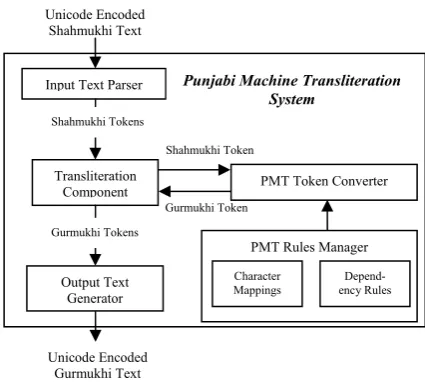
The architecture of PMT system and its func-tionality are described in this section. The system architecture of Punjabi Machine Transliteration System is shown in figure 1.
Unicode encoded Shahmukhi text input is re-ceived by the Input Text Parser that parses it into Shahmukhi words by using simple
[image:6.595.312.525.303.494.2]parsing techniques. These words are called Shahmukhi Tokens. Then these tokens are given to the Transliteration Component. This component gives each token to the PMT Token Converter that converts a Shahmukhi Token into a Gurmukhi Token by using the PMT Rules Manager, which consists of character mappings and dependency rules. The PMT To-ken Converter then gives the Gurmukhi To-ken back to the Transliteration Compo-nent. When all Shahmukhi Tokens are con-verted into Gurmukhi Tokens, then all Gurmukhi Tokens are passed to the Output Text Gen-erator that generates the output Unicode en-coded Gurmukhi text. The main PMT process is done by the PMT Token Converter and the PMT Rules Manager.
Figure 1: Architecture of PMT System
PMT system is a rule based transliteration sys-tem and is very robust. It is fast and accurate in its working. It can be used in domains involving Information Communication Technology (web, WAP, instant messaging, etc.).
5.2 PMT Process
The PMT Process is implemented in the PMT Token Converter and the PMT Rules Manager. For PMT, each Shahmukhi Token is parsed into its constituent characters and the character dependencies are determined on the basis of the occurrence and the contextual placement of the character in the token. In each Shahmukhi Token, there are some characters that bear dependencies and some characters are inde-pendent of such contextual dependencies for transliteration. If the character under considera-tion bears a dependency, then it is resolved and transliterated with the help of dependency rules.
Input Text Parser
PMT Rules Manager
Character Mappings
Depend-ency Rules
Unicode Encoded Shahmukhi Text
Unicode Encoded Gurmukhi Text
PMT Token Converter
Shahmukhi Token
Gurmukhi Token
Punjabi Machine Transliteration System
Output Text Generator Transliteration
Component
Shahmukhi Tokens
If the character under consideration does not bear a dependency, then its transliteration is achieved by character mapping. This is done through map-ping a character of the Shahmukhi token to its equivalent Gurmukhi character with the help of character mapping tables 1, 2, 3, 6 and 7, which-ever is applicable. In this way, a Shahmukhi To-ken is transliterated into its equivalent Gurmukhi Token.
Consider some input Shahmukhi text S. First it is parsed into Shahmukhi Tokens (S
1, S2… SN). Suppose that S
i = “y63„Zz” [vɑlejɑ̃] is the i th
Shah-mukhi Token. S
i is parsed into characters Vav (z) [v], Alef (Z) [ɑ], Lam (w) [l], Choti Yeh (~) [j], Alef (Z) [ɑ] and Noon Ghunna (y) [ŋ]. Then PMT mappings and dependency rules are applied to transliterate the Shahmukhi Token into a Gur-mukhi Token. The GurGur-mukhi Token G
i=“ਵਾਿਲਆਂ” is generated from Si. The step by step process is clearly shown in Table 8.
Sr. Character(s) Parsed Gurmukhi Token Mapping or Rule Applied
1 z→ਵ [v] ਵ Mapping Table 4
2 Z→◌ਾ [ɑ] ਵਾ Rule for ALEF
3 w→ਲ [l] ਵਾਲ Mapping Table 4
4 66→ਿ◌ਆ
[ɪɑ] ਵਾਿਲਆ Rule for YEH
5 y→◌ਂ [ŋ] ਵਾਿਲਆਂ NOONGHUNNA Rule for
[image:7.595.72.291.369.524.2]Note: → is read as ‘is transliterated into’. Table 8: Methodology of PMTS
In this way, all Shahmukhi Tokens are trans-literated into Gurmukhi Tokens (G1, G2 … Gn). From these Gurmukhi Tokens, Gurmukhi text G is generated.
The important point to be noted here is that input Shahmukhi text must contain all necessary diacritical marks, which are necessary for the correct pronunciation and understanding the meaning of the transliterated word.
6
Evaluation Experiments
6.1 Input Selection
The first task for evaluation of the PMT system is the selection of input texts. To consider the historical aspects, two manuscripts, poetry by Maqbal (Maqbal) and Heer by Waris Shah (Waris, 1766) were selected. Geographically
Punjab is divided into four parts eastern Punjab (Indian Punjab), central Punjab, southern Punjab and northern Punjab. All these geographical re-gions represent the major dialects of Punjabi. Hayms of Baba Nanak (eastern Punjab), Heer by Waris Shah (central Punjab), Hayms by Khawaja Farid (southern Punjab) and Saif-ul-Malooq by Mian Muhammad Bakhsh (northern Punjab) were selected for the evaluation of PMT system. All the above selected texts are categorized as classical literature of Punjabi. In modern litera-ture, poetry and short stories of different poets and writers were selected from some issues of Puncham (monthly Punjabi magazine since 1985) and other published books. All of these selected texts were then compiled into Unicode encoded text as none of them were available in this form before.
The main task after the compilation of all the selected texts into Unicode encoded texts is to put all necessary diacritical marks in the text. This is done with help of dictionaries. The accu-racy of the PMT system depends upon the neces-sary diacritical marks. Absence of the necesneces-sary diacritical marks affects the accuracy greatly.
6.2 Results
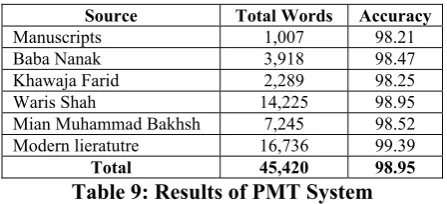
After the compilation of selected input texts, they are transliterated into Gurmukhi texts by using the PMT system. Then the transliterated Gur-mukhi texts are tested for errors and accuracy. Testing is done manually with help of dictionar-ies of Shahmukhi and Gurmukhi by persons who know both scripts. The results are given in Table 9.
Source Total Words Accuracy
Manuscripts 1,007 98.21
Baba Nanak 3,918 98.47
Khawaja Farid 2,289 98.25
Waris Shah 14,225 98.95
Mian Muhammad Bakhsh 7,245 98.52 Modern lieratutre 16,736 99.39
Total 45,420 98.95
Table 9: Results of PMT System
[image:7.595.304.528.519.621.2]7
Conclusion
Shahmukhi and Gurmukhi being the only two prevailing scripts for Punjabi expressions en-compass a population of almost 110 million around the globe. PMT is an endeavor to bridge the ethnical, cultural and geographical divisions between the Punjabi speaking communities. By implementing this system of transliteration, new horizons for thought, idea and belief will be shared and the world will gain an impetus on the efforts harmonizing relationships between na-tions. The large repository of historical, literary and religious work done by generations will now be available for easy transformation and critique for all. The research has future milestone ena-bling PMT system for back machine translitera-tion from Gurmukhi to Shahmukhi.
Reference
Ari Pirkola, Jarmo Toivonen, Heikki Keskustalo, Kari
Visala, and Kalervo Järvelin. 2003. Fuzzy
Transla-tion of Cross-Lingual Spelling Variants. In Pro-ceedings of the 26th annual international ACM SIGIR conference on Research and development in informaion retrieval. pp: 345 – 352
Baba Guru Nanak, arranged by Muhammad Asif Khan. 1998. "HH66 6666 63riW(Sayings of Baba Nanak in Punjabi Shahmukhi). Pakistan Punjabi Adbi Board, Lahore
Bhatia, Tej K. 2003. The Gurmukhi Script and Other
Writing Systems of Punjab: History, Structure and Identity. International Symposium on Indic Script: Past and future organized by Research Institute for the Languages and Cultures of Asia and Africa and Tokyo University of Foreign Studies, December 17 – 19. pp: 181 – 213
In-Ho Kang and GilChang Kim. 2000.
English-to-Korean transliteration using multiple unbounded overlapping phoneme chunks. In Proceedings of
the 17th conference on Computational Linguistics.
1: 418 – 424
Khawaja Farid (arranged by Muhammad Asif Khan).
" ääGuuEbZâa 63riW (Sayings of Khawaja Farid in Punjabi Shahmukhi). Pakistan Punjabi Adbi Board, Lahore
Knight, K. and Stalls, B. G. 1998. Translating Names
and Technical Terms in Arabic Tex. Proceedings of the COLING/ACL Workshop on Computational Approaches to Semitic Languages
Knight, Kevin and Graehl, Jonathan. 1997. Machine
Transliteration. In Proceedings of the 35th Annual
Meeting of the Association for Computational Lin-guistics. pp. 128-135
Knight, Kevin; Morgan Kaufmann and Graehl,
Jona-than. 1998. Machine Transliteration. In
Computa-tional Linguistics. 24(4): 599 – 612
Malik, M. G. Abbas. 2005. Towards Unicode
Com-patible Punjabi Character Set. In proceedings of
27th Internationalization and Unicode Conference,
6 – 8 April, Berlin, Germany
Maqbal. _âúGbäæ. Punjabi Manuscript in Oriental
Sec-tion, Main Library University of the Punjab, Quaid-e-Azam Campus, Lahore Pakistan; 7 pages; Access # 8773
Mian Muhammad Bakhsh (Edited by Fareer
Mu-hammad Faqeer). 2000. Saif-ul-Malooq. Al-Faisal
Pub. Urdu Bazar, Lahore
Nasreen AbdulJaleel, Leah S. Larkey. 2003.
Statisti-cal transliteration for English-Arabic cross lan-guage information retrieval. In Proceedings of the
12th international conference on information and
knowledge management. pp: 139 – 146
Paola Virga and Sanjeev Khudanpur. 2003.
Translit-eration of proper names in cross-language appli-cations. In Proceedings of the 26th annual
interna-tional ACM SIGIR conference on Research and development in information retrieval. pp: 365 – 366
Rahman Tariq. 2004. Language Policy and
Localiza-tion in Pakistan: Proposal for a Paradigmatic Shift. Crossing the Digital Divide, SCALLA Con-ference on Computational Linguistics, 5 – 7 Janu-ary 2004
Sung Young Jung, SungLim Hong and Eunok Peak.
2000. An English to Korean transliteration model
of extended markov window. In Proceedings of the
17th conference on Computational Linguistics.
1:383 – 389
Tanveer Bukhari. 2000. zegEZ ÌÌ6= ›P ~Ö. Urdu Science
Board, 299 Uper Mall, Lahore
Waris Shah. 1766. 6J6=Zg @¦. Punjabi Manuscript in
Ori-ental Section, Main Library University of the Pun-jab, Quaid-e-Azam Campus, Lahore Pakistan; 48 pages; Access # [Ui VI 135/]1443
Waris Shah (arranged by Naseem Ijaz). 1977. 6J6=Zg @¦.
Lehran, Punjabi Journal, Lahore
Yan Qu, Gregory Grefenstette, David A. Evans. 2003. Automatic transliteration for Japanese-to-English text retrieval. In Proceedings of the 26th annual