Proceedings of the 45th Annual Meeting of the Association of Computational Linguistics, pages 272–279,
The Infinite Tree
Jenny Rose Finkel, Trond Grenager, and Christopher D. Manning
Computer Science Department, Stanford University Stanford, CA 94305
{jrfinkel, grenager, manning}@cs.stanford.edu
Abstract
Historically, unsupervised learning tech-niques have lacked a principled technique for selecting the number of unseen compo-nents. Research into non-parametric priors, such as the Dirichlet process, has enabled in-stead the use of infinite models, in which the number of hidden categories is not fixed, but can grow with the amount of training data. Here we develop the infinite tree, a new infi-nite model capable of representing recursive branching structure over an arbitrarily large set of hidden categories. Specifically, we develop three infinite tree models, each of which enforces different independence as-sumptions, and for each model we define a simple direct assignment sampling inference procedure. We demonstrate the utility of our models by doing unsupervised learning of part-of-speech tags from treebank depen-dency skeleton structure, achieving an accu-racy of 75.34%, and by doing unsupervised splitting of part-of-speech tags, which in-creases the accuracy of a generative depen-dency parser from 85.11% to 87.35%.
1 Introduction
Model-based unsupervised learning techniques have historically lacked good methods for choosing the number of unseen components. For example, k -means or EM clustering require advance specifica-tion of the number of mixture components. But the introduction of nonparametric priors such as the Dirichlet process (Ferguson, 1973) enabled develop-ment of infinite mixture models, in which the num-ber of hidden components is not fixed, but emerges naturally from the training data (Antoniak, 1974).
Teh et al. (2006) proposed the hierarchical Dirich-let process (HDP) as a way of applying the DirichDirich-let process (DP) to more complex model forms, so as to allow multiple, group-specific, infinite mixture mod-els to share their mixture components. The closely related infinite hidden Markov model is an HMM in which the transitions are modeled using an HDP, enabling unsupervised learning of sequence models when the number of hidden states is unknown (Beal et al., 2002; Teh et al., 2006).
We extend this work by introducing the infinite tree model, which represents recursive branching structure over a potentially infinite set of hidden states. Such models are appropriate for the syntactic dependency structure of natural language. The hid-den states represent word categories (“tags”), the ob-servations they generate represent the words them-selves, and the tree structure represents syntactic de-pendencies between pairs of tags.
To validate the model, we test unsupervised learn-ing of tags conditioned on a given dependency tree structure. This is useful, because coarse-grained syntactic categories, such as those used in the Penn Treebank (PTB), make insufficient distinctions to be the basis of accurate syntactic parsing (Charniak, 1996). Hence, state-of-the-art parsers either supple-ment the part-of-speech (POS) tags with the lexical forms themselves (Collins, 2003; Charniak, 2000), manually split the tagset into a finer-grained one (Klein and Manning, 2003a), or learn finer grained tag distinctions using a heuristic learning procedure (Petrov et al., 2006). We demonstrate that the tags learned with our model are correlated with the PTB POS tags, and furthermore that they improve the ac-curacy of an automatic parser when used in training.
2 Finite Trees
We begin by presenting three finite tree models, each with different independence assumptions.
C
ρ πk
H φk
z1
z2 z3
[image:2.612.92.268.70.174.2]x1 x2 x3
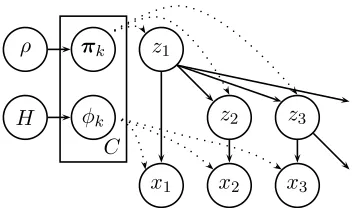
Figure 1: A graphical representation of the finite Bayesian tree model with independent children. The plate (rectangle) indicates that there is one copy of the model parameter variables for each statek≤C.
2.1 Independent Children
In the first model, children are generated indepen-dently of each other, conditioned on the parent. Let
tdenote both the tree and its root node,c(t)the list of children oft,ci(t)theithchild oft, andp(t)the
parent oft. Each treethas a hidden statezt(in a
syn-tax tree, the tag) and an observationxt(the word).1
The probability of a tree is given by the recursive definition:2
Ptr(t) = P(xt|zt)
Y
t′∈c(t)P(zt′|zt)Ptr(t
′)
To make the model Bayesian, we must define ran-dom variables to represent each of the model’s pa-rameters, and specify prior distributions for them. Let each of the hidden state variables haveC possi-ble values which we will index withk. Each statek
has a distinct distribution over observations, param-eterized byφk, which is distributed according to a
prior distribution over the parametersH:
φk|H ∼H
We generate each observation xt from some
distri-bution F(φzt) parameterized by φzt specific to its corresponding hidden statezt. IfF(φk)s are
multi-nomials, then a natural choice for H would be a Dirichlet distribution.3
The hidden state zt′ of each child is distributed according to a multinomial distributionπzt specific to the hidden stateztof the parent:
xt|zt∼F(φzt)
zt′|zt∼Multinomial(πzt)
1To model length, every child list ends with a distinguished
stop node, which has as its state a distinguished stop state.
2
We also define a distinguished nodet0, which generates the
root of the entire tree, andP(xt0|zt0) = 1.
3
A Dirichlet distribution is a distribution over the possible parameters of a multinomial distributions, and is distinct from the Dirichlet process.
Each multinomial over childrenπkis distributed
ac-cording to a Dirichlet distribution with parameterρ:
πk|ρ∼Dirichlet(ρ, . . . , ρ)
This model is presented graphically in Figure 1.
2.2 Simultaneous Children
The independent child model adopts strong indepen-dence assumptions, and we may instead want mod-els in which the children are conditioned on more than just the parent’s state. Our second model thus generates the states of all of the childrenc(t) simul-taneously:
Ptr(t) = P(xt|zt)P((zt′)t′∈c(t)|zt)
Y
t′∈c(t)Ptr(t
′)
where(zt′)t′∈c(t)indicates the list of tags of the chil-dren oft. To parameterize this model, we replace the multinomial distributionπkover states with a multi-nomial distributionλkover lists of states.4
2.3 Markov Children
The very large domain size of the child lists in the simultaneous child model may cause problems of sparse estimation. Another alternative is to use a first-order Markov process to generate children, in which each child’s state is conditioned on the previ-ous child’s state:
Ptr(t) = P(xt|zt)
Y|c(t)|
i=1 P(zci(t)|zci−1(t), zt)Ptr(t
′)
For this model, we augment all child lists with a dis-tinguished start node, c0(t), which has as its state
a distinguished start state, allowing us to capture the unique behavior of the first (observed) child. To parameterize this model, note that we will need to defineC(C+ 1)multinomials, one for each parent state and preceding child state (or a distinguished start state).
3 To Infinity, and Beyond . . .
This section reviews needed background material for our approach to making our tree models infinite.
3.1 The Dirichlet Process
Suppose we model a document as a bag of words produced by a mixture model, where the mixture components might be topics such as business, pol-itics, sports, etc. Using this model we can generate a
4
0 0.2
0.4 0.6
0.8 1
0 0.2 0.4 0.6 0.8 1
P(xi = "game") P(x
[image:3.612.87.278.67.207.2]i = "profit")
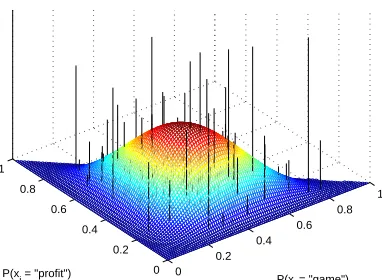
Figure 2: Plot of the density function of a Dirich-let distribution H (the surface) as well as a draw
G (the vertical lines, or sticks) from a Dirichlet process DP(α0, H) which has H as a base
mea-sure. Both distributions are defined over a sim-plex in which each point corresponds to a particular multinomial distribution over three possible words: “profit”, “game”, and “election”. The placement of the sticks is drawn from the distribution H, and is independent of their lengths, which is drawn from a stick-breaking process with parameterα0.
document by first generating a distribution over top-icsπ, and then for each position iin the document, generating a topic zi from π, and then a word xi
from the topic specific distribution φzi. The word distributions φk for each topic k are drawn from a
base distribution H. In Section 2, we sample C
multinomials φk from H. In the infinite mixture
model we sample an infinite number of multinomi-als fromH, using the Dirichlet process.
Formally, given a base distribution H and a con-centration parameterα0(loosely speaking, this
con-trols the relative sizes of the topics), a Dirichlet pro-cess DP(α0, H)is the distribution of a discrete
ran-dom probability measureGover the same (possibly continuous) space thatHis defined over; thus it is a measure over measures. In Figure 2, the sticks (ver-tical lines) show a drawGfrom a Dirichlet process where the base measureHis a Dirichlet distribution over 3 words. A draw comprises of an infinite num-ber of sticks, and each corresponding topic.
We factorGinto two coindexed distributions: π, a distribution over the integers, where the integer represents the index of a particular topic (i.e., the height of the sticks in the figure represent the proba-bility of the topic indexed by that stick) andφ, rep-resenting the word distribution of each of the
top-N
∞
α0 H
π φk
zi
xi
π|α0∼GEM(α0)
φk|H∼H zi|π∼π
xi|zi,φ∼F(φzi) N
∞
γ α0
β H
πj φk
zji
xji
[image:3.612.314.540.71.262.2](a) (b)
Figure 3: A graphical representation of a simple Dirichlet process mixture model (left) and a hierar-chical Dirichlet process model (right). Note that we show the stick-breaking representations of the mod-els, in which we have factoredG∼DP(α0, H)into two sets of variables:πandφ.
ics (i.e., the location of the sticks in the figure). To generateπwe first generate an infinite sequence of variablesπ′= (π′
k)∞k=1, each of which is distributed
according to the Beta distribution:
π′k|α0∼Beta(1, α0)
Thenπ= (πk)∞k=1is defined as:
πk=π′k
Yk−1
i=1(1−π ′
i)
Following Pitman (2002) we refer to this process as
π ∼GEM(α0). It should be noted thatP∞k=1πk=
1,5 and P(i) = πi. Then, according to the DP,
P(φi) =πi. The complete model, is shown
graphi-cally in Figure 3(a).
To build intuition, we walk through the process of generating from the infinite mixture model for the document example, where xi is the word at
posi-tion i, and zi is its topic. F is a multinomial
dis-tribution parameterized byφ, and H is a Dirichlet distribution. Instead of generating all of the infinite mixture components (πk)∞k=1 at once, we can build
them up incrementally. If there areK known top-ics, we represent only the known elements(πk)Kk=1
and represent the remaining probability massπu =
5
This is called the stick-breaking construction: we start with a stick of unit length, representing the entire probability mass, and successively break bits off the end of the stick, where the proportional amount broken off is represented byπ′
k and the
φ1 φ2 φ3 φ4φ5φ6 φ7 . . .
β:
πj :
[image:4.612.90.287.76.154.2]. . .
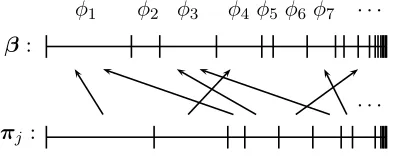
Figure 4: A graphical representation ofπj, a broken
stick, which is distributed according to a DP with a broken stickβ as a base measure. Eachβk
corre-sponds to aφk.
1 − (PKk=1πk). Initially we have πu = 1 and
φ= ().
For theith position in the document, we first draw a topic zi ∼ π. Ifzi 6= u, then we find the
coin-dexed topic φzi. If zi = u, the unseen topic, we make a drawb ∼Beta(1, α0)and setπK+1 = bπu
and πnewu = (1 −b)πu. Then we draw a
parame-terφK+1 ∼ H for the new topic, resulting inπ =
(π1, . . . , πK+1, πnewu )andφ = (φ1, . . . , φK+1). A
word is then drawn from this topic and emitted by the document.
3.2 The Hierarchical Dirichlet Process
Let’s generalize our previous example to a corpus of documents. As before, we have a set of shared topics, but now each document has its own charac-teristic distribution over these topics. We represent topic distributions both locally (for each document) and globally (across all documents) by use of a hier-archical Dirichlet process (HDP), which has a local DP for each document, in which the base measure is itself a draw from another, global, DP.
The complete HDP model is represented graphi-cally in Figure 3(b). Like the DP, it has global bro-ken stickβ = (βk)∞k=1and topic specific word
dis-tribution parameters φ= (φk)∞k=1, which are
coin-dexed. It differs from the DP in that it also has lo-cal broken sticks πj for each group j (in our case
documents). While the global stickβ ∼ GEM(γ) is generated as before, the local sticks πj are
dis-tributed according to a DP with base measure β: πj ∼DP(α0,β).
We illustrate this generation process in Figure 4. The upper unit line represents β, where the size of segment k represents the value of element βk, and
the lower unit line representsπj ∼DP(α0,β)for a
particular group j. Each element of the lower stick was sampled from a particular element of the upper
stick, and elements of the upper stick may be sam-pled multiple times or not at all; on average, larger elements will be sampled more often. Each element βk, as well as all elements ofπj that were sampled
from it, corresponds to a particular φk. Critically,
several distinct πj can be sampled from the same
βk and hence shareφk; this is how components are
shared among groups.
For concreteness, we show how to generate a cor-pus of documents from the HDP, generating one document at a time, and incrementally construct-ing our infinite objects. Initially we haveβu = 1,
φ = (), andπju = 1 for all j. We start with the
first position of the first document and draw a local topic y11 ∼ π1, which will returnu with
probabil-ity 1. Becausey11 =uwe must make a draw from
the base measure,β, which, because this is the first document, will also returnuwith probability 1. We must now breakβuintoβ1andβunew, and breakπ1u
intoπ11andπnew1u in the same manner presented for
the DP. Sinceπ11 now corresponds to global topic 1, we sample the wordx11 ∼Multinomial(φ1). To
sample each subsequent wordi, we first sample the local topicy1i ∼ π1. Ify1i 6= u, and π1y1i corre-sponds toβkin the global stick, then we sample the
wordx1i ∼ Multinomial(φk). Once the first
docu-ment has been sampled, subsequent docudocu-ments are sampled in a similar manner; initiallyπju = 1for
documentj, whileβcontinues to grow as more doc-uments are sampled.
4 Infinite Trees
We now use the techniques from Section 3 to create infinite versions of each tree model from Section 2.
4.1 Independent Children
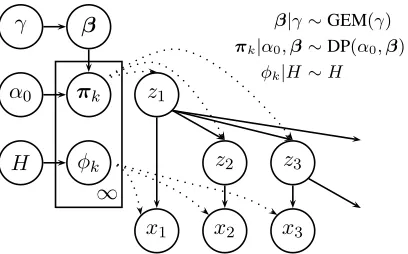
The changes required to make the Bayesian inde-pendent children model infinite don’t affect its ba-sic structure, as can be witnessed by comparing the graphical depiction of the infinite model in Figure 5 with that of the finite model in Figure 1. The in-stance variables ztand xt are parameterized as
be-fore. The primary change is that the number of copies of the state plate is infinite, as are the number of variablesπkandφk.
Note also that each distribution over possible child statesπkmust also be infinite, since the
num-ber of possible child states is potentially infinite. We achieve this by representing each of theπkvariables
β|γ∼GEM(γ)
πk|α0,β∼DP(α0,β)
φk|H∼H
∞
γ β
α0 πk
H φk
z1
z2 z3
[image:5.612.83.287.70.197.2]x1 x2 x3
Figure 5: A graphical representation of the infinite independent child model.
sampling eachπkfrom a DP with base measure β.
For the dependency tree application, φk is a vector
representing the parameters of a multinomial over words, andHis a Dirichlet distribution.
The infinite hidden Markov model (iHMM) or HDP-HMM (Beal et al., 2002; Teh et al., 2006) is a model of sequence data with transitions modeled by an HDP.6 The iHMM can be viewed as a special case of this model, where each state (except the stop state) produces exactly one child.
4.2 Simultaneous Children
The key problem in the definition of the simulta-neous children model is that of defining a distribu-tion over the lists of children produced by each state, since each child in the list has as its domain the posi-tive integers, representing the infinite set of possible states. Our solution is to construct a distributionLk
over lists of states from the distribution over individ-ual statesπk. The obvious approach is to sample the
states at each position i.i.d.:
P((zt′)t′∈c(t)|π) =
Y
t′∈c(t)
P(zt′|π) =
Y
t′∈c(t)
πzt′
However, we want our model to be able to rep-resent the fact that some child lists, ct, are more
or less probable than the product of the individual child probabilities would indicate. To address this, we can sample a state-conditional distribution over child listsλkfrom a DP withLkas a base measure.
6
The original iHMM paper (Beal et al., 2002) predates, and was the motivation for, the work presented in Teh et al. (2006), and is the origin of the term hierarchical Dirichlet process. However, they used the term to mean something slightly differ-ent than the HDP presdiffer-ented in Teh et al. (2006), and presdiffer-ented a sampling scheme for inference that was a heuristic approxima-tion of a Gibbs sampler.
Thus, we augment the basic model given in the pre-vious section with the variablesζ,Lk, andλk:
Lk|πk ∼Deterministic, as described above
λk|ζ, Lk ∼DP(ζ, Lk)
ct|λk ∼λk
An important consequence of defining Lk locally
(instead of globally, using β instead of theπks) is
that the model captures not only what sequences of children a state prefers, but also the individual chil-dren that state prefers; if a state gives high proba-bility to some particular sequence of children, then it is likely to also give high probability to other se-quences containing those same states, or a subset thereof.
4.3 Markov Children
In the Markov children model, more copies of the variableπare needed, because each child state must be conditioned both on the parent state and on the state of the preceding child. We use a new set of variables πki, where π is determined by the
par-ent state kand the state of the preceding sibling i. Each of theπkiis distributed asπkwas in the basic
model:πki∼DP(α0,β).
5 Inference
Our goal in inference is to draw a sample from the posterior over assignments of states to observations. We present an inference procedure for the infinite tree that is based on Gibbs sampling in the direct assignment representation, so named because we di-rectly assign global state indices to observations.7
Before we present the procedure, we define a few count variables. Recall from Figure 4 that each state
khas a local stick πk, each element of which
cor-responds to an element ofβ. In our sampling pro-cedure, we only keep elements ofπk andβ which
correspond to states observed in the data. We define the variablemjkto be the number of elements of the
finite observed portion ofπkwhich correspond toβj
andnjkto be the number of observations with state
kwhose parent’s state isj.
We also need a few model-specific counts. For the simultaneous children model we neednjz, which is
7
the number of times the state sequence z occurred as the children of state j. For the Markov chil-dren model we need the count variable nˆjik which
is the number of observations for a node with state
kwhose parent’s state isj and whose previous sib-ling’s state isi. In all cases we represent marginal counts using dot-notation, e.g.,n·kis the total
num-ber of nodes with statek, regardless of parent. Our procedure alternates between three distinct sampling stages: (1) sampling the state assignments
z, (2) sampling the counts mjk, and (3) sampling
the global stickβ. The only modification of the pro-cedure that is required for the different tree mod-els is the method for computing the probability of the child state sequence given the parent state P((zt′)t′∈c(t)|zt), defined separately for each model.
Samplingz. In this stage we sample a state for each tree node. The probability of nodetbeing as-signed statekis given by:
P(zt=k|z−t,β)∝P(zt=k,(zt′)t′∈s(t)|zp(t))
·P((zt′)t′∈c(t)|zt=k)·fk−xt(xt)
wheres(t)denotes the set of siblings oft,f−xt
k (xt)
denotes the posterior probability of observation xt
given all other observations assigned to statek, and z−tdenotes all state assignments exceptzt. In other
words, the probability is proportional to the product of three terms: the probability of the states oftand its siblings given its parentzp(t), the probability of the states of the childrenc(t)givenzt, and the
pos-terior probability of observation xt given zt. Note
that if we sampleztto be a previously unseen state,
we will need to extendβas discussed in Section 3.2. Now we give the equations for P((zt′)t′∈c(t)|zt)
for each of the models. In the independent child model the probability of generating each child is:
Pind(zci(t)=k|zt=j) =
njk+α0βk
nj·+α0
Pind((zt′)t′∈c(t)|zt=j) =
Y
t′∈c(t)Pind(zt′|zt=j) For the simultaneous child model, the probability of generating a sequence of children, z, takes into
ac-count how many times that sequence has been gen-erated, along with the likelihood of regenerating it:
Psim((zt′)t′∈c(t) =z|zt=j) =
njz+ζPind(z|zt=j)
nj·+ζ
Recall that ζ denotes the concentration parameter for the sequence generating DP. Lastly, we have the
DT NN IN DT NN VBD PRP$ NN TO VB NN EOS
[image:6.612.319.535.71.125.2]The man in the corner taught his dachshund to play golf EOS
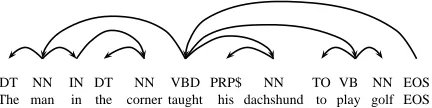
Figure 6: An example of a syntactic dependency tree where the dependencies are between tags (hidden states), and each tag generates a word (observation).
Markov child model:
Pm(zci(t)=k|zci−1(t) =i, zt=j) = ˆ
njik+α0βk
ˆ
nji·+α0
Pm((zt′)t′∈c(t)|zt) =
Y|c(t)|
i=1 Pm(zci(t)|zci−1(t), zt) Finally, we give the posterior probability of an ob-servation, given thatF(φk)is Multinomial(φk), and
that H is Dirichlet(ρ, . . . , ρ). LetN be the vocab-ulary size andn˙k be the number of observations x
with statek. Then:
f−xt
k (xt) =
˙ nxtk+ρ ˙
n·k+N ρ
Sampling m. We use the following procedure, which slightly modifies one from (Y. W. Teh, 2006, p.c.), to sample eachmjk:
SAMPLEM(j, k) 1 ifnjk= 0
2 thenmjk= 0
3 else mjk= 1
4 fori←2tonjk
5 do if rand()< α0
α0+i−1
6 thenmjk=mjk+ 1
7 returnmjk
Samplingβ. Lastly, we sample βusing the Di-richlet distribution:
(β1, . . . , βK, βu)∼Dirichlet(m·1, . . . , m·K, α0)
6 Experiments
We demonstrate infinite tree models on two dis-tinct syntax learning tasks: unsupervised POS learn-ing conditioned on untagged dependency trees and learning a split of an existing tagset, which improves the accuracy of an automatic syntactic parser.
the variablesπk, one each for the left and the right.
Generation of dependents on the right is completely independent of that for the left. The modifications of the other models are similar, but now there are sepa-rate sets ofπkvariables for the Markov child model,
and separateLkandλk variables for the
simultane-ous child model, for each of the left and right. For both experiments, we used dependency trees extracted from the Penn Treebank (Marcus et al., 1993) using the head rules and dependency extrac-tor from Yamada and Matsumoto (2003). As is stan-dard, we used WSJ sections 2–21 for training, sec-tion 22 for development, and secsec-tion 23 for testing.
6.1 Unsupervised POS Learning
In the first experiment, we do unsupervised part-of-speech learning conditioned on dependency trees. To be clear, the input to our algorithm is the de-pendency structure skeleton of the corpus, but not the POS tags, and the output is a labeling of each of the words in the tree for word class. Since the model knows nothing about the POS annotation, the new classes have arbitrary integer names, and are not guaranteed to correlate with the POS tag def-initions. We found that the choice of α0 and β
(the concentration parameters) did not affect the out-put much, while the value of ρ (the parameter for the base Dirichlet distribution) made a much larger difference. For all reported experiments, we set
α0 =β = 10and variedρ.
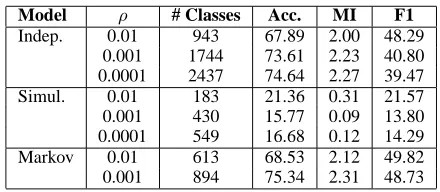
We use several metrics to evaluate the word classes. First, we use the standard approach of greedily assigning each of the learned classes to the POS tag with which it has the greatest overlap, and then computing tagging accuracy (Smith and Eisner, 2005; Haghighi and Klein, 2006).8 Additionally, we compute the mutual information of the learned clus-ters with the gold tags, and we compute the cluster F-score (Ghosh, 2003). See Table 1 for results of the different models, parameter settings, and met-rics. Given the variance in the number of classes learned it is a little difficult to interpret these results, but it is clear that the Markov child model is the best; it achieves superior performance to the inde-pendent child model on all metrics, while learning fewer word classes. The poor performance of the simultaneous model warrants further investigation, but we observed that the distributions learned by that
8
The advantage of this metric is that it’s comprehensible. The disadvantage is that it’s easy to inflate by adding classes.
Model ρ # Classes Acc. MI F1
[image:7.612.316.536.69.165.2]Indep. 0.01 943 67.89 2.00 48.29 0.001 1744 73.61 2.23 40.80 0.0001 2437 74.64 2.27 39.47 Simul. 0.01 183 21.36 0.31 21.57 0.001 430 15.77 0.09 13.80 0.0001 549 16.68 0.12 14.29 Markov 0.01 613 68.53 2.12 49.82 0.001 894 75.34 2.31 48.73
Table 1: Results of part unsupervised POS tagging on the different models, using a greedy accuracy measure.
model are far more spiked, potentially due to double counting of tags, since the sequence probabilities are already based on the local probabilities.
For comparison, Haghighi and Klein (2006) re-port an unsupervised baseline of 41.3%, and a best result of 80.5% from using hand-labeled prototypes and distributional similarity. However, they train on less data, and learn fewer word classes.
6.2 Unsupervised POS Splitting
In the second experiment we use the infinite tree models to learn a refinement of the PTB tags. We initialize the set of hidden states to the set of PTB tags, and then, during inference, constrain the sam-pling distribution over hidden stateztat each nodet
to include only states that are a refinement of the an-notated PTB tag at that position. The output of this training procedure is a new annotation of the words in the PTB with the learned tags. We then compare the performance of a generative dependency parser trained on the new refined tags with one trained on the base PTB tag set. We use the generative de-pendency parser distributed with the Stanford fac-tored parser (Klein and Manning, 2003b) for the comparison, since it performs simultaneous tagging and parsing during testing. In this experiment, un-labeled, directed, dependency parsing accuracy for the best model increased from 85.11% to 87.35%, a 15% error reduction. See Table 2 for the full results over all models and parameter settings.
7 Related Work
Model ρ Accuracy
[image:8.612.115.257.68.134.2]Baseline – 85.11 Independent 0.01 86.18 0.001 85.88 Markov 0.01 87.15 0.001 87.35
Table 2: Results of untyped, directed dependency parsing, where the POS tags in the training data have been split according to the various models. At test time, the POS tagging and parsing are done simulta-neously by the parser.
state probabilities. In contrast, Liang et al. (2007) define a global DP over sequences, with the base measure defined over the global state probabilities, β; locally, each state has an HDP, with this global DP as the base measure. We believe our choice to be more linguistically sensible: in our model, for a particular state, dependent sequences which are sim-ilar to one another increase one another’s likelihood. Additionally, their modeling decision made it diffi-cult to define a Gibbs sampler, and instead they use variational inference. Earlier, Johnson et al. (2007) presented adaptor grammars, which is a very simi-lar model to the HDP-PCFG. However they did not confine themselves to a binary branching structure and presented a more general framework for defin-ing the process for splittdefin-ing the states.
8 Discussion and Future Work
We have presented a set of novel infinite tree models and associated inference algorithms, which are suit-able for representing syntactic dependency structure. Because the models represent a potentially infinite number of hidden states, they permit unsupervised learning algorithms which naturally select a num-ber of word classes, or tags, based on qualities of the data. Although they require substantial techni-cal background to develop, the learning algorithms based on the models are actually simple in form, re-quiring only the maintenance of counts, and the con-struction of sampling distributions based on these counts. Our experimental results are preliminary but promising: they demonstrate that the model is capa-ble of capturing important syntactic structure.
Much remains to be done in applying infinite models to language structure, and an interesting ex-tension would be to develop inference algorithms that permit completely unsupervised learning of de-pendency structure.
Acknowledgments
Many thanks to Yeh Whye Teh for several enlight-ening conversations, and to the following mem-bers (and honorary member) of the Stanford NLP group for comments on an earlier draft: Thad Hughes, David Hall, Surabhi Gupta, Ani Nenkova, Sebastian Riedel. This work was supported by a Scottish Enterprise Edinburgh-Stanford Link grant (R37588), as part of the EASIE project, and by the Advanced Research and Development Activity (ARDA)’s Advanced Question Answering for Intel-ligence (AQUAINT) Phase II Program.
References
C. E. Antoniak. 1974. Mixtures of Dirichlet processes with ap-plications to Bayesian nonparametrics. Annals of Statistics, 2:1152–1174.
M.J. Beal, Z. Ghahramani, and C.E. Rasmussen. 2002. The infinite hidden Markov model. In Advances in Neural
Infor-mation Processing Systems, pages 577–584.
E. Charniak. 1996. Tree-bank grammars. In AAAI 1996, pages 1031–1036.
E. Charniak. 2000. A maximum-entropy-inspired parser. In
HLT-NAACL 2000, pages 132–139.
M. Collins. 2003. Head-driven statistical models for natural lan-guage parsing. Computational Linguistics, 29(4):589–637. T. S. Ferguson. 1973. A Bayesian analysis of some
nonpara-metric problems. Annals of Statistics, 1:209–230.
J. Ghosh. 2003. Scalable clustering methods for data mining. In N. Ye, editor, Handbook of Data Mining, chapter 10, pages 247–277. Lawrence Erlbaum Assoc.
A. Haghighi and D. Klein. 2006. Prototype-driven learning for sequence models. In HLT-NAACL 2006.
M. Johnson, T. Griffiths, and S. Goldwater. 2007. Adaptor grammars: A framework for specifying compositional non-parametric Bayesian models. In NIPS 2007.
D. Klein and C. D. Manning. 2003a. Accurate unlexicalized parsing. In ACL 2003.
D. Klein and C. D. Manning. 2003b. Factored A* search for models over sequences and trees. In IJCAI 2003.
P. Liang, S. Petrov, D. Klein, and M. Jordan. 2007. Nonpara-metric PCFGs using Dirichlet processes. In EMNLP 2007. M. P. Marcus, B. Santorini, and M. A. Marcinkiewicz. 1993.
Building a large annotated corpus of English: The Penn Treebank. Computational Linguistics, 19(2):313–330. S. Petrov, L. Barrett, R. Thibaux, and D. Klein. 2006. Learning
accurate, compact, and interpretable tree annotation. In ACL
44/COLING 21, pages 433–440.
J. Pitman. 2002. Poisson-Dirichlet and GEM invariant distribu-tions for split-and-merge transformadistribu-tions of an interval par-tition. Combinatorics, Probability and Computing, 11:501– 514.
N. A. Smith and J. Eisner. 2005. Contrastive estimation: Train-ing log-linear models on unlabeled data. In ACL 2005. Y. W. Teh, M.I. Jordan, M. J. Beal, and D.M. Blei. 2006.
Hier-archical Dirichlet processes. Journal of the American
Statis-tical Association, 101:1566–1581.
H. Yamada and Y. Matsumoto. 2003. Statistical dependency analysis with support vector machines. In Proceedings of