Applicability of Weibull Distribution to Description of Distributed Normalized
Critical Current of Bent-Damaged Bi2223 Composite Tape
Shojiro Ochiai
1, Hiroshi Okuda
1, Michinaka Sugano
2, Masaki Hojo
3, Kozo Osamura
4,
Tsuneo Kuroda
5, Hiroaki Kumakura
5, Hitoshi Kitaguchi
5, Kikuo Itoh
5and Hitoshi Wada
5 1Department of Materials Science and Engineering, Kyoto University, Kyoto 606-8501, Japan2Department of Electronic Science and Engineering, Kyoto University, Kyoto 615-8530, Japan 3Department of Mechanical Engineering and Science, Kyoto University, Kyoto 606-8501, Japan 4Research Institute for Applied Sciences, Kyoto 606-8202, Japan
5Superconducting Materials Center, National Institute for Materials Science, Tsukuba 305-0047, Japan
Critical current of bent-damaged Bi2223 composite tape differs from specimen to specimen. To describe the distributed critical current values of specimens, the three-parameter Weibull distribution function has been employed and has been demonstrated to describe the experimental results. In the present work, the reason for this was discussed by modeling analysis of the experimental results in a round robin test of VAMAS/TWA16. The distribution of the measured normalized critical current values was described well by using the damage evolution approach, in which the difference in damage evolution among the specimens was correlated to the distribution of critical current values. From this approach, the three-parameter Weibull distribution function for critical current values was derived, which gave almost the same parameter values for the minimum critical current, scale parameter and shape parameter as those obtained by the direct application of the Weibull distribution function to the experimental results. Based on this result, the reason why the normalized critical current values of bent-damaged composite tape is described by the three-parameter Weibull distribution function was accounted for in a quantitative manner by the difference in damage evolution among the specimens. [doi:10.2320/matertrans.MAW201001]
(Received March 25, 2010; Accepted June 17, 2010; Published August 4, 2010)
Keywords: Bi2223 composite superconductor, critical current distribution, bending, heterogeneous damage, Weibull distribution
1. Introduction
The critical current of Bi2223/Ag/Ag alloy composite tape under externally applied strain is known to be reduced first at the irreversible strain at which the damage of the Bi2223 filaments takes place, and then to be further reduced
with increasing strain due to damage evolution.1–14)
Hetero-geneous damage occurs, and the damage evolution behavior differs from specimen to specimen and from location to
location within a specimen.9–14)Accordingly, when a number
of specimens are tested, the critical current differs from specimen to specimen.
To describe the damage-induced distribution of critical current of the bent specimens, we have recently proposed a modeling approach that incorporates the correlation among the critical current, the shape of the core where the Bi2223 filaments are embedded, the applied bending strain and the
damage evolution.11,12,14)In this approach, the"
f"r value,
where"f is the fracture strain of the bare Bi2223 filaments
and "r is the residual strain of the filaments in the current
transport direction, was treated as a variable; using this value, the difference in damage amount among the specimens was
expressed. The"f"rvalue corresponds to the tensile strain
at which the filaments embedded in the composite tape are
fractured. Because the "r is negative (compressive) in the
Bi2223 composite tape, as has been demonstrated by X ray
diffraction analysis,7,8) the actual fracture strain of the
filaments in the composite tape is by "r higher than the
intrinsic fracture strain "f of the filaments alone.2,4,6–8,11,14)
The"f"rvalue is different from location to location within
a specimen as well as from specimen to specimen. In the
preceding works,11,12) the heterogeneous damage behavior
was formulated by the distributed "f"r values and was
correlated to the distribution of critical current values. The procedure for application and the features of this approach (hereinafter ‘‘damage approach’’) is presented later in Section 3.2. This approach was applied to the measured
values of the VAM1 sample in the round robin test10) of
VAMAS (Versailles project on advanced materials and standard)/TWA 16 (Technical working area 16, supercon-ducting materials). It was shown that the measured distribu-tion of the critical current values is described well by this approach. However, the calculation was carried out only numerically and the distinct distribution function could not be derived in the preceding works. In the present work, this approach was used extensively to obtain the distinct distribution function of the critical current of bent-damaged Bi2223 composite tape.
The outline of the present work is as follows. When the Weibull distribution is applied directly to the measured
normalized critical current values (Ic=Ic0 where Ic is the
critical current at arbitrary bending strain "B andIc0 is the
original critical current at"B¼0) for the VAM1 sample, the
Weibull parameters characterizing the distribution can be obtained empirically by curve fitting. This approach is called as ‘‘Weibull approach’’, hereinafter. The result of application of Weibull approach is presented in Section 4.1. Then the damage approach is applied to the same data. It is shown in Section 4.2 that the damage approach gives the same result as the Weibull approach. The reason why the distribution of
Ic=Ic0 values of the bent-damaged specimens is described
by the Weibull distribution function is discussed in 4.3, considering the formulation of the distribution function derived from the damage approach.
2. Data for Analysis
Figure 1 shows the variation of (a) the normalized critical
currentIc=Ic0and (b) COV (coefficient of variation) ofIc=Ic0
values with increasing bending strain"B for 33 specimens,
measured for VAM1 sample in the round robin test10) of
VAMAS/TWA 16. The test specimens had width (W) of
3.70 mm and thickness (t) of 0.270 mm on average. In the
measurement of the critical current of bent samples in the round robin test, bending strain was applied at room temperature by pressing the sample with the upper GFRP (glass fiber reinforced plastic) die to the lower one with the
same curvature. The bending strain"B(= tensile strain of the
outer surface of the composite on the tensile side) was given by"B¼t=ð2RÞwheretis the overall thickness of the sample
andRis the radius of the die. The specimens bent at room
temperature were cooled down to 77 K, and the critical
current Ic was measured with a criterion of 1mV/cm in a
self-magnetic field. The distance between the voltage taps was 30 mm. Details of the test procedure were reported in Ref. 10).
In the high bending strain range of"B¼0:6{1:0% where
all specimens have been damaged, the COV of Icvalues is
close to that of Ic=Ic0 (Fig. 1(b)). This suggests that the
difference in the extent of damage among the specimens is
responsible for the distribution commonly ofIcandIc=Ic0at
high bending strains. In the present work, we focused on the
distribution ofIc=Ic0values of the bent-damaged specimens,
and theIc=Ic0values at"B¼0:6, 0.8 and 1.0% were taken up
for analysis. The cumulative (F) and density (f) probability
of the critical current (Ic=Ic0) values at "B¼0:6, 0.8 and
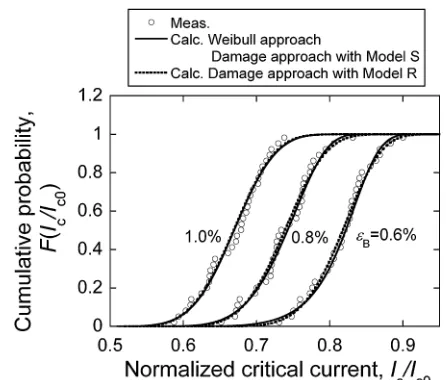
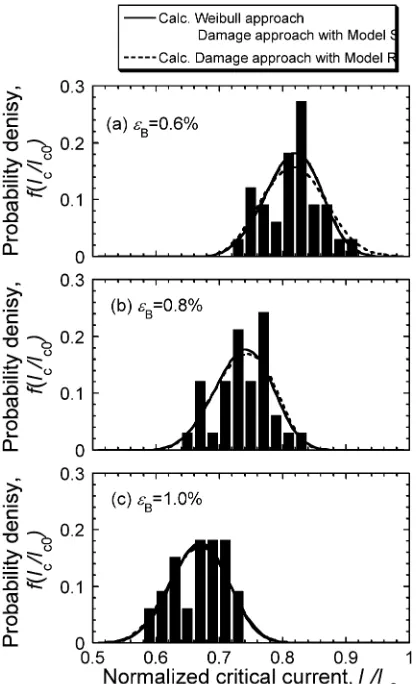
1.0%, taken from Fig. 1(a), are presented in Figs. 2 and 3, respectively. The results shown in Figs. 2 and 3 were analyzed by the Weibull approach and the damage approach.
3. Procedure for Analysis
3.1 Description of the distribution of Ic=Ic0 values by
means of the Weibull approach
The three parameter Weibull distribution function has been proposed originally to describe the strength distribution
of materials.15)This function has been used to describe the
transport critical current distribution11–14) and the critical
current distribution at weak links for analysis ofV(voltage)–
I(current) curve near the transition from superconducting to
normal conductive state.16,17) The three-parameter Weibull
distribution function is characterized by three parameters
(ðIc=Ic0Þmin is the minimum (lower limit) value of critical
current, ðIc=Ic0Þ0 is the scale parameter, and mis the shape
parameter). With these parameters, the cumulative
proba-bilityF of the critical current (Ic=Ic0) is expressed by
FðIc=Ic0Þ ¼1exp 1
Ic=Ic0 ðIc=Ic0Þmin
ðIc=Ic0Þ0
m
ð1Þ
The values of ðIc=Ic0Þmin, m and ðIc=Ic0Þ0 in eq. (1) which
describe the measured distributions at"B¼0:6, 0.8 and 1.0%
were estimated by the regression analysis, as shown in Section 4.1.
3.2 Description of the distribution of Ic=Ic0 values by
means of the damage approach
Figure 4(a) shows a micrograph of the transverse cross-section of the sample. When the thickness direction is enlarged by a factor of 3, the shape of the core (the region in which Bi2223 filaments are embedded in Ag) can be more clearly observed, as shown in Fig. 4(b).
Fig. 1 Variation of (a) normalized critical currentIc=Ic0and (b) coefficient
of variation (COV) ofIc=Ic0andIcvalues with increasing bending strain "B, measured for 33 specimens.10,11)
Fig. 2 Cumulative probability F of measured critical current Ic=Ic0 at "B¼0:6, 0.8 and 1.0%. Solid curves show the results analyzed using the
[image:2.595.60.278.68.375.2] [image:2.595.313.536.69.259.2]As the damage of the Bi2223 filaments existing in the core causes the reduction in critical current, it is necessary to formulate the shape. Taking the width- and
thickness-directions of the composite tape as the x- and y-axes,
respectively, and the center of the composite tape as x¼
y¼0 (Fig. 4(c)), and denoting the y-coordinate of the
boundary of the core as ycore, we formulated ycore as a
function of x in two models. One is the actual
shape-incorporated model with the core boundary ABCDEFGHA
in Fig. 4(c), which is referred to as Model S. This model is rigid but requires a relatively long time for calculation. Another model is used where the shape of the core is approximated as a rectangle (abcd in Fig. 4(c)); this model is referred to as Model R. This model is not rigid but is practical and simple to calculate; it gives a good approx-imation of the relation between critical current and damage front at high bending strains, as well as between critical current and bending strain, as shown later in Section 4.3.
3.2.1 Model S
In Model S, the actual shape of the core is used
(ABCDEFGHA in Fig. 4(c)), and the y-coordinate of the
boundary of the core, ycore, is expressed as a function of x
with a 9th order polynomial for the present sample.11,12)
The unit of length is millimeters.
ABC:ycore¼0:117324þ1:13901xþ10:0985x2þ38:6006x3þ83:9271x4
þ113:805x5þ97:9306x6þ51:8601x7þ15:3722x8þ1:94706x9
for 1:76<x<0:017 CDE: ycore¼0:0765863þ0:132501xþ1:36795x211:2465x3þ36:2954x4
63:3049x5þ64:1326x637:7293x7þ11:9598x81:58008x9
for 0:017<x<þ1:76
EFGHA: symmetry of rotation of ABCDE with respect tox¼y¼0
9 > > > > > > > > > > > = > > > > > > > > > > > ;
ð2Þ
Under the applied bending strain, tensile strain is exerted on the filaments in the core along the sample length direction (current transport direction). The exerted tensile strain is dependent on the location; it increases with distance from the
neutral axis.6,11,12)Accordingly, the filaments farthest from
the neutral axis, existing at ycore¼ycore,max (¼ycore,maxðSÞ
andycore,maxðRÞin Fig. 4(c) for Models S and R,
respective-ly), have the highest tensile strain and are fractured first at
Fig. 3 Probability densityfof measured critical currentIc=Ic0at"B¼0:6,
0.8 and 1.0%. Solid curves show results analyzed using the direct Weibull approach and the damage approach with Model S, which were on the same curves. Broken curves show the calculation results from eq. (9) based on the damage approach with Model R.
(a)
(b)
(c)
Fig. 4 Transverse cross-section of the composite tape. (a) Optical micro-graph in the as-observed state and the shape of the core. (b) Deformed optical micrograph, where the thickness direction is expanded by a factor 3; broken curve shows the core boundary. (c) Schematic representation of the geometry of the cross-section in relation to the damage extension. Damage occurs first at the outermost filaments at the maximum value of
ycore(ycore,max) when the bending strain"Breaches the irreversible bending
strain"B,irr. When the bending strain"Bis raised from"B,irrto"B;iand then
[image:3.595.307.548.69.297.2] [image:3.595.65.274.71.413.2]"B¼"B,irr (the irreversible bending strain at which damage
first occurs and critical current reduction starts). When the
bending strain is raised from"B,irr to"B;i and then to"B;iþ1,
the damage frontyf extends downward fromycore,max toyf;i
and then toyf;iþ1(Fig. 4(c)). The damage extension leads to
reduction in the cross-sectional area of the current trans-porting Bi2223 filaments and therefore critical current.
Denoting the tensile fracture strain of the filaments under
no residual strain as"f and the residual strain of the filaments
along the sample length direction as"r, the damage frontyf
is given by11,12)
yf ¼
ðt=2Þð"f"rÞ
"B
ð3Þ
The first damage takes place at yf ¼ycore,max at"B¼"B,irr
as stated above. Substituting yf ¼ycore,max and "B¼"B,irr
into eq. (3), we obtain the irreversible bending strain "B,irr
in the following form:
"B,irr¼
t=2
ycore,max
ð"f"rÞ ð4Þ
Because the "f"r value is different from specimen to
specimen and also from position to position within a
specimen, the yf (eq. (3)) and "B,irr (eq. (4)) are distributed
among the specimens. The normalized critical currentIc=Ic0
is 1(unity) for"B"B,irr. For"B"B,irr, the damage frontyf
extends downward as stated above, leading to reduction in the cross-sectional area of the current transporting Bi2223 filaments and therefore critical current.
In the Bi2223 composite tape, only the tensile side is damaged up to around 1.0% bending strain, as has been
verified by the X-ray diffraction analysis.18) In the present
work, we consider the case where only the core for y>0
(tensile side under the bending strain) is damaged. The experimental results are described for this condition, as shown later in Section 4.2. When all specimens are damaged
as in the present case (Ic=Ic0values of all specimens are less
than unity at"B¼0:6, 0.8 and 1.0% (Figs. 1, 2 and 3)), the
normalized critical current,Ic=Ic0, is expressed by11,12)
Ic
Ic0
¼1
Z
Wcore=2
Wcore=2
ðt=2Þ ycore
t=2 "f "r
"B
dx=Acore ð5Þ
where Acore (¼0:646mm2 in the present sample) is the
cross-sectional area of the core.
3.2.2 Model R
In Model R, the shape of the core is approximated as a rectangle (abcd in Fig. 4(c)). In this approximation, the
width of the core (Wcore ð¼3:52mmÞin Fig. 4(c)) and
cross-sectional area of the core (Acore¼0:646mm2) are taken to
be same as those of Model S. The x- and y-coordinates of
the boundary of the core, xcore and ycore, respectively, are
expressed by eq. (6).11)The unit of length is millimeters.
ab:ycore¼0:0918for1:76x1:76
bc:xcore¼1:76for0:0918y0:0918
cd:ycore¼ 0:0918for1:76x1:76
da:xcore¼ 1:76for0:0918y0:0918
9 > > > = > > > ;
ð6Þ
The relations among"B,yf=ðt=2Þ,"f"r and"B,irr given by
eqs. (3) and (4) hold both for Models R and S. Due to the
simplification of the shape of the core in Model R, Ic=Ic0
(<1) expressed by eq. (5) for Model S is reduced to
Ic
Ic0
¼1
2 1þ
1
ycore,max=ðt=2Þ
"f"r
"B
ð7Þ
whereycore,max¼ycore,maxðRÞ ð¼0:0918mmÞ.
4. Results and Discussion
4.1 Analysis of the distribution of Ic=Ic0 values by the
Weibull approach
When ðIc=Ic0Þmin¼0 in eq. (1), the parameters to be
estimated by the regression analysis are reduced to two
(ðIc=Ic0Þ0 and m). Such a function has been called a
two-parameter Weibull function. In the case of two-two-parameter
Weibull function, the relation of lnlnð1FÞ1 tolnðIc=Ic0Þ
is linear. If the measured (Ic=Ic0) values obey the
three-parameter function (eq. (1) with ðIc=Ic0Þmin>0), the plot
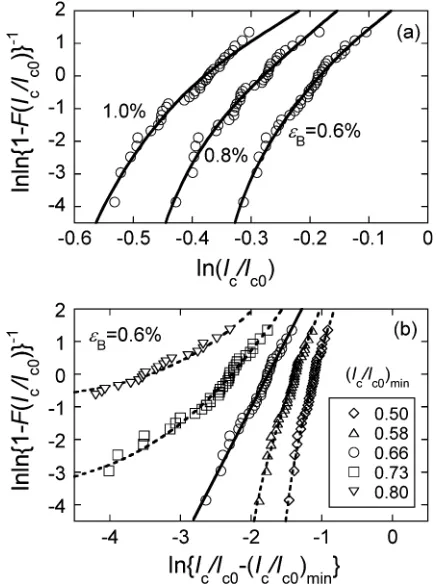
of lnlnð1FÞ1 against lnðIc=Ic0Þis convex.13) Figure 5(a)
shows the plot oflnlnð1FÞ1againstlnðIc=Ic0Þ, suggesting
that the distribution of theIc=Ic0values at"B¼0:6, 0.8 and
1.0% are described by the three-parameter Weibull
distribu-tion funcdistribu-tion withðIc=Ic0Þmin>0.
The values ofðIc=Ic0Þmin,mandðIc=Ic0Þ0that fit best to the
experimental result at each bending strain can be obtained by regression analysis in the following procedure. Taking the
data at"B¼0:6% as an example, the plot oflnlnð1FÞ1
Fig. 5 (a) Plot of lnlnð1FÞ1 against lnðIc=Ic0Þ for measured Ic=Ic0
values at"B¼0:6, 0.8 and 1.0%, which are upward convex. (b) Plot of
lnlnð1FÞ1againstlnfIc=Ic0 ðIc=Ic0Þmingfor variousðIc=Ic0Þminvalues
for measured Ic=Ic0 values at "B¼0:6%, as an example. The
lnlnð1FÞ1lnfI
c=Ic0 ðIc=Ic0Þmingcurve is convex whenðIc=Ic0Þmin
is low (ðIc=Ic0Þmin¼0:50and 0.58) but is linear whenðIc=Ic0Þminis 0.66,
[image:4.595.317.535.415.708.2]againstlnfIc=Ic0 ðIc=Ic0Þmingis convex when theðIc=Ic0Þmin
value is low (0.50, 0.58) but is concave when it is high (0.73, 0.80), as shown in Fig. 5(b). Between low and high values of
ðIc=Ic0Þmin, there exists a value of ðIc=Ic0Þmin that gives the
highest linearity for the relation betweenlnlnð1FÞ1 and
lnfIc=Ic0 ðIc=Ic0Þming, as shown by the case ofðIc=Ic0Þmin¼
0:66 in this example. Once this ðIc=Ic0Þmin value is
deter-mined, the values ofmandðIc=Ic0Þ0can be obtained from the
slope and extrapolation for the plot oflnlnð1FÞ1against
lnfIc=Ic0 ðIc=Ic0Þming.
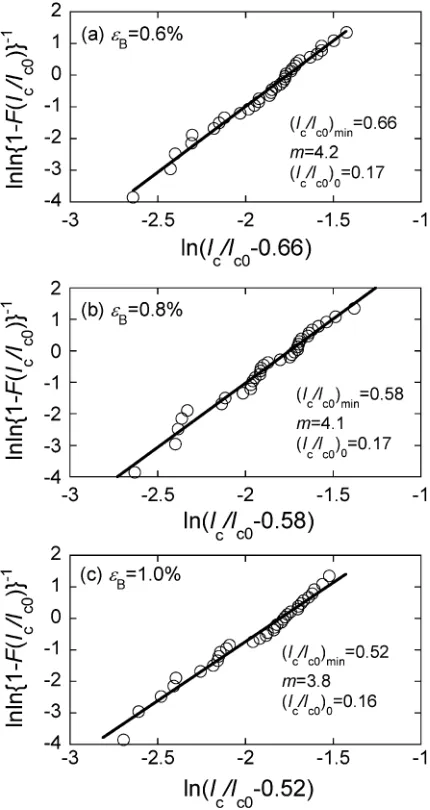
Figure 6 shows the plot of lnlnð1FÞ1 against lnfIc=
Ic0 ðIc=Ic0Þming, in which theðIc=Ic0Þminvalues that give the
highest linearity between the lnlnð1FÞ1 andlnfIc=Ic0
ðIc=Ic0Þming were 0.66, 0.58 and 0.52 at "B¼0:6, 0.8 and
1.0%, respectively. The high linearity between thelnlnð1
FÞ1andlnfIc=Ic0 ðIc=Ic0Þmingmeans that theIc=Ic0values
are described well by the three-parameter Weibull
distribu-tion funcdistribu-tion. The estimated values of fðIc=Ic0Þmin;m;
ðIc=Ic0Þ0gwere (0.66, 4.2, 0.17), (0.58, 4.1, 0.17) and (0.52,
3.8, 0.16) at"B¼0:6, 0.8 and 1.0%, respectively.
Substituting the estimated parameter values ofðIc=Ic0Þmin,
m and ðIc=Ic0Þ0 into eq. (1), the cumulative probability F–
critical currentIc=Ic0relations at"B¼0:6, 0.8 and 1.0% were
calculated, as shown by the solid curves in Fig. 2. The
measuredFIc=Ic0relations are well described. Moreover,
with the estimated parameter values, the cumulative proba-bility given by eq. (1) was converted to the density
probability f (frequency). The calculated fIc=Ic0relations
are presented as solid curves in Fig. 3, describing well the experimental results.
As shown above, it was found that the distribution ofIc=Ic0
values is described well by the three parameter Weibull distribution function. It should be noted that the decrease in
ðIc=Ic0Þmin with increasing bending strain "B, reflecting the
extension of the damage front of the most seriously damaged
specimen with increasing "B, could be estimated by the
Weibull approach quantitatively. However, the values of
Ic=Ic0, mandðIc=Ic0Þ0 were estimated as the fitting
param-eters at this stage. The physical meaning is discussed in Section 4.3.
4.2 Analysis of the distribution of Ic=Ic0 values by the
damage approach (Model S)
4.2.1 Estimation of distribution of"f "rvalues
If the distribution function of the"f"rvalues is known in
advance, the distribution of Ic=Ic0 can be calculated by
substitutingycore (eq. (2)), bending strain"Band the known
value ofAcore(0.646 mm2in the present sample) into eq. (5).
However, the"f"r value is not known in advance. In the
present work, using Model S in which the actual shape of the
core was incorporated, the "f"r values were
back-calcu-lated by substituting the following into eq. (5): the measured
Ic=Ic0values at each bending strain shown in Figs. 2 and 3,
theycoreexpressed by eq. (2), and the measured values of the
geometrical parameters (ycore,max¼ycore,maxðSÞ ¼0:117mm,
Wcore¼3:70mm,t¼0:270mm andAcore¼0:646mm2).
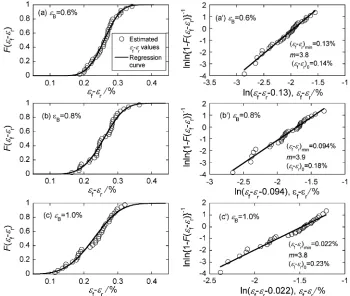
The cumulative probability F of the obtained "f"r
values at"B¼0:6, 0.8 and 1.0% are presented in Fig. 7(a),
(b), (c). The"f"rvalue corresponds to the tensile strain at
which the Bi2223 filaments in the composite tape fracture.
The average of "f"r value, ð"f"rÞave, was 0.25%. The
strain at which the filaments in the present composite tape are damaged under applied tensile strain has been estimated to be around 0.25% from the change in the stress carrying capacity upon occurrence of the damage in the stress-strain
curve.6,19) The estimated value ð"
f"rÞave¼0:25% in the
present work coincides with this value.
The distribution of the obtained "f"r values was
formulated by application of the three-parameter Weibull distribution function, which has widely been used to describe
the strength distribution of materials.15) According to this
function, the cumulative probability Fð"f"rÞ is expressed
by
Fð"f"rÞ ¼1exp
ð"f"rÞ ð"f"rÞmin
ð"f"rÞ0
m
ð8Þ
where ð"f"rÞmin is the minimum (lower limit) value of
"f"r, and ð"f"rÞ0 and m are the scale and shape
parameters, respectively. From the regression analysis, the
values of ð"f"rÞmin, ð"f "rÞ0 and m were estimated.
Fig. 6 Plot oflnlnð1FÞ1againstlnfI
c=Ic0 ðIc=Ic0ÞmingforðIc=Ic0Þmin
values that give the highest linearity between lnlnð1FÞ1 and lnfIc=Ic0 ðIc=Ic0Þming. (ðIc=Ic0Þmin¼0:66, 0.58 and 0.52 at "B¼0:6,
[image:5.595.62.277.72.477.2]Figure 7(a0), (b0), (c0) shows the plot oflnlnð1FÞ1against
lnf"f"r ð"f"rÞming, in which the ð"f"rÞmin values
that gave the highest linearity between lnlnð1FÞ1 and
lnf"f"r ð"f"rÞming were input. The high linearity
between lnlnð1FÞ1 andlnf"
f"r ð"f"rÞming means
that the "f"r values are described well by the
three-parameter Weibull distribution function. The estimated
values of fð"f"rÞmin;m;ð"f"rÞ0g were (0.13%, 3.8,
0.14%), (0.094%, 3.9, 0.18%) and (0.022%, 3.8, 0.23%) at "B¼0:6, 0.8 and 1.0%, respectively. The solid curves in
Fig. 7(a), (b), (c) show the results of the regression analysis
corresponding to the solid lines in Fig. 7(a0), (b0), (c0),
respectively.
4.2.2 Estimation of distribution ofIc=Ic0values using the
distributed"f "rvalues
By combining the distribution function of "f"r values
expressed by eq. (8) with eq. (5), and substituting ycore
(eq. (2)), the known values of t=2, Acore and "B, and the
estimated values of ð"f"rÞmin, m and ð"f"rÞ0, we
numerically calculated the cumulative (F) and density (f)
distributions of Ic=Ic0 at each bending strain. The
exper-imental results are reproduced well. It was confirmed that the present damage approach is a useful tool for reproduction of
distribution of Ic=Ic0 values with high accuracy. Note that
the calculation results were very close to the results of the Weibull approach shown with the solid curves in Figs. 2 and 3, and the difference between the damage approach and Weibull approach cannot be distinguished on this scale. This
means that (i) the distribution of"f"r values are estimated
accurately in the reverse analysis from distribution ofIc=Ic0
values to that of "f"r values through eq. (5) and (ii) the
critical current distribution of the Ic=Ic0 values obtained by
using the distributed"f"rvalues is expressed by the
three-parameter Weibull distribution as well as that obtained by the direct Weibull approach. An example demonstrating (i) and (ii) mentioned above is shown in Fig. 8. For comparison
with Fig. 5(b), this figure presents a plot of lnlnð1FÞ1
versus lnfIc=Ic0 ðIc=Ic0Þming for various ðIc=Ic0Þmin values
at "B¼0:6%, as calculated with the estimated distribution
function of "f "r values at "B¼0:6%. A linear relation
Fig. 7 Cumulative probability F of "f"r values at "B= (a) 0.6, (b) 0.8 and (c) 1.0%, and plot of lnlnð1FÞ1 against
lnf"f"r ð"f"rÞmingforð"f"rÞmin values that give the highest linearity betweenlnlnð1FÞ1and lnf"f"r ð"f"rÞming
(ð"f"rÞmin¼0:13, 0.094 and 0.022% at"B= (a0) 0.6, (b0) 0.8 and (c0) 1.0%, respectively).
Fig. 8 Plot oflnlnð1FÞ1 againstlnfI
c=Ic0 ðIc=Ic0Þming for different ðIc=Ic0Þmin-values for distributedIc=Ic0values calculated by substituting
the distributed"f"rvalues into eq. (5).ðIc=Ic0Þminvalues used in this
[image:6.595.122.472.72.368.2] [image:6.595.317.536.429.591.2]the same as that in Fig. 5(b) is actually obtained for
ðIc=Ic0Þmin ¼0:66. The mand ðIc=Ic0Þ0 values are found to
be 4.2 and 0.17, respectively, for ðIc=Ic0Þmin¼0:66, which
are the same as those obtained by the direct Weibull approach shown in Fig. 6(a).
Here, the important finding is that the distribution function
of the measured damage-controlled Ic=Ic0 values, as
ex-pressed by the three-parameter Weibull distribution, can be reproduced accurately by the distribution of the
damage-controlling"f"r values, as expressed by the
three-param-eter Weibull distribution. This result suggests the followings. (a) The distribution of the critical current of bent-damaged specimens is accounted for from the viewpoint of the difference in damage evolution among the specimens. (b)
In the Weibull approach, the parameters ofðIc=Ic0Þmin,mand
ðIc=Ic0Þ0 were obtained as the fitting parameters, but the
physical significance was unknown. The correlation of the
distribution of Ic=Ic0 values to the distribution of "f"r
values obtained in the present work demonstrates that the parameters obtained by the Weibull approach surely reflect the difference in the damage extent among the specimens.
As shown above, using Model S for the damage approach,
we observed the correlation of distribution of"f"r values,
which are related to the distribution of the damage front
as indicated by eq. (3), to the distribution of Ic=Ic0 values.
However, if only the Model S is used, only numerical calculation can be conducted. Accordingly, it is difficult to
formulate a direct correlation of the distribution of "f"r
values to the distribution ofIc=Ic0values.
In the next sub-section, Model R is used for the damage
approach to find the correspondence of the ð"f"rÞmin, m
andð"f"rÞ0values (which characterize the distribution of
damage evolution), to theðIc=Ic0Þmin,mandðIc=Ic0Þ0 values
(which characterize the distribution of critical current).
4.3 Derivation of three parameter Weibull distribution
function forIc=Ic0values from the damage approach
using Model R
4.3.1 Difference and similarity inIc=Ic0 values between
Models S and R
In Model R, the shape of the core is approximated as a rectangle (Fig. 4(c)). The accuracy in calculation with this model is lower than that with Model S, in which the actual shape of the core is incorporated. In this subsection, the
difference and similarity in Ic=Ic0 values between Models S
and R are examined in advance of application of Model R.
When the "f"r value is known, the Ic=Ic0 at"B"B,irr
can be calculated by eqs. (5) and (7) for Models S and R,
respectively. "B,irr can be calculated using eq. (4) with
ycore,max=ðt=2Þ ¼0:87and 0.68 for Models S and R,
respec-tively. As the average of "f"r values, ð"f"rÞave, was
0.25%, the average irreversible bending strain "B,irr,ave is
calculated to be 0.29 and 0.37% for Models S and R, respectively. Figure 9 shows the calculated variation of
average ofIc=Ic0values,ðIc=Ic0Þave, for bending strain"B. The
calculated values of ðIc=Ic0Þave at "B¼0:6, 0.8 and 1.0%
calculated using Models S and R are almost the same, while
the values ofðIc=Ic0Þaveat lower bending strain differ between
the models (values of"B,irr,aveandðIc=Ic0Þaveat"B¼0:4% are
overestimated by Model R) due to the simplification of the
shape of the core in Model R. Because the critical current
Ic=Ic0at"B¼0:6, 0.8 and 1.0% is well expressed in a simple
form by eq. (7) in Model R, eq. (7) is used for formulation
of distribution ofIc=Ic0values at these high bending strains.
4.3.2 Derivation of distribution function ofIc=Ic0values
using Model R
TheIc=Ic0 for"B"B,irr expressed by eq. (7) in Model R
is dependent on the "f"r value, which is distributed
according to eq. (8). Substituting "f"r¼ f2ðIc=Ic0Þ
1g"Bfycore,maxðRÞ=ðt=2Þg derived from eq. (7) into eq. (8),
we have
FðIc=Ic0 at"BÞ
¼1exp
Ic=Ic0
1
2þ
ð"f "rÞmin=ð2"BÞ
ycore,maxðRÞ=ðt=2Þ
ð"f"rÞ0=ð2"BÞ
ycore,maxðRÞ=ðt=2Þ
8 > > > < > > > : 9 > > > = > > > ; m 2 6 6 6 4 3 7 7 7 5:
ð9Þ
In a comparison of eq. (9) with eq. (1), eq. (9) is simply a
form of the three parameter Weibull distribution for Ic=Ic0
values with the correspondence of
ðIc=Ic0Þmin¼
1 2þ
ð"f"rÞmin=ð2"BÞ
ycore,maxðRÞ=ðt=2Þ
ð10Þ
ðIc=Ic0Þ0¼
ð"f"rÞ0=ð2"BÞ
ycore,maxðRÞ=ðt=2Þ
ð11Þ
m(Ic=Ic0distribution)¼m("f"r distribution): ð12Þ
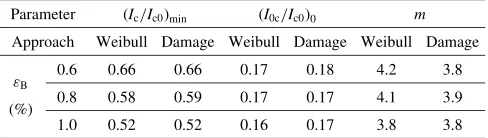
Substituting the parameter values of ð"f"rÞmin, ð"f"rÞ0
andmfor the"f"r distribution estimated by the statistical
analysis of "f"r values in the damage approach [fð"f
"rÞmin;m;ð"f"rÞ0g= (0.13%, 3.8, 0.14%), (0.094%, 3.9,
0.18%) and (0.022%, 3.8, 0.23%) at"B¼0:6, 0.8 and 1.0%,
respectively], and ycore,maxðRÞ=ðt=2Þ ¼0:68 into eqs. (10),
(11) and (12), we obtained the ðIc=Ic0Þmin, m and ðIc=Ic0Þ0
[image:7.595.313.534.73.217.2]values for the distribution of Ic=Ic0 values, as shown in
Table 1. The parameter values calculated by the damage approach with Model R are almost the same as those estimated by the Weibull approach. A direct comparison
of the calculated cumulative probability F and probability
Fig. 9 Measured and analyzed change in average critical currentðIc=Ic0Þave
with bending strain "B. Results analyzed using Models S and R for ð"f"rÞave¼0:25% are shown as solid and broken curves, respectively.
Average irreversible bending strains ("B,irr,ave) analyzed using Models S
[image:7.595.305.545.436.521.2]density f ofIc=Ic0values using eq. (9) based on the damage
approach using Model R with the measured ones is shown in Figs. 2 and 3, where the calculation results are presented
as broken curves. As shown above, the calculatedFðIc=Ic0Þ
(and fðIc=Ic0Þ) curves based on the damage approach with
Model S and direct Weibull approach are similar and the difference between them cannot be distinguished. The experimental results are described well also by the damage
approach with Model R. The slight difference at lower "B
(0.6 and 0.8%) between the damage approach with Model S (and the Weibull approach) and the damage approach with Model R stems from the simplification of the shape of the core in Model R.
It is important to note that the value ofmfor distribution of
Ic=Ic0is the same as that for the distribution of"f"rvalues
(eq. (12)) in Model R. "f"r refers to the tensile fracture
strain in the core of the Bi2223 filaments. The value ofmis
a measure of the coefficient of variation of the Ic=Ic0
ðIc=Ic0Þminas well as that of"f"r ð"f"rÞmin; for smaller
m, the distribution of the values of Ic=Ic0 ðIc=Ic0Þmin and
"f"r ð"f"rÞminis smaller. Equation (12) indicates that
the coefficient of variation of the normalized critical current distribution is governed by the difference in damage evolution among the specimens stemming from the
distri-buted "f"r values. As the distribution of "f"r values
follows the three-parameter Weibull distribution, the Ic=Ic0
values also follows the same type distribution function. In
this way, the reason why the distribution ofIc=Ic0values of
bent-damaged specimens is described by the three-parameter Weibull distribution function is accounted for by the differ-ence in damage evolution among the specimens.
5. Conclusions
(1) The distribution of the measured normalized critical current values of the Bi2223 composite tape (VAM1 sample) bent by 0.6, 0.8 and 1.0% in a round robin test of VAMAS/TWA16 were described by the three-parameter Weibull distribution function.
(2) The distribution of the measured normalized critical current values was also described well by the damage evolution approach, in which the difference in damage evolution among the specimens was correlated to the distribution critical current values. From this approach,
the Weibull distribution function for critical current values was derived, which gave almost the same parameter values of minimum critical current, scale parameter and shape parameter as those obtained by the direct application of the Weibull distribution function to the experimental results.
(3) Based on the results (1) and (2) above, the reason why the normalized critical current values of bent-damaged composite tape is described by the three-parameter Weibull distribution function was accounted for in a quantitative manner by the difference in damage evolution among the specimens.
Acknowledgement
The authors wish to express their gratitude to The Ministry of Education, Culture, Sports, Science and Technology, Japan, for a grant-in-aid for scientific research.
REFERENCES
1) H. Kitaguchi, K. Itoh, H. Kumakura, T. Takeuchi, K. Togano and H. Wada: IEEE Trans. Appl. Supercond.11(2001) 3058–3061. 2) R. Passerini, M. Dhalle’, E. Giannini, G. Witz, B. Seeber and R.
Flu¨kiger: Physica C371(2002) 173–184.
3) H. W. Weijers, J. Schwartz and B. ten Haken: Physica C372–376 (2002) 1364–1367.
4) K. Osamura, M. Sugano and K. Matsumoto: Supercond. Sci. Technol. 16(2003) 971–975.
5) H. S. Shin and K. Katagiri: Supercond. Sci. Technol.16(2003) 1012– 1018.
6) S. Ochiai, T. Matsuoka, J. K. Shin, H. Okuda, M. Sugano, M. Hojo and K. Osamura: Supercond. Sci. Technol.20(2007) 1076–1083. 7) S. Ochiai, J. K. Shin, S. Iwamoto, H. Okuda, S. S. Oh, D. W. Ha and
M. Sato: J. Appl. Phys.103(2008) 123911 (8 pp).
8) S. Ochiai, H. Rokkaku, J. K. Shin, S. Iwamoto, H. Okuda, K. Osamura, M. Sato, A. Otto and A. Malozemoff: Supercond. Sci. Technol.21 (2008) 075009 (13pp).
9) K. Katagiri, H. S. Shin, K. Kasaba, T. Tsukinokizawa, K. Hiroi, T. Kuroda, K. Itoh and H. Wada: Supercond. Sci. Technol.16(2003) 995– 999.
10) T. Kuroda,et al.: Physica C425(2005) 111–120.
11) S. Ochiai, J. K. Shin, H. Okuda, M. Sugano, M. Hojo, K. Osamura, T. Kuroda, K. Itoh and H. Wada: Supercond. Sci. Tecnol.21 (2008) 054002 (14pp).
12) S. Ochiai, H. Okuda, M. Sugano, M. Hojo, K. Osamura, T. Kuroda, K. Itoh, H. Kitaguchi, H. Kumakura and H. Wada: Supercond. Sci. Technol.23(2010) 025006 (12 pp).
13) S. Ochiai, M. Fujimoto, H. Okuda, S. S. Oh and D. W. Ha: J. Appl. Phys.105(2009) 06912 (8pp).
14) S. Ochiai, M. Fujimoto, J. K. Shin, H. Okuda, S. S. Oh and D. W. Ha: J. Appl. Phys.106(2009) 103916 (11 pp).
15) W. Weibull: J. Appl. Mech.28(1951) 293–297.
16) T. Kiss, T. Matsushita and F. Irie: Supercond. Sci. Technol.12(1999) 1079–1082.
17) M. Ahoranta, J. Lehtonen, P. Kova´cˇ, I. Husˇek and T. Melisˇek: Physica C401(2004) 241–245.
18) H. Okuda, J. K. Shin, S. Iwamoto, K. Morishita, Y. Mukai, H. Matsubayashi, S. Ochiai, A. Otto, E. J. Harley, A. Malozemoff and M. Sato: Scr. Mater.58(2008) 687–690.
[image:8.595.48.292.105.174.2]19) S. Ochiai, H. Okuda, M. Sugano, M. Hojo and K. Osamura: J. Appl. Phys.107(2010) 083904 (9pp).
Table 1 Estimated values ofðIc=Ic0Þmin,I0andmfrom the direct Weibull
approach and damage approach with Model R (eq. (9)) at"B¼0:6, 0.8
and 1.0%.
Parameter ðIc=Ic0Þmin ðI0c=Ic0Þ0 m
Approach Weibull Damage Weibull Damage Weibull Damage
"B
0.6 0.66 0.66 0.17 0.18 4.2 3.8