Computation of Equilibrium-State in Gas/Solid Materials Systems
Yalamanchili Krishna Rao
Department of Materials Science and Engineering, University of Washington, Roberts Hall, Box 352120, Seattle, WA 98195 USA
The determination of equilibrium-state in gas-solid materials systems is of practical interest; this consists of finding the values of intensive variables such as mole-fractions, partial pressures, activities or chemical potentials of constituents that occur in the gaseous and solid phases for stipulated temperature, pressure and initial reactant-gas composition. The mass-action iterative equilibrium constant method, shown to be a direct derivative of the minimization of Gibbs free energy, was used to compute the equilibrium-state in the carburizing and decarburizing iron-carbon heat treatment systems. By suitably combining the equilibrium partial pressure data with the extent of reaction formalism, the optimum feed-gas mixtures that ensuredneutralatmospheres were determined. [doi:10.2320/matertrans.48.787]
(Received July 24, 2006; Accepted January 25, 2007; Published March 25, 2007)
Keywords: equilibrium, heat treatment, carburizing, decarburizing, iron-carbon alloys, activity, mole-fraction, pressure, chemical potential, extent of reaction, solid solution
1. Introduction
The determination of equilibrium-state in high temperature systems is undertaken for practical considerations. At elevated temperatures, chemical processes (reactions) and transport phenomena occur at rapid rates and thus the equilibrium model tends to give a good representation of the actual state of the system. In general, for a system in stable equilibrium, the entropy is at maximum whereas the Gibbs free energy is at a minimum. That is, for chemical reaction equilibrium at constant temperature and pressure, the first-derivative of Gibbs free energy with respect to extent of reaction (") is nil.
ð@G=@"ÞT,P¼0 ð1Þ
where the variable " is indicative of the progress of the reaction.1) For the purpose of illustration, let us consider
the dissociation of one mol of copper iodide trimer into monomeric species atT ¼1600K and P¼0:5atm (50.663 kPa) total pressure.
Cu3I3(g)¼3CuI(g); ": extent of reaction ð2Þ
(1") mol3"mol; (1þ2"): molar amount of gas-phase:
The total Gibbs free energyGtof the monomer-trimer system
can be readily expressed in terms of chemical potentials and the respective molar amounts as follows:
Gt¼ ð3"Þ1þ ð1"Þ3
¼3"ðo1þRT lnP1Þ þ ð1"Þðo3þRT lnP3Þ ð3Þ
Using the data of Knacke and co-workers2) for standard
chemical potentials, in Jmol1,
1¼ 318551þRT lnP1
withP1 ¼ ½3"P=ð1þ2"Þfor CuI(g);
3¼ 942411þRT lnP3
withP3 ¼ ½ð1"ÞP=ð1þ2"Þfor Cu3I3(g):
At "¼0:05mol, P1¼6908Pa (0.06818 atm) and P3¼
43754Pa (0.43182 atm) with the result the chemical poten-tials become 1¼ 354277Jmol1 and 3¼ 953582
Jmol1; and eq. (3) yields G
t¼ 959045J. It is
advanta-geous to select asreference state1.0 mol of trimer at 1600 K and 50.663 kPa (0.5 atm), with reference chemical potential 3(r) ¼o3þRT lnP¼ 951632Jmol1. Thus, Gsys, the
relative free energy of the system becomes:
Gsys¼Gt3(r)¼ ð3"Þ1þ ð1"Þ3þ951632 ð4Þ
At "¼0:05mol, eq. (4) together with the above values of 1 and 3 yields Gsys¼ 7413J. The results of similar
calculations for Gsys at several values of the variable"are
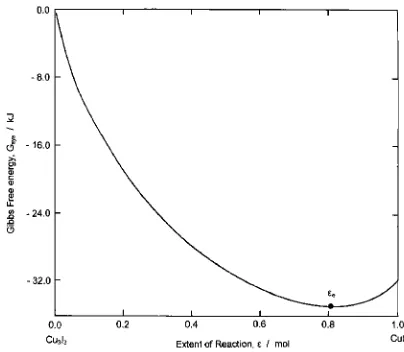
presented in Fig. 1. The free energy plot is seen to exhibit a minimum at"¼"e, theequilibrium extent of reaction. From
eqs. (1), (3) and (4), it is clear that for the system at equilibrium,
ð@Gsys=@"ÞT,P¼3o1þ3RT lnP1eo3RT lnP3e¼0
and
Go¼3o1o3¼ 13242J
¼ RT ln½ðP1eÞ3=P3e ¼ RT lnKe ð5Þ
Fig. 1 Gibbs free energy (Gsys) of the trimer-monomer system shown as a function of the extent (") of reaction Cu3I3= 3CuI. The free energy
minimumGsys¼ 34:73kJ occurs at"e¼0:8078mol,equilibrium-state
[image:1.595.324.526.303.479.2]On expressing the equilibrium partial pressures of the monomer (P1e) and the trimer (P3e) in terms of the
equi-librium extent of reaction ("e), eq. (5) provides,
ð27P2þ4KeÞð"eÞ33Keð"eÞ Ke¼0;
total pressureP¼0:5atm (50.663 kPa)
UsingKe¼expð13242=1600RÞ ¼2:706for the equilibrium
constant at 1600 K, the above equation was solved by trial and the equilibrium extent of reaction was determined: "e¼0:8078mol. This value corresponds to equilibrium
partial pressures of P1e¼46:944kPa for CuI(g) andP3e¼
3719Pa for Cu3I3(g), respectively. The saturation vapor
pressure of CuI(liq) is 55.151 kPa at 1600 K; and the system remains all-gas at the 50.663 kPa (0.5 atm) total pressure. The free energy minimum in Fig. 1 is found: since 1e¼
328786J and 3e¼ 986377J, it can be readily shown
that Gsys ¼ 34:73kJ. A small shift from the
equilib-rium-state, say, to "¼"e, where ¼0:0122mol gives
Gsys()¼ 34:723kJ; in a similar manner, "¼"eþ
pro-videsGsys(+) ¼ 34:722kJ. The net positive change inGsys
due to small displacement ‘’ in either direction can be construed as confirmation of the minimum in theGsys-"curve
for the system initially composed of 1 mol Cu3I3(g) trimer.
In the computation of equilibrium-state by minimizing Gibbs free energy (Gt), subject to the (elemental)
atom-balance constraints, the linear programming techniques pioneered by White, Johnson and Dantzig3) continue to occupy a favored position. An excellent review of the literature on equilibrium computation is offered by Smith and Missen.4)It is well to note that the free energy minimization procedure does not make use of stoichiometric equations that represent chemical reactions occurring in the system. In contrast, the latter form the main basis for law of mass-action calculations: Damko¨hler and Edse5)employed the non-linear
equilibrium constant expressions formulated in terms of species partial pressures and a converging successive approximations schemeto compute the equilibrium compo-sitions in the rocket-fuel-combustion systems; the Cruise-Villars method6,7)likewise makes use of reaction equilibria,
and equilibrium constants expressed in terms of mole-fractions of species present in the system, to determine the equilibrium-state. The accelerated or the brute-force con-vergence technique reported by Bahn,8)and later developed by Kellogg,9)bears a close resemblance to the earlier work of Damko¨hler and Edse.5)The selection of prime state variables (partial pressures of major species) and the direct use of equilibrium constants to calculate the remaining quantities are the main characteristics of this unusually-resilient com-putational method, especially suited for application to the determination of steady-states in closed-systems.10,11)
The free energy minimization algorithms such as the Rand,3) the NASA12) and the Solgas13) retain a large
following in the scientific community. At this juncture, it is well to note that there is no real dichotomy between the two approaches seeking to solve the problem of equilibrium; it remains to be shown that by minimizing the total free energy of the system in accordance with appropriate analogs of eq. (1), one can obtain the entire framework of theiterative equilibrium constant method,14)the ingenious computational scheme that originates with Damko¨hler and Edse.5)
2. Fe-C-H-O Gas-Solid System
Iron-carbon alloys are heat treated at high temperatures, usually in the range of 900–1050C, under controlled
atmospheres that consist of carbon monoxide, hydrogen, methane and water vapor. Such atmospheres can produce carbon-transfer between the gas-phase and the solid alloy.
Carburizing occurs under CO-rich atmosphere with a net addition of carbon to the hot steel surface. When the gas-phase is carbon-deficient and contains reactants carbon dioxide and water vapor in sufficient concentrations, rapid
decarburizationof the Fe-C(s) alloy takes place. During heat treatment under aneutralC-H-O atmosphere, there is neither the addition nor the removal of carbon from the surface of the hot steel; the composition of such an atmosphere would be regarded as equilibrium-state for the two-phase Fe-C-H-O system at the stipulated temperature and total pressure. Under heat-treating conditions that do not produce oxidation of the iron-constituent, the following species are normally present in the high-temperature system:
CO, CO2, CH4, H2, H2O: gas-phase; C, Fe: solid-alloy
The atom-matrix constructed of these seven species has a rank of four (that is, four kinds of atoms Fe, C, H, and O underlie the species); according to Gibbs stoichiometric rule, at the most three independent reaction equilibria are possible in this system:rm¼74¼3. The total Gibbs free energy
of the system can be expressed in terms of molar amountsni
and chemical potentialsiof the species.
Gt¼nCOCOþnCO2CO2þnCH4CH4
þnH2H2þnH2OH2OþnSCþnIFe ð6Þ
where nS and nI denote the respective molar amounts of
carbon and iron in the solid alloy.
The elemental mass balances for the solid/gas system can be formulated as follows:
noC¼nCOþnCO2þnCH4þnS¼constant ð7Þ
noH¼2ðnH2þnH2OÞ þ4nCH4¼constant ð8Þ
noO¼nCOþ2nCO2þnH2O¼constant ð9Þ
noFe¼nI¼constant ð10Þ
Differentiation of these mass-balance equations with respect tonCO yields
ð@nCO2=@nCOÞ þ1þ ð@nCH4=@nCOÞ þ ð@nS=@nCOÞ ¼0
2ð@nH2=@nCOÞ þ2ð@nH2O=@nCOÞ þ4ð@nCH4=@nCOÞ ¼0
1þ2ð@nCO2=@nCOÞ þ ð@nH2O=@nCOÞ ¼0
Since the iron constituent is not partaking in any reactions, eq. (10) is disregarded. Upon rearrangement of terms in the foregoing relations one obtains,
ð@nH2O=@nCOÞ ¼ 12ð@nCO2=@nCOÞ ð11Þ
ð@nCH4=@nCOÞ ¼0:50:5ð@nH2=@nCOÞ
þ ð@nCO2=@nCOÞ ð12Þ
ð@nS=@nCOÞ ¼ 1:52ð@nCO2=@nCOÞ
þ0:5ð@nH2=@nCOÞ ð13Þ
respect to molar amountnCOof carbon monoxide must equal
zero. From eq. (6),
0¼ ½COþ ð@nCO2=@nCOÞCO2þ ð@nCH4=@nCOÞCH4
þ ð@nH2=@nCOÞH2þ ð@nH2O=@nCOÞH2O
þ ð@nS=@nCOÞC
Substituting for the respective partial derivatives from eqs. (11), (12) and (13), it is found
f½COH2Oþ0:5CH41:5C
þ ð@nCO2=@nCOÞ½CO22H2OþCH42C
þ ð@nH2=@nCOÞ½H20:5CH4þ0:5Cg ¼0 ð14Þ
It is readily seen that each group of terms enclosed in the square brackets must vanish in order to satisfy eq. (14). Accordingly, the relations in terms of i’s and the
corre-sponding reaction equilibria are as follows:
COH2Oþ0:5CH41:5C¼0 ð15Þ
1.5C(s)þH2O(g)¼0.5CH4(g)þCO(g);"1 mol ðR1Þ
CO22H2OþCH42C¼0 ð16Þ
2C(s)þ2H2O(g)¼CH4(g)þCO2(g); "2 mol ðR2Þ
H20:5CH4þ0:5C¼0 ð17Þ
0.5CH4(g)¼0.5C(s)þH2(g); "3 mol ðR3Þ
It will be noted that the extensive quantities "1, "2 and"3
represent the extents of reaction for the equilibria (R1), (R2) and (R3), respectively. Thus, the minimization of free energy subject elemental mass balances shows that there exist three independent reactions or chemical potential constraints in this system.
3. Equilibrium-state in Steel Heat-Treating Systems
The iron-carbon phase diagram shows that austenite is an important phase, especially in steels at high temperatures; it is a homogeneous solid solution of carbon in face-centered-cubic -iron with a solubility limit of 2.11 w=o carbon at 1153C. The activity (a
C) of carbon in austenite was
investigated as a function of temperature and mole-fraction (XC). The following relationship was developed by Elliott
and Chipman15) using the extensive experimental data of Ban-yaet al.16)on carbon activities in austenite:
LogaC¼Log½XC=ð12XCÞ þ ð2300=TÞ
0:92þ ð3860=TÞ½XC=ð1XCÞ ð18Þ
where the logarithms are forbase tenand the temperature (T) is expressed in Kelvins.
The unknown intensive quantities are the chemical potentials CO,CO2,CH4,H2,H2O,C andFe—seven
altogether; furthermore, for the gas-phase, i¼oiþ
RT lnPi wherePi is the i-th species partial pressure; in the
Fe-C(s), C¼oCþRT lnaC and the non-independent
Fe¼oFeþRT lnaFe can be readily found by performing
Gibbs-Duhem integration of eq. (18). The application of Gibbs phase rule shows the system has four degrees of freedom; hence four state properties must be assigned specific values in order to fully define its thermodynamic state: (i) temperature (T) (ii) total pressure (P) (iii) inlet gas-composition, that is, (H=O) atom-ratio of feed-gas (iv) mole-fraction (XC) of carbon in steel. For the purpose
of illustration, the heat treatment of Fe-C(s) solid solution with XC¼0:02 (or 0.44 w=o C) at T ¼1200K and P¼
101:325kPa (1 atm) is considered; for the solid-phase, eq. (18) gives aC¼0:24058. The inlet gas contains 1 mol
each of CH4, CO and H2O and 0.5 mol H2: thus noH¼
7mols, no
C¼2mols and noO¼2mols, giving a (H=O)
atom-ratio of 3.5; a feed-gas having the same atom-ratio can also be constituted by mixing 3.5 mols H2 and 2 mols CO.
Whether such a gas-mixture transfers carbon to the Fe-C solid-solution at the specified temperature and pressure remains to be established. Furthermore, the composition of the feed-gas that ensures a neutral atmosphere—one that entails zero carbon-transfer between phases—is of practical interest; it should be determined as part of the equilibrium-state calculation. While changes may occur innC, the molar
amount of carbon, andnC=nO(¼C=O) atom-ratio of the
gas-phase, as it reaches a state of equilibrium with the Fe-C(s), the atom-ratioH=Oremains the same. Similar behaviour is indicated when the feed-gas is relatively lean with respect to carbon; in this instance, however, there will be a net transfer of carbon from the solid-alloy to the gas-phase resulting in a
decarburizedsurface-layer on the steel specimen.
4. Method of Calculation
The details of the iterative solution that makes use of equilibrium constants for the reactions (R1), (R2) and (R3) are presented. Data on standard chemical potentials (oi) for
the species CO, CO2, CH4, H2, H2O and C(s) are drawn from
Knacke, Kubaschewski and Hesselmann.2)At T ¼1200K, in kJmol1,
oCO¼ 371:442; oCO2 ¼ 685:576;
oCH4¼ 335:186;
o
H2¼ 179:347;
oH2O¼ 496:461;
o
C¼ 18:019:
Substituting CO¼oCOþRT lnPCO, . . . ., and C¼
o
CþRT lnaCin eq. (15), and rearranging terms, it is found
for reaction (R1),
GoR1 ¼oCOþ0:5oCH41:5
o
CoH2O
¼ RT lnf½PCOðPCH4Þ
0:5=½P H2OðaCÞ
1:5g
Thus, the equilibrium constantK1of reaction (R1) at 1200 K
is given by
K1¼ ½PCOðPCH4Þ
0:5
=½PH2OðaCÞ
1:5
¼expfGoR1=ð1200RÞg ¼4:75 ð19Þ
Similarly, one finds for reaction equilibria (R2) and (R3), from eqs. (16) and (17),
GoR2¼oCH4þ
o
CO22
o
C2
o
H2O¼ RT lnK2
K2¼ ½PCH4PCO2=½ðaCPH2OÞ
2 ¼0:44 ð20Þ
Furthermore,
GoR3¼0:5oCþoH20:5
o
CH4¼ RT lnK3
K3¼ ½ðaCÞ0:5PH2=½ðPCH4Þ
0:5 ¼8:0133 ð21Þ
The molar amounts of the species can be expressed in terms of extents of reactions:1)
nCO¼noCOþ"1; nCH4¼n
o
CH4þ0:5"1þ"20:5"3;
nCO2¼n
o
nH2¼n
o
H2þ"3; nH2O¼n
o
H2O"12"2;
nC¼noC1:5"12"2þ0:5"3 ð22d- fÞ
The net carbon-transfer,C, from the gas-phase to Fe-C(s) is
readily determined using,
C¼nCnoC¼0:5"31:5"12"2; mol ð23Þ
The iterative method described by Rao17) is similar in
many respects to the earlier works5,8,9)that employ
succes-sive approximations scheme to secure a converged solution. Of the five gaseous species listed, the two species CH4 and
CO are selected as ‘majors’ and reasonable estimates are made for their partial pressures: PCH4¼0:2P and PCO¼ 0:4P. The partial pressures of species H2O, CO2 and H2are
computed using the eqs. (19), (20), and (21) for the equi-librium constants K1,K2 andK3. At 101.325 kPa andaC¼
0:24058,
PH2O¼ ½PCOðPCH4Þ
0:5=½K
1ðaCÞ1:5 ¼32:333kPa
PCO2¼K2ðaCPH2OÞ
2=P
CH4¼1314Pa;
PH2¼K3ðPCH4=aCÞ
0:5¼740:31kPa
The new values forPE, the total pressure, andRHE, theH=O atom-ratio, are computed:
PE¼PCH4þPCOþPH2OþPCO2þPH2¼834:756kPa
RHE¼ ðHtot=OtotÞeq
¼ ½4PCH4þ2PH2Oþ2PH2=½PCOþ2PCO2þPH2O ¼21:542
Both of these exhibit large departures from the constraining values: P¼101:325kPa and RH¼3:5; thus, the first iteration values for the five Pi’s obtained above do not
represent equilibrium data. The following convergence equations are introduced to modify the two estimates admitted for the majors CH4 and CO at first iteration:
ðPCH4Þnew ¼ ðPCH4Þold½P=PE
0:04½RH=RHE0:06 ð24Þ
ðPCOÞnew ¼ ðPCOÞold½P=PE0:05 ð25Þ
With these modified values, the next iteration is completed and new values computed for the Pi’s, PE and RHE. The
computation is continued until the absolute departure ofPE fromPand that ofRHEfromRH, match the limits defined below:
j1:0 ðP=PEÞj ¼0:0001;
and j1:0 ðRH=RHEÞj ¼0:0001:
For the particular equilibrium between Fe-C(s) alloy con-taining 0.44w=oC and a feed-gas with theH=Oatom-ratio (RH) of 3.5, converged solution required 341 iterations.
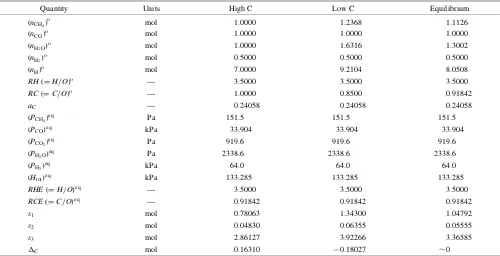
The data on equilibrium partial pressures are summarized in Table 1; the high C feed-gas consists of 1.0 mol each of CH4, CO and H2O and 0.5 mol H2, with an atom-ratio RH ð¼H=OÞo equal to 3.5. The iron-carbon solid solution contained 0.44w=oC which corresponds to a carbon-mole-fraction of 0.02 and an activity of aC¼0:24058. It will be
noted that the equilibrium gas-phase is relatively lean in CH4
and CO2; in lieu of CH4, if one were to choose H2 as major
species, converged solution is obtained in fewer iterations (184 to be exact). The carbon-to-oxygen atom-ratio decreases from RC¼1:0 in the feed-gas to RCE¼0:91842 of the equilibrium gas-phase; thus, there is a net transfer of carbon to the Fe-C(s) alloy. The amount of carbon transferred can be determined by eq. (23) using the extents of reactions evaluated from the data on equilibrium pressures.
nH2¼ ðPH2=HtotÞ
eqðn
HÞo¼ ðnH2Þ
oþ" 3;
and "3¼2:86127mol:High C (Table1)
nCO2¼ ðPCO2=HtotÞ
eqðn
HÞo¼"2;
[image:4.595.48.548.84.340.2]and "2¼0:0483mol:High C (column 3, Table 1) Table 1 C-O-H-Fe Equilibrium system at 1200 K and 101.325 kPa (1 atm).
Quantity Units High C Low C Equilibrium
ðnCH4Þ
o mol 1.0000 1.2368 1.1126
ðnCOÞo mol 1.0000 1.0000 1.0000
ðnH2OÞ
o mol 1.0000 1.6316 1.3002
ðnH2Þ
o mol 0.5000 0.5000 0.5000
ðnHÞo mol 7.0000 9.2104 8.0508
RHð¼H=OÞo — 3.5000 3.5000 3.5000
RCð¼C=OÞo — 1.0000 0.8500 0.91842
aC — 0.24058 0.24058 0.24058
ðPCH4Þ
eq Pa 151.5 151.5 151.5
ðPCOÞeq kPa 33.904 33.904 33.904
ðPCO2Þ
eq Pa 919.6 919.6 919.6
ðPH2OÞ
eq Pa 2338.6 2338.6 2338.6
ðPH2Þ
eq kPa 64.0 64.0 64.0
ðHtotÞeq kPa 133.285 133.285 133.285
RHEð¼H=OÞeq — 3.5000 3.5000 3.5000
RCEð¼C=OÞeq — 0.91842 0.91842 0.91842
"1 mol 0.78063 1.34300 1.04792
"2 mol 0.04830 0.06355 0.05555
"3 mol 2.86127 3.92266 3.36585
nCO¼ ðPCO=HtotÞeqðnHÞo¼ ðnCOÞoþ"1;
and "1¼0:78063mol:High C (Table1)
Substitutions into eq. (23) yield for net carbon transfer (C)
a value of 0.1631 mol; it is clear that prolonged heat treatment under ‘High C’ atmosphere promotes carburizing of steel. In contrast, the ‘Low C’ feed-gas (column 4, Table 1) induces a net transfer of C from the solid-alloy phase to the gaseous mixture; in this case, C¼ 0:18027mol. The equilibrium (C=O) atom-ratio, RCE¼
0:91842, is of significance in that it allows an exact prediction of the desired feed-gas composition to maintain aneutralatmosphere. In a four species feed-gas, with 1 mol CO and 0.5 mol H2, the molar amounts of CH4and H2O are:
noH2O¼ ½n
o
COð0:25RHRCEþ1:0Þ 0:5noH2
=½RCE0:25RHþ0:5 ð26Þ
noCH4¼ ½RCEðn
o
H2OÞ þn
o
COðRCE1:0Þ ð27Þ
The equilibrium feed-gas thus contains 1.1126 mols CH4,
1.3002 mols H2O, 1 mol CO and 0.5 mol H2; under this
atmosphere (RH¼3:5; RC¼0:91842) there occurs zero carbon-transfer, that is C¼0. Alternatively, a feed-gas
containing 28.43 mol% CH4, 33.23 mol% H2O, 25.56 mol%
CO and 12.78 mol% H2ensures that the carbon-content of the
Fe-C(s) alloy does not change during heat treatment at 1200 K.
5. Discussion of Results
The effect of varying theH=Oatom-ratio of the feed-gas from RH¼1:5 toRH¼8 was investigated for an Fe-C(s) alloy with XC¼0:02(or 0.44 w=o C) at 101.325 kPa total
pressure and 1200 K; the inlet gas mixtures were usually rich in carbon (or High C). The equilibrium gas composition— Pi’s of species CH4, CO, CO2, H2O, H2—and the
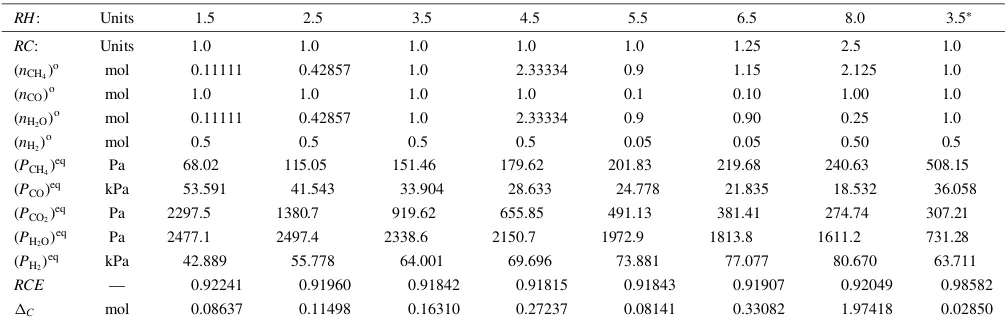
corre-sponding carbon-to-oxygen atom-ratio (RCE) were comput-ed. The results are listed in Table 2; it will be noted that
RCE¼ ½ðPCH4Þ
eqþ ðP
COÞeqþ ðPCO2Þ
eq
=½ðPCOÞeqþ2ðPCO2Þ
eqþ ðP H2OÞ
eq ð28Þ
A careful study of the data reveals that the inlet-gas C=O atom-ratio (RC) is consistently larger than the corresponding
equilibrium value (RCE); thus carbon-addition to the solid-phase is indicated for each of the seven feed-gas composi-tions selected. The influence ofH=O(orRH) atom-ratio on the equilibrium C=O (or RCE) atom-ratio appears to be small; for the most part,RCE0:92(Table 2). However, as the last column shows, for an iron-carbon alloy with XC¼
0:05 (or 1.12 w=o C) at 1200 K and 101.325 kPa total pressure, the equilibrium carbon-to-oxygen ratio (RCE) of the gas-phase is decidedly larger. One can use the data given in Table 2 in combination with eqs. (26) and (27) to constitute a feed-gas-mixture that serves as a neutral atmo-spherefor the heat treatment of steels.
As the hydrogen-to-oxygen atom-ratio (RH) of the inlet reactant gas-mixture is increased (Table 2), it is seen that the H2-concentration of the equilibrium gas-phase rises from
about 42 mol% at RH¼1:5 to about 80 mol% at RH¼8 while that of the carbon monoxide declines from about 53 mol% to 18 mol%. Similar trends were noted in the com-position of the gas-phase in equilibrium with an iron-carbon alloy containing 1.12 w=o C (or XC¼0:05). The effect of
temperature on the equilibrium-state in the two-phase (C-O-H-Fe) system was investigated: atT ¼1300K and 101.325 kPa total pressure, the equilibrium partial pressures were calculated for the iron-carbon alloys with XC¼0:05. The
data on the standard chemical potentials (oi) drawn from
Knacke and co-authors2) were used to compute the equi-librium constants for the reaction equilibria (R1), (R2) and (R3): o
CO ¼ 395:728, oCO2¼ 713:919,
o CH4¼ 361:63, o
H2¼ 196:664,
o
C¼ 20:968 and oH2O¼ 520:792kJmol1; furthermore, K
1¼9:47,K2¼0:47832
and K3¼11:4307, respectively. The equilibrium
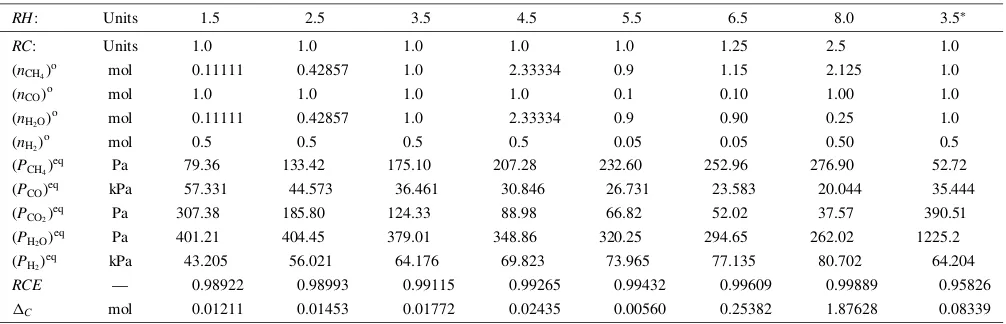
calcula-tions were made with the feed-gas H=O atom-ratio (RH) varied over a wide range; and the results are presented in Table 3.
The chosen inlet-gas mixtures are expected to add carbon to the solid-alloy during the heat treatment; the net carbon-transfer (C) was computed from the equilibrium gas-phase
[image:5.595.46.550.93.254.2]partial pressures for each of the sevenH=Oatom-ratios. The zero-additionneutral atmospherethat maintains an unchang-ing carbon-content of the Fe-C(s) alloy is easily established by means of eqs. (26) and (27) using the data onRHandRCE of Table 3. For instance, a feed-gas consisting of 1.0108 mols
Table 2 Effect of feed-gas composition on equilibrium in the C-O-H-Fe system at 1200 K and 101.325 kPa (1 atm) forXC¼0:02(0.44
w=oC).
RH: Units 1.5 2.5 3.5 4.5 5.5 6.5 8.0 3.5
RC: Units 1.0 1.0 1.0 1.0 1.0 1.25 2.5 1.0
ðnCH4Þ
o mol 0.11111 0.42857 1.0 2.33334 0.9 1.15 2.125 1.0
ðnCOÞo mol 1.0 1.0 1.0 1.0 0.1 0.10 1.00 1.0
ðnH2OÞ
o mol 0.11111 0.42857 1.0 2.33334 0.9 0.90 0.25 1.0
ðnH2Þ
o mol 0.5 0.5 0.5 0.5 0.05 0.05 0.50 0.5
ðPCH4Þ
eq Pa 68.02 115.05 151.46 179.62 201.83 219.68 240.63 508.15
ðPCOÞeq kPa 53.591 41.543 33.904 28.633 24.778 21.835 18.532 36.058
ðPCO2Þ
eq Pa 2297.5 1380.7 919.62 655.85 491.13 381.41 274.74 307.21
ðPH2OÞ
eq Pa 2477.1 2497.4 2338.6 2150.7 1972.9 1813.8 1611.2 731.28
ðPH2Þ
eq kPa 42.889 55.778 64.001 69.696 73.881 77.077 80.670 63.711
RCE — 0.92241 0.91960 0.91842 0.91815 0.91843 0.91907 0.92049 0.98582
C mol 0.08637 0.11498 0.16310 0.27237 0.08141 0.33082 1.97418 0.02850
This run is for an iron-carbon alloy withX
CH4, 1 mol CO, 1.0287 mols H2O and 0.5 mol H2, with
atom-ratios H=O (or RH) = 3.5 and C=O (or RCE) = 0.99115 provides the desired neutral atmosphere (C0) at 1300 K
[image:6.595.47.550.93.255.2]and 101.325 kPa pressure. Similar feed-gas compositions can be selected for the otherH=O(orRH) atom-ratios listed in Table 3.
In the present work, only five gaseous species were considered significant; the species OH(g), H(g) and O2(g)
were not included in the iterative computation as their concentrations are regarded insignificant. Whether this assumption is valid can be determined by considering the three related reaction equilibria (R4), (R5) and (R6); at 1300 K, the standard chemical potentials (o
i) for OH(g),
H(g) and O2(g) obtained from published sources2,18) are 227:013, 49.867 and295:418kJmol1, respectively.
H2O¼OHþ0.5H2; "4 mol; K4 ¼1:402108 ðR4Þ
0.5H2¼H; "5 mol; K5¼1:110106 ðR5Þ
H2O¼H2þ0.5O2; "6 mol; K6¼8:155108 ðR6Þ
Selecting the results of equilibrium calculation for the Fe-C(s) alloy containing 1.12w=oC (orXC¼0:05) and a
feed-gas with aH=Oatom-ratio ofRH¼3:5(column 5, Table 3), the equilibrium partial pressures of the minor species are determined as follows:
POH¼ ðK4PH2OÞ=ðPH2Þ
0:5¼6:69106Pa;
PH¼K5ðPH2Þ
0:5¼8:95102Pa;
PO2¼ ½ðK6PH2OÞ=PH2
2¼2:351014Pa
Thus, neglecting the presence of species OH(g), H(g) and O2(g) in the C-O-H-Fe system does not have any significant
effect on the results of the equilibrium calculations.
6. Conclusions
Themass-action equilibrium constant method, derived by minimizing Gibbs free energy, determines the equilibrium-state in terms of intensive equilibrium-state variables (Pi’s); these data are
then combined with extent of reaction formalism1)to deduce extensive quantities such as the molar amounts of species at equilibrium.
Acknowledgments
The valuable assistance of Mr. Laszlo Szeleczki, Senior Computer Specialist of the Department of Materials Science and Engineering, is duly acknowledged. Thanks are also due to the staff of the Academic Computer Center, Mary Gates Hall, University of Washington, Seattle, Washington.
REFERENCES
1) I. Prigogine: Introduction to Thermodynamics of Irreversible Proc-esses, Second Edn., (John Wiley & Sons, New York, 1961) pp. 4–7. 2) O. Knacke, O. Kubaschewski and K. Hesselmann (Ed):
Thermochem-ical Properties of Inorganic Substances, Second Edn., (Springer-Verlag, Berlin and New York, 1991) pp. 2412.
3) W. B. White, S. M. Johnson and G. B. Dantzig: J. Chem. Phys.28 (1958) 751–755.
4) W. R. Smith and R. W. Missen: Chemical Reaction Equilibrium Analysis: Theory and Algorithms, (John Wiley & Sons, New York, 1982) pp. 364.
5) G. Damko¨hler and R. Edse: Z. Elektrochem.49(1943) 178–186. 6) D. R. Cruise: J. Phys. Chem.68(1964) 3797–3802.
7) D. S. Villars: J. Phys. Chem.63(1959) 521–525.
8) G. S. Bahn:Kinetics, Equilibria and Performance of High Temperature Systems. Proceedings of the First Conference, Ed. G. S. Bahn and E. E. Zukoski, (Butterworth, Washington, D.C., 1960) pp. 137–140. 9) H. H. Kellogg: Metall. Trans.2(1971) 2161–2169.
10) Y. K. Rao and C. H. Raeder: J. Mater. Synth. Process.3(1995) 49–68. 11) Y. K. Rao: High Temp. Mater. Sci.34(1995) 293–342.
12) S. Gordon, F. J. Zeleznik and V. N. Huff: NASA Technical Note, (National Aeronautics and Space Adminstration, Washington, D.C., 1959) D-132.
13) G. Eriksson: Acta Chem. Scand.25(1971) 2651–2658. 14) Y. K. Rao: High Temp. Mater. Sci.36(1996) 173–183.
15) J. F. Elliott and J. Chipman:Chemical Metallurgy of Iron and Steel, (Iron and Steel Institute, London, U.K., 1973) 348.
16) S. Ban-ya, J. F. Elliott and J. Chipman: Metall. Trans.1(1970) 1313– 1320.
17) Y. K. Rao: Stoichiometry and Thermodynamics of Metallurgical Processes, (Cambridge University Press, Cambridge and New York, 1985), Ch. 11.
18) M. W. Chase, Jr. (Ed):NIST-JANAF Thermochemical Tables, Fourth Edn., (American Institute of Physics, Woodbury, New York, 1998) 1298.
Table 3 Effect of feed-gas composition on equilibrium in the C-O-H-Fe system at 1300 K and 101.325 kPa (1 atm) forXC¼0:05(or 1.12
w=oC).
RH: Units 1.5 2.5 3.5 4.5 5.5 6.5 8.0 3.5
RC: Units 1.0 1.0 1.0 1.0 1.0 1.25 2.5 1.0
ðnCH4Þ
o mol 0.11111 0.42857 1.0 2.33334 0.9 1.15 2.125 1.0
ðnCOÞo mol 1.0 1.0 1.0 1.0 0.1 0.10 1.00 1.0
ðnH2OÞ
o mol 0.11111 0.42857 1.0 2.33334 0.9 0.90 0.25 1.0
ðnH2Þ
o mol 0.5 0.5 0.5 0.5 0.05 0.05 0.50 0.5
ðPCH4Þ
eq Pa 79.36 133.42 175.10 207.28 232.60 252.96 276.90 52.72
ðPCOÞeq kPa 57.331 44.573 36.461 30.846 26.731 23.583 20.044 35.444
ðPCO2Þ
eq Pa 307.38 185.80 124.33 88.98 66.82 52.02 37.57 390.51
ðPH2OÞ
eq Pa 401.21 404.45 379.01 348.86 320.25 294.65 262.02 1225.2
ðPH2Þ
eq kPa 43.205 56.021 64.176 69.823 73.965 77.135 80.702 64.204
RCE — 0.98922 0.98993 0.99115 0.99265 0.99432 0.99609 0.99889 0.95826
C mol 0.01211 0.01453 0.01772 0.02435 0.00560 0.25382 1.87628 0.08339
This run is for an iron-carbon alloy withX