Magic for Filter Optimization in Dynamic Bottom-up Processing
G u i d o
Minnen*
SFB 340, U n i v e r s i t y o f T f i b i n g e n K l e i n e W i l h e l m s t r a f l e . 113
D-72074 T i i b i n g e n , G e r m a n y
e-mail : minnen~sf s. nphil, uni-tuebingen, de
A b s t r a c t
Off-line compilation of logic grammars us- ing
Magic
allows an incorporation of fil- tering into the logic underlying the gram- mar. The explicit definite clause charac- terization of filtering resulting from Magic compilation allows processor independent and logically clean optimizations ofdy-
namic bottom-up processing
with respect to goal-directedness. Twofilter optimizations
based on the program transformation tech- nique of Unfolding are discussed which are of practical and theoretical interest.
1 I n t r o d u c t i o n
In natural language processing
filtering
is used to weed out those search paths that are redundant, i.e., are not going to be used in the proof tree corre- sponding to the natural language expression to be generated or parsed. Filter optimization often com- prises an extension of a specific processing strategy such that it exploits specific knowledge about gram- mars and/or the computational task(s) that one is using them for. At the same time it often remains unclear how these optimizations relate to each other and what they actually mean. In this paper I show how starting from a definite clause characterization of filtering derived automatically from a logic gram- mar using Magic compilation, filter optimizations can be performed in a processor independent and logically clean fashion.Magic (templates)
is a general compilation tech- nique for efficient bottom-up evaluation of logic pro- grams developed in the deductive database commu- nity (Ramakrishnan et al., 1992). Given a logic pro- gram, Magic produces a new program in which the filtering as normally resulting from top-down eval- uation is explicitly characterized through, so-called,*url:
http://www.sfs.nphil.uni-tuebingen/'minnen
magic predicates,
which produce variable bindings for filtering when evaluated bottom-up. The origi- nal rules of the program are extended such that these bindings can be made effective.As a result of the definite clause characterization of filtering, Magic brings filtering into the logic un- derlying the grammar. I discuss two filter optimiza- tions. These optimizations are direction indepen- dent in the sense that they are useful for both gen- eration and parsing. For expository reasons, though, they are presented merely on the basis of examples of generation.
Magic compilation does not limit the informa- tion that can be used for filtering. This can lead to nontermination as the tree fragments enumer- ated in bottom-up evaluation of magic compiled grammars are
connected
(Johnson, forthcoming). More specifically, 'magic generation' falls prey to non-termination in the face of head recursion, i.e., the generation analog of left recursion in parsing. This necessitates adynamic
processing strategy, i.e., memoization, extended with an abstraction function like, e.g., restriction (Shieber, 1985), to weaken fil- tering and a subsumption check to discard redun- dant results. It is shown that for a large class of grammars the subsumption check which often influ- ences processing efficiency rather dramatically can be eliminated through fine-tuning of the magic pred- icates derived for a particular grammar after apply- ing an abstraction function in an off-line fashion.Unfolding can be used to eliminate superfluous fil- tering steps. Given an off-line optimization of the order in which the right-hand side categories in the rules of a logic grammar are processed (Minnen et al., 1996) the resulting processing behavior can be considered a generalization of the head corner gen- eration approach (Shieber et al., 1990): Without the need to rely on notions such as
semantic head
and2
Definite Clause C h a r a c t e r i z a t i o n
of Filtering
Many approaches focus on exploiting specific knowl- edge about grammars a n d / o r the computational task(s) t h a t one is using them for by making filter- ing explicit and extending the processing strategy such that this information can be made effective. In generation, examples of such extended process- ing strategies are head corner generation with its semantic linking (Shieber et al., 1990) or bottom-up (Earley) generation with a semantic filter (Shieber, 1988). Even though these approaches often accom- plish considerable improvements with respect to ef- ficiency or termination behavior, it remains unclear how these optimizations relate to each other and w h a t comprises the logic behind these specialized forms of filtering. By bringing filtering into the logic underlying the grammar it is possible to show in a perspicuous and logically clean way how and why fil- tering can be optimized in a particular fashion and how various approaches relate to each other.
2.1 Magic Compilation
Magic makes filtering explicit through characterizing it as definite clauses. Intuitively understood, filter- ing is reversed as binding information t h a t normally becomes available as a result of top-down evaluation is derived by bottom-up evaluation of the definite clause characterization of filtering. The following is the basic Magic algorithm taken from Ramakrishnan et al. (1992).
Let P be a program and q(E) a query on the program. We construct a new program ping. Initially ping is empty.
1. Create a new predicate
magic_p
for each predicate p in P. The arity is t h a t of p.2. For each rule in P, add the
modified
version
of the rule to p-~9. If rule r has head, say,p({),
the modified ver- sion is obtained by adding the literalmagic_p(t)
to the body.3. For each rule r in P with head, say,
p({),
and for each literal q~(~) in its body, add amagic rule
to ping. The head ismagic_qi(~).
The body con- tains the literalmagic_p(t),
and all the literals that precede qi in the rule. 4. Create aseed
factmagic_q(5)
from thequery.
To illustrate the algorithm I zoom in on the applica- tion of the above algorithm to one particular gram-
mar rule. Suppose the original grammar rule looks as follows:
s (P0, P, VForm, SSem) : -
v p ( P l ,P,VForm, [CSem] ,SSem), np (P0,PI, CSem).
Step 2 of the algorithm results in the following mod- ified version of the original grammar rule:
s (P0, P , V F o r m , SSem) : -
magic_s ( P 0 , P , V F o r m , SSem) , v p ( P l ,P ,VForm, [CSem] , SSem) , n p (P0, PI, CSem).
A magic literal is added to the right-hand side of the rule which 'guards' the application of the rule. This does not change the semantics of the original g r a m m a r as it merely serves as a way to incorpo- rate the relevant bindings derived with the magic predicates to avoid redundant applications of a rule. Corresponding to the first right-hand side literal in the original rule step 3 derives the following magic rule:
m a g i c _ v p (Pl, P, VForm, [CSem] , SSem) : - m a g i c _ s (P0, P, V F o r m , S S e m ) .
It is used to derive from the guard for the original rule a guard for the rules defining the first right-hand side literal. T h e second right-hand side literal in the
original rule leads to the following magic rule: magic_up (P0, P1, CSem) : -
m a g i c_s (P0, P, VForm, SSem) , v p ( P l , P , V F o r m , [CSem] ,SSem) .
Finally, step 4 of the algorithm ensures t h a t a seed is created. Assuming t h a t the original rule is defining the start category, the query corresponding to the generation of the s "John buys Mary a book" leads to the following seed:
magic_s (P0 ,P, finite ,buys (john, a (book) ,mary) ). T h e seed constitutes a representation of the initial bindings provided by the query that is used by the magic predicates to derive guards. Note that the creation of the seed can be delayed until run-time, i.e., the g r a m m a r does not need to be recompiled for every possible query.
2.2 E x a m p l e
Magic compilation is illustrated on the basis of the
(1) sentence(P0,P,decl(SSem)):- s(P0,P,finite,SSem). (2) s(P0,P,VForm,SSem):-
vp(P1,P,VForm,[CSem],SSem). np(P0,PI,CSem),
(3) vp(P0,P,VForm,Args,SSem):-
vp(PO,Pl,VForm,[CSemIArgs],SSem), np(Pl,P,CSem).
(4) vp(PO,P,VForm,Args,SSem):- v(PO,P,VForm,Args,SSem).
(5) np(P0,P,NPSem) :- pn (P0, P, NPSem) (6) np(P0,P,NPSem) :-
det (P0 ,PI ,NSem, NPSem),
n(Pl ,P, NSem).
(7) det ( [alP], P,NSem, a (NSem)).
(8) v( [buyslP] ,P, finite, [I ,D,S] ,buys (S ,D, I) ). (9) pn([mary[P] ,P,mary)
(10)n ( [bookIP] ,P,book).
Figure 1: Simple head-recursive grammar.
memoization extended with an abstraction function and a subsumption check. Strict bottom-up gener- ation is not attractive either as it is extremely in- efficient: One is forced to generate all possible nat- ural language expressions licensed b y the g r a m m a r and subsequently check them against the start cate- gory. It is possible to make the process more efficient through excluding specific lexical entries with a se- mantic filter. The use of such a semantic filter in bottom-up evaluation requires the g r a m m a r to obey the semantic monotonicity constraint in order to en- sure completeness(Shieber, 1988) (see below).
The 'magic-compiled g r a m m a r ' in figure 2 is the result of applying the algorithm in the previous sec- tion to the head-recursive example g r a m m a r and subsequently performing two optimizations (Beeri and Ramakrishnan, 1991): All (calls to) magic pred- icates corresponding to lexical entries are removed. Furthermore, data-flow analysis is used to fine-tune the magic predicates for the specific processing task at hand, i.e., generation3 Given a user-specified
abstract query, i.e., a specification of the intended input (Beeri and Ramakrishnan, 1991) those argu- ments which are not bound and which therefore serve no filtering purpose are removed. The modi- fied versions of the original rules in the g r a m m a r are adapted accordingly. T h e effect of taking data-flow into account can be observed by comparing the rules for mag±c_vp and mag±c_np in the previous section with rule 12 and 14 in figure 2, respectively.
Figure 3 shows the results from generation of the s e n t e n c e "John buys Mary a book". In the case of this example the seed looks as follows:
magic_sentence (decl (buys (john, a (book) ,mary) ) ).
T h e ]acts, i.e., passive edges/items, in figure 3 re- sulted from semi-naive bottom-up evaluation (Ra-
IFor expository reasons some data-flow information that does restrict processing is not taken into account. E.g., the fact that the vp literal in rule 2 is always called with a one-element list is ignored here, but see section 3.1.
makrishnan et al., 1992) which constitutes a dy- namic bottom-up evaluation, where repeated deriva- tion of facts from the same earlier derived facts (as in
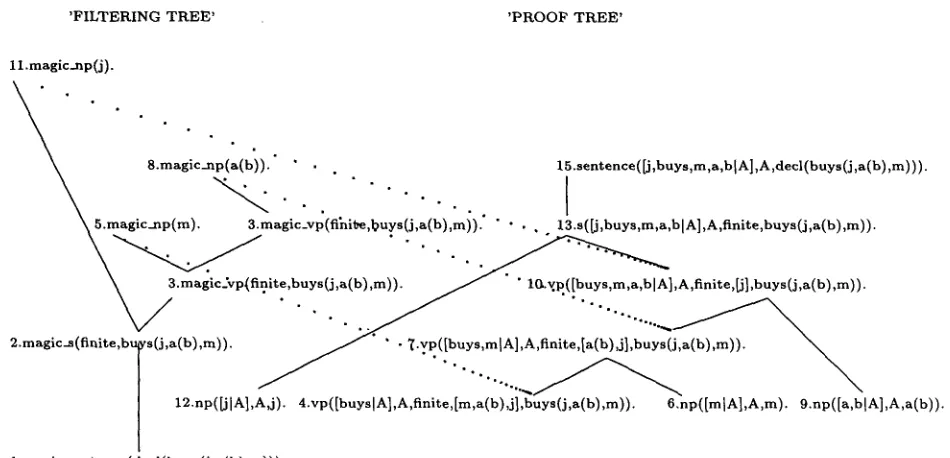
naive evaluation; Bancilhon, 1985) is blocked. (Ac- tive edges are not memoized.) T h e figure 2 consist of two tree structures (connected through dotted lines) of which the left one corresponds to the filtering part of the derivation. The filtering tree is reversed and derives magic facts starting from the seed in a bottom-up fashion. T h e tree on the right is the proof tree for the example sentence which is built up as a result of unifying in the derived magic facts when applying a particular rule. E.g., in order to derive fact 13, magic fact 2 is unified with the magic literal in the modified version of rule 2 (in addition to the facts 12 and 10). This, however, is not represented in order to keep the figure clear. Dotted lines are used to represent when 'normal' facts are combined with magic facts to derive new magic facts.
As can be reconstructed from the numbering of the facts in figure 3 the resulting processing behav- ior is identical to the behavior t h a t would result from Earley generation as in Gerdemann (1991) ex- cept that the different filtering steps are performed in a bottom-up fashion. In order to obtain a gen- erator similar to the bottom-up generator as de- scribed in Shieber (1988) the compilation process can be modified such that only lexical entries are extended with magic literals. Just like in case of Shieber's b o t t o m - u p generator, bottom-up evalua- tion of magic-compiled grammars produced with this Magic variant is only guaranteed to be complete in case the original grammar obeys the semantic mono- tonicity constraint.
~The numbering of the facts corresponds to the order in which they are derived. A number of lexical entries have been added to the example grammar. The facts cor- responding to lexical entries are ignored. For expository reasons the phonology and semantics of lexical entries (except for vs) are abbreviated by the first letter. Fur- thermore the fact corresponding to the vp "buys Mary a book John" is not included.
(1) sentence (P0 ,P ,decl (SSem))
:
- magic_sentence (decl (SSem)), s (P0, P, finite, SSem). (2) s(P0,P,VForm,SSem) :-magic_s (VForm, SSem),
vp(P1 ,P,VForm, [CSem] ,SSem), np (P0 ,PI, CSem).
(3) vp(P0,P,VForm,hrgs,SSem) :- magic_vp (VForm, SSem),
vp(P0,PI ,VForm, [CSem]hrgs] ,SSem), np (Pl, P, CSem).
(4) vp(PO,P,VForm,Args,SSem) :- magic_vp (VForm, SSem), v (P0,P,VForm, Args, SSem) . (5) np(P0,P,NPSem) :-
magic_np (NPSem) , pn (P0, P, NPSem).
(6) np(P0,P,NPSem) :- magic_np (NPSem), det (P0 ,PI ,NSem,NPSem), n (PI,P,NSem).
(7) det ( [aiP] , P, NSem, a (NSem)) .
(8) v ([buyslP] ,P,finite, [I,D,S] ,buys (S,D,I)).
(9)
pn([mary[P] ,P,mary) (i0) n( [booklP] ,P,book). (I I) magic_s (finite, SSem) : -magic_sentence (decl (SSem)) . (12) magic_vp(VForm,SSem) :-
magic_s (VForm, SSem) . (13) magic_vp(VForm,SSem) :-
magic_vp (VForm, SSem). (14) magic_np(CSem) :-
magic_s (VForm, SSem) , vp(Pl ,P,VForm, [CSem] ,SSem). (15) magic_np(CSem) :-
magic_vp (VForm, SSem) ,
vp (P0,Pl,VForm, [CSemlArgs] , SSem) .
Figure 2: Magic compiled version 1 of the grammar in figure 1.
'FILTERING TREE' ' P R O O F TREE'
11 magic.rip(j)
\ •
" ~ " " . • • • • •
8.magic-n~" " •
li.sentence(~,buys,m,a,b[A],A,decl(buys(j,a(b),m))).
~ - m ~ ' m a g i c - v p ( f i r * i t ~ , b u y s ( j , a ( b ) , m i ) . " " " • , 13.s(~,buys,m,a,blA],A,finite,buys(j,a(b),m)).
\
3.maglc-*vp(finite,buys
(j,a(b),ml)."" " ~ ] , A , f i n i t e , [ j l , b u y s ( j , a ( b ) , m ) ) .
2 rn gic (finite,b~s
(j,a(b),rn)).. / / "
• "~.vi(,buy.s:m,Ai,A
, [ . ~ . ~ a ( b ) , m ) ) .
tinct
I 12
np([jlA ]
Aj) 4 vp([buyslA ] A finlte,[m,a(b)3]
buys(j a(b) m))6
np([mIA],A m)9
np([a blA ] A a(b))1.magic-sentence(decl(buys(j,a(b),m))).
[image:4.612.79.554.411.640.2]3 Filter Optimization through
Program Transformation
As a result of characterizing filtering by a definite clause representation Magic brings filtering inside of the logic underlying the grammar. This allows it to be optimized in a processor independent and logi- cally clean fashion. I discuss two possible filter opti- mizations based on a program transformation tech- nique called unfolding (Tamaki and Sato, 1984) also referred to as partial execution, e.g., in Pereira and Shieber (1987).
3.1
Subsumption Checking
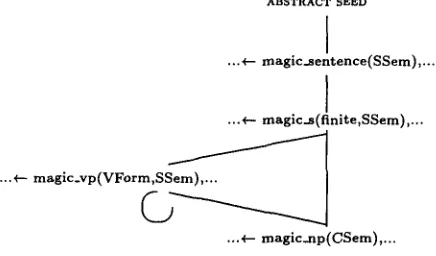
Just like top-down evaluation of the original gram- mar bottom-up evaluation of its magic compiled ver- sion falls prey to non-termination in the face of head recursion. It is however possible to eliminate the subsumption check through fine-tuning the magic predicates derived for a particular grammar in an off-line fashion. In order to illustrate how the magic predicates can be adapted such that the subsump- tion check can be eliminated it is necessary to take a closer look at the relation between the magic pred- icates and the facts they derive. In figure 4 the re- lation between the magic predicates for the example grammar is represented by an unfolding tree (Pet- torossi and Proietti, 1994). This, however, is not an ordinary unfolding tree as it is constructed on the basis of an abstract seed, i.e., a seed adorned with a specification of which arguments are to be con- sidered bound. Note that an abstract seed can be derived from the user-specified abstract query. Only the magic part of the abstract unfolding tree is rep- resented.
A B S T R A C T SEED
L
. . . 4 - m a g i e _ s e n t e n e e ( S S e m ) , . . .
...4-- m a g i c _ s f i n i t e , S S e m ) , . . .
- . 4 - magic_vp (VForm,SSem),...
...+-- m a g i c _ n p ( C S e m ) , . . .
Figure 4: Abstract unfolding tree representing the relation between the magic predicates in the compiled grammar.
The abstract unfolding tree in figure 4 clearly shows why there exists the need for subsumption checking: Rule 13 in figure 2 produces infinitely
many magic_vp facts. This 'cyclic' magic rule is de- rived from the head-recursive vp rule in the example grammar. There is however no reason to keep this rule in the magic-compiled grammar. It influences neither the efficiency of processing with the gram- mar nor the completeness of the evaluation process. 3.1.1
Off-line Abstraction
Finding these types of cycles in the magic part of the compiled grammar is in general undecidable. It is possible though to 'trim' the magic predicates by applying an abstraction function. As a result of the explicit representation of filtering we do not need to postpone abstraction until run-time, but can trim the magic predicates off-line. One can consider this as bringing abstraction into the logic as the definite clause representation of filtering is weakened such that only a mild form of connectedness results which does not affect completeness (Shieber, 1985). Con- sider the following magic rule:
m a g i c _ v p ( V F o r m , [CgemlArgs] , SSem) :-
m a g i c _ v p (VForm, Args, SSem) .
This is the rule that is derived from the head- recursive vp rule when the partially specified sub- categorization list is considered as filtering informa- tion (cf., fn. 1). The rule builds up infinitely large subcategorization lists of which eventually only one is to be matched against the subcategorization list of, e.g., the lexical entry for "buys". Though this rule is not cyclic, it becomes cyclic upon off-line ab- straction:
magic_vp (VForm, [CSem I_3 , SSem) : - m a g i c _ v p (VForm, [CSem2l_] , SSem) .
Through trimming this magic rule, e.g., given a bounded term depth (Sato and Tamaki, 1984) or a restrictor (Shieber, 1985), constructing an abstract unfolding tree reveals the fact that a cycle results from the magic rule. This information can then be used to discard the culprit.
3.1.2
Indexing
[image:5.612.63.281.510.638.2]ing technique described in Gerdemann (1991). 3 The indexing technique is illustrated on the basis of the running example: Rule 14 in figure 1 is coupled to the modified version of the original s rule that insti- gated it, i.e., rule 2. Both rules receive an index: s (PO, P, VForm, SSem) : -
magic _s (P0, P, VForm, SSem), vp(P1 ,P,VForm, [CSem], SSem), np (P0,P1 ,CSem, index_l). magic_rip (CSem, i n d e x _ l ) : -
magi c_s (P0, P, VForm, SSem), vp (P1, P, VForm, [CSem], SSem).
The modified versions of the rules defining nps are adapted such that they percolate up the index of the guarding magic fact that licensed its application. This is illustrated on the basis of the adapted version of rule 14:
np (P0, P, NPSem, INDEX) : - magic_rip (NPSem, INDEX), pn (P0, P, NPSem).
As is illustrated in section 3.3 this allows the avoid- ance of spurious ambiguities in the absence of sub- sumption check in case of the example grammar.
3.2 R e d u n d a n t F i l t e r i n g Steps
Unfolding can also be used to collapse filtering steps. As becomes apparent upon closer investigation of the abstract unfolding tree in figure 4 the magic predi- cates magic_sentence, magic_s and magic_vp pro- vide virtually identical variable bindings to guard bottom-up application of the modified versions of the original grammar rules. Unfolding can be used to reduce the number of magic facts that are produced during processing. E.g., in figure 2 the magic_s rule:
magic_s ( f i n i t e , S S e m ) : -
m a g i c _ s e n t e n c e (decl ( S S e m ) ) .
can be eliminated by unfolding the magic_s literal in the modified s rule:
s(PO,P,VFOP~,SSem):- magic_s(VFORM,SSem),
vp(P1,P,VF01~,,[CSem],SSem), np(P0,P1,CSem).
This results in the following new rule which uses the seed for filtering directly without the need for an intermediate filtering step:
3This technique resembles an extension of Magic called
Counting
(Beeri and Ramakrishnan, 1991). How- ever, Counting is more refined as it allows to distinguish between different levels of recursion and serves entirely different purposes.s(P0,P,finite,SSem):-
magic_sentence(decl(SSem)), vp(P1,P,finite,[CSem],SSem), np(P0,P1,CSem).
Note that the unfolding of the magic_s literal leads to the instantiation of the argument VFORM to f i n i t e . As a result of the fact that there are no other magic_s literals in the remainder of the magic-compiled grammar the magic_s rule can be discarded.
This filter optimization is reminiscent of comput- ing the deterministic closure over the magic part of a compiled grammar (DSrre, 1993) at compile time. Performing this optimization throughout the magic part of the grammar in figure 2 not only leads to a more succinct grammar, but brings about a different processing behavior. Generation with the resulting grammar can be compared best with head corner generation (Shieber et al., 1990) (see next section). 3.3 E x a m p l e
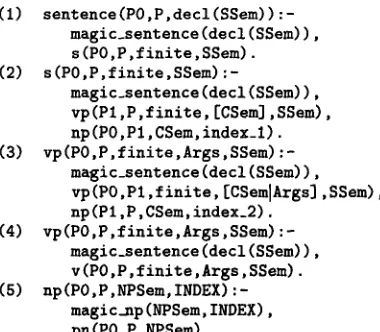
After cycle removal, incorporating relevant indexing and the collapsing of redundant magic predicates the magic-compiled grammar from figure 2 looks as dis- played in figure 5. Figure 6 shows the chart resulting from generation of the sentence "John buys Mary a book" .4 The seed is identical to the one used for the example in the previous section. The
facts
in the chart resulted fromnot-so-naive
bottom-up evalu- ation: semi-naive evaluation without subsumption checking (Ramakrishnan et al., 1992). The result- ing processing behavior is similar to the behavior that would result from head corner generation ex- cept that the different filtering steps are performed in a bottom-up fashion. The head corner approach jumps top-down from pivot to pivot in order to sat- isfy its assumptions concerning the flow of seman- tic information, i.e., semantic chaining, and subse- quently generates starting from the semantic head in a bottom-up fashion. In the example, the seed is used without any delay to apply the base case of the vp-procedure, thereby jumping over all intermediate chain and non-chain rules. In this respect the initial reordering of rule 2 which led to rule 2 in the final grammar in figure 5 is crucial (see section 4).4 D e p e n d e n c y C o n s t r a i n t o n G r a m m a r
(i) sentence(P0,P,decl(SSem)):- magic_sentence(dec1(SSem)), s(P0,P,finite,SSem). (2) s(P0,P,finite,SSem):-
magic_sentence(decl(SSem)), vp(Pl,P,finite,[CSem],SSem), np(P0,PI,CSem, index_l). (3) vp(P0,P,finite,Args,SSem):-
magic_sentence(decl(SSem)), vp(P0,Pl,finite,[CSem)Args],SSem), np(Pi,P,CSem,index_2),
(4) vp(P0,P,finite,Args,SSem):- magic_sentence(decl(SSem)), v(P0,P,finite,Args,SSem). (5) np(P0,P,NPSem, INDEX):-
magic_np(NPSem, INDEX), pn(P0,P,NPSem).
(6) np(P0,P,NPSem,INDEX) :- magic_up (NPSem, INDEX), det (P0,PI ,NSem,NPSem), n(Pl ,P,NSem).
(7) det([aIP],P,NSem,a(NSem)).
(8) v ( [ b u y s l P ] , P , f i n i t e , [I,D,S] , b u y s ( S , D , I ) ) .
(9) pn ( [marylP], P ,mary) (10) n([booklP] ,P,book). (14) magic_np(CSem, index_l) :-
magic_sentence (decl (SSem)), vp (PI,P, finite, [CSem], SSem). (15) magic_np (CSem, index_2) : -
magic_sentence (decl (SSem)), vp (P0,PI, finite, [CSemlArgs], SSem).
11.magic_np(j,i_l).
°
6.magic.np(a(b i ,i..2). "
_2)
Figure 5: Magic compiled version 2 of the grammar in figure 1.
lS.sentence(~,buys,m,a,bIA],A,decl(buys(j,a(b),m))).
I
. . . . 13.s([j,buys,m,a,blA],A,finite,buys(j,a(b),m)).
• . . , . . . " , . , . , , ,
• ~,A,finite,[j],buys(j,a(b),m)).
ll.nP(~mA],Aj,iA). 2.vp([buyslA],A,finite,[m,a(b)j],buys(j,a(b),m)). 4.np([mlA],A,m,i-2). 7.np([a,bIA],A,a(b),i-2 ).
1.magic_sentence(decl(buys(j,a(b),m))).
Figure 6: 'Connecting up' facts resulting from not-so-naive generation of the sentence "John buys Mary a book" with the magic-compiled grammar from figure 5.
right-hand sides of the rules in the g r a m m a r as dis- cussed in section 3.3. If the s rule in the running example is not optimized, the resulting processing behavior would not have fallen out so nicely: In this case it leads either to an intermediate filtering step for the non-chaining s e n t e n c e rule or to the addi- tion of the literal corresponding to the subject np to all chain and non-chain rules along the path to the semantic head.
Even when cycles are removed from the magic part of a compiled g r a m m a r and indexing is used to avoid spurious ambiguities as discussed in the previous sec- tion, subsumption checking can not always be elim- inated. T h e g r a m m a r must be finitely ambiguous, i.e., fulfill the off-line parsability constraint (Shieber, 1989). Furthermore, the grammar is required to obey what I refer to as the dependency constraint:
When a particular right-hand side literal can not be
evaluated deterministically, the results of its evalu- ation must uniquely determine the remainder of the right-hand side of the rule in which it appears. Fig- ure 7 gives a schematic example of a grammar that does not obey the dependency constraint. Given
(1) c a t _ l ( . . . ) : -
magic_cat_l(Filter),
cat_2(Filter,Dependency .... ), cat_3(Dependency).
(2) magic_cat_3(Filter):- magic_cat_l(Filter),
cat_2(Filter,Dependency,...). (3) cat_2(property_l,property_2 .... ). (4) cat_2(property_l,property_2 .... ).
Figure 7: Abstract example grammar not obeying the dependency constraint.
[image:7.612.58.248.79.245.2] [image:7.612.68.524.293.445.2]a derived fact or seed magic_cat_l(property_l) bottom-up evaluation of the abstract grammar in figure 7 leads to spurious ambiguity. There are two possible solutions for cat_2 as a result of the fact that the filtering resulting from the magic literal in rule 1 is too unspecific. This is not problematic as long as this nondeterminism will eventually disap- pear, e.g., by combining these solutions with the so- lutions to cat_3. The problem arises as a result of the fact that these solutions lead to identical filters for the evaluation of the cat_~ literal, i.e., the solu- tions to cat_2 do not uniquely determine cat_3.
Also with respect to the dependency constraint an optimization of the rules in the grammar is impor- tant. Through reordering the right-hand sides of the rules in the grammar the amount of nondeterminism can be drastically reduced as shown in Minnen et al. (1996). This way of following the intended semantic dependencies the dependency constraint is satisfied automatically for a large class of grammars.
5 C o n c l u d i n g R e m a r k s
Magic evaluation constitutes an interesting combi- nation of the advantages of top-down and bottom- up evaluation. It allows bottom-up filtering that achieves a goai-directedness which corresponds to dynamic top-down evaluation with abstraction and subsumption checking. For a large class of grammars in effect identical operations can be performed off- line thereby allowing for more efficient processing. Furthermore, it enables a reduction of the number of edges that need to be stored through unfolding magic predicates.
6 A c k n o w l e d g m e n t s
The presented research was sponsored by Teilprojekt B4 "From Constraints to Rules: Efficient Compila- tion of HPSG Grammars" of the Sonderforschungs- bereich 340 of the Deutsche Forschungsgemeinschaft. The author wishes to thank Dale Gerdemann, Mark Johnson, Thilo G6tz and the anonymous reviewers for valuable comments and discussion. Of course, the author is responsible for all remaining errors.
R e f e r e n c e s
Francois Bancilhon. 1985. Naive Evaluation of Re- cursively Defined Relations. In Brodie and My- lopoulos, editors, On Knowledge Base Manage-
ment Systems - Integrating Database and AI Sys-
tems. Springer-Verlag.
Catriel Beeri and Raghu Ramakrishnan. 1991. On the Power of Magic. Journal of Logic Program- ming 10.
Jochen DSrre. 1 9 9 3 . Generalizing Earley De- duction for Constraint-based Grammars. DSrre and Dorna, editors, Computational Aspects of Constraint-Based Linguistic Description I,
DYANA-2, Deliverable R1.2.A.
Dale Gerdemann. 1991. Parsing and Generation of
Unification Grammars. Ph.D. thesis, University
of Illinois, USA.
Mark Johnson. forthcoming. Constraint-based Nat-
ural Language Parsing. Brown University, Rich-
mond, USA. Draft of 6 August 1995.
Guido Minnen, Dale Gerdemann, and Erhard Hin- richs. 1996. Direct Automated Inversion of Logic Grammars. New Generation Computing 14.
Fernando Pereira and Stuart Shieber. 1987. Pro-
log and Natui'al Language Analysis. CSLI Lecture
Notes, No. 10. Center for the Study of Language and Information, Chicago, USA.
Alberto Pettorossi and Maurizio Proietti. 1994. Transformations of Logic Programs: Foundations and Techniques. Journal of Logic Programming
19/2o.
Raghu Ramakrishnan, Divesh Srivastava, and S. Su- darshan. 1992. Efficient Bottom-up Evaluation of Logic Programs. In Vandewalle, editor, The State of the Art in Computer Systems and Software En-
gineering. Kluwer Academic Publishers.
Taisuke Sato and Hisao Tamaki. 1984. Enumeration of Success Patterns in Logic Programs. Theoreti-
cal Computer Sience 34.
Stuart Shieber, Gertjan van Noord, Robert Moore, and Fernando Pereira. 1990. Semantic Head- driven Generation. Computational Linguistics 16.
Stuart Shieber. 1985. Using Restriction to Extend Parsing Algorithms for Complex Feature-based Formalisms. In Proceedings of the 23rd Annual Meeting Association for Computational Linguis-
tics, Chicago, USA.
Stuart Shieber. 1988. A Uniform Architecture for Parsing and Generation. In Proceedings of the 12th Conference on Computational Linguis-
tics, Budapest, Hungary.
Stuart Shieber. 1989. Parsing and Type Inference for Natural and Computer Languages. Ph.D. the- sis, Stanford University, USA.
Hisao Tamaki and Taisuke Sato. 1984. Unfold/Fold Transformation of Logic Programs. In Proceed- ings of the 2nd International Conference on Logic