Low carbon spaces: area-based carbon
emission reduction -
a scoping study
Low Carbon Spaces
Area-Based Carbon Emission
Reduction: A Scoping Study
Prepared for the Sustainable Development
Commission by the Tyndall
Centre for Climate
Change Research
March 2002
Simon Shackley
1, Paul Fleming
2and Harriet Bulkeley
3With: Sarah Mander1, Ken Green1, John Turnpenny4, Abigail Bristow5 Darryn McEvoy6, Dorian Speakman1 and Sebastian Carney1
1) Tyndall Centre at UMIST
2) Institute of Energy & Sustainable Development, De Montfort University 3) St.Catherine's College, University of Cambridge
4) Tyndall Centre at UEA
Contents:
Glossary of Acronyms
Summary
1. Introduction
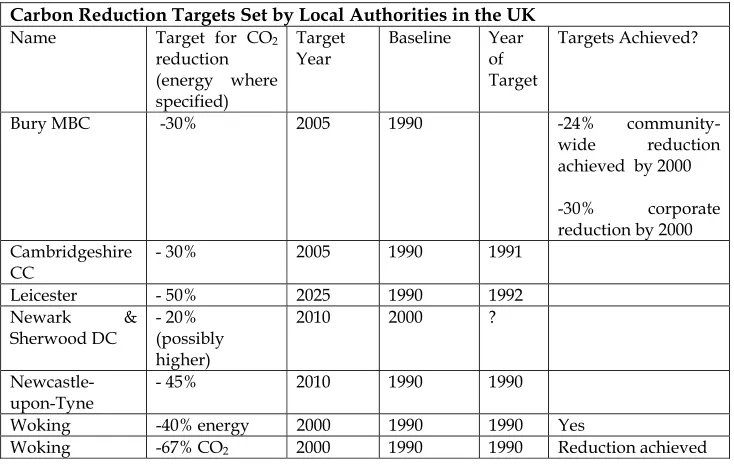
2. Overview
3. Local Government Experiences
4. Exemplars of Low-Carbon Sustainable Energy
5. Experience in Other Countries
6. Consultees
7. References
Appendix One: The Players
Appendix Two: Recommendations
Appendix Three: A Note on the Transport Sector
Glossary of Acronyms
BRE Building Research Establishment CAT Centre for Alternative Technology CHP Combined Heat and Power CCL Climate change levy
CCP Councils for Climate Protection CO2 Carbon dioxide
CT Carbon Trust
DEFRA Department of Environment, Food and Rural Affairs DTI Department of Trade & Industry
DTLR Department of Transport, Local Government and the Regions EEC Energy Efficiency Commitment
EESoP Energy Efficiency Standards of Performance Programme EEACs Energy Efficiency Advisory Centres
ESCO Energy Services Company EST Energy Saving Trust GDP Gross Domestic Product GHG Greenhouse gas
HECA Home Energy Conservation Act
IDeA Improvement and Development Agency
IPPC Integrated Pollution and Prevention Control Directive LA Local Authority
MRETT Midlands Renewable Energy TechnologyTransfer NETA New Electricity Trading Arrangements
NGOs Non-governmental Organisations OFGEM Office of Gas and Electricity Markets
RCEP Royal Commission on Environmental Pollution RDA Regional Development Agencies
SDC Sustainable Development Commission SEV Sherwood Energy Village
TNEI The Northern Energy Initiative URCs Urban Regeneration Companies
Summary of Report
Background to this report
The Sustainable Development Commission has been examining the prospects for an area-based approach to reducing carbon emissions in which different spatial and administrative scales are examined in relation to each other. In this way areas, organisations and initiatives which have achieved significant reduction in carbon emissions, but which are often isolated, can be joined-up and good ideas and experiences more widely shared. The Commission appointed a team led by the Tyndall Centre for Climate Change Research in January 2002 to review existing experiences on 'carbon reduction' at the sub-UK scale and to draw out lessons and recommendations for a workshop and subsequent project(s).
In this report 'Scale' refers to a range of units of different spatial dimensions. We also use it to refer to a range of administrative units operating at different spatial scales (e.g. local, regional and national governments).
Key Points
• Actions at the local to regional scale are needed to deliver extensive carbon emission reductions, but to date most strategic thinking has focused on national policy levers and mechanisms.
• There is great untapped potential for 'bottom-up' led carbon reduction at the local to regional scale to tackle social, economic and environmental objectives.
• There is a welter of different agencies, programmes and policies which influence local carbon reduction and a lack of co-ordination, information-sharing and integration between efforts as a consequence. This, and limited funding, increase the transaction costs in undertaking carbon reduction work.
• The representative bodies, executives and regional institutions (Assemblies, Development Agencies, etc.) will increasingly function as bridges between the 468 local authorities in the UK and central government and EU.
• All local authorities have undertaken standard energy efficiency measures as part of estates and housing management.
• Local authorities have limited ability to use the planning system to reduce the carbon intensity of development because the statutory framework and guidance does not permit rejection of applications on the basis of their carbon emissions.
• Reducing carbon intensity (carbon per unit of energy) can occur independently of a reduction in energy intensity (energy per unit of economic activity), e.g. through use of renewable energy. Sustainable energy requires a reduction in both
carbon and energy intensity. Carbon intensity can be reduced at national (or international) scales, contra most energy intensity reduction, which takes place locally. What are the sustainability implications of local or regional versus national reductions in carbon intensity?
• A dozen or so local authorities have led the way on low-carbon sustainable
• The conditions for successful local authority engagement are: enduring commitment from leading members of the council and from senior officers; in-house energy specialists driving the work forward; partnerships with private, public and NGO sectors; and ability to attract top-up funding.
• Local learning-loops emerge around successful authorities, which spin-out to motivate other local authorities, the private sector and community groups.
• Momentum and capacity are sustained by local learning-loops, bringing in new organisations, resources and enhancing the reputation and status of the partners.
• The private sector is a major actor in reducing carbon emissions, often acting corporately rather than initiating partnerships, though there are excellent examples of joint approaches with local authorities and communities.
• In part on account of restrictions imposed by clients, construction, design, architecture and development firms can, but rarely do, have a major influence over the embedded carbon in new development.
• In the Netherlands the private and NGO sectors frequently initiate partnerships with local authorities and their customers or members: this may be a consequence of more widespread district heating systems, as well as the wider-uptake of green electricity tariffs than in the UK.
• It is currently virtually impossible to measure carbon emissions at the sub-UK scale, hence to monitor the effectiveness of policy measures; this has contributed to a lack of evidence-based policymaking in the field.
The Sustainable Development Commission Area-Based Work
• There are, as yet, no carbon reduction programmes working across a wide range of spatial or organisational scales, though there are strong growth points, e.g. the Energy Saving Trust, the Councils for Climate Protection (Local Government Association) and regional efforts (e.g. RDAs). This absence may, to some extent, reflect the difficulty of organising such an activity.
• The Sustainable Development Commission should select one region or devolved administration for the area-based work, though there are arguments for, and against, selecting a region containing more leading, average or less proactive local authorities and organisations.
• Each scale in the region selected should identify a partner from another region or devolved administration with which to make a comparison, extend experience and expertise (we call this the 'low carbon pathfinder').
• The project(s) should be set against the long term carbon reduction target of 60% by 2050 as proposed by the Royal Commission for Environmental Protection. This should then be telescoped down to more immediate shorter-term milestones (e.g. 10% in next 5 years).
• The extent to which a regional target can be met by activity outside of the region (determined largely through national policy) should be decided upon in advance.
• Some work is already underway on local to regional climate change impacts and adaptation. At the present time it is better for the carbon reduction project to proceed as a separate activity, though there should be close exchange of information.
What the Report is about
As noted above, the Sustainable Development Commission appointed a team led by the Tyndall Centre for Climate Change Research in January 2002 to review existing experiences on 'carbon reduction' at the sub-UK scale and to draw out lessons and recommendations for a workshop and subsequent project(s).
The process
A large number of relevant individuals and organisations were informed of the project(s) via email lists. Information has been collected by submissions of project proformas (accessible via the web) and other data. Approximately 70 telephone interviews have been conducted across the UK. We would like to thank the cooperation and assistance of all those involved in providing information and their perspectives.
A new strategic focus on local to regional carbon reduction is
needed
A large reduction of carbon dioxide emissions requires a combination of 'top-down' and 'bottom-up' policy measures. To date, the top-down options (taxation, national regulation, policies, programmes and guidance) have received more strategic attention than bottom-up options (pro-active local and regional initiatives). The evolving strategic role of the Devolved Administrations and regional institutions creates a favourable context for area-based carbon reduction; many of their key priorities have a strong link to carbon emissions (regeneration, inward investment, renewable energy, efficiency, transport, new markets, job creation, rural diversification, etc.). Implementation of strategies is now taking place through task forces, planning and objectives-setting, though carbon reduction typically extends across the principal sectoral and functional priorities and groupings. The 3 devolved administrations and 9 English regions also act at a necessary and appropriate scale for action: able to bring together, mobilise, stimulate learning between and represent 30 to 50 local authorities, whilst sufficiently 'close-to-the-ground' to understand and reflect local and regional distinctiveness in strategy and planning.
The potential for local to regional carbon reduction remains largely
untapped
There are currently many 'transaction costs' for local authorities and other organisations to become fully engaged with the low-carbon agenda. These transaction costs arise because of:
• The inherent greater fragmentation of the demand-side of energy than of its
supply-side;
• The need for many initiatives to work across local authority or other organisational functions, forming partnerships with NGOs, community groups, and the private sector, all of which can take a lot of time and negotiation.
• Need for experienced and dedicated staff to bid continually for outside funds as more secure funding tends not to be available (also reducing time spent on implementation and monitoring);
• The lack of integration with private-sector work on energy efficiency required under the Energy Efficiency Commitment.
To realise the full potential, better coordination and integration is required.
Local and regional carbon reduction offers the potential for
tackling multiple policy and social objectives
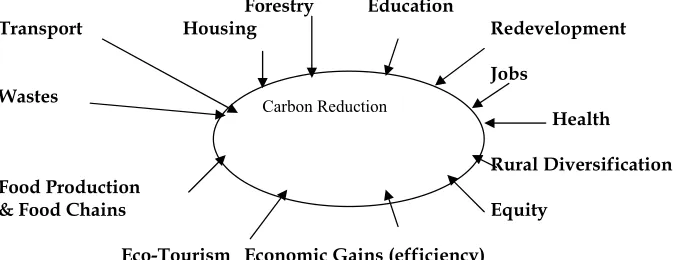
Examples of the multiple social, economic and environmental benefits arising from carbon reduction activities and depicted in figure 1 below are perhaps more evident, tangible and 'believable' at the local to regional scale than they are nationally.
Forestry Education
Transport Housing Redevelopment
Jobs Wastes
Health
Rural Diversification
Food Production
& Food Chains Equity
[image:8.595.78.417.306.436.2]Eco-Tourism Economic Gains (efficiency)
Figure One: Examples of Multiple Consequences of Carbon Reduction at the Local Scale
For example, planting fast growing trees and crops for energy not only reduces net carbon emissions but can provide rural diversification and jobs, improve biodiversity and amenity, assist remediation of brown land, provide a sink for wastes, encourage adoption and innovation of new energy technologies and new transport fuels and even promote eco-tourism. We do not, at present, possess adequate techniques for assessing the full set of potential consequences of low-carbon sustainable energy options.
Sustainable energy issues have been marginalised within most of
local government (with some notable exceptions)
Local government has a long history of work in energy management in estates and asset management departments. Wider sustainable energy issues tend, however, to
fall 'between the cracks' of local government departments (housing, estates, education, parks, environment, etc.) and hence do not become the responsibility of an individual or unit. Lack of a clear allocation of responsibility and of resources, attention to other policy issues and lack of interest by elected members and senior officials probably explains most of the inactivity. Local authority energy specialists can often see the wider issues but have become 'ghettoised'.
There are three phases of local government engagement in the climate change issue: a) the early 1990s at the time of the Rio 'Earth Summit' when several authorities set ambitious carbon reduction targets; b) the mid- to late- 1990s when the Cities for Climate Protection (CCP) programme got going; and c) from 2000 to the current time, with the relaunched CCP and renewed setting of ambitious local targets, including several carbon neutral city proposals. The differences between carbon reduction and energy efficiency have not been appreciated by all local and regional authorities: the leading authorities have, however, recognised the need for efficiency, demand management and lower-carbon energy (including renewable energy) to go hand-in-hand.
Local authorities have minimal abilities to influence carbon emissions through the planning system because they would find it difficult to refuse applications on the basis that they incur higher carbon emissions than alternative developments. Where the local authority actually owns land to be developed there may be greater opportunity to influence energy efficiency and transport links; and likewise the planning authority has some persuasive influence on a quid pro quo basis where a prime site is being developed. The statutory framework and associated guidance simply does not exist to allow low-carbon sustainable energy to be required. The Transport Act 2000 does allow Local Authorities to implement Local Transport Plans, including urban traffic charges. The difficulty here is that good alternative public transport systems are frequently not available, so levies may displace rather than reduce car traffic. Reducing the carbon load from transport remains a most challenging area.
Local to regional development of sustainable energy has some
success stories but is patchy
There are a dozen or so leading local authorities in the UK which have pursued low-carbon sustainable energy policies for a decade or more. This includes: Newcastle-upon-Tyne, Leicester, Nottingham, Nottinghamshire, Southampton, Bristol, Cardiff, Woking, Newark & Sherwood, Kirklees, and the London Boroughs of Sutton, Tower Hamlets, Southwark and Corporation of London. The key determining factors for local authority success stories appear to be:
• Highly motivated and enthusiastic energy specialists, often working in the
authority for a number of years;
• Obtaining high-level and enduring cross-party commitment from the elected
• Obtaining high-level and enduring commitment from the Chief Executive or other senior members of the executive;
• Entering into partnerships with other organisations in the public, private,
voluntary and NGO sectors;
• Marrying-up the 'energy management & efficiency' agenda with the wider
sustainable development agenda, so increasing issue-ownership and motivation across the authority and its partners;
• Ability to access additional financial sources from central government, Europe and the private sector;
• Reputational and status gains arising from work becoming known locally,
regionally, nationally and internationally;
• Ownership of substantial infrastructure for delivering low-carbon energy
systems, e.g. district Combined Heat and Power systems.
At present it is largely chance where synergy between the above factors gets activity under way. This will not be a sufficient mechanism for rolling-out low-carbon programmes and policies to all 468 local authorities in the UK. Even within the pro-active authority areas, the low-carbon buildings, developments and transport systems are usually islands of excellence in a sea of business as usual.
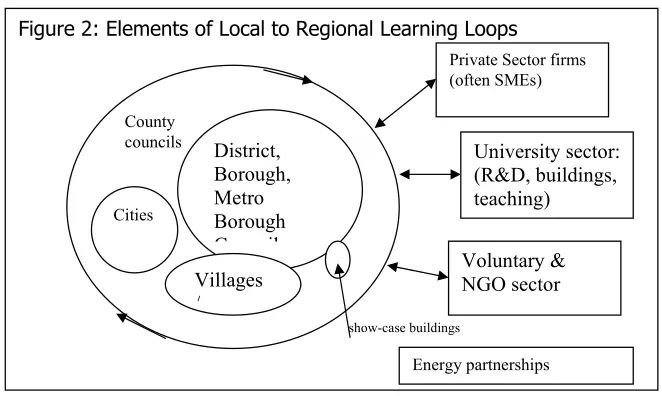
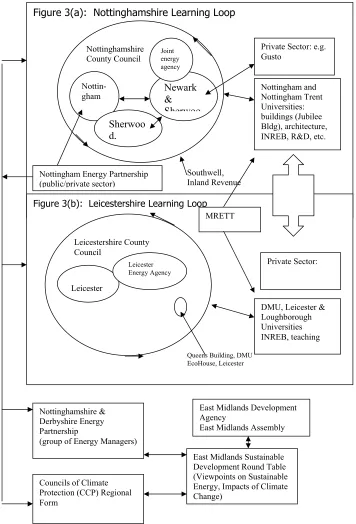
Local Learning Loops
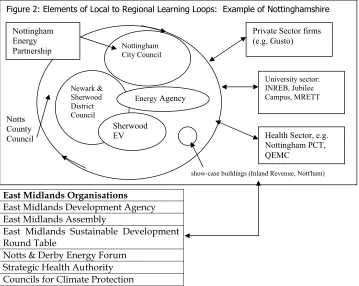
Leading-edge local authorities are often at the epicenter of local learning loops. These engage parts of the community not readily reached by the local authority acting alone. Parts of the North East, South West, East Midlands, South and Central Wales present good examples of local learning loops, which are gradually extending out to the regional scale. An example of a learning loop is illustrated in figure 2; it shows how a range of scales and associated organisations in the Nottinghamshire area are interrelated, and extend outwards to the East Midlands region. Momentum is maintained through local learning loops, attracting talent, resources, small innovative firms, new partners, publicity and so on. Hence it is no accident that leading-edge low-carbon authorities, SMEs, universities, NGOs, community groups and exemplars of best practice tend to be clustered in particular locales. Local
exemplars (buildings, developments, communities, etc.) have an important
East Midlands Organisations
East Midlands Development Agency East Midlands Assembly
East Midlands Sustainable Development Round Table
Notts & Derby Energy Forum Strategic Health Authority Councils for Climate Protection
The Role of Other Organisations
The involvement of other public sector organisations, NGOs, community groups and private companies in carbon reduction initiatives is set to grow, driven in part by national policy and also by market opportunities. To date some small companies have participated in local learning loops where carbon reduction meshes with, or indeed comes to mould, a company's own vision. There are good examples of public-private-community partnerships in the energy efficiency area. This includes several new hospitals (e.g. Princess Margaret's, Swindon), mixed residential & commercial combined heat and power (e.g. Barkantine (Isle of Dogs), Woking, Sheffield, Southampton) and university campus developments (e.g. Jubilee Campus, Nottingham), where design, building and architectural companies have inspired a lower-carbon route. Reducing the carbon load of development is, however, the exception rather the rule for developers and is rarely specified by the client.
[image:11.595.74.433.84.370.2]Energy supply companies will invest £500 million in energy efficiency in the domestic, public and SME sectors over the next three years through the government's Energy Efficiency Commitment (EEC). Whilst this is a huge opportunity for efficiency gains, the EEC programme needs to work with the objectives of local authorities and local and regional partnerships. Other (often continental European) companies have become involved in providing technological expertise in infrastructural-type projects, e.g. CHP and fuel cells, or in building design and
Figure 2: Elements of Local to Regional Learning Loops: Example of Nottinghamshire
Notts County Council
Individual
show-case buildings (Inland Revenue, Nott'ham)
Nottingham City Council
Newark & Sherwood District Council
Private Sector firms (e.g. Gusto)
Sherwood EV
University sector: INREB, Jubilee Campus, MRETT
Health Sector, e.g. Nottingham PCT, QEMC
Nottingham Energy Partnership
architecture. Innovative community-led initiatives have spun-off from local learning loops, such as the Sherwood Energy Village.
There are (as yet) no carbon reduction Initiatives integrated across
spatial or political administrative scales
Nowhere have we identified a project on carbon reduction which looks explicitly across a number of spatial and organisational scales. There are elements of such an approach in the Energy Saving Trust's Low-Carbon Innovation Programme, which include community-scale projects involving small firms and schools, and in its city-wide Planet York project, involving the public, private and household sectors, including transport. The Councils for Climate Protection pilot is also adopting an area-based approach to emission inventories, target-setting and mitigation activities. The significant organisational barriers to an area-based approach extending beyond administrative boundaries may be one reason why such integrative approaches have not emerged. The transaction and economic costs of carbon reduction are much lower where new build is taking place. Hence, large-scale area-based regeneration represents one of the best opportunities for reducing carbon emissions, but is not yet evident in partnerships such as the Urban Regeneration Companies.
International comparisons are at an early stage, but reveal some
differences
Strategic thinking appears to be focused at the national level in a number of other EU countries, though many developments might have lessons for the UK. There are six times as many green electricity tariff customers in the Netherlands than in the UK (10% of households in the Netherlands, compared to less than a quarter of a percent of UK households). NGOs and companies have been active in recruiting this customer base, bringing the municipality on board as appropriate. The success is partly explained by the parity of green and normal tariffs, but is no doubt also cultural. Combined Heat & Power (CHP) plants provide 30 to 40% of the electricity in the Netherlands, compared to 6% in the UK. This has also led to much private-sector led development, since local supplies of heat and power emerge looking for a market. The Australian Cities for Climate Protection Programme has had a wide uptake and has been very well resourced by government. Partnerships around carbon reduction between UK and other EU15 cities and regions might be highly productive in sharing knowledge, experiences and resources.
At present, we cannot monitor the effectiveness of low-carbon
initiatives
Issues surrounding an area-based carbon reduction programme
Targets & Expectations
Ambitious long-term targets for carbon reduction are valuable, but often best seen as 'aspirational' given that the target formulators rarely have the agency to deliver them. Milestones can be used to monitor and manage the achievement of long-term targets over shorter time scales. The reason for realistic short-term targets is that expectations about reduction in energy use have been raised before but not met, breeding disappointment and scepticism. The key challenge is sustaining a programme of modest reductions over an extended time period to achieve substantial change. It is also vital that a partnership and community has ownership of targets and (some of) the means by which they can be achieved.
Benefits and disadvantages of selecting areas and regions
Selecting one region or devolved administration runs the risk of choosing an 'unrepresentative case' and begs the question of how the area should be chosen The evidence presented in the report of local learning loops suggests strongly that the benefits of selecting a single region outweigh the risks. Given the complexity involved in forming wide-ranging partnerships across administrative boundaries, and between the public, private and NGO sectors, we also advise that the region selected be one with demonstrated networking capacity and history of work in the sustainable energy domain. In order to maximise the learning potential from the project, however, we suggest that the selected region partner another region or devolved administration at each spatial and organisational scale (the low carbon pathfinder approach).
Growth points for the project(s)
The project should work from the existing growth points on low carbon sustainable energy. This includes the Councils for Climate Protection, due to be extended in 2002 to all councils in the UK with an interest,. It also includes the existing Energy Saving Trust programmes, the proposed regional-scale work of the Carbon Trust, and the Countryside Agency Renewables Initiative (organised sub-regionally). At the local government scale, it includes the Home Energy Conservation officers and numerous energy efficiency, renewable energy and transportation initiatives.
Incentives
area? This could be related to incentives from local authorities, energy supply companies, community development funds, and so on.
Including climate change impacts and adaptation
Chapter One: Introduction
In January 2002 the Sustainable Development Commission (SDC) commissioned the Tyndall Centre to report on initiatives underway in the UK to reduce emissions of carbon dioxide and other greenhouse gases. The SDC is interested in promoting a project or set of projects on carbon reduction using a spatial approach, in which different scales are joined together for mutual benefit. It identified a review of existing spatially-based studies as the first step, including an assessment of those approaches which appear to be more or less successful and an explanation, where possible, of such successes and failures. The team put together by the Tyndall Centre included analysts of energy management at the local and regional scales, sectoral experts and policy analysts.
The challenge facing the team was to identify where initiatives had a distinct 'carbon reduction' theme. Without some filter, the review could have become swamped with huge amounts of information about all the many thousands of policies, programmes and projects relating to energy efficiency. We initially proposed filtering out all those programmes and projects which did not have an ambitious carbon reduction target, though we relaxed this condition somewhat when it was evident that many organisations thought about small, short-term targets as the first (albeit unofficial) step along the carbon reduction pathway. As a compromise we selected a reduction target of beyond the Kyoto one of -12.5% of greenhouse gases by 2010.
Approach Adopted
We collected information on projects, programmes, policies, research and other initiatives by sending email messages to a large number of individuals and email distribution lists. A standard proforma has been posted onto the Tyndall website to allow respondents to complete the basic information required for the database. We also used the proforma to collect the data we required during telephone interviews and through examination of information on websites.
We have conducted approximately 70 telephone interviews with a wide range of experts on energy management, energy efficiency, local government and its response to climate change. The breakdown of respondents is as follows:
Local Government 24
Regional Government 6
Devolved Administrations 3
Central Government 6
NGOs 8
Other public sector 5
Private Sector 11
Academics 1
The Structure of the Report and Authorship
Chapter Two provides a comprehensive overview of the main analytical findings of the research and its implications for future area-based carbon reduction work. It is an expanded version and justification of the summary.
Lead Author: Simon Shackley; Supporting Authors: Paul Fleming and John Turnpenny
Chapter Three provides a more detailed evaluation of experiences in local government, including a few detailed case-studies of sub-UK scale approaches and programmes. The experience of the Councils for Climate Protection from 1993 to 1999 is described and evaluated, followed by a detailed case-study analysis of Newcastle-upon-Tyne, Cambridgeshire and Leicester. The case-studies illuminate the opportunities and problems with reducing carbon emissions through local authority activities on transport, planning and energy efficiency improvements.
Lead Author: Harriet Bulkeley; Supporting Authors: Paul Fleming, Simon Shackley
Chapter Four provides a qualitative account of some of the most important and interesting developments on reducing carbon emissions from the perspective of the Sustainable Development Commission’s study.
Lead Authors: Sarah Mander & Simon Shackley; Contributing Authors: Sebastian Carney, Dorian Speakman, Darryn McEvoy
Chapter Five provides some information on activities in other countries.
Lead Authors: Harriet Bulkeley (Australia), Ken Green (Netherlands); Supporting Authors: Darryn McEvoy, Paul Fleming
Lead Author: Paul Fleming, Supporting Author: Sarah Mander, Sebastian Carney, Simon Shackley
Appendix Two: The main purpose of this report is not to provide recommendations, but a number of important ones have nevertheless arisen during the analysis. These are presented in this appendix.
Lead Authors: Paul Fleming & Simon Shackley
Appendix Three: Transport is a rather unusual sector compared to other areas in terms of measures which can be adopted and appropriate scales of activity. Hence, we have included a separate discussion of opportunities for carbon reduction, and initiatives underway, in the transport sector.
Lead Author: Abigail Bristow
Appendix Four: provides the database of projects so-far identified. This is inevitably incomplete given the short time-scale in which the scoping study has been conducted and the very wide range of potential examples which could be included. The data base does, however, provide a starting point for the assemblage of a comprehensive database on low-carbon initiatives, which is (to our knowledge) unique in the UK.
Contributing authors: Sarah Mander, John Turnpenny, Darryn McEvoy, Ken Green, Simon Shackley
Limitations
Whilst much information has been obtained, the work is only a scoping study and we were to some extent dependent, given the time and resource scale, on data being provided to us. We did fairly extensive web searchers and through the interviews learnt about a large number of initiatives. Nevertheless, we have undoubtedly missed some important initiatives and programmes; the sheer number of organisations, programmes, and initiatives across the UK makes this almost an inevitability. We hope that the database can be maintained and developed by an appropriate organisation as a future resource.
Acknowledgements
Development Agency) and Don Snow (Mandix Consulting), who were particularly important in shaping the thinking of the writing team.
Chapter Two: Overview of the Report
The context
1. The energy review of the Cabinet Office1 has endorsed ambitious long-term
carbon reduction targets, in line with the Royal Commission on Environmental Pollution2. Through the 'Kyoto Protocol', the Government has a legally-binding
target of a 12.5% reduction in emissions of six greenhouse gases by 2008-2012 and
a domestic target of a 20% reduction in emissions of CO2 by 2010. The
Government has set out how it intends to reach these targets in its Climate
Change Programme3. The programme includes a combination of fiscal
instruments (e.g. Climate Change Levy, emissions trading), regulation (e.g. Integrated Pollution Prevention and Control (IPPC) Directive), transport policy (e.g. local transport plans) and voluntary agreements on commercial energy efficiency. Other important components are the Renewables Obligation and domestic energy efficiency improvements through utilities and local authorities. The key delivery agencies in addition to Government Departments, regional and local government are the Carbon Trust (for commercial and industrial sectors, development of low-carbon technologies, etc.) and the Energy Saving Trust (for domestic sector, including transport). Government is considering devolving targets for renewable energy to the regional scale.
2. The national programme delivers short-term carbon reduction through fiscal, regulatory and advisory policies. It is not possible to state in any detail how large long-term carbon emission reductions will be achieved. Changes in technology will no doubt be critical, as the Carbon Trust has argued4. Yet, we do
not know which future low-carbon technologies will become dominant. Economic policy and fiscal incentives such as carbon taxes and carbon emissions trading have enormous potential, but we have little reliable information on exactly how such fiscal instruments will function and whether they alone could deliver large carbon reduction. There are also many other aspects of sustainability, such as the interaction between emissions trading, siting of pollution sources, equity and environmental justice, which need full consideration. Local and national objectives can also clash, as has been the case with the development of wind power, sanctioned by the (now-defunct) Non-Fossil Fuel Obligation (NFFO) nationally, but thwarted by local opposition, which the local planning authorities have been reluctant to ignore. Secondly the Energy efficiency Commitment (formerly the Energy Efficiency Standards of Performance) has put a duty on utilities to invest in energy efficiency. However, this investment can be in competition with Local Authorities' work on energy efficiency improvements under the Home Energy Conservation Act. The local implementation of national policy objectives cannot simply be assumed, particularly where new infrastructure, new technologies and changes in land-use are implied.
A new strategic focus on local to regional carbon
reduction is needed
3. The Cabinet Office energy review refrained from recommending specific long-term carbon reduction targets because (inter alia) such a policy commitment would only be effective as part of an international agreement. This should not deter efforts to establish ambitious long-term strategic targets for CO2 reduction
at the sub- UK scale, however: such is warranted if a precautionary approach to the science is adopted.
4. A different approach to such 'top-down' policy making is explored in this report, namely a 'bottom-up' approach from activities at sub-UK scales (e.g. individual, community, local authority, regional and devolved administration). There is a huge untapped potential for carbon reduction at the sub-UK scale which has received much less attention from national-scale policy makers. The distinction is that between 'top-down' policy, which relies for its success on setting the regulatory, fiscal and administrative context in which lower-level decisions are taken, and the 'bottom-up' approach which involves decisions being taken pro-actively at community, local and regional scales. The local to regional decision-takers are not simply responding to policy signals set at the national scale, therefore, but are changing the local decision-making context in which policy at all levels is being implemented. Both top-down and bottom-up decision-making approaches are healthy features of a democracy; a bias towards top-down policymaking may stifle diversity, experimentation and innovation, whilst over-reliance on bottom-up approaches produces fragmentation, replication and hence inefficiency and possible lack of learning and transfer of best knowledge and practice.
5. The time is ripe for such an approach, in particular utilising the new-found autonomy and dynamism at the regional scales in England and the devolved administrations of Scotland, Wales and Northern Ireland. All regions and parts of the UK have conducted thorough reviews of the role of renewable energy. This has been facilitated through DTI funding in the last several years and builds upon publicly-funded assessments conducted for several decades on a spatial basis. Every region and part of the UK therefore has a good baseline for developing a regional strategy on renewable energy development and most appear to be taking-up the opportunity so provided (e.g. through the Renewable Energy Support Programme in Wales). A regional renewable energy agency is already up-and-running in the North East and a new private-public renewable energy partnership has now been established in the North West.
The National Assembly of Wales has published a draft Climate Change Programme for Wales.5 The Assembly is the only Government in Europe to have
a constitutional duty to promote sustainable development (section 121 Government of Wales Act). A comprehensive set of policies have been put in place and a disaggregated greenhouse gas emissions inventory for Wales produced. The domestic target of a 20% reduction in CO2 emissions by 2010 is
endorsed, but the difficulties associated with establishing a separate Welsh target
are noted (e.g. distinguishing between the impact of UK-wide and devolved measures; difficulty of establishing emissions inventory) and a renewables target of 5% electricity by 2003 is proposed. Scotland' s Climate Change Programme and related initiatives are extensive and include the objective of increasing electricity from renewable energy to around 18% by 2010 (significantly about the UK target of 10%, and with much greater longer-term potential).6 The Scottish
Government is intending to introduce locational guidance on renewable energy development and improved building standards.
A review of English regional strategies indicates relative lack of attention to carbon reduction, however. The initial guidance to Regional Development Agencies (RDAs) from central government on regional strategies did not mention carbon emissions and the only core indicator for sustainable development is
percentage of new homes built on previously developed land.7 Subsequent
supplementary guidance identified greenhouse gas emissions as one factor to take into account in the appraisal of projects, and left open the possibility of including GHG emission reduction targets in regionally-specific targets. A notable exception to most RDA strategies is the Regional Action Plan and Regional Economic Strategy for Yorkshire & Humberside, which set a target for reducing emissions of the basket of six greenhouse gases by 'more than 20%' by 2010 (relative to 1990).8 This target and emphasis has been achieved through the
Yorkshire Energy Forum, a public-private body which considers all aspects of energy consumption and demand and has produced a report on baseline energy use in the region.
Despite the specific lack of mention of carbon emission reduction in most regional strategies, what is striking is the extent to which nearly all strategies mention many of the following issues, all of which have significant overlap with the objective of reducing carbon emissions:
• Climate change as an important issue for the region
• The importance of sustainable development as a set of framing principles
• Objective of developing the environmental technologies sector, including new and renewable energy technologies
• Objective of improving efficiency and cutting out unnecessary waste
• Objective of assisting the rural economy, sustainable land-use and rural
diversification
• Objective of improving quality of life, e.g. through improved built environment
• Need for a more sustainable solution to transportation within the region.
Most regions have produced Regional Sustainable Development Framework documents through Regional Assemblies and / or the regional Government Office. These have a strong emphasis on climate change, reducing energy consumption and reducing greenhouse gas (GHG) emissions. The Yorkshire & Humberside framework has a section devoted to reducing GHG emissions, which adopts the -20% CO2 by 2010 target, and a target of 10% renewable energy
6 Climate Change Programme for Scotland 2000 7 DTI 1999, 1999a
by 2010.9 It also aims to produce a regional GHG inventory and a climate change
strategy. The report lists a useful set of activities required at the regional scale, as well as related activities at national, sub-regional and local-scales. A criticism levelled at regional policy-making has frequently been that the economic and sustainability policies have been pursued almost independently and without sufficient iteration. The East Midlands provides an exemplar of good practice in this regard through its Integrated Regional Strategy (IRS), which pulls together the economic and planning strategies and subjects them to a common sustainability appraisal. Many of the key challenges identified in the IRS relate directly or indirectly to reducing carbon emissions.10
The potential for local to regional carbon reduction
remains largely untapped
6. Policy-making remains highly centralised in the UK, despite moves towards
decentralisation in the last five years. Nowhere else in the European Union do cities and regions have as little political autonomy as is the case in England. The potential in the devolved administrations is in principle greater; Scotland, for example, has its own Climate Change Programme, the potential to establish its own greenhouse gas emissions reduction targets, its own renewable energy targets and a greenhouse gas emissions inventory. Yet, energy and transport policy are still largely the province of the UK government, and opportunities for distinctive sub-UK scale policies which will directly affect carbon emissions (such as taxation) are highly limited.
7. The capacity of the local to regional scale to act is resource-limited with respect to finance and skilled people. Under the current arrangements, success requires local to regional agencies to be highly opportunistic in seeking funding from all available routes. Whilst with some advantages, such an approach can deter longer-term strategic thinking and become a drain on limited resources through over use of personnel in continual pursuit of grants. Such an approach is also competitive, pitting organisations against each other rather than encouraging partnerships and collective working. A solely grants-led approach requires the applicants to respond to a specific 'call', and may limit the opportunities for truly innovative schemes and thinking to flourish at the local to regional scale. Resource limitations also mean that funding is directed at the implementation of projects, not on monitoring, evaluation, information-sharing and publicity. This contributes to fragmentation and does not encourage learning from past experiences (i.e. evidence-based policy).
8. The top-down approach assumes that strategic and policy decision-making takes place within central government and is then implemented at the local level. This approach can become self-reinforcing in that it reduces incentives for those who wish to think and operate strategically to work locally to regionally. It also reduces the 'ownership' of policies and programmes, since those at the local to regional scale do not perceive that they have had a large input to national policies which are rolled-out locally. Increased ownership is likely to facilitate efficient,
effective and creative implementation and to increase the flow of ideas from 'on the ground' back up to central government. There have been instances in the past where central government supported programmes which were technically illegal because the local authority did not possess the statutory powers to conduct the work. This illustrates the need for effective two-way communication between local and national levels.
9. Because of the large number of government departments, programmes and
agencies, as well as EU programmes, from which funding is potentially available, it is virtually impossible to gain a holistic picture of what decarbonsiation activities are currently taking place at the local to regional scale, a problem identified in much area-based policy11. Relevant funding is available
from the following departments and agencies: EST, Carbon Trust, DTI (renewables programme, construction industry), DEFRA (energy efficiency, energy crops, environment improvement fund, Warm Front, Community Energy), DTLR (planning, transport, public sector building), New Opportunities Fund, Countryside Agency, EU Commission (Thermie, SAVE, SRB, ERDF, etc.), Regional Development Agencies and local authorities. Furthermore, many government-funded schemes are administered by other not-for-profit organisations (such as NEF, CSE, CREATE, etc.) creating a further raft of relevant
bodies.12 The RCEP depicted the complex set of organisations involved,
reproduced here as figure 1.
10. There has been a lack of integration in the UK between sustainable energy
decision-making organisations, agencies, programmes and policies. Experience and examples of best practice in energy management, transport, low-carbon buildings and developments, low-carbon communities, companies, public sector organisations, occur in disparate circumstances across the 468 local authorities within the UK. The overall impression is one of fragmentation of activity and efforts, skills and resources.
11. Some organisations can negotiate their way through this confusing milieu of opportunities, but for some (and perhaps many) the administrative burden, the transaction and opportunity costs become overwhelming. Proposal writing takes over from actually delivering carbon reduction, or else candidate organisations do not enter into the territory of sustainable energy at all. The ‘perpetual pilot project’, which some funding agencies seem to prefer, can be frustrating to energy professionals who feel that they know what needs to be done but are having to continually request funding under new labels and assessment criteria.
12. Government Departments were structured prior to the emergence of climate
change as a high-level policy priority. Hence, many departments and their agencies find that they have a climate-change 'interest' and support related programmes and projects. There is insufficient central coordination, compounded by European and local and regional level initiatives. It is likely that the fragmented welter of funders, programmes and projects is
11 PIU 2000
12 Appendix One provides a review of the main national-level organisations and programmes
productive in terms of overall efficiency and effectiveness in delivering carbon reductions sustainably.
13. The dynamics of local to regional scale activities are quite distinct from national-scale dynamics. The key individuals, organisations and networks involved are different, but so also are the ways in which partnerships operate. National policy and local-regional policies can, for the most part, sit comfortably alongside one another, however. In other cases there are less easily resolved disconnections between these policy levels. A case-in-point is the Standards of Performance Programme, now re-named the Energy Efficiency Commitment. Under this programme, the gas and electricity regulator OFGEM allows a small sum of money to be levied per customer to pay for energy efficiency improvements, especially for low-income households (initially £1, now £3, per customer). Yet, private-sector led schemes have sometimes had the unintended consequence of undercutting home improvement schemes supported by the Local Authority. This is because the major suppliers were able to conduct more extensive marketing and publicity and to offer larger discounts to the target public than local authorities. There has been no formal connection between the suppliers’ statutory requirement under the Energy Efficiency Commitment and the Local Authorities’ statutory commitment under the Home Energy Conservation Act (HECA) to improve domestic energy efficiency.
14. The private sector and government has traditionally found it easier to deal with the supply-side of energy, since there are a relatively small number of players who can cover the range of issues required to increase or modify supply. The demand-side, on the other hand, is highly fragmented, with many different types of organisations involved at different scales, and many disparate issues. Hence, multiple-contracts are required, taking much more negotiating time and producing more complex commercial and regulatory arrangements: the transaction costs and risk of failure increase. Most government-supported work on the demand-side has dealt with individual industrial and commercial sectors (mainly through the Energy Efficiency Best Practice Programme) or at the individual / householder level (through the EST), where the issues, options and decision-making frameworks (if not always the way to effect change) are reasonably clearly set out. Local government cannot be treated as a further ‘sector’ as they are multi-functional, subject to democratic oversight, and facilitators as well as delivery agencies.
Local and regional carbon reduction offers the potential
for tackling multiple policy and social objectives
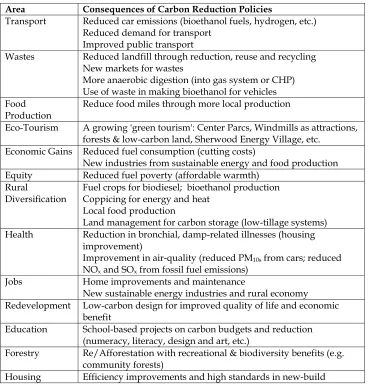
15. Low carbon initiatives are usually perceived as being driven by national climate-change objectives. Their true benefits only emerge, however, when we include the full suite of environmental, social and economic benefits at scales from the local upwards. When seen in this light, low-carbon initiatives may be more
Figure 2: Multiple Consequences of Local to Regional Carbon Reduction Efforts
Forestry Education
Transport Housing Redevelopment
Jobs Wastes
Health
Rural Diversification
Food Production
& Food Chains Equity
[image:26.595.72.441.263.650.2]Eco-Tourism Economic Gains (efficiency)
Table One: MultipleConsequences of Carbon Reduction Policies
Area Consequences of Carbon Reduction Policies
Transport Reduced car emissions (bioethanol fuels, hydrogen, etc.) Reduced demand for transport
Improved public transport
Wastes Reduced landfill through reduction, reuse and recycling
New markets for wastes
More anaerobic digestion (into gas system or CHP) Use of waste in making bioethanol for vehicles Food
Production Reduce food miles through more local production
Eco-Tourism A growing 'green tourism': Center Parcs, Windmills as attractions, forests & low-carbon land, Sherwood Energy Village, etc.
Economic Gains Reduced fuel consumption (cutting costs)
New industries from sustainable energy and food production
Equity Reduced fuel poverty (affordable warmth)
Rural
Diversification
Fuel crops for biodiesel; bioethanol production Coppicing for energy and heat
Local food production
Land management for carbon storage (low-tillage systems)
Health Reduction in bronchial, damp-related illnesses (housing
improvement)
Improvement in air-quality (reduced PM10s from cars; reduced
NOx and SOx from fossil fuel emissions)
Jobs Home improvements and maintenance
New sustainable energy industries and rural economy Redevelopment Low-carbon design for improved quality of life and economic
benefit
Education School-based projects on carbon budgets and reduction
(numeracy, literacy, design and art, etc.)
Forestry Re/Afforestation with recreational & biodiversity benefits (e.g. community forests)
Housing Efficiency improvements and high standards in new-build
16. A few examples of particular local to regional circumstances will help illuminate the above argument.
• Derelict land is a particular problem in the older industrialised areas. There may be opportunities for planting trees or energy crops (biomass) on brown land, which not only helps off-set carbon emissions, but also provides open green-spaces for recreation in, or near to, urban areas. English Partnerships and Yorkshire Forward have one such scheme for reclamation of old coal mining sites, whilst Community Forests in the North West are also linking-up the re-use of brown land with the low-carbon agenda across the region. If large enough schemes were developed, there would be some benefit for local employment and integration with local waste strategies is also possible (e.g. composting) and with district heating (e.g. Sheffield is investigating use of biomass in its city-centre CHP). A large number of individual buildings and facilities across the UK are now integrating local biomass into their energy systems, so reducing payment of the Climate Change Levy.
• The future use of marginal agricultural land is in question given changing
agricultural support policies and Foot and Mouth Disease. Development of biomass may make sense where local opportunities for using power and heat exist (e.g. dairies, schools), and where biodiversity objectives can be fulfilled. Use of biomass to produce bioethanol (or energy crops for biodiesel) could be integrated into local transport plans, especially where public or private-sector transport fleets can be re-fuelled centrally.
• A totally different example involves a closed-industrial loop, e.g. through use of biomass (or more controversially waste) as a fuel, followed by sequestration of carbon dioxide from the flue gases. The overall effect could be net carbon neutral or net carbon absorbing. Local opportunities may exist where suitable geological reservoirs (e.g. salt caverns, aquifers) and infrastructure (e.g. pipelines) already exist, and where there is an abundant supply of biomass (possibly in North West, Yorkshire & Humberside and Scotland).
17. A major problem in assessing the local benefits and costs of low-carbon initiatives is the lack of robust tools and methods for reliably evaluating the ancillary benefits and costs in terms of environmental, social and economic aspects of sustainable development. In the absence of such integrated assessment, the true value of low-carbon initiatives for sustainable development is, in many cases, greatly underestimated. In summary, only when we look across the wide spectrum of potential benefits at the local to regional scales are the opportunities of a low-carbon economy fully appreciated.
Sustainable energy issues have been marginalised within
most local government (with some notable exceptions)
Earth in 198913 was instrumental in raising the profile of the local authority
energy manager. In the 1990s the remit broadened out from the authority's own buildings to the public, private and domestic sector buildings within the administrative boundaries of the authority. The Energy Efficiency Advice Centres (EEACs), of which there are now 52 around the UK, were established by partnership with the Energy Saving Trust (EST), to provide free and impartial advice to the general public and small businesses. The EST has also supported innovative schemes on energy efficiency and conservation in schools and now has a transport programme. The Best Practice Programme, now part of the Carbon Trust, has produced some guidance on energy efficiency in the public sector and one report on sustainable communities, though most of its case-studies are sectorally-focused. Despite all these efforts, energy issues within local authorities have frequently become 'ghettoised' - hived-off as technical support functions within estates management, rather than being a core activity of the Sustainable Development Unit or (better still) the Chief Executive's group.
19. An important reason is the lack of political motivation on the part of Elected Members, Chief Executive and Departmental Directors due to energy being some-what 'invisible' compared to other issues. The reorganisation of local government functions and turnover of experienced staff may also have contributed to the loss of institutional memory and capacity on energy management. Energy issues typically 'fall between the cracks' of local authority departments, i.e. housing, transport, estates management, parks and community development. As such Department Directors, and the Cabinet Members with oversight of individual departments, do not see the 'whole picture' when it comes to sustainable energy and the issue as a whole is downgraded. Given such fragmentation low-carbon sustainable energy is not receiving the attention which it so critically deserves for effective local-authority action.
20. The professional organisation of energy and building specialists (e.g. architects, building service engineers, construction engineers, housing officers, community development officers, etc.) may also have mitigated against more coordinated approaches and encouraged technical fragmentation.
21. An early initiative was the formation of the Central and Local Government
Environment Forum in the early 1990s. This brought together representatives from Government (Ministers, senior civil servants) and Local Government (Council Leaders and senior officers) to discuss environmental issues. The Forum's Efficiency Working Group recommended a 15% energy reduction target within 5 years, but this does not appear to have been monitored and the means for its fulfillment were never established.
22. In the wake of the Rio 'Earth Summit' in 1992, local authorities began to get actively involved in the global climate change issue, e.g. through the Cities for Climate Protection (CCP) campaign of the International Council for Local Environmental Initiatives.14 (Chapter 3). At about this time several pioneering
authorities adopted ambitious carbon-reduction targets of up to 50% by 2010 or 2025 (relative to 1990), e.g. Newcastle-upon-Tyne, Newark & Sherwood and
Leicester (see Table 2). Newcastle and Leicester were founding members of the European Cities Network of Energy and Environmentally Conscious Cities. Electricity privatisation and subsequent commercial and regulatory change largely hindered the realisation of these ambitious targets (Chapter 3).
Table 2: Carbon Reduction Targets Set by Local Authorities in the UK
Carbon Reduction Targets Set by Local Authorities in the UK
Name Target for CO2
reduction (energy where specified)
Target Year
Baseline Year of Target
Targets Achieved?
Bury MBC -30% 2005 1990 -24% community-wide reduction achieved by 2000
-30% corporate reduction by 2000
Cambridgeshire CC
- 30% 2005 1990 1991 Leicester - 50% 2025 1990 1992 Newark &
Sherwood DC
- 20% (possibly higher)
2010 2000 ?
Newcastle-upon-Tyne
- 45% 2010 1990 1990 Woking -40% energy 2000 1990 1990 Yes
Woking -67% CO2 2000 1990 1990 Reduction achieved
23. The passing of the Home Energy Conservation Act (HECA) in 1996 was
important in raising the profile of energy consumption in the domestic building stock within the authorities' administrative boundaries. HECA enabled ambitious targets to be set for domestic energy and carbon reduction, usually 30% efficiency improvements over 10 years, and levered some additional resource to local authorities through competitions administered by the EST. However, much larger resources (and possibly new powers) would have had to be provided to local authorities to enable most of them to meet the ambitious targets. A conclusive review of HECA is not yet available as the programme is only half-way through, but most authorities appear to be struggling to reach their targets, and some are a long way behind. (One leading edge authority, Kirklees, has reported 12% improvements in efficiency to date, suggesting that the 30% target will be challenging for many other authorities). A further problem has been the lack of an agreed methodology for calculating the improvements in energy efficiency under HECA. Hence, local authorities have used different technical models and/or surveys, but there is little evidence that the resultant data is strictly comparable.
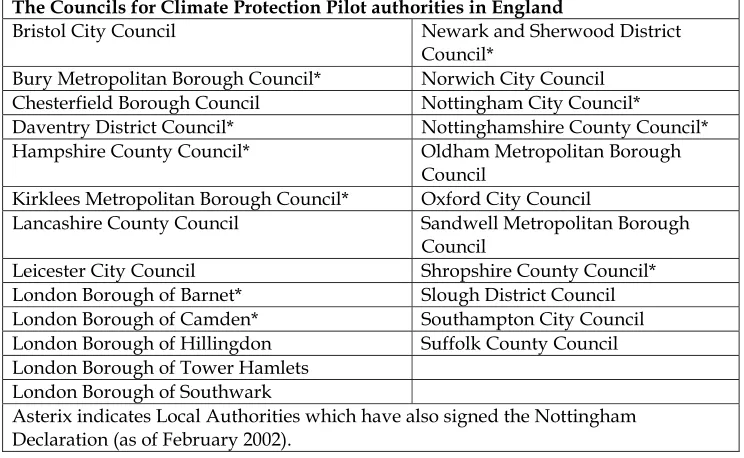
have set a community-wide emission reduction target, whilst 20% have conducted some inventory work on greenhouse gas emissions. 64% have been involved in raising awareness amongst their own employees and 68% claim to have acted to raise awareness of climate change amongst the wider community.15
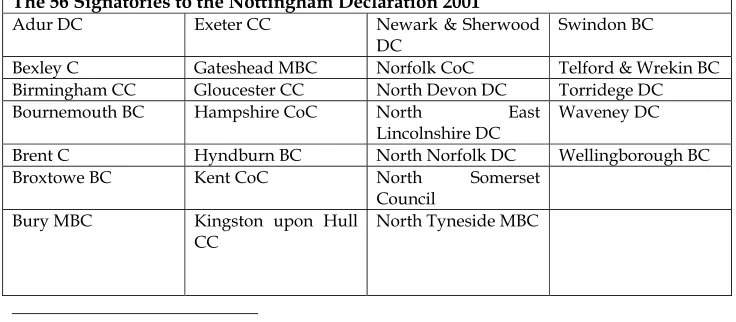
[image:30.595.71.443.344.573.2]More have been involved in raising awareness amongst their worksforce of transport (89%) and renewable energy (92%). The CCP was re-launched in 2000 as the Councils for Climate Protection, with support from DEFRA and the Improvement and Development Agency (IDeA). The main focus of the CCP between 2000 and 2002 has been the preparation of local greenhouse inventories using a standard international methodology in the 24 pilot authorities (see Table 3). The first inventories are beginning to emerge from the pilot authorities (e.g. Lancashire and Bury in February and March 2002). 56 local authorities have recently signed the Nottingham Declaration, which proposes a carbon reduction target of -20% by 2010 (relative to 1990) (see Table 4). Some authorities are now considering even more ambitious carbon reduction targets, e.g. Newcastle-upon-Tyne and Plymouth are proposing a net zero carbon target, and Greater London is also considering a large reduction target. Several local authorities without a strong reputation in sustainable energy management are now becoming more involved in the low-carbon agenda and putting together proposals and projects, suggesting the wider appeal of carbon reduction policies than energy per se.
Table 3: List of Councils Participating in the CCP Pilot Greenhouse Gas Inventory Project (England & Wales)
The Councils for Climate Protection Pilot authorities in England
Bristol City Council Newark and Sherwood District
Council*
Bury Metropolitan Borough Council* Norwich City Council
Chesterfield Borough Council Nottingham City Council*
Daventry District Council* Nottinghamshire County Council*
Hampshire County Council* Oldham Metropolitan Borough
Council
Kirklees Metropolitan Borough Council* Oxford City Council
Lancashire County Council Sandwell Metropolitan Borough
Council
Leicester City Council Shropshire County Council*
London Borough of Barnet* Slough District Council
London Borough of Camden* Southampton City Council
London Borough of Hillingdon Suffolk County Council
London Borough of Tower Hamlets London Borough of Southwark
Asterix indicates Local Authorities which have also signed the Nottingham Declaration (as of February 2002).
25. The achievement of carbon reduction targets in local government has been
primarily through traditional energy management, efficiency and conservation policies, measures and programmes. A key driver has been to limit the incidence of 'fuel poverty' in the UK, whereby low-income households are not consuming
sufficient energy for optimal comfort levels. Government support on energy efficiency has been preferentially directed towards alleviation of fuel poverty, e.g. through the Warm Front and Energy Efficiency Commitment (formerly the Energy Effiency Standards of Performance programmes).
26. Local planning controls have not yet been particularly successful to date in achieving low-carbon development. This is despite the fact that 60 to 80% of councils include sustainable energy in the planning process and that a quarter of authorities consider energy use when deciding on individual planning applications.16 The limited success stories relate to control over development on
land actually owned by the Council, where higher standards of energy efficiency and better public transport links, have been introduced (e.g. in Newcastle). To a lesser extent, planning authorities have also been able to influence development on prime land within its area (Chapter 3). There is a lack of resources on the part of local authorities to act where they have the powers to do so, however, and a lack of powers to act in many areas relevant to reducing local emissions of greenhouse gases. Even the leading-edge authorities have found it very difficult to implement policies because of lack of statutory or negotiating powers, conflict with other policy objectives (e.g. economic development and inward investment) and lack of influence over the detail of new development or use of energy in existing buildings or in transportation. Isolated pockets of good practice therefore tend to exist in a sea of business as usual, without sufficient extension of the ideas, techniques and practices.
27. Those policy programmes which have been implemented are focused, in the
main, on the provision of infrastructure, technical solutions and information. It is not clear whether these approaches can achieve sufficient action by individuals, communities and businesses to reduce energy consumption. Some attempts have been made to use alternative forms of demand management which deliver a ‘package’ of information and opportunities for individuals, but there is strong resistance to ‘hard’ demand management from other parts of local authorities and their constituencies.
28. The Government is directing local authorities to consider the environmental impacts of their service delivery and policy goals through “best value”. 18% of councils have integrated specific local performance indicators on greenhouse gas emissions into their Best Value programmes.17 On the other hand, successive
waves of reform to local government have decentralised management of local government property and services, so that individual buildings manage their own budgets, the latest example of this being schools. This means that the benefits of scale in investing in energy efficiency measures are lost, and the council has little influence over energy management decisions in public services. Furthermore, new guidelines for benchmarking and comparing service delivery seem to neglect the sustainable development aspect written into “best value” in favour of more crude measures which focus on cost. Some local authorities have proposed including sustainable energy as a statutory requirements under Best Value.
29. The new ‘Community Plans’ are intended to replace a range of existing plans for different local authority functions (education, police, health, environment, transport etc.). Whilst the guidance from the DTLR surrounding their formulation includes sustainable development, a strong steer that climate change and carbon reduction be a key criteria to be included for all plans is not provided. DTLR aimed to avoid over-prescription in advising on how plans are drawn-up. The problem with this some what 'hands off' approach is that it will work less well for 'invisible' than for highly visible issues. Climate change impacts and energy are not issues which tend to motivate most local activitists and we know from focus group research that many members of the public think of litter, crime and local transport when asked about 'environment' rather than global issues such as climate change18. Hence, there are less likely to be local
voices who are pressurising the local authority to take action on sustainable energy and to ease climate change than is the case for local issues such as air pollution, transport, crime and so on.
30. Transport is the most rapidly growing source of CO2 emissions in the UK and
[image:32.595.71.439.487.648.2]probably the most difficult area to tackle. Past experience suggests a lack of influence by the local authority over public transport provision and travel choice behaviour. Policies have been dependent on voluntary action by individuals and co-operation by transport providers. There has been an over-emphasis on ‘countable’ measures resulting in traditional approaches – infrastructure provision and information – while more innovative, effective but less readily measured approaches have been less explored and supported. There has perhaps been a lack of resources to support non-capital projects. Politically, local authorities have found it difficult to build strong coalitions from the community and stakeholders in support of ‘hard’ demand management measures for transport without alternatives in place. The problem is that alternatives to car travel are only likely to be effective with the implementation of hard demand management measures (chapter 3). We appear, therefore, to be highly dependent upon incremental and radical technological advances to reduce transport-related carbon emissions (delivered mainly by the private sector).
Table 4: Local Authority Signatories to the Nottingham Declaration (as of February 2002)
The 56 Signatories to the Nottingham Declaration 2001
Adur DC Exeter CC Newark & Sherwood DC
Swindon BC
Bexley C Gateshead MBC Norfolk CoC Telford & Wrekin BC Birmingham CC Gloucester CC North Devon DC Torridege DC Bournemouth BC Hampshire CoC North East
Lincolnshire DC
Waveney DC Brent C Hyndburn BC North Norfolk DC Wellingborough BC Broxtowe BC Kent CoC North Somerset
Council Bury MBC Kingston upon Hull
CC
North Tyneside MBC