
Lancet Neurol 2019; 18: 736–47
See Commentpage 711 Faculty of Health and Human Sciences, School of Health Professions, University of Plymouth, Peninsula Allied Health Centre, Plymouth, UK (Prof J Freeman PhD, W Hendrie PhD, L Jarrett PhD, R Dennett BSc); Norwich MS Centre, Norwich, UK (W Hendrie); Mardon Neurorehabilitation Centre, Royal Devon and Exeter NHS Foundation Trust, Exeter, UK (L Jarrett); University of Exeter Medical School, Health Economics Group, University of Exeter, Exeter, UK (A Hawton PhD); NIHR Research Design Service (A Barton MSc), Medical Statistics Group (B Jones MSc, S Creanor BSc) and Peninsula Clinical Trials Unit (S Creanor), Faculty of Medicine and Dentistry, University of Plymouth, Plymouth, UK; and School of Medicine, Medical and Biological Sciences, University of St Andrews, St Andrews, UK (Prof J Zajicek PhD) Correspondence to: Prof Jennifer Freeman, Faculty of Health and Human Sciences, School of Health Professions, University of Plymouth, Peninsula Allied Health Centre, Plymouth PL6 8BH, UK jenny.freeman@plymouth. ac.uk
Assessment of a home-based standing frame programme
in people with progressive multiple sclerosis (SUMS):
a pragmatic, multi-centre, randomised, controlled trial
and cost-effectiveness analysis
Jennifer Freeman, Wendy Hendrie, Louise Jarrett, Annie Hawton, Andrew Barton, Rachel Dennett, Ben Jones, John Zajicek, Siobhan Creanor
Summary
Background People severely impaired with progressive multiple sclerosis spend much of their day sitting, with very few options to improve motor function. As a result, secondary physical and psychosocial complications can occur. Effective and feasible self-management strategies are needed to reduce sedentary behaviour and enhance motor function. In this study, we aimed to assess the clinical and cost effectiveness of a home-based, self-managed, standing frame programme.
Methods SUMS was a pragmatic, multicentre, randomised controlled superiority trial of people with progressive multiple sclerosis and severe mobility impairment, undertaken in eight centres from two regions in the UK. The study had assessor-blinded outcome assessments with use of clinician-rated and patient-rated measures at baseline, 20 weeks, and 36 weeks. After baseline assessment, participants were randomised (1:1) by computer-generated assignment to either a standing frame programme plus usual care or usual care alone. The intervention consisted of two home-based physiotherapy sessions (60 min each) to set up the standing frame programme, supported by six follow-up telephone calls (15 min per call). Participants were asked to stand for 30 min, three times per week over 20 weeks, and encouraged to continue in the longer term, although no further physiotherapy support was provided. The primary clinical outcome was motor function measured by the Amended Motor Club Assessment (AMCA) score at week 36, analysed in the modified intention-to-treat population (excluding only patients who were deemed ineligible after randomisation, those who withdrew from the trial and were unwilling for their previously collected data to be used, or those who did not provide baseline and week 36 measurements). A 9-point AMCA score change was considered clinically meaningful a priori. Adverse events were collected through a daily preformatted patient diary throughout the 36 weeks and analysed in the modified intention-to-treat population. An economic assessment established the resources required to provide the standing frame programme, estimated intervention costs, and estimate cost effectiveness. This trial is registered with the International Standard Randomised Controlled Trials, number ISRCTN69614598.
Findings Between Sept 16, 2015, and April 28, 2017, 285 people with progressive multiple sclerosis were screened for eligibility, and 140 were randomly assigned to either the standing frame group (n=71) or the usual care group (n=69). Of these, 122 completed the primary outcome assessment (61 participants in both groups) for the modified intention-to-treat analysis. The use of the standing frame resulted in a significant increase in AMCA score compared with that for usual care alone, with a fully adjusted between-group difference in AMCA score at 36 weeks of 4·7 points (95% CI 1·9–7·5; p=0·0014). For adverse events collected through patient diaries, we observed a disparity between the two groups in the frequency of short-term musculoskeletal pain (486 [41%] of 1188 adverse events in the standing frame group vs 160 [22%] of 736 adverse events in the usual care group), which was potentially related to the intervention. The musculoskeletal pain lasted longer than 7 days in five participants (two in the standing frame group and three in the usual care group). No serious adverse events related to the study occurred. The standing frame group had a mean 0·018 (95% CI –0·014 to 0·051) additional quality-adjusted life-years (QALYs) compared with those of the usual care group, and the estimated incremental cost-per-QALY was approximately £14 700.
Interpretation The standing frame programme significantly increased motor function in people with severe progressive multiple sclerosis, although not to the degree that was considered a priori as clinically meaningful. The standing frame is one of the first physiotherapy interventions to be effective in this population. We suggest that the programme is feasible as a home-based, self-managed intervention that could be routinely implemented in clinical practice in the UK.
Funding UK National Institute of Health Research.
Introduction
Multiple sclerosis is a progressive, neurological condition that affects 2·5 million people worldwide. The disease impacts all aspects of patients’ lives, having substantial and adverse effects on quality of life. Multiple sclerosis is associated with high direct and indirect costs to patients, their families, and society. These costs are highly correlated with increasing immobility.1
Mobility is a major concern for people with multiple sclerosis.2 It is estimated that, within 10–15 years of diagnosis, approximately 80% of people will have impaired mobility. Eventually, an estimated 25% of patients are wheel chair dependent.3 Mobility spans more than walk ing, including also standing, transferring, and moving in bed.4 These are important activities for maintaining independence, particularly for people who are severely physic ally impaired. Individuals with pro gressive mul tiple sclerosis spend much of their day sitting,5 often with reduced ability to change position. In response, insidious but preventable secondary complica tions can occur, including muscle wasting, reduced skin integ rity, spasms, constipation, depression, and low ered self
esteem.6 These problems can compound the primary
neurological dis ability, accelerating loss of independence, and can even be mistaken for disease progression. Furthermore, long periods of sitting time are associated with increased risks of morbidity and mortality.5 The clinical importance of these issues is underlined by their
consistent promin ence in policy documents for longterm neurological conditions.4,7
Strong evidence exists that increases in physical activity can improve mobility and minimise secondary health problems in people with mild to moderate multiple sclerosis,8 and evidence suggests that this might also be the case for people with severe multiple sclerosis.9,10 Despite this evidence, up to 78% of people with mul tiple scler osis do not participate in meaningful physical activity.11 There can be considerable barriers to keeping active when mobility impairment is severe.12 Interventions have typic ally been resource intensive, entailing reg ular super vised sessions by a physiotherapist or sports therapist, in an outpatient or hospital setting, and relying on expen sive equipment that cannot be used in the home envir onment.9,10 Moreover, more data are needed regarding adherence when supervision ceases.
Finite healthcare resources mean that ongoing super vision of physical activity programmes is rarely possible. Effective selfmanagement strategies, which are low cost and realistic to implement, are needed for people with severe physical limitations to optimise their engage ment in physical activity. Regular supported standing with use of standing frames, which can be used within people’s homes, is one such option. Standing frames enable indi viduals with restricted mobility, balance, or lower limb or trunk control the opportunity to spend time in sup ported standing. Proposed benefits of standing include
Research in context
Evidence before this study
We searched electronic databases (MEDLINE, AMED, CINAHL, Embase, PsycINFO, and PEDro) for manuscripts published in English and with study populations aged older than 18 years, from database inception to Aug 1, 2018. Search terms were “multiple sclerosis” and “standing frames”, “standing tables”, or “standing wheelchairs”. We also checked the reference lists from identified papers and searched ClinicalTrials.gov and the International Standard Randomised Controlled Trials registry. No adequately powered randomised controlled trials assessing the clinical or cost effectiveness of a standing intervention were identified. Our search revealed one systematic review of standing in people with upper motor neuron disorders that cited a small pilot randomised trial in people with multiple sclerosis (n=6) and one mixed-methods study (AB case study design plus interviews, n=9), neither of which exclusively recruited people with progressive multiple sclerosis. To our knowledge, no randomised controlled trials of standing frame use in people with multiple sclerosis have been undertaken since our literature search.
Added value of this study
To our knowledge, the SUMS study is the largest randomised controlled trial assessing physical rehabilitation in people with progressive multiple sclerosis. It is the first assessor-blinded, multicentre, randomised trial to investigate the clinical and cost effectiveness, safety, and tolerability of a supported standing
frame programme plus usual care versus usual care alone in people with progressive multiple sclerosis whose standing balance and walking is severely impaired. The standing frame programme was well tolerated in people with multiple sclerosis who were unable to walk or whose mobility was limited to a maximum of 20 m with a bilateral walking aid. The standing programme significantly increased motor function in people with progressive multiple sclerosis, although not to the degree that was considered a priori as clinically meaningful.
The response of participants varied regarding standing but, on average, longer standing times were associated with
significantly greater improvements in motor function, with the confidence intervals containing the a priori clinically meaningful improvement. Our cost-effectiveness analysis showed that the standing frame programme had an estimated incremental cost of approximately £14 700 per quality-adjusted life-year (QALY) and a 0·52 to 0·61 probability of being cost effective at the National Institute of Health and Care Excellence threshold of £20 000–30 000 per QALY.
Implications of all the available evidence
strengthening antigravity muscles, providing prolonged weightbearing muscle stretch, enhancing respiratory func tion, and maintaining bone density.6 Although prelim inary evidence has shown benefit for their use in people with multiple sclerosis,13–15 no appropriately powered random ised controlled trials have been done. In line with the conclusions of a systematic review6 that such evi dence was needed, we aimed to assess whether a homebased standing frame programme was clinically effective and to explore its costeffectiveness in people with severe, progressive multiple sclerosis.
Methods
Study design and participants
The trial methods, previously published in detail,16 are briefly described in line with existing guidelines.17–20The SUMS study was an individually randomised, controlled, pragmatic, multicentre, superiority trial with masked outcome assessments in people with progressive mul tiple sclerosis. Participants were randomly assigned to receive either usual care or usual care plus a standing programme, with masked assessments done at baseline, 20 weeks postrandomisation (aligned with the end of the protocol intervention period for those allocated to the intervention group), and again 16 weeks afterwards (36 weeks postrandomisation).
Participants were recruited through eight healthcare organisations, including the UK National Health Service (NHS) Trusts, social enterprises, and third sector mul tiple sclerosis therapy centres, in two regions (Devon–Cornwall and East Anglia) of the UK. Individuals were invited consecutively until the allocated number of standing frames (dependent on commissioning costs) at each healthcare organisation had been reached. Key inclusion criteria were age older than 18 years, a diag nosis of pro gressive multiple sclerosis (primary or sec on dary) accord ing to McDonald’s criteria,21 and a score of 6·5–8·0 on the Expanded Disability Status Scale (EDSS). Key exclusion criteria were being within 3 months of ceasing a multiple sclerosis diseasemodify ing drug, receiving steroid treat ment within the preced ing month, or part icipat ing in another clinical trial. Full inclusion and exclusion criteria are reported in the protocol paper.16
This study was ethically approved by the NHS Health Research Authority Committee South West—Frenchay Research Ethics Committee (15/SW/0088). Participants provided written informed consent before enrolment or undertaking any studyrelated pro cedures.
People with multiple sclerosis were actively involved throughout the study, including in the develop ment of the research questions, study design, trial manage ment and steering groups, writing of study materials, and dissemination activities.
Randomisation and masking
The 1:1 allocation sequence was done with randomsized permuted blocks, stratified by region (Devon–Cornwall or
East Anglia) and baseline EDSS score (≤7·0 or ≥7·5). The sequence was computer generated in conjunction with an independent statistician who had no further involvement in the trial. The randomisation list and the programme that generated it were stored in a secure network location within the Peninsula Clinical Trials Unit, registered with the UK Clinical Research Collaboration, accessible only to those responsible for providing the system. Participants were randomly assigned after baseline assessment, with the masked assessor inputting the participant details directly into the randomisation website.
It was not possible to mask trial participants, carers, or treating physiotherapists because of the nature of the intervention. However, outcome assessors (research therapists) were masked to treatment allocation, and all assessments were done independently and away from the participant’s home. At each assessment timepoint, research therapists were asked whether they were un masked to group allocation; 114 (89%) of 128 answers at week 20 and 110 (87%) of 126 at week 36 were “no”. The trial statisticians were masked for the primary analysis of the primary outcome.
Procedures
Participants allocated to the standing frame group were issued with a wooden Oswestry standing frame (Theo Davies & Sons, Wrexham, UK), funded through the UK NHS commissioning process and delivered to the participant’s home before the first physiotherapy session. The person with multiple sclerosis and their standing assistant (typically their spouse) engaged in two faceto face, homebased, 60min physiotherapy sessions, aimed at setting up, implementing, and progressing the standing programme according to ability, supplemented by online advice and DVDs. These were supported by six scripted telephone calls (15 min per call) that used a behaviour change approach22 to increase the participant’s self efficacy, intended to enhance longterm engagement.
In line with previous research,14 participants were asked to stand in the frame for 30 min three times per week over 20 weeks, and to record the frequency and duration of each stand in a daily diary. This allowed for a graduated introduction to standing. At the end of the 20week period, participants were encouraged to continue to regularly stand, although no further physiotherapy support was provided. On trial completion, participants were able to keep the frame, providing they used it at least once per week.
The use of standing frames is a recognised core skill for UKtrained neurological physiotherapists. To standardise and optimise implementation of the intervention, we provided educational materials and assessed fidelity to
them.16 All participants received their usual health
and social service input throughout the study period.16 This input was recorded on a selfreport healthcare and socialcare resource form, which included changes in medication.
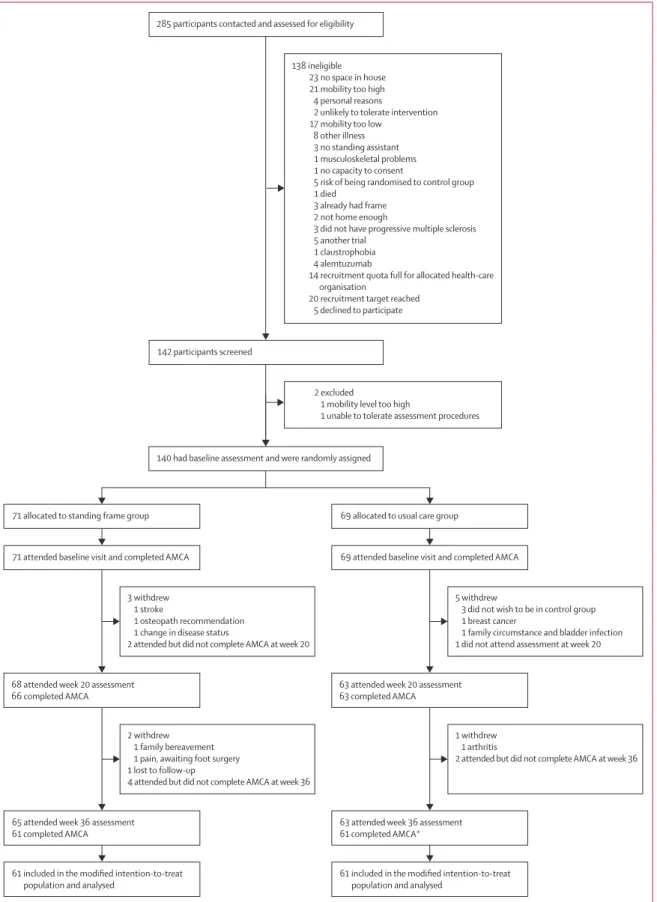
Figure 1: Trial profile
AMCA=Amended Motor Club Assessment. *One participant did not attend the 20-week assessment but returned for week 36. 285 participants contacted and assessed for eligibility
142 participants screened
140 had baseline assessment and were randomly assigned 2 excluded
1 mobility level too high
1 unable to tolerate assessment procedures
71 allocated to standing frame group
71 attended baseline visit and completed AMCA
68 attended week 20 assessment 66 completed AMCA
3 withdrew 1 stroke
1 osteopath recommendation 1 change in disease status
2 attended but did not complete AMCA at week 20
65 attended week 36 assessment 61 completed AMCA
2 withdrew 1 family bereavement 1 pain, awaiting foot surgery 1 lost to follow-up
4 attended but did not complete AMCA at week 36
61 included in the modified intention-to-treat population and analysed
69 allocated to usual care group
69 attended baseline visit and completed AMCA
63 attended week 20 assessment 63 completed AMCA
5 withdrew
3 did not wish to be in control group 1 breast cancer
1 family circumstance and bladder infection 1 did not attend assessment at week 20
63 attended week 36 assessment 61 completed AMCA*
1 withdrew 1 arthritis
2 attended but did not complete AMCA at week 36
61 included in the modified intention-to-treat population and analysed
138 ineligible 23 no space in house 21 mobility too high 4 personal reasons
2 unlikely to tolerate intervention 17 mobility too low
8 other illness 3 no standing assistant 1 musculoskeletal problems 1 no capacity to consent
5 risk of being randomised to control group 1 died
3 already had frame 2 not home enough
3 did not have progressive multiple sclerosis 5 another trial
1 claustrophobia 4 alemtuzumab
14 recruitment quota full for allocated health-care organisation
Outcomes
Validated outcome measures included clinicianrated assessments and selfreported questionnaires. The prim ary outcome was motor function as measured by the
Amended Motor Club Assessment (AMCA) score23 at the
primary endpoint of 36 weeks postrandomisation. This score was developed for use by physiotherapists in a clinical setting to assess motor function in people with multiple sclerosis and has shown validity, reliability, and responsiveness.14,23,24 The AMCA score (range 0–76) is the sum of two subscores. The functional activity subscore (16 items, each scored 0–3) comprises key functional activities of the trunk and lower limbs, such as rolling in bed, sittostand, and sitting and standing balance. The lower limb movement subscore (14 items, each scored 0–2) rates motor impairment by grading hip and knee flexion and knee flexion and dorsiflexion in lying, sitting, and standing positions.
The secondary outcomes, at weeks 20 and 36, were
measure ments of explanatory physical impairments
(length of hip flexors, hamstrings and ankle plantar flex ors [manual goniometry], knee extensor strength [hand held dynamometer], spasm frequency [Penn Spasm Frequency Scale], and forced expiratory volume at 1 s [handheld spirometer]);16 clinical outcomes (bowel and bladder control [bladder and bowel control scales], sitting balance [modified functional reach in sitting], and falls frequency); and quality of life (29item Multiple Sclerosis Impact Scale [MSIS29, version 2]). AMCA score at week 20 and the two AMCA subscores at week 36 were also measured as secondary outcomes. Participants were classified as fallers if they selfreported falling on 2 or more days during three different periods: up to week 20, up to week 36, and between weeks 21 and 36.
All participants were asked to record new symptoms, falls, and medication changes in a daily preformatted diary. Intervention participants were asked to record frequency and duration of standing sessions and any adverse events they had. A serious adverse event was defined as an untoward occurrence that resulted in death, was lifethreatening, required hospital admission, or was
Standing frame group (n=71)
Usual care
group (n=69) All (n=140)
Age, years 58·5
(51·3–66·4) (54·1–66·0)60·1 (52·6–66·2)59·6 Mean EDSS score
(SD; range) 6·5–8·0)7·3 (0·6; 6·5–8·0)7·2 (0·6; 6·5–8·0)7·3 (0·6;
6·5 24 (34%) 18 (26%) 42 (30%)
7·0 11 (15%) 17 (25%) 28 (20%)
7·5 11 (15%) 16 (23%) 27 (19%)
8·0 25 (35%) 18 (26%) 43 (31%)
Sex
Men 31 (44%) 19 (28%) 50 (36%)
Women 40 (56%) 50 (72%) 90 (64%)
Type of multiple sclerosis
Primary progressive 28 (39%) 16 (23%) 44 (31%) Secondary
progressive 43 (61%) 53 (77%) 96 (69%)
Most recent relapse
>1 year 62 (87%) 63 (91%) 125 (89%)
Within 3 months 2 (3%) 2 (3%) 4 (3%)
Within 6 months 2 (3%) 0 2 (1%)
Within 12 months 1 (1%) 2 (3%) 3 (2%)
Unknown 4 (6%) 2 (3%) 6 (4%)
Occupation
Unemployed 5 (7%) 3 (4%) 8 (6%)
Student 0 1 (1%) 1 (1%)
Part-time work 2 (3%) 7 (10%) 9 (6%)
Full-time work 1 (1%) 1 (1%) 2 (1%)
Retired due to age 7 (10%) 8 (12%) 15 (11%) Medically retired 56 (79%) 49 (71%) 105 (75%) Indoor walking aid
One stick 3 (4%) 2 (3%) 5 (4%)
Two sticks 7 (10%) 8 (12%) 15 (11%)
Frame 27 (38%) 30 (43%) 57 (41%)
Wheelchair 47 (66%) 48 (70%) 95 (68%)
(Table 1 continues in next column)
Standing frame group (n=71)
Usual care
group (n=69) All (n=140)
(Continued from previous column) Outdoor walking aid
One stick 2 (3%) 2 (3%) 4 (3%)
Two sticks 6 (8%) 6 (9%) 12 (9%)
Frame 11 (15%) 15 (22%) 26 (19%)
Wheelchair 67 (94%) 64 (93%) 131 (94%)
Wheelchair use
None 4 (6%) 4 (6%) 8 (6%)
Occasionally 4 (6%) 3 (4%) 7 (5%)
Monthly 2 (3%) 1 (1%) 3 (2%)
Weekly 13 (18%) 10 (14%) 23 (16%)
Daily 48 (68%) 51 (74%) 99 (71%)
Medical History
None of note 14 (20%) 13 (19%) 27 (19%)
Osteoarthritis 6 (8%) 9 (13%) 15 (11%)
Coronary heart disease or hypertension
15 (21%) 9 (13%) 24 (17%)
Diabetes 8 (11%) 1 (1%) 9 (6%)
COPD 6 (8%) 1 (1%) 7 (5%)
Migraine 7 (10%) 5 (7%) 12 (9%)
Other neurological
condition 4 (6%) 3 (4%) 7 (5%)
Depression 27 (38%) 30 (43%) 57 (41%)
Osteoporosis 5 (7%) 8 (12%) 13 (9%)
Other 25 (35%) 23 (33%) 48 (34%)
Data are n (%) or median (IQR), unless otherwise specified. EDSS=Expanded Disability Status Scale. COPD=chronic obstructive pulmonary disease.
considered medically significant by the investigator. An embedded qualitative component explored the contemp oraneous subjective experiences of using a standing frame within daily life through audiorecorded diaries by a subgroup of intervention participants. These data will be reported in a future publication.
Statistical analysis
The target sample size was based on comparing AMCA scores at week 36 between allocated groups, adjusting for baseline AMCA score, and detecting a minimal clinically important difference of 9 points, assuming an estimated SD 20 for AMCA score and estimated correlation of
0·55 between baseline and week 36 AMCA scores.16 The
detection of a 9point betweengroup difference with 80% power and at a 5% significance level required followup data from 55 participants per group. We allowed for 20% loss to followup or noncompletion of primary outcome and set the recruitment target at 140 participants.
The analyses were prespecified in a statistical analysis plan approved by the trial steering committee before analysis started, except for the analysis method for spasm frequency. Primary analyses were adjusted for the stratification factors (region and baseline EDSS) as fixed effects and baseline scores where appropriate (ie, fully adjusted models); results adjusted for baseline scores
alone are also presented. Estimated betweengroup dif ferences are presented with twosided 95% CIs, with the twosided significance level for hypothesis testing set at 5%. The analyses were done with Stata SE (version 14.2).
The primary analysis population was defined as all participants who completed baseline and 36week assess ments. The primary analysis of the primary out come, AMCA score at 36 weeks, followed a modified intention totreat approach, regardless of compliance to the inter vention, but did exclude patients who were deemed ineligible after randomisation, those who withdrew from the trial and were unwilling for their previously collected data to be used, or those who did not provide baseline and week 36 measurements (ie, there was no imputation of missing baseline or week 36 scores for the primary analysis), and used an analysis of covariance (ANCOVA) approach. As prespecified in the statistical analysis plan, Complier Average Causal Effect (CACE) sensitivity analy ses were done on the 36week AMCA scores. This method provides an unbiased estim ate of the interven tion effect, based on participants who complied with the standing intervention protocol.25 The agreed statistical analysis plan listed six compliance definitions that could trigger a CACE analysis25 (appendix p 2), if at least 20% of participants allocated to the intervention group were classed as non compliers in the definition. The CACE analysis, triggered
AMCA score for standing
frame group (n=71) AMCA score for usual care group (n=69) AMCA score for compliers AMCA score for non-compliers plus usual care group Fully adjusted analysis, mean difference (95% CI)*
Analysis adjusted for baseline alone, mean difference (95% CI)
Baseline Week 36 Baseline Week 36 Baseline Week 36 Baseline Week 36
mITT analysis 26·1 (13·9; 3·0–59·0; n=71)†
29·3 (17·2; 1·0–68·0; n=61)†
30·2 (14·6; 6·0–66·0; n=69)†
28·2 (17·0; 0·0–68·0; n=61)†
·· ·· ·· ·· 4·7 (1·9–7·5);
p=0·0014 4·6 (1·6–7·6); p=0·0030
CACE analyses
Best 16 weeks ·· ·· ·· ·· 26·2 (13·7;
3·0–56·0; n=49)†
29·9 (16·0; 6·0–65·0; n=46)†
29·1 (14·6;
6·0–66·0; n=91)† 1·0–68·0; 28·4 (17·5; n=76)†
6·1 (2·5–9·8);
p=0·00094 6·1 (2·2–9·9); p=0·0020
Worst 16 weeks ·· ·· ·· ·· 28·2 (13·4;
8·0–56·0; n=36)†
31·6 (16·4; 8·0–65·0; n=35)†
28·1 (14·7;
3·0–66·0; n=104)† 1·0–68·0; 27·9 (17·1; n=87)†
7·9 (3·1–12·8);
p=0·0013 p=0·00257·9 (2·8–13·0);
Weeks 5–20 ·· ·· ·· ·· 26·7 (14·0;
3·0–56·0; n=46)†
30·5 (15·9; 6·0–65·0; n=43)†
28·8 (14·5;
6·0–66·0; n=94)† 1·0–68·0; 28·1 (17·5; n=79)†
6·5 (2·6–10·4);
p=0·0010 6·5 (2·3–10·6); p=0·0022
Best 32 weeks ·· ·· ·· ·· 26·6 (14·0;
3·0–56·0; n=46)†
32·4 (16·6; 6·0–65·0; n=43)†
32·4 (16·6;
6·0–65·0; n=43)† 6·0–66·0; 28·0 (14·5; n=94)†
6·5 (2·7–10·4);
p=0·00077 6·5 (2·4–10·5); p=0·0016
Worst 32 weeks ·· ·· ·· ·· 28·4 (13·9;
8·0–56·0; n=36)†
32·4 (16·6; 6·0–65·0; n=35)†
28·0 (14·5;
3·0–66·0; n=104)† 1·0–68·0; 27·5 (16·9; n=87)†
7·9 (3·1–12·7);
p=0·0013 p=0·00257·8 (2·8–12·9);
Weeks 5–36 ·· ·· ·· ·· 27·3 (13·8;
3·0–56·0; n=42)†
31·9 (15·7; 6·0–65·0; n=41)†
28·5 (14·6;
4·0–66·0; n=98)† 1·0–68·0; 27·5 (17·4; n=81)†
6·8 (2·8–10·8);
p=0·00078 6·8 (2·6–11·0); p=0·0016
Data are mean (SD; range), unless otherwise specified. Mean differences in both analyses are between the standing and usual care group. *Adjusted for baseline AMCA Score, region and Expanded Disability Status Scale category.†n is the total number of participants who provided data at that timepoint.
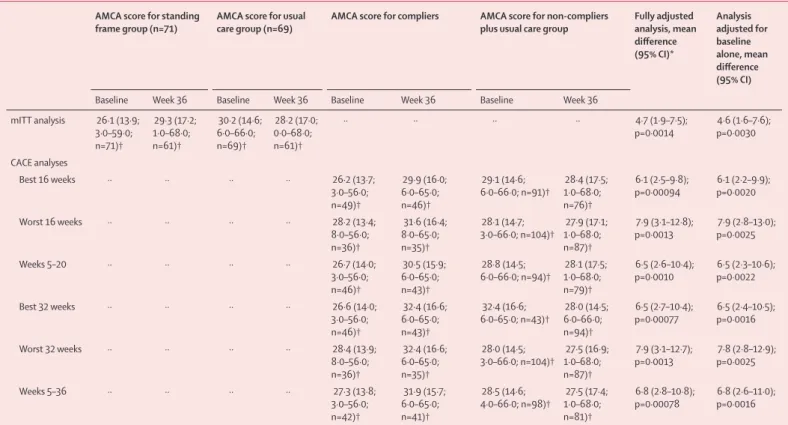
Table 2: Primary outcome of Amended Motor Club Assessment (AMCA) scores at 36 weeks: primary modified intention-to-treat (mITT) analysis and Complier AverageCausal Effect (CACE) sensitivity analyses
For the statistical analysis plan see https://www.plymouth.ac. uk/research/sums
for all six definitions, used twostage least squares instru mental variable regression, with treat ment allocation as the instrument for the binary com pliance variable and adjustment for baseline AMCA score, region, and EDSS category.25
A repeatedmeasures model was fitted to the post baseline AMCA scores, including adjustment for baseline AMCA score, stratification variables, and the inter act ion term between allocated group and timepoint.
Betweengroup pairwise comparisons at 20 and 36 weeks were calculated with use of marginal linear predictions and CIs from the fitted model.
All secondary outcomes were analysed on a modified intentiontotreat basis, with an ANCOVA approach, for both fully adjusted models and models with adjustment for base line measures alone, except spasm frequency and falls. Ordinal logistic regression was prespecified for the analysis of the 5level Penn Spasm Frequency Scale; however, because of insufficient numbers in some of the response categories, a dichotomisation of no spasms–mild spasms versus infrequent spasms–more than 1 per h–more than 10 per h was agreed. We used logistic regression to analyse the dichotomised Penn Spasm Frequency Scale and the binary outcome of fallers– nonfallers with adjustment for stratification factors.
We did a withintrial costeffectiveness analysis. This estimated the additional costs of delivering the inter vention, costs associated with health, social care, carer and patient resource use, and qualityadjusted lifeyears (QALYs) over the 36week trial period. QALYs were estimated with use of selfreport EQ5D5L (the fivelevel version of EQ5D,a standardised generic instrument for measuring health status) data collected at baseline and at 20week and 36week followup, and by applying the so
called crosswalk algorithm3 to provide QALY weights
from the UK general population valuation survey of the threelevel version of EQ5D.4 The primary perspective was the UK NHS and Personal Social Services (PSS), with a broader societal perspective considered in sensitivity analyses. Detailed methods are provided in the appendix (pp 3–9).
Standing frame group (n=71)
Usual care group (n=69)
Adverse events lasting <7 days 1188 736
Pain 551 180
Categorised according to organ classification*
Musculoskeletal 486 160
Neurological 16 12
Abdominal 9 6
Gynaecological 0 2
Renal 2 0
Respiratory 1 0
Spasms 231 197
Fatigue 60 184
Urinary tract infection 45 36
Numbness or sensory disturbance 41 33
Tremor or shaking 7 24
Weakness 24 23
Constipation or diarrhoea 7 17
Vertigo 22 9
Virus 31 5
Chest Infection 16 5
Leg or back stiffness or tightness 23 2
Headache 3 3
Visual disturbance 3 3
Seizures 0 2
Balance problems 5 2
Loss of bladder control 0 2
Slurred speech 0 1
Multiple sclerosis relapse 1 1
Confusion 0 1
Rash 0 1
Toe infection 0 1
Shingles 0 1
Bladder spasms 2 1
Blood in urine 0 1
Nausea or vomiting 2 1
Low sodium 1 0
Ankle swelling 4 0
Depression 1 0
Shortness of breath 3 0
Tennis elbow 1 0
Low blood pressure 3 0
Bruising 1 0
(Table 3 continues in next column)
Standing frame group (n=71)
Usual care group (n=69)
(Continued from previous column) Participants reporting adverse events
lasting ≥7 days (number of participants) 28 21
Urinary tract infection 10 4
Chest infection 10 5
Nervous system 4 6
Spasms 2 4
Fatigue 2 1
Weakness 0 1
Stiff legs 1 0
Bowel difficulties 0 3
Infection 1 0
Psychiatric (depression) 1 0
Musculoskeletal pain† 2 3
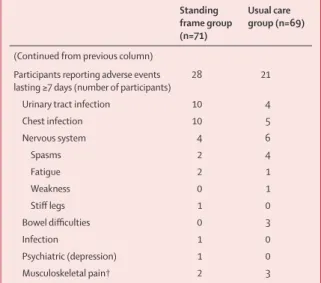
*Pain categorised according to the MedDRA organ classification system. †Usual care group: coccyx pain (lasting 18 days), heel pain (9 days), and hip pain (22 days); standing frame group: back pain (lasting 11 days) and joint ache (14 days).
This trial is registered with the International Standard Randomised Controlled Trials, number ISRCTN69614598.
Role of the funding source
This was an investigatorinitiated study. The sponsor and funders of the study had no role in study design, data collection, data analysis, data interpretation, or writing of the report. All authors had full access to all the data in the study and responsibility for writing the manuscript. The corresponding author had final responsibility for the decision to submit for publication.
Results
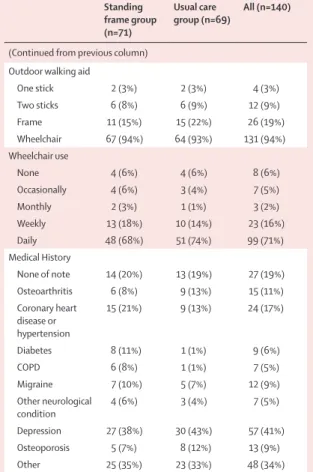
Between Sept 16, 2015, and April 28, 2017, we screened 285 potential participants. After screening, 140 participants were randomly assigned to either use a standing frame in addition to usual care (n=71) or to usual care alone (n=69; figure 1). Baseline characteristics were broadly consistent across the allocated groups (table 1). Some imbalances in sex and type of multiple sclerosis were observed: the pro portion of men allocated to the standing frame group was higher than that allocated to the usual care group, and the proportion of participants with primary pro gressive multiple sclerosis was higher in the standing frame group than in the usual care group (table 1). Additionally, there was an imbalance in baseline AMCA score, with a lower mean score in the standing frame group compared to that in the usual care group (table 2).
At the primary endpoint, 36 weeks postrandomisation, the pooled (ie, across both groups) SD of the AMCA score was 16·9 points, with a correlation between baseline and week 36 AMCA score of 0·86. Individuallevel changes in the score between baseline and week 36 assessments by allocated group are shown in appendix (p 10). The AMCA score at week 36 was significantly higher in the standing frame group than the usual care group, with a fully adjusted betweengroup mean difference of 4·7 points (95% CI 1·9–7·5, p=0·0014; table 2). Results of the analysis adjusted for baseline AMCA score alone were similar.
Analyses of 36week AMCA subscores and shortterm AMCA scores at 20 weeks showed significant fully adjusted betweengroup mean differences in favour of the standing frame group (appendix pp 11, 14). We observed shortterm, statistically significant differences in favour of the standing frame group at 20 weeks in hip goniometry, knee extensor strength, and in both the physical and psychological components of the MSIS29 scale (appendix pp 11–13). We also observed longer term significant differences, at 36 weeks, in hip and ankle goniometry in favour of the standing frame group; the shortterm differences
in MSIS29 scale were not sus tained at 36 weeks
(appendix pp 14–16). The proportion of participants having two or more falls during weeks 21–36 was significantly lower in the standing frame group, with odds ratio of 0·43 (95% CI 0·20–0·94, p=0·035), but there was no significant betweengroup difference over weeks 1–20 or the full
36week study period. Fall ing days per personyear, pooled across both groups, was 9·9 during 36 weeks.
18 serious adverse events were reported in 15 partici pants (seven participants in the usual care group and eight in the standing frame group; three participants each had two serious adverse events), none of which occurred during or in relation to the standing frame intervention. These serious adverse events were in line with expectations: urinary tract infections (n=8), cardio vascular events (stroke [n=2] and arrhythmia [n=1]), breast cancer (n=1), falls (n=3, of whom two participants fractured a hip), respiratory infections (n=2), and burns (n=1). In two individuals, pressure sores on the heels developed after hospital admission. For one of these participants, this resulted in the inability to continue using the frame after hospital discharge, despite regular use prehospitalisation.
Our adverse event reporting was based on socalled new symptoms, recorded with preformatted daily diaries, and is distinct from the serious adverse event data. Overall, 1924 symptoms were recorded (1188 in the standing frame group and 736 in the usual care group; table 3). These were expected in people with multiple sclerosis.3 We observed a disparity between the groups in the frequency of shortterm musculoskeletal pains, such as aching leg muscles, which was potentially related to the intervention. The musculoskeletal pain lasted for longer than 7 days in five individuals (two in the standing frame group and three in the usual care group).
Prespecified sensitivity analyses of the primary out come with additional adjustment for variables with observed
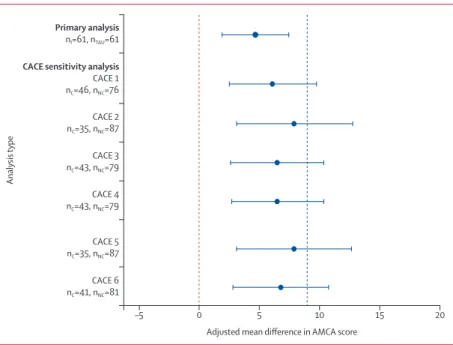
Figure 2: Fully adjusted mean difference in Amended Motor Club Assessment (AMCA) score at 36 weeks for the primary analysis and Complier Average Causal Effect (CACE) sensitivity analyses
CACE sensitivity analyses done under the six compliance definitions (numbered 1–6).Error bars represent 95% CIs. The blue dashed line represents the pre-specified minimal clinically important difference of 9 points on the AMCA scale. nI=number of participants in the standing frame group. nTAU=number of participants in the usual care group.
nC=number of compliers. nNC=number of compliers plus participants in the usual care group.
–5
Analysis
type
Adjusted mean difference in AMCA score
0 5 10 15 20
Primary analysis nI=61, nTAU=61
CACE sensitivity analysis CACE 1 nC=46, nNC=76
CACE 2 nC=35, nNC=87
CACE 3 nC=43, nNC=79
CACE 4 nC=43, nNC=79
CACE 5 nC=35, nNC=87
baseline imbalance (sex and type of multiple sclerosis)
were consistent with the primary analysis results. The
planned CACE sensitivity analyses yielded results con
sistent with the primary analysis, although, under the CACE approach, the average betweengroup mean differ ences were larger and all the CIs included 9·0 (figure 2). The repeatedmeasures modelling gave similar results to the primary analysis, with a significant betweengroup difference in mean AMCA score at week 20 of 3·7 points (95% CI 1·2–6·2, p=0·004) and at week 36 of 4·5 points (2·0–7·0, p<0·001).
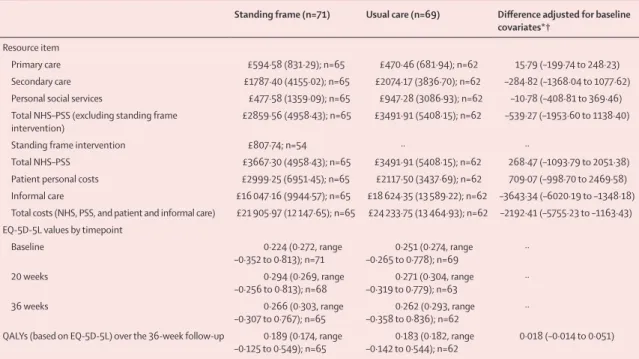
The estimated mean intervention cost per participant was £808 (SD 91; appendix p 17). The main cost drivers were the standing frame (£504) and physiotherapist home visits (£76). Mean costs to the NHS–PSS over the followup period (adjusted for cost at baseline, EDSS category, and region) were approximately £539 less for the standing frame group than for the usual care group, excluding the cost of the intervention itself. With the addition of the intervention cost, adjusted mean costs to the NHS–PSS were approximately £268 greater for the standing frame group (table 4, and appendix pp 18–26). The amount
of informal care used by our study popu lation was
substantial, and application of a national average hourly rate to this time gave an adjusted informal care cost of approximately £3643 less in the standing frame group than in the usual care group (table 4; appendix pp 18–26). The mean EQ5D5L increase from baseline to 36week followup was 0·042 for the stand ing frame group and 0·01 for the usual care group. This equated to an adjusted
mean of 0·018 (95% CI –0·014 to 0·051) additional QALYs over the period of followup (table 4).
The costperQALY of the intervention from the perspective of the NHS–PSS was approximately £14 700 (appendix pp 27). Uncertainty around this estimate is illustrated in the costeffectiveness plane of bootstrapped replicates of incremental costs and incremental QALYs (appendix pp 28). These simulations suggested that, on 87% of occasions, the standing frame group would have greater QALYs over the period of followup than those of the usual care group. The bootstrap replicates also indi cated a 0·52 probability of the intervention being con sidered costeffective at a willingnesstopay threshold of £20 000 per QALY and a 0·61 probability at a threshold of £30 000 per QALY. Broadening the analysis perspective beyond health and social care, in line with the recom mendations of the Second Panel on CostEffectiveness in Health and Medicine,26 increased the apparent cost effectiveness of the intervention.
There were few missing data and thus, we did not use multiple imputation. Sensitivity analyses explored the broader societal perspective and also took into account the 10year life of the frames and the NHS’s policy of equipment reuse. For both scenarios, the interven tion appeared dominant in terms of costeffectiveness (appendix pp 27–28).
Discussion
Our results provide highquality evidence that, compared with usual care alone, regular use of frame standing plus
Standing frame (n=71) Usual care (n=69) Difference adjusted for baseline covariates*†
Resource item
Primary care £594·58 (831·29); n=65 £470·46 (681·94); n=62 15·79 (–199·74 to 248·23)
Secondary care £1787·40 (4155·02); n=65 £2074·17 (3836·70); n=62 –284·82 (–1368·04 to 1077·62) Personal social services £477·58 (1359·09); n=65 £947·28 (3086·93); n=62 –10·78 (–408·81 to 369·46) Total NHS–PSS (excluding standing frame
intervention) £2859·56 (4958·43); n=65 £3491·91 (5408·15); n=62 –539·27 (–1953·60 to 1138·40)
Standing frame intervention £807·74; n=54 ·· ··
Total NHS–PSS £3667·30 (4958·43); n=65 £3491·91 (5408·15); n=62 268·47 (–1093·79 to 2051·38) Patient personal costs £2999·25 (6951·45); n=65 £2117·50 (3437·69); n=62 709·07 (–998·70 to 2469·58) Informal care £16 047·16 (9944·57); n=65 £18 624·35 (13 589·22); n=62 –3643·34 (–6020·19 to –1348·18) Total costs (NHS, PSS, and patient and informal care) £21 905·97 (12 147·65); n=65 £24 233·75 (13 464·93); n=62 –2192·41 (–5755·23 to –1163·43) EQ-5D-5L values by timepoint
Baseline 0·224 (0·272, range
–0·352 to 0·813); n=71 –0·265 to 0·778); n=690·251 (0·274, range ··
20 weeks 0·294 (0·269, range
–0·256 to 0·813); n=68 –0·319 to 0·779); n=630·271 (0·304, range ··
36 weeks 0·266 (0·303, range
–0·307 to 0·767); n=65 –0·358 to 0·836); n=620·262 (0·293, range ·· QALYs (based on EQ-5D-5L) over the 36-week follow-up 0·189 (0·174, range
–0·125 to 0·549); n=65 –0·142 to 0·544); n=620·183 (0·182, range 0·018 (–0·014 to 0·051) Data are mean (SD) or mean (95% CI), unless otherwise specified. *Cost (specific to each cost component) orEQ-5D-5L value at baseline, Expanded Disability Status Scale category (≥7·5 to <7·5) at baseline, and region. †Mean (95% CI) from bootstrap with 10 000 replication.
usual care provides significant improvements in motor function (our primary outcome) in people severely physically impaired with progressive multiple sclerosis, although not to the degree that was considered a priori as clinically meaningful. We also found evidence for differences in favour of the standing frame group regarding hip and ankle joint range and quality of life (secondary outcomes). This standing frame intervention was shown to be feasible for people with progressive multiple sclerosis to selfmanage with the help of a standing assistant and for physiotherapists to implement within routine clinical practice.
Less clearcut is whether the outcome of the standing frame intervention was clinically meaningful. Interpretat ion is difficult because of the insufficient evidence to define what constitutes a minimal clinically important difference on the AMCA score. We relied on the only two physiotherapy studies we were aware of that had used the AMCA score; both suggested that a 9point improvement was clinically relevant in people with severe multiple sclerosis.14,24 A 9point change could mean, for example, that a person could have improved so that they could balance in sitting to dress themselves (3 points), transfer independently (3 points), and stand without having to use their hands for balance (3 points). However, an improvement in any single one of these functional acti vities might constitute a clinically meaningful change. This view is supported by the audio narrative accounts of the changes undergone by SUMS study participants. When considering the design of future studies, further explorat ion is needed regarding the minimal clinically import ant difference on this measure for severely impaired individuals.
Our CACE analysis showed that accounting for compliance to the intervention resulted in a larger estim ated intervention effect, with the prespecified minimal clinically important difference of 9 points on the AMCA score contained within the 95% CIs of all six compliance definitions. This suggests a positive association between compliance with the intervention and the motor benefits gained. This is consistent with theoretical expectations and with the results of (low methodological quality) studies of standing frame use in populations with other neurological conditions.6
To sustain any benefits gained from physical activity, individuals need to maintain longterm engagement, which is a particular challenge for people with a disability.27 Evidence is scarce regarding longterm adherence in people with multiple sclerosis to physical activity interven tions; however, nonadherence rates are as high as 80% for individuals with chronic conditions for which interven tions might aim to slow down decline rather than to cure.27 Two thirds of the participants in the standing frame group continued to stand regularly in the frame during the 36week period, which, in light of the literature, we consider to be a high proportion. Furthermore, 70% of participants who had a standing frame during the study
requested to keep the frame on completing the study, thus further supporting the feasibility and acceptability of the intervention.
Behavioural change techniques were an integral component of the standing frame intervention. To comple ment the physiotherapy advice and support, individuals had access to paperbased, DVD, and online resources, designed to equip them and their standing assistants with the knowledge and skills necessary to undertake this activity within their own homes. Aimed at enhancing self efficacy,22 this approach was considered essential because selfefficacy is a key determinant of physical activity
behaviour in people with multiple sclerosis28 and is
typically low.12
Tolerability of an intervention is important for adher ence and thus, capturing adverse events potentially associated with the intervention was important. We achieved this by using daily, selfreported, preformatted diaries. However, freetext description of adverse events was often ambig uous, making it difficult to determine whether they were new symptoms. Therefore, it is challenging to precisely state what proportion of these broadranging symptoms are related to the standing frame intervention. Bias in reporting of adverse events is also possible because the standing frame group recorded both details of each
standing session and any new symptoms in the same
diaries, potentially triggering reporting of new symptoms more comprehensively than in the usual care group. However, overall, the data suggest that this intervention is well tolerated; the adverse events were typically transient (lasting less than 7 days), musculo skeletal in nature (aches and pains), and occurred early in the programme when participants were probably adjust ing to recommencement of regular standing. Importantly, physiotherapists should inform people that shortterm musculoskeletal aches and pains might occur and provide education about how to manage this. From a methodologi cal perspective, effective and reliable systems for collect ing adverse event data in rehabilitation trials should be further investigated.
Our study has several strengths. To our knowledge, this is the largest randomised controlled physical rehabilitation study to date undertaken in severely impaired people with progressive multiple sclerosis. It was the first definitive multicentre randomised controlled trial to assess the clinical and cost effectiveness, safety, and tolerability of a homebased, selfmanaged standing frame programme in this population. The study was originally planned to have 80% power, on the basis of conservative assumptions;16 with our observed SD being lower and the correlation between baseline and week 36 AMCA scores higher than anticipated, we were able to estimate the intervention effect with increased precision. Our costeffectiveness analysis assumed that a new standing frame would be purchased for everyone in the intervention group; however, given the NHS policy of equipment reuse, and the average 10year life of a frame, our costeffectiveness estimate is likely to be conservative.
Another strength of our study is that it was a pragmatic trial. To maximise generalisability of the results, we minimised our exclusion criteria. The intervention was delivered by physiotherapists working within the NHS, who did not undergo specific training for this intervention, making it likely that similar results would be gained on implementation within usual practice. However, we should note that our findings cannot automatically be generalised to other countries that do not have a similar organisational context. The publication of our educational resources on a freely available website aims to enhance shared, evidencebased, decision making about the effect of introducing this intervention to people’s daily lives.
Our study has several limitations. Our primary eco nomic outcome measure was QALYs, in line with guidance by the National Institute for Health and Care Excellence. The difference in EQ5D5L scores (used to calculate QALYs) between the standing frame and usual care groups at 36weeks did not reach the minimal clinically important difference for the EQ5D5L score described by Marra and colleagues.29 Therefore, it could be argued that the QALY gain was not perceptibly different from zero, implying that the intervention was not costeffective. However, the standing frame interven tion did appear effective from the patient’s perspective when considered across outcome measures, specifically according to the primary clinical outcome measure. Our main analysis might have been restrictive in identifying benefits of the intervention, and a broader societal perspective might have been preferable.
The usual care group was not offered an intervention and hence, we could not exclude that placebo effects might have contributed to the benefits experienced by the standing frame group. However, the primary outcome was clinicianrated and measured by a masked assessor, which should reduce the effect of this. Nevertheless, further research is needed to disentangle the intrinsic effects of standing from nonspecific effects due to, for example, attention. It is also possible that drug inter ventions might have contrib uted to any of the changes observed. However, participants were excluded if there had been any recent changes in diseasemodifying ther apies, and they were asked to record any medication changes throughout the study period; the two groups were balanced in terms of medica tion changes, there fore, this is unlikely to account for the betweengroup differences.
In conclusion, there is a paucity of evidencebased, self management interventions that are recommended for people severely impaired with progressive multiple scler osis who have few treatment options available. We hope this inter ven tion can now be offered and reimbursed more widely as a management option for this population.
Contributors
JF, WH, LJ, SC, and AB developed the study. JF, WH, LJ, SC, AB, AH, and JZ contributed to trial design, data interpretation, and writing of the report. RD contributed to data acquisition, data interpretation, and writing For the SUMS educational
resources see https://www. plymouth.ac.uk/research/sums
of the report. SC and BJ were responsible for the statistical analysis and data interpretation. All authors approved the final draft of the manuscript. Declaration of interests
We declare no competing interests. Data sharing
The SUMS study protocol and statistical analysis plan are publicly available at https://www.plymouth.ac.uk/research/sums. Individual participant data that underlie the results will be made available (after deidentification) on a controlled access basis, subject to suitable data sharing agreements. Requests for data sharing should be made to the Chief Investigator (CI; J Freeman) in the first instance. Requesters will be asked to complete an application form detailing specific requirements, rationale, and proposed usage. Requests will be reviewed by the CI and study sponsor, who will consider the viability and suitability of the request and the credentials of the requester. Where access to requested data is granted, requesters will be asked to sign a data sharing agreement. Requested data will be made available, along with supporting documentation (eg, data dictionary) on a secure server or through other secure data transfer method.
Acknowledgments
The study was fully funded by the National Institute of Health Research (Research for Patient Benefit Programme; PBPG1013–32047), UK. The authors are indebted to all participants of the SUMS trial. We are grateful to physiotherapists at each NHS site who were instrumental for the successful implementation of the standing programmes, and to Steve Hooley, Emily Rogers, and Danielle Munford who undertook the masked assessments. We thank David Russell and Helen Cherry, who were our patient representatives; Carol Lunn, our study administrator; Prof Paul Ewings, for methodological advice; and Pauline McGlone (chief operating officer Clinical Research Network South West), for her assistance with negotiating excess treatment costs.
References
1 Kobelt G, Thompson A, Berg J, et al. New insights into the burden
and costs of multiple sclerosis in Europe. Mult Scler 2017; 23: 1123–36.
2 Heesen C, Bohm J, Reich C, Kasper J, Goebel M, Gold SM.
Patient perception of bodily functions in multiple sclerosis: Gait and visual function are the most valuable. Mult Scler 2008; 14: 998–91.
3 Giesser BS. Primer on multiple sclerosis. London: Oxford University
Press, 2011.
4 National Institute of Clinical Excellence. Multiple sclerosis:
management of multiple sclerosis in primary and secondary care. NICE Clinical Guideline 186. 2014. http://www.nice.org.uk/ guidance/cg186 (accessed Feb 1, 2019).
5 Sasaki JE, Motl RW, Cutter G, Marrie RA, Tyry T, Salter A.
National estimates of selfreported sitting time in adults with multiple sclerosis. Mult Scler J Exp Transl Clin 2018; 4: 2055217318754368.
6 Newman M, Barker K. The effect of supported standing in adults
with upper motor neurone disorders: a systematic review. Clin Rehabil 2012 26: 1059–77.
7 Department of Health. National service framework for long term
conditions. 2005. https://www.gov.uk/government/publications/ qualitystandardsforsupportingpeoplewithlongtermconditions (accessed Feb 1, 2019).
8 LatimerCheung AE, Pilutti LA, Hicks AL, et al. Effects of exercise
training on fitness, mobility, fatigue, and healthrelated quality of life among adults with multiple sclerosis: a systematic review to inform guideline development. Arch Phys Med Rehabil 2013; 94: 1800–28.
9 Edwards T, Pilutti LA. The effect of exercise training in adults with
multiple sclerosis with severe mobility disability: a systematic review and future research directions. Mult Scler Rel Disord 2017; 16: 31–39. 10 Skjerbaek AG, Naesby M, Lutzen K, et al. Endurance training is
feasible in severely disabled patients with progressive multiple sclerosis. Mult Scler 2014; 20: 627–23.
11 Marrie RA, Horwitz R, Cutter G, Tyry T, Campagnolo D, Vollmer T. High frequency of adverse health behaviors in multiple sclerosis. Mult Scler 2009; 15: 105–13.
13 Baker K, Cassidy E, RoneAdams S. Therapeutic standing for people with multiple sclerosis: efficacy and feasibility. Int J Ther Rehabil 2007; 14: 104–09.
14 Hendrie WA, Watson MJ, McArthur MS. A pilot mixed methods investigation of the use of Oswestry standing frames in the homes of nine people with severe multiple sclerosis. Disabil Rehabil 2014; 37: 1178–85.
15 Nordstrom B, Naslund A, Eriksson A, Nyberg L, Ekenberg L. The impact of supported standing on wellbeing and quality of life. Physiother Can 2013; 65: 49–57.
16 Freeman JA, Hendrie W, Creanor S, et al. Standing up in multiple sclerosis (SUMS): protocol for a multicentre randomised controlled trial evaluating the clinical and cost effectiveness of a homebased selfmanagement standing frame programme in people with progressive multiple sclerosis. BMC Neurol 2016; 16: 62. 17 Schulz KF, Altman DG, Moher D. CONSORT 2010 statement:
updated guidelines for reporting parallel group randomised trials. BMJ 2010; 340: c332.
18 Boutron I, Altman DG, Moher D, Schulz KF, Ravaud P. CONSORT statement for randomized trials of nonpharmacologic treatments: a 2017 update and a CONSORT extension for nonpharmacologic trial abstracts. Ann Intern Med 2017; 167: 40–47.
19 Hoffmann TC, Glasziou PP, Boutron I, et al. Better reporting of interventions: template for intervention description and replication (TIDieR) checklist and guide. BMJ 2014; 348: g1687.
20 Husereau D, Drummond M, Petrou S, et al. Consolidated health economic evaluation reporting standards (CHEERS)—explanation and elaboration: a report of the ISPOR health economic evaluations publication guidelines good reporting practices task force. Value Health 2013; 16: 231–50.
21 Polman CH, Reingold SC, Banwell B, et al. Diagnostic criteria for multiple sclerosis: 2010 revisions to the McDonald criteria. Ann Neurol 2011; 69: 292–302.
22 National Institute of Clinical Excellence. Behaviour change: individual approaches Public Health Guideline. 2014. https://nice. org.uk/guidance/ph49 (accessed Feb 1, 2019).
23 De Souza LH, Ashburn A. Assessment of motor function in people with multiple sclerosis. Phys Res Int 1996; 1: 98–111.
24 Craig J, Young C, Ennis M, Baker G, Boggild M. A randomised controlled trial comparing rehabilitation against standard therapy in multiple sclerosis patients receiving intravenous steroid treatment. J Neurol Neurosurg Psychiatry 2003; 74: 1225–12.
25 Sussman JB, Hayward RA. An IV for the RCT: using instrumental variables to adjust for treatment contamination in randomised controlled trials BMJ 2010; 340: c2073.
26 Sanders GD, Neumann PJ, Basu A, et al. Recommendations for conduct, methodological practices, and reporting of costeffectiveness analyses second panel on costeffectiveness in health and medicine. JAMA 2016; 316: 1093–103.
27 Middleton KR, Anton SD, Perri MG. Longterm adherence to health behavior change. Am J Lifestyle Med 2013; 7: 395–404.
28 Streber R, Peters S, Pfeifer K. Systematic review of correlates and determinants of physical activity in persons with multiple sclerosis. Arch Phys Med Rehabil 2016; 97: 633–45.
![INFO/C: [Consumer Policy and Health Protection] No 9, November 1993](data:image/gif;base64,R0lGODlhAQABAIAAAP///wAAACH5BAEAAAAALAAAAAABAAEAAAICRAEAOw==)