GROWTH AND DEVELOPMENT
1
Lucas Silva Barreira,
2João Carlos Medeiros,
Felippe Ratke and
1
Department of Soil and Plant Nutrition
2
Department of Agriculture, Federal University of
3Department of Fitotecnia, Federal University of
ARTICLE INFO ABSTRACT
In tropical fertilization. soybean Yellow October
three replications combination 400 kg leaf area, approximately soybean of 6 to phosphate
Copyright©2017, Lucas Silva Barreira et al. This is an open access article distributed under the Creative Commons Att unrestricted use, distribution, and reproduction in any medium, provided the original work is properly cited.
INTRODUCTION
The soybean crop (Glycine max (L.) Merrill) economic and social potential, and stands out among the most exploited crops in all agricultural activity in Brazil, corresponding cultivated area in the country (Conab, 2016). macronutrients essential to the development soybean, phosphorus has a prime position, so of this nutrient in the plant become necessary 2011). Phosphorus is the most limiting nutrient productivity in tropical soils (Oliveira Júnior plays a key role in all metabolites related to and utilization (Prado et al. 2010). This nutrient the soil decreases plant growth and yield reproductive stages (Filho et al., 2013), reflecting impact on productivity. However, a good nutrient to the plant provides significant increases production (Prado et al., 2010).
*Corresponding author: Wéverson Lima Fonseca
Department of Fitotecnia, Federal University of Ceara, Fortaleza, Ceará, Brazil.
ISSN: 0975-833X
Article History:
Received 14th October, 2016
Received in revised form
25th November, 2016
Accepted 18th December, 2016
Published online 31st January,2017
Key words:
Soil Acidity, Liming, Phosphating,
Glycin Max.
Citation: Lucas Silva Barreira, João Carlos Medeiros, Jaqueline Dalla Rosa, Fabio Mielezrski, Rafael Felippe Ra
2017. “Growth and development of soybean according
44481-44486.
RESEARCH ARTICLE
DEVELOPMENT OF SOYBEAN ACCORDING TO LIMESTONE
AND PHOSPHORUS DOSES
João Carlos Medeiros,
2Jaqueline Dalla Rosa,
2Fabio Mielezrski,
Felippe Ratke and
3*Wéverson Lima Fonseca
Plant Nutrition, Federal University of Piauí, Bom Jesus, Piauí, Brazil
Department of Agriculture, Federal University of Piauí, Bom Jesus, Piauí, Brazil
Department of Fitotecnia, Federal University of Ceara, Fortaleza, Ceará, Brazil
ABSTRACT
tropical soils, the correction of soil acidity may help increase fertilization. In this sense, the aim of this study was to evaluate soybean plants (Glycine max) under different doses of limestone Yellow Latosol. The study was performed in a greenhouse of the
October to November, 2014. The experiment was performed in a completely replications and the treatments were arranged in a 4x5 factorial combination of liming (0, 1.5, 6.0 and 12 Mg ha-1) and doses of
kg ha1 de P
2O5) At 50 days after sowing, the following variables
area, stem diameter, fresh matter and dry matter of plants. approximately 6 Mg ha-1 of limestone and 260 kg ha-1 of P2O
soybean plants. The soil pH increases with the limestone dose increase, to 6.5 with the application of 12 Mg ha-1 of limestone. The
phosphate fertilization was positive for the soybean growth and development.
is an open access article distributed under the Creative Commons Attribution License, which use, distribution, and reproduction in any medium, provided the original work is properly cited.
Merrill) has great out over the years segments of the corresponding to 57% of all 2016). Among the and high yield of so adequate levels necessary (Neto et al., nutrient of biomass Júnior et al., 2008) and energy acquisition nutrient deficiency in potential at early reflecting the negative good supply of this increases in soybean
Wéverson Lima Fonseca,
Department of Fitotecnia, Federal University of Ceara, Fortaleza,
Most of the soils, especially those have adequate levels of phosphorus, raise the levels immediately or Phosphorus deficiency in tropical and the presence of highly crystalline and amorphous oxides 2010). For making this nutrient quantities of limestone and phosphate since some of these soils may (Bonfim-Silva et al., 2014). Many interaction between liming and to plants, in which increasing efficiency of phosphorus use
2000; Viviane et al., 2010; Negreiros, 2015). This occurs because limestone the exchangeable Al+3 due to the decrease in phosphorus retention, solution (Moretto and Viecelli, are characterized by the high levels of phosphorus available greatest capacity to multiply these regions (Bastos et al., 2010).
International Journal of Current Research Vol. 9, Issue, 01, pp.44481-44486, January, 2017
INTERNATIONAL
Lucas Silva Barreira, João Carlos Medeiros, Jaqueline Dalla Rosa, Fabio Mielezrski, Rafael Felippe Ra
according to limestone and phosphorus doses’”, International Journal of Current Research
LIMESTONE
Fabio Mielezrski,
2Rafael
Piauí, Bom Jesus, Piauí, Brazil
Piauí, Brazil
Ceara, Fortaleza, Ceará, Brazil
increase the efficiency of phosphate evaluate the growth and development of limestone and phosphorus in a dystrophic the Federal University of Piauí, from completely randomized design, with factorial scheme, constituted by the of phosphorus (0 , 100, 200, 300 and variables were evaluated: plant height, plants. The combined application of O5 provides the highest growths in
increase, reaching values in the range The interaction between liming and development.
ribution License, which permits
those in the Cerrado region, do not phosphorus, culminating in the need to or gradually (Neto et al., 2010). tropical soils is higher due to acid pH weathered minerals such as oxides of Fe and Al (Broggui et al., nutrient available to the plants, large phosphate fertilizers are required, may adsorb the nutrient content Many studies show the positive and the availability of phosphorus soil pH values lead to a better by plants (Martins and Pitelli, Negreiros, 2014; Marin et al., limestone application neutralizes the increase in pH, and provides retention, increasing its availability in Viecelli, 2012). Although tropical soils degree of weathering and low available to plants, Brazil presents the current soybean production in 2010).
INTERNATIONAL JOURNAL OF CURRENT RESEARCH
Lucas Silva Barreira, João Carlos Medeiros, Jaqueline Dalla Rosa, Fabio Mielezrski, Rafael Felippe Ratke and Wéverson Lima Fonseca,
Due to the limited information available about the interaction between liming and phosphating for first year of cultivation areas, the aim of this study was to evaluate the growth and development characteristics of soybean plants under different doses of phosphorus and limestone in cerrado soil.
MATERIALS AND METHODS
Location of the experimental area
The study was performed in a greenhouse at the Federal University of Piauí - UFPI, in Bom Jesus, PI, from October to November 2014. According to Köppen classification, the climate of the region is type Aw tropical, characterized by being hot and humid and with average temperature of 24 ºC. It presents average annual precipitation around 1,100 mm, with rainfall concentrated in the period from November to March (Jacomine, 1986).
Installation and conduction of the experiment
The experimental units consisted of pots with 4 kg of soil (dry base), passed through a 2 mm sieve, with three replications, in
a completely randomized design. The treatments were arranged
in a 4x5 factorial scheme, consisting of the combination of liming (0, 1.5, 6.0 and 12 Mg ha-1) with dolomitic limestone (RTNP 91%) and phosphorus doses (0, 100, 200, 300 and 400 kg kg ha-1 of P2O5), using simple superphosphate (SSP,
consisting of 18% of P2O5, 16% of Calcium and 8% of sulfur).
. The control treatment was considered as a zero dose for limestone and P2O5.
It was used a Dystrophic Yellow Latosol soil (Embrapa, 2013), with loam-sandy clay texture from an area with native vegetation cover. After the collection, at depth of 0-0.20 m, the soil was dried, in a 2 mm mesh sieve and, later, led to analysis for determining the chemical composition. The results of soil chemical analysis are presented in Table 1.
Liming was performed 40 days before sowing the crop, in September 2014. The limestone was added and incorporated into the experimental units soil. Phosphorus doses, together with a single dose of potassium (150 kg ha-1 of KCL), were applied at the time of sowing. For sowing, four soybean seeds (Intacta RR2 Pro) were used per pot at a depth of 0.05 m. At 15 days after sowing, the thinning was performed, maintaining 2 plants per pot.
Analyzed variables
At 50 days after sowing, when the plants were in stage V10, the following determinations were made: plant height; leaf area; stem diameter; fresh matter and dry matter of plants. The plant height determination was characterized as the distance from the soil to the insertion of the last expanded leaf. A digital pachymeter was used for the stem diameter. A leaf area meter model LI-3000 Meter Area was used to determine the leaf area (LA), with a subsequent reading and adjustment in equation (1):
=
∑ (1)LA =leaf area; LS =leaf surfacee SA = soil area.
The fresh matter of the plants was determined by the mass of the plants cut at a height of 0.1 m from the soil surface.
After weighing, the plants were packed in paper bags and taken to the oven at 65°C for 72 hours. After drying the plants were weighed to determine the dry matter. After the growth evaluation of the shoot part of the soybean plants, from each pot, a soil sample was collected to determine the soil pH in each treatment.
Statistical analysis
The results were submitted to normality analysis by Shapiro-Wilk test and variance by F test (p<0.05) with the aid of the statistical program "R" version 3.1.2. The quantitative factor (corrective dose and P2O5) was analyzed with adjustments of
multiple regression equations (surface response) through Sigmaplot 11.0 software.
RESULTS AND DISCUSSION
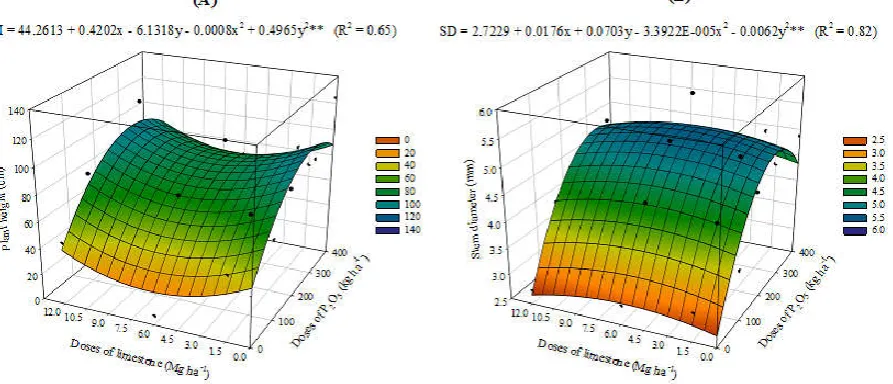
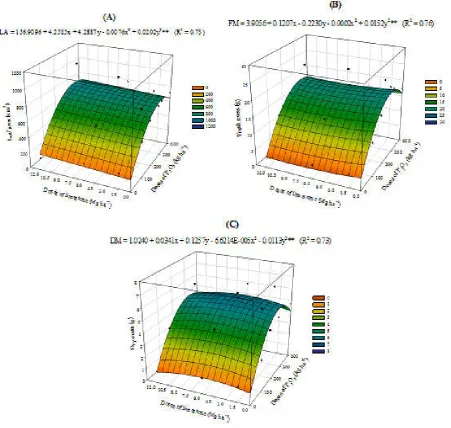
A significant interaction between limestone doses and phosphorus was observed for plant height (PH), leaf area (LA), stem diameter (SD), fresh mass (FM) and dry mass (DM) of soybean plants (Table 2). All variables were affected by phosphorus and limestone doses, which, acted in an associated way, enabling the adjustment of a response surface model, from which their doses can be optimized, aiming the mean maximization of these variables (Figure 1 and 2). Phosphate fertilization and liming positively influenced the PH increase (Figure 1A). These results show that the maximum height of plants (80.51 cm) was obtained with the joint application of 6.18 Mg ha-1 of limestone and 262 kg ha-1 of P2O5. The PH
increment at this dose is 81.89% higher than the control. The higher growth of the plant can be attributed to the addition of limestone and phosphorus that improved the chemical properties of the soil. The limestone contributed to increase pH (Figure 3) and consequently, increased the availability of phosphorus. These observations can be reinforced by studies carried by Negreiros (2014), who applied limestone and phosphorus sources in Piauí cerrado soil and observed an increase in the sum of bases (SB), saturation for bases (V), phosphorus contents, calcium and magnesium in the 0-20 cm soil layer.
Similarly, evaluating the effect of phosphate fertilization and liming on the interference relationships between soybean and capim-marmelada, verified that the use of liming with the increase of 70% in soil base saturation, showed an increase in plant height (13.33%) at 49 days after the beginning of the experiment (Martins and Pitelli, 2000). Neto et al. (2010) evaluating the phosphate fertilization in the soybean crop in an Oxisol in Piaui Southwest, observed that the dose of 95.60 kg ha-1 of P2O5 in soil with elevation of 50% in the soil base
saturation, provided an increase of plant height (14.91%) in relation to the control. At the same time, there is a decrease in plant height for limestone and phosphorus doses higher than the maximum (Figure 1A). This inversion between dose increase and reduction of plant growth is possibly related to the excessive pH soil increase, contributing to the unavailability of micronutrients, and also due to the toxic effect of phosphorus excess in the plant. Similar results were observed in other studies with a decrease in height of soybean plants with doses above 95.60 kg ha-1 of P2O5 (Neto et al., 2010) and 140 kg ha-1
of P2O5 (Valadão Junior et al., 2008). Thus, soybean responses
The SD of the soybean plants was positively influenced by the doses of limestone and doses of P2O5 (Figure 1B). The
maximum stem diameter (5.6 mm) was reached with doses of 5.67 Mg ha-1 of limestone associated with 259.42 kg ha-1of P2O5 With the application of these doses there was an
increment of the SD in 105.80% when compared to the control. A larger stem diameter is associated with a more pronounced development of the shoot and especially the root system, favoring the plant survival and development (Paiva et al., 2011). In addition, growth in diameter is directly related to liquid photosynthesis, which depends on accumulated carbohydrates and auxins and a favorable balance between liquid photosynthesis and respiration (Sousa et al., 2011). Phosphate fertilization and liming positively affected the LA increase (Figure 2A). The maximum leaf area of plants (805.86 cm) was obtained with the joint doses of 12 Mg ha-1 of limestone and 279,70 kg ha-1 of P2O5, promoting an increase of
413% in relation to the control. The increase of the leaf area with liming and phosphate fertilization in soybean was demonstrated by Martins and Pitelli (2000), who verified an increase of 32.31% by liming and 198.58% by 200 ppm of P2O5. Leaf area can be considered a productivity index, given
the importance of photosynthetic organisms in organic production (Ferreira et al., 2014).
Thus, Marin et al. (2015) when evaluating the effect of phosphate fertilization on the production of soybean seeds, observed that plants that received increasing doses of phosphorus in soil corrected with one ton of limestone per hectare, originated plants able to maximize the number of grains per plant with increase in productivity. For FM and DM of soybean plants, there was a positive influence of phosphorus and limestone doses (Figure 2B and 2C). The maximum value of fresh mass (21.30 g) was reached with doses of 7.34 Mg ha-1 of limestone in association with 301.75 kg ha-1 of P2O5,
providing an increase of 445.33% in relation to the control. The maximum dry mass (5.76 g) was obtained with the joint doses of 5.56 Mg ha-1 of limestone and 257.50 kg ha-1 of P2O5,
[image:3.595.82.529.287.479.2]providing an increase of 462.88% compared to the control. Positive results for the weight of shoot dry mass of the soybean shoot were observed at 49 days after the beginning of the experiment, with a 22.08% increase due to the liming effect (Martins and Pitelli, 2000). Viviane et al. (2010) verified that the increase in pH in CaCl2 of the soil promoted an increase in the shoot dry mass yield of soybean for both studied soils. For the Dystroferric Red Latosol, the response was linear, with a dry mass increase of about 11% between the original pH (5.6) and pH 7.0, while in the Red Latosol Dystrophic the response
Table 1. Chemical characterization of the Dystrophic Yellow Latosol, in the 0 - 0.20 m layer
pH P K+ Ca2+ Mg2+ Al3+ H+AL SB t T m V OC
--- mg dm-3 -- --- cmol dm-3 --- --- % --- mg dm-3
4.2 0.4 37.5 0.2 0.1 1 4.1 0.4 1.4 4.5 71.6 8.8 2.62
PH in water, P: phosphorus, K+: potassium, Ca2+: calcium, Mg2+: magnesium, Al3+: aluminum, H + Al: hydrogen + aluminum, SB: sum of bases, m: Saturation by aluminum, V: saturation for bases and CO: organic carbon.
Table 2. Analysis of variance of the growth variables of soybean crop after the use of limestone and phosphorus doses
Variation Source Mean Squares
HP LA SD FM DM
Limestone doses 760.55* 70807.40* 0.4ns 21.43ns 3.4*
Phosporum doses 4122.3** 685861.33** 9.90** 486.73** 37.18**
Limestone x Phosphorum 1000.73** 67672.95** 0.57* 42.94** 3.22**
C. V. (%) 19.47 23.07 11.1 21.97 26.1
** Significant at 1%; * Significant at 5% and ns not significant. C. V. - coefficient of variation. PH: plant
height, LA: leaf area, SD: stem diameter, FM: fresh matter and DM: dry matter of soybean plants.
Figure 2. Means for leaf area - LA (A), fresh mass - FM (B) and dry mass - DM (C) of soybean according to doses of phosphorus (x) and limestone doses (y). ** Significant at 1%
Figure 3. pH values of the soil according to phosphorus doses (x) and limestone doses (y). ** Significant at 1%
4.0 4.5 5.0 5.5 6.0 6.5 7.0 7.5
0 100
200 300
400
0.0 1.5 3.0 4.5 6.0 7.5 9.0 10.5 12.0
S
o
il
p
H
Dos
es o
f P2
O5 (k
g ha
-1)
Doses of limeston e (Mg ha-1
)
pH = 4.8828 + 3.8074E-005x + 0.3620y - 2.1012E-006x2 - 0.0140y2** (R2 = 0.98)
[image:4.595.198.430.554.730.2]to the soil pH increase was quadratic, resulting in an increase of 18% in the dry mass. The production of fresh and dry mass increased as a consequence of the increments promoted in other developmental components, such as height, stem diameter and leaf area. These results of plant growth can be justified by the greater availability of phosphorus in the soil due to the application of limestone and phosphorus. A study performed by Negreiros (2014), with the interaction of limestone and phosphorus applied to the soil, provided a higher soil phosphorus content in the depth of 0-40 cm. When phosphorus is available to plants in adequate amounts, it promotes greater growth and greater leaf area, causing greater solar radiation uptake and increased photoassimilate production (Bonfim-Silva et al., 2011). The soil pH was significantly affected by the application of limestone and phosphorus to the soil (Figure 3). According to the results, pH increased with the limestone dose increase, reaching maximum value (7.21) with the application of 12 Mg ha-1 of limestone. However, the pH reduced with the phosphorus dosage increasing. Negreiros (2014), also found that the liming practice contributed to the increase of pH and reduction of the acidity components, Al3+ (aluminum), H + Al (potential acidity) and m (aluminum saturation). Natale et al. (2007) also verified the positive effects that liming promotes in the improvement of soil chemical attributes related to acidity, increasing pH, Ca2, Mg2+, SB and V contents and decreasing H + Al, up to 60 cm depth (in the line spacing and in the crop line).
The application of 6 Mg ha-1of limestone was enough to maintain the soil pH at the ideal level for the crop development (between 6 and 6.5), because at this level, there is an ideal nutrient availability balance for the plants. Thus, providing a better development and greater productivity. According to Prochnow et al. (2004), in general, the availability of P is higher in soils with pH in the range of 5.5 to 7.0. In a study performed by Brevilieri (2012) about phosphorus fertilization in soybean cultivation on a Red Latosol, it was verified that the use of 180 kg ha-1 of P2O5 promoted maximum productivity
(1860.5 Kg ha-1). The higher doses of limestone cause the overliming phenomenon that happens when excessive doses of limestone are applied to the soil, a fact that limits the development of the crop and the availability of cationic micronutrients in the soil (Silva et al., 2015).
Conclusion
The interaction between liming and phosphate fertilization is positive and favors the soybean growth and development. The combined application of approximately 6 Mg ha-1 of limestone and 260 kg ha-1 of P2O5 provides the highest growths
in soybean plants. The soil pH increases with the limestone dose increase, reaching values in the range of 6 to 6.5 with the application of 12 Mg ha-1 of limestone.
REFERENCES
Bastos, A.L., Costa, J.P.V., Silva, I.F., Raposo, R.W.C., Oliveira, F.A., Albuquerque, A.W. 2010. Resposta do milho a doses de fósforo. Revista Brasileira Engenharia Agrícola Ambiental, 14(5): 485–491.
Bonfim-Silva, E.M., Guimarães, S.L., Farias, L.N., Oliveira, J.R., Bosa, C.K., Fontenelli, J.V. 2014. Adubação fosfatada no desenvolvimento e produção de feijão guandu em
latossolo vermelho do cerrado em primeiro cultivo. Bioscience Journal, 30(5): 1380-1388.
Bonfim-Silva, E.M., Silva, T.J., Cabral, C.E.A.; Gonçalves, J.M., Pereira, M.T.J. 2011. Produção e morfologia da leguminosa java submetida a adubação fosfatada. Enciclopédia Biosfera, 7(12): 1-10.
Brevilieri, R.C. 2012. Adubação fosfatada na cultura da soja em Latossolo Vermelho cultivado há 16 anos sob diferentes sistemas de manejo. 52p. (Dissertação de Mestrado) - Universidade Estadual de Mato Grosso do Sul, Aquidauana, Brasil.
Broggui, F., Freire, F.J., Freire, M.B.G.S., Nascimento, C.W.A., Oliveira, A.C. 2010. Avaliação da disponibilidade, adsorção e níveis críticos de fósforo em diferentes solos. Revista Ceres, 57(2): 247-252.
Conab – Companhia Nacional de Abastecimento. Acompanhamento da safra brasileira de grãos, v. 3 - Safra 2015/16, n. 5 - Quinto Levantamento, Brasília, p. 1-182,
Fevereiro. 2016.
http://www.conab.gov.br/OlalaCMS/uploads/arquivos/16_ 02_04_09_05_00_boletim_graos_fevereiro_2016.pdf <acesso em 19 abr. 2016.
Empresa Brasileira De Pesquisa Agropecuária - Embrapa. 2013. Sistema brasileiro de classificação de solos. 3.ed. Brasília, Brasil. 353p.
Ferreira, M.M.A.A.S, Souza, G.S., Santos, A.R. 2014. Produção de mudas de rúcula em diferentes substratos cultivadas sob malhas coloridas. Enciclopédia Biosfera, 10(18): 2429-2440.
Filho, F.B., Ferreira, M.E., Vieira, R.D., Cruz, M.C.P., Centurion, M.A.P.C., Sylvestre, T.B., Ruiz, J.G.C.L. 2013. Adubação com fósforo e potássio para produção e qualidade de sementes de soja. Pesquisa Agropecuária Brasileira, 48(7): 783-790.
Marin, R.S.F., Bahry, C.A., Nardino, M., Zimmer, P.D. 2015. Efeito da adubação fosfatada na produção de sementes de soja. Revista Ceres, 62(3): 265-274.
Martins, D., Pitelli, R.A. 2000. Efeito da adubação fosfatada e da calagem nas relações de Interferência entre plantas de soja e capim-marmelada. Planta Daninha,18(2): 331-347. Moretto, T., Viecelli, C.A. 2012. Efeito de diferentes doses de
Cálcio aplicado no sulco de plantio sobre a produtividade da soja. Cascavel,5(3): 47-52.
Natale, W., Prado, R.M., Rozane, D.E., Romualdo, L.M. 2007. Efeitos da calagem na fertilidade do solo e na nutrição e produtividade da goiabeira. Revista Brasileira de Ciência do Solo, 31(6): 1475-1485.
Negreiros, A.B. 2014. Teores de nutrientes, atributos microbianos e dinâmica do fósforo em função da calagem, fosfatagem e manejo do solo no cerrado piauiense. 64f. (Dissertação de Mestrado) - Universidade Federal do Piauí, Bom Jesus, Brasil.
Neto, F.A., Gravina, G.A., Monteiro, M.M.S., Morais, F.B., Petter, F.A., Albuquerque, J.A.A. 2011. Análise de trilha do rendimento de grãos de soja na microrregião do Alto Médio Gurguéia.Comunicata Scientiae, 2(2): 107-112. Neto, F.A., Gravina, G.A., Souza, N.O.S., Bezerra, A.A.C.
2010. Adubação fosfatada na cultura da soja na microrregião do Alto Médio Gurguéia. Revista Ciência Agronômica, 41(2): 266-271.
Oliveira Junior, A., Prochnow, L.I., Klepker, D. 2008. Eficiência agronômica de fosfato natural reativo na cultura da soja. Pesquisa Agropecuária Brasileira, 43(5): 623-631. Paiva, E.P., Maia, S.S.S., Cunha, C.S.M., Coelho, M.F.B.,
desenvolvimento de mudas de manjericão (Ocimum basilicum L.). Revista Caatinga, 24(4): 62-67.
Prado, R.M., Franco, C.F., Puga, A.P. 2010. Deficiências de macronutrientes em plantas de soja cv. BRSMG 68 (Vencedora) cultivada em solução nutritiva. Comunicata Scientiae 1(2): 114-119.
Prochnow, L.I., Alcarde, J.C., Chien, S.H. 2004. Eficiência agronômica dos fosfatos totalmente acidulados. In: Yamada, T., Abdalla, S.R.S. (Ed.). Fósforo na agricultura brasileira. Piracicaba: Potafos. p. 605-663.
Silva, F.C.M., Sachs, L.G., Fonseca, I.C.B., João, J.T. 2015. Liming in Agricultural Production Models with and
Without the Adoption of Crop-Livestock
Integration. Revista Brasileira de Ciência do Solo 39(5): 1463-1472.
Sousa, G.G., Novelino, J.O., Scalon, S.Q.P., Marchetti, M.E. 2011. Crescimento de mudas de maracujazeiro em função de adubação à base de boro e material de cupinzeiro. Pesquisa Agropecuária Tropical, 41(2): 170-178.
Valadão Júnior, D.D., Bergamim, A.C., Venturoso, L.R., Caron, B.O., Schmidt, D. 2008. Adubação fosfatada na cultura da soja em Rondônia. Scientia Agraria, 9(3): 369-375.
Viviani, C.A., Marchetti, M.E., Vitorino, A.C.T., Novelino, J.O., Gonçalves, M.C. 2010. Disponibilidade de fósforo em dois latosolos argilosos e seu acúmulo em plantas de soja, em função do aumento do pH. Ciência e Agrotecnologia, 34(1): 61-67.