THE EFFECTIVENESS OF "REWRITE" AS INDIRECT FEEDBACK ON WRITING AND
THE LEARNING OUTCOME IN GRADE SEVEN
*
Ali Abdalla El
Department of English Language and Literature, Faculty of Letters and Humanities,
Branch 4, Zahle, Lebanese University, Lebanon
ARTICLE INFO ABSTRACT
Providing feedback in language learning is an essential step in the learning process,
has always been what type of feedback and when and how to provide it. Some support the idea of providing direct corrective feedback, while others support the idea of indirect corrective feedback. This study investigated two Grade 7 EFL cla
other as the treatment group; the former received direct correction where the teacher pr
model, and the latter received indirect correction where the teacher indicated the occurrence and location of the error. Then the teacher gave the treatment group their papers back to rewrite them at home and bring them back to get the final grade. Both
their achievement. The purpose of the study was to check whe
a way of feedback is a better way for language learning than traditional corrective feedback. The results showed that indirect correction contributed more to language learning. Finally, the
interviewed the
of the experiment. She reported that students in the treatment group not only improved their writing, but they became more motivated as a result of the "rewrite".
Copyright © 2018, Ali Abdalla El-Husseini and Abeer Taha permits unrestricted use, distribution, and reproduction
INTRODUCTION
This study examined some types of correction feedback to see whether some types are more effective in language learning than others in Grade 7 at a private school in Lebanon. For years English language teachers, parents, and officials in the Ministry of Education in Lebanon have expressed concern about their students' abilities to use correct English in speaking and writing. In spite of six years of English instruction, with an average of six hours a week, most high school students graduate with little skill in expressing themselves well in English writing. Unfortunately, no proper evaluation has been done to see the reasons for that, but some put a part of the blame on the direct correction provided by the teachers, which goes completely unnoticed by the learners (Kulhavy and Stock, 1989). Foreign language teachers, concerned with the identification, correction, and prevention of spoken and written errors made by their students, can profit greatl
acquisition research. Years ago, a significant and positive change occurred in the attitudes of second language learning researchers towards learners' errors.
*Corresponding author: Ali Abdalla El-Husseini,
Department of English Language and Literature, Faculty of Letters and Humanities, Branch 4, Zahle, Lebanese University, Lebanon.
ISSN: 0975-833X
Article History:
Received 09th December, 2017 Received in revised form 29th January, 2018
Accepted 11th February, 2018 Published online 30th March, 2018
Citation: Ali Abdalla El-Husseini and Abeer Taha
In Grade Seven”, International Journal of Current Research Key words:
Direct Correction, Error Correction, Indirect Correction, Teacher's Feedback, Writing.
RESEARCH ARTICLE
THE EFFECTIVENESS OF "REWRITE" AS INDIRECT FEEDBACK ON WRITING AND
THE LEARNING OUTCOME IN GRADE SEVEN
Ali Abdalla El-Husseini and Abeer Taha
Department of English Language and Literature, Faculty of Letters and Humanities,
Branch 4, Zahle, Lebanese University, Lebanon
ABSTRACT
Providing feedback in language learning is an essential step in the learning process,
has always been what type of feedback and when and how to provide it. Some support the idea of providing direct corrective feedback, while others support the idea of indirect corrective feedback. This study investigated two Grade 7 EFL classes with one operating as the control group and the other as the treatment group; the former received direct correction where the teacher pr
model, and the latter received indirect correction where the teacher indicated the occurrence and on of the error. Then the teacher gave the treatment group their papers back to rewrite them at home and bring them back to get the final grade. Both groups were given pre and post
their achievement. The purpose of the study was to check whether indirect feedback and
a way of feedback is a better way for language learning than traditional corrective feedback. The results showed that indirect correction contributed more to language learning. Finally, the
interviewed the teacher and asked about her experience with the two classes after the implementation of the experiment. She reported that students in the treatment group not only improved their writing, but they became more motivated as a result of the "rewrite".
Husseini and Abeer Taha. This is an open access article distributed under the Creative in any medium, provided the original work is properly cited.
This study examined some types of correction feedback to see whether some types are more effective in language learning than others in Grade 7 at a private school in Lebanon. For language teachers, parents, and officials in the Ministry of Education in Lebanon have expressed concern about their students' abilities to use correct English in speaking and writing. In spite of six years of English instruction, with an urs a week, most high school students graduate with little skill in expressing themselves well in English writing. Unfortunately, no proper evaluation has been done to see the reasons for that, but some put a part of the ided by the teachers, which goes completely unnoticed by the learners (Kulhavy and Stock, 1989). Foreign language teachers, concerned with the identification, correction, and prevention of spoken and written errors made by their students, can profit greatly from language acquisition research. Years ago, a significant and positive change occurred in the attitudes of second language learning
Husseini,
and Literature, Faculty of Letters and Humanities, Branch 4, Zahle, Lebanese University, Lebanon.
This attitude is summarized by George (1972) when he states
that "at the beginning of the sixties the word 'error' was
associated with correction, at the end with learning."
Within this perspective, researchers in language learning have become increasingly interested in the study and analysis of students' errors (Brookhart, 2017; Pawlak, 2004; Taylor,1975; Truscott, 2007). Further, they propose that learners' errors should be expected and accepted as a natural result of language learning. The overriding objective of most of the studies has been to try to understand the processes underlying second language learning. Based on students' observed written sentences or spoken utterances, investigators attempted to infer the best way to deal with errors to contribute to language learning (AlBuainain, 2007a
2007). The method of providing feedback has always been an issue. Correcting students' writing is time
therefore, many teachers dislike correcting students' writing. The goal of writing classes, however, is to promote l performance in writing accurately across different genres. This requires explicit instruction on many items such as grammar, punctuation, spelling, structure, style as well as on generating and expressing ideas. Tennant (2001) used two methods for editing/correcting students writing: (1) to write corrections on the paper, using a red pen to make them clearly visible; (2) and
International Journal of Current Research Vol. 10, Issue, 03, pp.67252-67256, March, 2018
Husseini and Abeer Taha, 2018. “The Effectiveness Of "Rewrite" As Indirect Feedback On Writing And The Learning Outcome International Journal of Current Research, 10, (03), 67252-67256.
THE EFFECTIVENESS OF "REWRITE" AS INDIRECT FEEDBACK ON WRITING AND
Department of English Language and Literature, Faculty of Letters and Humanities,
Providing feedback in language learning is an essential step in the learning process, but the question has always been what type of feedback and when and how to provide it. Some support the idea of providing direct corrective feedback, while others support the idea of indirect corrective feedback. sses with one operating as the control group and the other as the treatment group; the former received direct correction where the teacher provided the model, and the latter received indirect correction where the teacher indicated the occurrence and on of the error. Then the teacher gave the treatment group their papers back to rewrite them at groups were given pre and post-tests to check ther indirect feedback and "rewrite" as a way of feedback is a better way for language learning than traditional corrective feedback. The results showed that indirect correction contributed more to language learning. Finally, the researcher teacher and asked about her experience with the two classes after the implementation of the experiment. She reported that students in the treatment group not only improved their writing,
Creative Commons Attribution License, which
This attitude is summarized by George (1972) when he states
"at the beginning of the sixties the word 'error' was associated with correction, at the end with learning." (p. 112) Within this perspective, researchers in language learning have become increasingly interested in the study and analysis of errors (Brookhart, 2017; Pawlak, 2004; Taylor,1975; Truscott, 2007). Further, they propose that learners' errors should be expected and accepted as a natural result of language learning. The overriding objective of most of the studies has derstand the processes underlying second language learning. Based on students' observed written sentences or spoken utterances, investigators attempted to infer the best way to deal with errors to contribute to language and b; Ferris, 2002; Mosbah, 2007). The method of providing feedback has always been an issue. Correcting students' writing is time-consuming work, therefore, many teachers dislike correcting students' writing. The goal of writing classes, however, is to promote learners' performance in writing accurately across different genres. This requires explicit instruction on many items such as grammar, punctuation, spelling, structure, style as well as on generating and expressing ideas. Tennant (2001) used two methods for editing/correcting students writing: (1) to write corrections on the paper, using a red pen to make them clearly visible; (2) and
OF CURRENT RESEARCH
“more effective method” to write lengthy comments explaining grammar points, rising questions concerning meaning and logical development, suggesting alternative wording, and reorganizing text. When faced with such tasks some teachers will react with comments like “Oh, no”. However, the results are rewarding because students can learn better. For example, students can be reminded of a previously studied grammar rule through explaining its applicability in a specific instance. So it is always helpful for teachers to move beyond simple correction to providing explanations for changes suggested (AlBuainain, 2007a). Other studies dealt with effects of correction in general on the ability of learners' writing (Ferris 2002), while others dealt with types of correction used in the classroom (Mosbah, 2007) without checking their influence on the learners' writing development. The researcher could not find any studies in literature that checked the relationship between types of corrective feedback, as classified by Allwright (1988), and learners' improvement in writing. The "rewrite corrective strategy is supposed to be more effective than traditional way of correction, i.e providing remedies and models whether with or without explanation.
Purpose of the Study
Studies on error treatment (Kim and Weaver, 2002; Johnson 2004; Lantolf and thorne, 2006, Al Buainain, 2007b) are inconclusive as to which corrective method is better than the other. The purpose of the study is based on one main objective to compare two types of feedback to see whether the "rewrite" correction strategy is more effective and leads to better learning outcome.
Significance of the Study
English is taught in Lebanese schools and universities as a first foreign language. It is a required subject and students must pass their English tests, in addition to other subjects in school, in order to be promoted to the next grade level. Students in both intermediate and secondary schools receive six hours of English instruction per week. Grade seven students receive eight hours of English instruction per week. Some of the English teachers are Lebanese who have graduated from colleges of education in Lebanon, with a B.A. in English; very few are native speakers of English, who came from England. The teaching methods used in most English classes are mainly traditional, following mostly the grammar-translation method and supplemented sometimes by audio-lingual practices. In Lebanon, empirical research regarding students' performance at different levels of English learning is not only scarce but is well-needed. The implementation and effectiveness of "rewrite" is also to be investigated since it is believed to be the best way of error correction. It is hoped that this study will increase our store of knowledge in this field of corrective feedback and provide useful information for both curriculum designers, teachers and teacher trainers. Here the definition of some terms is needed.
Error
It is difficult to precisely define "error". Indeed researchers have defined it in different ways depending on their theoretical positions. George (1972:2) defined "error" as ―an unwanted form, specifically, a form which a particular course designer or teacher does not want. This is a subjective definition that is not based on specific criteria against which an utterance may be checked.
Such a definition led the early error treatment researchers, for example, All wright (1975) and Chaudron (1986) to claim that teachers were inconsistent in treating learners‘ errors. Error is also defined by dictionaries as any sentence, word or group of words, which is unacceptable from native speakers' perspective because it violates one or more of the standard grammatical rules of the language.
Rewrite
Rewrite is a correction strategy whereby a teacher indicates the occurrence of errors without indicating the type or providing any models or remedy as is usually the practice, and asking the learners to rewrite their compositions doing their utmost to correct these errors by consulting dictionaries, people, etc. The teacher grades the papers after the rewriting process.
Statement of the Problem
Providing corrective feedback, whether direct or indirect, is an essential part of teaching; Some teachers complain that despite the fact that they correct some items several times, they still appear in the learners' output. This encouraged the researcher to look into this to check and diagnose the problem. When he checked the students' written work, he realized that the teacher provided direct correction which went unnoticed by the learners since their main focus is on grades not errors. Moreover, the teachers complained that they spent a lot of time on direct correction providing remedies and models filling the learners' sheets with red marks and comments. The main research question is:
Does "rewrite" contribute more to improving the writing skill and the learning outcome than traditional feedback?
Literature Review
corrections go unnoticed". On the other hand, when we correct according to the "rewrite" strategy proposed in this study, the learner has to go and read, research, ask, consult and write again correcting errors indicated by the teacher. Is this not the aim of teaching in the first place? Do we not want learners to do all this things?. In this study, treatment refers to teachers‘ reactions when an error is committed. Unless clearly stated, the terms treatment and correction are used interchangeably in this study. Used in this sense, treatment embraces Allwright's (1988) classification of errors, Lennon's (1991) notion of feedback and James‘s (1998) notions of feedback and correction. It is very much in line with Allwright and Bailey‘s (1996) notion of treatment.
METHODOLOGY
Research Design
This study will employ the quantitative and qualitative approaches for collection and analysis of data from the participants of the study. Primary and secondary analysis will be used. By primary data collection method it meant that the process of gathering data will be from only sources that are first hand. The process of data collection and gathering is hectic, time consuming and tiring but the best part is that the use of both approaches gives most relevant and accurate results. For the investigation of a phenomenon or to address and cater to a problem related to the phenomenon, scientific method of quantitative research is utilized (O’Cathain, Murphy and Nicholl, 2007). The implementation of this scientific research method is done with the objective that the end result will be void of any biasness, and an improvement of validity and reliability will be observed. The reliability of the information that is collected from the respondents or the participants is anticipated throughout the quantitative analysis method of scientific research (O’Cathain, Murphy and Nicholl, 2007). The other method of scientific research is the qualitative analysis and approach. This method is in contrast with the quantitative research method in the main aim to answer the research questions of the study. Moreover, it also attempts to cater the exploration of innovative and newer levels of knowledge in an environment or setting that is natural (Creswell, 2008). The major backing of the quantitative approach of research is the instrument that is the samples of writing and feedback collected from the teacher(s) during a semester of four months. This will include homework, test and every written production assessed by the teacher.
Data Collection Technique
There are basically two kinds of data collection techniques used in this study: primary research method and secondary research method.
Secondary Research
Secondary research is involved in gathering the information that relates to the understanding of the subject and the core concept of the study. This is implemented in the information presented in the literature review. In order to execute the literature review the secondary data was collected from various multiple sources. This aided in the formulation of literature review. These multiple sources included academic journals, books, magazines, government publications, trade publications and other authentic internet based press releases. In a study by Kumar (2007), it was suggested that the secondary data is responsible for the provision of valuable and authentic
information as compared to the data or information collected after a limited research. Additionally, it has also been observed that the secondary data aids in gathering latest and most authentic information along with the theoretical data that is related to the subject on which the study is based.The university libraries are comprised of scientific databases that were accessed in order to get the most updated and relevant information. The choice of literature and the measurement of its relevancy should be based on the research topic and the publication year. The libraries that are individual and those that are public will be used to get the best possible data. This also includes the online databases and libraries.
Primary Research
The second most important type of technique in data collection is the primary research approach. This technique is quite flexible in terms of the control over the information and the data that are collected. Furthermore, the information gathered will ultimately be created by the author of the study. In this method, the tools or instruments will include observations, interviews tests, etc. Additionally, it should be noted that the researcher has to adopt the most critical and careful execution in order to find the most accurate, relevant, reliable, unbiased and recent information. In accordance with the research by Creswell (2008), primary research is often categorized as the fieldwork (p. 65). This is because the researcher approaches the field and collects the data that includes school, organization, community centre, etc. The primary research is also responsible for provision of control over the findings as it is the prospective work. However, when the comparison of time consumption is done between the primary research and secondary research is done, primary research proves to be more time consuming, tiring and lacks cost effectiveness (Creswell, 2008).
Sample Size (Participants)
In the study by Kumar (2007) it was emphasized that selection of sample is significant along with the strict criteria which makes sure that the right participants are selected for the research. Adequate sampling technique enables the accuracy of the collected data and information along with aiding in time saving and cost effectiveness. This will enable not just finding the right participants for this research, but will also improve the unbiasness in selecting those participants. The population for the study consists of students of two sections in grade seven in a private school. The sample size of the participants is 60 students from both sections 30 students in each. They were numbered as S1, S2, S3, … S30 in each section. The participants were divided into control group and treatment group both taught by the same teacher. In one section, she taught the control group using traditional corrective method (direct correction), while with the treatment group, she used the "rewrite" method; that is, she indicated the occurrence of the error, located it for the learners and gave them a second try to present better writing work.
Data Collection and Analysis Procedure
Data Collection Process: The researcher carried out the same
projects corrected by the teacher were also checked to make sure the teacher followed the "rewrite" approach in providing feedback to the treatment group and traditional correction for the control group.
RESULTS
Data Analyses
After the scores of the participants were collected at the beginning and end of the term, they were compared to see if
the learners on the treatment group achieved more and improved their writing more than the control group. The learners' compositions were also checked to see whether the teacher provided the proper correction to the right group.
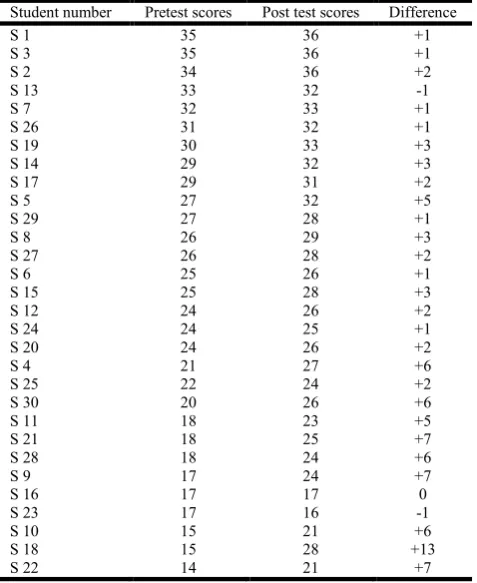
[image:4.595.177.424.119.415.2]The results of the study are presented in tables 1 and 2. Table 1 presents the number of the students, the pre and post test scores of the control group (section A). It starts with the highest score and ends with the lowest. Column 4 shows the differences
Table 1. The results of the pre and post tests in the control group (section A)
Student number Pretest scores Post test scores Difference
S 20 35 34 -1
S19 34 31 -3
S 15 32 33 +1
S 6 31 30 -1
S 29 31 30 -1
S 9 30 32 +2
S 28 30 27 -3
S 27 29 26 -3
S 26 28 27 -1
S 18 27 25 -2
S 5 27 28 +1
S 3 26 26 0
S 11 26 26 0
S 13 25 26 +1
S 24 25 26 +1
S 23 24 27 +3
S 17 24 26 +2
S 2 23 21 -2
S 7 21 22 +1
S 12 21 20 -1
S 1 18 20 +2
S 10 18 15 -3
S 30 18 21 +3
S 8 17 19 +2
S 16 17 19 +2
S 21 17 19 +2
S 25 16 19 +3
S 22 15 16 +1
S14 15 18 +3
S 4 14 15 +1
Table 2. The results of the pre and post tests in the treatment group (section B)
Student number Pretest scores Post test scores Difference
S 1 35 36 +1
S 3 35 36 +1
S 2 34 36 +2
S 13 33 32 -1
S 7 32 33 +1
S 26 31 32 +1
S 19 30 33 +3
S 14 29 32 +3
S 17 29 31 +2
S 5 27 32 +5
S 29 27 28 +1
S 8 26 29 +3
S 27 26 28 +2
S 6 25 26 +1
S 15 25 28 +3
S 12 24 26 +2
S 24 24 25 +1
S 20 24 26 +2
S 4 21 27 +6
S 25 22 24 +2
S 30 20 26 +6
S 11 18 23 +5
S 21 18 25 +7
S 28 18 24 +6
S 9 17 24 +7
S 16 17 17 0
S 23 17 16 -1
S 10 15 21 +6
S 18 15 28 +13
[image:4.595.183.422.441.733.2]between the scores. Table 2 presents the number of the students, the pre and post test scores of the treatment group (section B). It starts with the highest score for S1 and ends with the lowest for S18. Column 4 shows the difference between the scores.
DISCUSSION
Table 1 shows that the average of improvement in the control group was +0.33 with the highest grade of improvement =+3 and the lowest grade of improvement =-3.
The mean of improvement = 0. Seventeen students improved their scores slightly between +1 and +3. Table 2 shows that the mean of improvement = +6 and the average of improvement =+3.23. Twenty seven students in the treatment group improved their scores between +1 and +13. These results indicate that indirect correction led to better learning more than direct correction. The girl who improved her score by +13 points told the teacher that she loved that way of correction because she had to correct herself after being given the second try. She went to check her errors with friends, dictionary, google, etc.. This means that the answer to the research question is positive. As Brookhart (2017), Truscott (2007) argue, indirect correction (rewrite) contributes more to improving writing skills and the learning outcome than traditional feedback. Direct correction goes unnoticed by the learners, and students are more interested in their scores rather than feedback, as Kulhavy and stock (1989) reported. This should encourage teachers to use indirect correction if they want their students to care about their errors and go find solutions for them.
REFERENCES
Al-Buainain, H. 2007a. Students' Writing Errors in ESL: a
Case Study. ling.auf.net/lingbuzz/001050/current.pdf.
Retrieved on March 27, 2017.
AlBuainain, H. A. 2007b. Researching Types and Causes of errors in Arabic Speakers' Writing, in Midraj, S., Jendli, A.
and Sellami, R. (Eds).Research in ELT Issues. TESOL
Arabia: Dubai, UAE (pp 195-224).
Allwright, R. 1975. Problems in the study of the language teacher's treatment of errors, in M. K. Burst and H. C.
Dulay, eds. On TESOL 75: New Directions in SL Learning,
Teaching and Bilingual education, 96-109. Washington, D.C. TESOL.
Allwright, R. 1988. Abservation in The Language Classroom.
Longman.
Allwright, R. and K. Bailey. 1996. Focus on the Language
Classroom: An Introduction to Classroom Research for Language Teachers. Cambridge: CUP.
Brookhart, S. 2017. How to Give Effective Feedback to your
Students, 2nd ed. Alexandria, VA: ASCD.
Chaudron, C. 1986. Teachers ‘priorities in correcting learners‘ errors in French immersion classes, in Day, R. (ed)
Talking to learn: Conversation in Second Language Acquisition, Rowley, Massachusetts: Newbury House Publishers.
Creswell, J. W. 2008. Research Design: Qualitative, Quantitative, and Mixed Methods Approaches. Publisher: Sage Publications, Inc; 3rd edition. Pp. 65-68.
Dulay, H. and Burt, M. 1974. "A new perspective on the creative construction hypothesis in child second language acquisition." Working Papers on Bilingualism, 4, 71-98. Ferris, D. 2002. Treatment of Errors in Second Language
Students' writing. A in Arbor, MI. The University of
Michigan.
George, H. W. 1972. Common errors in language learning: Insights from English. Rowley, Mass.: Newbury House Publishers, pp. 112.
James, C. 1998. Errors in Language Learning and Use:
Exploring Error Analysis, Pearson Education Limited: England.
Johnson, M. 2004. A philosophy of second language acquisition. New Haven, CT: Yale University Press. Kim, S. T. and Weaver, D. 2002. Communication research
about the internet: A thematic meta-analysis. New Media and Society, 4(4), 518-538.
Kulhavy, R. W. and W. A. Stock 1989. Feedback in Written
Instruction: the place of response certitude. Educational
Psychology Review, 1:279-308.
Kumar, M. 2007. Mixed methodology research design in
educational technology. Alberta Journal of Educational
Research, 53(1), 34-44.
Lantolf, J. P. and Thorne, S. L. 2006. Sociocultural theory and
the genesis of second language development. Oxford, UK: Oxford University Press.
Lennon, P. 1991. Error: some problems of definition, identification, and distinction,
Applied Linguistics, 12, 180-195.
Mosbah, G. A. 2007. Treatment of Classroom Oral Errors: a Comparative Study Between Native and Nonnative
Speaking teachers. An unpublished PhD thesis, School of
Education, University of Leicester, UK.
O’Cathain, A., Murphy, E. and Nicholl, J. 2007. Integration
and publications as indicators of "yield" from mixed
methods studies, Journal of Mixed Methods Research, 1,
147-163.
Pawlak, M. 2004. Describing and Researching Interactive Processes in the Foreign Language Classroom. Konin: Państwowa Wyższa Szkoła Zawodowa.
Taylor, Barry P. 1975. Toward a theory of language
acquisition. Language Learning, 24, 23-25.
Tennant, S. 2001. Useful Resources for Editing Academic
Writing in English. English Teaching forum. Volume: 32.
No. 2. 26-29.
Truscott, J. 2007. The effect of error correction on learners'
ability to write accurately. Journal of Second Language
writing, 16 (2007), 255-272.