COMPARATIVE EVALUATION OF THE DIMENSIONAL ACCURACY OF THREE DIFFERENT
IRREVERSIBLE HYDROCOLLOID IMPRESSION MATERIALS AT DIFFERENT STORAGE
1
Dr. Debashish Basak, *
,2Dr. Arunoday Kumar,
4Dr. Dhruba Chatterjee,
5Dr. Anirban Das,
1
Department of Prosthodontics Crown and Bridge, Hazaribag College of Dental Sciences and Hospital,
2
Department of Prosthodontics Crown and Bridge, Reg
3
Department of Conservative and Endodontics, Guru Nanak Institute of Dental Science,
4
Department of Oral and Maxillofacial surgery, Private Practice, Kolkata
5
Department of Pedodontics, Kusum Devi Sundar Lal Dugar Jain Dental College and Hospital, Cossipore,
6
Department of Oral and Maxillofacial Surgery, Regional institute of Medical Sciences, Dental College, Imphal
7
Department of Oral and Maxillofacial
ARTICLE INFO ABSTRACT
Purpose:
impression materials at three different storage periods.
Materials and Methods:
model in this study. Three customised abutments A,B,C were CAD/CAM machined to simulate
and two in the posterior region on either side of the ridge. The centre of the cross hair reference lines made on the occlusal surfaces of abutments was used for
total of 90 impressions of the master model was made by all three irreversible hydrocolloids and stored in three different storage period of 30 minutes,
after three storag
abutments were measured with
Results:
between all thre periods.
Conclusion:
greater than the conventional Algitex in delayed pouring of the
Copyright©2017, Dr. Debashish Basak et al. This is an open access article distributed under the Creative Commons Att unrestricted use, distribution, and reproduction in any medium, provided the original work is properly cited.
INTRODUCTION
Making an impression is the first step towards fabrication of a prosthesis. Irreversible hydrocolloid, commonly called as alginate is a viscoelastic material that was developed in 1940 during world war II. (Alka Patwa et al., 2012
Akeredolu, 2004) It is one of the most commonly used impression material in partially edentulous conditions. Patwa et al., 2012; Ekanem and Akeredolu, 2004
*Corresponding author: Dr. Arunoday Kumar,
Department of Prosthodontics Crown and Bridge, Regional Institute of Medical Sciences, Dental College, Imphal
ISSN: 0975-833X
Article History:
Received 26th January, 2017
Received in revised form
05th February, 2017
Accepted 15th March, 2017
Published online 20th April,2017
Citation: Dr. Debashish Basak, Dr. Arunoday Kumar, Dr. Debojyoti Das irreversible hydrocolloid impression materials at different storage periods
Key words: Impression Material, Dimensional Accuracy, Storage, Cast, Hydrocolloid, CAD/CAM.
RESEARCH ARTICLE
COMPARATIVE EVALUATION OF THE DIMENSIONAL ACCURACY OF THREE DIFFERENT
IRREVERSIBLE HYDROCOLLOID IMPRESSION MATERIALS AT DIFFERENT STORAGE
PERIODS - AN INVITRO STUDY
Dr. Arunoday Kumar,
3Dr. Debojyoti Das,
3Dr. Anirban Das,
6Dr. Praveen B. Reddy and
7Dr. Amrendra Kumar
Department of Prosthodontics Crown and Bridge, Hazaribag College of Dental Sciences and Hospital,
Demotand, Hazaribag
Department of Prosthodontics Crown and Bridge, Regional Institute of Medical Sciences, Dental College, Imphal
Department of Conservative and Endodontics, Guru Nanak Institute of Dental Science,
Kolkata, West Bengal
Department of Oral and Maxillofacial surgery, Private Practice, Kolkata
dodontics, Kusum Devi Sundar Lal Dugar Jain Dental College and Hospital, Cossipore,
Kolkata, West Bengal
Department of Oral and Maxillofacial Surgery, Regional institute of Medical Sciences, Dental College, Imphal
Department of Oral and Maxillofacial Surgery, Private Practice, Patna
ABSTRACT
Purpose: The purpose of the study was to compare the dimensional stability of three different alginate impression materials at three different storage periods.
Materials and Methods: A brass model representing maxillary edentulous ridge was u model in this study. Three customised abutments A,B,C were CAD/CAM machined to
simulate full veneer preparation. They were positioned on the master model one in the anterior region and two in the posterior region on either side of the ridge. The centre of the cross hair reference lines made on the occlusal surfaces of abutments was used for measuring linear dimensional changes. A total of 90 impressions of the master model was made by all three irreversible hydrocolloids and stored in three different storage period of 30 minutes, 12 hours and 24 hours. The casts were poured after three storage period with type IV gypsum product and the inter abutment distance between the abutments were measured with the electronic vernier caliper.
Results: ANOVA analysis showed no significant differences (p< .05) at 30 minutes storage period between all three alginates and a very high significant difference (p< .001) at 12 and 24 hours storage periods.
lusion: The dimensional accuracy of the improvised alginates Cavex CA37 and Neocolloid were greater than the conventional Algitex in delayed pouring of the cast.
is an open access article distributed under the Creative Commons Att use, distribution, and reproduction in any medium, provided the original work is properly cited.
Making an impression is the first step towards fabrication of a commonly called as alginate is a viscoelastic material that was developed in 1940 2012; Ekanem and It is one of the most commonly used impression material in partially edentulous conditions. (Alka 2004; Kenneth J.
Department of Prosthodontics Crown and Bridge, Regional Institute of
Anusavice, 2003) Due to their relative inexpensiveness, patient comfort, acceptable taste, and ease of manipulation, alginates have stood the test of time and have become an integral aspect in the practice of dentistry. (
Cook, 1986; Powers and Sakaguchi
alginate is for diagnostic cast. The diagnostic cast many times need accuracy. (Kenneth J. Anusavice
1969; Marker, 1996) The alginates lack accuracy due to poor dimensional stability and surface reproduction. The way in which the accuracy of an impression changes during the period after withdrawal from the mouth
die is a measure of its dimensional stability. International Journal of Current Research
Vol. 9, Issue, 04, pp.48733-48739, April, 2017
INTERNATIONAL
OF CURRENT RESEARCH
Citation: Dr. Debashish Basak, Dr. Arunoday Kumar, Dr. Debojyoti Das et al. 2017. “Comparative evaluation of the dimensional accuracy of three different
irreversible hydrocolloid impression materials at different storage periods - An invitro study”, International Journal of Current Research
COMPARATIVE EVALUATION OF THE DIMENSIONAL ACCURACY OF THREE DIFFERENT
IRREVERSIBLE HYDROCOLLOID IMPRESSION MATERIALS AT DIFFERENT STORAGE
3
Dr. Niladri Maiti,
Dr. Amrendra Kumar
Department of Prosthodontics Crown and Bridge, Hazaribag College of Dental Sciences and Hospital,
ional Institute of Medical Sciences, Dental College, Imphal
Department of Conservative and Endodontics, Guru Nanak Institute of Dental Science,
Department of Oral and Maxillofacial surgery, Private Practice, Kolkata
dodontics, Kusum Devi Sundar Lal Dugar Jain Dental College and Hospital, Cossipore,
Department of Oral and Maxillofacial Surgery, Regional institute of Medical Sciences, Dental College, Imphal
Surgery, Private Practice, Patna
The purpose of the study was to compare the dimensional stability of three different alginate
A brass model representing maxillary edentulous ridge was used as a master model in this study. Three customised abutments A,B,C were CAD/CAM machined to
full veneer preparation. They were positioned on the master model one in the anterior region and two in the posterior region on either side of the ridge. The centre of the cross hair reference lines measuring linear dimensional changes. A total of 90 impressions of the master model was made by all three irreversible hydrocolloids and 12 hours and 24 hours. The casts were poured e period with type IV gypsum product and the inter abutment distance between the
ANOVA analysis showed no significant differences (p< .05) at 30 minutes storage period e alginates and a very high significant difference (p< .001) at 12 and 24 hours storage
The dimensional accuracy of the improvised alginates Cavex CA37 and Neocolloid were cast.
is an open access article distributed under the Creative Commons Attribution License, which permits
Due to their relative inexpensiveness, patient comfort, acceptable taste, and ease of manipulation, alginates od the test of time and have become an integral aspect (Ekanem and Akeredolu, 2004; Sakaguchi, 2006) The common use of alginate is for diagnostic cast. The diagnostic cast many times Kenneth J. Anusavice, 2003; Kenneth et al., The alginates lack accuracy due to poor dimensional stability and surface reproduction. The way in which the accuracy of an impression changes during the period after withdrawal from the mouth and pouring to make a cast or die is a measure of its dimensional stability. (Shaba et al.,
INTERNATIONAL JOURNAL OF CURRENT RESEARCH
“Comparative evaluation of the dimensional accuracy of three different
2007) An ideal impression material should have perfect dimensional stability such that the impression would retain its original accuracy indefinitely. (Shaba et al., 2007) Most acceptable limits for accuracy are from 0.1% to 0.27%. Other researchers claim that a value of 50 μm is the maximum acceptable discrepancy between a master cast and a poured impression made from the master model. (Brett et al., 1995) The common factors that cause dimensional changes in alginate impressions are setting contraction, thermal contraction and release of internal stresses on cooling from the body temperature to room temperature. (Marker, 1996; Mc Cabe and Angus Walls, 1998) These changes can be due to inherent properties of syneresis, imbibitions and evaporation. (Kenneth J. Anusavice, 2003; Marker, 1996) The setting reaction of alginate causes replacement of monovalent ions by divalent ions result in cross-linking of the alginate chains that continues to increase after the material has set and this contributes to dimensional changes after withdrawl from the oral cavity. The dimensional stability is directly related to storage period of the alginate impression and it changes with increasing storage time. So it is highly recommended to pour the cast immediately or 10 to 15 minutes to the maximum of 30 minutes of storage after taking impression with alginate to avoid dimensional changes. So to overcome the dimensional inaccuracy, various companies have started marketing improvised or extended storage alginates, which they claim to be near equivalent to elastomers in accuracy and can bepoured after long time. (Toros Alcan et al., 2009) The limited scientific investigations evaluating the dimensional stability of extended-storage alginates, support manufacturers’ claims of acceptable results even after 100 hours of storage period. Thus this in-vitro study was conducted to determine the dimensional accuracy of the casts obtained from three types of alginate impression materials poured after three different storage periods. The objective of this study were to determine the influence of storage period on the dimensional changes of alginate impressions.
MATERIALS AND METHODS
In this study, a custom made brass model similar to maxillary edentulous alveolar ridge CADCAM machined with three abutments (A,B,C) simulating full veneer preparations having 6o total occlusal convergence and shoulder finish line with 1mm width was used as a master model. (Alex Hoyos et al., 2011; Holtan et al., 1991) The customised abutments are present one in anterior and two in posterior region of the ridge. They had cross hair reference points on occlusal surface to facilitate future measurements (Figure 1). The impression of
the master model was made using three alginate materials (1. Algitex; 71216, Dental Products India, Mumbai, India. 2.
Neocolloid; 143900, Zhermack, Badia Polesine, Italy. 3.Cavex; 110321, Haarlem, Netherlands) with the help of rim-lock stock metal trays (German dental stock trays-GDC, Rim lock perforated) (Figure 4). A total of 90 impressions of the master model was made. 30 impressions were made for each group of three alginate impression materials. Casts were poured with Type IV gypsum (50589; Pearl Stone, Asian Chemicals, Gujrat, India) at three different time interval for each type of alginate, 30 minutes,12 hours and 24 hours (Figure 6). The impression procedure was made by standardising as described by Hoyos. A and Holtan with the help of impression zig. (Alex Hoyos and Karl Johan Soderholm, 2011; Holtan et al., 1991) The zig consists of two upper and lower square brass metal bases. The lower brass metal base consists of three parallel guide posts of same height The metal base was designed to
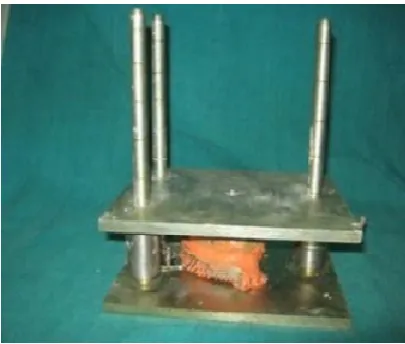
[image:2.595.330.540.222.393.2]attach the stock metal rim-lock trays of same size U-1 with a screw in repeatable reference position with two lateral metal screws to prevent the tray from lateral movements during impression procedure (Figure 2,3). To the upper metal plate, the brass master model was attached and the plate consisted of three holes corresponding to the guide post which allowed the upper plate to slide smoothly along the guide post to meet the impression tray in the lower plate. Three removable vertical metal stops were attached to the guide post to limit range of motion of the upper plate, so that, it controls the seating of master model against the tray in a consistent position for all impressions made. The upper plate was attached with a metal screw to prevent dislodgement of the plate and also to control the plate anywhere along its sliding path in the guide post.
[image:2.595.334.535.419.574.2]Fig. 1. Master model with abutment-a,b,c
Fig. 2. Master model with impression zig apparatus
[image:2.595.332.535.599.771.2]Fig. 4. Alginate impression of the master model
Fig. 5. Impressions stored in air sealed plastic bag
Fig. 6. Cast poured with Type IV Gypsum
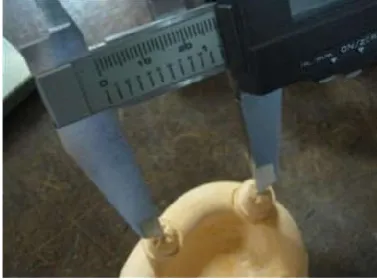
Fig. 7. Dimensions measured with vernier caliper
The Master model along with the zig was taken and the rim lock tray was attached with screw on the lower plate and positioned so that the upper plate with the master model obtain a 3 mm space all around the tray by the help of vertical stops present in the guide post. The alginate impression material was then weighed and hand mixed in water/ powder ratio (Algitex-23gm/100ml distilled water, Cavex CA37-21.2gm/46ml, Neocolloid-23gm/100ml) according to manufacturer’s instructions for 30 seconds and placed on the tray. The upper plate with the master model was then guided to slide slowly downwards along the post until it was stopped by the vertical stops to meet the tray with alginate impression material. The impression with the tray was kept for 1 minute until it was set and then the master model was removed from the impression in one stroke. The impression of the master model was kept in three storage period 30 minutes, 12 hours and 24 hours in an air tight packet with a wet cotton roll inside to achieve a 100% relative humidity (Figure 5). Type IV dental stone–Die stone (Pearl Stone, Asian chemicals, Gujrat, India) was hand mixed for 10 to 30 seconds using 25 ml of distilled water per 100g of gypsum powder and poured. After 45 mins (final set), the gypsum cast was retrieved. All cast fabrication was done by single operator. The linear dimensions between the three abutments in the master model and in the casts obtained were measured with help of a electronic vernier caliper (Mitutoyo, Kawasaki, Japan 0.01mm accuracy). The interabutment distance between the junction of cross hair lines of AB, AC and BC were measured (Figure 7).
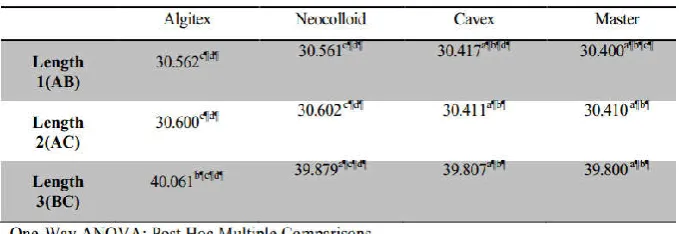
The One way analysis of variance were used (ANOVA) for comparison of dimensional accuracy of cast obtained from the three types of alginate impression materials after three different storage periods. The level of significance was set at p<0.05.The mean linear measurement of the inter-abutment distance in the master model are AB-30.40 mm, AC-30.41 mm, BC39.80 mm. These linear measurements are compared in the result with the casts obtained from the three alginate impression materials in different pouring time.
RESULTS
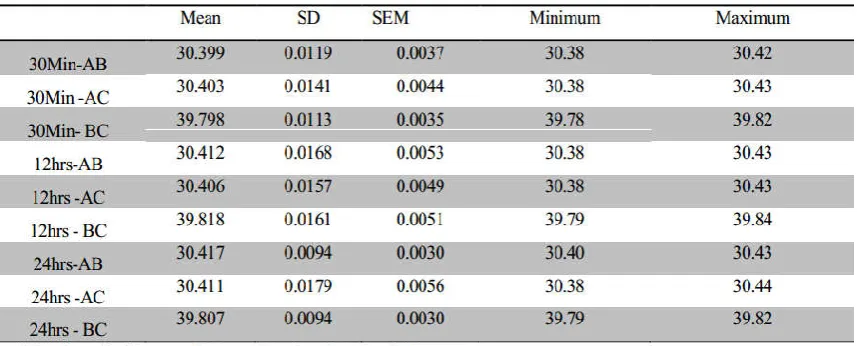
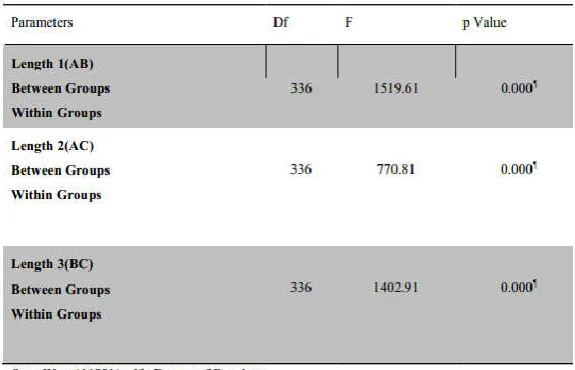
The mean value of each inter-abutment distance AB,AC,BC of all three alginate impression materials at three different storage periods were tabulated and statistically analysed (Table I,II,III). At 30 minutes of storage period there was no significant difference in dimensional changes between the three alginates p>0.05 (Table IV).At 12 and 24 hours of storage period significant dimensional changes were found between the three alginates p<0.05 (Table V, VII). Thus multi comparison test had been done in 12 and 24 hours to find out the alginates undergone most dimensional changes (Table VI,VIII). It was found that Cavex CA37 had undergone the least dimensional changes than the other two alginates in comparison with the dimensions of master model (Table VI,VIII).
DISCUSSION
[image:3.595.77.255.423.618.2] [image:3.595.69.258.644.784.2]Table I. Frequency Distribution Table for Algitex (mm)
Table II. Frequency Distribution Table for Neocolloid (mm)
[image:4.595.90.519.572.745.2]Table IV. Group Comparison of interabutment distance after 30 min
Table V. Group Comparison of interabutment distance after 12Hrs
Table VI. Group Comparison of interabutment distance after 12Hrs
*=p<0.05= statistically significant (SS); † =p<0.01= Highly Significant (HS); ¶=p<0.001= Very Highly Significant (VHS); a = compared with Algitex; b = compared with Neocolloid; c = compared with Cavex; d =compared with Master.
[image:5.595.152.444.446.520.2] [image:5.595.155.443.577.762.2]improvised alginate- Neocolloid and Cavex CA37 were taken These are taken in reference to previous studies where they compared the dimensional accuracy of conventional alginates with extended storage and found that the later gives more accurate dimensions than the former. (Mary P. Walker et al., 2010) In this study the storage period for the alginate impressions were 30 minutes, 12 hours, 24 hours. Based on the previous studies by Walk.P.M, the maximum recommended storage time of conventional alginate before pouring the cast is ranged from immediately to up to 30 minutes of storage. (Mary P. Walker et al., 2010; Deepa et al., 2010) Many authors have found that extended storage alginate impressions can be poured delayed up to 5 days and gives less dimensional changes if stored properly (Skinner and Pomes, 1946; Terence A. Imbery et al., 2010). It was found that the dimensional changes of alginate impressions at 12 hours and 24 hours are 0.06 % and 0.13 % respectively. 18 The previous studies shows that the linear dimensional changes of the impressions caused due to evaporation and imbibition of water if stored outside the environment. This can be prevented if stored in 100% relative humidity. The sealed plastic bag was used in this study are customised by keeping wet cotton inside the bag without contact with the impression or sprinkling water droplets inside the plastic bag in order to get 100 % relative humidity The brass master model used in this study were similar to that made by Alex Hoyos al. (Alex Hoyos and Karl Johan Soderholm, 2011) The brass master model is rigid, water insoluble and thus taken as control group that does not undergo change in dimensions at any storage time. The impression apparatus used in this study was standardised and customised from that described by Holtan and Alex (Alex Hoyos and Karl Johan Soderholm, 2011; Holtan et al., 1991) This is done to maintain an uniform thickness and minimizing the lateral stresses on the alginate impressions during taking out and thus preventing from dimensional changes. (Danish Muzaffar et al., 2011)
In the present study, stock metal rim lock perforated trays of similar size were used for all the impressions (Farzin and Panahandeh, 2010; Luis J. Rueda et al., 1996). This is due to the rigidity of the tray that can prevent from distortion during removal from the model it as reported by Lueda and Hoyos (Alex Hoyos et al., 2011; Mendez, 1985; Luis J. Rueda et al., 1996) Dimensional stability is the ability of a material to maintain accuracy across time. (Nicholls, 1977) The process that influences dimensional stability are the gelation properties and viscoelastic behaviour resulting in net expansion or shrinkage of the impressions followed by undersized or oversized casts. (Terence A. Imbery et al., 2010) In this study, no significant difference in dimensions among the conventional and extended storage alginates were found at 30 minutes of
storage time. This could be due to the fact that the elastic recovery of all the impressions takes place within 30 minutes. (Deepa et al., 2010) At 12 and 24 hours conventional alginate shows greater dimensional changes than the extended storage alginates. The loss of water from the interior of the material collapses the fibrillar cross-linked network (Stéfani Becker Rodrigues et al., 2012) and contraction of the impressions occurs towards the wall of the tray making the reference point to move farther apart (Brett.I.Cohen et al., 1995; Chiranjeevi Reddy et al., 2010; Terence A. Imbery et al., 2010). The extended storage alginates shows very less dimensional discrepencies at 12 and 24 hours. This is due to the fact that these alginates contain higher calcium to sodium ratios, high mannuronic acid content, higher ratios of filler to alginic polymer, differences in bound to unbound water, lower weight molecular-polymer chains, acidic pH, sufficiently high elastic limit and increased compressive strength. (Terence A. Imbery et al., 2010) The higher ratios of filler in the ingredients offers greater gel strength, helps in bound of water inside the gel resulting in less shrinkage and distortion. (Fellows and Thomas, 2008) The manufacturers have developed these improved “non shrinking” hydrocolloids simply by fine tuning of these parameters with addition of osmotic effective ingredients like crystalline sodium sulphate.31In this study, Cavex CA37 shows most dimensional accuracy than others followed by Neocolloid and Algitex, Cavex has 83.3 % filler particles and higher ratios of Ca: Na ratios in its ingredients31. The Cavex has also high elastic recovery of about 97% greater than recommended ISO1563 and A.D. Astandard 18.Many researchers though found the best dimensional stability of the alginate impression material, if poured immediately The results of our study and indicate that extended storage alginates – Cavex CA37, Neocolloid provides better dimensional stability than conventional alginate in extended pouring time if stored properly. Some limitations of this study can be identified. First the metal master model was used with least number of undercuts to prevent from distortion during impressions. Clinically undercuts in mouth can cause more distortion. Second, impressions were not subjected to disinfection procedure that might cause dimensional change. Third using stock tray instead of custom tray may affect in dimensions. Additional research in future is needed to determine how newer improvised alginate materials would respond to similar treatments.
Conclusion
[image:6.595.129.469.78.195.2]Within the limitation of this in-vitro investigation the following conclusions can be drawn:
Table VIII. Group Comparison of interabutment distance after 24 Hrs
1. All three alginate impression materials shows no significant difference in dimensional changes at 30 minutes storage period in comparison to very high significant difference at 12 hours and 24 hours of storage period
2. Improvised or extended storage alginates like Cavex CA 37 shows higher dimensional stability than other two conventional alginate neocolloid and algitex at all three storage period
3. The mean values of dimensions in general increases with storage time for all alginates, so to obtain best dimensional stability, immediate pouring is recommended
REFERENCES
Alex Hoyos and Karl Johan Soderholm, 2011. Influence of Tray Rigidity and Impression Technique on Accuracy of Polyvinyl Siloxane Impressions: Int J Prosthodont., 24:49-54.
Alka Patwa, Deval Shah, Sareen Duseja, 2012. The Effects Of Environment and Time Intervals On The Dimensional Stability Of Three Indigenously Produced Irreversible Hydrocolloids. NJIRM, 3(4) : 131-134
Arne Haug, Sverre Myklestad, Bjorn Larsen, Olav Smidsrod, 1967. Correlation between chemical structure and Physical properties of Alginates. Acta Chem Scand., 21,3,768-778 Brett.I.Cohen, Mark Pagnillo, BS.Allan.S.Deutsch, Bury Lee
Musikant: 1995. Dimensional Accuracy of Three Different Alginate Impression Materials. J Prosthodont., 4,3,195-199.
Brett.I.Cohen, MarkPagnillo, BS..Allan.S.Deutsch, Bury Lee Musikant, 1995. Dimensional Accuracv of Three Different Alginate Impression Materials. J Prosthodont, 4,3,195-199. Chiranjeevi Reddy.G, Anil kumar Gujjari, Shambhu. H.S. 2010. Influence of long term storage on the linear dimensional accuracy of improved alginate impressions-An in vitro study. TPDI, 1,2,34-37
Christina Erbe, Sabine Ruf, Bernd Wöstmann and Markus Balkenhol, 2012. Dimensional stability of contemporary irreversible hydrocolloids:Humidor versus wet tissue storage, J Prosthet Dent, 108:114-122.
Cook. W. 1986. Alginate dental impression materials: Chemistry, structure, and properties. J Biomed Mater Res., 20:1-24.
Craig, R.G. 1988. Review of Dental Impression. Adv Dent Res., 2,1:51-64
Danish Muzaffar, Syed Hammad Ahsan, Ashar Afaq, 2011. Dimensional changes in alginate impression during immersion in a disinfectant solution. J Pak Med Assoc., 61:6,756-759
Deepa T. Chandran, Dary C. Jagger, Robert G. Jagger and Michele E. Barbour, 2010. Two-and three-dimensional accuracy of dental impression materials: Effects of storage time and moisture contamination. Bio-Medical Materials and Engineering, 6, 243–249
Ekanem. E.E. and Akeredolu P.A. 2004. Disinfection of dental impression in teaching Hospitals in south Western Nigeria: Implications in the era of AIDS. Nig.Dent.J., 1,1,13-16 Farzin M. and H. Panahandeh, 2010. Effect of Pouring Time
and Storage Temperature on Dimensional Stability of Casts Made from Irreversible Hydrocolloid. J Dent, 7,4,179-184
Fellows, C.M. and G.A.Thomas, 2008. Determination of bound and unbound water in dental alginate irreversible hydrocolloid by nuclear magnetic resonance spectroscopy. Dent Mater, 1-8
Holtan JR, Olin PS. and Rudney JD. 1991. Dimensional stability of polyvinylsiloxane impression material following ethylene oxide and steam autoclave sterilization. J Prosthet Dent, 65: 519-525.
Jamani KD. 2002. The effect of pouring time and storage condition on the accuracy of irreversible hydrocolloid impressions. Saudi Dent J., 14, 3: 126-30.
Kenneth D. Rudd, Robert M. Morrow, and Robert R. Strunk, Kenneth, 1969. Accurate alginate impressions, J Prosthet Dent, 22,3,294-300
Kenneth J. Anusavice, 2003. Phillip’s Science and Art of Dental Materials. 11th ed. Saunders (Elsevier) publications. Luis J. Rueda, Jenny T. Sy-Munoz, W. Patrick Naylor, Chrales J. Goodacre, Marjiorie L. Swartz, 1996. The effect of using custom or stock trays on the accuracy of gypsum casts. Int J Prosthodont, 9:367-373.
Marker, VA. 1996. Hydrocolloid impression materials. In: Anusavice KJ, Phillips editors. Science of Dental Materials, 10th edition Philadelphia: WB Saunders; 111-137
Mary P. Walker; Jason Burckhard; David A. Mitts; Karen B. Williams, 2010. Dimensional change over time of extended-storage alginate impression materials. Angle Orthod., 80:1110–1115
Maya Davidovich Pinhas, Havazelet Bianco-Peled, 2010. A quantitative analysis of alginate swelling. Carbohydrate Polymers, 79, 1020–1027.
Mc Cabe J.F, Angus Walls. 1998. Impression materials: Classification and requirements. In: Applied dental Materials. 8th ed. Cambridge: Blackwell, 118-132.
Mendez AJ. 1985. The influence of impression trays on the accuracy of stone casts poured from irreversible hydrocolloid impressions. J Prosthet Dent, 54:383–388. Nicholls, J. 1977. Measurement of distortion: theoretical
considerations. J Prosthet Dent, 37,5,:578–86.
Powers. J.M. and Sakaguchi R.L. 2006. Craigs restorative dental materials. 13th ed. St Louis, Mo: Mosby Elsevier. Shaba, O.P., I.C. Adegbulugbe, O.H. Oderinu, 2007.
Dimensional stability of alginate impression material over a four hours time frame. Nig Q J Hosp Med., 17,1,-4. Skinner EW. and Pomes, CE. 1946. Synerisis in
Hydrocolloids. JADA, 33: 1253
Stéfani Becker Rodrigues Carolina Rocha Augusto Vicente Castelo Branco Leitune Susana Maria Werner Samuel Fabrício Mezzomo Collares, 2012. Influence of delayed pouring on irreversible hydrocolloid properties. Braz Oral Res., 26,5:404-9
Terence A. Imbery, Joshua Nehring, BS; Charles Janus, Peter C. Moon: 2010. Accuracy and dimensional stability of extended-pour and conventional alginate impression materials. JAIDA, 14,1:32-39
Toros Alcan; Cenk Ceylanog lub; Bekir Baysal, 2009. The Relationship between Digital Model Accuracy and Time-Dependent Deformation of Alginate Impressions. Angle Orthod., 79,30-36