LEARNING THROUGH THE INTEGRATION OF DIGITAL RESOURCES
*,1
Dr. Mohammed Elazami Elhassani,
1
Assistant Professor of Higher
2
Doctoral Training "Bioactive Molecules, Health and Biotechnology", Center for Doctoral Studies "Science and
Technology", LIRDIST, Faculty of Sciences Dhar Mahraz
3
Professor of Organic Chemistry (Organic Che
Didactics of Sciences and Technology, Faculty of Sciences Dhar Mahraz
ARTICLE INFO ABSTRACT
This research aims to
the learner in Morocco from the perspective of teachers and managers, focusing on the diagnosis of the barriers that interfere with the use of the information and communicati
infrastructure in the institutions of public secondary education. The conducted field research aimed at finding out the perspectives of the
selected a special sample of staff
facilities. I mean a multimedia room equipped with the horizon of knowledge of the level of efficiency of the actors and stand on the reasons for the imbalance. Is it attributed to the work of leadership in the formulation of strategies that are built away from the involvement of teachers in the field, or that flaw refers to professors and managers who tend towards waiting for solutions and lack of initiative private act? The research concl
professors and directors lacking the ways to manage digital resources and make use of it. This is due to ways that measure the digital resources in education and employment due to the poor institutio qualification and the quality limitations.
Copyright©2017, Dr. Mohammed Elazami Elhassani et al
permits unrestricted use, distribution, and reproduction in any medium, provided the original work is properly cited.
INTRODUCTION
The information and communication technology brought to the world today is a sharp shift of community
connotations of meaning. It has covered all walks of life and marked our society thanks to its trio: computer technology and communication systems (Pasha, 2009), Engineering Automatic Control (Alarabawi, 2000), and fast changes in everything, where the technologies feed on each other to the accumulation of discoveries and inventions as a ball of snow rolling. All around us has become digital par excellence, and the space turned to volatile numbers here and there, a carrier of billions of information and data where it linked the ICT computers to each other thanks to the Internet to facilitate access to information and emancipation to become accessible to all, and
*Corresponding author: Dr. Mohammed Elazami Elhassani,
Assistant Professor of Higher Education. Regional Centre of Training and Education (CRMEF), Fès – Meknes Region
ISSN: 0975-833X
Article History: Received 03rd March, 2017
Received in revised form 12th April, 2017
Accepted 18th May, 2017
Published online 30th June, 2017
Citation: Dr. Mohammed Elazami Elhassani, Youssef NAFIDI
the moroccan educational system”, International Journal of Current Resea
Key words:
Secondary Education, Integration of ICT, Teacher, Director, Training, Genie Program, Digital resources.
Available online at http://www.journal
RESEARCH ARTICLE
THE INTEGRATION OF DIGITAL RESOURCES IN THE MOROCCAN
EDUCATIONAL SYSTEM
. Mohammed Elazami Elhassani,
2Youssef Nafidi and
3Dr. Anouar Alami
Assistant Professor of Higher Education, Regional Centre of Training and Education (CRMEF),
Fès – Meknes Region
Doctoral Training "Bioactive Molecules, Health and Biotechnology", Center for Doctoral Studies "Science and
Technology", LIRDIST, Faculty of Sciences Dhar Mahraz – Sidi Mohammed Ben Abdellah University, Morocco
Professor of Organic Chemistry (Organic Chemistry Lab (LCO), InterdisciplinaryLaboratory of Research in
Didactics of Sciences and Technology, Faculty of Sciences Dhar Mahraz –Sidi Mohammed Ben Abdellah
University, Morocco
ABSTRACT
This research aims to shed light on the issue of the employment of digital resources for the benefit of the learner in Morocco from the perspective of teachers and managers, focusing on the diagnosis of the barriers that interfere with the use of the information and communicati
infrastructure in the institutions of public secondary education. The conducted field research aimed at finding out the perspectives of the professors and directors of these institutions.
selected a special sample of staff having a great deal of information and communication technology facilities. I mean a multimedia room equipped with the horizon of knowledge of the level of efficiency of the actors and stand on the reasons for the imbalance. Is it attributed to the work of leadership in the formulation of strategies that are built away from the involvement of teachers in the field, or that flaw refers to professors and managers who tend towards waiting for solutions and lack of initiative private act? The research concluded that among the most important outcomes, we find the professors and directors lacking the ways to manage digital resources and make use of it. This is due to ways that measure the digital resources in education and employment due to the poor institutio qualification and the quality limitations.
. Mohammed Elazami Elhassani et al.This is an open access article distributed under the Creative Commons Att use, distribution, and reproduction in any medium, provided the original work is properly cited.
The information and communication technology brought to the world today is a sharp shift of community with all its connotations of meaning. It has covered all walks of life and marked our society thanks to its trio: computer technology and Engineering Automatic Control (Alarabawi, 2000), and fast changes in everything, where the technologies feed on each other to the accumulation of discoveries and inventions as a ball of snow rolling. All around us has become digital par excellence, and the space turned to volatile numbers here and there, a carrier of billions ation and data where it linked the ICT computers to each other thanks to the Internet to facilitate access to information and emancipation to become accessible to all, and
. Mohammed Elazami Elhassani,
Higher Education. Regional Centre of Training
to move on to the knowledge society. Information and telecommunications technology have broken down barriers between states and canceled visa regime on the passage o information. So, the space became cultural globalized and the social changes started with all its effects in one area or across the globe, moving from place to place at lightning speed. become useless to go on with an education that does not take all this into account, and today’s school
methods and renew it to keep pace with the world around us. It is unreasonable to has the world outside of its walls invaded by technology with all its powerful potential (the power of image, sound and movement and access to the worlds of three dimensions) at the time when this school is surrounded by rigidity and tradition where there is neither excitement nor suspense (the world of four walls, a blackboard, chalk and dust). It is a state of virt
sophisticated reality, a world of
communities outside the school walls, and misery inside.ICT has imposed on all countries, including Morocco, to reconsider
International Journal of Current Research Vol. 9, Issue, 06, pp.52809-52818, June, 2017
. Mohammed Elazami Elhassani, Youssef NAFIDI and Dr. Anouar ALAMI, 2017. “Learning through
International Journal of Current Research, 9, (06), 52809-52818.
Available online at http://www.journalcra.com
IN THE MOROCCAN
Dr. Anouar Alami
Regional Centre of Training and Education (CRMEF),
Doctoral Training "Bioactive Molecules, Health and Biotechnology", Center for Doctoral Studies "Science and
Sidi Mohammed Ben Abdellah University, Morocco
mistry Lab (LCO), InterdisciplinaryLaboratory of Research in
Sidi Mohammed Ben Abdellah
shed light on the issue of the employment of digital resources for the benefit of the learner in Morocco from the perspective of teachers and managers, focusing on the diagnosis of the barriers that interfere with the use of the information and communication technology’s infrastructure in the institutions of public secondary education. The conducted field research aimed at professors and directors of these institutions. To this end, we having a great deal of information and communication technology facilities. I mean a multimedia room equipped with the horizon of knowledge of the level of efficiency of the actors and stand on the reasons for the imbalance. Is it attributed to the work of the leadership in the formulation of strategies that are built away from the involvement of teachers in the field, or that flaw refers to professors and managers who tend towards waiting for solutions and lack uded that among the most important outcomes, we find the professors and directors lacking the ways to manage digital resources and make use of it. This is due to ways that measure the digital resources in education and employment due to the poor institutional
is an open access article distributed under the Creative Commons Attribution License, which
to move on to the knowledge society. Information and telecommunications technology have broken down barriers between states and canceled visa regime on the passage of information. So, the space became cultural globalized and the social changes started with all its effects in one area or across the globe, moving from place to place at lightning speed. It has become useless to go on with an education that does not take and today’s school has to develop its methods and renew it to keep pace with the world around us. It is unreasonable to has the world outside of its walls invaded by technology with all its powerful potential (the power of image, nd and movement and access to the worlds of three-dimensions) at the time when this school is surrounded by rigidity and tradition where there is neither excitement nor suspense (the world of four walls, a blackboard, chalk and dust). It is a state of virtual schizophrenia between a sophisticated reality, a world of World -per-click and virtual communities outside the school walls, and misery inside.ICT has imposed on all countries, including Morocco, to reconsider
INTERNATIONAL JOURNAL OF CURRENT RESEARCH
the educational curricula and perceptions of its educational systems in relation to what it wants from the graduation of learners and the changing conditions of community
development. The integration of information and
communication technology in education became a key pillar either at the level of facilitating education or at the level of development of the methodological and technological potential of the educated strengthening their abilities of self-learning and to adapting to changes and launching initiatives to bring about the desired societal advancement. Based on this vision, the National Charter for Education and Training (The kingdom of Morocco, Special committee for education and training, 1999). in its tenth pillar calls for the integration of information and communication technology in education, and this is what the government clarified in an ambitious program called the program of dissemination of information and communication technology in the educational field Genie (the kingdom of Morocco, Genie Directorate, 2006). Genie program was launched with a vision that is based on three main axes, which are equipment, training and the production of digital resources program. It began laying the infrastructure of educational institutions present in multimedia halls linked to the Internet network on the one hand, and the rehabilitation of human resources - teachers and teachers in particular - over the composition in the use of ICT adoption multiplier configuration, on the other hand. However, the section of the production of digital content remains postponed if we exclude betting on what it was possible to result in formations received by the actors or produced by teacher’s innovators or what is broadcast on the Internet. In addition, the Ministry of National Education of Morocco pursued the policy of encouraging excellence, innovation and creativity. Therefore, it has launched a number of initiatives in partnership with international interferers from the American Aid Program USAID, Microsoft Intel, Microsoft Intel, UNESCO, the United Nations Development Program PNUD, and the Korean Agency for International Development KOICA. Despite all of the above mentioned, the learner continued in looking forward to a vibrant school. The implementation of the new roles of the school – with all what this change demands of new habits and double efforts under a conservative educational environment- is not easy, but it may clash with a fierce resistance for change from many actors who are not yet convinced of its importance for one reason or another. In this regard, we have tried in this research to shed light on the issue of the employment of digital resources (Tennant, 1999) for the benefit of the Moroccan learner, focusing on the diagnosis and exploration of barriers through a field study aimed at representations of visions of professors and managers who work in the institutions of multimedia halls
Theorical Framework
The information and communication technologies are known as a set of tools, and devices that provide storage and processing of information and then retrieving it, as well as delivering it via the various communication devices to any place in the world, or received from any place in the world (Stevenson, 1997). Objectives of ICT investment and employment of digital resources in education are multiple. Excitement and suspense are important elements for the success of the educational process of learning as they are relied on to bring the attention of the learner to make him an active and motivated participant. In addition, we make him psychologically relaxed to follow up the lesson without feeling
bored and ensure smooth achievement process. The elements the learner’s excitement are many: a picture, sound, movement and color (Azeemi and Raza, 2005). In the educational process, we need, when concepts are abstract or complex, simplification. It may be, for example, the use of mind maps (Alduweish, 2011; Rassas, 1987) so that we draw the network of relationships and explain the links. As we need to rectify notable weakness among a certain class of students. Moreover, learners need special skills to integrate into a knowledge society where the fundamental communication and sharing of knowledge is necessary in light of the flood of information. Updating knowledge as become, from day to day and even from hour to hour for those who want to keep pace with his age, inevitable or he will lose many bets. Accustoming learners to adopt self-learning strategies (Albakri, 2007) has become one of the key concerns of the teacher in order to free them to build self-knowledge on the one hand, as well as starting to satisfy their cognitive thirst without the need for external intervention on the other. Digital resources are broadcast on the Web to entice with its adoption of the differential theory (Robbes, 2009; Meirieu, 1996) in the learning depending on the learner's ability to comprehend and produce. Among the basics of a knowledgeable society is the enlightenment of the learner concerning the ways of dealing with the information; searching, summarizing, reducing, sifting and detecting. Moreover, this is a knowledge that will provide them the speed in accessing information and efficiency in choosing the best, checking its sources (Mohammed Abdel Salam, 2013). Because of the learner’s use of Digital Resources.
of mechanisms devised by designers of sites and Internet experts to gain access to information. The search for digital resources using search engines are starting clicking on the Internet browser and typing a search engine URL, and then enter the key words in the search box. Search engines are known as (Sounboul, 2001) as "a software program designed to help find stored on Informatics World Wide Web networks documents (World Wide Web) or on a personal computer. The first search engines were built depending on the techniques used in managing classic libraries. Indexes are built(Index) for documents which form the basis of the data useful in the search for any piece of information via the use of the pioneers of the network for key that is specific for the targeted topic.
Among the most famous search engines: Google, Yahoo.
For research, techniques are multiple it depends on:
Search techniques using Boolean logic (Paul George,
1847)
Find using file extensions
Find properties using the Advanced Search
Find using hyperlinks
Social networking and file-sharing sites
The ways of searching for Digital resources take several forms depending on the storage area. The step taken for teacher training in research methods via the internet or on different disks important in view of the ability to surf the net purposefully to download or share these various resources in order to employ them in the teaching-learning process. Despite the vast amount of resources, however, poses some challenges for the teacher: the challenges in the ability to classify and evaluate it through amending its content to harmonize with the underlined objectives. As for evaluating digital resources, the teacher needs to focus assessing digital resources that should be used to achieving educational and scientific goals that are behind integrating it in the teaching-learning process. In this, it needs a scientific assessment via networks based on exact standards and indices. Today, the existence of multi-media room is considered a qualitative development in educational institutions on the path of development of educational practice learning. It is a space for interactive digital technology and communication allow learners trading various forms of information-rich digital resources (images, video links, sounds, texts) that need to be part of a template to employ them. Which makes the teacher forced to develop educational practices towards investing the creative energies of his students through their accomplishments of projects (The Ministry of Education and training of Tunisia, 2006). You can employ digital learning resources in the project via using digital resources as tools to get the other, either through research or communication. Service-interventions of digital resources are multiple in the learners' projects facilitating it first to accomplish these projects adding to that the communicative, creative and productive services that are present not only in the product, but go beyond that to the production tools themselves.
MATERIALS AND METHODOLOGY
Morocco has participated in an ambitious program to integrate ICT, especially the integration of digital resources in the classroom practice, and we recognize a clear slowness in innovation in educational practice. To detect the causes behind
this slowdown, we will try in this research to answer the following questions:
What is the infrastructure, in terms of information and
communication technology, available in secondary education institutions?
How formations cover the information and
communication technology for all teachers?
How familiar teachers are with the modern technologies
in ways that measure digital resources and employment in educating in the light of poor infrastructure for
information and communication technology
infrastructure investment?
What are the avenues available to teachers for digital
resources?
To what extent teachers are able to align digital
resources to the needs of the learner.
This research will be an analytical study of the status of the management of digital resources and employment in educating learners in Morocco, and then we will study and collect documentation available about the Genie program, especially with regard to digital resources, as well as the collection of field data by employing social survey method with a sample. In order to answer research questions, we put a questionnaire for managers and another for teachers in institutions of public education in High School preparatory and qualifying school. The questionnaire was adopted as a form of scientific research (Alassaf, 1992), which helped us to collect the appropriate data.
The data was collected through a distributed questionnaire after getting permission from the Regional Academy of education and formation for Fez-Boulmane region. The teacher’s questionnaire consists of 15 questions and manager’s questionnaire of 7 questions; some of these questions are closed and others are open focusing on the following themes:
Personal information
Infrastructure for information and communication
technology
Investment of teachers for multimedia room
Teachers configurations for the use of information and
communication technology
Digital resources and ways of accessing it
The alignment of digital resources to the needs of
learners
Pedagogical employment of digital resources
(pedagogical scenario)
of physics, chemistry, mathematics, science, and history and geography subjects, representing 10% of the total professors of these institutions and 15 managers representing 100% of the total of the number of managers in these institutions. All this gave us a realistic picture, and nearly 85% of teachers and 100% of managers responded.
RESEARCH FINDINGS
The scientific identification of the extent of teachers’ knowledge about the ways of management and employment of digital resources in teaching needs, in light of the weakness of the existing investment in information and communication technology’s infrastructure structures, a conducted field study in order to identify the reasons behind all that. In this section of research, we will focus on providing our findings presenting information and knowledge on the subject that we have accumulated whether through our personal experience or through the obtained documents during periods of study accomplishment. All of this is for the aim of getting out with conclusions and deductions that may allow us to give some recommendations on the topic.
Results of the directed application form to the managers
Table1. Director’s data by Gender and Age
Age Gender
Data
51-60 41-50
31-40 Women Men
10 5
0 2 13 Frequency
66,60% 33,40%
0% 13,33%
86,66% Percentage
We can see that the ratio of males represents 86.66 percent and the group of an age limited between (51 and 60 years old) exceeds 66.60 per cent the fact that explains the luck of embarking on initiatives that may require efforts, movement and taking responsibilities bearing in mind that all managers have a bachelor degree.
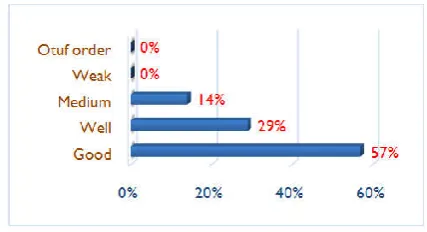
86.00% of managers reported that they have one multi-media room in the institution. 13.40% also said that the number of computers Hall is (six computers), while 20.00% said that, the number in their institution is (14 computers). At the time when 66.60% reported that, the number of computers is (21).The variation in the number of computers is explained to be linked to the number of learners in those institutions. On the other hand, and with regard to the access to the Internet, 26.70% reported that the service is available in the room. In terms of assessing the quality of computers, the managers reported that (57%) of computers are good, 29% are not too bad and 14% are medium. We record low rate of investment of the multimedia hall. 46.60% of the directors have said that the hall only “sometimes” used while 13.40% said that these halls are
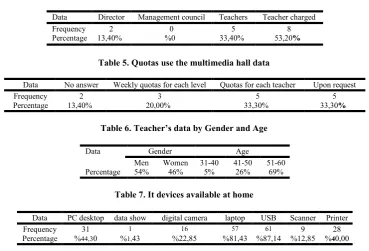
[image:4.595.324.538.190.306.2]never used. On the other hand, we note that 60.00% of managers stated that they have the Charter of the conduct of the hall. The problem of the management of the hall is visible and clear in the statement of 13.40% of the respondents that "the director is the manager" and 33.40% said that "teachers are the managers", while 53.20% said that "charged teacher is the manager" with no contribution of to "management council" in any proportion in the management of the hall, and this raises a question mark over the understanding of the educational administration of the roles of the Council and its activation in the creating collective solutions to the problems of institutions.
Figure 1. Computer classification by Directors
The above mentioned problems at the level of the management is enhanced by what the interviewees said in terms of how they distribute sessions of access to the hall on teachers every week. It was received by 13.40%, and the rest answered that they manage it weekly with the rate of 20.00% for the weekly sessions customized for each level, and 33.30% for the sessions customized for each teacher adding to that 33.30% for the weekly-managed sessions depending on demand.73.20% of the managers see that the way of getting digital resources is to "tell the officials to expedite the sector by providing them with digital resources", while the percentage of those who relied on "special initiatives for acquisition" to raise this matter did not exceed 13.40%.
These figures show undoubtedly that total reliance on the ministry is still prevalent and that the management based on opening up on the entourage remains an initiative and not a vision that governs practices. Through an initial reading of the data above, we can see that the ratio of males represent 54%, while the proportion of females represent 46%. In addition, the proportion of the age group of the researched is between 51 and 60 years to 69%. Six percent of the total respondents said that the condition and type of computers is very good, 38% of them said that it is good, and 21% of them said that it is medium. In addition, in its total represents 65% of respondents and these are important rates that proves the usefulness of computers for investment.
Table 2. Data about multimedia halls
Internet service Number of computers by institutions
Number of multimedia halls in school Data
No Yes
21 14
6 1
0 Number of available material
11
4 10
3 2
13 2
Frequency
%73,30 %26,70
66%,60 20,00%
%13,40 %86,00
%14,00 Percentage
Table 3. Data on the use of multimedia hall
The degree of use of the multimedia hall Charter multimedia hall
Data
Never Rarely Sometimes
Often Always No
Yes
2
0
7 4
2 6
9 Frequency
%
13,4
0%
46,6% %
26,6
%
13,4
%
40,00
%
In terms of personal gear, 44.30% said that they have office computers, 81.43% have laptops and 22.85% said they have access to digital photographers. The surprise in all this is that the data revealed that 1.43% had access to a projector hardware, which is an important proof that helps to adopt the information and communication technology in the educational process in preparation and achievement. Moreover, the presence of all this gear is explained by many factors, including:
The insistence of the professors’ children on their
parents to acquire these tools and means to be in terms with the developed age.
The steady decline of the cost of this gear.
facilitating social institutions of education to get gear
informational programs such windows and achievement as a support to the program of Genie
[image:5.595.112.482.61.312.2]Despite all that, the data provided have shown a low rate of access to halls of 11%, and the amount of access is lower where the percentage of access is 8%once a week. While the percentage of who enter the hall more than three times does not exceed 2%.
Figure 2. Computer classification by Teachers
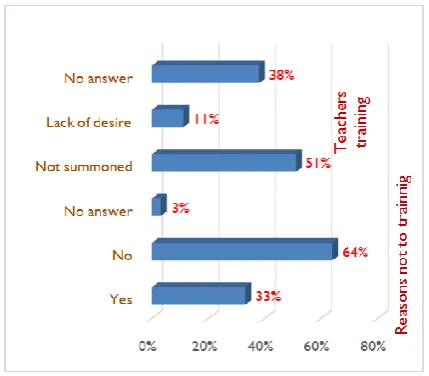
If we compare between the answers of directors and the ones of teachers concerning the use of halls, we will notice that there is a difference in the answers due to the responsibility of each category.64% of the respondents said that they were not subjected to any configuration, and 51% of them said that they
were not called up for training. These shocking statements show the big failure of the followed strategy in the configuration. In addition, it reveals the extent of the gap between this axis and the axis of processing. The percentage of 11%, which expressed its "unwillingness to configuration", shows that the resistance to change is due to the weakness of sensitization or advanced age for teachers.
Figure3.Exploitation of the multimedia rooms
As for the quality of training, 82.60% of the teachers who benefited from the training said that they have undergone the basic formation in informatics. It is a technical formation par excellence where the participant recognizes the basics of employment running some of the programs as a package (Office), and the Windows operating system (Windows) with no focus on pedagogical and creative side the idea that reflects their inability to develop pedagogical activities to use computers properly. On the other hand, we record that it is only the proportion of 14.50% that spent from its own money for self-formation itself and competencies development. From the table, It is shown that the proportion of 74% benefits from the configuration and employed by digital resources while 21% are not employed for reasons already mentioned such as poor Table 4. Management of multimedia data hall
Teacher charged Teachers
Management council Director
Data
8 5
0 2
Frequency
%
53,20 %
33,40 0
% %
13,40 Percentage
Table 5. Quotas use the multimedia hall data
Upon request Quotas for each teacher
Weekly quotas for each level No answer
Data
5 5
3 2
Frequency
%
33,30 %
33,30 %
20,00 %
13,40 Percentage
Table 6. Teacher’s data by Gender and Age
Age Gender
Data
51-60 41-50 31-40 Women Men
69% 26% 5%
46% 54%
Percentage
Table 7. It devices available at home
Printer Scanner
USB laptop digital camera
data show PC desktop
Data
28 9
61 57
16 1
31 Frequency
%40,00 %12,85
%87,14 %81,43
%22,85 %1,43
[image:5.595.58.271.595.706.2]training or lack of relevance of the educational needs in addition to the lack of digital resources, which cover only limited materials and in a few levels.
Figure 4. Teachers training
The quality of the integration of digital resources by the sample used in teaching knows the dominance of the use of vibrant resources which give a sense of life, and this is what the child needs; such as videos by 50.00% and image by 47, 14% because of its dimensions, facility, and the multiplicity of employment within many of office programs such as the programs: Word, PowerPoint, and texts by 31.43%.
However, we note the lack of the use of interactive simulations as applications by 1.43%. This may be due to the weakness of the configuration in ways of searching, ways of downloading, sound, simulation or lack of knowledge of the ways of including video files in the office software. To know all this, we put questions about the use of the Internet.11.43% said that they" always" use the Internet for digital resources and 41.43% "often declared," and it is the ratio that reflects the importance of the Web as a source of digital resources. The above table shows that the adoption of CDs acquired from the presence of the interviewer sample is "sometimes" increased by 11.43% and this may be due to a lack of these drives in libraries on the one hand, or due to not harmonizing many of the contents of the Moroccan educational curriculum on the other hand. The
[image:6.595.315.553.124.229.2]use of the disks provided by the ministry did not enter only at the beginning of the year 2011, and it was reinforced with the distribution of digital bag although only a few of those contents and levels covered by the institutions that have been distributed.
Figure 5.Digital resources used
This what explains the likely proportion of 7.14% who did not use it, but we on the other hand, note that a significant number of the interviewed teachers; a rate that reaches 32.86%, expressed its permanent, most of the time or sometimes use of the disks. Over 37.14% of the respondents reported "always" using search engines for digital resources, while (22.86%) expressed their "often" use. This is logical in view of the important and pivotal role they play in the delivery of search engines for surfers to reach their goal. Despite the importance of the e-mail in sharing information, URLs and files bilaterally or in groups, we find a medium percentage of the respondents to about 25% often or sometimes uses it while the percentage
of those who do not use it reaches 10.00%, and all this is due to the lack of awareness-raising capabilities of these tools and the potential offered by the user. The remaining low percentage uses chat to receive the file and send it by 4.29%, and which is cast in the column "Sometimes". It is understandable given the fact that this tool has always been geared for dialogue and exchange of views and news on the one hand, and it is considered a personal tool not invested for educational functions of the other. The answer with "never" reflects the lack of creativity of the 17.14% of the respondents to develop some tools to expand the functions intended for educational services. The coming Questions come to investigate the ways in which the sample of respondents use the search engines that are considered a way of getting into Table 8. Type training
Self-formation Professional Development Program
Program Intel Initial training computer
Data
% 14,50 % 4,34
% 0 %82,60
[image:6.595.100.496.425.585.2]Percentage
Table 9. Use of digital resources by training beneficiaries
Data
Yes No No answer Percentage
74% 21% 5%
Table 10. Data internet use
Never Scarcely Sometimes
Often Always No answer
Data
%
1,43 % 1,43 % 12,86 % 41,43 % 11,43 % 31,43 Percentage
Table 11. Use acquired discs by teachers to get digital resources
Never Scarcely Sometimes
Often Always No answer
Data
%
5,71 % 8,57 %
11,43 % 2,86 0 % %
digital resources. A very important amount of respondents of 40.00% said that it "Always" uses the searching fields whereas20.00% “often” uses it. These percentages reflect the importance of these search fields because of its pleasing and easy use.
In the same vein goes the question about the results of the use of extension files. 17.14% of respondents that ‘said they sometimes use this way while 10.00% said that they do not. As for the use of advanced search, we record an increase in the interviewee’s sample that responded with "sometimes" with a percentage of 21.43%, while the proportion of respondents with "never" represents 5.71% compared with the previous
questions. This can be explained by the adoption of the Advanced Search on a clear hyperlink to access the page choices with the use of drop-down lists accompanied by explanations, thus, facilitating the selection by clicking on the desired characteristics.
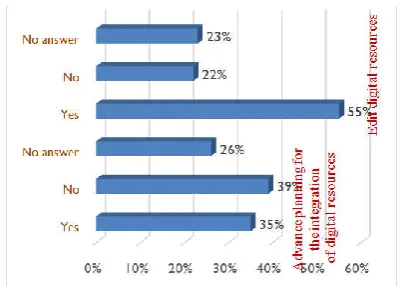
The graph shown above shows that the percentage of those who lead the digital resources to fit the needs of their students is limited to 35%, reflecting the weakness of the given formation that does not suit the teachers’ needs in the classroom. In planning for the integration of systematic digital resources in teaching, we note that 55% of the respondents said that they rely on it, while the stated 22% say that they do not Table 12. Use search engines to get digital resources
Never Scarcely
Sometimes Often
Always No answer
Data
%
0 %
0 8,57% 22,86%
37,14% 31,43%
Percentage
Table 13. The email for the occurrence on the digital resources
E-mail useto get digital resources Data
Never Scarcely Sometimes
Often Always No answer
%
10,00 %
0 %
10,00 % 15,71 %
0 % 64,29 Percentage
Table 14. Use chat to get digital resources
Never Scarcely Sometimes
Often Always No answer
Data
%
17,14 % 5,71 %
4,29 %
0 % 0 %
72,86 Percentage
Table 15.Use extension files to get digital resources
Never Scarcely Sometimes
Often Always No answer
Data
10,00%
4,28% 17,14%
2,86% 1,43%
64,29% Percentage
Table 16. Use Advanced Search to get digital resources
Never Scarcely Sometimes
Often Always No answer
Data
5,71%
1,43% 21,43%
2,86% 1,43%
67,14% Percentage
Table 17. Educational grid use in the pre-planning for the integration of digital resources
Educational grid use in the pre-planning for the integration of digital resources Data
Never Scarcely
Sometimes Often
Always
%
32,9 %
1,43 5,71%
%31,43% 28,57%
Percentage
Table 18. Use of own scenario grid in the pre-planning for the integration of digital resources
Never Scarcely
Sometimes Often
Always Data
%
50,00 %1,43
% 5,71 %35,71
% 7,14 Percentage
Table 19. Encourage learners to use digital resources
Yes No
No answer Data
32,00 % 48,00%
20,00% Percentage
Table 20. Achievement of learners to projects using digital resources
Data
Never Scarcely
Sometimes Often
Always
%
40,00 %
21,43 %
14,29 17,14% %
7,14 Percentage
Table 21. Achievement of learners to research using digital resources
Data
Never Scarcely
Sometimes Often
Always
%
11,43 %
0 % 27,14 %
35,71 %
do so, which means that digital resources are used randomly and not subject to methodological steps that are clear and exact. 60.00% of the respondents Said that they always or often rely on planning using pedagogical-fiber; that is to say, they refer only to the use of digital supplier and its objectives and perhaps time would take its incorporation in the ration with references to the activities of the learners.
Figure6. Use discs being provided by the ministry to get digital resources
[image:8.595.54.269.148.279.2]
Figure 7. Use the search engines to get digital resources
Figure 8. Modulation and integrating digital resources
Figure 9.Achievement of learner’s interactive exercises using digital resources
As for the question of pedagogical scenario, 35.71% of respondents have answered the interviewer that they often rely on scenario fiber; the special one that highlights action from A
to Z. At the time When only the proportion of 7.14% that uses it permanently. These percentages reflect the quality of training and its weaknesses. In terms of teachers’ encouragement of their students to use digital resources and get familiar with the computer and the Internet, 48.00% of respondents said that they do, as opposed to 32.00% of them. These percentages show the development of the performance of teachers towards the adoption of modern technologies in the revitalization of learning. Animation itself still does not reach to the ambitions desired in terms of quality. It is not based on the creative side present in projects’ accomplishment. Only 7.14% in the respondents’ sample has said in this regard that they «always" encourage their students on the completion of projects relying on digital resources compared with 40.00% who "never" do support this approach. The reason for this lies largely in the weakness of raising awareness of the importance of teaching using active and creative ways. The ministry’s encouragement and its adoption of forums that examine these issues and assess its workshops where teachers share examples of good practices and even invent others, remains weak. The encouragement of learners to do research using digital resources remains of great importance for the respondents’ sample. This is "always" carried out by 25.71%, "often" by 35.71% and "sometimes" by 27.14%. In addition, these percentages are important showing the encouragement to promote research competencies of the learner by adopting sources from outside the classroom, and cracking the idea that the teacher is the owner of knowledge. The graph above shows low rates with respect to the adoption of the respondents to complete the exercises for learners using interactive digital resources. This is "always" done by 11.43% and «often by 12.86%. This is due mainly to the weakness of the configuration that supports teacher training on the production of interactive exercises with simple programs.
DISCUSSION
First conclusion: through the collection and analysis of statements made by the sample respondents, we found that the problem does not lie in the weakness of infrastructure that can be considered a good given what is available of a gear at the level of halls or at the level of what the teachers themselves own. But, it is mainly due to an imbalance in the management of the work of those structures, structures of existing institutions such as the Council measure that does not invest in innovation to activate the work of multimedia solutions for the hall in order to obtain digital resources or used in teaching, which makes us wonder about the leadership role for managers. The second conclusion: the respondents confirmed what our research hypothesis suggested Find; about 64% of the teachers were not subjected to any composition highlighting why they are not called up for training, or the lack of desire to do so or for other reasons. In addition, those who have undergone training showed unsuitable quality for the employment of digital resources. 82, 60% of them have benefited from "the foundation training in informatics," a composition of a technical search that teaches the ABCs of dealing with the computer. While only 4.34%who benefited from the "Professional Development Program". On the other hand, the statements of respondents who employ digital resources revealed the very modest abilities to handle search, Downloads and amendment and this is clear in the following:
Abundant employment of image and videos while there
[image:8.595.62.265.423.566.2] The use of the Internet for digital resources with low efficiency, not using in their search via the Internet the extension of the files, and the Advanced Search only with low proportions.
Low suitability and adjustment for digital resources.
Poor planning for the systematic integration of digital
resources in teaching using the pedagogical scenario.
The weakness of their investment for digital resources
in the completion of projects with learners.
The weakness or rather the absence of configuration in addition to the lack of provision of the Minister in charge of the developed pedagogical digital resources meant only for teaching in educational institutions keeping pace with the curriculum, largely explains the weakness of the investment of multimedia halls. 87% of the respondents stated that they do not benefit from it and that 8% of those who use it benefit from it only once a week. So what will be brought to learners in these halls? One of the obstacles against the employment of digital resources in teaching, we find the school’s timetable. Majority of teachers express their unwillingness to volunteer outside the quotas intended for formation or the use of multi-media hall. Finally, with regard to the needs of the respondents, over 71.43% of them expressed their desire to provide a computer and over-head projector for the teacher, which reinforces our conviction that the problem of moving toward the hall in conjunction with the use of time is present and strong. At the time when 45.71% of them ask for providing digital resources through the completion of an electronic portal. With the exception of what the professors provided of other resources put by Genie program in the hard drives of computers and multimedia hall, we do not find managing innovations in this regard on the level of the educational administration and the Council of management. Concerning the holding of Forums to raise awareness about the importance of digital resources and taking advantage of formations for a perfect investment in digital resources, it has been expressed with a percentage that exceeds 57.14%.
Conclusions & Recommendations
This research deals with an important educational subject that focuses on trying to find out the real problems that hinders the investment of the infrastructures meant for information and communication technology, especially the integration of digital resources in the classroom practices. Our goal was to stand over the educators' knowledge in ways that measure digital resources and employment in education. Especially since the digital resources are an essential rib in the integration of
information and communication technology triangle
(infrastructure, formation and digital resources), and we cannot talk about the integration of these technologies in the education of learners if One of these ribs is misfired. To conduct our research, we chose our sample from an environment that consists of informatics: multimedia rooms for a great focus on the human element and his competencies. As we studied the collection of documents and data and the statements of the respondents, cast in the questionnaire, in order to identify the reasons for the imbalance. Is it because of the leadership in the formulation of strategies that are built away from the involvement of teachers in the field, or that the disorder is due to the professors and managers who tend to wait for solutions with no initiative? Our findings can be summarized as an answer to the problematic that is; the knowledge of teachers concerning the ways of managing and employing the digital
resources in teaching is very weak in its total. This is due to the weakness of the institutional configuration or to the quality limitations.
Depending on the findings and conclusions that have been reached, we offer several suggestions, and in light of what has been monitoring the problems, we suggest the following:
Work on the development of management councils to
look after the completion of a weekly timetable that integrates multimedia hall in the weekly teacher’s sessions so that the teachers show the half-days when they will use the hall to program their sessions accordingly.
Submitting a recommendation to the ministry to
reconsider the restructuring of the current timetable that has become an obstacle to many of the formative and integrated activities, and encouraging awareness campaigns to highlight the importance of information and communication technology in making the rich learning environment by celebrating some good practices and valuing it. Also, embracing local and national conferences for this purpose to facilitate the funding.
A good plan for the configuration that draws a map for
this act on the level of regions and conjures the benefit from the existing energies on its level and on the level of the nation in its whole. It may go further to draw a strategy to build partnerships with national and international associations to support the formation.
The development of the different formation offers
depending on the strategies adopted from the real needs through formations carried out by the ministry, and encourages its partners, civil society associations and national experts to carry it out.
Adoption of private information and communications
technology in the formation of teachers and inspectors for deepening the pedagogical and communicative dimension of this technology.
Deepening the formation of inspectors with regard to
the employment of information and communications technology in searching, suitability, communicating and producing in order to lead them to the framing in this field.
Ensuring the organization of workshops that draws
pedagogical scenarios for the employment of ICT in various materials in order to create a bank of ideas.
Organizing competitions for the best effective
educational institution, especially the ones with multimedia hall, which into consideration the project, achievement and the cooperative management. Also, the one that values the institution, directors and active teachers.
Creating national, regional and local projects, pushing
towards the use of halls by teachers; for example, creating competitiveness about school agendas, sites or the creation of cultural contests adopting the digital gear codes.
Valuing the role of mentor (Tice) new advisors and
encourage them to carry out these tasks, and to ensure the deepening of their training.
education for children through the optimal integration of this huge number of modern technologies, and focus as well as to study the proper ways to invest national talent available from professors and community associations and civil actors in the educational field in training and research, production and transfer of expertise. Great hope that pieces of research will delve into these domains to improve the performance of our educational and teaching system and to put new ways to address the existing national problems by creating a state of thinking and analysis of the reality of children's education in Morocco. In addition, we hope that what we have reached of results and data to be a first step to formulate new problematic and hypotheses for new pieces of research that deal with this subject in a deeper way. Because we believe that, the employment of digital resources in the child’s learning remains a fertile and promising field for the study, exploration and analysis.
Acknowledgements
We would like to thank the partnership between the Academy of the Fez-Boulemane region and the Sidi Mohamed BenAbdellah University, for financial backing and support for this experiment.
REFERENCES
Al Gergawi, Z., 2010. Educational methodology rules for the construction of the questionnaire, Press Abnae Aljarah, Gaza.
ALarabawi, I., 2000. Automatic Control Engineering, Beirut: Dar Arabia, Publishing and Distribution.
Alassaf, S. 1992. Researcher in behavioral science guide, University of Imam Muhammad, Riyad .
Albakri, T., 2007. The first chapter in a new book, J.r. 101, the concept of self-education, Kuwait.
Alduweish, I., 2011. Mental maps of the Koran, the easiest way to save and reasoning together, Saudi Arabia: the publication by the world body to manage the Koran. Badr Sounboul, N., 2001. Introduction to search engines in the
network, Saudi Arabia, Riyadh: King Fahd University.
Hamdani, M. et al. 2006. Scientific Research Methodology - the basics of scientific research methods, Oman: Alwarraq Foundation.
HAMDAOUI, J., 2006. Issues of education and teaching, Sherfate series, number 19, First Edition, p105-107. Informatics magazine 2003. The Ministry of Education, Saudi
Arabia, Al-Saud, library, information technology,
electronic books and educational means of communication, Saudi Arabia, Riyadh: See the link:http://informatics. gov.sa.
MEIRIEU, P.1996. La pédagogie différenciée : enfermement ou ouverture ? (pp. 1-32). Site de Philippe Meirieu.
Mohamed Abdel Salam, O., 2013. Virtual learning groups, E-Learning Magazine, Issue 12.
Pasha, M., 2009. Book simplify communications systems, Egypt, see link: www.kutub.info/library/book/2686
Paul, G. 1847. England scientist, the mathematical analysis of logic.
Rassas, M. 1987. Translation book brain and thought Charles First, Dar Almaerifa.
ROBBES, B. 2009. la pédagogie différenciée, France: Université de Cergy-Pontoise/IUFM de Versailles.
Stevenson, D., 1997. The Independent ICT in Schools
Commission, Information and Communications
Technology in UK Schools: An Independent Inquiry . Impact noted in Jim Kelly.
Tennant, R., 1999. “Digital v. Electronic v. Virtual Libraries”. The Kingdom of Morocco, 1999. Special Committee for
Education and Training, National Charter for Education and Training, Morocco, Rabat.
The Kingdom of Morocco, the Ministry of National Education, 2006. Genie Directorate, dissemination technology of information and communication in education program, Morocco: Rabat, see link: www.genie.gov.ma.
The Ministry of Education and Training of Tunisia 2006. Pedagogical document for the completion of the project, p. 4, see link: http://www.edunet.tn/ressources/pedagogie/ doc_pedago.pdf.
Yousuf Azeemi, Samina T. and Raza, S.Mohsin 2005. Evidence-Based Complementary and Alternative Medicine. 2(4): 481-488.