ISSN Print: 2327-5219
DOI: 10.4236/jcc.2019.71006 Jan. 28, 2019 61 Journal of Computer and Communications
A Tree Pattern Matching Algorithm for XML
Queries with Structural Preferences
*
Maurice Tchoupé Tchendji
1, Lionel Tadonfouet
2, Thomas Tébougang Tchendji
11Department of Mathematics and Computer Science, Faculty of Sciences, University of Dschang, Dschang, Cameroon 2INRIA, Paris, France
Abstract
In the XML community, exact queries allow users to specify exactly what they want to check and/or retrieve in an XML document. When they are applied to a semi-structured document or to a document with an overly complex model, the lack or the ignorance of the explicit document model (DTD—Document Type Definition, Schema, etc.) increases the risk of ob-taining an empty result set when the query is too specific, or, too large result set when it is too vague (e.g. it contains wildcards such as “*”). The reason is that in both cases, users write queries according to the document model they have in mind; this can be very far from the one that can actually be extracted from the document. Opposed to exact queries, preference queries are more flexible and can be relaxed to expand the search space during their evalua-tions. Indeed, during their evaluation, certain constraints (the preferences they contain) can be relaxed if necessary to avoid precisely empty results; moreover, the returned answers can be filtered to retain only the best ones. This paper presents an algorithm for evaluating such queries inspired by the
TreeMatch algorithm proposed by Yao et al. for exact queries. In the pro-posed algorithm, the best answers are obtained by using an adaptation of the Skyline operator (defined in relational databases) in the context of documents (trees) to incrementally filter into the partial solutions set, those which satisfy the maximum of preferential constraints. The only restriction imposed on documents is No-Self-Containment.
Keywords
Semi-Structured Documents, Preference Queries, Tree Pattern Matching,
TreeMatch Algorithm, XML, The Skyline Operator
*This paper is the extended version of the one titled Evaluation des requêtes avec préférences struc-turelles sur les documents XML [1] presented at CARI’14.
How to cite this paper: Tchendji, M.T., Tadonfouet, L. and Tchendji, T.T. (2019) A Tree Pattern Matching Algorithm for XML Queries with Structural Preferences. Jour-nal of Computer and Communications, 7, 61-83.
https://doi.org/10.4236/jcc.2019.71006
Received: December 3, 2018 Accepted: January 25, 2019 Published: January 28, 2019 Copyright © 2019 by author(s) and Scientific Research Publishing Inc. This work is licensed under the Creative Commons Attribution International License (CC BY 4.0).
DOI: 10.4236/jcc.2019.71006 62 Journal of Computer and Communications
1. Introduction
Semi-structured documents are increasingly used in the IT community for pub-lishing as well as for exchanging information among applications. Their ever in-creasing number coupled with the diversity of users and uses encourages the de-velopment of ever more efficient techniques for their usage in particular, through dedicated quering languages [2]. Indeed, as for traditional Databases (DB), the need to develop techniques for extracting information from a collec-tion of XML documents (we are talking about XML DB) was very quickly felt, as well to meet the requirements of users/applications needing to explore the web or an XML DB, or for exploiting active documents1[3].
Initially, query techniques used in classical DBs had been adapted for use in XML DBs. Unfortunately, this approach is not always appropriate because it on-ly allows to manage the XML subfamion-ly of structured documents2, leaving aside
that made up of the large collection of the so-called semi-structured documents. In fact, as opposed to the data manipulated in classical DBs that are structured (we know the schema of the DB), those manipulated in the XML community are generally self-descriptive (semi-structured) i.e., do not have a document model (DTD—Document Type Definition, Schema, etc.). This makes their exploitation and specifically their interrogation through queries very difficult, because of the inexistence or lack of knowledge (by the queries initiator) of their underlying structures: we want to query a document for which we do not know its exact structure (its model). Queries are formulated on the basis of what users believed about the content and/or the structure of the document to be interrogated. Usually, in such situations, in order to maximize chances of obtaining a con-vincing result, one formulates queries in the most general way to avoid as much as possible having an empty result. In doing so, by the extreme minimization of constraints, one can obtain a very important number of results.
The problems of the absence and/or overabundance of results for a query have also emerged within the community of relational DB (RDB). As a solution, the concept of preference queries was proposed and specific languages have been developed: SQLf [4], Preference SQL [5], Preference Queries [6], etc. This con-cept has also been adopted within the XML community and languages such as XPref [7], Preference XPath [8] etc. have been created.
Intuitively, a preference query specifies the user’s desiderata and has two parts: a main condition (similar to a classical query; it is also called exact query or strict query) which aims to select for a RDB a set of n-tuples, or if it is an XML DB, all subtrees of the DB corresponding to the given (tree) pattern, and a preferential part used to specify optional (but preferred) requirements; these requirements can be quantitative or qualitative. Note immediately that an answer to a
prefe-1An active document is a document with dynamic parts (nodes) encapsulating queries on other
documents. Their dynamic parts (nodes) are supplemented by necessity—at the moment of its use—by executing queries that they encapsulate.
2An XML document is said to be structured if it is valid with respect to a given document model; for
DOI: 10.4236/jcc.2019.71006 63 Journal of Computer and Communications rence query may not satisfy all or some of the requirements specified in its pre-ferential part, but must necessarily satisfy all those of the main condition.
Initially, the concept of preference queries was motivated among others by the observation that DB users do not generally want to obtain all the answers of a query, but rather, the best or most preferred ones. Subsequently, it was applied in the opposite case (case of an empty answer) to return answers that are “close” to user’s wishes; it’s according to this understanding that they can be qualified as
flexible.
Like a RDB, an XML document contains information (data); it also encapsu-lates a structure that must be taken into account during its querying. In order to transpose the preference concept to XML documents, Sara Cohen et al. in [9] distinguish two types of preferences: those concerning values (the user may pre-fer results that contain certain values, e.g. low price, best price, etc.) and those related to the document’s structure (the user may prefer results with a certain structure, e.g. existence of a “discount” node or existence in the document’s structure of an arc between “departure” and “arrival” nodes etc.).
The problem addressed in this paper concerns the evaluation of XML prefe-rence queries wherein prefeprefe-rences are related only to the document’s structure. Our goal is to propose an algorithm for evaluating such queries by relying on the optimal algorithm proposed by Yao et al. in [10] for the evaluation of exact que-ries.
The proposed algorithm will use an adaptation of the Skyline operator (de-fined in RDB [11]) in the context of XML documents (trees), to incrementally filter the best answers from partial solutions of a query (tree). Finally, it will only return answers that satisfy a maximum of constraints called SkyTrees (see Sec. 3.3): they are the best answers since they are not dominated according to the Skyline operator.
In this paper, 1) we assume as in [10] that the used XML documents are non-recursive3: from this hypothesis, an important property is derived (see Sec.
2.2.1) that allow to considerably accelerate as in [10], the complexity of the pro-posed algorithm; 2) to clearly present our approach, we use a sub-language of the query language proposed by Sara et al. [9]; in fact, we focus only on prefe-rences related to structure called in the following, structural preferences.
Organization of the manuscript: Section 2 presents some concepts related to
semi-structured documents as well as the principle of the TreeMatch[10] algo-rithm. Section 3 is devoted to the presentation of TreeMatchPreference, an ex-tension of TreeMatch to the case of preferences queries. Section 4 presents an experimental study of TreeMatchPreference as well as the prototype built for this purpose. Finally, Section 5 is dedicated to the conclusion.
2. Preliminaries
We present in this section some concepts related to semi-structured documents
DOI: 10.4236/jcc.2019.71006 64 Journal of Computer and Communications used in this manuscript. Concepts of exact queries and preference queries are defined more formally. Moreover, the principle of TreeMatch algorithm [10] al-lowing the evaluation of exact queries is also presented.
2.1. XML Documents, Queries and Evaluations
An XML document is a text file created according to the specifications of the XML standard4. From a purely organizational point of view, it consists of a set of
logical structuring units called “elements” or “Tag”; it can be abstractly represented5 by a tree
(
,)
d d
D= N E where Nd is a set of tagged nodes; each
node of Nd represents a Tag contained in the document and is tagged by this Tag.
Ed is a set of arcs; each arc connects two nodes of Nd according to the existing
relationship between tags involved in the (textual) document. For any node x in
Nd, function labeld(x) returns its tag. For example, in Figure 1(b) we have a tree
representation of an XML document in which a labelled node “a1” represents an occurrence of the “A” tag of the document.
As for XML documents, an exact structural queryQ can also be represented by a tree Q=
(
N Eq, q)
in which Nq is a set of labelled nodes, Eq a set of arcs each connecting two nodes of Nq; each arc is represented by the pair of nodes itconnects. If ar is an arc, function orig(ar) (resp. dest(ar)) returns the source (resp. destination) node of ar. For example, if ar connects ns and nd, we write
(
s, d)
ar= n n , and therefore, orig(ar)= ns and dest(ar) = nd. There are two types of arcs in Eq: those connecting a parent node to one of his children denoted child
(x, y) (or x/y) and those connecting a node to one of his descendants denoted
desc (x, y) (or x//y). For any node x N∈ q, function labelq (x) returns its label.
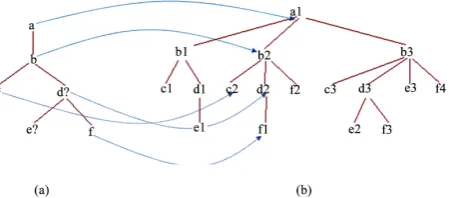
Figure 1(a) presents a tree representation of an exact (structural) query con-taining only parent-child arcs.
Let, Q=
(
N Eq, q)
be a query, D=(
N Ed, d)
an XML document, two nodesd d
n ∈N and nq∈Nq, two arcs ad E∈ d and aq E∈ q:
We’ll say that, nd is an occurrence of nq in D if labeld (nd)= labelq (nq).
Simi-larly, we’ll say that ad is an occurrence of aq in D if orig (ad) is an occurrence of orig (aq) and, dest(ad) is an occurrence of dest(aq).
Let ψ :Nq Nd be an application. We’ll say that ψ
( )
Nq is a matching ofQ in D if the following three conditions are satisfied for all x y N, ∈ q: 1)
( )
( )
x y= ⇔ψ x =ψ y . 2) label xq
( )
=labeld(
ψ( )
x)
. 3) if( )
/ / q
x y E∈ ⇒ψ x is an ancestor of ψ
( )
y ; if x y E/ ∈ q⇒ψ( )
x is theparent of ψ
( )
y i.e. ψ( ) ( )
x /ψ y ∈Ed. Q is satisfied in D if there is a match of Q in D. An example of query match-ing is shown in Figure 1 (blue lines).
As stated earlier, a preference query makes it possible to express requirements some of which are flexible i.e. may not be satisfied when matching. As for exact queries, a preference query can be represented by a tree
(
N Eq, q)
in which: 1)4http://www.w3.org/XML/
5In an abstract document, one can ignore texts and attributes nodes: these are not relevant for the
DOI: 10.4236/jcc.2019.71006 65 Journal of Computer and Communications The set of nodes Nq is partitioned into two subsets: Nreq containing the required
or strict nodes—each of them must necessarily have an occurrence in any result of the query—and Npref containing the preferred nodes i.e. may not have an
oc-currence in the results. 2) The Eq set of arcs is likewise partitioned into two
sub-sets: Ereq containing required arcs and Epref containing preferential arcs.
A preference query P=
(
Nreq,Npref,Ereq,Epref)
is satisfied on a document D if the exact query Qp =(
Nreq,Ereq)
is satisfied on D and elements of Npref as wellas those of Epref possibly have occurrences in D. Figure 2(a) is an example of a
preference query’s tree representation; nodes whose labels contain “?” are prefe-rence nodes. The blue lines in Figure 2 show an example of a matching of a pre-ference query on the document of Figure 1(b). Note on this figure that all the required nodes (a, b, c, f) have occurrences; the preference node “d” has some too. On the other hand, the preference node “e” does not have an occurrence in the highlighted solution.
2.2. The
TreeMatch
Algorithm
[image:5.595.262.487.447.545.2]Native evaluation approaches of XML queries can be grouped into two classes: class of the one using decomposition-merge-join [12] [13], and the class of those making a direct evaluation [10] [14] [15] [16]. Among algorithms developed in the second class and handling only non-recursive documents, TreeMatch algo-rithm developed by Yao et al. [10] has the best time complexity. Generally, in these algorithms, each XML document is manipulated through an index built from an annotation of the latter following the coding (region coding) introduced by Li et al. [17] where each document node is represented by a (start, end, level)
Figure 1. Example of the matching (blue lines) of an exact query (a) on an XML document (b).
[image:5.595.263.488.593.692.2]DOI: 10.4236/jcc.2019.71006 66 Journal of Computer and Communications triplet. In the subsequent, we write Q=
(
N Eq, q)
the exact XML query to be evaluated on the XML document noted D=(
N Ed, d)
.2.2.1. Data Structures and Constraints Used in TreeMatch
In TreeMatch, in order to evaluate query Q on document D, a document index based on region coding as indicated above is firstly built. From this index, linked lists Tq, q N∈ q6 are retrieved: Tq is a linked list of q’s occurrences in D; these
occurrences are sorted according to the start component of the triplets annotat-ing the various occurrences of the node q. A stack Sq is associated with each
query node q; it will store solutions of the evaluation of the subquery rooted in q. For each of the Tq lists, a traversing pointer (called TqCurrent) is used to
lo-cate at any time the Tq’s element being processed; it initially points on the first
Tq’s element. Three primitives are used in TreeMatch: Advance(Tq) which
makes TqCurrent point on the next element of Tq, Isleaf(q) which tests if the query node q is a leaf and NumOfChildren(q) which returns the number of children in the query node q: we note q ii
(
=0, ,(
NumOfChildren q( )
−1)
)
aq’s child.
An important property of queries handled by TreeMatch—which we also use as a hypothesis—is that of No-Self-Containment i.e. queries nodes’s tags are non-recursive. Indeed, as underlined in [10], for any query Q=
(
Nq Eq,)
sa-tisfying this property, for any internal query’s node q, any pair of nodes {x, y} appearing in Tq have no common descendants. As a result, when executingTreeMatch, Tq lists are traversed without going back. Moreover, the matching’s
result of subquery rooted on q N∈ q, can be partition into (disjoint) subsets,
each containing an occurrence of q. It is this partitioning which allows a com-pact encoding of the partial solutions (stored in stacks), from which final (global) solution is generated, partition after partition.
2.2.2. Principle
Let Q=
(
N Eq, q)
be an exact query, D=(
N Ed, d)
a document. TreeMatch[10] algorithm looks for all matchings of Q in D by recursively calling the find(q) function to determine if the current occurrence of q in Tq (given by pointer
TqCurrent) belongs to a partial solution. Where appropriate, the constituents of the said (partial) solution are compactly encoded in stacks associated with nodes of the subquery rooted in q.
Note that, a partial solution is an intermediate result obtained by evaluating a
q subquery of Q by matching all the q subquery’s nodes (from the occurrence pointed to by TqCurrent) with nodes in D; it is such that all occurrences of des-cending nodes of q are descendants of the occurrence of q pointed to by TqCur-rent: such D’s node occurrences are said to be covered by the current occurrence of q in Tq7. Partial solutions are likely to be completed further to obtain a
com-6In order to simplify the presentation, as long as there is no ambiguity, in the rest of this paper, we
will not make any difference between a node and its label.
7In general, when a node n belongs to a subtree rooted in r, we say that r covers n; in this case,
DOI: 10.4236/jcc.2019.71006 67 Journal of Computer and Communications plete solutions; if it cannot be done for a given partial solution, it must be prop-erly removed from various stacks. Thus, when ending the query Q processing, the various (partials) solutions are encoded in the different stacks; all that re-mains is to browse them appropriately in order to synthesize the final solutions and send them back in a more usable form (a tree for instance): GenerateSolu-tion() is the routine that performs this processing in TreeMatch.
3. The
TreeMatchPreference
Algorithm
TreeMatchPreference is an enriched version of TreeMatch that emphasizes on
processing induced by the potential presence of preference nodes in a preference query.
3.1. Principle
Like TreeMatch, TreeMatchPreference is recursive. As input it takes a preference query as well as an index (a set of Tq lists) of the document to be queried. It matches the query with the document (through its index) and returns the best matches, by recursively calling function find (q, TqCurrent, maxPosition)8, to
find all possible matches in the subquery rooted in q, from its TqCurrent occur-rence. The result obtained on each node is encoded in the stack associated with it.
Function find (q, TqCurrent, maxPosition) is called to determine if the cur-rent occurrence TqCurrent of q is a partial solution; its third parameter ( maxPo-sition) makes it possible to ensure that in recursive calls, the only occurrences of descending nodes of q that will be taken into account will be exclusively those whose “end” component of their region encoding is less than maxposition. In-deed, as illustrated in Figure 3 and Figure 4, if we have a query in which qi
(child of q) is a preference node, we have to distinguish two situations during the matching: the first one is relative to the case in which several occurrences of qi
are covered by the same occurrence of q (see Figure 3), and the second one concern the case in which two consecutive occurrences of qi are covered by two different occurrences of q (see Figure 4). Finally, during the execution of func-tion find (q, TqCurrent, maxPosition), the current occurrence TqCurrent of q is a partial solution if: either q is a leaf, or, each q’s child has a partial solution cov-ered by TqCurrent. Moreover, if q is a preference node, find (q, TqCurrent,
maxPosition) must determine whether there are partial solutions that do not in-clude the current occurrence of q: such solutions exist if each of the q’s child has at least a partial solution in the subtrees situated between the current q’s occur-rence (TqCurrent) and the one that follows it in Tq. In the following, we qualify
such partial solutions as mediocre partial solutions because they do not contain any occurrences of the (preference) query node being processed.
Generally speaking, during the matching process of a query rooted in q, each of its (descending) internal nodes qi will be process by sequentially applying the
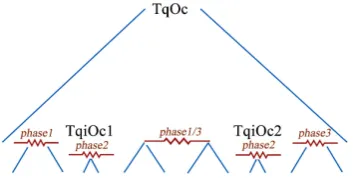
DOI: 10.4236/jcc.2019.71006 68 Journal of Computer and Communications same series of operations (grouped in phases, see Figure 5) on each of its occur-rences. In particular, we distinguish three phases named phase 1, phase 2 and
phase 3; only operations in phase 2 are applied on occurrences of required nodes. In fact, for a preference node qi, phase 1 (resp. phase 3) look for the existence of
mediocre partial solutions not covered by the current occurrence of qi and
be-longing to the subtrees preceding it9 (resp. following it); these occurrences must
also be covered by the current occurrence TqOc of q (qi is a q’s child node). In
phase 2 however, the processing attempts to find the existence of partial solu-tions covered by the current occurrence of qi.
By grouping in phases treatments to be performed to match qi (a q’s child
[image:8.595.285.462.279.368.2]node), two main cases (see Figure 3 and Figure 4) can be observed: The first case (see Figure 3) concerns the processing of two (many) successive occur-rences of qi (in Tqi) covered by the same occurrence of q: here, the process
[image:8.595.258.487.397.488.2]Figure 3. Occurrences of qi covered by the same occurrence of q.
Figure 4. Occurrences of qi covered by different occurrences of q.
Figure 5. An illustration of the three phases to be observed when processing a query node instance.
9As we will see in function find() (Algorithm 2), it is the third parameter (maxPosition) of find()
[image:8.595.289.456.519.656.2]DOI: 10.4236/jcc.2019.71006 69 Journal of Computer and Communications performed during the phase 3 processing of the first occurrence coincides with that performed during the phase 1 processing of the second occurrence. In the second case (see Figure 4), two occurrences of qi are covered by two different
occurrences of q: here, we must distinguish the mediocre partial solutions re-sulting from the processing in phase 3 of the first occurrence of qi and covered
by the first occurrence of q, from the mediocre partial solutions resulting from the processing in phase 1 of the second occurrence of qi and covered by the
second occurrence of q. As mentioned before, it is the maxPosition parameter of function find(), and the fact that lists Tqi are traversed without going back that allows to solve this problem.
3.2. Algorithm
In order to facilitate the management of the mediocre partial solutions resulting from the introduction of preference nodes, update is made to the structures of the tuples inserted in stacks used in [10].
q being a query node and prefNode(q) (resp. exactNode(q)) designating the set of preferential (resp. required) nodes covered by q, the set of q’s descending nodes is given by: descendingNodes(q)= prefNode(q) ∪exactNode(q). For in-stance, for the query sketched in Figure 2(a), we have: prefNode(a)={d, e} and
exactNode(a)={a, b, c, f }. Let tupq be the encoding of a tuple to be pushed in
Sq. tupq consists of five fields and is of the form tupq =(self, parent, exactnode,
prefnode, pushCount) in which:
self contains the occurrence tqcurrent of q.
parent contains the parent’s occurrence of q in Q; it covers that contained in
self.
exactNode contains sequence d1, , dk of exactNode(q)’s nodes occur-rences.
prefNode contains sequence dk+1, , dn of prefNode(q)’s nodes occur-rences.
Pushcount is a counter incremented when pushing in the stack. This field is used as needed by the cleanStack() function (Algorithm 4) to pop “
Push-count” tuples in the current stack when a partial solution cannot be
com-pleted to obtain a complete one.
exactNode and prefNode fields are used exclusively during the generation of the final solution (Algorithm 3).
3.2.1. The TreeMatchPreference Algorithm for Preference Queries
In TreeMatchPreference (Algorithm 1, line 1), TqCurrent initialy point on the first node in Tq10. Then, if q is a preferred node, the phase1 processing is done
with the eventual update of the stack associated with q (lines 3-5).
The phase 2 is then triggered with the call of function find(q, TqCurrent,
TqCurrent.end) to check if the current q’s occurrence (TqCurrent) can extend
10In function find(), we use the routines pHead(Tq) that return the reference of the first element of
DOI: 10.4236/jcc.2019.71006 70 Journal of Computer and Communications some partial solutions to get complete ones. If so, the stack associated with q is updated accordingly (lines 6 - 7). Then, TqCurrent is moved on to the Tq’s next
item (line 8) to activate the phase 3 (lines 9 - 15) and the cycle starts again. Al-gorithm 1 ends with a call to the function in charge of browsing the different stacks to synthesize the final answer (line 16).
Tuples to be pushed in stacks have the form <tqcurrent, parent_, Pushcount> where, “tqcurrent” is the value to be assigned to the self field: this value is either the q’s current occurrence, or a symbolic value denoted Φ if q is a preference node; in this case, one must be either in the phase 1 or else in the phase 3 of the treatment. parent_ is the value to be assigned to the tuple’s parent field: this val-ue is the valval-ue of the parent node’s occurrence of q covering tqcurrent, or is equal to the symbolic value “root” if this parent must be located beyond the root (Algorithm 1, lines 5 and 12).
3.2.2. The Find Algorithm for Preference Queries
The new version of the find() function that handles preferences takes three input parameters: find(q, TqCurrent, maxPosition) (Algorithm 2); the first parameter
q is the current node of the query being evaluated, the second parameter
TqCurrent is either a q’s occurrence, or (in the case where we are in phase 1) the occurrence of his closest ancestor. The third parameter maxPosition is an integer used to set an upper limit on the positions of the nodes that can be processed during the call11.
The different processing phases of q’s occurrences are highlighted in Algo-rithm 2 via comments. Treatments related to phase 1 are encoded in lines 7 - 10, while those relating to phase 2 are in lines 25 - 27; finally, in lines 29 - 34 we have those relating to phase 3. When partial solutions encoded in stacks cannot be extended to obtain a complete solution, they are popped (Algorithm 2, lines 13 - 15) by using function cleanStack() (Algorithm 4).
Algorithm 1: The TreeMatchPreference algorithm for preference queries.
11For example, with the call find(q, TqCurrent, 20), only nodes with a value less than 20 in the “start”
DOI: 10.4236/jcc.2019.71006 71 Journal of Computer and Communications
3.3. The Result Generation Process
Function GenerateSolution() (Algorithm 3) is called to produce an explicit (tree) representation of the final result—consisting of the best answers to the query—from the information encoded in the tuples stored in the stacks.
As mentioned in the introduction, intuitively, a match (a tree) will be more preferred if it contains the largest number of preference nodes’s occurrences. However, note immediately that two matchings (let’s call them r1 and r2) can be incomparable; this is the case if there are at least two query nodes, X and Y, such that exactly one of the two matches, r1 or r2, contains an X’s occurrence and in this case, only the other contains a Y’s occurrence. It is from this observation that we had the inspiration to use an instrumented version of the Skyline opera-tor[11] for the selection of the best answers. In fact, by using this operator, we can define a partial order on the answers so that the best answers are the maxi-mum elements for that order.
Recall that, as defined in RDB, Skyline operator[11] allows to select the best n-tuples of a relational table; it can be briefly, presented as follows: let’s consider a relational table R with schema R P
(
1, , , P PK K+1, , Pn)
and two tuples(
1, , ,k k 1, , n)
p= p p p+ p and q=
(
q1, , , q qk k+1, , qn)
in R. For queries inwhich preferences relate to fields Pk+1, , Pn, we’ll say that p dominates q and
we write p q> , if the following conditions are met:
1) pi=qi, for all i=1,2, , k./* required node occurrences coincide */.
2) p qi≥ i for all i=
(
k+1 , ,)
n.3) there are i k, 1
(
+ ≤ ≤)
i n, and pi>qi.By considering the so far manipulated data structures, (see Sec. 3.2), we pro-pose a new definition of the notion of dominance that is more suitable for com-paring partial solutions produced during the matching; this notion will allow us to easily synthesize the best answers: they are those which are not dominated.
Definition 1. The dimension of a tuple—Let
(
, , , , ,1 1, ,)
q k k n
tup = parent self d d d + d be a tuple encoded in a stack. The
dimension of tupq noted dim tup
( )
q , is the set of query nodes qdk+1, , qdnfor which dk+1, , dn are occurrences: dim tup
( )
q ⊆ prefNode q( )
.Definition 2. Non dominated Tuple—Let
(
, , , , ,1 1, ,)
q k k n
tup = parent self d d d + d and
(
, , , , ,1 1, ,)
q k k m
tup′ = parent self d′ ′ ′ d d′ ′+ d′ be two tuples belonging to the same
stack. We say that tupq dominates tup′q and we write tupq >tup′q, if tup′q’s dimension is included (strictly) in tupq’s dimension:
(
)
(
( )
( )
)
(
tupq>tupq′ ⇔ dim tupq′ ⊂dim tupq)
.DOI: 10.4236/jcc.2019.71006 72 Journal of Computer and Communications Algorithm 2: The find algorithm for preference queries.
the dominance relation defined above makes it possible to make this selection:
an answer (a tuple) is retained only if it is not dominated by any other. Function
filterSkylineSolution() called in Algorithm 3 is used to incrementally make this selection.
More precisely, function GenerateSolution() (Algorithm 3) performs a preorder traversal of different stacks associated with nodes of the query tree. At each node, it realizes the equijoin of the associated stack and those of her child-ren and stores the non dominated tuples in the same stack (overwrite). Finally, query’s answer is synthesized from the leaves of the query tree and is stored in the stack associated with the root node of the query tree.
DOI: 10.4236/jcc.2019.71006 73 Journal of Computer and Communications
3.4. Illustration
This subsection is devoted to a completely illustrated presentation (from the data initialization to the generation of the final solution) of the matching of a prefe-rence query (see Figure 6) on an XML data source (see Figure 7). An index T
(the Tq lists, Figure 8) is build from the XML data source, and the evaluation function TreeMatchPreference (a, T) is called to match the query with the data source. Notice that, parameter “a” used in the call is the root node of the query (see Figure 6).
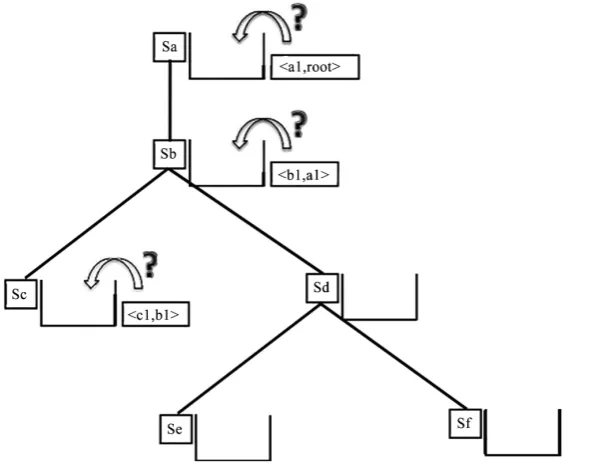
TreeMatchPreference starts by examining whether the first occurrence “a1” of “a” in Ta is a solution to the query rooted in “a”. More precisely, the goal is to
determine (see Figure 9) if “a1” is the root of a subtree consisting of well-structured occurrences of b, c, f and possibly d and e? If so, the tuple < a1,
root,1> must be pushed in Sa (the stack associated with the query node a).
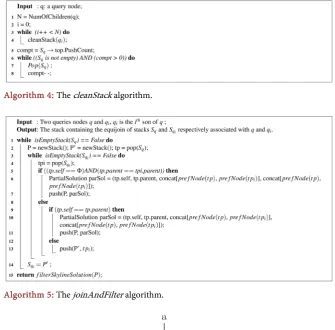
Algorithm 4: The cleanStack algorithm.
[image:13.595.203.539.284.614.2]Algorithm 5: The joinAndFilter algorithm.
DOI: 10.4236/jcc.2019.71006 74 Journal of Computer and Communications Figure 7. Region coding labelling of the nodes of an update of Figure 1(b).
Figure 8.Tq obtained from the data source of Figure 7.
[image:14.595.156.460.477.709.2]DOI: 10.4236/jcc.2019.71006 75 Journal of Computer and Communications Knowing that node “a” has a son (node “b”) and that TreeMatchPreference
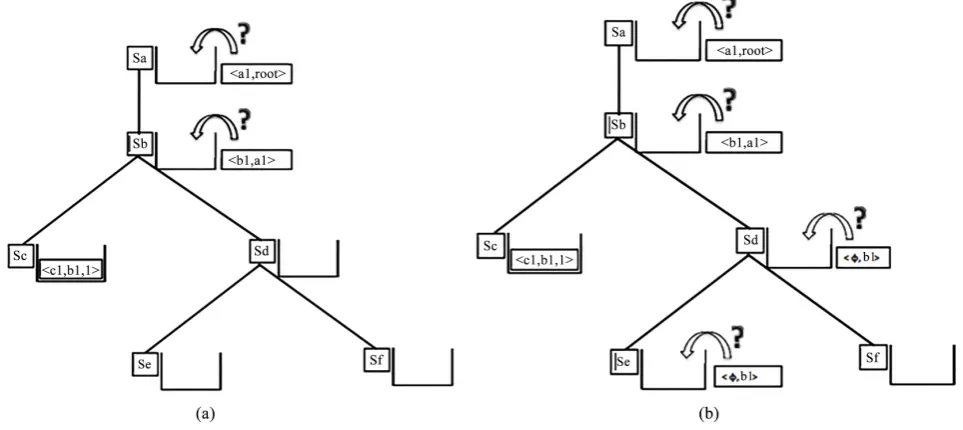
make a call to the recursive function (find()) when matching, the previous ques-tion is renewed on the current occurrence “b1” of “b” to examine if “b1” is a partial solution12? This question is equivalent to this one: “should we push tuple
< b1, a1> in Sb?”. Like before, due to the function find() recursion, the question
“should we push tuple < c1, b1> in Sc?” is examined (see Figure 9) and the
an-swer is “Yes” since, c is a leaf node and c1 is covered by b1; tuple < c1, b1> is then pushed in Sc (see Figure 10(a)).
After tuple < c1, b1>’s stacking, Tc’s traversing pointer is moved to the next
occurrence of c; “c2” then becomes the new current occurrence of “c”. Since c2 is not covered by “b1”, evaluation continues on “d” (the second son of “b”); the current occurrence of “d” in Td is “d1”. Since d is a preference node,
Tree-MatchPreference examine if tuple <Φ, b1> can be pushed in Sd? This
corres-ponds to the execution of the so-called phase 1 (Algorithm 2, line 8). As above, the recursion of find() and the fact that e is a preferential node must lead to another test: “should we push tuple <Φ, b1> in Se?” (see Figure 10(b)). Note that
in the tuple <Φ, b1>, the attribute parent is set to b1 (and self = Φ); this reflects the fact that the parent of e does not have any occurrences in the partial solution under construction13.
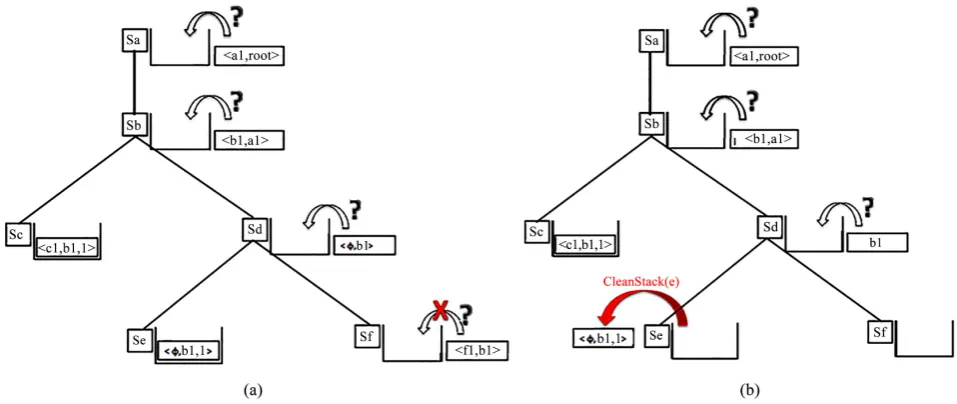
The test “push <Φ, b1> in Se?” is positive since e is a leaf (Algorithm 2, line 1);
<Φ, b1, 1> tuple is then stacked (see Figure 11(a)) and the Te’s traversing
poin-ter is moved to “e2”. Since “e2” is not covered by “d1”, the processing continues with the evaluation of f (the next child of “d”), f1 being its current occurrence. The test “push < f1, b1> in Sf?” is performed with a negative answer since f1 is
not covered by b1: <f1, b1> can’t be pushed in Sf (see Figure 11(a)). The
nega-tive answer to the test “push < f1, b1> in Sf?” imposes the deletion (by using
function cleanStack) of one tuple (pushCount =1) in Se which is “linked” to “b1”
in Sd (see Figure 11(b)).
After going through all the lists Tq (q∈
{
a b c d e f, , , , ,}
), TreeMatchPreferencewill have stored in each stack (see Figure 12) a compact encoding of all solutions (tuples) of the query.
Function generateSolution() is then called to produce the non dominated tuples. To do this, it merges and cleans the contents of stacks by performing at each node the equijoin of the stack associated with it and that of its children; only non dominated tuples are retained. Function joinAndFilter() (Algorithm 5) is used for this purpose.
Figure 13 shows the executing result of function generateSolution() when it is
12Remember that a b
i occurrence of b is a partial solution if and only if there exists an occurrence of
each of its sons (here c and d) which are sons of bi and which are themselves partial solutions. 13We are evaluating a mediocre partial solution (see Sec. 3.1) which does not include a d occurrence.
DOI: 10.4236/jcc.2019.71006 76 Journal of Computer and Communications run over the stacks sketched in Figure 12. generateSolution() being recursive and performing a pre-order traversal of the query tree, it is invoked by providing it with the root node of the query. The first merge is made between the Sb and Sc
stacks to provide the new Sb stack (dotted in Figure 13). The second merge is
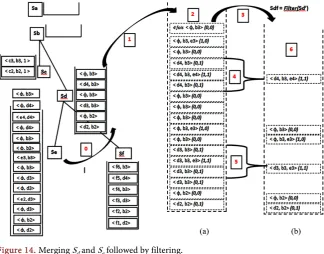
made between the Se and Sd stacks to obtain the stack sketched in Figure 14(a).
Note that each tuple of this stack is followed by a pair of binaries (x,y) in which,
x (resp. y) allows us to know if the tuple contains (“1”) or not (“0”) an occur-rence of a prefeoccur-rence node e (resp. d). For instance, for a stack entry containing <d4, b3, e4>(1, 1)>, the pair (x, y) is equal to (1, 1); this means that tuple < d4,
b3, e4> contain an e’s occurrence (e4 for this case) and a d’s occurrence (d4 for this case). On the other hand, <Φ, b3, e3>(1, 0) indicates the presence (x = “1”) of an occurrence of e (e3 in this case) and no occurrence (y = “0”) of d. A tuple that does not have any occurrences of the preference nodes will have this pair equal to (0,0).
After merging Sd and Se, the filter function is applied to the result to remove
duplicate tuples as well as to extract those that are not dominated. Figure 14(b) shows the resulting stack; it gives an illustration (on the portion noted [4]) of the extraction of the not dominated tuple < d4, b3, e4> among tuples {<d4, b3>, <d4,
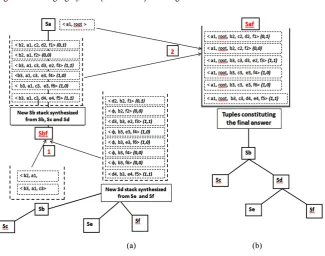
b3, e4>}. The stack of the Figure 14(b) is finally the one associated with node “d”; it is subsequently merged with Sf. Proceeding as for Se, we have the new
stack Sdf (see Figure 15(a)), and finally that of Saf(see Figure 16(b)) which
con-tains only not dominated tuples: these are the best answers sought.
4. Implementation and Experimental Study of
TreeMatchPreference
[image:16.595.57.539.493.708.2]
In the previous section, we described TreeMatchPreference together with func-tions on which it relies upon when evaluating a query. In order to facilitate its
DOI: 10.4236/jcc.2019.71006 77 Journal of Computer and Communications Figure 11. Pushing <Φ, b1> in Se and negative answer for test of pushing (<f1, b1> in Sf) (a) and pop of <Φ, b1> from Se (b).
[image:17.595.132.467.309.694.2]DOI: 10.4236/jcc.2019.71006 78 Journal of Computer and Communications Figure 13. Merging Sd and Se followed by Sd’s filtering.
[image:18.595.210.535.467.721.2]DOI: 10.4236/jcc.2019.71006 79 Journal of Computer and Communications Figure 15. Merging Sb and Sc followed by filtering.
Figure 16. Merging Sdf and Sb(a), merging Sbf and Sa (b) followed by filtering.
[image:19.595.211.537.350.606.2]DOI: 10.4236/jcc.2019.71006 80 Journal of Computer and Communications many preference queries on various XML data sources. A summary of the work done for this purpose is presented in the following two subsections.
4.1. XML Databases and Sample Queries
SigmodRecord.xml contains an index set of SIGMOD registry items
(http://www.dia.uniroma3.it/Araneus/Sigmod). The following queries have been applied to this file:
1) “SigmodRecord[/issue[/volume?/15?]/articles/article/authors/author/Sophie Cluet]’’: search all articles of author “Sophie Cluet” belonging to the fifteenth volume’s publication; the fact of belonging to the fifteenth volume of publica-tions is preferential.
2) “/authors[/author/Sergey Brin]/author/Rajeev Meitwani?”: search all ar-ticles written by authors “Sergey Brin” and “Rajeev Meitwani”. In the best case, the returned results will have these two authors and in the worst case, only those of “Sergey Brin” will be returned, because “Rajeev Meitwani” is preferential. part.xml contains information about products of the Transaction Processing
Performance Council (TPC-http://www.tpc.org/tpch/). The following queries have been applied to this file:
1) “table[/T[/INT/P_BRAND/Brand#13?]/P_CONTAINER/SM_CASE]”: this query looks for products from the “SM_CASE” container with a preference over those belonging to the “Brand#13” brand.
2) “table[/T[/P_TYPE/LARGE?][/P_SIZE/10]/P_CONTAINER/MED_BOX?]”: this query searches for size 10 products in any container with a preference for those from the “MED_BOX” container.
The last experiment file mydata.xml is not part of a repository. It was created by following the XML document fragment of Figure 7 and two queries (“a[/b[/c]/d?[/e?]/f]’’ and “a[/b[/c]/d?[/e]/f]’’) were executed on it.
4.2. An Overview of the Tool Developed for Executing Preference
Queries
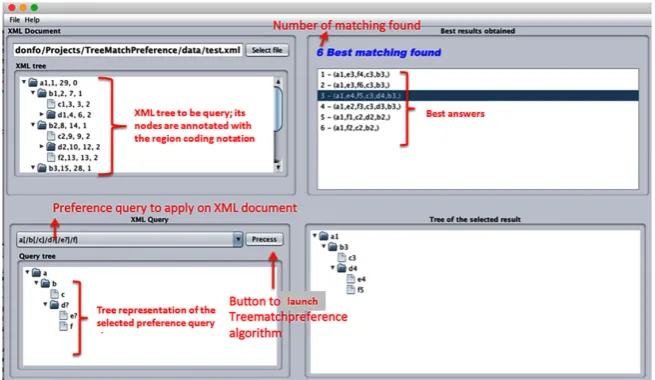
The main window of the developed prototype is divided into four panels (see Figure 17):
The upper left panel is used to select the data source to query.
The lower left panel is used to select an existing query or to edit a new one. The top right panel is used to display the best answers.
The lower right panel displays the tree structure of a selected answer in the upper right panel.
DOI: 10.4236/jcc.2019.71006 81 Journal of Computer and Communications Figure 17. The GUI of the tool developed for experimenting the evaluation of preference queries.
Figure 18. A screenshot sketching the matching process.
When selecting an element (a query) in this drop-down menu, its tree repre-sentation is drawn just below. Right next to the drop-down menu, the “Process” button is used to launch the document querying process. Best matches found are displayed on the top left panel (see Figure 18) and the selection of one of them causes the display on the down left panel of its tree representation (see Figure 18).
5. Conclusions
This article focused on importing the concept of preference queries into the XML community. For this purpose, we have proposed TreeMatchPreference
[image:21.595.208.536.307.497.2]pre-DOI: 10.4236/jcc.2019.71006 82 Journal of Computer and Communications ferences.
Inspired by Skyline techniques used in RBD for evaluating preference queries [18] [19], we proposed a so-called SkyTrees. SkyTrees is the set of best (non-dominated) answers obtained when using TreeMatchPreference to match a preference query on an XML data source.
A short-term work will consist of the full analytical study of the proposed al-gorithm and its extension to the processing of value-based preference queries.
We also plan to explore a presentation of the proposed algorithms following a grammatical approach inspired by that adopted by Bouchou et al. [20] for XML integrity constraint validation: the expected gain is the fluidity of the presenta-tion (algorithm design would be more modular) and the reducpresenta-tion of the query’s tree traversing time.
Acknowledgements
Authors warmly thank Beatrice Bouchou for suggesting the theme discussed in this paper.
Conflicts of Interest
The authors declare no conflicts of interest regarding the publication of this pa-per.
References
[1] Tchendji, M.T. and Tadonfouet, L. (2014) Evaluation des requêtes avec préférences structurelles sur les documents XML. In: Sellami, M., Badouel, E. and Lo, M., Eds.,
Actes du CARI 2014, Saint-Louis, 333-341.
[2] Cho, S.R. and Balke, W.-T. (2009) Building an Efficient Preference XML Query Processor. Proceedings of the 2009 ACM Symposium on Applied Computing, Ho-nolulu, 8-12 March 2009, 1585-1586.
[3] Abiteboul, S. (1999) On Views and XML. Proceedings of the 18th ACM Symposium on Principles of Database Systems, Philadelphia, 31 May-3 June 1999, 1-9.
https://doi.org/10.1145/303976.303977
[4] Bosc, P. and Pivert, O. (1995) SQLf: A Relational Database Language for Fuzzy Querying. IEEE Transactions on Fuzzy Systems, 3, 1-17.
[5] Kiebling, W. (2002) Foundations of Preferences in Database Systems. Proceedings of the 28th International Conference on Very Large Databases (VLDB), Hong Kong 20-23 August 2002, 311-322. https://doi.org/10.1016/B978-155860869-6/50035-4
[6] Chomicki, J. (2003) Preference Formulas in Relational Queries. ACM Transactions on Database Systems (TODS), 28, 427-466.
[7] Agrawal, R., Kiernan, J., Srikant, R. and Xu, Y.R.(2003) An XPath-Based Preference Language for P3P. Proceedings of the 12th international conference on World Wide Web, Budapest, 20-24 May 2003, 629-639.
[8] Kieβling, W., Hafenrichter, B., Fischer, S. and Holland, S. (2001) Preference XPATH: A Query Language for E-Commerce. Proc. 5th Intern. Konferenz für Wirtschaftsinformatik, Augsburg, September 2001, 425-440.
DOI: 10.4236/jcc.2019.71006 83 Journal of Computer and Communications Proceedings of the 2009 IEEE International Conference on Data Engineering, Shanghai, 29 March-2 April 2009, 30-37. https://doi.org/10.1109/ICDE.2009.24
[10] Yao, J.T. and Zhang, M. (2004) A Fast Tree Pattern Matching Algorithm for XML Query. Proceedings of the 2004 IEEE/WIC/ACM International Conference on Web Intelligence, Beijing, 20-24 September 2004, 235-241.
https://doi.org/10.1109/WI.2004.10048
[11] Börzsönyi, S., Kossmann, D. and Stocker, K. (2001) The Skyline Operator. Pro-ceedings of the 17th International Conference on Data Engineering, Hiedelberg, 2-6 April 2001, 421-430.
[12] Zhang, C., Naughton, J.F., DeWitt, D.J., Luo, Q. and Lohman, G.M. (2001) On Supporting Containment Queries in Relational Database Management Systems.
Proceedings of the 2001 ACM SIGMOD International Conference on Management of Data, Santa Barbara, CA, 21-24 May 2001, 425-436.
https://doi.org/10.1145/375663.375722
[13] Al-Khalifa, S., Jagadish, H.V., Koudas, N., Patel, J.M., Srivastava, D. and Wu, Y. (2002) Structural Joins: A Primitive for Efficient xml Query Pattern Matching. Pro-ceedings of the 18th International Conference on Data Engineering, San Jose, 26 February-1 March 2002, 141-152. https://doi.org/10.1109/ICDE.2002.994704
[14] Lu, J., Chen, T. and Ling, T.W. (2004) Efficient Processing of xml Twig Patterns with Parent Child Edges: A Look-Ahead Approach. Proceedings of the 13th ACM International Conference on Information and Knowledge Management, New York, NY, 8-13 November 2004, 533-542. https://doi.org/10.1145/1031171.1031272
[15] Chen, S., Li, H.-G., Tatemura, J., Hsiung, W.-P., Agrawal, D. and Candan, K.S. (2006) Twig2stack: Bottom-Up Processing of Generalized-Tree-Pattern Queries over xml Documents. Proceedings of the 32nd International Conference on Very Large Data Bases, Seoul, 12-15 September 2006, 283-294.
[16] Jiang, Z., Luo, C., Hou, W., Zhu, Q. and Che, D. (2007) Efficient Processing of XML Twig Pattern: A Novel One-Phase Holistic Solution. 18th International Conference Database and Expert Systems Applications, Regensburg, 3-7 September 2007, 87-97.
https://doi.org/10.1007/978-3-540-74469-6_10
[17] Li, Q. and Moon, B. (2001) Indexing and Querying XML Data for Regular Path Ex-pressions. Proceedings of the 27th VLDB Conference, Roma, 11-14 September 2001, 361-370.
[18] Tan, K.-L., Eng, P.-K. and Ooi, B.C. (2001) Efficient Progressive Skyline Computa-tion. Proceedings of the 27th VLDB Conference, Roma, 11-14 September 2001, 301-310.
[19] Bouadi, T., Bringay, S., Poncelet, P. and Teisseire, M. (2010) Requêtes skyline avec prise en compte des préférences utilisateurs pour des données volumineuses. Ex-traction et gestion des connaissances, Hammamet, 26 au 29 janvier 2010, 399-404. [20] Béatrice, B., Ferrari Mirian Halfeld Lima Maria Adriana Vidigal (2011) Attribute