1
Retraction Notice
Title of retracted article: Target Verification via Novel Adaptive Segmentation Used to Detect and Track Moving Objects
Author(s): Ching-Shiang Lee,Hsu-Ping Yang, Jing-Wein Wang
* Corresponding author. Email: [email protected]
Journal:
Open Journal of Applied Sciences (OJAppS)
Year: 2018
Volume: 8
Number: 10
Pages (from - to): 472-485
DOI (to PDF): https://doi.org/10.4236/ojapps.2018.810038
Paper ID at SCIRP: 2310869
Article page: http://www.scirp.org/Journal/PaperInformation.aspx?PaperID=88061
Retraction date: 2019-01-10
Retraction initiative (multiple responses allowed; mark with X): XAll authors
Some of the authors:
Editor with hints from Journal owner (publisher)
Institution:
Reader:
Other:
Retraction type (multiple responses allowed):
Unreliable findings
Lab error Inconsistent data Analytical error Biased interpretation
Other:
Irreproducible results
Failure to disclose a major competing interest likely to influence interpretations or recommendations
Unethical research
Fraud
Data fabrication Fake publication Other:
Plagiarism Self plagiarism Overlap Redundant publication *
Copyright infringement Other legal concern:
Editorial reasons
Handling error Unreliable review(s) Decision error Other:
XOther:
Results of publication (only one response allowed):
Xare still valid.
were found to be overall invalid.
Author's conduct (only one response allowed): honest error
academic misconduct
Xnone (not applicable in this case – e.g. in case of editorial reasons)
2 History
Expression of Concern:
yes, date: yyyy-mm-dd
Xno
Correction:
yes, date: yyyy-mm-dd
Xno
Comment:
The paper is withdrawn from "Open Journal of Applied Sciences" due to personal reasons from the corresponding author of this paper.
This article has been retracted to straighten the academic record. In making this decision, the Editorial Board follows COPE's Retraction Guidelines. The aim is to promote the circulation of scientific research by offering an ideal research publication platform with due consideration of internationally accepted standards on publication ethics. The Editorial Board would like to extend its sincere apologies for any inconvenience this retraction may have caused.
ISSN Online: 2165-3925 ISSN Print: 2165-3917
DOI: 10.4236/ojapps.2018.810038 Oct. 29, 2018 472 Open Journal of Applied Sciences
Target Verification via Novel Adaptive
Segmentation Used to Detect and Track
Moving Objects
Ching-Shiang Lee
1, Hsu-Ping Yang
1*, Jing-Wein Wang
21Department of Electrical Engineering, National Kaohsiung University of Science and Technology, Taiwan
2Graduate Institutes of Photonics and Communications, National Kaohsiung University of Science and Technology, Taiwan
Abstract
It is an original study to integrate the utmost activities and academic research. In this research, a new image segmentation (NIS) is present to search object information for initial target verification in the region of interest (ROI) area in global histogram. After that adaptive singular value decomposition (ASVD) is combined to suppress variation in lighting for color images. HSV color model integrates computer vision techniques made to fit the dynamic environments for object detection. In addition, several tracking algorithms are applied to estimate and track the activity data. Experimental results show that the objects could successfully detect and track the sequence of images, performance and the tracking rate in accordance with accurate Kalman filter (HSV) which is better than the other algorithms.
Keywords
New Image Segmentation (NIS), Region of Interest (ROI), Adaptive Singular Value Decomposition (ASVD), HSV Color Model
1. Introduction
A wise family for segmentation which involves integrating features such as brightness, color, mode-finding, and graph partitioning texture over local image patches and then clustering those features based on fitting mixture models is used. The multi-label, an interactive image segmentation algorithm, is formu-lated in discrete space using combinatorial analogs of standard operators and principles of continuous potential there, allowing it to be applied in arbitrary dimension on arbitrary graphs [1]. Besides, the contour detector combines
mul-How to cite this paper: Lee, C.-S., Yang, H.-P. and Wang, J.-W. (2018) Target Veri-fication via Novel Adaptive Segmentation Used to Detect and Track Moving Objects. Open Journal of Applied Sciences, 8, 472-485.
https://doi.org/10.4236/ojapps.2018.810038
Received: September 25, 2018 Accepted: October 26, 2018 Published: October 29, 2018
Copyright © 2018 by authors and Scientific Research Publishing Inc. This work is licensed under the Creative Commons Attribution International License (CC BY 4.0).
http://creativecommons.org/licenses/by/4.0/
Open Access
DOI: 10.4236/ojapps.2018.810038 473 Open Journal of Applied Sciences tiple local cues into a globalization framework based on spectral clustering. The segmentation of the state-of-the-art algorithmconsists of generic machinery for transforming the output of any contour detector into a hierarchical regional tree
[2]. On the other hand, color detection is a primary aspect of many computer vi-sion applications including face, illicit content detection and other related appli-cations. The HSV (Hue, Saturation and Value) in color space distribution and part of the computer vision technique are applied to detect the object after initial target verification in this paper [3]-[8].
Camshift algorithm, Kalman Filter, frame difference, optical flow and particle filter are often demonstrated in the tracking field. The Camshift algorithm is able to handle dynamic distributions by readjusting the search window size for the next frame based on the moment of the current frame’s distribution. It is a variation of the Meanshift algorithm, which is based on the principles of the Meanshift algorithm, and also accounts for dynamically changing distributions
[5] [9]; Frame difference method is to recognize the motion of objects found in the two given images and pixels belonging to the same object [10] [11]. Besides, the Kalman filter is the field for moving object tracking field in sequential im-ages and has numerous applications: vehicle, surveillance cameras, navigation, perceptual user interface, tracking objects (missiles, face, head, hands) and many computer vision applications [12] [13] [14].
The activities of the Laser sailboat, Paragliding, Windsurfing and Kitesurfing features in our experiment are described as: Laser sailboat is a popular activity of small dinghy sailors. The boat may be sailed by either one or two people. It was designed by Bruce Kirby (Canadian), and emphasizes simplicity and perfor-mance in the world; Paragliding is a lightweight, free-flying, foot-launched glider aircraft with no rigid primary structure. It is a recreational and competitive ad-venture sport of flying. Windsurfing uses the wind to move forward while surf-ing uses the force of waves. It is a sailsurf-ing activity, in which a board is powered across the water by the wind. Finally, Kitesurfing is a recreational and adventure sport. It is a surface water sport combining aspects of snowboarding, windsurf-ing, Paraglidwindsurf-ing, and gymnastics into one extreme sport.
2. Novel Adaptive Segmentation (NAS)
The novel adaptive segmentation (NAS) combines both adaptive singular value decomposition (ASVD) to reduce the effect about the light variation, and new image segmentation (NIS) for the region of interest (ROI) area, which is utilized to confirm the initial target verification.
2.1. Adaptive Singular Value Decomposition (ASVD)
To reduce the effect of the light variation in object tracking, adaptive singular value decomposition was utilized in every individual color channel of RGB [15]. The color image is compressed by R, G and B color space. The XD is an origi-nal color image with resolution of m n× . D∈
{
R G B, ,}
revealing the R, G andDOI: 10.4236/ojapps.2018.810038 474 Open Journal of Applied Sciences
B color channels used; m n3
D
X ∈ℜ × × ;
{
, ,}
m nR G B
X X X ∈ℜ ×
. The singular value decomposition of a color image is shown below:
T
D D D D
X =U ∑ V (1) where ∑D is the singular value matrix, UD and VD are orthogonal matrices. To reduce the effect of the light variation in target identification, the singular value matrix was multiplied by the weighted compensation coefficient ξD to deal with low contrast problems from varying light. The ASVD formula is shown in Equation (2).
(
)
TED D D D D
X =U
ξ
∑ V (2)ED
X is the image after adaptive lighting compensation, ξD is weighted compensation coefficient of color channel D, derived from (3) and (4):
( )
Max uD =um (3)
( )
(
)
( )
0.5, 1 Max
Max
G u m
D
D D
u u
σ
ξ = × ∑ ∑= =
(4)
D
u is the mean color value of color channel D; um is the greatest mean col-or value of the three colcol-or channels; ∑G u( =0.5, 1σ=) is the normalized intensity
image that has a Gaussian probability distribution function with mean of 0.5 and variance of 1. Figure 1 shows the results of the lightness from 180 down to 155 by ASVD in the Laser sailboat images.
[image:5.595.74.538.180.700.2](a) (b)
Figure 1. Histogram of the Laser sailboat: (a) Original images; (b) ASVD images.
DOI: 10.4236/ojapps.2018.810038 475 Open Journal of Applied Sciences
2.2. New Image Segmentation (NIS)
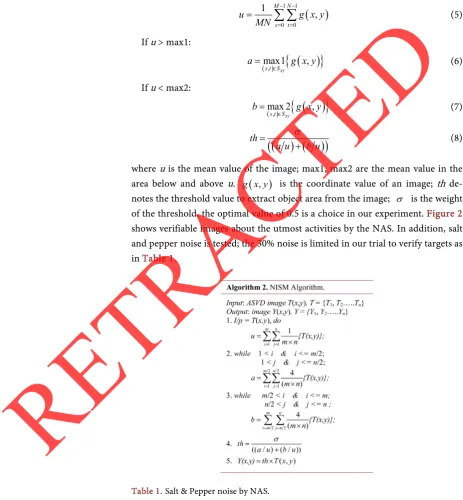
A new image segmentation to segment the region by global threshold is utilized to propose a new method to segment the ROI (region of interest) area. It is rapid and efficient to separate foreground and background data to obtain approximate object data for preliminary target recognition. The derived equation is defined as below:
( )
1 1
0 0
1 M N ,
s t
u g x y
MN
− −
= =
=
∑ ∑
(5)If u > max1:
( )max1s t S, xy
{
( )
,}
a g x y
∈
= (6)
If u < max2:
( ),
{
( )
}
max 2 ,
xy s t S
b g x y
∈
= (7)
( ) ( )
(
)
th
a u b u
σ
=
+ (8)
where u is themean value of the image; max1, max2 are the mean value in the area below and above u. g x y
(
,)
is the coordinate value of an image; th de-notes the threshold value to extract object area from the image; σ is the weight of the threshold, the optimal value of 0.5 is a choice in our experiment. Figure 2 [image:6.595.75.539.168.669.2]shows verifiable images about the utmost activities by the NAS. In addition, salt and pepper noise is tested; the 30% noise is limited in our trial to verify targets as in Table 1.
Table 1. Salt & Pepper noise by NAS.
Item Noise (%) Size (Pixels) Verification T Time (Second)
1 25 320 × 180 Successful 3.48
2 30 320 × 180 False 3.48
DOI: 10.4236/ojapps.2018.810038 476 Open Journal of Applied Sciences
(a)
(b)
Figure 2. NAS results of the utmost activiteis: (a) Original images, (b) Verifiable images.
2.3. Comparison of NAS with Other Segmentation
We refer to the D. Martin segmentation and simulate the choosing an optimal scale of the entire dataset (ODS) or per image (OIS), as well as the average preci-sion (AP) in Berkeley segmentation database. Figure 3 and Table 2 show the results of our proposed NAS and the comparison to relevant segmentation me-thods in the Berkeley segmentation database. Besides, we randomly selected por-trait images of 100 people to test the NAS in the FEI, FERET_550, CMU-PIE68 (128) and Multi_Pie_session01 (128), respectively. The comparison is shown in
Table 3.
3. Object Detection
The target detection stages include HSV color model, computer vision tech-nique, optimal parameter assignment, and comparison of ASVD with other light compensation.
3.1. HSV Color Model
The color space distribution identifies a particular combination of the color model and the mapping function. HSV (Hue, Saturation and Value) is a color space mostly expressed as a nonlinear combination of the RGB values. The R, G,
B and HSV color model (single-hexcone model of color space) are shown as
Figure 4 [16].
The single-hexcone model of color space is the outer edge of the top of the cone with all the pure colors. The H parameter describes the angle around the wheel. The S (saturation) is zero for any color on the axis of the cone, the center of the top circle is white. An increase in the value of the S corresponds to a movement away from the axis. The V (value or lightness) is zero for black. An increase in the value of V corresponds to a movement away from black and to-ward the top of the cone.
3.2. Computer Vision Technique
Dilation, erosion and connected component labeling are utilized in this experi-ment. Both dilation and erosion are primary operations in morphological image processing. The simplest applications of dilation and erosion are for bridging gaps and eliminating irrelevant detail from a binary image. Connected component
DOI: 10.4236/ojapps.2018.810038 477 Open Journal of Applied Sciences
Figure 3. NAS results in Berkeley segmentation database: (a) Original images, (b) Verifi-able images.
Figure 4. RGB and single-hexcone model of color space: (a) RGB model, (b) sin-gle-hexcone model.
Table 2. Compared to relevant studies in the Berkeley segmentation database.
Item Method ODS OIS AP
1 gPb-owt-ucm 0.71 0.74 0.77
2 NASM 0.68 0.66 0.64
3 Mean Shift 0.63 0.66 0.62
4 NCuts 0.62 0.66 0.59
5 Cany-owt-ucm 0.58 0.63 0.59
6 Felz-Hutt 0.58 0.62 0.54
Table 3. Comparative results in the face dataset by NIS.
Item Dataset ASVD Score
1 FET Yes 0.62
2 FET No 0.48
3 FERET_550 Yes 0.61
5 CMU-PIE68 (128) Yes 0.60
6 CMU-PIE68 (128) No 0.45
7 Multi_Pie_session01 (128) Yes 0.53
8 Multi_Pie_session01 (128) No 0.42
labeling is a cluster, which puts the same label to connect pixels in the same area and different labels in different areas.
DOI: 10.4236/ojapps.2018.810038 478 Open Journal of Applied Sciences
3.3. Optimal Parameter Assignment
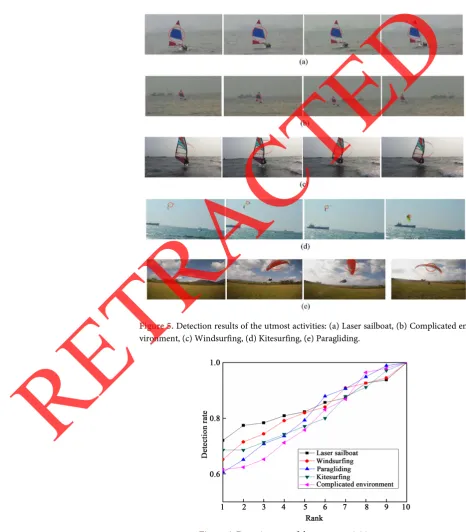
The HSV color model is utilized in four types and five different environments. The optimal value of blue color is set between 0.61 - 0.667, red color value is chosen to approximate zero and green color sets the value between 0.275 - 0.33 in our experiment. The above optimal parameter setting could completely achieve object detection as in Figure 5. Figure 6 shows the moving object detec-tion rate by normalizadetec-tion the maximum experimental data.
[image:9.595.67.534.183.716.2]Figure 5. Detection results of the utmost activities: (a) Laser sailboat, (b) Complicated en-vironment, (c) Windsurfing, (d) Kitesurfing, (e) Paragliding.
Figure 6. Detection rate of the utmost activities.
DOI: 10.4236/ojapps.2018.810038 479 Open Journal of Applied Sciences
3.4. Comparison of ASVD with Other Light Compensation
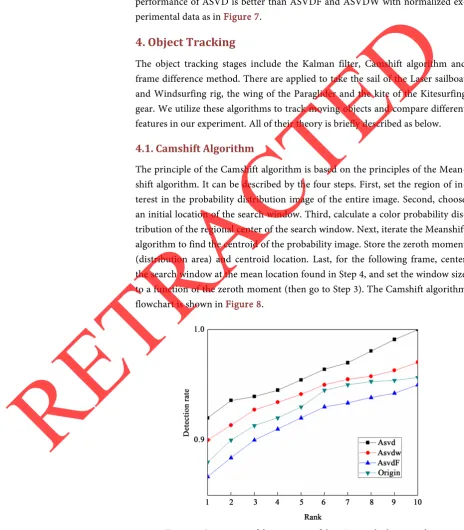
The other light compensation methods are adaptive singular value decomposi-tion in the two-dimensional discrete Fourier domain (ASVDF) for lighting de-tection, and a novel illumination compensation method called adaptive singu-lar-value decomposition in the 2D discrete wavelet domain (ASVDW), which could be used to overcome lighting variation problem [17] [18]; The detection performance of ASVD is better than ASVDF and ASVDW with normalized ex-perimental data as in Figure 7.
4. Object Tracking
The object tracking stages include the Kalman filter, Camshift algorithm and frame difference method. There are applied to take the sail of the Laser sailboat and Windsurfing rig, the wing of the Paraglider and the kite of the Kitesurfing gear. We utilize these algorithms to track moving objects and compare different features in our experiment. All of their theory is briefly described as below.
4.1. Camshift Algorithm
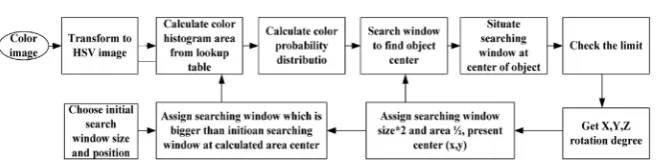
[image:10.595.71.536.172.703.2]The principle of the Camshift algorithm is based on the principles of the Mean-shift algorithm. It can be described by the four steps. First, set the region of in-terest in the probability distribution image of the entire image. Second, choose an initial location of the search window. Third, calculate a color probability dis-tribution of the regional center of the search window. Next, iterate the Meanshift algorithm to find the centroid of the probability image. Store the zeroth moment (distribution area) and centroid location. Last, for the following frame, center the search window at the mean location found in Step 4, and set the window size to a function of the zeroth moment (then go to Step 3). The Camshift algorithm flowchart is shown in Figure 8.
Figure 7. Comparison of detection rate of the ASVD and relevant studies in the Laser sailboat.
DOI: 10.4236/ojapps.2018.810038 480 Open Journal of Applied Sciences
Figure 8. Camshift algorithm flowchart.
4.2. Kalman Filter Algorithm
The Kalman filter is based on the optimal recursive data processing algorithm and performs the restrictive probability density propagation. It is a set of ma-thematical equations which establishes an efficient computational (recursive) means to estimate the state of a process in several aspects [19] [20]. It calculates estimations of past, present, and future states, and it can do the same even when the precise nature of the modeled system is unknown.
The Kalman filter estimates a process by using a form of feedback control. The filter estimates the process state at some time and then obtains feedback in the form of noisy measurements. The equations of the Kalman filters fall into two groups. First, time update and measurement update equations. The time update equations are responsible for projecting forward (in time) the current state and error covariance estimates to obtain the priori estimate for the next time step. Second, the measurement update equations are responsible for the feedback. For a linear, discrete-time system, the Kalman filter random process estimated model, ongoing cycle and signal-flow graph are shown in Figures 9-11.
4.3. Frame Difference (Background Subtraction) Method
The background subtraction method is the core of the background subtraction algorithm which is to utilize the difference of the current image and background image to detect and recognize moving objects. It is a simple algorithm, but very sensitive to the changes in the external environment and has poor an-ti-interference ability. This method could obtain the complete movement data and detect the moving object from the difference of the current image and back-ground image [21] [22] [23] [24]. The background subtraction is based on four principal steps which are described as below:
1) Pre-Processing
First, spatial smoothing is utilized to eliminate device noise and remove vari-ous environmental factors under different light intensities. Another main factor is the data format used by the background subtraction model.
2) Background Modeling
This step uses the new video frame in order to calculate and update the back-ground model. The backback-ground model should be robust against environmental changes in the background, but sensitive enough to identify all moving objects of interest.
DOI: 10.4236/ojapps.2018.810038 481 Open Journal of Applied Sciences
Figure 9. A complete picture of the operation of the Kalman filter.
Figure 10. The ongoing discrete Kalman filter cycle.
Figure 11.Signal-flow graph representation of a line distrete-time dynamical system.
3) Foreground Detection
It compares the video frame with the background model, and identifies can-didate foreground pixels from the frame. A commonly-used approach for fore-ground detection is to check whether the pixels are significantly different from the corresponding background estimated.
4) Data Validation
Finally, this step eliminates any pixels which are not connected to the image. It involves the process of improving the foreground mask based on the informa-tion obtained from the outside background model.
Several different kinds of algorithms are used to track moving objects and ex-perimental results data are normalized to the maximum value. The results show that objects could successfully track the sequence of images, the tracking rate performance of the Kalman filter (HSV) is better than the other algorithms in the same condition as in Figure 12. Besides, Figure 13 and Table 4 are the comparison results about tracking rate of the Kalman filter (HSV) and relevant utmost activities.
DOI: 10.4236/ojapps.2018.810038 482 Open Journal of Applied Sciences
Figure 12. Comparison of the tracking rate of the Kaman filte (HSV) and relevant studies in the Laser sailboat.
Figure 13. Comparison of the tracking rate of the Kaman filter (HSV) and relevant utmost activities.
Table 4. Object tracking rate (%) of the utmost activities.
Item Activity Kalman filter (HSV) (Frame difference) Camshift Kalman filter
1 Laser sailboat 89.35 78.35 58.61
2 Windsurfing 88.50 25.24 62.55
3 Paragliding 89.18 47.95 66.15
4 Kitesurfing 86.61 31.62 66.36
5 Complicated environment 87.15 57.44 64.28
5. Experimental Results and Discussion
We desire to reduce the effect of light variation before initial target verification. Adaptive singular value decomposition (ASVD) is utilized in every individual color channel of RGB. The images are demonstrating the color luminance value
DOI: 10.4236/ojapps.2018.810038 483 Open Journal of Applied Sciences of 180 down to 150 to reduce the illumination variation effect as in Figure 1. In addition, Figure 7 shows the performance of ASVD better than other light compensation of ASVDW and ASVDF. Second, the NIS is proposed to search the target region of interest (ROI) area that is efficient and rapidly to judge the object information for initial target verification. Besides, we compare NAS and other segmentation in the Berkeley segmentation database, in which an average score could achieve 0.64, better than most of the other image segmentation as in
Table 2. Moreover, salt and pepper and four kinds of the face datasets are a trial of NAS. Where 30% salt and pepper noise is the limit, a 50% score from ran-domly chosen datasets of 100 frames, shows with light variation is better than without light variation.
Third, HSV color model and several computer vision methods are applied to fit the dynamic environments for object detection. Four different utmost activi-ties are utilized to test the above methods. It could completely detect the moving object as in Figure 5. Fourth, we apply several different tracking algorithms to track moving objects, which include the Laser sailboat, Windsurfer, Paraglider and Kitesurfer. In our experiment, the sail of the Laser sailboat and Windsurfing rig, the wing of the Paraglider and the kite of the Kitesurfing gear are assumed candidates in the video. Experimental results reveal that objects could be suc-cessfully tracked in the sequential images, and the performances of accurate tracking rate, which approach 86.61 by Kalman filter (HSV) and is better than the other algorithms. The Kalman filter (HSV) is very powerful, desirable and robust in cases when the object loses tracking briefly as in Figure 10 and Table 4.
In our experiment, the Kalman filter (frame difference) is worse for tracking moving objects among Windsurfing, Paragliding, Kitesurfing and complicated environment due to weather causes: changes in the clouds, and a violent varia-tion of the wind and waves. Alternatively, airstream influenced by the sunshine and strong wind cause the Paraglider to be unstable and dangerous. Gusty wind and abrupt wave vibration affect the position error in the moving direction of the sea activity.
6. Conclusion
A new image segmentation is proposed, which is used rapidly and efficiently to judge the approximate object data; after that ASVD is utilized to suppress varia-tion in lighting for color images; HSV color model, some of the computer vision techniques and Kalman filter (HSV) tracking algorithms are suitable for the dy-namic environments for moving object detection and tracking in this research.
Acknowledgements
The author would like to thank to Dr. Luke K. Wang, Ching-Shiang Lee and Jing-Wein Wang, They gave advices and guidelines. I would like to appreciate their contribution in this paper.
DOI: 10.4236/ojapps.2018.810038 484 Open Journal of Applied Sciences
Conflicts of Interest
The authors declare no conflicts of interest regarding the publication of this pa-per.
References
[1] Leo, G.(2006) Random Walks for Image Segmentation. IEEE Transactions on Pat-tern Analysis and Machine Intelligence, 28, 1768-1783.
https://doi.org/10.1109/TPAMI.2006.233
[2] Pablo, A.E., Michael, M., Charless, F. and Jitendra, M. (2011) Contour Detection and Hierarchical Image Segmentation.IEEE Transactions on Pattern Analysis and Machine Intelligence, 33, 898-916. https://doi.org/10.1109/TPAMI.2010.161
[3] Kakumanu, P., Makrogiannis, S. and Bourbakis, N. (2007) A Survey of Skin-Color Modeling and Detection Methods. Pattern Recognition, 40, 1106-1122.
https://doi.org/10.1016/j.patcog.2006.06.010
[4] Bashir, M., Syed, A. and Rahman, A. (2015) A Hybrid Skin Color Detection Using HSV an YCgCr Color Space for Face Detection. Proceedings of IEEE International Conference on Signal and Image Processing Applications (ICSIPA), Kuala Lumpur, 19-21 October 2015, 95-98.
[5] Kim, G.W. and Kang, D.S. (2015) Modified CAMshift Algorithm Based on HSV Color Model for Tracking Objects. International Journal of Software Engineering and Its Applications,9, 193-200. https://doi.org/10.14257/ijseia.2015.9.7.20
[6] Yang, H.P., Lee, C.S. and Wang, J.W. (2017) Object Detection for Image Track Ap-plication. Proceedings of the International Symposium on Novel and Sustainable Technology, Tainan, 19-20 October 2017, B60-B61.
[7] Joan, S.D., Liu, C.M., Chang, C.C. and Chen, Z. (1994) A New Algorithm and Its VLSI Architecture Design for Connected Component Labeling. Proceedings of IEEE International Symposium on Circuits and SYSTEMS, London, 30 May-2 June 1994, 565-568.
[8] Rafael, C.G. and Richard, E.W. (2002) Digital Image Processing: Morphological Image Processing. 2nd Edition, Prentice-Hall, Inc., Upper Saddle River, NJ. [9] Wang, J.Z., Li, C.S. and Yang, H.P. (2017) Real Time Objects/ Targets Recognition
and Image Tracking Applications. Proceedings of the 2017 International Confe-rence on Information Technology and Industrial Application, Taipei, 28 April 2017, 125-130.
[10] Nishu, S. (2014) Motion Detection Based on Frame Difference Method. Interna-tional Journal of Information & Computation Technology, 4, 1559-1565.
[11] Wang, L.K., Yang, H.P. and Wang, J.Z. (2016) A Robust Windsurfing Recognition for Sequence Tracking Applications. Proceedings of the International Symposium on Novel and Sustainable Technology, Tainan, 6-7 October 2016, C-68-C-69. [12] Kalman, R.E. (1960) A New Approach to Linear Filtering and Prediction Problem.
Journal of Basic Engineering, 82, 35-45. https://doi.org/10.1115/1.3662552
[13] Ali, A., Wang, J.L. and Ding, W.D. (2010). Evaluating the Performances of Adaptive Kalman Filter Method in GPS/INS Integration. Journal of Global Positioning Sys-tems,9, 33-40. https://doi.org/10.5081/jgps.9.1.33
[14] Yang, H.P., Li, C.S. and Wang, J.Z. (2017) Windsurfing Detection for Sequence Image Tracking Application. Proceedings of the 2017 International Conference on Information Technology and Industrial Application, Taipei, 28 April 2017, 120-124.
DOI: 10.4236/ojapps.2018.810038 485 Open Journal of Applied Sciences [15] Wang, J.W., Lee, J.S. and Chen, W.Y. (2011) Face Recognition Based on Projected
Color Space with Lighting Compensation. IEEE Signal Processing Letters, 18, 567-570. https://doi.org/10.1109/LSP.2011.2163798
[16] The Single-Hexcone Model of Color Space Comes from a New Mexico Tech.
http://infohost.nmt.edu/tcc/help/pubs/colortheory/web/hsv.html
[17] Wang, J.W., Le, N.T., Lee, J.S. and Wang, C.C. (2016) Color Face Image Enhance-ment Using Adaptive Singular Value Decomposition in Fourier Domain for Face Recognition. Pattern Recognition, 57, 31-49.
https://doi.org/10.1016/j.patcog.2016.03.021
[18] Wang, J.W., Le, N.T., Lee, J.S. and Wang, C.C. (2018) Illumination Compensation for Face Recognition Using Adaptive Singular Value Decomposition in the Wavelet Domain. Information Science, 435, 69-93. https://doi.org/10.1016/j.ins.2017.12.057
[19] Welch, G. and Bishop, G. (2001) An Introduction to the Kalman Filter. Siggraph 2001, Course 8, Chapter 4, Chapel Hill.
[20] Prajapati, D. and Galiyawala, H.J. (2015) A Review on Moving Object Detection and Tracking. International Journal of Computer Application,5, 168-175.
[21] Trambadiya, D. and Varnagar, C. (2015) A Review on Moving Object Detection and Tracking Methods. National Conference on Emerging Trends on Computer, Elec-trical and Electronics Engineering,Rajkot, 13-14 March 2015.
[22] Yang, J.B., Shi, M. and Yi, Q.M. (2012) A New Method for Motion Target Detection by Background Subtraction and Update. Physics Procedia, 33,1768-1775.
https://doi.org/10.1016/j.phpro.2012.05.283
[23] Santosh, D.H.H., Venkatesh, P., Poornesh, P., Rao, L.N. and Kumar, N.A. (2013) Tracking Multiple Moving Objects Using Gaussian Mixture Model. International Journal of Soft Computing and Engineering, 3, 114-119.
[24] Ke, J., Ashok, A. and Neifeld, M.A. (2011) Block-Wise Motion Detection Using Compressive Imaging System. Optics Communications,284, 1170-1180.
https://doi.org/10.1016/j.optcom.2010.11.028