Learning Semantic Constraints for
the Automatic Discovery of Part-Whole Relations
Roxana Girju
Human Language Technology
Research Institute,
University of Texas at Dallas
and
Computer Science Department,
Baylor University
[email protected]
Adriana Badulescu and Dan Moldovan
Human Language Technology
Research Institute,
University of Texas at Dallas
[email protected]
,
[email protected]
Abstract
The discovery of semantic relations from text becomes increasingly important for applica-tions such as Question Answering, Informa-tion ExtracInforma-tion, Text SummarizaInforma-tion, Text Un-derstanding, and others. The semantic rela-tions are detected by checking selectional con-straints. This paper presents a method and its results for learning semantic constraints to de-tect part-whole relations. Twenty constraints were found. Their validity was tested on a 10,000 sentence corpus, and the targeted part-whole relations were detected with an accuracy of 83%.
1
Introduction
1.1 Problem description
An important semantic relation for several NLP applica-tions is the part-whole relation, or meronymy. Consider the text:
The car’s mail messenger is busy at work in the mail car as the train moves along. Through the open side door of the car, moving scenery can be seen. The worker is alarmed when he hears an unusual sound. He peeks through the door’s keyhole leading to the tender and locomotive cab and sees the two ban-dits trying to break through the express car door.
There are six part-whole relations in this text: 1) the mail car is part of the train, 2) the side door is part of the car, 3) the keyhole is part of the door, 4) the cab is part of the locomotive, 5) the door is part of the car, and 6) the car is part of the express train (the last two in the compound noun express car door).
Understanding part-whole relations allows Question Answering systems to address questions such as “What are the components of X?, What is X made of? and others. Question Answering, Information Extraction and Text Summarization systems often need to identify relations between entities as well as synthesize information gath-ered from multiple documents. More and more knowl-edge intensive techniques are used to augment statistical methods when building advanced NLP applications.
This paper provides a method for deriving semantic constraints necessary to discover part-whole relations.
1.2 Semantics of part-whole relation
There are different ways in which we refer to something as being a part of something else, and this led many re-searchers to claim that meronymy is a complex relation that “should be treated as a collection of relations, not as a single relation” (Iris et al. , 1988).
Based on linguistic and cognitive considerations about the way parts contribute to the structure of the wholes, Winston, Chaffin and Hermann (Winston et al. , 1987) determined in 1987 six types of part-whole rela-tions: Component-Integral object (wheel - car), Member-Collection (soldier - army), Portion-Mass (meter - kilo-meter), Stuff-Object (alcohol - wine), Feature-Activity (paying - shopping), and Place-Area (oasis - desert).
The part-whole relations in WordNet are classified into three basic types: Member-of (e.g., UKIS-MEMBER-OF
NATO), Stuff-of (e.g., carbon IS-STUFF-OF coal), and all other part-whole relations grouped under the general name of Part-of (e.g., legIS-PART-OFtable). In this paper we lump together all the part-whole relation types, but if necessary, one can train the system separately on each of the six meronymy types to increase the learning accuracy.
1.3 Previous work
meronymy relation in text. Hearst (Hearst, 1998) de-veloped a method for the automatic acquisition of hyper-nymy relations by identifying a set of frequently used and unambiguous lexico-syntactic patterns. Then, she tried applying the same method to meronymy, but with-out much success, as the patterns detected also expressed other semantic relations.
In 1999, Berland and Charniak (Charniak, 1999) ap-plied statistical methods on a very large corpus to find part-whole relations. Using Hearst’s method, they fo-cused on a small set of lexico-syntactic patterns that fre-quently refer to meronymy and a list of 6 seeds represent-ing whole objects. Their system’s output was an ordered list of possible parts according to some statistical metrics. The accuracy obtained for the first 50 parts was 55%.
2
Lexico-syntactic patterns expressing
meronymy
2.1 Variety of meronymy expressions
Since there are many ways in which something can be part of something else, there is a variety of lexico-syntactic structures that can express the meronymy se-mantic relation. Expressions that reflect sese-mantic rela-tions are either explicit or implicit. The explicit ones are further broken down into unambiguous and ambiguous.
A. Explicit part-whole constructions
There are unambiguous lexical expressions that always convey a part-whole relation. For example:
The substance consists of two ingre-dients.
The cloud was made of dust.
Iceland is a member of NATO.
In these cases the simple detection of the patterns leads to the discovery of part-whole relations.
On the other hand, there are many ambiguous expres-sions that are explicit but convey part-whole relations only in some contexts. These expressions can be detected only with complex semantic constraints.
Examples are:
The horn is part of the car.
(whereas ‘‘He is part of the game’’ is not meronymic).
B. Implicit part-whole constructions
In addition to the explicit patterns, there are other patterns that express part-whole relations implicitly. Examples are: girl’s mouth, eyes of the baby, door knob, oxygen-rich water, high heel shoes.
2.2 An algorithm for finding lexico-syntactic patterns
In order to identify lexical forms that express part-whole relations, the following algorithm was used:
Step 1. Pick pairs of WordNet concepts
,
among which there is a part-whole relation.
We selected 100 pairs of part-whole concepts that were evenly distributed over all nine WordNet noun hierar-chies.
Step 2. Extract lexico-syntactic patterns that link the two selected concepts of each pair by searching a collection of texts.
For each pair of part-whole concepts determined above, search a collection of documents and retain only the sentences containing that pair. We chose two dis-tinct text collections: SemCor 1.7 and LA Times from TREC-9. From each collection 10,000 sentences were selected randomly. We manually inspected these sen-tences and picked only those in which the pairs referred to meronymy.
The result of this step is a list of lexico-syntactic ex-pressions that reflect meronymy. From syntactic point of view, these patterns can be classified in two major cate-gories:
Phrase-level patterns, where the part and whole concepts are included in the same phrase. For exam-ple, in the pattern “ ” the noun phrase that contains the part (X) and the prepositional phrase that contains the whole (Y) form a noun phrase (NP). Throughout this paper, X represents the part, and Y represents the whole.
Sentence-level patterns, where the part-whole rela-tion is intrasentential. A frequent example is the pat-tern “ verb ”.
From the 20,000 SemCor and LA Times sentences, 535 part-whole occurrences were detected. Of these 493 (92.15%) were phrase-level patterns and only 42 sentence-level patterns. There were 54 distinct meronymic lexico-syntactic patterns, of which 36 phrase-level patterns and 18 sentence-phrase-level patterns. The most frequent phrase-level patterns were:
“of ” occurring 173 of 493 times or 35%;
“’s ” occurring 71 of 493 times or 14%;
The most frequent sentence-level pattern was
“ Verb ” occurring 18 of 42 times (43%).
above. The problem, however, is that these are some of the most ambiguous part-whole relation patterns. For ex-ample, in addition to meronymic relations, the genitives can expressPOSSESSION(Mary’s toy),KINSHIP(Mary’s brother), and many other relations. The same is true for “ Verb ” patterns (“Kate has green eyes” is meronymic, while “Kate has a cat” isPOSSESSION).
As it can be seen, the genitives and the have-verb pat-terns are ambiguous. Thus we need some semantic con-straints to differentiate the part-whole relations from the other possible meanings these patterns may have.
3
Learning Semantic Constraints
3.1 Approach
The learning procedure proposed here is supervised, for the learning algorithm is provided with a set of in-puts along with the corresponding set of correct outin-puts. Based on a set of positive and negative meronymic train-ing examples provided and annotated by the user, the al-gorithm creates a decision tree and a set of rules that clas-sify new data. The rules produce constraints on the noun constituents of the lexical patterns.
For the discovery of the semantic constraints we used C4.5 decision tree learning (Quinlan, 1993). The learned function is represented by a decision tree, or a set of if-then rules. The decision tree learning searches a complete hypothesis space from simple to complex hypotheses un-til it finds a hypothesis consistent with the data. Its bias is a preference for the shorter tree that places high in-formation gain attributes closer to the root. The error in the training examples can be overcome by using different training and a test corpora, or by cross-validation tech-niques.
C4.5 receives in general two input files, the NAMES file defining the names of the attributes, attribute values and classes, and the DATA file containing the examples. The output of C4.5 consists of two types of files, the TREE file containing the decision tree and some statis-tics, and the RULES file containing the rules extracted from the decision tree and some statistics for training and test data. This last file also contains a default rule that is usually used to classify unseen instances when no other rule applies.
3.2 Preprocessing Part-Whole Lexico-Syntactic Patterns
Since our constraint learning procedure is based on the semantic information provided by WordNet, we need to preprocess the noun phrases (NPs) extracted and identify the part and the whole. For each NP we keep only the largest word sequence (from left to right) that is defined in WordNet as a concept.
For example, from the noun phrase “brown carving
knife” the procedure retains only “carving knife”, as it is the WordNet concept with the largest number of words in the noun phrase. For each such concept, we manually annotate it with its corresponding sense in WordNet, for example carving knife 1 means sense number 1.
3.3 Building the Training Corpus and the Test Corpus
In order to learn the constraints, we used the SemCor 1.7 and TREC 9 text collections. From the first two sets of the SemCor collection, 19,000 sentences were selected. Another 100,000 sentences were extracted from the LA Times articles of TREC 9. A corpus “A” was thus created from the selected sentences of each text collection. Each sentence in this corpus was then parsed using the syntac-tic parser developed by Charniak (Charniak, 2000).
Focusing only on the sentences containing relations in-dicated by the three patterns considered, we manually annotated all the noun phrases in the 53,944 relation-ships matched by these patterns with their correspond-ing senses in WordNet (with the exception of those from SemCor). 6,973 of these relationships were part-whole relations, while 46,971 were not meronymic relations.
We used for training a corpus of 34,609 positive exam-ples (6,973 pairs of NPs in a part-whole relation extracted from the corpus “A” and 27,636 extracted from WordNet as selected pairs) and 46,971 negative examples (the non-part-whole relations extracted from corpus “A”).
3.4 Learning Algorithm
Input: positive and negative meronymic examples of pairs of concepts.
Output:semantic constraints on concepts.
Step 1. Generalize the training examples
Initially, the training corpus consists of examples that have the following format:
part#sense; whole#sense; target ,
where target can be either “Yes” or “No”, as the rela-tion between the part and whole is meronymy or not. For example,
oasis 1; desert 1; Yes in-dicates that between oasis and desert there is a meronymic relation.
From this initial set of examples an intermediate cor-pus was created by expanding each example using the following format:
part#sense, class part#sense; whole#sense, class whole#sense;
target ,
where class part and class whole correspond to the WordNet semantic classes of the part, respec-tively whole concepts. For instance, the initial
example
aria 1; opera 1; Yes
be-comes
abstraction 6; Yes , as the part concept aria 1 belongs to the entity 1 hierarchy in WordNet and the whole conceptopera 1is part of the abstraction 6hierarchy.
From this intermediate corpus a generalized set of training examples was built, retaining only the semantic classes and the target value. At this point, the generalized training corpus contains three types of examples:
1. Positive examples
X hierarchy#sense; Y hierarchy#sense; Yes
2. Negative examples
X hierarchy#sense; Y hierarchy#sense; No 3. Ambiguous examples
X hierarchy#sense; Y hierarchy#sense; Yes/No
The third situation occurs when the training cor-pus contains both positive and negative examples for the same hierarchy types. For example, both rela-tions
apartment 1; woman 1; No and
hand 1; woman 1; Yes are mapped into the more general type
entity 1; entity 1; Yes/No . However, the first example is negative (a
POSSESSIONrelation), while the second one is a positive example.
Step 2. Learning constraints for unambiguous examples For the unambiguous examples in the generalized train-ing corpus (those that are either positive or negative), con-straints are determined using C4.5. In this context, the features are the components of the relation (the part and, respectively the whole) and the values of the features are their corresponding WordNet semantic classes (the fur-thest ancestor in WordNet of the corresponding concept). With the first two types of examples, the unambiguous ones, a new training corpus was created on which we ap-plied C4.5 using a 10-fold cross validation. The output is represented by 10 sets of rules generated from these unambiguous examples.
The rules in each set were ranked according to their frequency of occurrence and average accuracy obtained for that particular set. In order to use the best rules, we decided to keep only the ones that had a frequency above a threshold (occur in at least 7 of the 10 sets of rules) and an average accuracy greater than 50
.
Step 3. Specialize the ambiguous examples
A part of the generalized training corpus contains am-biguous examples. These examples refer to the same se-mantic classes in WordNet, but their target value is in some cases “Yes” and in others “No”. Since C4.5 can-not be applied in this situation, we recursively specialize these examples to eliminate the ambiguity.
The specialization procedure is based on theIS-A in-formation provided by WordNet. Initially, each semantic class represented the root of one of the noun hierarchies in WordNet. By specialization, a semantic class is re-placed with its first hyponym, i.e. the concept immedi-ately below in the hierarchy. For this task, we considered again the intermediate training corpus of examples.
For instance, the examples
apartment 1, entity 1; woman 1, entity 1; No
and
hand 1, entity 1; woman 1, entity 1; Yes that caused the ambiguity
entity ; entity 1; Yes/No , were
replaced with
apartment 1, whole 2;
woman 1, causal agent 1; No ,
re-spectively
hand 1, part 7; woman 1,
causal agent 1; Yes . These two intermediate examples are thus generalized in the less ambiguous examples
whole 2; causal agent 1; No and
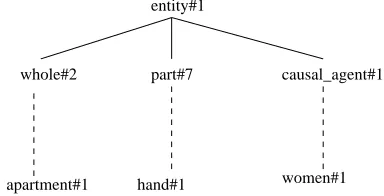
part 7; causal agent 1; Yes . This way, we specialize the ambiguous examples with more specific values for the attributes. The specialization process for this particular example is shown in Figure 1.
causal_agent#1
apartment#1 hand#1 women#1 entity#1
[image:4.612.327.519.303.401.2]whole#2 part#7
Figure 1:The specialization of the ambiguous training exam-ples with the corresponding WordNet hyponyms as new seman-tic classes
Although this specialization procedure eliminates a part of the ambiguous examples, there is no guarantee it will work for all the ambiguous examples of this type. This is because the specialization splits the initial hier-archy into smaller distinct subhierarchies, and thus, the examples are distributed over this new set of subhier-archies. For the examples described above, the proce-dure eliminates the ambiguity through specialization of the semantic classes into two new ones: whole - causal agent, and respectively part - causal agent. However, if the training corpus contained the examples
leg 2; insect 1; Yes and
world 7; insect 1; No , the procedure specializes them in the ambigu-ous example
part 7; organism 1; Yes/No and the ambiguity still remains.
file DATA
Learn
C4.5 using
Format
Specialize Examples for Next Iteration
Examples Training Format Generalize
Examples
Examples Ambiguous
Examples
Unambiguous
Constraints Examples
Classes
NAMES file
Detect
Ambiguous
Examples
Examples
Semantic classes Semantic
Features
[image:5.612.109.504.19.178.2]New Semantic Classes New Examples
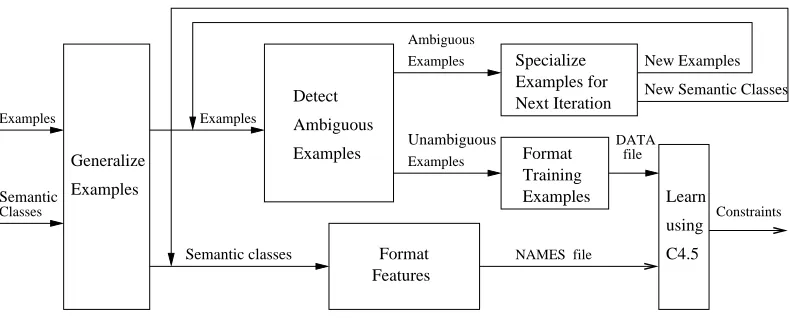
Figure 2: Architecture of the constraint learning procedure.
of iterations produced by the program to specialize ambiguous data:
entity 1 - entity 1
body of water 1 - location 1 location 1 - body of water 1 location 1 - object 1
region 1 - artifact 1 region 3 - artifact 1
Each indentation represents a new iteration.
3.5 The Constraints
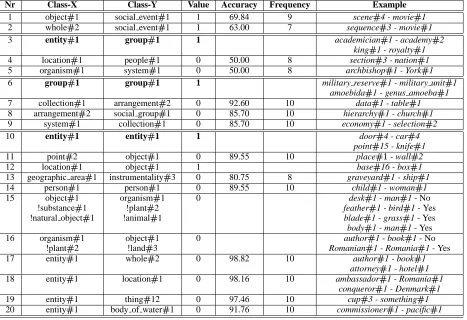
Table 1 summarizes the constraints learned by the pro-gram. The meaning of a constraint with the part Class-X, the whole Class-Y and the value 1 is “if Part is a Class-X and Whole is a Class-Y then it is a part-whole relation” and for the value 0 is “if Part is a Class-X and Whole is a Class-Y then it is not a part-whole relation”. For exam-ple, “if Part is an entity and the Whole is a whole 2 then it is not a part-whole relation”. (whole 2 is the WordNet concept meaning “an assemblage of parts that is regarded as a single entity”).
When forming larger, more complex rules, if the part and the whole contain more then one value, one of these values is negated (preceded by !). For example for the part object 1 and the whole organism 1 the constraint is “if the Part is object 1 and not substance 1 and not natural object 1 and the Whole is organism 1 and not plant 2 and not animal 1 then NO part-whole rela-tion”.
4
Results for discovering part-whole
relations
To validate the constraints for extracting part-whole re-lations, a new test corpus “B” was created from other
10,000 sentences of TREC-9 LA Times news articles. This corpus was parsed and disambiguated using a Word Sense Disambiguation system that has an accuracy of 81
when disambiguating nouns in open-domain (Mi-halcea and Moldovan, 2001). The results provided by the part-whole relation discovery procedure were validated by a human annotator.
Let us define the precision and recall performance met-rics in this context:
! "#$&%'()&!*+,$- .
&!*+,$- /,$%'(
*012 3
45&! 6#$%'&()7*',- 3
489&!*+,$-
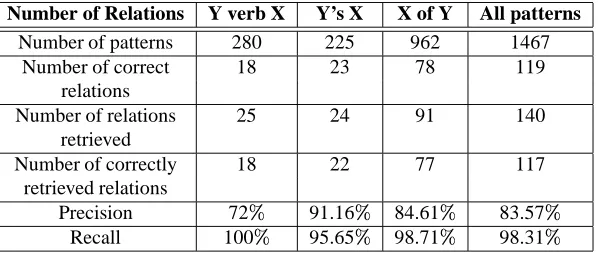
On the test corpus there were 119 meronymy relations expressed by the three patterns considered. The system retrieved 140 relations, of which 117 were meronymy re-lations and 23 were non-meronymy rere-lations, yielding a precision of 83% and a recall of 98%. Table 2 shows the results obtained for each of the three patterns and for all of them.
However, there were other 43 manner relations found in the corpus, expressed by other than the three lexico-syntactic patterns considered in this paper, yielding a global meronymy relation coverage (recall) of 72
. [117/119+43]
Nr Class-X Class-Y Value Accuracy Frequency Example
1 object 1 social event 1 1 69.84 9 scene 4 - movie 1
2 whole 2 social event 1 1 63.00 7 sequence 3 - movie 1
3 entity 1 group 1 1 academician 1 - academy 2
king 1 - royalty 1
4 location 1 people 1 0 50.00 8 section 3 - nation 1
5 organism 1 system 1 0 50.00 8 archbishop 1 - York 1
6 group 1 group 1 1 military reserve 1 - military unit 1
amoebida 1 - genus amoeba 1
7 collection 1 arrangement 2 0 92.60 10 data 1 - table 1
8 arrangement 2 social group 1 0 85.70 10 hierarchy 1 - church 1
9 system 1 collection 1 0 85.70 10 economy 1 - selection 2
10 entity 1 entity 1 1 door 4 - car 4
point 15 - knife 1
11 point 2 object 1 0 89.55 10 place - wall 2
12 location 1 object 1 1 base 16 - box 1
13 geographic area 1 instrumentality 3 0 80.75 8 graveyard 1 - ship 1
14 person 1 person 1 0 89.55 10 child 1 - woman 1
15 object 1 organism 1 0 desk 1 - man 1 - No
!substance 1 !plant 2 feather 1 - bird 1 - Yes
!natural object 1 !animal 1 blade 1 - grass 1 - Yes
body 1 - man 1 - Yes
16 organism 1 object 1 0 author 1 - book 1 - No
!plant 2 !land 3 Romanian 1 - Romania 1 - Yes
17 entity 1 whole 2 0 98.82 10 author 1 - book 1
attorney 1 - hotel 1
18 entity 1 location 1 0 98.16 10 ambassador 1 - Romania 1
conqueror 1 - Denmark 1
19 entity 1 thing 12 0 97.46 10 cup 3 - something 1
[image:6.612.75.542.22.342.2]20 entity 1 body of water 1 0 91.76 10 commissioner 1 - pacific 1
Table 1: The list of all the constrains accompanied by examples (! means “is not”, 1 means “Is a part-whole relation,” and 0 means “Is not a part-whole relation” )
5
Application to Question Answering
The part-whole semantic relation occurs with high fre-quency in open text. Its discovery is paramount for many applications. In this section we mention only Question Answering. For many questions such as “What parts does General Electric manufacture?”, “What are the compo-nents of X?”, “What is Y made of?”, etc., the discovery of part-whole relations is necessary to assemble the right answer.
The concepts and part-whole relations acquired from a collection of documents can be useful in answering difficult questions that normally cannot be handled based solely on keywords matching and proximity. As the level of difficulty increases, Question Answering systems need richer semantic resources, including ontologies and larger knowledge bases. Consider the question:
What does the AH-64A Apache helicopter consist of?
For questions like this, the system must extract all the components the war helicopter has. Unless an ontology of such army attack helicopter parts exists in the
knowl-edge base, which in an open domain situation is highly unlikely, the system must first acquire from the docu-ment collection all the direct and indirect pieces the he-licopter is made of. These parts can be scattered all over the text collection, so the Question Answering system has to gather together these partial answers into a single and concise hierarchy of parts. This technique is called An-swer Fusion.
Using a state-of-the-art Question Answering system (Harabagiu et al. , 2001) adapted for Answer Fusion (Girju, 2001) and including a meronymy module, the question presented above was answered by searching the Internet at the website for Defence Industries - Army (www.army-technology.com). The system started with the question focus AH-64A Apache helicopter and extracted and disambiguated all the meronymy relations using the part-whole module. The following taxonomic ontology was created for this question:
AH-64A Apache Helicopter
Helfire air-to-surface missile millimetre wave seeker 70mm Folding Fin Aerial rocket 30mm Cannon camera
Number of Relations Y verb X Y’s X X of Y All patterns
Number of patterns 280 225 962 1467
Number of correct 18 23 78 119
relations
Number of relations 25 24 91 140
retrieved
Number of correctly 18 22 77 117
retrieved relations
Precision 72
91.16
84.61
83.57
Recall 100
95.65
98.71
98.31
[image:7.612.159.458.21.149.2]
Table 2: The number relations obtained and the accuracy for each pattern and for all the patterns used for this research
General Electric 1700-GE engine 4-rail launchers
four-bladed main rotor anti-tank laser guided missile
Longbow millimetre wave fire control radar integrated radar frequency interferometer rotating turret
tandem cockpit Kevlar seats
For example, the relation “AH-64A Apache helicopter has part Hellfire air-to-surface missile” was determined from the sentence “ AH-64A Apache helicopter has a Longbow-millimeter wave fire control radar and a Hell-fire air-to-surface missile”. For validation only the heads of the noun phrases were considered as they occur in WordNet (i.e., helicopter and air-to-surface missile, re-spectively).
6
Conclusions
The method presented in this paper for the detection and validation of part-whole relation is semi-automatic and has a better accuracy than the previous attempts (Charniak, 1999). It discovers semi-automatically the part-whole lexico-syntactic patterns and learns (automat-ically) the semantic constraints needed for the disam-biguation of these generally applicable patterns.
We combined the results of the decision tree learning with an IS-A hierarchy (the WordNet IS-A relation) spe-cialization for a more accurate learning.
The method presented in this paper can be generalized to discover other semantic relations. The only part-whole elements used in this algorithm were the patterns and the training examples. Thus the learning procedure and the validation procedure are generally applicable and we in-tend to use the method for the detection of other semantic relations such as manner, influence, and others. The in-convenience of the method is that for a very precise learn-ing the number of examples (both positive and negative) should be very large.
We also intend to automate the detection of
lexico-syntactic patterns and to discover constraints for all the part-whole patterns.
References
Matthew Berland and Eugene Charniak. 1999. Finding Parts in Very Large Corpora. In Proceedings of the 37th Annual Meeting of the Association for the Com-putational Linguistics (ACL-99), pages 57-64, College Park, MD.
Eugene Charniak. 2000. A maximum-entropy-inspired parser. In Proceedings of the North American Chap-ter of the Association for Computational Linguistics (NAACL 2000), Seattle, WA.
M. Evens, B. Litowitz, J. Markowitz, R. Smith, and O. Werner. 1980. Lexical-semantic relations: A Com-parative Survey. In Proceedings of the Linguistic Re-search, pages 187-190, Edmonton, Canada.
Peter Gerstl and Simone Pribbenow. 1996. A concep-tual theory of Part-Whole Relations and Its Applica-tions. In Data and Knowledge Engineering, 20(3), pages 305-322.
Roxana Girju. 2001. Answer Fusion with On-Line Ontology Development. In Proceedings of the North American Chapter of the Association for Computa-tional Linguistics (NAACL) - Student Research Work-shop, (NAACL 2001), Pittsburgh, PA.
Marti Hearst. 1998. Automated Discovery of Word-Net Relations. In An Electronic Lexical Database and Some of its Applications, MIT Press, Cambridge, MA.
Madelyn Iris, Bonnie Litowitz and Martha Evens. 1988. Problems of the Part-Whole Relation. In Relational Models of the Lexicon: Representing Knowledge in Se-mantic Networks, Cambridge University Press, Evens (ed.), pages 261-288.
S. Harabagiu, D. Moldovan, M. Pasca, M. Surdeanu, R. Mihalcea, R. Girju, V. Rus, F. Lacatusu, P. Moraescu, and R. Bunescu. 2001. Answering Complex, List and Context Questions with LCC’s Question-Answering Server. In Proceedings of the TExt Retrieval Confer-ence for Question Answering (TREC 10).
J. Ross Quinlan. 1993. C4.5: Programs for Machine Learning. Morgan Kaufmann.