366
Maximizing SLU Performance with Minimal Training Data Using Hybrid
RNN Plus Rule-based Approach
Takeshi Homma Adriano S. Arantes Maria Teresa Gonzalez Diaz Masahito Togami Hitachi America, Ltd.
3315 Scott Boulevard, 4th Floor, Santa Clara, CA 95054, USA
{Adriano.Arantes, Teresa.GonzalezDiaz}@hal.hitachi.com
Abstract
Spoken language understanding (SLU) by using recurrent neural networks (RNN) achieves good performances for large training data sets, but collecting large training datasets is a challenge, especially for new voice applications. Therefore, the purpose of this study is to maximize SLU performances, especially for small train-ing data sets. To this aim, we propose a novel CRF-based dialog act selector which chooses suitable dialog acts from outputs of RNN SLU and rule-based SLU. We evaluate the selector by using DSTC2 cor-pus when RNN SLU is trained by less than 1,000 training sentences. The evaluation demonstrates the selector achieves Micro F1 better than both RNN and rule-based SLUs. In addition, it shows the selector achieves better Macro F1 than RNN SLU and the same Macro F1 as rule-based SLU. Thus, we confirmed our method offers ad-vantages in SLU performances for small training data sets.
1 Introduction
Spoken language understanding (SLU) was fur-ther researched by using rule-based methods (Bellegarda, 2013) and machine learning (ML) (Tur et al.,2010). ML achieves good SLU perfor-mances for large training data sets. However, ML-based SLU with small training data results in poor performances. Therefore, if we want to launch a new spoken dialog service as fast as possible, we cannot use ML-based SLUs as there is no time to prepare sufficient training data.
The goal of this study is to maximize SLU performances especially when the training data
size is small. To achieve this objective, we
propose a selection method which chooses a suitable SLU either from rule-based or ML-based SLUs depending on SLU output
relia-bility. While researchers have studied
selec-tion methods to choose a suitable SLU result from plural SLUs by applying several
algo-rithms (Hahn et al.,2008;Katsumaru et al.,2009;
Karahan et al., 2003;Wang et al., 2002), most of them focused on selectors that improve SLU per-formances for large training data sets. However, their selection methods did not take into account the impact on performance for different training data sizes, specifically, how a selector would work on small training data.
Previous studies have evaluated SLU perfor-mances by metrics such as Micro F1. Neverthe-less, performance evaluation by only Micro F1 is not suitable for practical dialog systems as these systems must recognize all dialog acts that users can say. In practical dialog systems, the distribu-tion of dialog acts for actual user utterances is usu-ally uneven. On this scenario, even if SLU com-pletely fails to recognize some rare dialog acts, the Micro F1 remains almost unchanged and that is the main reason why systems cannot exclusively rely on this metric.
Macro F1 is another common major metric in SLU. Macro F1 computes an averaged Micro F1 of all dialog acts and decreases drastically when it fails to recognize rare dialog acts. Thus, we eval-uate Macro F1 as a better metric to confirm that a selector can recognize all dialog acts.
ŝĂůŽŐ Đƚ ŚƵŶŬ
ĂĨĨŝƌŵ;Ϳ LJĞƐ
ŝŶĨŽƌŵ;ĂƌĞĂсŶŽƌƚŚͿ ŶŽƌƚŚ
ŶŽƌƚŚĂƌĞĂ ŝŶĨŽƌŵ;ĨŽŽĚсĂƐŝĂŶ ŽƌŝĞŶƚĂůͿ ĂƐŝĂŶ ŽƌŝĞŶƚĂů
ĂƐŝĂŶ ŽƌŝĞŶƚĂůĨŽŽĚ
͘͘͘ ͘͘͘
;ϮͿŚƵŶŬ
LJĞƐ͗ĂĨĨŝƌŵ;ͿͬͲϭ͘Ϭ ^ƚĂƌƚ
ͬŶĚ ŶŽƌƚŚ͗ŝŶĨŽƌŵ;ĂƌĞĂсŶŽƌƚŚͿͬͲϭ͘Ϭ ŶŽƌƚŚ͗ɸ ĂƌĞĂ͗ŝŶĨŽƌŵ;ĂƌĞĂсŶŽƌƚŚͿͬͲϮ͘ϭ ĂƐŝĂŶ͗ɸ ŽƌŝĞŶƚĂů͗ŝŶĨŽƌŵ;ĨŽŽĚсĂƐŝĂŶ ŽƌŝĞŶƚĂůͿͬͲϮ͘ϭ ĂƐŝĂŶ͗ɸ ŽƌŝĞŶƚĂů͗ɸ ĨŽŽĚ͗ŝŶĨŽƌŵ;ĨŽŽĚсĂƐŝĂŶ ŽƌŝĞŶƚĂůͿͬͲϯ͘Ϯ фĂƌďх͗ɸ
;ϯͿ^ĞŵĂŶƚŝĐ&^d
ŝĂůŽŐ Đƚ ŽŶǀĞƌƐŝŽŶZƵůĞ
ĂĨĨŝƌŵ;Ϳ LJĞƐ
ŝŶĨŽƌŵ;ĂƌĞĂс䠆Ϳ 䠆
ŝŶĨŽƌŵ;ĂƌĞĂс䠆Ϳ 䠆ĂƌĞĂ ŝŶĨŽƌŵ;ĨŽŽĚс䠆Ϳ 䠆
ŝŶĨŽƌŵ;ĨŽŽĚс䠆Ϳ 䠆ĨŽŽĚ
͘͘͘ ͘͘͘
;ϭͿdĞŵƉůĂƚĞ
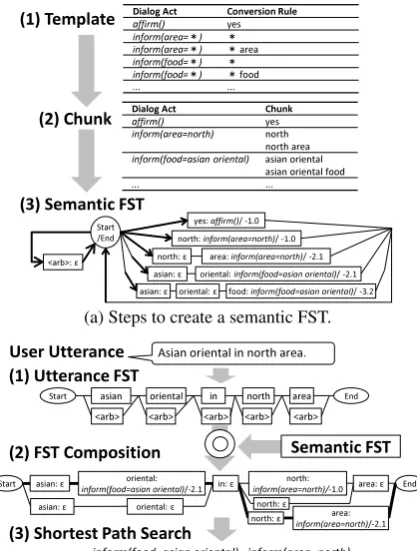
(a) Steps to create a semantic FST.
;ϭͿhƚƚĞƌĂŶĐĞ&^d
;ϮͿ&^dŽŵƉŽƐŝƚŝŽŶ
ŝŶĨŽƌŵ;ĨŽŽĚсĂƐŝĂŶ ŽƌŝĞŶƚĂůͿ͕ŝŶĨŽƌŵ;ĂƌĞĂсŶŽƌƚŚͿ
ƐŝĂŶŽƌŝĞŶƚĂůŝŶŶŽƌƚŚĂƌĞĂ͘
ŝŶ ŶŽƌƚŚ ĂƌĞĂ ŶĚ
ŽƌŝĞŶƚĂů
фĂƌďх фĂƌďх фĂƌďх фĂƌďх
^ƚĂƌƚ ĂƐŝĂŶ
фĂƌďх
ŽƌŝĞŶƚĂů͗ ŝŶĨŽƌŵ;ĨŽŽĚсĂƐŝĂŶ ŽƌŝĞŶƚĂůͿͬͲϮ͘ϭ ^ƚĂƌƚ ĂƐŝĂŶ͗ɸ
ŽƌŝĞŶƚĂů͗ɸ ŝŶ͗ɸ
ŶŽƌƚŚ͗ɸ ĂƌĞĂ͗ ŝŶĨŽƌŵ;ĂƌĞĂсŶŽƌƚŚͿͬͲϮ͘ϭ ŶŽƌƚŚ͗
ŝŶĨŽƌŵ;ĂƌĞĂсŶŽƌƚŚͿͬͲϭ͘Ϭ
ĂƐŝĂŶ͗ɸ
ĂƌĞĂ͗ɸ ŶĚ
;ϯͿ^ŚŽƌƚĞƐƚWĂƚŚ^ĞĂƌĐŚ hƐĞƌhƚƚĞƌĂŶĐĞ
^ĞŵĂŶƚŝĐ&^d
ŶŽƌƚŚ͗ɸ
[image:2.595.77.286.62.338.2](b) Steps of SLU after user utterance using semantic FST. Figure 1: Rule-based SLU by using semantic finite
state transducers. <arb>is a symbol that accepts
any word.εmeans no dialog acts are output.
ǁŝͲϭ͕ƉŝͲϭ͕ĨŝͲϭ͕ƌŝͲϭ
ƋŝͲϭ Ƌŝ Ƌŝнϭ
ǁŝ͕Ɖŝ͕Ĩŝ͕ƌŝ ǁŝнϭ͕Ɖŝнϭ͕Ĩŝнϭ͕ƌŝнϭ
ǁŝ Ɖŝ Ĩŝ ƌŝ
Ƌ͕ŝ Ƌ/͕ŝ Ƌ&͕ŝ ƋZ͕ŝ ͗ǁŽƌĚ
͗WK^ƚĂŐ
͗ĚŝĂůŽŐĂĐƚŽƵƚƉƵƚĨƌŽŵ&^d ͗ĚŝĂůŽŐĂĐƚŽƵƚƉƵƚĨƌŽŵZEE
͗ďŽƚŚĂƌĞĐŽƌƌĞĐƚ ͗ďŽƚŚĂƌĞŝŶĐŽƌƌĞĐƚ ͗&^dŝƐĐŽƌƌĞĐƚ ͗ZEEŝƐĐŽƌƌĞĐƚ Ƌŝс
[image:2.595.87.277.405.506.2]WƌŽďĂďŝůŝƚŝĞƐǁŚĞŶ͘͘͘
Figure 2: Model for dialog act selection.
performances by using not only Micro F1 but also Macro F1.
Experiments validate our novel approach and demonstrate that the proposed selector produces better SLU performances (up to 10.1% Micro F1 and 19.2% Macro F1) than ML-based for small training data sets and achieves “upper bound” of SLU performances regardless of training data size. This result confirms that our selector helps to im-prove ML-based SLU performance even if we uti-lize very limited training data.
2 SLU Algorithms
2.1 Rule-based Algorithm
Our rule-based SLU utilizes a SLU using fi-nite state transducers (FST) modified from
(Ferreira et al., 2015) (Figure 1). SLU develop-ers prepare templates that convert each dialog act
to chunks. Chunks are phrases that users may
say when they intend to perform the dialog acts. The chunks are embedded to an FST which we
call “semantic FST” (Figure1.a). The user
utter-ance is also converted to an utterutter-ance FST
(Fig-ure1.b). Then, the method executes a FST
com-position operation (Mohri, 1997) between the
ut-terance FST and the semantic FST. Finally, the method searches the shortest path within a com-posed FST. The SLU results are the dialog acts along the shortest path, i.e., a path with mini-mal summed weights. Based on heuristics, dialog acts generated from many words are more confi-dent than the ones generated from just few words. Thus, the semantic FST weights are adjusted to prioritize dialog acts generated from many words.
2.2 RNN Algorithm
We used gated recurrent units (GRU) RNN
cells for ML-based SLU (Mesnil et al., 2015;
Zhang and Wang,2016). Each GRU cell receives one word and POS (Part-Of-Speech) tag. We con-vert hidden states of a GRU to probabilities of di-alog acts that the word belongs to. The algorithm selects the dialog acts with maximum probabilities from all words. The gathered dialog acts represent SLU results. In previous studies, each RNN cell outputs dialog acts with in/out/begin (IOB) tags. Our GRU cell, however, outputs dialog acts with-out IOB tags because this condition resulted in better accuracies in a preliminary experiment.
2.3 Selection Algorithm
Figure 2 shows a selection model that receives
word and POS tag. In addition, it receives dialog acts obtained from FST and RNN generated for a corresponding word. Finally, the model outputs probabilities of 4-class judgements: both dialog acts are correct (BC), both dialog acts are incor-rect (BI), FST outputs corincor-rect dialog act (FC), and RNN outputs correct dialog act (RC). We imple-ment this model by using CRF.
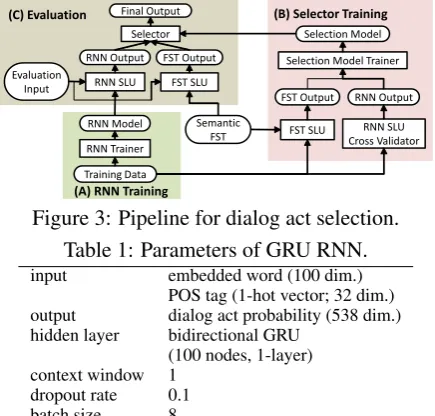
Figure3shows a pipeline of the selection
ZEEdƌĂŝŶĞƌ
dƌĂŝŶŝŶŐĂƚĂ
ZEEDŽĚĞů ZEE^>h
ƌŽƐƐsĂůŝĚĂƚŽƌ ZEEKƵƚƉƵƚ
&^d^>h ^ĞŵĂŶƚŝĐ
&^d
&^dKƵƚƉƵƚ ^ĞůĞĐƚŝŽŶDŽĚĞůdƌĂŝŶĞƌ
^ĞůĞĐƚŝŽŶDŽĚĞů
ǀĂůƵĂƚŝŽŶ
/ŶƉƵƚ ZEE^>h ZEEKƵƚƉƵƚ
&^d^>h &^dKƵƚƉƵƚ ^ĞůĞĐƚŽƌ &ŝŶĂůKƵƚƉƵƚ
;ͿZEEdƌĂŝŶŝŶŐ
[image:3.595.73.291.63.271.2];Ϳ^ĞůĞĐƚŽƌdƌĂŝŶŝŶŐ ;ͿǀĂůƵĂƚŝŽŶ
Figure 3: Pipeline for dialog act selection. Table 1: Parameters of GRU RNN.
input embedded word (100 dim.)
POS tag (1-hot vector; 32 dim.) output dialog act probability (538 dim.) hidden layer bidirectional GRU
(100 nodes, 1-layer) context window 1
dropout rate 0.1
batch size 8
make training inputs. These SLU results are used for training of the selection model.
3 Evaluation
3.1 Dataset
We used a corpus from the Dialog State Track-ing Challenge 2 (DSTC2), to evaluate our method (Henderson et al., 2014). This corpus contains transcribed sentences of user utterances for
restau-rant reservation dialogs. The sentences have
sentence-level dialog acts. From the
sentence-level dialog acts, we manually annotated word-level dialog acts. The DSTC2 corpus has a train-ing set of 11,677 sentences, a development set of 3,934, and a test set of 9,890. From the train-ing set, we randomly chose sentences to create training sets with various sentence sizes (100– 10,000). Distribution of dialog acts in DSTC2 cor-pus is skewed; only 25% of dialog acts appeared in 90% of sentences for both training and test sets. The DSTC2 corpus has an “ontology” which de-fines all dialog acts that user may say. This on-tology defines 659 dialog acts. 649 dialog acts
are defined in forms of intent(slot=value), e.g.,
inform(food=chinese),deny(area=west), and
con-firm(pricerange=cheap). Other 10 dialog acts are
defined by onlyintent, e.g.,affirm(),negate(), and
hello().
3.2 SLU Methods
RNN Table 1 shows the configuration of GRU
for RNN SLU. The GRU receives an embedded word vector with 1-hot POS tag vector. The
em-bedding weights are initialized with normally dis-tributed random numbers. The hidden states of a GRU are converted to an output vector with dialog acts probabilities, by multiplying a linear matrix and softmax function. The dimension of an out-put vector is 538 (537 acts and “no act” class) be-cause the largest training set (10k sentences) con-tains only 537 dialog acts. The hyper parameters for RNN is determined based on SLU performance in the development set. We terminate RNN train-ing when Micro F1 on the development set is max-imized.
FST We manually made 43 templates to
con-vert dialog acts in DSTC2 ontology to 975 chunks.
Figure 1.a step (1) shows template examples.
When a dialog act has avalue, we create chunks
by embedding thevalue. Created chunks are
con-verted to a semantic FST.
3.3 Selection Method
The CRF-based selector uses the following input features: word, POS tag, dialog act that FST SLU outputs, and dialog act that RNN SLU outputs. It also outputs a 4-class judgement (see Figure 2). The CRF model is trained to maximize probabil-ities that the selector outputs correct judgement classes. Features and hyper parameters for train-ing CRF are determined based on selection accu-racies of dialog acts in the development set. A window size for making features is set to 5. We use 3-gram features within the window. During evaluation, we choose dialog acts as follows. As-suming that the selection model outputs maximum probability in BI, we discard both dialog acts ob-tained from FST and RNN SLUs. Otherwise, we compare probabilities of FC and RC. For a larger FC, we adopt a dialog act output from FST SLU. In case RC is larger, we adopt a dialog act output
from RNN SLU. We use CRF++ (Kudo,2013) for
training and evaluation of the selection model.
3.4 Training Data Expansion
Whitelaw et al. (2008) reported methods to
in-crease small training data for named entity recog-nition by expanding them using entity dictionar-ies. We used the same method to increase training data for RNN by using the ontology in DSTC2.
Figure4illustrates the method to increase training
data. From one training sentence, we make
ad-ditional training sentences by replacing thevalue
sen-/ΖŵůŽŽŬŝŶŐĨŽƌƚŚĂŝ
Ͳ Ͳ Ͳ ŝŶĨŽƌŵ;ĨŽŽĚсƚŚĂŝͿ ^>Kd s>h
ĨŽŽĚ ƚŚĂŝ
ďƌŝƚŝƐŚ ƐĞĂĨŽŽĚ ͘͘͘
KZ/'/E>dZ/E/E'^EdE KEdK>K'z
/ΖŵůŽŽŬŝŶŐĨŽƌďƌŝƚŝƐŚ Ͳ Ͳ Ͳ ŝŶĨŽƌŵ;ĨŽŽĚсďƌŝƚŝƐŚͿ /ΖŵůŽŽŬŝŶŐĨŽƌƐĞĂĨŽŽĚ
Ͳ Ͳ Ͳ ŝŶĨŽƌŵ;ĨŽŽĚсƐĞĂĨŽŽĚͿ
[image:4.595.92.273.65.131.2]yWEdZ/E/E'^EdE
Figure 4: Expansion of training data for RNN training as baseline condition.
Ϭ͘ϳ Ϭ͘ϴ Ϭ͘ϵ ϭ͘Ϭ
ϭ Ϭ Ϭ ϭ Ϭ Ϭ Ϭ ϭ Ϭ Ϭ Ϭ Ϭ
D
/ZK
&
ϭ
Ͳ
ηK&dZ/E/E'dͲ
&^d ZEE
ZEEͲ ^>
^>Ͳ
(a) Micro F1
Ϭ͘ϱ Ϭ͘ϲ Ϭ͘ϳ Ϭ͘ϴ Ϭ͘ϵ ϭ͘Ϭ
ϭ Ϭ Ϭ ϭ Ϭ Ϭ Ϭ ϭ Ϭ Ϭ Ϭ Ϭ
D
Z
K
&
ϭ
Ͳ
ηK&dZ/E/E'dͲ
&^d ZEE
ZEEͲ ^>
^>Ͳ
(b) Macro F1
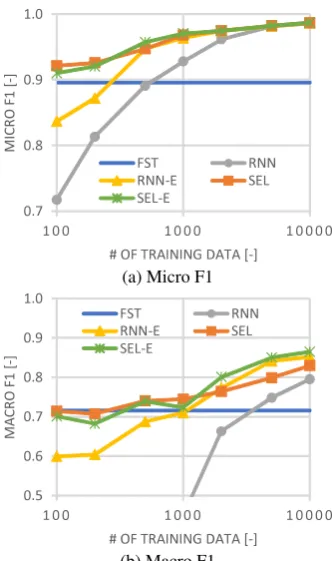
Figure 5: Evaluation results of SLU performances.
tences do not exist in the training data. By using this method, for example, we increase the training set with 100 sentences to 1.2k, and a set with 10k sentences to 67k.
Experimental conditions are as follows.
FST SLU by FST.
RNN SLU by RNN.
RNN-E SLU by RNN trained using expanded training data.
SEL Selection from FST and RNN.
SEL-E Selection from FST and RNN-E.
In SEL-E condition, RNN cross validation uses expanded sentences as training data, and non-expanded sentences as evaluation data.
3.5 Results
Figure5shows SLU performances. We first focus
on results for small training data sets (<1k). SEL and SEL-E achieved better Micro F1 than others
(Figure5.a). Especially, when training sentences
were less than 500, SEL achieved Micro F1 6.2–
10.1% better than ML-based SLU (RNN-E), and 2.8–3.3% better than FST SLU. SEL also resulted in Macro F1 7.7–19.2% better than RNN-E (see
Figure5.b). Although SEL resulted in Macro F1
slightly lower than FST in some small-sized train-ing data, the decreastrain-ing rate was at most 1.2% (FST 0.716, SEL 0.707 at 200 training sentences). SEL-E resulted in Macro F1 with the biggest de-creasing rate compared to FST (4.7% at 200 train-ing sentences). Therefore, our approach suggests that SEL is a suitable selection method to improve SLU accuracies for small training data.
Next, we focus on results for large training data
sets (≥1k). SEL and SEL-E provided almost the
same Micro F1 as RNN-E. Meanwhile, SEL-E achieved the best Macro F1 among all SLUs at 2k or larger training sentences. SEL-E improved Macro F1 with rates of 1.1–3.6% from RNN-E. Because SEL-E achieves the highest SLU perfor-mances, our approach suggests that SEL-E is the best selection method among the ones evaluated to improve SLU accuracies at large training data.
4 Conclusion
This work aims to improve SLU performance for small training data sets. We achieve this goal by proposing a novel CRF-based dialog act selector which chooses suitable SLU outputs either from rule-based or ML-based SLUs. Other main con-tributions are: novel selector method evaluation for different training data sizes; and, SLU per-formance assessment using Micro F1 and Macro
F1. Experimental results show that our
selec-tion methods achieve up to 10.1% Micro F1 and 19.2% Macro F1 performance improvements com-pared to ML-based SLU for small training data. For large training data, our proposed methods out-perform state-of-the-art RNN SLU methods for Macro F1 up to 3.6% while keeping Micro F1 equivalent to RNN SLU.
[image:4.595.97.265.163.444.2]References
Jerome R. Bellegarda. 2013. Large-scale personal as-sistant technology deployment: the Siri experience. InProceedings of the Annual Conference of the In-ternational Speech Communication Association (In-terspeech), pages 2029–2033, Lyon, France.
Emmanuel Ferreira, Bassam Jabaian, and Fabrice Lef`evre. 2015. Zero-shot semantic parser for spoken language understanding. InProceedings of the An-nual Conference of the International Speech Com-munication Association (Interspeech), pages 1403– 1407, Dresden, Germany.
Stefan Hahn, Patrick Lehnen, and Hermann Ney. 2008. System combination for spoken language under-standing. InProceedings of the Annual Conference of the International Speech Communication Associ-ation (Interspeech), pages 236–239, Brisbane, Aus-tralia.
Matthew Henderson, Blaise Thomson, and Jason Williams. 2014. The second dialog state tracking challenge. In Proceedings of the SIGDIAL, pages 263–272, Philadelphia, Pennsylvania, USA.
Mercan Karahan, Dilek Hakkani-T¨ur, Giuseppe Ric-cardi, and Gokhan Tur. 2003. Combining classifiers for spoken language understanding. InProceedings of the IEEE Workshop on Automatic Speech Recog-nition and Understanding (ASRU), pages 589–594, St. Thomas, Virgin Islands, USA.
Masaki Katsumaru, Mikio Nakano, Kazunori Ko-matani, Kotaro Funakoshi, Tetsuya Ogata, and Hi-roshi G. Okuno. 2009. Improving speech under-standing accuracy with limited training data using multiple language models and multiple understand-ing models. In Proceedings of the Annual Con-ference of the International Speech Communica-tion AssociaCommunica-tion (Interspeech), pages 2735–2738, Brighton, United Kingdom.
Taku Kudo. 2013. CRF++: Yet another crf toolkit.
https://taku910.github.io/crfpp.
Ac-cessed: Aug. 15, 2017.
Gr´egoire Mesnil, Yann Dauphin, Kaisheng Yao, Yoshua Bengio, Li Deng, Dilek Hakkani-T¨ur, Xi-aodong He, Larry Heck, Gokhan Tur, Dong Yu, and Geoffrey Zweig. 2015. Using recurrent neural net-works for slot filling in spoken language understand-ing. IEEE/ACM Transactions on Audio, Speech, and Language Processing, 23(3):530–539.
Mehryar Mohri. 1997. Finite-state transducers in lan-guage and speech processing. Computational Lin-guistics, 23(2):269–311.
Gokhan Tur, Dilek Hakkani-T¨ur, and Larry Heck. 2010. What is left to be understood in ATIS? In Proceedings of the IEEE Workshop on Spoken Lan-guage Technology (SLT), pages 19–24, Berkeley, California, USA.
Ye-Yi Wang, Alex Acero, Ciprian Chelba, Brendan Frey, and Leon Wong. 2002. Combination of sta-tistical and rule-based approaches for spoken lan-guage understanding. InProceedings of the Interna-tional Conference on Spoken Language Processing (ICSLP), pages 609–612, Denver, Colorado, USA.
Casey Whitelaw, Alex Kehlenbeck, Nemanja Petro-vic, and Lyle Ungar. 2008. Web-scale named en-tity recognition. InProceedings of the ACM Confer-ence on Information and Knowledge Management (CIKM), pages 123–132, Napa, California, USA.