Proceedings of NAACL-HLT 2018, pages 708–713
Deep Dungeons and Dragons: Learning Character-Action Interactions
from Role-Playing Game Transcripts
Annie Louis University of Edinburgh
10 Crichton Street Edinburgh EH8 9AB [email protected]
Charles Sutton University of Edinburgh
10 Crichton Street Edinburgh EH8 9AB [email protected]
Abstract
An essential aspect to understanding narra-tives is to grasp the interaction between char-acters in a story and the actions they take. We examine whether computational models can capture this interaction, when both char-acter attributes and actions are expressed as complex natural language descriptions. We propose role-playing games as a testbed for this problem, and introduce a large corpus1of
game transcripts collected from online discus-sion forums. Using neural language models which combine character and action descrip-tions from these stories, we show that we can learn the latent ties. Action sequences are bet-ter predicted when the characbet-ter performing the action is also taken into account, and vice versa for character attributes.
1 Introduction
Imagine a giant, a dwarf, and a fairy in a combat situation. We would expect them to act differently, and conversely, if we are told of even a few actions taken by a character in a story, we naturally start to draw inferences about that character’s person-ality. Communicating narrative is a fundamental task of natural language, and understanding nar-rative requires modelling the interaction between events and characters.2
In this paper, we propose that collaboratively-told stories that arise in certain types of games pro-vide a natural test bed for the problem of inferring interactions between characters and actions in nar-ratives. We present a corpus of role-playing game (RPG) transcripts where characters and action se-quences are described with complex natural lan-guage texts. Table1shows an example character
1http://groups.inf.ed.ac.uk/cup/ddd/ 2In this paper, the wordcharacterwill always be used in the sense of “character in a story” rather than the sense of “character in a token”.
Character description
Name: Ana Blackclaw; Age: 27; Gender: Female Appearance: Standing at a mighty 6’5, she is a giant among her fellow humans. Her face is light, though paler than the average man or woman’s, and is marked by scars. ... Her body is muscular, as it would have to be to carry both her armor and the hammer. Her light grey eyes nearly always keep a bored expression. Her canines seem a tad larger than the normal person’s. Preferred Weapon: Hammer. Preferred Armor: Heavy. Gift: Binoculars. Darksign: No.
Action description
She stopped dead in her tracks as the hissing began. A grumble escaped her as it did so, and she looked over to make sure the other woman was doing fine. Seeing that all was not entirely well, she allowed herself to slide down, her hand gripping the slope side once more to slow herself. Once that was accomplished, she reached out and grabbed the back of the girl’s neck, pulling her back to steady herself. The giant remained silent as she did so, and then glanced over to the nearby skeletons. They would be upon them soon. Her grip tightened on the hammer as she glanced from side to side. It would not be a fun fight.
Table 1: Example descriptions from our RPG corpus
description, and an action text for the same char-acter. This example shows how the ties between characters and their actions are subtly present in the text descriptions, and learning the latent ties between them is a difficult task. Based on our cor-pus, and using neural language models, this work demonstrates an initial success on this problem.
The ability to understand and generate narra-tives is a useful skill for natural language systems, for example, to plan a coherent answer to a ques-tion, or to generate a summary of a document. Prior work on narrative processing has focused on inducing disjoint sets of character and event types (as topic models), capturing the relationship be-tween characters in the same story, or extracting character-action pairs as low level noun-verb tu-ples. However, these models do not aim to match or infer characters and actions from each other.
We make two contributions towards closing this gap. We introduce a corpus of thousands of RPG
transcripts and demonstrate predictive cues be-tween characters and actions by building neural language models with facility for adding side in-formation. We show that a language model over action text obtains lower perplexity when we also make available a representation of the character who produced each token. Likewise, a language model for character descriptions benefits from in-formation about the actions the character made. Our findings open up new possibilities for making sophisticated inference over narrative texts.
2 Related work
In work on narratives, both characters and actions have received significant attention, albeit sepa-rately. There is work on inducingtypes of char-acters (Bamman et al., 2013, 2014) or relation-ships between characters (Chang et al.,2009; El-son et al., 2010; Chaturvedi et al., 2016; Iyyer et al., 2016). Often these approaches are based on probabilistic topic models or more recently dis-tributed word representations computed by neural networks. Others focus on learning regular and repetitive event sequences in stories (Chambers and Jurafsky, 2009;McIntyre and Lapata,2009), together with some information about the agent of the actions. These extractions are fairly low-level, in the form of noun-verb pairs. There are also models for clustering stories either based on their characters (Frermann and Szarvas,2017), or sentiment and topic (Elsner,2012,2015).
The above approaches mine types of actions or characters. This work focuses on infering the latent ties between actions and characters, and whether one aspect can help predict the other. Flekova and Gurevych(2015) present recent work related to this latter idea. They classify characters based on their speech and actions into an intro-vert or extrointro-vert class. In contrast, we focus on attributes of characters and actions beyond such coarse traits, and when these attributes are ex-pressed as complex descriptions.
3 A corpus of RPG transcripts
Traditionally, RPGs are played orally with players seated around a table. But there are also online forums where users play RPGs by posting text de-scriptions instead.
We collected a corpus of RPG threads from one such website roleplayerguild.com. Here each game play is recorded in two threads. In one
of these, each player posts a detailed text descrip-tion of the role (character) she is going to play in the game, which we call acharacter description. This description includes the character’s physi-cal appearance, personality, family background, as well as special and supernatural powers, and pos-sessions. A second thread consists of the actual game play where each player contributes a post when his turn comes. Each post describes how the character that is assumed by that specific player responds to the game situation. Thus the story de-velops collaboratively. We call each post in the story thread an action description. An example from our corpus of a character description and an action description is shown in Table1.
A noteworthy aspect of these RPGs is that char-acter attributes are determined by writing the de-scriptions before the game starts. The story thread itself then focuses predominantly on the actions and does not reiterate character attributes. More-over, we know unambiguously which character is associated with each action post. Such mapped pairs of clean character descriptions and associ-ated actions would be difficult to obtain from nov-els or other stories without sophisticated analysis. Our corpus contains 1,544 RPGs spanning a va-riety of themes—fantasy, apocalyptic, romance, anime, military, horror, and adventure. There are a total of 56,576 posts, comprising of 25.3M to-kens. The maximum number of posts in a story is 753, minimum 2, and the average is 26. Note that many stories are in progress and some are long running. There are 9,771 unique characters in the corpus, and their descriptions amount to 8.5M to-kens. There is a minimum of 1, average 6, and maximum 24 characters in a single story.
‘ability’, ‘profile’, ‘talent’, etc., even when they do not contain the name. For action descriptions, we only keep sentences which start with the char-acter’s name. We do not use pronouns since action text may refer to other salient characters as well.
Finally, we replace the main character (contrib-utor) of a post with an “ENT” (for entity) token. Other proper names in a post are replaced with a “NAME” token and numbers with a “NUM” to-ken. We drop all punctuation and any text with less than 5 tokens. After these preprocessing steps, we have 1,439 stories containing 1.48M tokens for action descriptions and 2.95M for characters.
4 Learning character-action interactions
We examine the feasibility of inferring character-action intercharacter-actions from text using neural language models (LM) with side information.
4.1 ACTIONandCHARlanguage models Thestory line, that is, the full text of a story is the token sequenceX =x1...xKcreated by
concate-nating the tokens across all the action descriptions of the story. The posts are taken in time order with-out any mark for post boundaries. LetCbe the set of all characters in a story. For each character j, we denote the character description as the token sequenceCj =cj1. . . cjm.
We build separate language models for action sequences and for character descriptions. The ac-tion sequence model is over the story lines (the se-quence of all action descriptions in a story), i.e.X as defined above. The character description model is over individual character descriptions i.e.,Cj.
First we describe the language modelP(X)for the story line. We hypothesize in this work that a better model ofX can be built by taking into count the character in focus for each individual ac-tion descripac-tion. First, a baseline recurrent neural network (RNN) language model, which we denote ACTION-LM, would be
hi =LSTM(hi−1,xi−1) P(xi|x1. . . xi−1) =softmax(Whvhi+bv)
Herexi−1 is the embedding of the input token xi−1, andhi−1 is the hidden state which summa-rizes the token sequencex1. . . xi−2.LSTM com-putes the next hidden state using an LSTM cell (Hochreiter and Schmidhuber, 1997). The out-put layer produces a probability distribution over the LM vocabulary using weight matrix Whv ∈
R|V|∗|h|where|h|is the hidden size and|V|is the vocabulary size;bv is the bias vector.
To take the character descriptions into account when generating actions, we define a second model ACTION-LMS which estimates
P(X|C) =
K
Y
i=1
p(xi|zi, x1...xi−1, z1...zi−1),
where zl is a variable indicating which
char-acter produced the token xl. For this model, we
essentially augment the RNNs with the character descriptions as side information. For each token xl, the side information is the character
descrip-tion indicated by zl, i.e, Czl. We follow the ap-proach byMikolov and Zweig(2012), andHoang et al.(2016), where a feature embedding vectore
representing side information is input to both the RNN’s hidden and output layers, or to one of them. During development, we found that concatenating the feature embedding with the token embedding at the input layer, and with the hidden state at out-put layer gave the best performance. More for-mally, ACTION-LMS computes:
hi =LSTM
hi−1,
xi−1
ei
P(xi|x1. . .xi−1) =softmax
Wrv
hi ei
+bv
whereeiis a representation of the character which
produced the tokenxi. The hidden statehi−1now summarizes both the action tokens up toi−2and the character information up toi−1. The output layer weight matrix isWrv ∈ R|V|∗(|h|+|e|)where
|h|is the size of the RNN hidden unit, and|e|the feature embedding size.
In our work, the feature embedding itself comes from a feedforward neural network trained jointly within the LM. This feature network takes as in-put the average value of pretrained embeddings3
for the tokens in the character description (we re-move stopwords4). This initial vector is passed
through hidden layers to yield the feature embed-dinge(reminiscent of deep averaging networks by
Iyyer et al.(2015)).
The language models for character descriptions are similar in structure. First, we call the un-conditioned modelP(Ci)for a character
descrip-tionCiasCHAR-LM; this is again an LSTM
lan-guage model. Second, we implementCHAR-LMS 3300 dimensionword2vec(Mikolov et al.,2013) embed-dings trained on the 1 billion word Google News Corpus.
which estimates P(Ci|XCi), where XCi is the subsequence ofXonly containing the tokens pro-duced by Ci. We obtain this conditional
proba-bility based on the same architecture as ACTION -LMS. Here the input to the feature neural network is the average pretrained embeddings of the tokens (without stopwords) inXCi.
4.2 Experiments
We randomly divide our corpus into 100 stories for testing, 20 for development, and the rest, 1319 for training. We compare the two ACTION language models, based on a vocabulary size of 20,000, and theCHARmodels have a vocabulary of 10,000.
Some posts are long even after our filtering steps, and create a winding story line when con-catenated. So we also explore whether limits on description lengths is useful. In ACTIONmodels, a limit ofg means that only the first g words of each post are concatenated to formX. ForCHAR models, only the first g words of the description Ci is used as the sequence for the LM. The same
limitgis given to both the models with and with-out side information. When using side informa-tion, we can restrict the conditioning text as well, to a maximum of h words. We tune these limit parameters, as well as the number of hidden lay-ers, hidden unit sizes and dropout probability on a development set.
For theACTIONmodels, we setgto 100 words. ACTION-LM uses 2 layers with 256 hidden units each. ACTION-LMS has 1 layer with 256 hid-den units for the feature network withhset to 25 words, and 1 layer with 50 units for the RNN part. For theCHARmodels,g= 200words.CHAR-LM has one hidden layer with 100 units. For CHAR -LMS, the best network was the same asACTION -LMS but with h = 100 (the first 100 words of all the action posts by that character are com-bined as the side information). We apply a dropout probability of 0.65, clip gradients at 5.0, and use the Adam algorithm (Kingma and Ba, 2015) for optimization. All our models can trained in an hour, ACTION-LM with 14 epochs, CHAR-LM 62,ACTION-LMS 60 andCHAR-LMS 91 epochs. We implemented the models in TensorFlow5.
4.3 Results
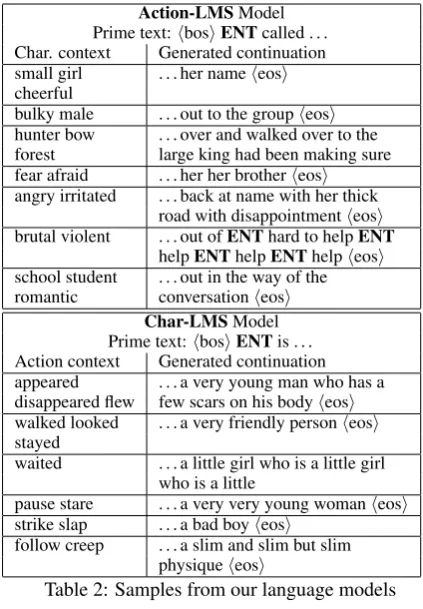
First, we provide examples of the patterns cap-tured by ACTION-LMS andCHAR-LMS by
sam-5https://www.tensorflow.org
Action-LMSModel Prime text:hbosiENTcalled . . . Char. context Generated continuation small girl . . . her nameheosi cheerful
bulky male . . . out to the groupheosi hunter bow . . . over and walked over to the forest large king had been making sure fear afraid . . . her her brotherheosi angry irritated . . . back at name with her thick
road with disappointmentheosi brutal violent . . . out ofENThard to helpENT
helpENThelpENThelpheosi school student . . . out in the way of the romantic conversationheosi
Char-LMSModel Prime text:hbosiENTis . . . Action context Generated continuation appeared . . . a very young man who has a disappeared flew few scars on his bodyheosi walked looked . . . a very friendly personheosi stayed
waited . . . a little girl who is a little girl who is a little
pause stare . . . a very very young womanheosi strike slap . . . a bad boyheosi
follow creep . . . a slim and slim but slim physiqueheosi
Table 2: Samples from our language models
Model Train Dev Test
ACTION-LM 82.56 106.83 105.06
ACTION-LMS 57.38 94.95 96.91
CHAR-LM 69.45 118.78 106.12
[image:4.595.306.518.61.366.2]CHAR-LMS 61.84 110.13 100.86
Table 3: Perplexities of our models
pling from the models (Table2). For side informa-tion, we use simple words (taken from the descrip-tions in our test corpus) for closer examination.
For ACTION-LMS, we seed the story line with the priming text “hbosiENTcalled”, whereENT
is the token in our vocabulary referring to the main character of a post. hbosi is a beginning of sen-tence marker. Different inputs for the condition-ing character description are shown under “Char. context”. We then sample from the LM follow-ing a greedy approach takfollow-ing the most likely to-ken at each step until either the end toto-kenheosior a maximum of 12 tokens is reached. The sample is shown under “generated continuation”. Simi-larly, we sample from CHAR-LMS where the se-quence is first primed with “ENTis a”. We find that both models capture interesting ties between character attributes and actions. However, there is much scope for improved models of generation.
charac-ter and action LMs, adding side information leads to a significant decrease in perplexity showing that the interdependence between the two aspects can be learned computationally. Again, there is a lot of scope for improving the language mod-els given that the development and test perplexities are much higher than those during training.
5 Conclusions
We have proposed and demonstrated the feasi-bility of capturing interactions between charac-ters and their actions in stories. While our neu-ral models show that the data can be better mod-eled by combining both aspects, one might eventu-ally want to infer a missing modality by sampling or generation from the model. We plan to work on these improvements for future work, and also explore evaluation methods which go beyond lan-guage model perplexities, and capture model as-pects closer to the task and domain.
References
David Bamman, Brendan O’Connor, and Noah A. Smith. 2013. Learning latent personas of film char-acters. In Proceedings of the 51st Annual Meet-ing of the Association for Computational LMeet-inguis- Linguis-tics. pages 352–361.
David Bamman, Ted Underwood, and Noah A. Smith. 2014. A bayesian mixed effects model of literary character. InProceedings of the 52nd Annual Meet-ing of the Association for Computational LMeet-inguis- Linguis-tics. pages 370–379.
Nathanael Chambers and Dan Jurafsky. 2009. Unsu-pervised learning of narrative schemas and their par-ticipants. InProceedings of the Joint Conference of the 47th Annual Meeting of the ACL and the 4th In-ternational Joint Conference on Natural Language Processing of the AFNLP. pages 602–610.
Jonathan Chang, Jordan Boyd-Graber, and David M. Blei. 2009. Connections between the lines: Aug-menting social networks with text. InProceedings of the 15th ACM SIGKDD International Conference on Knowledge Discovery and Data Mining. pages 169–178.
Snigdha Chaturvedi, Shashank Srivastava, Hal Daum´e III, and Chris Dyer. 2016. Modeling evolving relationships between characters in lit-erary novels. In Proceedings of the Thirtieth AAAI Conference on Artificial Intelligence. pages 2704–2710.
Micha Elsner. 2012. Character-based kernels for nov-elistic plot structure. In Proceedings of the 13th Conference of the European Chapter of the Associa-tion for ComputaAssocia-tional Linguistics. pages 634–644.
Micha Elsner. 2015. Abstract representations of plot structure. Linguistic Issues in Language Technology 12(5):1–31.
David K. Elson, Nicholas Dames, and Kathleen R. McKeown. 2010. Extracting social networks from literary fiction. InProceedings of the 48th Annual Meeting of the Association for Computational Lin-guistics. pages 138–147.
Lucie Flekova and Iryna Gurevych. 2015. Personal-ity profiling of fictional characters using sense-level links between lexical resources. In Proceedings of the Conference on Empirical Methods in Natural Language Processing. pages 1805–1816.
Lea Frermann and Gy¨orgy Szarvas. 2017. Inducing semantic micro-clusters from deep multi-view rep-resentations of novels. InProceedings of the Con-ference on Empirical Methods in Natural Language Processing. pages 1873–1883.
Cong Duy Vu Hoang, Trevor Cohn, and Gholamreza Haffari. 2016. Incorporating side information into recurrent neural network language models. In Pro-ceedings of the 2016 Conference of the North Amer-ican Chapter of the Association for Computational Linguistics: Human Language Technologies. pages 1250–1255.
Sepp Hochreiter and J¨urgen Schmidhuber. 1997. Long short-term memory. Neural Computation 9(8):1735–1780.
Mohit Iyyer, Anupam Guha, Snigdha Chaturvedi, Jor-dan Boyd-Graber, and Hal Daum´e III. 2016. Feud-ing families and former friends: Unsupervised learn-ing for dynamic fictional relationships. In Proceed-ings of the Conference of the North American Chap-ter of the Association for Computational Linguistics: Human Language Technologies. pages 1534–1544. Mohit Iyyer, Varun Manjunatha, Jordan Boyd-Graber,
and Hal Daum´e III. 2015. Deep unordered compo-sition rivals syntactic methods for text classification. In Proceedings of the 53rd Annual Meeting of the Association for Computational Linguistics and the 7th International Joint Conference on Natural Lan-guage Processing. pages 1681–1691.
Diederik P. Kingma and Jimmy Ba. 2015. Adam: A method for stochastic optimization. InProceedings of the International Conference on Learning Repre-sentations.
Neil McIntyre and Mirella Lapata. 2009. Learning to tell tales: A data-driven approach to story genera-tion. InProceedings of the Joint Conference of the 47th Annual Meeting of the ACL and the 4th Interna-tional Joint Conference on Natural Language Pro-cessing of the AFNLP. pages 217–225.