Revisiting the Centroid-based Method: A Strong Baseline for
Multi-Document Summarization
Demian Gholipour Ghalandari Aylien Ltd., Dublin, Ireland
Abstract
The centroid-based model for extractive document summarization is a simple and fast baseline that ranks sentences based on their similarity to a centroid vector. In this paper, we apply this ranking to possible summaries instead of sentences and use a simple greedy algorithm to find the best summary. Furthermore, we show possi-bilities to scale up to larger input docu-ment collections by selecting a small num-ber of sentences from each document prior to constructing the summary. Experiments were done on the DUC2004 dataset for multi-document summarization. We ob-serve a higher performance over the orig-inal model, on par with more complex state-of-the-art methods.
1 Introduction
Extractive multi-document summarization (MDS) aims to summarize a collection of documents by selecting a small number of sentences that repre-sent the original content appropriately. Typical ob-jectives for assembling a summary include infor-mation coverage and non-redundancy. A wide va-riety of methods have been introduced to approach MDS.
Many approaches are based on sentence rank-ing, i.e. assigning each sentence a score that dicates how well the sentence summarizes the in-put (Erkan and Radev,2004;Hong and Nenkova,
2014;Cao et al.,2015). A summary is created by selecting the top entries of the ranked list of sen-tences. Since the sentences are often treated sepa-rately, these models might allow redundancy in the summary. Therefore, they are often extended by an anti-redundancy filter while de-queuing ranked sentence lists.
Other approaches work at summary-level rather than sentence-level and aim to optimize functions of sets of sentences to find good summaries, such as KL-divergence between probability distribu-tions (Haghighi and Vanderwende, 2009) or sub-modular functions that represent coverage, diver-sity, etc. (Lin and Bilmes,2011)
The centroid-based model belongs to the for-mer group: it represents sentences as bag-of-word (BOW) vectors with TF-IDF weighting and uses a centroid of these vectors to represent the whole document collection (Radev et al.,2004). The sen-tences are ranked by their cosine similarity to the centroid vector. This method is often found as a baseline in evaluations where it usually is out-performed (Erkan and Radev,2004;Hong et al.,
2014).
This baseline can easily be adapted to work at the summary-level instead the sentence level. This is done by representing a summary as the centroid of its sentence vectors and maximizing the simi-larity between the summary centroid and the cen-troid of the document collection. A simple greedy algorithm is used to find the best summary under a length constraint.
In order to keep the method efficient, we outline different methods to select a small number of can-didate sentences from each document in the input collection before constructing the summary.
We test these modifications on the DUC2004 dataset for multi-document summarization. The results show an improvement of Rouge scores over the original centroid method. The performance is on par with state-of-the-art methods which shows that the similarity between a summary centroid and the input centroid is a well-suited function for global summary optimization.
The summarization approach presented in this paper is fast, unsupervised and simple to imple-ment. Nevertheless, it performs as well as more
complex state-of-the-art approaches in terms of Rouge scores on the DUC2004 dataset. It can be used as a strong baseline for future research or as a fast and easy-to-deploy summarization tool.
2 Approach
2.1 Original Centroid-based Method
The original centroid-based model is described by
Radev et al. (2004). It represents sentences as BOW vectors with TF-IDF weighting. The cen-troid vector is the sum of all sentence vectors and each sentence is scored by the cosine similarity between its vector representation and the centroid vector. Cosine similarity measures how close two vectors A andB are based on their angle and is defined as follows:
sim(A, B) = A·B
|A||B| (1)
A summary is selected by de-queuing the ranked list of sentences in decreasing order until the de-sired summary length is reached.
Rossiello et al. (2017) implement this original model with the following modifications:
1. In order to avoid redundant sentences in the summary, a new sentence is only included if it does not exceed a certain maximum sim-ilarity to any of the already included sen-tences.
2. To focus on only the most important terms of the input documents, the values in the cen-troid vector which fall below a tuned thresh-old are set to zero.
This model, which includes the anti-redundancy filter and the selection of top-ranking features, is treated as the ”original” centroid-based model in this paper.
We implement the selection of top-ranking fea-tures for both the original and modified models slightly differently to Rossiello et al. (2017): all words in the vocabulary are ranked by their value in the centroid vector. On a development dataset, a parameter is tuned that defines the proportion of the ranked vocabulary that is represented in the centroid vector and the rest is set to zero. This variant resulted in more stable behavior for differ-ent amounts of input documdiffer-ents.
2.2 Modified Summary Selection
The similarity to the centroid vector can also be used to score a summary instead of a sentence. By representing a summary as the sum of its sentence vectors, it can be compared to the centroid, which is different from adding centroid-similarity scores of individual sentences.
With this modification, the summarization task is explicitly modelled as finding a combination of sentences that summarize the input well together instead of finding sentences that summarize the input well independently. This strategy should also be less dependent on anti-redundancy filter-ing since a combination of redundant sentences is probably less similar to the centroid than a more diverse selection that covers different prevalent topics.
In the experiments, we will therefore call this modification the ”global” variant of the centroid model. The same principle is used by the KL-Summodel (Haghighi and Vanderwende,2009) in which the optimal summary minimizes the KL-divergence of the probability distribution of words in the input from the distribution in the summary. KLSum uses a greedy algorithm to find the best summary. Starting with an empty summary, the algorithm includes at each iteration the sentence that maximizes the similarity to the centroid when added to the already selected sentences. We also use this algorithm for sentence selection. The pro-cedure is depicted in Algorithm1below.
Algorithm 1Greedy Sentence Selection
1: Input:input sentencesD,centroidc, limit 2: Output:summary sentencesS
3: S← ∅
4: length←0
5: whilelength < limitandD6=∅do 6: sbest←arg max
s∈D sim(S∪ {s}, c)
7: S ←S∪ {sbest} 8: D←D\ {sbest} 9: length←length+ 1
2.3 Preselection of Sentences
if the amount of input documents was larger, e.g. for the summarization of top-100 search results in document retrieval.
Therefore, we explore different methods for re-ducing the number of input sentences before ap-plying the greedy sentence selection algorithm to make the model more suited for larger inputs. It is also important to examine how this affects Rouge scores.
We test the following methods of selecting N
sentences from each document as candidates for the greedy sentence selection algorithm:
N-first
The first N sentences of the document are se-lected. This results in a mixture of a lead-N base-line and the centroid-based method.
N-best
The sentences are ranked separately in each docu-ment by their cosine similarity to the centroid vec-tor, in decreasing order. TheN best sentences of each document are selected as candidates.
New-TF-IDF
Each sentence is scored by the sum of the TF-IDF scores of the terms that are mentioned in that sen-tence for the first time in the document. The in-tuition is that sentences are preferred if they intro-duce new important information to a document.
Note that in each of these candidate selection methods, the centroid vector is always computed as the sum of all sentence vectors, including the ones of the ignored sentences.
3 Experiments
Datasets
For testing, we use the DUC2004 Task 2 dataset from the Document Understanding Conference (DUC). The dataset consists of 50 document clus-ters containing 10 documents each. For tun-ing hyperparameters, we use the CNN/Daily Mail dataset (Hermann et al., 2015) which provides summary bulletpoints for individual news articles. In order to adapt the dataset for MDS, 50 CNN ar-ticles were randomly selected as documents to ini-tialize 50 clusters. For each of these seed articles, 9 articles with the highest word-overlap in the first 3 sentences were added to that cluster. This re-sulted in 50 documents clusters, each containing 10 topically related articles. The reference sum-maries for each cluster were created by
interleav-ing the sentences of the article summaries until a length contraint (100 words) was reached.
Baselines & Evaluation
Hong et al.(2014) published SumRepo, a reposi-tory of summaries for the DUC2004 dataset gener-ated by several baseline and state-of-the-art meth-ods1. We evaluate summaries generated by a
se-lection of these methods on the same data that we use for testing. We calculate Rouge scores with the Rouge toolkit (Lin,2004). In order to compare our results toHong et al.(2014) we use the same Rouge settings as they do2 and report results for
Rouge-1, Rouge-2 and Rouge-4 recall. The base-lines include a basic centroid-based model without an anti-redundancy filter and feature reduction.
Preprocessing
In the summarization methods proposed in this pa-per, the preprocessing includes sentence segmen-tation, lowercasing and stopword removal.
Parameter Tuning
The similarity threshold for avoiding redundancy (r) and the vocabulary-included-in-centroid ratio (v) are tuned with the original centroid model on our development set. Values from0to1with step size0.1were tested using a grid search. The op-timal values forr andvwere0.6and0.1, respec-tively. These values were used for all tested vari-ants of the centroid model. For the different meth-ods of choosing N sentences of each document before summarization, we tunedN separately for each, with values from 1 to 10, using the global model. The best N found for N-first, N-best, new-tfidf were 7, 2 and 3 respectively.
Results
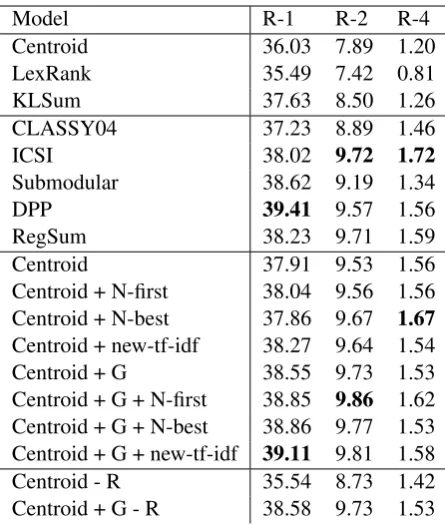
Table1 shows the Rouge scores measured in our experiments. The first two sections show results for baseline and SOTA summaries from SumRepo. The third section shows the summarization vari-ants presented in this paper. ”G” indicates that the global greedy algorithm was used instead of sentence-level ranking. In the last section, ”- R” indicates that the method was tested without the anti-redundancy filter.
1http://www.cis.upenn.edu/˜nlp/
corpora/sumrepo.html
2ROUGE-1.5.5 with the settings -n 4 -m -a -l 100 -x -c 95
Model R-1 R-2 R-4
Centroid 36.03 7.89 1.20
LexRank 35.49 7.42 0.81
KLSum 37.63 8.50 1.26
CLASSY04 37.23 8.89 1.46
ICSI 38.02 9.72 1.72
Submodular 38.62 9.19 1.34
DPP 39.41 9.57 1.56
RegSum 38.23 9.71 1.59
Centroid 37.91 9.53 1.56
Centroid + N-first 38.04 9.56 1.56 Centroid + N-best 37.86 9.67 1.67
Centroid + new-tf-idf 38.27 9.64 1.54 Centroid + G 38.55 9.73 1.53 Centroid + G + N-first 38.85 9.86 1.62 Centroid + G + N-best 38.86 9.77 1.53 Centroid + G + new-tf-idf 39.11 9.81 1.58 Centroid - R 35.54 8.73 1.42 Centroid + G - R 38.58 9.73 1.53
Table 1: Rouge scores on DUC2004.
Both the global optimization and the sentence preselection have a positive impact on the perfor-mance.
The global + new-TF-IDF variant outperforms all but the DPP model in Rouge-1 recall. The global + N-first variant outperforms all other mod-els in Rouge-2 recall. However, the Rouge scores of the SOTA methods and the introduced centroid variants are in a very similar range.
Interestingly, the original centroid-based model, without any of the new modifications introduced in this paper, already shows quite high Rouge scores in comparison to the other baseline meth-ods. This is due to the anti-redundancy filter and the selection of top-ranking features.
In order to see whether the global sentence se-lection alleviates the need for an anti-redundancy filter, the original method and the global method (without N sentences per document selection) were tested without it (section 4 in Table 1). In terms of Rouge-1 recall, the original model is clearly very dependent on checking for redun-dancy when including sentences, while the global variant does not change its performance much without the anti-redundancy filter. This matches the expectation that the globally motivated method handles redundancy implicitly.
4 Example Summaries
Table2 shows generated example summaries us-ing the global centroid method with the three sen-tence preselection methods. For readability, trun-cated sentences (due to the 100-word limit) at the end of the summaries are excluded. The original positions of the summary sentences, i.e. the in-dices of the document and the sentence inside the document are given. As can be seen in the exam-ples, the N-first method is restricted to sentences appearing early in documents. In the new-TF-IDF example, the second and third sentences were preselected because high ranking features such as ”robot” and ”arm” appeared for the first time in the respective documents.
5 Related Work
In addition to various works on sophisticated mod-els for multi-document summarization, other ex-periments have been done showing that simple modifications to the standard baseline methods can perform quite well.
Rossiello et al. (2017) improved the centroid-based method by representing sentences as sums of word embeddings instead of TF-IDF vectors so that semantic relationships between sentences that have no words in common can be captured.
Mackie et al. (2016) also evaluated summaries from SumRepo and did experiments on improv-ing baseline systems such as the centroid-based and the KL-divergence method with different anti-redundancy filters. Their best optimized baseline obtained a performance similar to the ICSI method in SumRepo.
6 Conclusion
In this paper we show that simple modifications to the centroid-based method can bring its perfor-mance to the same level as state-of-the-art meth-ods on the DUC2004 dataset. The resulting sum-marization methods are unsupervised, efficient and do not require complicated feature engineer-ing or trainengineer-ing.
Changing from a ranking-based method to a global optimization method increases perfor-mance and makes the summarizer less dependent on explicitly checking for redundancy. This can be useful for input document collections with differ-ing levels of content diversity.
[image:4.595.72.295.60.323.2]Example Summaries N-first(N=7)
For the second day in a row, astronauts boarded space shuttle Endeavour on Friday for liftoff on NASA’s first space station construction flight. Endeavour and its astronauts closed in Sunday to capture the first piece of the international space station, the Russian-made Zarya control module that had to be connected to the Unity chamber aboard the shuttle. Mission Control gave the astronauts plenty of time for the tasks. On their 12-day flight, Endeavour’s astronauts are to locate a Russian part already in orbit, grasp it with the shuttle’s robot arm and attach the new U.S. module.
Sentence positions (doc, sent):(0, 0), (1, 0), (1, 5), (8, 5)
N-best(N=2)
For the second day in a row, astronauts boarded space shuttle Endeavour on Friday for liftoff on NASA’s first space station construction flight. The astronauts will use the shuttle robot arm to capture the Russian space station piece and attach it to Unity. Mission Control ordered the pilots to fire the shuttle thrusters to put an extra three miles between Endeavour and the space junk, putting Endeavour a total of five miles from the orbiting debris. On their 12-day flight, Endeavour’s astronauts are to locate a Russian part already in orbit, grasp it with the shuttle’s robot arm and attach the new U.S. module.
Sentence positions (doc, sent):(0, 0), (0, 20), (2, 19), (8, 5)
New-TF-IDF(N=3)
For the second day in a row, astronauts boarded space shuttle Endeavour on Friday for liftoff on NASA’s first space station construction flight. The astronauts will use the shuttle robot arm to capture the Russian space station piece and attach it to Unity. The shuttle’s 50-foot robot arm had never before been assigned to handle an object as massive as the 44,000-pound Zarya, a power and propulsion module that was launched from Kazakhstan on Nov. 20. Endeavour’s astronauts connected the first two building blocks of the international space station on Sunday, creating a seven-story tower in the shuttle cargo bay.
Sentence positions (doc, sent):(0, 0), (0, 20), (1, 12), (5, 0)
Table 2: Summaries of the clusterd30031in DUC2004 generated by the modified centroid method using different sentence preselection methods.
lead to additional improvements while reducing computation effort, if global optimization is be-ing used. These methods could be useful for other summarization models that rely on pairwise sim-ilarity computations between all input sentences, or other properties which would slow down sum-marization of large numbers of input sentences.
The modified methods can also be used as strong baselines for future experiments in multi-document summarization.
References
Ziqiang Cao, Furu Wei, Li Dong, Sujian Li, and Ming Zhou. 2015. Ranking with recursive neural net-works and its application to multi-document sum-marization. InAAAI. pages 2153–2159.
G¨unes Erkan and Dragomir R. Radev. 2004. Lexrank: Graph-based lexical centrality as salience in text summarization. Journal of Artificial Intelligence Research22:457–479.
Aria Haghighi and Lucy Vanderwende. 2009. Explor-ing content models for multi-document summariza-tion. In Proceedings of Human Language Tech-nologies: The 2009 Annual Conference of the North American Chapter of the Association for Compu-tational Linguistics. Association for Computational Linguistics, pages 362–370.
Karl Moritz Hermann, Tomas Kocisky, Edward Grefenstette, Lasse Espeholt, Will Kay, Mustafa
Su-leyman, and Phil Blunsom. 2015. Teaching ma-chines to read and comprehend. InAdvances in Neu-ral Information Processing Systems. pages 1693– 1701.
Kai Hong, John M. Conroy, Benoit Favre, Alex Kulesza, Hui Lin, and Ani Nenkova. 2014. A repos-itory of state of the art and competitive baseline sum-maries for generic news summarization. InLREC. pages 1608–1616.
Kai Hong and Ani Nenkova. 2014. Improving the estimation of word importance for news multi-document summarization. InEACL. pages 712–721. Chin-Yew Lin. 2004. Rouge: A package for auto-matic evaluation of summaries. InText summariza-tion branches out: Proceedings of the ACL-04 work-shop. Barcelona, Spain, volume 8.
Hui Lin and Jeff Bilmes. 2011. A class of submodu-lar functions for document summarization. In Pro-ceedings of the 49th Annual Meeting of the Asso-ciation for Computational Linguistics: Human Lan-guage Technologies-Volume 1. Association for Com-putational Linguistics, pages 510–520.
Stuart Mackie, Richard McCreadie, Craig Macdonald, and Iadh Ounis. 2016. Experiments in newswire summarisation. In European Conference on Infor-mation Retrieval. Springer, pages 421–435.