An Analysis of Frequency- and Memory-Based Processing Costs
Marten van Schijndel The Ohio State University [email protected]
William Schuler The Ohio State University [email protected]
Abstract
The frequency of words and syntactic con-structions has been observed to have a sub-stantial effect on language processing. This begs the question of what causes certain con-structions to be more or less frequent. A the-ory of grounding (Phillips, 2010) would sug-gest that cognitive limitations might cause lan-guages to develop frequent constructions in such a way as to avoid processing costs. This paper studies how current theories of working memory fit into theories of language process-ing and what influence memory limitations may have over reading times. Measures of such limitations are evaluated on eye-tracking data and the results are compared with predic-tions made by different theories of processing.
1 Introduction
Frequency effects in language have been isolated and observed in many studies (Trueswell, 1996; Jurafsky, 1996; Hale, 2001; Demberg and Keller, 2008). These effects are important because they il-luminate the ontogeny of language (how individual speakers have acquired language), but they do not answer questions about the phylogeny of language (how the language came to its current form).
Phillips (2010) has hypothesized that grammar rule probabilities may be grounded in memory lim-itations. Increased delays in processing center-embedded sentences as the number of embeddings increases, for example, are often explained in terms of a complexity cost associated with maintaining in-complete dependencies in working memory (Gib-son, 2000; Lewis and Vasishth, 2005). Other stud-ies have shown a link between processing delays
and the low frequency of center-embedded construc-tions like object relatives (Hale, 2001), but they have not explored the source of this low frequency. A grounding hypothesis would claim that the low probability of generating such a structure may arise from an associated memory load. In this account, while these complexity costs may involve language-specific concepts such as referent or argument link-ing, the underlying explanation would be one of memory limitations (Gibson, 2000) or neural acti-vation (Lewis and Vasishth, 2005).
This paper seeks to explore the different predic-tions made by these theories on a broad-coverage corpus of eye-tracking data (Kennedy et al., 2003). In addition, the current experiment seeks to isolate memory effects from frequency effects in the same task. The results show that memory load measures are a significant factor even when frequency mea-sures are residualized out.
The remainder of this paper is organized as fol-lows: Sections 2 and 3 describe several frequency and memory measures. Section 4 describes a proba-bilistic hierarchic sequence model that allows all of these measures to be directly computed. Section 5 describes how these measures were used to predict reading time durations on the Dundee eye-tracking corpus. Sections 6 and 7 present results and discuss.
2 Frequency Measures
2.1 Surprisal
One of the strongest predictors of processing com-plexity is surprisal (Hale, 2001). It has been shown in numerous studies to have a strong correlation with reading time durations in eye-tracking and self-paced reading studies when calculated with a variety
of models (Levy, 2008; Roark et al., 2009; Wu et al., 2010).
Surprisal predicts the integration difficulty that a wordxtat time steptpresents given the preceding context and is calculated as follows:
surprisal(xt) =−log2 P
s∈S(x1...xt)P(s)
P
s∈S(x1...xt−1)P(s)
!
(1) whereS(x1. . . xt)is the set of syntactic trees whose leaves havex1. . . xtas a prefix.1
In essence, surprisal measures how unexpected constructions are in a given context. What it does not provide is an explanation for why certain con-structions would be less common and thus more sur-prising.
2.2 Entropy Reduction
Processing difficulty can also be measured in terms of entropy (Shannon, 1948). A larger entropy over a random variable corresponds to greater uncertainty over the observed value it will take. The entropy of a syntactic derivation over the sequencex1. . . xtis calculated as:2
H(x1...t) =
X
s∈S(x1...xt)
−P(s)·log
2P(s) (2)
Reduction in entropy has been found to predict processing complexity (Hale, 2003; Hale, 2006; Roark et al., 2009; Wu et al., 2010; Hale, 2011):
∆H(x1...t) = max(0, H(x1...t−1)−H(x1...t)) (3)
This measures the change in uncertainty about the discourse as each new word is processed.
3 Memory Measures
3.1 Dependency Locality
In Dependency Locality Theory (DLT) (Gibson, 2000), complexity arises from intervening referents introduced between a predicate and its argument. Under the original formulation of DLT, there is a
1
The parser in this study uses a beam. However, given high parser accuracy, Roark (2001) showed that calculating com-plexity metrics over a beam should obtain similar results to the full complexity calculation.
2
The incremental formulation used here was first proposed in Wu et al. (2010).
storagecost for each new referent introduced and an
integrationcost for each referent intervening in a de-pendency projection. This is a simplification made for ease of computation, and subsequent work has found DLT to be more accurate cross-linguistically if the intervening elements are structurally defined rather than defined in terms of referents (Kwon et al., 2010). That is, simply having a particular ref-erent intervene in a dependency projection may not have as great an effect on processing complexity as the syntactic construction the referent appears in. Therefore, this work reinterprets the costs of depen-dency locality to be related to the events of begin-ning a center embedding (storage) and completing a center embedding (integration). Note that anti-locality effects (where longer dependencies are eas-ier to process) have also been observed in some lan-guages, and DLT is unable to account for these phe-nomena (Vasishth and Lewis, 2006).
3.2 ACT-R
Processing complexity has also been attributed to confusability (Lewis and Vasishth, 2005) as defined in domain-general cognitive models like ACT-R (Anderson et al., 2004).
S
VP
NP
—–
NP
N D
the V
bought NP
N
studio D
the
S/NP
)
[image:3.612.92.279.57.180.2]NP/N
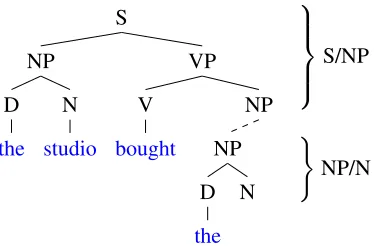
Figure 1: Two disjoint connected components of a phrase structure tree for the sentenceThe studio bought the pub-lisher’s rights,shown immediately prior to the word pub-lisher.
those previously encoded (similarity-based encod-ing interference) (Lewis et al., 2006).
3.3 Hierarchic Sequential Prediction
Current models of working memory in structured tasks are defined in terms of hierarchies of sequen-tial processes, in which superordinate sequences can be interrupted by subordinate sequences and resume when the subordinate sequences have concluded (Botvinick, 2007). These models rely ontemporal
cueing as well as content-based cueing to explain how an interrupted sequence may be recalled for continuation.
Temporal cueing is based on a context of temporal features for the current state (Howard and Kahana, 2002). The temporal context in which the subor-dinate sequence concludes must be similar enough to the temporal context in which it was initiated to recall where in the superordinate sequence the sub-ordinate sequence occurred. For example, the act of making breakfast may be interrupted by a phone call. Once the call is complete, the temporal context is sufficiently similar to when the call began that one is able to continue preparing breakfast. The associ-ation between the current temporal context and the temporal context prior to the interruption is strong enough to cue the next action.
Temporal cueing is complemented by sequential
(content-based) cueing (Botvinick, 2007) in which the content of an individual element is associated with, and thus cues, the following element. For ex-ample, recalling the 20th note of a song is difficult, but when playing the song, each note cues the
fol-lowing note, leading one to play the 20th note with-out difficulty.
Hierarchic sequential prediction may be directly applicable to processing syntactic center embed-dings (van Schijndel et al., in press). An ongoing parse may be viewed graph-theoretically as one or more connected components of incomplete phrase structure trees (see Figure 1). Beginning a new sub-ordinate sequence (a center embedding) introduces a new connected component, disjoint from that of the superordinate sequence. As the subordinate se-quence proceeds, the new component gains asso-ciated discourse referents, each sequentially cued from the last, until finally it merges with the super-ordinate connected component at the end of the em-bedded clause, forming a single connected compo-nent representing the parse up to that point. Since it is not connected to the subordinate connected component prior to merging, the superordinate con-nected component must be recalled through tempo-ral cueing.
McElree (2001; 2006) has found that retrieval of any non-focused (or in this case, unconnected) element from memory leads to slower processing. Therefore, integrating two disjoint connected com-ponents should be expected to incur a processing cost due to the need to recall the current state of the superordinate sequence to continue the parse. Such a cost would corroborate a DLT-like theory where integration slows processing.
3.4 Dynamic Recruitment of Additional Processing Resources
Language processing is typically centered in the left hemisphere of the brain (for right-handed individ-uals). Just and Varma (2007) provide fMRI re-sults suggesting readers dynamically recruit addi-tional processing resources such as the right-side ho-mologues of the language processing areas of the brain when processing center-embedded construc-tions. Once an embedded construction terminates, the reader may still have temporary access to these extra processing resources, which may briefly speed processing.
allow the rest of the embedded structure to be pro-cessed at the usual speed. Upon completing an em-bedding, the difficulty arising from memory retrieval (McElree, 2001) would be ameliorated by these ex-tra processing resources, and the reduced process-ing complexity arisprocess-ing from reduced memory load would yield a temporaryfacilitation in processing. No longer requiring the additional resources to cope with the increased embedding, the processor would release them, returning the processor to its usual speed. Unlike anti-locality, where processing is facilitated in longer passages due to accumulating probabilistic evidence, a model of dynamic recruit-ment of additional processing resources would pre-dict universal facilitation after a center embedding of any length, modulo frequency effects.
3.5 Embedding Difference
Wu et al. (2010) propose an explicit measure of the difficulty associated with processing center-embedded constructions, which is similar to the pre-dictions of dynamic recruitment and is defined in terms of changes in memory load. They calcu-late a probabilistically-weighted average embedding depth as follows:
µemb(x1. . . xt) =
X
s∈S(x1...xt)
d(s)·P(s) (4)
where d(s) returns the embedding depth of the derivationsatxt in a variant of a left-corner pars-ing process.3Embedding difference may then be de-rived as:
EmbDiff(x1. . . xt) =µemb(x1. . . xt)− (5)
µemb(x1. . . xt−1)
This is hypothesized to correlate positively with processing load: increasing the embedding depth in-creases processing load and decreasing it reduces processing load. Note that embedding difference makes the opposite prediction from DLT in that in-tegrating an embedded clause is predicted to speed processing. In fact, the predictions of embedding
3
As pointed out by Wu et al. (2010), in practice this can be computed over a beam of potential parses in which case it must be normalized by the total probability of the beam.
difference are such that it may be viewed as an im-plementation of the predictions of a hierarchic se-quential processing model with dynamic recruitment of additional resources.
4 Model
This paper uses a hierarchic sequence model imple-mentation of a left-corner parser variant (van Schijn-del et al., in press), which represents connected com-ponents of phrase structure trees in hierarchies of hidden random variables. This requires, at each time stept:
• a hierarchically-organized set ofN connected component statesqn
t, each consisting of an ac-tive sign of categoryaqn
t, and an awaited sign
of categorybqn
t, separated by a slash ‘/’; and
• an observed wordxt.
Each connected component state in this model then represents a contiguous portion of a phrase structure tree (see Figure 1 on preceding page).
The operations of this parser can be defined as a deductive system (Shieber et al., 1995) with an input sequence consisting of a top-level connected com-ponent state⊤/⊤, corresponding to an existing dis-course context, followed by a sequence of observed wordsx1,x2, . . .4 If an observationxtcan attach as the awaited sign of the most recent (most subordi-nate) connected componenta/b, it is hypothesized to do so, turning this incomplete sign into a com-plete sign a(F–, below); or if the observation can serve as a lower descendant of this awaited sign, it is hypothesized to form the first complete signa′in
a newly initiated connected component (F+):
a/b xt
a b→xt (F–)
a/b xt
a/b a′ b +
→a′...; a′ →xt (F+)
Then, if either of these complete signs (a or a′
above, matched toa′′below) can attach as an initial
4
A deductive system consists of inferences or productions
of the form:P
QR, meaning premisePentails conclusionQ
⊤/⊤ the ⊤/⊤, D F+
⊤/⊤, NP/N L– studio ⊤/⊤, NP F–
⊤/⊤, S/VP L– bought
⊤/⊤, S/VP, V F+ ⊤/⊤, S/NP L+ the
⊤/⊤, S/NP, D F+
⊤/⊤, S/NP, NP/N L– publisher
⊤/⊤, S/NP, NP F– ⊤/⊤, S/NP, D/G L– ’s
⊤/⊤, S/NP, D F– ⊤/⊤, S/N L+ rights
[image:5.612.137.486.54.255.2]⊤/⊤, S F– ⊤/⊤ L+
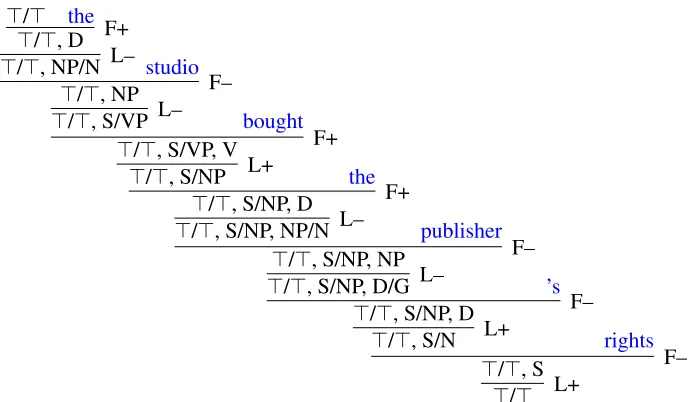
Figure 2: Example parse (in the form of a deductive proof) of the sentenceThe studio bought the publisher’s rights, using F+, F–, L+, and L– productions. Each pair of deductions combines a context of one or more connected compo-nent states with a sign (word) observed in that context. By applying the F and L rules to the observed sign and context, the parser is able to generate a consequent context. Initially, the context corresponds to a connected pre-sentential dialogue state⊤/⊤. Whentheis observed, the parser applies F+ to begin a new connected component stateD. By
applying L–, the parser determines that this new connected component is unfinished and generates an appropriate incomplete connected component stateNP/N, encoding the superordinate state⊤/⊤for later retrieval. Further on, the
parser observes’sand uses F– to avoid generating a new connected component, which completes the sign D. The parser follows this up with L+ to recall the superordinate connected component state S/NP and integrate it into the most deeply embedded connected component, which results in a less deeply embedded structure.
child of the awaited sign of the immediately superor-dinate connected component statea/b, it is hypoth-esized to do so and terminate the subordinate con-nected component state, withxtas the last observa-tion of the terminated connected component (L+); or if the observation can serve as a lower descendant of this awaited sign, it is hypothesized to remain dis-joint and form its own connected component (L–):
a/b a′′
a/b′′ b→a ′′
b′′
(L+)
a/b a′′
a/b a′
/b′′ b +
→a′...; a′ →a′′b′′ (L–)
These operations can be made probabilistic. The probabilityσof a transition at time steptis defined in terms of (i) a probabilityφof initiating a new con-nected component state withxt as its first observa-tion, multiplied by (ii) the probabilityλof terminat-ing a connected component state withxt as its last observation, multiplied by (iii) the probabilities α
andβof generating categories for active and awaited signsaqn
t andbq n
t in the resulting most subordinate
connected component stateqn
t. This kind of model can be defined directly on PCFG probabilities and trained to produce state-of-the-art accuracy by using the latent variable annotation of Petrov et al. (2006) (van Schijndel et al., in press).5
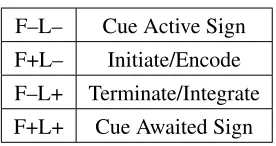
An example parse is shown in Figure 2. Since two binary structural decisions (F and L) must be made in order to generate each word, there are four possible structures that may be generated (see Ta-ble 1). The F+L– transition initiates a new level of embedding at wordxtand so requires the super-ordinate state to be encoded for later retrieval (e.g. on observing the in Figure 2). The F–L+ transi-tion completes the deepest level of embedding and therefore requires the recall of the current superor-dinate connected component state with which the
5The model has been shown to achieve an F-score of 87.8,
F–L– Cue Active Sign
F+L– Initiate/Encode
F–L+ Terminate/Integrate
[image:6.612.117.255.54.127.2]F+L+ Cue Awaited Sign
Table 1: The hierarchical structure decisions and the op-erations they represent. F+L– initiates a new connected component, F–L+ integrates two disjoint connected com-ponents into a single connected component, and F–L– and F+L+ sequentially cue, respectively, a new active sign (along with an associated awaited sign) and a new awaited sign from the most recent connected component.
subordinate connected component state will be in-tegrated. For example, in Figure 2, upon observ-ing ’s, the parser must use temporal cueing to re-call that it is in the middle of processing an NP(to complete anS), which sequentially cues a prediction ofN. F–L– transitions complete the awaited sign of the most subordinate state and so sequentially cue a following connected component state at the same tier of the hierarchy. For example, in Figure 2, after observingstudio, the parser uses the completedNP to sequentially cue the prediction that it has finished the left child of an S. F+L+ transitions locally ex-pand the awaited sign of the most subordinate state and so should also not require any recall or encod-ing. For example, in Figure 2, observing bought
while awaiting a VP sequentially cues a prediction ofNP.
F+L–, then, loosely corresponds to a storage ac-tion under DLT as more hierarchic levels must now be maintained at each future step of the parse. As stated before, it differs from DLT in that it is sensi-tive to the depth of embedding rather than a partic-ular subset of syntactic categories. Wu et al. (2010) found that increasing the embedding depth led to longer reading times in a self-paced reading experi-ment. In ACT-R terms, F+L– corresponds to an en-codingaction, potentially causing processing diffi-culty resulting from the similarity of the current sign to previously encoded signs.
F–L+, by contrast, is similar to DLT’s integra-tion action since a subordinate connected compo-nent is integrated into the rest of the parse structure. This represents a temporal cueing event in which the awaited category of the superordinate connected
Theory F+L– F–L+
DLT positive positive
ACT-R positive positive
Hier. Sequential Prediction positive Dynamic Recruitment positive negative Embedding Difference positive negative
Table 2: Each theory’s prediction of the direction of the correlation between each hierachical structure predic-tor and reading times. Hierarchic sequential prediction is agnostic about the processing speed of F+L– opera-tions, and none of the theories make any predictions as to the sign associated with the within-embedding measures F–L– and F+L+.
component is recalled. In contrast to DLT, embed-ding difference and dynamic recruitment would pre-dict a shorter reading time in the F–L+ case be-cause of the reduction in memory load. In an ACT-R framework, reading time durations can increase at the retrieval site because the retrieval causes compe-tition among similarly encoded signs in the context set. While it is possible for reading times to decrease when completing a center embedding in ACT-R (Va-sishth and Lewis, 2006), this would be expressed as a frequency effect due to certain argument types commonly foreshadowing their predicates (Jaeger et al., 2008). Since frequency effects are factored sep-arately from memory effects in this study, ACT-R would predict longer residual (memory-based) read-ing times when completread-ing an embeddread-ing.
Predicted correlations to reading times for the F and L transitions are summarized in Table 2.
5 Eye-tracking
[image:6.612.316.541.56.141.2]with integration difficulty.
Since this work focuses on incremental process-ing, all processing that occurs up to a given point in the sentence is of interest. Therefore, in this study, predictions will be compared to go-past durations. Go-past durations are calculated by summing all fix-ations in a region of text, including regressions, un-til a new region is fixated, which accounts for addi-tional processing that may take place after initial lex-ical access, but before the next region is processed. For example, if one region ends at word 5 in a sen-tence, and the next fixation lands on word 8, then the
go-past regionconsists of words 6-8 and thego-past durationsums all fixations until a fixation occurs af-ter word 8.
6 Evaluation
The measures presented in this paper were evaluated on the Dundee eye-tracking corpus (Kennedy et al., 2003). The corpus consists of 2388 sentences of nat-urally occurring news text written in standard British English. The corpus also includes eye-tracking data from 10 native English speakers, which provides a test corpus of 260,124 subject-duration pairs of reading time data. Of this, any fixated words ap-pearing fewer than 5 times in the training data were considered unknown and were filtered out to obtain accurate predictions. Fixations on the first or last words of a line were also filtered out to avoid any ‘wrap-up’ effects resulting from preparing to sac-cade to the beginning of the next line or resulting from orienting to a new line. Additionally, following Demberg and Keller (2008), any fixations that skip more than 4 words were attributed to track loss by the eyetracker or lack of attention of the reader and so were excluded from the analysis. This left the fi-nal evaluation corpus with 151,331 subject-duration pairs.
The evaluation consisted of fitting a linear mixed-effects model (Baayen et al., 2008) to reading time durations using the lmer function of the lme4 R package (Bates et al., 2011; R Development Core Team, 2010). This allowed by-subject and by-item variation to be included in the initial regression as random intercepts in addition to several baseline pre-dictors.6Before fitting, the durations extracted from
6Each fixed effect was centered to reduce collinearity.
the corpus were log-transformed, producing more normally distributed data to obey the assumptions of linear mixed effects models.7
Included among the fixed effects were the posi-tion in the sentence that initiated the go-past region (SENTPOS) and the number of characters in the ini-tiating word (NRCHAR). The difficulty of integrat-ing a word may be seen in whether the immediately following word was fixated (NEXTISFIX), and sim-ilarly if the immediately previous word was fixated (PREVISFIX) the current word probably need not be fixated for as long. Finally, unigram (LOGPROB) and bigram probabilities are included. The bigram probabilities are those of the current word given the previous word (LOGFWPROB) and the current word given the following word (LOGBWPROB). Fossum and Levy (2012) showed that for n-gram probabili-ties to be effective predictors on the Dundee corpus, they must be calculated from a wide variety of texts, so following them, this study used the Brown corpus (Francis and Kucera, 1979), the WSJ Sections 02-21 (Marcus et al., 1993), the written text portion of the British National Corpus (BNC Consortium, 2007), and the Dundee corpus (Kennedy et al., 2003). This amounted to an n-gram training corpus of roughly 87 million words. These statistics were smoothed using the SRILM (Stolcke, 2002) implementation of modified Kneser-Ney smoothing (Chen and Good-man, 1998). Finally, total surprisal (SURP) was in-cluded to account for frequency effects in the base-line.
The preceding measures are commonly used in baseline models to fit reading time data (Demberg and Keller, 2008; Frank and Bod, 2011; Fossum and Levy, 2012) and were calculated from the final word of each go-past region. The following measures create a more sophisticated baseline by accumulat-ing over the entire go-past region to capture what must be integrated into the discourse to continue the parse. One factor (CWDELTA) simply counts the number of words in each go-past region.
Cumula-7
tive total surprisal (CUMUSURP) and cumulative en-tropy reduction (ENTRED) give the surprisal (Hale, 2001) and entropy reduction (Hale, 2003) summed over the go-past region. To avoid convergence is-sues, each of the cumulative measures is residual-ized from the next simpler model in the following order: CWDELTA from the standard baseline, CU -MUSURPfrom the baseline withCWDELTA, andEN -TREDfrom the baseline with all other effects.
Residualization was accomplished by using the simpler mixed-effects model to fit the measure of in-terest. The residuals from that model fit were then used in place of the factor of interest. All joint inter-actions were included in the baseline model as well. Finally, to account for spillover effects (Just et al., 1982) where processing from a previous region con-tributes to the following duration, the above baseline predictors from the previous go-past region were in-cluded as factors for the current region.
HavingSURPas a predictor withCUMUSURPmay seem redundant, but initial analyses showed SURP was a significant predictor over CUMUSURP when CWDELTAwas a separate factor in the baseline (cur-rent: p = 2.2 ·10−16 spillover: p = 2·10−15)
and vice versa (current: p= 2.2·10−16 spillover:
p = 6 ·10−5). One reason for this could be that
go-past durations conflate complexity experienced when initially fixating on a region with the difficulty experienced during regressions. By including both versions of surprisal, the model is able to account for frequency effects occurring in both conditions.
This study is only interested in how well the pro-posed memory-based measures fit the data over the baseline, so to avoid fitting to the test data or weak-ening the baseline by overfitting to training data, the full baseline was used in the final evaluation.
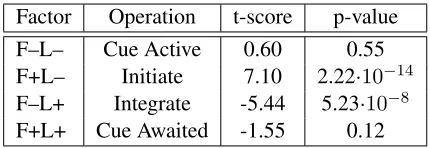
Each measure proposed in this paper was summed over go-past regions to make it cumulative and was residualized from all non-spillover factors be-fore being included on top of the full baseline as a main effect. Likewise, the spillover version of each proposed measure was residualized from the other spillover factors before being included as a main ef-fect. Only a single proposed measure (or its spillover corrollary) was included in each model. The results shown in Table 3 reflect the probability of the full model fit being obtained by the model lacking each factor of interest. This was found via posterior
sam-Factor Operation t-score p-value
F–L– Cue Active 0.60 0.55 F+L– Initiate 7.10 2.22·10−14
F–L+ Integrate -5.44 5.23·10−8
[image:8.612.319.534.56.130.2]F+L+ Cue Awaited -1.55 0.12
Table 3: Significance of each of the structure generation outcomes at predicting log-transformed durations when added to the baseline as a main effect after being residu-alized from it. The sign of the t-score indicates the direc-tion of the correladirec-tion between the residualized factor and go-past durations. Note that these factors are all based on the current go-past region; the spillover corollaries of these were not significant predictors of reading times.
pling of each factor using the Markov chain Monte Carlo implementation of thelanguageRR package (Baayen, 2008).
The results indicate that the F+L– and F–L+ mea-sures were both significant predictors of duration as expected. Further, F–L– and F+L+, which both sim-ply reflect sequential cueing, were not significant predictors of go-past duration, also as expected.
7 Discussion and Conclusion
The fact that F+L– was strongly predictive over the baseline is encouraging as it suggests that memory limitations could provide at least a partial explana-tion ofwhycertain constructions are less frequent in corpora and thus yield a high surprisal. Moreover, it indicates that the model corroborates the shared prediction of most of the memory-based models that initiating a new connected component slows pro-cessing.
integration action to see if the integration facilita-tion observed in this study is driven by longer em-beddings or if there is simply a general facilitation effect when completing embeddings.
The finding of a negative integration cost was pre-viously observed by Wu et al. (2010) as well as Demberg and Keller (2008), although Demberg and Keller calculated it using the original referent-based definitions of Gibson (1998; 2000) and varied which parts of speech counted for calculating integration cost. Ultimately, Demberg and Keller (2008) con-cluded that the negative coefficient was evidence that integration cost was not a good broad-coverage predictor of reading times; however, this study has replicated the effect and showed it to be a very strong predictor of reading times, albeit one that is corre-lated with facilitation rather than inhibition.
It is interesting that many studies have found negative integration cost using naturalistic stimuli while others have consistently found positive inte-gration cost when using constructed stimuli with multiple center embeddings presented without con-text (Gibson, 2000; Chen et al., 2005; Kwon et al., 2010). It may be the case that any dynamic re-cruitment is overwhelmed by the memory demands of multiply center-embedded stimuli. Alternatively, it may be that the difficulty of processing multiply center-embedded sentences containing ambiguities produces anxiety in subjects, which slows process-ing at implicit prosodic boundaries (Fodor, 2002; Mitchell et al., 2008). In any case, the source of this discrepancy presents an attractive target for future research.
In general, sequential prediction does not seem to present people with any special ease or difficulty as evidenced by the lack of significance of F–L– and F+L+ predictions when frequency effects are factored out. This supports a theory of sequential, content-based cueing (Botvinick, 2007) that predicts that certain states would directly cue other states and thus avoid recall difficulty. An example of this may be seen in the case of a transitive verb triggering the prediction of a direct object. This kind of cue-ing would show up as a frequency effect predicted by surprisal rather than as a memory-based cost, due to frequent occurrences becoming ingrained as a learned skill. Future work could use these sequen-tial cueing operations to investigate further claims
of the dynamic recruitment hypothesis. One of the implications of the hypothesis is that recruitment of resources alleviates the initial encoding cost, which allows the parser to continue on as before the em-bedding. DLT, on the other hand, predicts that there is a storage cost for maintaining unresolved depen-dencies during a parse (Gibson, 2000). By weight-ing each of the sequential cueweight-ing operations with the embedding depth at which it occurs, an experiment may be able to test these two predictions.
This study has shown that measures based on working memory operations have strong predictivity over other previously proposed measures including those associated with frequency effects. This sug-gests that memory limitations may provide a partial explanation of what gives rise to frequency effects. Lastly, this paper provides evidence that there is a robust facilitation effect in English that arises from completing center embeddings.
The hierarchic sequence model, all evaluation scripts, and regression results for all baseline pre-dictors used in this paper are freely available at http://sourceforge.net/projects/modelblocks/.
Acknowledgements
Thanks to Peter Culicover, Micha Elsner, and three anonymous reviewers for helpful suggestions. This work was funded by an OSU Department of Lin-guistics Targeted Investment for Excellence (TIE) grant for collaborative interdisciplinary projects conducted during the academic year 2012-13.
References
John R. Anderson, Dan Bothell, Michael D. Byrne, S. Douglass, Christian Lebiere, and Y. Qin. 2004. An integrated theory of the mind. Psychological Review, 111(4):1036–1060.
R. Harald Baayen, D. J. Davidson, and Douglas M. Bates. 2008. Mixed-effects modeling with crossed random effects for subjects and items. Journal of Memory and Language, 59:390–412.
R. Harald Baayen. 2008. Analyzing Linguistic Data: A Practical Introduction to Statistics using R. Cam-bridge University Press, New York, NY.
Matthew Botvinick. 2007. Multilevel structure in behav-ior and in the brain: a computational model of Fuster’s hierarchy. Philosophical Transactions of the Royal So-ciety, Series B: Biological Sciences, 362:1615–1626. Stanley F. Chen and Joshua Goodman. 1998. An
empir-ical study of smoothing techniques for language mod-eling. Technical report, Harvard University.
Evan Chen, Edward Gibson, and Florian Wolf. 2005. Online syntactic storage costs in sentence comprehen-sion. Journal of Memory and Language, 52(1):144– 169.
Charles Clifton, Adrian Staub, and Keith Rayner. 2007. Eye movements in reading words and sentences. In Eye movements: A window on mind and brain, pages 341–372. Elsevier.
Vera Demberg and Frank Keller. 2008. Data from eye-tracking corpora as evidence for theories of syntactic processing complexity. Cognition, 109(2):193–210. Janet Fodor. 2002. Prosodic disambiguation in silent
reading. In M. Hirotani, editor, In Proceedings of NELS 32.
Victoria Fossum and Roger Levy. 2012. Sequential vs. hierarchical syntactic models of human incremen-tal sentence processing. In Proceedings of CMCL-NAACL 2012. Association for Computational Linguis-tics.
W. Nelson Francis and Henry Kucera. 1979. The brown corpus: A standard corpus of present-day edited amer-ican english.
Stefan Frank and Rens Bod. 2011. Insensitivity of the human sentence-processing system to hierarchical structure. Psychological Science.
Edward Gibson. 1998. Linguistic complexity: Locality of syntactic dependencies. Cognition, 68(1):1–76. Edward Gibson. 2000. The dependency locality theory:
A distance-based theory of linguistic complexity. In Image, language, brain: Papers from the first mind ar-ticulation project symposium, pages 95–126.
John Hale. 2001. A probabilistic earley parser as a psycholinguistic model. InProceedings of the second meeting of the North American chapter of the Associ-ation for ComputAssoci-ational Linguistics, pages 159–166, Pittsburgh, PA.
John Hale. 2003. Grammar, Uncertainty and Sen-tence Processing. Ph.D. thesis, Cognitive Science, The Johns Hopkins University.
John Hale. 2006. Uncertainty about the rest of the sen-tence. Cognitive Science, 30(4):609–642.
John Hale. 2011. What a rational parser would do. Cog-nitive Science, 35(3):399–443.
Marc W. Howard and Michael J. Kahana. 2002. A dis-tributed representation of temporal context. Journal of Mathematical Psychology, 45:269–299.
F. T. Jaeger, E. Fedorenko, P. Hofmeister, and E. Gib-son. 2008. Expectation-based syntactic processing: Antilocality outside of head-final languages. In The 21st CUNY Sentence Processing Conference.
Daniel Jurafsky. 1996. A probabilistic model of lexical and syntactic access and disambiguation. Cognitive Science: A Multidisciplinary Journal, 20(2):137–194. Marcel Adam Just and Sashank Varma. 2007. The or-ganization of thinking: What functional brain imaging reveals about the neuroarchitecture of complex cogni-tion. Cognitive, Affective, & Behavioral Neuroscience, 7:153–191.
Marcel Adam Just, Patricia A. Carpenter, and Jacque-line D. Woolley. 1982. Paradigms and processes in reading comprehension. Journal of Experimental Psy-chology: General, 111:228–238.
Alan Kennedy, James Pynte, and Robin Hill. 2003. The Dundee corpus. InProceedings of the 12th European conference on eye movement.
Nayoung Kwon, Yoonhyoung Lee, Peter C. Gordon, Robert Kluender, and Maria Polinsky. 2010. Cog-nitive and linguistic factors affecting subject/object asymmetry: An eye-tracking study of pre-nominal rel-ative clauses in korean.Language, 86(3):561. Roger Levy. 2008. Expectation-based syntactic
compre-hension. Cognition, 106(3):1126–1177.
Richard L. Lewis and Shravan Vasishth. 2005. An activation-based model of sentence processing as skilled memory retrieval. Cognitive Science, 29(3):375–419.
Richard L. Lewis, Shravan Vasishth, and Jane A. Van Dyke. 2006. Computational principles of working memory in sentence comprehension. Trends in Cog-nitive Science, 10(10):447–454.
Mitchell P. Marcus, Beatrice Santorini, and Mary Ann Marcinkiewicz. 1993. Building a large annotated cor-pus of English: the Penn Treebank. Computational Linguistics, 19(2):313–330.
Brian McElree. 2001. Working memory and focal atten-tion. Journal of Experimental Psychology, Learning Memory and Cognition, 27(3):817–835.
Brian McElree. 2006. Accessing recent events. The Psy-chology of Learning and Motivation, 46:155–200. D. Mitchell, X. Shen, M. Green, and T. Hodgson. 2008.
Accounting for regressive eye-movements in models of sentence processing: A reappraisal of the selective reanalysis hypothesis. Journal of Memory and Lan-guage, 59:266–293.
Slav Petrov, Leon Barrett, Romain Thibaux, and Dan Klein. 2006. Learning accurate, compact, and inter-pretable tree annotation. InProceedings of the 44th Annual Meeting of the Association for Computational Linguistics (COLING/ACL’06).
Colin Phillips. 2010. Some arguments and non-arguments for reductionist accounts of syntactic phe-nomena. Language and Cognitive Processes, 28:156– 187.
R Development Core Team, 2010. R: A Language and Environment for Statistical Computing. R Foundation for Statistical Computing, Vienna, Austria. ISBN 3-900051-07-0.
Brian Roark, Asaf Bachrach, Carlos Cardenas, and Christophe Pallier. 2009. Deriving lexical and syn-tactic expectation-based measures for psycholinguistic modeling via incremental top-down parsing. Proceed-ings of the 2009 Conference on Empirical Methods in Natural Langauge Processing, pages 324–333. Brian Roark. 2001. Probabilistic top-down parsing
and language modeling. Computational Linguistics, 27(2):249–276.
Claude Shannon. 1948. A mathematical theory of com-munication. Bell System Technical Journal, 27:379– 423, 623–656.
Stuart M. Shieber, Yves Schabes, and Fernando C.N. Pereira. 1995. Principles and implementation of de-ductive parsing. Journal of Logic Programming, 24:3– 36.
Andreas Stolcke. 2002. Srilm – an extensible language modeling toolkit. InSeventh International Conference on Spoken Language Processing.
John Trueswell. 1996. The role of lexical frequency in syntactic ambiguity resolution. Journal of Memory and Language, 35:566–585.
Marten van Schijndel, Andy Exley, and William Schuler. in press. A model of language processing as hierarchic sequential prediction.Topics in Cognitive Science. Shravan Vasishth and Richard L. Lewis. 2006.
Argument-head distance and processing complexity: Explaining both locality and antilocality effects. Lan-guage, 82(4):767–794.