S Bandyopadhyay, D S Sharma and R Sangal. Proc. of the 14th Intl. Conference on Natural Language Processing, pages 236–244, Kolkata, India. December 2017. c2016 NLP Association of India (NLPAI)
Malayalam VerbFrames
Jisha P JayanCentre for Development of Imaging Technology
Thiruvanathapuram
Asha S Nair
Centre for Development of Imaging Technology
Thiruvanathapuram
ashanaircdit@ gmail.com
Govindaru V
Centre for Development of Imaging Technology
Thiruvanathapuram
Abstract
Verbs acts as a major role in describing a sentence meaning. Capturing of the syn-tactic distributions of occurrence of a verb in a sentence is the VerbFrame. This pa-per tests the applicability of verbframe ap-proach that has been developed for Hindi language in Malayalam. Around 255 verbs were selected for this study, show-ing the basic argument structure of words with these verbs.
Keywords- verbframe; karaka relations; semantic; syntactic;
1 Introduction
Verbs are the most important grammatical cate-gory in any language. With the help of an action, activity and state are denoted. The arguments of the verb indicate various participants required by the verb. Verbs play a noteworthy part in inter-preting meaning of a sentence, therefore, the study of the argument structure of a verb and their syn-tactic behavior will provide the needed knowledge base for intelligent NLP applications. Verbframe is the gathering of the syntactic distribution of the verb occurrence in any sentence. Paninian Gram-matical Framework (PGF) is followed in creating a Verbframe as verb plays the important role in the sentence analysis.
The relation of verb with the alternate units of a sentence, in a language may be encoded in vari-ous ways. Among them, the word order and the presence of case markers on the arguments are very often used by computational linguists. There are, however, languages in which the marking can be present of the verb itself rather than its argu-ments (Butt, 2010). Such types of relations fre-quently reflect semantics of a verb, that-means the syntactic behavior of the verb provides a good sup-port to understand its semantics. Researchers also
encode other information such as tense, aspect, modality, gender, number, person etc., with verb, that allow language specific variations.
This paper is intended to develop verbframe for Malayalam language which has got grammatical roots from Dravidian and Aryan languages. This paper presents the work in different stages, begin-ning in Section 2 with the major works related. Section 3 introduces the Verb Frame and its de-scription . Section 4 describes the Verb frame for Malayalam. Finally, Section 5 concludes the pa-per.
2 State of Art
Some of the famous linguistic sources related to verb argument structure, are discussed briefly in this section. Levin’s work on verb classes (Beth, 1993) indicates the relationship between seman-tic and syntacseman-tic behavior of the English verbs. The verb behavior can be used to get an insight into linguistically applicable aspects of the verb meaning (Beth, 1995). VerbNet (VN) (Kipper, 2000) (Kipper, 2005) is a domain-independent; hi-erarchical, wide-coverage of online verb dictio-nary which extends Levin’s verb classes (Beth, 1993) and providing syntactic and semantic infor-mation for English verbs. It is mapped to various language resources such as Wordnett (Fellbaum, 1998), FrameNet, and PropBank. Each class of verbs in VN is described by thematic roles, selec-tional restrictions on the arguments, and syntactic frames (Beth, 1993).
2002). Each set of argument labels and their def-initions is called a frameset. As an example, con-sider the frameset for the verbdance. This verb takes the dancer:Arg0, dance:Arg1 , partner:Arg2 and audience:Arg3 as essential roles. It also has non-essential roles such as location:Argm-loc and time:Argm-tmp. This is for capturing spatio-temporal aspects of verbs.
FrameNet (FN) (Baker et al., 1998) is an on-line lexical resource for English, based totally on frame semantics and supported by means of cor-pus evidence. FN groups words in accordance to the conceptual structures, i.e., frames that under-lie them (Arun, 2008) . The paper describes three major components such as: (1) Lexicon; (2) Frame Database; (3) Annotated Example Sentences. The Frame database deals with the descriptions of each frame’s basic conceptual structure, and provides the names and descriptions of the elements par-ticipating in such structure (Begum, 2017). Anno-tated Sentences are marked to illustrate the seman-tic and morpho-syntacseman-tic properties of the lexical items. Each frame contains numerous elements, i.e., core (core arguments) and non-core (adjuncts or peripheral roles) elements which are considered as semantic roles. For example, core elements of the frame Getting-up are person/animal getting up from sleep and place of sleeping; non-core ele-ments are time, purpose, etc.
All these resources looks into the argument structure of English verbs. They gives the syn-tactic and semantic information, and correlation between them. These resources are also mapped to each other making individual resources much richer. In the work of creating verb frames for Hindi, the argument structure of verb is captured using Karaka relations which capture both syntac-tic and semansyntac-tic information about the verbs. Be-tween Karaka relations, thematic roles and Prop-bank annotation, a mapping is done . Begum et al. (Begum, 2008) mentioned their experience with the creation of Hindi verb frames. These frames are further classified based on a Paninian gram-mar framework using 6 Karaka relations. This method considered the morphology, syntactic vari-ations and semantics of the verb to divide it into various classes.
Based on similar approach, Ghosh (Ghosh, 2014) created a resource for verb frames for com-pound verbs in Bengali language. The main aim of the paper is to investigate if the vector verb
from the compound verb is able to retain its case marking properties and argument structure or not. Additionally the knowledge and syntax associated with verb frames can be utilized for categorizing and analyzing the verb words for various NLP ap-plications.
Soni et al. (Ghosh, 2013) explores the applica-tion of verb frames and the conjuncts in sentence simplification for Hindi language. The method proposed by the authors includes usage of con-juncts as a first level of sentence simplification. This is followed by using verb frames enhanced with tense, aspect and modality features. It is a rule based system and its output is evaluated man-ually and automatically using the BLEU score for the ease of readability and simplification.
A semi-automatic annotator tool for verb frames was developed by Hanumant et al (Redkar, 2016). The tool is used for extracting and generat-ing the verb frames automatically from the exam-ple sentences of Marathi wordnet. The paper ex-plains the concept and working of the verb - frame tool with its advantages and disadvantages. Other related work by Schulte (Walde, 2009) has also explored verb frames for the English language.
3 Verb Frames
In all languages, verb plays the major part-of-speech category. Verbs are used to define actions, activities and states. Ability of the verbs to choose their arguments and/or adjuncts is termed as ‘verb sub-categorization’or ‘verb valency’. Combina-tion of funcCombina-tional units that are elicited by a verb is refered to as verb frames. In linguistics, verb-framing and satellite-verb-framing are typological de-scriptions of how verb phrases in different lan-guages describe the path of motion or the manner of motion, respectively (Redkar, 2016).
Karaka1relation for a verb. They are:
1. Karaka : dependency arc labels.
2. The necessity of the argument whether it is mandatory (m) or desirable (d).
3. Case Markers / Vibhakti: post-position or the case associated with the nominal.
4. Lexical category of the arguments.
5. The Position of the demanded nominal with respect to verb whether it is left(l) or right(r).
Verb frames are built for the base form of a verb. The demands undergo a subsequent change based on the tense, aspect and modality (TAM) of the verb used in the sentence. Knowledge about the transformations induced on the base form of a verb by TAM is stored in the form of transformation charts for each distinct TAM.
In the present work we develop verbframe for Malayalam based on Karaka theory developed by IIIT-Hyderabad for Hindi.
4 Malayalam Verb Frame
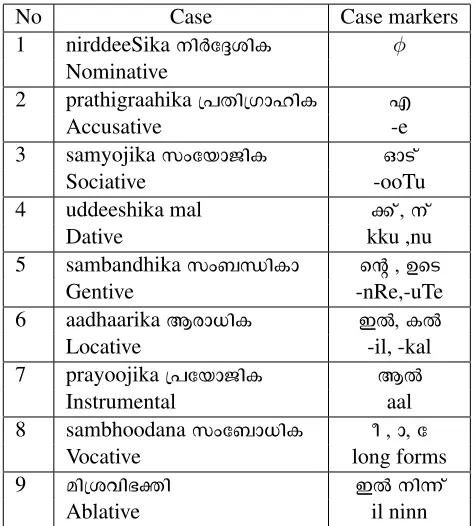
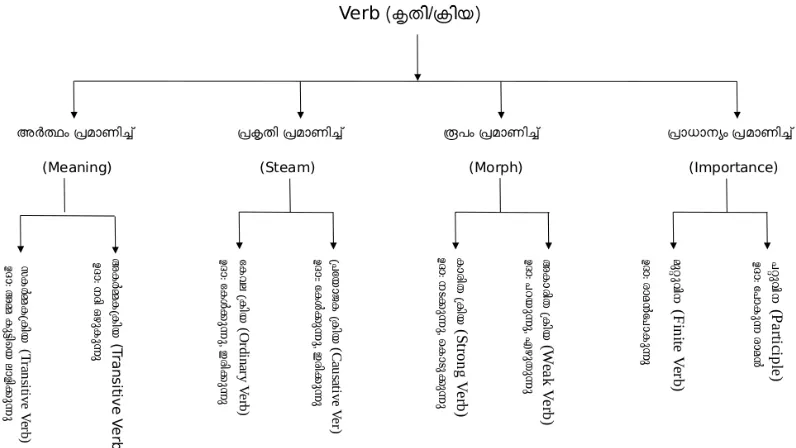
Amid the semantic analysis, verb is taken as the central, element of the sentence. According to Paninian viewpoint, there are four levels in un-derstanding any sentence (Bharati, 1995) namely the surface level (uttered sentence), the vibhakthi level, the Karaka level and the semantic level. The Karaka level has related to semantics on one side and on the other side with the syntax. Karaka re-lation can be identified from markers/suffixes or case endings after the noun. The Karaka relations in Malayalam are analyzed from the point of vib-hakthi and the postpositions that associate with it. The types of verb and the vibhakthi markers in Malayalam are illustrated in Figure 1 and Table 1 respectively.
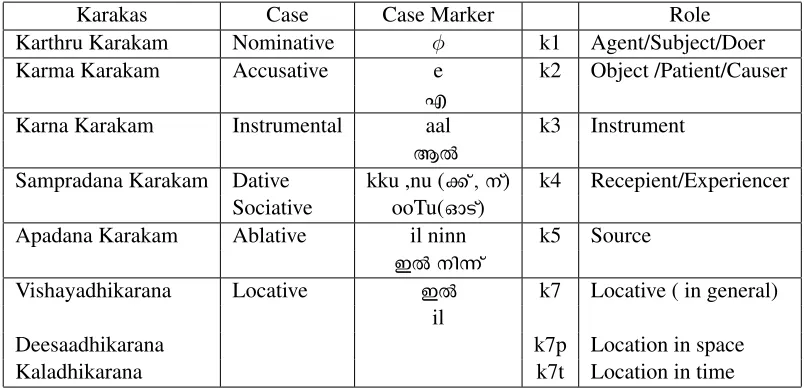
The roles and the dependency relation based on IIIT H approach, are shown in Table 2.
The genitive noun does not have any direct grammatical or semantic relation with the verb but only the noun modified by the genitive is related to the verb. The Genetive case “hw_á
oIneoõ-2o” saMbhndhikaavibhaktiotherwise Possessive
takes the markers “t” nRe, “DtS” uTe. Eg (a):cnat A\ob° eÁq.
1karakas are the typed dependency labels in Computa-tional Paninian Framework (Bharati, 1993)
No Case Case markers
1 nirddeeSika\o±u¥foI φ Nominative
2 prathigraahika}]Xo}KnioI F
Accusative -e
3 samyojikahwubnPoI ¨Sm
Sociative -ooTu
4 uddeeshika mal ·m , \m
Dative kku ,nu
5 sambandhikahw_áoIn t , DtS
Gentive -nRe,-uTe
6 aadhaarikaBcn[oI C², I²
Locative -il, -kal
7 prayoojika}]ubnPoI B²
Instrumental aal
8 sambhoodanahwu_n[oI p , n, u
Vocative long forms
9 ao}feoõ2o C² \oÁm
[image:3.612.314.552.37.300.2]Ablative il ninn
Table 1: Case and Case Markers
ramanRe aniyan vannu. Raman’s brother came.
Eg (b):AejqtS AÅ ]l¼q . avaLuTe amma paranjnju. Her mother said.
Because of this, the genitive noun can be removed from the sentence without affecting the grammati-cality of the sentence
Dependency annotated data are used for devel-oping Malayalam verb frames. The dependency annotation is a collective process of Tokeniser, Morphological Analyser, POS tagger, Chunker and Dependency annotation. A raw text will be given as the input and the text is converted into tokens, identifies grammatical features of the individual words, assigns parts of speech (POS) tags to each word , groups them to phrases and the dependency tree diagrams are drawn. Malayalam has tendency to join a wide variety of suffixes with a single word forming compound words, which makes the process more complicated. Therefore complicated words are spllited and then analysed in the present analysis. As an example, consider the following sentence.
aÊm õ¸W hn[\ºtj Au]¸o»m ]k¹-¼obo² _o6 , _o12 tteÊao\qI³ [ncnjw ASºobo½q¾m .
Figure 1: Verb types in Malayalam
dhaaraaLaM aTangngiyiTTuNTu.
In comparison to other food items, rice gruel is rich in vitamins B-6 and B-12.
The sentenence is annotated as follows: <Sentence id=”1”>
1 (( NP <fs
af=’hn[-\,n,ne,pl,3,d,F,NGaLe’ head=’hn[\ºtj’ name=’NP’ drel=’k2:VGF’>
1.1 aÊm QT QTF <fs af=’aÊm,qtf,,,,,,’ name=’a-Êm’>
1.2 õ¸W JJ<fs af=’õ¸W,adj,,,,,,’ name=’õ-¸W’>
1.3 hn[\ºtjN NN
<fs af=’hn[\,n,ne,pl,3,d,F,NGaLe’ name=’hn[\ºtj’>
1.4 Au]¸o»m PSP <fs af=’Au]n¸o-»m,psp,,,,,,’ name=’Au]¸o»m’>
))
2 (( NP <fs af=’]k¹¼o,n,ne,pl,3,d,C²,il’ head=’]k¹¼obo²’ name=’NP2’ drel=’k7:VGF’>
2.1 ]k¹¼obo² N NN <fs af=’]k¹-¼o,n,ne,pl,3,d,C²,il’ name=’]k¹¼obo²’>
))
3 (( NP <fs af=’_o6,n,ne,sg,3,d,0,0’ name=’NP3’ drel=’ccof:NULL CCP’>
3.1 _o6 N NN <fs af=’_o6,n,ne,sg,3,d,0,0’
name=’_o6’>
3.2 , RD PUNC <fs af=’&comma,punc,,,,,,’ name=’,’>
))
4 (( NULL CCP<fs af=’,,,,,,,’ dmrel=’k1:VGF’ name=’NULL CCP’>
4.1 NULL CC<fs af=’,,,,,,,’ name=’NULL’> ))
5 (( NP <fs af=’tteÊao-\m,n,ne,pl,3,d,I³,kaLu’ head=’tteÊao\qI³’ name=’NP4’ drel=’ccof:NULL CCP’>
5.1 _o12 N NN <fs af=’_o12,n,ne,sg,3,d,0,0’ name=’_o12’>
5.2 tteÊao\qI³ N NN <fs af=’tteÊao-\m,n,ne,pl,3,d,I³,kaLu’ name=’tteÊao\qI³’>
))
6 (( JJP<fs af=’,qtf,,,,,,’ head=’4’ name=’JJP’ drel=’pof:VGF’>
6.1 [ncnjw QT QTF <fs af=’[ncnjw,qtf,,,,,,’ name=’[ncnjw’>
))
7 (( VGF <fs
af=’AS-ºm,v,,,,,CD¾m,iTTuNTu’ head=’ASºobo-½q¾m’ name=’VGF’ Participles m=’C½m’ Participles=’yes’>
Karakas Case Case Marker Role Karthru Karakam Nominative φ k1 Agent/Subject/Doer Karma Karakam Accusative e k2 Object /Patient/Causer
F
Karna Karakam Instrumental aal k3 Instrument B²
Sampradana Karakam Dative kku ,nu (·m , \m) k4 Recepient/Experiencer Sociative ooTu(¨Sm)
Apadana Karakam Ablative il ninn k5 Source C² \oÁm
Vishayadhikarana Locative C² k7 Locative ( in general) il
Deesaadhikarana k7p Location in space
[image:5.612.106.508.37.233.2]Kaladhikarana k7t Location in time
Table 2: Karakas and Role (IIIT-H)
Participles m=’C½m’ Participles=’yes’> ))
8 (( BLK <fs af=’.,punc,,,,,,’ head=’.36’ name=’BLK’ drel=’rsym:VGF’>
8.1 . RD PUNC<fs af=’.,punc,,,,,,’ name=’.’> ))
</Sentence>
The dependency annotation is tree is given in Fig-ure 2.
4.1 Diagnosis
Diagnosis of Malayalam verbfame is illustrated with an example of a verb entry with the descrip-tion and verb frame. Gloss explains meaning of the particular verbal root. Arc label is to show the dependency relation between any words and the verb that exist in a sentence. Necessity is valency. Valency is the the number of grammatical aspects of verbs which combines other words in that sen-tence. On the other hand, it is the capacity of verbs that how many arguments, it can combine with it-self at time. The distinction among the modifiers and complements is mostly defined using valency, which is a central notion in the theoretical tradi-tion of dependency analysis (Theoritical traditradi-tion of dependency analysis has limitation in Computa-tional Linguistics that has discussed widely in re-cent years. So it is not detailed here). Although the exact characterization of this notion differs from one theoretical framework to the other, va-lency is usually related to the semantic predicate-argument structure associated with certain classes of lexemes, in particular verbs but sometimes also
nouns and adjectives (Nivre, 2005). The idea is that the verb imposes requirements on its syntac-tic dependents that reflect its interpretation as a se-mantic predicate. Dependents that correspond to the arguments of the predicate can be mandatory or optional (Nivre, 2005). The valency frame of the verb is generally taken to incorporate argument dependents, however some theories also allow de-sirable non-arguments to be included. Position ba-sically refers to on which side of the verb, the par-ticular word takes place in the sentence. That is, the word can occur either on the left side of the verb or right side of the verb. So, ’l’ stands for the word left and ’r’ stands for the word right.
Verb::ASºm aTangngu SID:: ASºm %VT%S1 Verb Sense::
Eng Gloss::to contain Verb Class::
Verb in Same Class::
TAM for the verb root::CC½mD¾m i iTT uNTu
Frames::
Example::aÊm õ¸W hn[\ºtj Au]¸o»m ]k¹¼obo² _o6 , _o12 tteÊao\qI³ [ncnjw ASºobo½q¾m .
maRRu bhakshaNa saadhanangngaLe apeek-shiccu pazhangkanjnjiyil b6 , b-12 vaiR-RaminukaL dhaaraaLaM aTangngiyiTTuNTu. In comparison to other food items, rice gruel is rich in vitamins B-6 and B12.
Figure 2: Dependency tree for given example
arc nec- Vibhakti Lex posn reln label essity Type
k2 m I³F n l c
(kaLe)
k7 m C² n l c
(il)
k1 m I³ n l c
(kal)
pof m 0 n l c
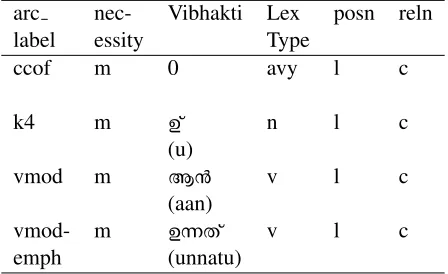
In the verbframe file above as example, the first feild gives the name of the verb. SID is the unique sense identification number. It is rep-resented as verb root%verb type%sense number. The verb types in Malayalam are distinguished into transtitive, intransitive and causative. Here in the example the type of the verb is transtitive and is represent byVT. Verbs in Same Class field gives the list of all the verbs that have same mean-ing as the given verb. Since Malayalam is a verb final language, by default, all the words are kept normally on the left side of the verb. Rarely, it happens that particular word occurs on the right side of the verb. As an example consider the fol-lowing sentence:
F¹odqw õcX\nSy¿o\m XtÁ }fªtNdq¿n° BWm \pdoa CuÃn³ }fao·qÁXm .
enkiluM bharatanaaTyattinu tanne shRaddha ce-luttaan aaNu niilima ippoL shRamikkunnatu. Nilima is now trying to focus on Bharatanatyam itself.
In the above example, “BWm” aaN is the finite verb and it occurs in between the given sentence. These type of constructions are found mostly. In such cases, the the words that follow the final
verbs are positioned on the right side. The verb frame for above example is as follows :
arc nec- Vibhakti Lex posn reln
label essity Type
ccof m 0 avy l c
k4 m Dm n l c
(u)
vmod m B° v l c
(aan)
vmod- m DÁXm v l c
emph (unnatu)
Verbframe of a similar verb in different sen-tences varies according to argument relations (Karaka relations) change. For example, for the verb “InWnw” kaaNaaM, different frames are shown below.
Verb::InWmkaaN SID::InWm%VT%S1 Verb Sense::
Eng Gloss::to see Verb Class::
Verb in Same Class::
TAM for the verb root::Bw aaM Frames::
Example::1
eÉqe\nS° }Knaºjqw t\²ebdqIjqw KX-Ind }]vUoubntS \o²·qÁ a\Ijqw Fºqw InWnw .
vaLLuvanaaTan graamangngaLuM nelvay-alukaLuM gatakaala prauDiyooTe nilkkunna manakaLuM engnguM kaaNaaM.
Valluvanadan villages, paddy fields and the abode houses of Malayali Brahmins with its historical pride can be seen.
FRAME ID::1
arc nec- Vibhakti Lex posn reln label essity Type
k1 m Dw n l c
(uM)
adv d 0 adv l c
Example::2
CeotS DÉ eyru]nboÂo² \oÁm gouÈnºm \-Kc¿ot , }]uXyIo»m cn}Xobo² Zp]ndwIsXw BIqÁ DÃ|danb InkmN InWnw .
iviTe uLLa vyuupooyinRil ninnu Silloongng na-garattinRE , pratyeekiccu raatriyil diipaalaMkRI-taM aakuna ujjvalamaaya kaazhcha kaaNaM. From the view point here, the city of Shillong, es-pecially the magnificent view of the city decorated with lights at night can be seen.
FRAME ID::2
arc nec- Vibhakti Lex posn reln label essity Type
k5 m C²\oÁm n l c
(ilninn)
k1 d 0 n l c
Example::3
eouZf¿m tNÁn² }fpd¹bodqw _ndobodqw Ht· cnab° h±Iyr½qI³ InWnw .
videeshattu cennaal sRIIlangkayiluM baaliyiluM okke raamayan sarkyuuTTukaL kaaNaaM. If you go abroad, the Ramayan circuits can be seen especially in Sri Lanka and Bali.
FRAME ID::3
arc nec- Vibhakti Lex posn reln label essity Type
vmod m 0 v l c
k7p m C² n l c
(il)
k1 d I³ n l c
(kal)
Example::4
_Imhlo² \oÁm AÕmIoudnapʱ eS·qIok·q anlo AidynuZeobqtS AÄdw InWnw .
baksaRil ninnu anjcu kiloomiiRRar vaTakkuk-izhakku maaRi ahalyaadeeviyuTe ampalaM kaaNaaM.
The temple of Ahalya Devi is located five kilome-ters north-east from Buxar.
FRAME ID::4
arc nec- Vibhakti Lex posn reln
label essity Type
k5 m C²\oÁm n l c
(ilninn)
vmod m C v l c
(i)
k1 d I³ n l c
(kal)
Example::5
õncX¿o² arÁq }][n\ eoõnKºjo² t]½etc InWnw : CuÐn- Bcy° ewfP± , }ZneoU ewf-P± , awuKn³- Bcy° ewfP± .
bhaaratattil muunu pradhaana vibhaagangngaLil peTTavare kaaNaaM : intoo-aaryan , draaviDa vaMshajar , maMgooL - aaryan vaMshajar. There are three main groups in India: Indo-Aryan tribes, Dravidian and Mangol-Aryan tribes. FRAME ID::5
arc nec- Vibhakti Lex posn reln label essity Type
k1 m A±F v l c
(are)
k1 d 0 n r c
Example::6
BwKoIw , enNoIw , hnX|oIw , Bincyw FÁp Aõo\bcpXoI³ GÊ·ql»odqIujntS aqSoubÊo² InWnw
aaMgikaM, vaacikaM, saatvikaM, aahaaryaM enni abhinjayariitikal eeRRakkuRaccilikaLoTe kaaNaaM.
Different styles of actings like Agikam, Vachikam, Satvikam, Aharyam are found in a ritualistic art form Mudiyettu.
FRAME ID::6
arc nec- Vibhakti Lex posn reln
label essity Type
k1 d I³ n l c
(kal)
k4 d I³¨SmF n l c
(kaLooTe)
k7 m C² n l c
(il)
other verb frames as the argument relations namely the Karaka relations are changing. In the present study, we have taken 3000 dependency an-notated sentences for generating the verb frames. Verb frames for 255 verbs2 were generated from
these sentences.
There are some sentences which have 2 finite verbs. Such sentences are not considered in the present study. Examples for such a sentence: AXo°tl A±Yw a\ôodn·n° B±·qw \oba hinbw uXuS¾o ecqw FÁqw uXnÁqÁoÈ . atinRe arthaM manassilaakkaan aarkkum niyama sahaayaM teeTeeNTi varuM ennuM toonnunnilla. It does not appear to have any legal assistance to understand the meaning.
In the above sentence, the “FÁqw”(ennuM) is the connector. To this connector, the two finite verbs “ecqw””varuMand “uXnÁqÁoÈ ”toonnunnilla is joined in the dependency tree. The sentenence is annotated as follows and the dependency tree diagram is depiced in Figure 3.
5 Conclusion and Future Directions 5.1 Conclusion
Application of approach for generating verbframe developed by IIIT-H seems to be adopted for Malayalam languages. However we have to ex-plore how does this can be made applicable for the sentences which have two or more finite verbs.
5.2 Future Directions
This work can be further extended to classify the verb frames according to the semantic nature of the verb. Also attempts can be made to extract the verb frames from dependency annotated corpora though some machine learning approaches.
Acknowledgement
We acknowledge Consortium for Developing De-pendency TreeBanks for Indian Languages and its leader IIIT-Hyderabad, especially Prof. Dipti Misra Sharma and Department of Electronics & Information Technology (DeitY) , Government of India .
References
Beth Levin. 1993. English Verb lasses and Alterna-tions. A Preliminary Investigation, University of Chicago press.
[image:8.612.321.538.77.558.2]2Only finite verbs are considered.
Figure 3: Dependency tree for given example
Beth Levin and Malka Rappaport Hovav. 1995. Un-accusativity: At the syntax-lexical semantics inter-face., MIT press. 26.
Karin Kipper Schuler. 2005. VerbNet: A Broad-coverage, Comprehensive Verb Lexicon, PhD dis-sertation, Computer and Information Science De-partment, University of Pennsylvania.
Karin Kipper, Hoa Trang Dang and Martha Palmer . 2000. VerbNet: Class based construction of a verb lexicon, InAAAI/IAAI, 691 696.
Christiane Fellbaum. 1998. WordNet An Electronic Lexical Database, MIT press.
Paul Kingsbury and Martha Palmer. 2003. PropBank: the next level of treebank, InProceedings of Tree-banks and lexical Theories, Vol. 3.
Martha Palmer, Daniel Gildea, and Paul Kingsbury. 2005.The proposition bank: An annotated corpus of semantic roles., InComputational linguistics, Vol. 31(1) , 71-106.
Paul Kingsbury and Martha Palmer. 2002. PropBank: the next level of treebank, InProceedings of the 3rd International Conference on Language Resources and Evaluation, pp. 1989-1993.
Rafiya Begum, Samar Husain, Lakshmi Bai, and Dipti Misra Sharma. 2008. Developing Verb Frames for Hindi., InLREC.
Collin F Baker, Charles J Fillmore, and John B Lowe . 1998. The Berkeley FrameNet Project, In Pro-ceedings of the 36th Annual Meeting of the Associ-ation for ComputAssoci-ational Linguistics and 17th Inter-national Conference on Computational Linguistics, Association for Computational Linguistics. 6:86-90. Rafiya Begum and Dipti Misra Sharma. 2017. De-velopment and Analysis of Verb Frame Lexicon for Hindi., InLinguistics and Literature Studies. 5(1):1-22.
Rafiya Begum, Samar Husain, Arun Dhwaj, Lak-shmi Bai, cc and Rajeev Sangal. 2008.Dependency Annotation Scheme for Indian Languages., In IJC-NLP. 721-726.
Sanjukta Ghosh. 2014. Making Verb Frames for Bangla Vector Verbs., In Proceedings of 11th Intl. Conference on Natural Language Processing. 305314.
Ankush Soni, Sambhav Jain, and Dipti Misra Sharma. 2013.Exploring Verb Frames for Sentence Simplifi-cation in Hindi., InIJCNLP. 1082-1086.
Hanumant Redkar, Sandhya Singh, Nandini Ghag, Jai Paranjape, and Nilesh Joshi. 2016. Verbfram-ator: Semi-Automatic Verb Frame Annotator Tool with Special Reference to Marathi., In Proceeding s of 13th International Conference on Natural Lan-guage Processing. pp-299.
Schulte im Walde and Sabine. 2009. The induction of verb frames and verb classes from corpora.,Corpus Linguistics. An International Handbook. Mouton de Gruyter, Berlin.
Akshar Bharati, Vineet Chaitanya, Rajeev Sangal, and K V Ramakrishnamacharyulu. 1995. Natu-ral language processing: a Paninian perspective., Prentice-Hall of India New Delhi.
Joakim Nivre. 2005. Dependency grammar and de-pendency parsing., InMSI report. 5133(1959):1-32.
Akshar Bharati and Rajeev Sangal. 1993. Parsing free word order languages in the Paninian framework, In
Proceedings of the 31st annual meeting on Associa-tion for ComputaAssocia-tional Linguistics Association for Computational Linguistics. 105-111.
Miriam Butt. 2010. The light verb jungle: still hack-ing away., InComplex predicates in cross-linguistic perspectiveCambridge University Press. 48-78.