Enhancing Automatic Wordnet Construction Using Word Embeddings
Feras Al Tarouti
University of Colorado Colorado Springs 1420 Austin Bluffs Pkwy
Colorado Springs, CO 80918, USA [email protected]
Jugal Kalita
University of Colorado Colorado Springs 1420 Austin Bluffs Pkwy
Colorado Springs, CO 80918, USA [email protected]
Abstract
Researchers have shown that a wordnet for a new language, possibly resource-poor, can be constructed automatically by translating wordnets of resource-rich languages. The quality of these constructed wordnets is af-fected by the quality of the resources used such as dictionaries and translation methods in the construction process. Recent work shows that vector representation of words (word em-beddings) can be used to discover related words in text. In this paper, we propose a method that performs such similarity compu-tation using word embeddings to improve the quality of automatically constructed wordnets.
1 Introduction
A wordnet is a lexical ontology of words. High-quality wordnets have been developed for only a few languages. Wordnets, other than the Princeton WordNet (PWN) (Fellbaum, 1998), are typically constructed by one of two approaches. The trans-lation approach translates the PWN to target lan-guages (Saveski and Trajkovski, 2010; Oliver and Climent, 2012; Lam et al., 2014). In contrast, the merge approach builds the semantic taxonomy of a wordnet in a target language, and then aligns it with the Princeton WordNet by generating transla-tions (Gunawan and Saputra, 2010; Rodr´ıguez et al., 2008).
In this paper, we propose a method to enhance the translation approach using word embeddings pro-duced by theword2vec algorithm (Mikolov et al., 2013). We produce wordnets in several languages
although the current paper focuses only on the new Arabic wordnet we construct.
2 Constructing Initial Wordnet
We start by automatically generating wordnet synsets for a target language T using the method presented by (Lam et al., 2014), which trans-lates synsets from several intermediate wordnets and ranks them. The approach generates wordnet synsets that do not include any semantic links be-tween them. This paper discusses how we con-struct the semantic links between synsets inT. Fig-ure 1 shows that we take advantage of the fact that the wordnet synsets created in the previous step are aligned with PWN. This means that synsets with the same meaning for different languages share the same synset ID. To construct the links between synsets in our new wordnet TWN for language
T, we extract each synsetT W N
i from T W N and
find the corresponding synset in PWN,synsetP W N
i .
Here, i is the ID of the synset. Then, for each
synsetP W N
i , we extract each semantic relations rj
and all linkedsynsetP W N
k within PWN. Finally, if synsetk, i.e., a synset with IDkis present in TWN,
we add a link betweensynsetT W N
i andsynsetT W Nk
in the newly constructedT W N.
3 Generating Word Embeddings
In order to validate the synsets we create using trans-lation and obtain retrans-lations between them, we use the
word2vecalgorithm (Mikolov et al., 2013) to gen-erate word representations from an existing corpus. The word2vec algorithm uses a feedforward neu-ral network to predict the vector representation of
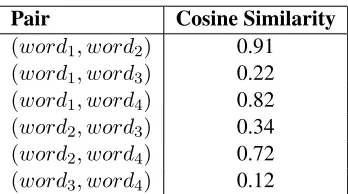
Pair Cosine Similarity
(word1, word2) 0.91
(word1, word3) 0.22
(word1, word4) 0.82
(word2, word3) 0.34
(word2, word4) 0.72
[image:2.612.100.274.61.158.2](word3, word4) 0.12
Table 1:An example of cosine similarity between words in a candidate synset
words within a multi-dimensional language model.
W ord2vechas two variations: Skip-Gram (SG) and Continuous Bag-Of-Words (CBOW). In the SG ver-sion, the neural network predicts words adjacent to a given word on either side, while in the CBOW model the network predicts the word in the middle of a given sequence of words. In the work presented in this paper, we generate representations of words using both models with several different vector and window sizes to obtain the settings for the highest precision. The purpose of the steps discussed next is to improve the quality of synsets produced by the translation process in addition to generating re-lations among the synsets.
Figure 1:Creating wordnet semantic relations using interme-diate wordnet.
3.1 Removing irrelevant words in synsets We compute the cosine similarity between word vec-tors within each single synset in TWN, the word-net being constructed in languageT, to filter false word members within synsets. To filter the initially constructed synsets in TWN, we pick a threshold value α such that the selected words have cosine similarity larger thanαwith each other. For exam-ple, letsynsetc
i ={word1, word2, word3, word4}
be a candidate synset to be potentially included in TWN. We compute the cosine similarity between all the possible pairs of words in synsetc
i. Then,
we extract the pair of words with the highest cosine similarity. If this pair of words have cosine similar-ity larger thanα, the pair is kept in the final synset
synseti, otherwise,synsetciitself is discarded. This
may have been a low quality candidate synset gen-erated in the translation process. Next, among the remaining words insynsetc
i, a word is kept if it has
a connection with any word insynsetiwith
similar-ity higher thanα. For example, let us assume that the cosine similarity between the words insynsetc i
are as shown in Table 1 andα=0.70. First, the pair with the highest cosine similarity,(word1, word2)
is kept in the final synseti since its cosine
simi-larity is larger than α. Then, word3 is discarded since it does not have any cosine similarity larger than α with any of the words in the current final
synseti. Finally,word4is keptsynsetisince it does
have a cosine similarity withword1that satisfies the thresholdα.
3.2 Validating candidate relations
Similarly, we compute the cosine similarity be-tween words within pairs of semantically related synsets. This allow us to verify the constructed relations between synsets in TWN. For example, let synseti = {wordi1, wordi2, wordi3, wordi4}, synsetj = {wordj1, wordj2, wordj3, wordj4}be
synsets in TWN. And letρijbe a candidate semantic
relation betweensynsetiandsynsetj. We compute
the cosine similarity between all the possible pairs of words from synseti to synsetj and obtain the
maximum similarity obtained. Then, if this value is larger than a thresholdαρ, then we retain the relation ρij, otherwise, we discard it.
3.3 Selecting thresholds
To pick the synset similarity threshold valueαand the thresholdαρ for each semantic relation we
[image:2.612.75.299.396.538.2]4 Experiments
We discuss the generation of a wordnet for Arabic as an example although we have worked with several other languages.
4.1 Datasets and Resources Used
[image:3.612.328.524.62.173.2]To construct the core wordnet, i.e., wordnet synsets, we use the Microsoft Translator to translate English synsets from PWN to Arabic synsets. We have se-lected the Microsoft Translator because it gives ac-ceptable quality free of cost. For generating vector representations of the Arabic Words we use the fol-lowing freely available corpora: Watan-2004 corpus (12 million words) (Abbas et al., 2011), Khaleej-2004 corpus (3 million) (Abbas and Smaili, 2005) and 21 million words of Wikipedia1Arabic articles, combined to a single file.
Figure 2: A histogram of synonyms, semantically related words, and non-related words extracted from AWN.
In order to compute the synset similarity thresh-old valueαand the threshold for each semantic re-lationαρ, we use the freely available Arabic
word-net (AWN) (Rodr´ıguez et al., 2008). AWN was manually constructed in 2006 and has been semi-automatically enhanced and extended several times. We start by extracting synonym words, semantically related words, and non-related words from AWN. Then, we use the histogram representation of the co-sine similarity of the previous sets of words to set the thresholds. As Figure 2 shows, more than 67% of the non-related words have cosine similarity less than 0.1, while about 23% of the synonym words in
1https://ar.wikipedia.org
Relation Weighted AverageSimilarity
Synonyms 0.28
Hypernyms 0.22
TopicDomains 0.23
PartHolonyms 0.28
[image:3.612.352.497.211.293.2]InstanceHypernyms 0.08 MemberMeronyms 0.29
Table 2: The weighted average similarity between related words in AWN.
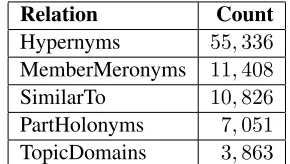
Relation Count Hypernyms 55,336
MemberMeronyms 11,408
SimilarTo 10,826
PartHolonyms 7,051
TopicDomains 3,863
Table 3:Number of Arabic synset relations we create.
AWN have a cosine similarity less than 0.1. Further-more, about 34% of the semantically related words in AWN have cosine similarity less than 0.1. Table 2 shows the weighted average cosine similarity be-tween synonyms, hypernyms, topic-domain related, part-holonyms, instance-hypernyms, and member-meronyms in AWN where the frequency of the sim-ilarity value is the weight.
4.2 Creating an Arabic Wordnet
We choose the algorithm for creating wordnet synsets presented by (Lam et al., 2014) because it requires a limited number of freely available re-sources, which makes it applicable to resource-poor languages. Then, we apply the method we propose in Section 2 to create semantic links between Arabic synsets. Table 3 shows statistics of some of the cre-ated links between synsets in our Arabic wordnet.
[image:3.612.84.290.308.475.2]Algorithm Vector Size Similarity Average
SG 100 0.289
SG 200 0.258
SG 500 0.194
CBOW 100 0.288
CBOW 200 0.259
[image:4.612.317.536.62.159.2]CBOW 500 0.195
Table 4:Comparison between the weighted similarity average obtained using differentword2vecsettings.
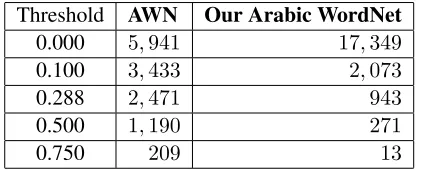
Threshold AWN Our Arabic WordNet
0.000 5,941 17,349
0.100 3,433 2,073
0.288 2,471 943
0.500 1,190 271
[image:4.612.76.302.63.161.2]0.750 209 13
Table 5:Comparison between the number of synsets in AWN and our Arabic wordnet using different threshold values.
0.277 respectively. Then, we compare between the SG and the CBOW with different vector sizes. Ta-ble 4 shows the weighted average cosine similar-ity obtained between16,000pairs of synonyms in AWN using both variations ofword2vec, with win-dow size=3 and vector size set to100,200, and500. We notice that both versions produce almost similar results with a slight advantage to SG with the cost of more execution time. However, for the corpus we use, smaller vector size produces better precision.
4.4 Evaluation & Discussion
We compute cosine similarity between semanti-cally related words extracted from our initial Ara-bic wordnet produced in Section 4.2. The lan-guage model to calculate the cosine similarity is cre-ated using CBOW with vector size=100 and window size=3. Table 5 shows a comparison between the number of Arabic synsets we create and the number of synsets in AWN.
We notice that the translation method we use pro-duces high number of synsets compared to the man-ually constructed AWN. However, the number of synsets sharply decreases after filtering the initial synonyms using the method described in Section 3. Although our Arabic wordnet is automatically cre-ated, the number of synsets we create is 60% of the number of synsets in the manually created AWN
Threshold Range 0- 0.1 0.1 - 0.288 0.288 - 1 Synonyms 34.8% 56.8% 78.4% Hypernyms 45.2% 57.2% 84.4% PartHolonym 50.8% 75.2% 90.4%
Member-Meronym 40.8% 56.8% 79.6% Table 6:Precision of the Arabic wordnet we create.
when filtering the synsets usingα= 0.1.
We evaluate precision by comparing 600 pairs of synonyms, hypernyms, part-holonyms, and member-meronyms with three ranges of cosine sim-ilarity values: 0 to 0.1, 0.1 to 0.288, and 0.288 to 1. We asked 3 Arabic speakers to evaluate the pairs using a 0 to 5 scale where 0 represents the minimum score and 5 represents the maximum score. We com-pute precision by taking the average score and con-verting it to a percentage. See Table 6.
The precision of the synonyms, hypernyms, part-holonyms, and member-meronyms we produce is 78.4%, 84.4%, 90.4%, and 79.6% respectively, with the threshold set to 0.288. This is higher than the precision obtained by (Lam et al., 2014) which pro-duces synonyms with 76.4% precision when just us-ing PWN. Our results suggest that usus-ing lower preci-sion for producing synsets reduces the quality of the other created semantic relations. Our results clearly show that pairs with higher cosine similarity are more likely to be semantically related. It confirms the benefit of combining the translation method with word embeddings in the process of automatically generating new wordnets.
5 Conclusion & Future Work
[image:4.612.82.293.199.284.2]References
Mourad Abbas and Kamel Smaili. 2005. Comparison of topic identification methods for arabic language. In
International Conference on Recent Advances in Nat-ural Language Processing-RANLP 2005, volume 14. Mourad Abbas, Kamel Sma¨ıli, and Daoud Berkani.
2011. Evaluation of topic identification methods on arabic corpora.JDIM, 9(5):185–192.
Christiane Fellbaum. 1998. Wordnet: An electronic lexi-cal database. MIT Press Cambridge.
G Gunawan and Andy Saputra. 2010. Building synsets for Indonesian Wordnet with monolingual lexical re-sources. InAsian Language Processing (IALP), 2010 International Conference on, pages 297–300. IEEE. Khang Nhut Lam, Feras A. Tarouti, and Jugal Kalita.
2014. Automatically constructing wordnet synsets. In
52nd Annual Meeting of the Association for Computa-tional Linguistics (ACL 2014), Baltimore, USA, June. Tomas Mikolov, Wen-tau Yih, and Geoffrey Zweig.
2013. Linguistic regularities in continuous space word representations. InHLT-NAACL, pages 746–751. Antoni Oliver and Salvador Climent. 2012. Parallel
cor-pora for wordnet construction: Machine translation vs. automatic sense tagging. InComputational Linguis-tics and Intelligent Text Processing, pages 110–121. Springer.
Horacio Rodr´ıguez, David Farwell, Javi Ferreres, Manuel Bertran, Musa Alkhalifa, and Maria Ant`onia Mart´ı. 2008. Arabic wordnet: Semi-automatic extensions us-ing bayesian inference. InLREC.