Automated WordNet Construction Using Word Embeddings
Mikhail Khodak, Andrej Risteski, Christiane Fellbaum and Sanjeev Arora
Computer Science Department, Princeton University, 35 Olden St., Princeton, New Jersey 08540
{mkhodak,risteski,fellbaum,arora}@cs.princeton.edu
Abstract
We present a fully unsupervised method for automated construction of WordNets based upon recent advances in distribu-tional representations of sentences and word-senses combined with readily avail-able machine translation tools. The ap-proach requires very few linguistic re-sources and is thus extensible to multiple target languages. To evaluate our method we construct two 600-word test sets for word-to-synset matching in French and Russian using native speakers and evalu-ate the performance of our method along with several other recent approaches. Our method exceeds the best language-specific and multi-lingual automated WordNets in F-score for both languages. The databases we construct for French and Russian, both languages without large publicly available manually constructed WordNets, will be publicly released along with the test sets.
1 Introduction
A WordNet is a lexical database for languages based upon a structure introduced by the Princeton WordNet (PWN) for English in which sets of cog-nitive synonyms, or synsets, are interconnected with arcs standing for semantic and lexical rela-tions between them (Fellbaum, 1972). WordNets are widely used in computational linguistics, in-formation retrieval, and machine translation. Con-structing one by hand is time-consuming and dif-ficult, motivating a search for automated or semi-automated methods. We present an unsupervised method based on word embeddings and word-sense induction and build and evaluate WordNets for French and Russian. Our approach needs only a large unannotated corpus like Wikipedia in the
target language and machine translation (MT) be-tween that language and English.
A standard minimal WordNet design is to have synsets connected by hyponym-hypernym rela-tions and linked back to PWN (Global WordNet Association, 2017). This allows for applications to cross-lingual tasks and rests on the assumption that synsets and their relations are invariant across languages (Sagot and Fiˇser, 2008). For example, while all senses of English wordtie may not line up with all senses of French word cravate, the sense “necktie” will exist in both languages and be represented by the same synset.
Thus MT is often used for automated Word-Nets to generate a set of candidate synsets for each word win the target language by getting a set of English translations ofwand using them to query PWN (we will refer to this as MT+PWN). The number of candidate synsets produced may not be small, even as large as a hundred for some polyse-mous verbs. Thus one needs a way to select from the candidates ofwthose synsets that are its true senses. The main contributions of this paper is a newword embedding-based method for matching words to synsets and the release of two large word-synset matching test sets for French and Russian.1 Though there has been some work using word-vectors for WordNets (see Section 2), the result-ing databases have been small, containresult-ing less than 1000 words. Using embeddings for this task is challenging due to the need for good ways to use PWN synset information and account for the breakdown of cosine-similarity for polysemous words. We approach the first issue by representing synset information using recent work on sentence-embeddings by Arora et al. (2017). To handle pol-ysemy we devise a sense clustering scheme based on Word Sense Induction (WSI) via linear
alge-1 https://github.com/mkhodak/pawn
bra over word-vectors (Arora et al., 2016a). We demonstrate how thissense purificationprocedure effectively combines clustering with embeddings, thus being applicable to many word-sense disam-biguation (WSD) and induction-related tasks. Us-ing both techniques yields a WordNet method that outperforms other language-independent methods as well as language-specific approaches such as WOLF, the French WordNet used by the Natural Language ToolKit (Sagot and Fiˇser, 2008; Bond and Foster, 2013; Bird et al., 2009).
Our second contribution is the creation of two new 600-word test sets in French and Russian that are larger and more comprehensive than any cur-rently available, containing 200 each of nouns, verbs, and adjectives. They are constructed by pre-senting native speakers with all candidate synsets produced as above by MT+PWN and treating the senses they pick out as “ground truth” for measur-ing precision and recall. The motivation behind separating by part-of-speech (POS) is that nouns are often easier than adjectives and verbs, so re-porting one number — as done by some past work — allows high noun performance to mask low per-formance on adjectives and verbs.
Using these test sets, we can begin addressing the difficulties of evaluation for non-English auto-mated WordNets due to the use of different and unreported test data, incompatible metrics (e.g. matching synsets to words vs. retrieving words for synsets), and differing cross-lingual dictionaries. In this paper we use the test sets to evaluate our method and several other automated WordNets.
2 Related Work
There have been many language-specific ap-proaches for building automated WordNets, no-tably for Korean (Lee et al., 2000), French (Sagot and Fiˇser, 2008; Pradet et al., 2013), and Persian (Montazery and Faili, 2010). These approaches also use MT+PWN to get candidate word-synset pairs, but often use further resources — such as bilingual corpora, expert knowledge, or WordNets in related languages — to select correct senses.
The Korean construction depends on a classifier trained on 3260 word-sense matchings that yields 93.6% precision and 77.1% recall, albeit only on nouns. The Persian WordNet uses a scoring func-tion based on related words between languages (requiring expert knowledge and parallel corpora) and achieves 82.6% precision, though without
re-porting recall and POS-separated statistics. The most comparable results to ours are from the Wordnet Libre du Franc¸ais (WOLF) of Sagot and Fiˇser (2008), which leverages multiple Euro-pean WordNet projects. Our best method exceeds this approach on our test set and benefits from hav-ing far fewer resource requirements. The Wordnet du Franc¸ais (WoNeF) of Pradet et al. (2013) de-pends on combining linguistic models by a voting scheme. Their performance is found to be gener-ally below WOLF’s, so we compare to the latter.
There has also been work on multi-language WordNets, specifically the Extended Open Multi-lingual Wordnet (OMW) (Bond and Foster, 2013), which scraped Wiktionary, and the Universal Mul-tilingual Wordnet (UWN) (de Melo and Weikum, 2009), which used multiple translations to rate word-sense matches. In our evaluation both pro-duce high-precision/low-coverage WordNets.
Finally, there have been recent vector ap-proaches for an Arabic WordNet (Tarouti and Kalita, 2016) and a Bengali WordNet (Nasirud-din et al., 2014). The Arabic effort uses a cosine-similarity threshold for correcting direct transla-tion and reports a precision of 78.4% on synonym matching, although its small size (943 synsets) indicates a poor precision/recall trade-off. The Bengali WordNet paper examines WSI on word vectors, evaluating clustering methods on seven words and achievingF1-scores of at best 52.1%. It
is likely that standard clustering techniques are in-sufficient when one needs many thousands of clus-ters, an issue we address via sparse coding.
Our use of distributional word embeddings to construct WordNets is the latest in a long line of their applications, e.g. approximating word simi-larity and solving word-analogies (Mikolov et al., 2013). The latter discovery was cited as the in-spiration for the theoretical model in Arora et al. (2016b), whose Squared-Norm (SN) vectors we use; the computation is similar in form and per-formance to GloVe (Pennington et al., 2014).
3 Methods for WordNet Construction
assign a score to each candidate synset
French-English Dictionary French word
'dalle' flagstone PrincetonWordNet
flag
slab
� � � � � � �
�
correct synsets:
flag.n.06
-slab.n.01 � retrieved synsets:
slab.n.01 � Target
Word
get translations of target word using a bilingual dictionary or machine translation (MT)
get set of candidate synsets by querying Princeton WordNet (PWN) using translations of
Translations
MT + PWN Synset
Scoring ThresholdMatching
return all synsets with score above a threshold
Candidates SynsetScore 0.41 Threshold
flag.n.01 flag.n.04 flag.n.06 flag.n.07 iris.n.01 masthead.n.01
pin.n.08 slab.n.01
[image:3.595.89.513.59.207.2]score = 0.280 score = 0.222 score = 0.360 score = 0.161 score = 0.200 score = 0.195 score = 0.251 score = 0.521
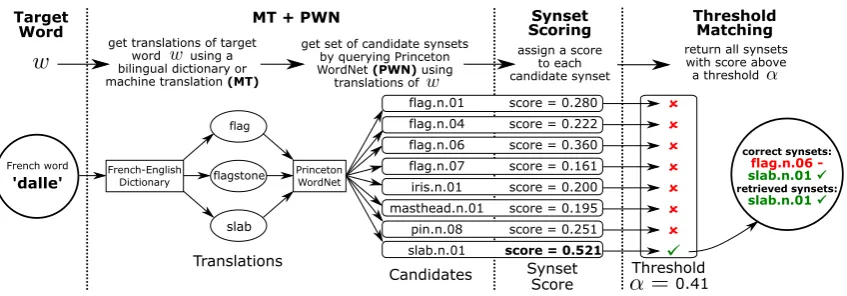
Figure 1: The score-threshold procedure for French wordw=dalle(flagstone, slab). Candidate synsets generated by MT+PWN are given a score and matched towif the score is above a thresholdα.
accept only the highest-scoring synset. This score-thresholdmethod is illustrated in Figure 1.
Thus we need methods to assign high scores to correct candidate synsets ofw and low scores to incorrect ones. We use unsupervised word vec-tors in the target language computed from a large text corpus (e.g. Wikipedia). Section 3.1 presents a simple baseline that improves upon MT+PWN via a cosine-similarity metric betweenwand each synset’s lemmas. A more sophisticatedsynset rep-resentationmethod using sentence-embeddings is described in Section 3.2. Finally, in Section 3.3 we discuss WSI-based procedures for improving the score-threshold method for words with fine sense distinctions or poorly-annotated synsets.
In this section we assume a vocabularyV of tar-get language words with associatedd-dimensional unit word-vectors vw ∈ Rd for d |V| (e.g.
d = 300for vocabulary size 50000) trained on a large text corpus. Each wordw∈V also has a set of candidate synsets found by MT+PWN. We call synsetsS, S0 in PWNrelated, denotedS ∼S0, if
one is a hyponym, meronym, antonym, or attribute of the other, if they share a verb group, orS =S0.
3.1 Baseline: Average Similarity Method
This method for scoring synsets can be seen as a simple baseline. Given a candidate synset S, we define TS ⊂ V as the set of translations of its
lemmas from English to the target language. The score of S is then 1
|TS| P
w0∈TSvw ·vw0, the
av-erage cosine similarity betweenw and the trans-lated lemmas ofS. Although straightforward, this scoring method is quite noisy, as averaging word-vectors dilutes similarity performance, and does not use all synset information provided by PWN.
3.2 Method 1: Synset Representation
To improve upon this baseline we need a better vector representation of S to score S via cosine similarity withvw. Previous efforts in synset and
sense embeddings (Iacobacci et al., 2015; Rothe and Sch¨utze, 2015) often use extra resources such as WordNet or BabelNet for the target language (Navigli and Ponzetto, 2012). As such databases are not always available, we propose a synset rep-resentationuSthat is unsupervised, needing no
ex-tra resources beyond MT and PWN, and leverages recent work on sentence embeddings.
This new representation combines embeddings of synset information given by PWN, e.g. synset relations, definitions, and example sentences. To create these embeddings we first consider the question of how to represent a list of wordsLas a vector inRd. One way is to simply take the
nor-malized sumvˆ(LSUM)of their word-vectors, where
vL(SUM)= X w0∈L
vw0
Potentially more useful is to compute a vector
ˆ
v(LSIF) via the sentence embedding formula of Arora et al. (2017), based on smooth inverse fre-quency(SIF) weighting, which (fora= 10−4 and
before normalization) is expressed as
v(LSIF)= X w0∈L
a
a+P{w0}vw0
SIF is similar in spirit to TF-IDF (Salton and Buckley, 1988) and builds on work of Wieting et al. (2016); it has been found to perform well on other similarity tasks (Arora et al., 2017).
likely because sentences contain many distractor words that SIF will weight lower while the pres-ence of distractors among lemmas is independent of word frequency. Thus to compute the synset scoreuS ·vw we make the vector representation
uS ofSthe element-wise average of:
• vˆT(SUMS ) TSis the set of translations of
lemmas ofS(as in Section3.1).
• vˆR(SUMS ) RS=
S
S0∼STS0
\TSis the
set of lemma translations of synsetsS0related toS. • vˆD(SIFS ) DSis the list of tokens in the
translated definition ofS.
• 1
|Es|
X
E∈ES
ˆ
v(ESIF) Ein the translated example sent-Scontains the lists of tokens ences ofS(excluded ifShas no example sentences).
3.3 Method 2: Better Matching Using WSI
We found through examination that the score-threshold method we have used so far performs poorly in two main cases:
(a) the word w has no candidate synset with score high-enough to clear the threshold. (b) whas multiple closely related synsets that are
all correct matches but some of which have a much lower score than others.
Here we address both issues by using sense infor-mation found by applying a word-sense induction method first introduced in Arora et al. (2016a).
We summarize their WSI-model – referred to henceforth as Linear-WSI — in Section 3.3.1. Then in Section 3.3.2 we devise asense purifica-tionprocedure for constructing a word-cluster for each induced sense of a word. Applying this pro-cedure to construct word-cluster representations of candidates synsets provides an additional metric for the correctness of word-synset matches that can be used to devise aw-specific thresholdαw to
ameliorate problem (a). Meanwhile, using Linear-WSI to associate similar candidate synsets ofwto each other provides a way to address problem (b). We explain these methodologies in Section 3.3.3.
3.3.1 Summary of Linear-WSI Model
In Arora et al. (2016a) the authors posit that the vector of a polysemous word can be linearly de-composed into vectors associated to its senses.
Avg. Similarity (Baseline)
Unweighted Summation
SIF-Weighted Summation
Synset Rep. (Method 1) Synset Lemmas
Synset Lemmas + Related Lemmas
Synset Definition
Synset Definition + Example Sentences
All Synset Information Average Lemma Similarity
Synset Representation
[image:4.595.308.522.58.219.2]0.55 0.60 0.65
Figure 2: F-score comparison between using un-weighted summation and SIF-un-weighted summa-tion for embedding PWN synset informasumma-tion.
Thus for w =tie — which can be an article of clothing, a drawn match, and so on — we would have vw ≈ avw(clothing) +bvw(match) +. . . for a, b ∈ R. It is unclear how to find such sense-vectors, but one expects different words to have closely related sense-vectors, e.g. for w0 =bow
the vectorvw0(clothing) would be close to the
vec-torvw(clothing)oftie. Thus the Linear-WSI model
proposes using sparse coding, namely finding a set of unit basis vectorsa1, . . . , ak∈Rds.t.∀w∈V,
vw= k
X
i=1
Rwiai+ηw, (1)
fork > d,ηw a noise vector, and at mosts
coef-ficientsRwinonzero. The hope is that the
sense-vectorvw(clothing)oftieis in the neighborhood of
a vectorais.t.Rwi>0. Indeed, fork= 2000and
s= 5, Arora et al. (2016a) report that solving (1) represents English word-senses as well as a com-petent non-native speaker and significantly better than older clustering methods for WSI.
3.3.2 Sense Purification
While (1) is a good WSI method, its use for build-ing WordNets is hampered by its inability to pro-duce more than a few thousand senses ai, as
set-ting a largekyields repetitive rather than different senses. As this is far fewer than the number of synsets in PWN, we use sense purification to ad-dress this by extracting a cluster of words related toai as well aswto represent each sense. In
ad-dition towandai, the procedure takes as input a
(pistol)
(shooting) (to shoot) (species)
(crossbow) (kind)
(family)
(plant)
(coriander) (cilantro)
(celery)
[image:5.595.74.531.67.188.2](garlic)
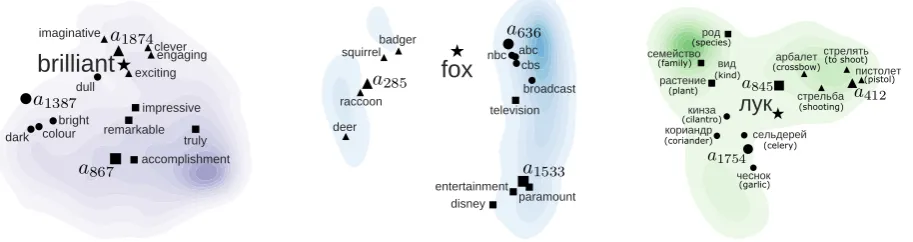
Figure 3: Isometric mapping of sense-cluster vectors forw=brilliant,fox, andлук(bow, onion). wis
marked by a star and each senseai ofw, shown by a large marker, has an associated cluster of words
with the same marker shape. Contours are densities of vectors close towand at least one senseai.
C⊂V0of sizencontainingwthat maximizes f = xmin=a
ior
x=vw0:w0∈C
Median{x·vw0 :w0 ∈C} (2)
A clusterCmaximizing this must ensure that nei-therai nor any wordw0 ∈ C(includingw0 = w)
has low average cosine similarity with cluster-words, resulting in a dense cluster close to both
wandai. We explain this further in Appendix A.
We illustrate this method in Figure 3 by pu-rifying the senses of English words brilliant and fox and Russian word лук, which has the
senses “bow” (weapon), “onion” (vegetable), and “onion” (plant). Note how correct senses are re-covered across POS and language and for proper and common noun senses.
3.3.3 Applying WSI to Synset Matching
The problem addressed by sense purification is that senses ai induced by Linear-WSI have too
many related words; purification solves this by extracting a cluster of words related to w from the words close toai. When translating WordNet
synsets, we have a similar problem in that transla-tions of a synset’s lemmas may not be relevant to the synset itself. Thus we can try to create a puri-fied representation of each candidate synsetSofw
by extracting a cluster of translated lemmas close towand one of its induced senses. We run purifi-cation on every senseai in the sparse
representa-tion (1) ofw, using as a search-spaceV0 =VSthe
set of translations of all lemmas of synsetsS0
re-lated toS in PWN (i.e. S0 ∼S as defined in
Sec-tion 3). To each synsetS we associate the sense
aS and corresponding clusterCS that are optimal
in the objective (2) among all sensesaiofw.
Although we find a senseaSand purified
repre-sentation CS for each candidate synset of w, we
note that an incorrect synset is likely to have a lower objective value (2) than a correct synset as it likely has fewer words related towin its search-spaceVS. However, usingfS=f(w, aS, CS)as a
synset score is difficult as some synsets have very small search-spaces, leading to inconsistent scor-ing even for correct synsets.
Instead we usefSas part of aw-specific
thresh-old αw = min{α, uS∗ ·vw}, where uS is the
vector representation of S from Section 3.2 and
S∗ = arg maxf
S+uS·vw. This attempts to
ad-dress problem (a) of the score-threshold method — that some words have no synsets above the cut-offαand returning only the highest-scoring synset in such cases will not retrieve multiple sense for polysemous words. By the construction ofαw, if
wis polysemous, a synset other than the one with the highest scoreuS·vwmay have a better value of
fS and thus found to beS∗; then all synsets with
higher scores will be matched tow, allowing for multiple matches even if no synset clears the cut-offα. Otherwise ifwis monosemous, we expect the correct synsetS to have the highest value for bothuS·vwandfS, makingS∗ =S. Then if no
synset has score greater thanαthe threshold will be set touS·vw, the highest synset-score, so only
the highest scoring synset will be matched tow. To address problem (b) of the threshold method — thatwmight have multiple correct and closely related candidate synsets of which only some clear the cutoff — we observe that closely related synsets of w will have similar search-spaces VS
and so are likely to be associated to the same sense
ai. For example, in Figure 4 the candidates of
dallerelated to its correct meanings as a flagstone or slab are associated to the same sensea892while
Candidates SynsetScore 0.50 Threshold AssociatedSense French word
'dalle'
get a set of candidate synsets by querying Princeton WordNet using
translations of
MT + PWN ThresholdMatching
use sense purification to associate a sense to each candidate synset match to all
candidate synsets with score above
a threshold
�
�
Sense-Association
by Purification Sense-AgglomerationProcedure perform cutoff matching with
a lower threshold on all synsets sharing a sense with an already matched synset
target word
Threshold 0.25
correct synsets:
flag.n.06 � slab.n.01 �
retrieved synsets:
flag.n.06 � slab.n.01 �
sense = sense = sense = sense = sense = sense = sense = sense =
� � � � � � �
� flag.n.01
flag.n.04 flag.n.06 flag.n.07 iris.n.01 masthead.n.01
pin.n.08 slab.n.01
[image:6.595.83.514.62.212.2]score = 0.280 score = 0.222 score = 0.360 score = 0.161 score = 0.200 score = 0.195 score = 0.251 score = 0.521
Figure 4: The score-threshold and sense-agglomeration procedure for French wordw=dalle(flagstone, slab). Candidate synsets are given a score and matched to wif they clear a high threshold αw (as in
Section 3.2). If an unmatched synset shares a senseai with a matched synset, it is compared to a low
thresholdβ(the sense-agglomeration procedure in Section 3.3.3).
flag are mostly matched to other senses. This mo-tivates thesense agglomerationprocedure, which uses threshold-clearing synsets to match synsets with the same sense below the score-threshold. Forβ < α, the procedure is roughly as follows:
1. Run score-threshold method with cutoffαw.
2. For each synsetS with scoreuS·vw below
the threshold, check for a synsetS0with score uS0 ·vwabove the threshold andaS0 =aS.
3. IfuS·vw ≥βand the clustersCS, CS0satisfy
a cluster similarity condition, matchStow.
We include the lower cutoffβ because even sim-ilar synsets may not both be senses of the same word. The cluster similarity condition, available in Appendix B.2, ensures the relatedness of synsets sharing a senseai, as an erroneous synsetS0may
be associated to the same sense as a correct one. In summary, the improved synset matching ap-proach has two steps: 1-conduct score-threshold matching using the modified thresholdαw; 2-run
the sense-agglomeration procedure on all senses
ai of w having at least one threshold-clearing
synset S. Although for fixedα both steps focus on improving the recall of the threshold method, in practice they allowαto be higher, so that both pre-cision and recall are improved. For example, note the recovery of a correct synset left unmatched by the score-threshold method in the simplified de-piction of sense-agglomeration shown in Figure 4.
4 Evaluation of Methods
We evaluate our method’s accuracy and coverage by constructing and testing WordNets for French and Russian. For both we train 300-dimensional SN word embeddings (Arora et al., 2016b) on co-occurrences of words occurring at least 1000 times, or having candidate PWN synsets and oc-curring at least 100 times, in the lemmatized Wikipedia corpus. This yields|V| ≈ 50000. For Linear-WSI we run sparse coding with sparsity
s = 4 and basis-sizek = 2000 and use set-size
n = 5for purification. To get candidate synsets we use Google and Microsoft Translators and the dictionary of the translation company ECTACO, while for sentence-length MT we use Microsoft.
4.1 Testsets
A common way to evaluate accuracy of an auto-mated WordNet is to compare its synsets or word matchings to a manually-constructed one. How-ever, the existing ELRA French Wordnet2 is not public and half the size of ours while Russian WordNets are either even smaller and not linked to PWN3or obtained via direct translation4.
Instead we construct test sets for each language that allow for evaluation of our methods and oth-ers. We randomly chose 200 each of adjectives, nouns, and verbs from the set of target language words whose English translations appear in the synsets of the Core WordNet. Their “ground truth”
2 http://catalog.elra.info/product_
info.php?products_id=550
3 http://project.phil.spbu.ru/RussNet/
Method POS F.5-Score∗ F1-Score∗ Precision∗ Recall∗ Coverage Synsets α β
Direct Translation (MT + PWN)
Adj. 50.3 59.3 46.1 100.0 99.9 11271 Noun 56.2 64.6 52.2 100.0 100.0 74477 Verb 41.4 51.3 37.0 100.0 100.0 13017 Total 49.3 58.4 45.1 100.0 100.0 100174†
Wordnet Libre du Franc¸ais
(WOLF) (Sagot and Fiˇser, 2008)
Adj. 66.3 58.6 78.1 53.4 84.8 6865 Noun 68.6 58.7 83.2 51.5 95.0 36667 Verb 60.8 48.4 81.0 39.6 88.2 7671 Total 65.2 55.2 80.8 48.2 92.2 52757†
Universal Wordnet (de Melo and Weikum, 2009)
Adj. 64.5 51.5 88.3 42.3 69.2 7407 Noun 67.5 52.2 94.1 40.8 75.9 24670 Verb 55.4 39.5 88.0 28.5 76.2 5624 Total 62.5 47.7 90.1 37.2 75.0 39497†
Extended Open Multilingual Wordnet
(Bond and Foster, 2013)
Adj. 58.4 40.8 90.9 28.4 54.7 2689 Noun 61.3 43.8 96.5 31.7 66.6 14936 Verb 47.8 29.4 95.9 18.6 57.7 2331 Total 55.9 38.0 94.5 26.2 63.2 20449†
Baseline: Average Similarity
(Section 3.1)
Adj. 62.8±0.0 62.6±0.0 65.3±0.0 68.5±0.0 88.7 9687 0.31 Noun 67.3±0.0 65.4±0.1 71.6±0.1 69.0±0.1 92.2 37970 0.27 Verb 51.8±0.0 50.8±0.1 55.9±0.1 57.0±0.1 83.5 10037 0.26 Total 60.6±0.0 59.6±0.0 64.3±0.0 64.9±0.0 90.0 58962†
Method 1: Synset Representation
(Section 3.2)
Adj. 65.9±0.0 60.4±0.0 75.9±0.1 59.5±0.1 85.1 8512 0.47 Noun 71.0±0.0 67.3±0.1 78.7±0.1 69.1±0.1 96.7 35663 0.41 Verb 61.6±0.0 53.0±0.0 78.7±0.1 49.8±0.1 89.9 8619 0.45 Total 66.2±0.0 60.2±0.0 77.8±0.0 59.5±0.1 93.7 53852†
Method 2: Synset Representation
+ Linear-WSI (Section 3.3)
Adj. 67.7±0.0 62.5±0.1 76.9±0.1 62.6±0.1 91.2 8912 0.56 0.42 Noun 73.0±0.0 66.0±0.1 83.7±0.1 62.0±0.2 90.9 34001 0.50 0.25 Verb 64.4±0.0 55.9±0.0 79.3±0.0 51.5±0.1 93.6 9262 0.46 0.28 Total 68.4±0.0 61.5±0.0 80.0±0.0 58.7±0.1 91.5 53208†
∗Micro-averages over a randomly held-out half of the data; parameters tuned on the other half. 95% asymptotic confidence
intervals found with 10000 randomized trials.
[image:7.595.77.522.62.398.2]†Includes adverb synsets. For the last three methods they are matched with the same parameter values (αandβ) as for adjectives.
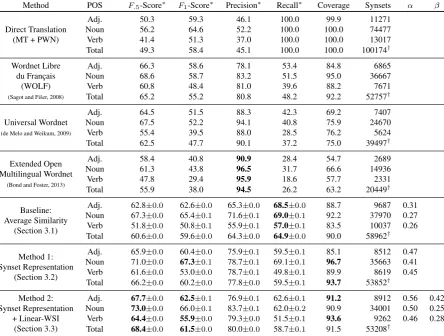
Table 1: French WordNet Results
word senses are picked by native speakers, who were asked to perform the same matching task de-scribed in Section 3, i.e. select correct synsets for a word given a set of candidates generated by MT + PWN. For example, the French word foie has one translation,liverwith four PWN synsets: 1-“glandular organ”; 2-“liver used as meat”; 3-“person with a special life style”; 4-“someone liv-ing in a place.” The first two align with senses of foie while the others do not, so the expert marks the first two as good and the others as neg-ative. Two native speakers for each language were trained by an author with knowledge of WordNet and at least 10 years of experience in each lan-guage. Inconsistencies in the matchings of the two speakers were resolved by the same author.
We get 600 words and about 12000 candidate word-synset pairs for each language, with adjec-tives and nouns having on average about 15 can-didates and verbs having about 30. These num-bers makes the test set larger than many others,
with French, Korean, and Persian WordNets cited in Section 2 being evaluated on 183 pairs, 3260 pairs, and 500 words, respectively. Accuracy mea-sured with respect to this ground truth estimates how well an algorithm does compared to humans.
generate for that word, negating the loss of pre-cision incurred by other methods due to the use of different dictionaries. We also do not penalize other WordNets for test words they do not contain. In addition to precision and recall, we report the Coveragestatistic as the proportion of the Core set of most-used synsets, a semi-automatically con-structed set of about 5000 PWN frequent senses, that are matched to at least one word (Fellbaum, 1972). While an imperfect metric given different sense usage by language, the synsets are universal-enough for it to be a good indicator of usability.
4.2 Evaluation Results
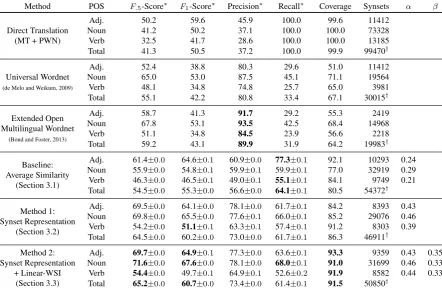
We report the evaluation of methods in Section 3 in Tables 1 & 2 alongside evaluations of UWN (de Melo and Weikum, 2009), OWM (Bond and Foster, 2013), and WOLF (Sagot and Fiˇser, 2008). Parameters α and β were tuned to maximize the micro-averaged F.5-score 1.25.25·Precision·Precision+·RecallRecall, used
instead of F1 to prioritize precision, which is
of-ten more important for application purposes. Our synset representation method (Section 3.2) exceeds the similarity baseline by 6% inF.5-score
for French and 10% for Russian. For French it is competitive with the best other WordNet (WOLF) and in both languages exceeds both multi-lingual WordNets. Improving this method via Linear-WSI (Section 3.3) leads to 2% improvement in F.5
-score for French and 1% for Russian. Our methods also perform best inF1-score and Core coverage.
As expected from a Wiktionary-scraping method, OMW achieves the best precision across languages, although it and UWN have low recall and Core coverage. The performance of our best method for French exceeds that of WOLF in F.5-score across POS while achieving
similar coverage. WOLF’s recall performance is markedly lower than the evaluation in Sagot and Fiˇser (2008, Table 4); we believe this stems from our use of words matched to Core synsets, not random words, leading to a more difficult test set as common words are more-polysemous and have more synsets to retrieve. There is no comparable automated Russian-only WordNet, with only semi-automated and incomplete efforts (Yablonsky and Sukhonogov, 2006).
Comparing across POS, we do best on nouns and worst on verbs, likely due to the greater pol-ysemy of verbs. Between languages, performance is similar for adjectives but slightly worse on
Rus-sian nouns and much worse on RusRus-sian verbs. The discrepancy in verbs can be explained by a difference in treating the reflexive case and aspec-tual variants due to the grammatical complexity of Russian verbs. In French, making a verb reflexive requires adding a word while in Russian the verb itself changes, e.g. to wash→to wash oneself is laver→se laverin French butмыть→мыться in
Russian. Thus we do not distinguish the reflex-ive case for French as the token found is the same but for Russian we do, so bothмытьand мыть-сяmay appear and have distinct synset matches.
Thus matching Russian verbs is challenging as the reflexive usage of a verb is often contextually sim-ilar to the non-reflexive usage. Another compli-cation for Russian verbs is due to aspectual verb pairs; thus to dohas aspects (делать, сделать)
in Russian that are treated as distinct verbs while in French these are just different tenses of the verb faire. Both factors pose challenges for differentiat-ing Russian verb senses by a distributional model. Overall however the method is shown to be ro-bust to how close the target language is to English, with nouns and adjectives performing well in both languages and the difference for verbs stemming from an intrinsic quality rather than dissimilarity with English. This can be further examined by testing the method on a non-European language.
5 Conclusion and Future Work
We have shown how to leverage recent advances in word embeddings for fully-automated WordNet construction. Our best approach combining sen-tence embeddings, and recent methods for WSI obtains performance 5-16% above the naive base-line in F.5-score as well as outperforming
previ-ous language-specific and multi-lingual methods. A notable feature of our work is that we require only a large corpus in the target language and au-tomated translation into/from English, both avail-able for many languages lacking good WordNets.
Method POS F.5-Score∗ F1-Score∗ Precision∗ Recall∗ Coverage Synsets α β
Direct Translation (MT + PWN)
Adj. 50.2 59.6 45.9 100.0 99.6 11412 Noun 41.2 50.2 37.1 100.0 100.0 73328 Verb 32.5 41.7 28.6 100.0 100.0 13185 Total 41.3 50.5 37.2 100.0 99.9 99470†
Universal Wordnet (de Melo and Weikum, 2009)
Adj. 52.4 38.8 80.3 29.6 51.0 11412 Noun 65.0 53.0 87.5 45.1 71.1 19564 Verb 48.1 34.8 74.8 25.7 65.0 3981 Total 55.1 42.2 80.8 33.4 67.1 30015†
Extended Open Multilingual Wordnet
(Bond and Foster, 2013)
Adj. 58.7 41.3 91.7 29.2 55.3 2419 Noun 67.8 53.1 93.5 42.5 68.4 14968 Verb 51.1 34.8 84.5 23.9 56.6 2218 Total 59.2 43.1 89.9 31.9 64.2 19983†
Baseline: Average Similarity
(Section 3.1)
Adj. 61.4±0.0 64.6±0.1 60.9±0.0 77.3±0.1 92.1 10293 0.24 Noun 55.9±0.0 54.8±0.1 59.9±0.1 59.9±0.1 77.0 32919 0.29 Verb 46.3±0.0 46.5±0.1 49.0±0.1 55.1±0.1 84.1 9749 0.21 Total 54.5±0.0 55.3±0.0 56.6±0.0 64.1±0.1 80.5 54372†
Method 1: Synset Representation
(Section 3.2)
Adj. 69.5±0.0 64.1±0.0 78.1±0.0 61.7±0.1 84.2 8393 0.43 Noun 69.8±0.0 65.5±0.0 77.6±0.1 66.0±0.1 85.2 29076 0.46 Verb 54.2±0.0 51.1±0.1 63.3±0.1 57.4±0.1 91.2 8303 0.39 Total 64.5±0.0 60.2±0.0 73.0±0.0 61.7±0.1 86.3 46911†
Method 2: Synset Representation
+ Linear-WSI (Section 3.3)
Adj. 69.7±0.0 64.9±0.1 77.3±0.0 63.6±0.1 93.3 9359 0.43 0.35 Noun 71.6±0.0 67.6±0.0 78.1±0.0 68.0±0.1 91.0 31699 0.46 0.33 Verb 54.4±0.0 49.7±0.1 64.9±0.1 52.6±0.2 91.9 8582 0.44 0.33 Total 65.2±0.0 60.7±0.0 73.4±0.0 61.4±0.1 91.5 50850†
∗Micro-averages over a randomly held-out half of the data; parameters tuned on the other half. 95% asymptotic confidence
intervals found with 10000 randomized trials.
[image:9.595.77.520.61.352.2]†Includes adverb synsets. For the last three methods they are matched with the same parameter values (αandβ) as for adjectives.
Table 2: Russian WordNet Results
Further improvement to our work may come from other methods in word-embeddings, such as multi-lingual word-vectors (Faruqui and Dyer, 2014). Our techniques can also be combined with others, both language-specific and multi-lingual, for automated WordNet construction. In addition, our method for associating multiple synsets to the same sense can contribute to efforts to improve PWN through sense clustering (Snow et al., 2007). Finally, our sense purification procedure, which uses word-vectors to extract clusters representing word-senses, likely has further WSI and WSD ap-plications; such exploration is left to future work.
Acknowledgments
We thank Angel Chang and Yingyu Liang for helpful discussion at various stages of this pa-per. This work was supported in part by NSF grants CCF-1302518, CCF-1527371, Simons In-vestigator Award, Simons Collaboration Grant, and ONR-N00014-16-1-2329.
References
Michal Aharon, Michael Elad, and Alfred Bruckstein. 2006. K-svd: An algorithm for designing overcom-plete dictionaries for sparse representation. IEEE Transactions on Signal Processing, 54(11).
Sanjeev Arora, Yuanzhi Li, Yingyu Liang, Tengyu Ma, and Andrej Risteski. 2016a. Linear algebraic struc-ture of word sense, with applications to polysemy.
Sanjeev Arora, Yuanzhi Li, Yingyu Liang, Tengyu Ma, and Andrej Risteski. 2016b. Rand-walk: A la-tent variable model approach to word embeddings. Transactions of the Association for Computational Linguistics, 4:385–399.
Sanjeev Arora, Yingyu Liang, and Tengyu Ma. 2017. A simple but tough-to-beat baseline for sentence em-beddings. InInternational Conference on Learning Representations. To Appear.
Steven Bird, Edward Loper, and Ewan Klein. 2009. Natural Language Processing with Python. O’Reilly Media Inc.
Gerard de Melo and Gerhard Weikum. 2009. Towards a universal wordnet by learning from combined evi-dence. InProceedings of the 18th ACM Conference on Information and Knowledge Management.
Manaal Faruqui and Chris Dyer. 2014. Improving vector space word representations using multilingual correlation. InProceedings of the 14th Conference of the European Chapter of the Association for Com-putational Linguistics.
Christiane Fellbaum. 1972. WordNet: An Electronic Lexical Database. MIT Press, Cambridge, MA.
Global WordNet Association. 2017. Wordnets in the world.
Ignaci Iacobacci, Mohammad Taher Pilehvar, and Roberto Navigli. 2015. Sensembed: Learning sense embeddings for word and relational similarity. In Proceedings of the 53rd Annual Meeting of the As-sociation for Computational Linguistics.
Changki Lee, Geunbae Lee, and Seo JungYun. 2000. Automated wordnet mapping using word sense dis-ambiguation. InProceedings of the 2000 Joint SIG-DAT Conference on Empirical Methods in Natural Language Processing and Very Large Corpora.
Tomas Mikolov, Kai Chen, Greg Corrado, and Jeffrey Dean. 2013. Efficient estimation of word represen-tations in vector space.
Mortaza Montazery and Heshaam Faili. 2010. Auto-matic persian wordnet construction. InProceedings of the 23rd International Conference on Computa-tional Linguistics.
Mohammad Nasiruddin, Didier Schwab, and Andon Tchechmedjiev. 2014. Induction de sens pour en-richir des ressources lexicales. In21´eme Traitement Automatique des Langues Naturelles.
Roberto Navigli and Simone Paolo Ponzetto. 2012. Babelnet: The automatic construction, evaluation and application of a wide-coverage multilingual se-mantic network. Artificial Intelligence, 193.
Jeffrey Pennington, Richard Socher, and Christo-pher D. Manning. 2014. Glove: Global vectors for word representation. In Proceedings of Empirical Methods in Natural Language Processing.
Quentin Pradet, Ga¨el de Chalendar, and Jeanne Bague-nier Desormeaux. 2013. Wonef, an improved, ex-panded and evaluated automatic french translation of wordnet. In Proceedings of the Seventh Global Wordnet Conference.
Sascha Rothe and Hinrich Sch¨utze. 2015. Autoex-tend: Extending word embeddings to embeddings for synsets and lexemes. InProceedings of the 53rd Annual Meeting of the Association for Computa-tional Linguistics.
Benoˆıt Sagot and Darja Fiˇser. 2008. Building a free french wordnet from multilingual resources. In Pro-ceedings of the Sixth International Language Re-sources and Evaluation Conference.
Gerald Salton and Christopher Buckley. 1988. Term-weighting approaches in automatic text retrieval. In-formation Processing & Management, 24(5). Rion Snow, Sushant Prakash, Daniel Jurafsky, and
An-drew Y. Ng. 2007. Learning to merge word senses. InProceedings of the 2007 Joint Conference on Em-pirical Methods in Natural Language Processing and Computational Natural Language Learning. Feras Al Tarouti and Jugal Kalita. 2016. Enhancing
automatic wordnet construction using word embed-dings. InProceedings of the Workshop on Multilin-gual and Cross-linMultilin-gual Methods in NLP.
John Wieting, Mohit Bansal, Kevin Gimpel, and Karen Livescu. 2016. Towards universal paraphrastic sen-tence embeddings. InInternational Conference on Learning Representations.
Sergey Yablonsky and Andrej Sukhonogov. 2006. Semi-automated english-russian wordnet construc-tion: Initial resources, software and methods of translation. InProceedings of the Global WordNet Conference.
A Purification Procedure
As discussed in Section 3.3.1, the Linear-WSI model (Arora et al., 2016a) posits that there ex-ists anovercomplete basisa1, . . . , ak∈Rdof unit
vectors such that each wordw∈V can be approx-imately represented by a linear combination of at mostsbasis vectors (see Equation 1). Finding the basis vectorsaiand their coefficientsRwirequires
solving the optimization problem
minimize kY −RAk2
subject to kRwk0 ≤s ∀ w∈V
whereY ∈ R|V|×n has word-vectors as its rows,
R∈R|V|×kis the matrix of coefficientsR wi, and
A ∈ Rk×dhas the overcomplete basisa1, . . . , ak
as its rows. This problem is non-convex and can be solved approximately via the K-SVD algorithm (Aharon et al., 2006).
Given a word w, the purification procedure is a method for purifying the senses induced via Linear-WSI (the vectorsai s.t. Rwi 6= 0) by
number of word-senses (Arora et al., 2016a). The procedure is inspired by the hope that words re-lated to each sense of w will form clusters near bothvwand one of its sensesai. Given a fixed
set-sizenand a search-spaceV0 ⊂V, we realize this
hope via the optimization problem maximize
C⊂V0 γ
subject to
γ ≤ Median{vx·vw0 :w0 ∈C\{x}} ∀ x∈C γ ≤ Median{ai·vw0 :w0 ∈C}
w∈C, |C|=n
This problem is equivalent to maximizing (2) with constraints|C| = nandw ∈ C ⊂ V0. The
ob-jective value is constrained to be the lowest me-dian cosine similarity between any word x ∈ C
or the senseai and the rest ofC, so optimizing it
ensures that the words inC are closely related to each other and toai. Forcing the cluster to contain
wleads to the words inCbeing close towas well. For computational purposes we solve this prob-lem approximately using a greedy algorithm that starts withC={w}and repeatedly adds the word inV0\Cthat results in the best objective value
un-til|C|=n. Speed of computation is also a reason for using a search-spaceV0 ⊂ V rather than the
entire vocabulary as a source of words for the clus-ter; we found that restrictingV0to be all wordsw0
s.t. min{vw0 ·vw, vw0 ·ai} ≥ .2 dramatically
re-duces processing time with little performance loss. The purification procedure represents only one sense ofw, so to perform WSI we generate clus-ters for all sensesai s.t. Rwi > 0. If two senses
have clusters that share a word other thanw, only the cluster with the higher objective value is re-turned. To find the clusters displayed in Figure 3 we use this procedure with cluster sizen = 5on English and Russian SN vectors decomposed with basis sizek= 2000and sparsitys= 4.
B Applying WSI to Synset Matching
We use the purification procedure to represent the candidate synsets of a wordwby clusters of words related towand one if its sensesai. First, for each
synsetSwe define the search-space
VS =
[
S0∼S TS0
whereTS0 is the set of translations of lemmas of S0as in Section 3.1. Then given a wordw, one of
its candidate synsetsS, and a fixed set sizen, we run the following procedure:
1. For each senseaiin the sparse representation
(1) of w let Ci be the output cluster of the
purification procedure run on sense ai with
search-spaceV0 =V
S.
2. Return the (sense, sense-cluster) pair
(aS, CS) with the highest purification
procedure objective value among sensesai.
In the following methods we will assume that each candidate synsetSofwhas a senseaSand
sense-clusterCS associated to it in this way. Examples
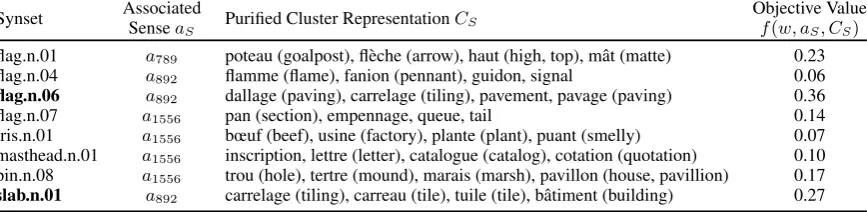
of such clusters for the French word dalle (flag-stone, slab) are provided in Table 3.
B.1 Word-Specific Threshold
One application of Linear-WSI is the creation of a word-specific thresholdαw to use in the
score-threshold method instead of a global cutoffα. We do this by using the quality of the sense clusterCS
of each candidate synsetSofwas an indicator of the correctness of that synset. Recalling that uS
is the synset representation ofS as a vector (see Section 3.2) and lettingfS =f(w, aS, CS)be the
objective value (2), we findαwas follows:
1. FindS∗= arg max
Sis a candidate ofwfS+uS·vw.
2. Letαw = min{α, uS∗·vw}.
As this modified threshold may be lower than more than one candidate synset ofwit allows for multiple synset matches even when no synset has score high enough to clear the thresholdα.
B.2 Sense-Agglomeration Procedure
We use Linear-WSI more explicitly through the sense-agglomeration procedure, which attempts to recover unmatched synsets using matched synsets sharing the same senseaiofw. We define the
clus-ter similarity ρ between word-clusters C1, C2 ⊂ V as the median of all cosine-similarities of pairs of words in their set product, i.e.
ρ(C1, C2) = Median{vx·vy :x∈C1, y ∈C2}.
Then we say that two clustersC1, C2aresimilarif
ρ(C1, C2)≥min{ρ(C1, C1), ρ(C2, C2)},
Synset AssociatedSensea
S Purified Cluster RepresentationCS
Objective Value
f(w, aS, CS)
flag.n.01 a789 poteau (goalpost), fl`eche (arrow), haut (high, top), mˆat (matte) 0.23
flag.n.04 a892 flamme (flame), fanion (pennant), guidon, signal 0.06
flag.n.06 a892 dallage (paving), carrelage (tiling), pavement, pavage (paving) 0.36
flag.n.07 a1556 pan (section), empennage, queue, tail 0.14
iris.n.01 a1556 bœuf (beef), usine (factory), plante (plant), puant (smelly) 0.07
masthead.n.01 a1556 inscription, lettre (letter), catalogue (catalog), cotation (quotation) 0.10
pin.n.08 a1556 trou (hole), tertre (mound), marais (marsh), pavillon (house, pavillion) 0.17
[image:12.595.83.517.63.169.2]slab.n.01 a892 carrelage (tiling), carreau (tile), tuile (tile), bˆatiment (building) 0.27 Table 3: Purified Synset Representations of dalle (flagstone, slab). Note how the correct candidate synsets (bolded) have clusters of words closely related to the correct meaning while the other clusters have many unrelated words, leading to lower objective values.
Then given a global low thresholdβ ≤α, for each sense ai in the sparse representation (1),
sense-agglomeration consists of the following algorithm: 1. LetMibe the set of candidate synsetsSofw
that haveaS =aiand score above the
thresh-oldαw. Stop ifMi=∅.
2. LetUibe the set of candidate synsetsSofw
that haveaS =aiand score below the
thresh-oldαw. Stop ifUi =∅.
3. For each synsetS ∈ Ui, ordered by
synset-score, check thatCS is similar (in the above
sense) to all clustersCS0 forS0∈Miand has
score higher thanβ. If both are true, addSto
Miand removeSfromUi. Otherwise stop.
The sense-agglomeration procedure allows an un-matched synsetSto be returned as a correct synset of w provided it shares a sense with a different matched synset S0 and satisfies cluster similarity