A Comparison of Weak Supervision methods for
Knowledge Base Construction
Ameet Soni
Department of Computer Science Swarthmore College [email protected]
Dileep Viswanathan
School of Informatics and Computing Indiana University
Niranjan Pachaiyappan School of Informatics and Computing
Indiana University [email protected]
Sriraam Natarajan
School of Informatics and Computing Indiana University
Abstract
We present a comparison ofweakanddistant supervision methods for producing proxy ex-amples for supervised relation extraction. We find that knowledge-based weak supervision tends to outperform popular distance supervi-sion techniques, providing a higher yield of positive examples and more accurate models.
1 Introduction
In performingrelation extractionin knowledge base population (KBP), the need for human-annotated examples (i.e., gold-standard) examples, is pro-hibitively expensive. One solution is to generate a set of so-calledsilver-standardexamples fromweak
ordistant supervisionmethods.
While several papers have demonstrated the ben-efits of using these approaches (Mintz et al., 2009; Riedel et al., 2010; Takamatsu et al., 2012), we are not familiar with any work that compares methods for generating weak labels for KBP. In this work, we seek to address the question of which weak su-pervision techniques provide the best basis for learn-ing accurate models and scale appropriately with the KBP task. We address two approaches:
• Distant supervision (DS) – this popular tech-nique entails referencing external knowledge bases, such as Freebase, as a source of seed facts. These facts are then linked to a cor-pus to identify positive training examples. We consider two variations for a corpus – extract-ing positive sentences from the actual train-ing/testing corpus (CDS) (i.e., newswire
doc-uments) versus using sentences from external data sources (EDS) (e.g., Wikipedia articles).
• Knowledge-based weak supervision (KWS) – Natarajan et al. (2014) showed that we can en-code the “world knowledge” of domain experts, who have some inherent rules for identifying positive training examples during manual an-notation (e.g., “home teams are more likely to win a game” for a sports corpus). Using these rules, we can automatically generate new posi-tive examples that simulate the human expert’s annotations in a training corpus.
In this paper, we present our approaches for gen-erating examples in further detail. We evaluate all three approaches on the TAC KBP corpus. We will also describe our pipeline, which utilizes relational dependency networks (RDNs) (Neville and Jensen, 2007; Natarajan et al., 2010). We note that the cen-tral focus of this paper is not to showcase RDNs for this task – that has been done in previous work – but rather to investigate weak supervision techniques.
Our results show that knowledge-based weak su-pervision is the preferred choice for producing train-ing examples when good rules are available, ap-proaching the accuracy of gold-standard data sets. This method produces examples at a higher rate than DS with fewer mislabels and is flexible to adapt to a diverse set of relations. Distant supervision tech-niques scale quicker and excel when domain knowl-edge is difficult to encode. However, they tend to yield fewer results and are not applicable when a rel-evant database does not already exist.
Figure 1:Full RDN relation extraction pipeline
2 The Relational Dependency Network Framework
In this work, we consider a framework for perform-ing learnperform-ing and inference from stochastic, noisy, relational data called Relational Dependency Net-works (RDNs) (Neville and Jensen, 2007; Natara-jan et al., 2010). RDNs extend dependency net-works (DN) (Heckerman et al., 2001) to the rela-tional setting. The key idea in a DN is to approxi-mate the joint distribution over a set of random vari-ables as a product of their marginal distributions, i.e., P(y1, ..., yn|X) ≈ QiP(yi|X). It has been
shown that employing Gibbs sampling in the pres-ence of a large amount of data allows this approx-imation to be particularly effective. Note that, one does not have to explicitly check for acyclicity mak-ing these DNs particularly easy to be learned.
In an RDN, typically, each distribution is repre-sented by a relational probability tree (RPT) (Neville et al., 2003). However, following previous work (Natarajan et al., 2010), we replace the RPT of each distribution with a set of relational regression trees (Blockeel and Raedt, 1998) built in a sequential manner i.e., replace a single tree with a set of gradi-ent boosted trees. This approach has been shown to have state-of-the-art results in learning RDNs and we adapted boosting to learn for relation extraction. Since this method requires negative examples, we created negative examples by considering all pos-sible combinations of entities that are not present in positive example set and sampled twice as many negatives as positive examples. We encourage the reader to refer to our previous work for in-depth de-tails on the RDN algorithm (Neville et al., 2003; Natarajan et al., 2010).
The entire algorithmic pipeline is summarized in
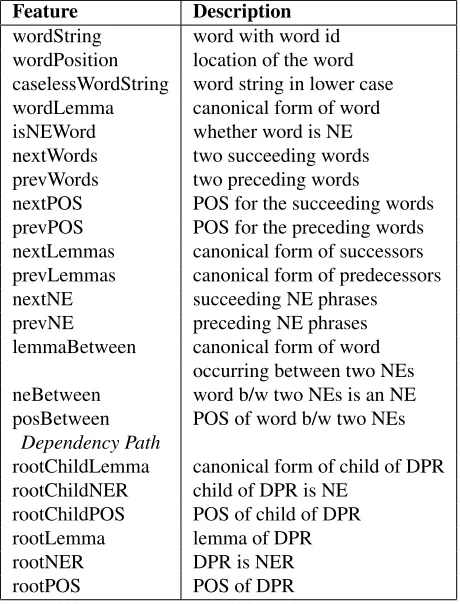
Feature Description
wordString word with word id wordPosition location of the word caselessWordString word string in lower case wordLemma canonical form of word isNEWord whether word is NE nextWords two succeeding words prevWords two preceding words
nextPOS POS for the succeeding words prevPOS POS for the preceding words nextLemmas canonical form of successors prevLemmas canonical form of predecessors nextNE succeeding NE phrases prevNE preceding NE phrases lemmaBetween canonical form of word
occurring between two NEs neBetween word b/w two NEs is an NE posBetween POS of word b/w two NEs
Dependency Path
rootChildLemma canonical form of child of DPR rootChildNER child of DPR is NE
rootChildPOS POS of child of DPR rootLemma lemma of DPR
rootNER DPR is NER
[image:2.612.313.543.55.357.2]rootPOS POS of DPR
Table 1:Features derived from the training corpus used by our learning system. POS - part of speech. NE - Named Entity. DPR - root of dependency path tree.
Figure 1. Given a training corpus of raw text doc-uments, our learning algorithm first converts these documents into a set of facts (i.e., features) that are encoded in first order logic (FOL). Raw text is pro-cessed using the Stanford CoreNLP Toolkit1
(Man-ning et al., 2014) to extract parts-of-speech, word lemmas, etc. as well as generate parse trees, depen-dency graphs and named-entity recognition informa-tion. The full set of extracted features is available in Table 1. These features are used to train our RDN model. For some (unlabeled) test corpus, the RDN model is utilized to perform inference and identify positive entities.
3 Weak Supervision Frameworks
We analyze two general types of weak supervision that have been successfully applied in other natural language tasks – distant supervision and knowledge-based weak supervision.
3.1 Distant supervision
Distant supervision entails the use of external knowledge (e.g., a database) to heuristically la-bel examples. Following standard procedure, we use three data sources – Never Ending Language Learner (NELL) (Carlson et al., 2010), Wikipedia Infoboxes and Freebase. For a given target rela-tion, we identify relevant database(s), where the en-tries in the database formentity pairs(e.g., an entry of (Barack Obama, Malia Obama) for a parent database) that will serve as a seed for positive train-ing examples. These pairs must then be mapped to
mentionsin our corpus – that is, we must find sen-tences in our corpus that contain both entities to-gether (Zhang et al., 2012). This process is done heuristically and is fraught with potential errors and noise (Riedel et al., 2010).
We identify two methods for mapping entities to mentions to create positive training examples. The first maps entity pairs to sentences in a training cor-pus native to our test domain (e.g., TAC KBP 2014). We refer to this as Corpus Distant Supervision, or
CDS. This has the advantage of providing examples that are similar to the problem at hand and closer to the test queries. However, this can potentially omit thousands of example mentions that occur in a dif-ferent context than the training corpus (e.g., a corpus of business articles will not contain matches to ac-tors or sports players). As a result, most entity pairs in a database will fail to map to a corpus (while oth-ers may have several mappings).
To overcome this limitation, we alternatively map entity pairs to mentions in their corresponding Wikipedia article(s). By scraping these articles for relevant sentences, we hypothesize that we can de-tect a higher hit rate for each database entry. Any sentence containing the relevant entity pair is pro-cessed as a positive training example for our learn-ing algorithm. We will refer to this technique as
EDSfor external-text distant supervision.
3.2 Knowledge-based weak supervision
While the literature supports distant supervision as a viable alternative, the quality of the generated labels is crucially dependent on the heuristic that is being used to map the relations to the knowledge base. As noted by Riedel et al. (2010), the distant supervision
assumption can be too strong, particularly when the source used for labeling the examples is external to the learning task at hand.
Natarajan et al. (2014) proposed work based on the following insight: labels are typically created by “domain experts” who annotate the labels care-fully, and who typically employ some inherent rules in their mind to create examples. For instance, con-sider identifying a person’s family relationship from news articles. We may have an inductive bias to-wards believing two persons in a sentence with the same last name are related, or that the words “son” or “daughter” are strong indicators of a parent rela-tion. We call thisworld knowledge as it describes the domain (or the world) of the target relation. We aim to use such knowledge to create examples for learning from text.
To this effect, we encode the domain expert’s knowledge in the form of first-order logic rules with accompanying weights to indicate the expert’s confidence. We use the probabilistic logic for-malism Markov Logic Networks (Domingos and Lowd, 2009) to perform inference on unlabeled text (e.g., the TAC KBP corpus). Potential entity pairs from the corpus are queried to the MLN, yielding (weakly-supervised) positive examples. We choose MLNs as they permit domain experts to easily write rules while providing a probabilistic framework that can handle noise, uncertainty, and preferences while simultaneously ranking positive examples.
In our experiments, we found that the difference between multiple weight settings do not affect the results as long as the ordering between the rules is maintained – only the scale of the probabilities varies. We use the Tuffy system (Niu et al., 2011) to perform inference. The inference algorithm imple-mented inside Tuffy appears to be robust and scales well to millions of documents2.
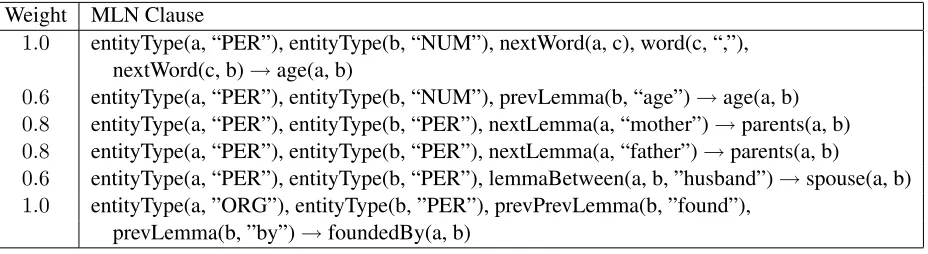
For the KBP task, some rules that we used are shown in Table 2. For example, the first rule identi-fies any number following a person’s name and sep-arated by a comma is likely to be the person’s age (e.g., “Sharon, 42”). The third and fourth rule pro-vide examples of rules that utilize more textual fea-tures; these rules state the appearance of the lemma
2As the structure and weights are pre-defined by the expert,
Weight MLN Clause
1.0 entityType(a, “PER”), entityType(b, “NUM”), nextWord(a, c), word(c, “,”), nextWord(c, b)→age(a, b)
0.6 entityType(a, “PER”), entityType(b, “NUM”), prevLemma(b, “age”)→age(a, b)
0.8 entityType(a, “PER”), entityType(b, “PER”), nextLemma(a, “mother”)→parents(a, b)
0.8 entityType(a, “PER”), entityType(b, “PER”), nextLemma(a, “father”)→parents(a, b)
0.6 entityType(a, “PER”), entityType(b, “PER”), lemmaBetween(a, b, ”husband”)→spouse(a, b)
[image:4.612.77.541.54.181.2]1.0 entityType(a, ”ORG”), entityType(b, ”PER”), prevPrevLemma(b, ”found”), prevLemma(b, ”by”)→foundedBy(a, b)
Table 2:A sample of knowledge-based rules for weak supervision. The first value defines a weight, or confidence in the accuracy of the rule. The target relation appears at the end of each clause. “PER”, “ORG”, “NUM” represent entities that are persons, organizations, and numbers, respectively.
“mother” or “father” between two persons is indica-tive of a parent relationship (e.g.,“Malia’s father, Barack, introduced her...”).
4 Experiments and Results
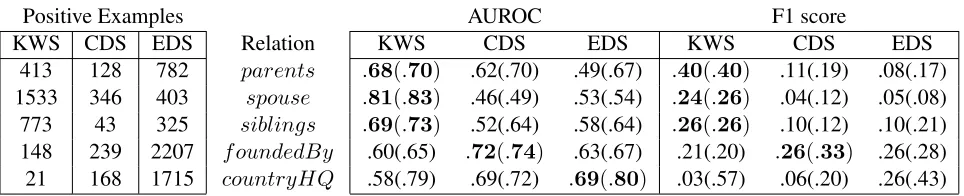
We consider five TAC KBP relations from two cat-egories, person and organization, chosen based on prior work for TAC KBP 2015. The relations are listed in the middle of Table 3 along with the counts of number of positives retrieved by each method (left). The TAC KBP 2014 corpus is used for train-ing (or Wikipedia articles as is the case for EDS) while TAC KBP 2015 is used for testing. Another relation,age, is omitted from the results since a cor-responding database is not available for distant su-pervision.
In our experiments, Freebase yields entity pairs for three out of the five relations (siblings,
spouse, and foundedBy) while Wikipedia In-foboxes provides entity pairs for the parents and
countryOfHeadquarters(countryHQfor short) relations. NELL is utilized to supplement mentions forsiblings. For KWS, a range of 4 to 8 rules are derived for each relation; only 5% of the training corpus was queried to generate KWS examples due – this proved sufficient for most relations although the number could easily be expanded as part of fu-ture work. Additionally, only the first 500 examples are actually utilized from Table 3. Performing larger runs is part of work in progress.
The results are obtained from averaging 5 differ-ent runs for each condition/relation. Across the runs, the test set is constant but the training set is sub-sampled with 75% membership to create more
ro-bust estimates of performance. The results are pre-sented in right table of Table 3. We consider two standard metrics - area under the ROC curve and F1 score3. Table 3 also includes results after
supple-menting each weak/distant supervision with a small set (20) of gold-standard examples.
5 Discussion and Conclusions
Our experiments indicate strengths and weaknesses for each approach. The KWS framework, in gen-eral, outperforms the other methods in both metrics for the person relations, while being comparable for
countryHQ. The tables do not even include age, the top performer for KWS. In fact, for several of the relations, the AUROC and F1 score approach or im-prove upon results when using a large, gold-standard training set (with the exception offoundedBy). For person relations, it produces more examples than ei-ther DS method, despite using only a fraction of the corpus. KWS struggles with creating good positive examples in our two organization relations, although it performed fairly similarly for headquarters despite limited examples. This was largely due to our inabil-ity to write discriminating rules that both achieves high recall and few false positives, demonstrating one drawback to the approach – the need for good (and formalisable) world knowledge.
Distant supervision did well where databases were easy to map – particularly, the organization re-lations andparents. There is no discernible differ-ence between CDS and EDS, meaning that we
can-3Other metrics (e.g., accuracy, recall, AUPR) agree with the
Positive Examples AUROC F1 score
[image:5.612.72.554.54.152.2]KWS CDS EDS Relation KWS CDS EDS KWS CDS EDS 413 128 782 parents .68(.70) .62(.70) .49(.67) .40(.40) .11(.19) .08(.17) 1533 346 403 spouse .81(.83) .46(.49) .53(.54) .24(.26) .04(.12) .05(.08) 773 43 325 siblings .69(.73) .52(.64) .58(.64) .26(.26) .10(.12) .10(.21) 148 239 2207 foundedBy .60(.65) .72(.74) .63(.67) .21(.20) .26(.33) .26(.28) 21 168 1715 countryHQ .58(.79) .69(.72) .69(.80) .03(.57) .06(.20) .26(.43)
Table 3: LEFTNumber of positive examples produced by each method per relation. The first three relations are person re-lations (per) while the last two describe organizations (org). RIGHTArea under the ROC curve (AUROC) and F1 measures for knowledge-based weak supervision (KWS), corpus distant supervision (CDS) and external source distant supervision (EDS). Numbers in parentheses are the results with 20 gold-standard examples. Emphasis indicates best performance for that relation.
not verify our hypothesis one way or the other (al-though the native corpus does slightly better in F1). This does give evidence that EDS is potentially use-ful when a large native corpus is not available for a task. If a large database exists with simple mapping heuristics, it can yield a large number of examples and perform well. Distant supervision is computa-tionally faster and can easily scan an entire corpus, but MLNs yield a higher rate of positives and require less overhead.
Current efforts aim to expand upon these initial results by analyzing more relations (e.g., all 31 from TAC KBP) as well as by extending to other KB tasks such as medical abstract analysis. Furthermore, we were limited to only utilizing 5% of the corpus for KWS; an interesting question is whether there is a cap on the number of positives needed for good performance. Lastly, an interesting avenue of fu-ture work is whether the various weak supervision techniques can be combined together to achieve a more heterogeneous set of training examples. We hypothesize the data-centric approach of distant su-pervision would combine well with the knowledge-centric approach of KWS to achieve accuracies su-perior to even a large gold-standard set.
References
[Blockeel and Raedt1998] H. Blockeel and L. De Raedt. 1998. Top-down induction of first-order logical deci-sion trees.Artificial intelligence, 101(1):285–297. [Carlson et al.2010] A. Carlson, J. Betteridge, B. Kisiel,
B. Settles, E. Hruschka Jr., and T.Mitchell. 2010. To-ward an architecture for never-ending language learn-ing. InProceedings of the Twenty-Fourth Conference on Artificial Intelligence (AAAI).
[Domingos and Lowd2009] P. Domingos and D. Lowd. 2009.Markov Logic: An Interface Layer for AI. Mor-gan & Claypool, San Rafael, CA.
[Heckerman et al.2001] D. Heckerman, D. Chickering, C. Meek, R. Rounthwaite, and C. Kadie. 2001. De-pendency networks for inference, collaborative filter-ing, and data visualization.Journal of Machine Learn-ing Research, pages 49–75.
[Manning et al.2014] C. Manning, M. Surdeanu, J. Bauer, J. Finkel, S. Bethard, and D. McClosky. 2014. The Stanford CoreNLP natural language processing toolkit. In Proceedings of 52nd Annual Meeting of the Association for Computational Linguistics: System Demonstrations, pages 55–60.
[Mintz et al.2009] M. Mintz, S. Bills, R. Snow, and D. Ju-rafsky. 2009. Distant supervision for relation extrac-tion without labeled data. InProceedings of the Joint Conference of the 47th Annual Meeting of the ACL and the 4th International Joint Conference on Natural Lan-guage Processing of the AFNLP: Volume 2 - Volume 2. [Natarajan et al.2010] S. Natarajan, T. Khot, K. Kersting, B. Gutmann, and J. Shavlik. 2010. Boosting relational dependency networks. In Proceedings of the Inter-national Conference on Inductive Logic Programming (ILP).
[Natarajan et al.2014] S. Natarajan, J. Picado, T. Khot, K. Kersting, C. Re, and J. Shavlik. 2014. Effectively creating weakly labeled training examples via approxi-mate domain knowledge. InInternational Conference on Inductive Logic Programming.
[Neville and Jensen2007] J. Neville and D. Jensen. 2007. Relational dependency networks. In Introduction to Statistical Relational Learning. MIT Press.
[Niu et al.2011] F. Niu, C. R´e, A. Doan, and J. W. Shav-lik. 2011. Tuffy: Scaling up statistical inference in Markov logic networks using an RDBMS. Proceed-ings of Very Large Data Bases (PVLDB), 4(6):373– 384.
[Riedel et al.2010] S. Riedel, L. Yao, and A. McCallum. 2010. Modeling relations and their mentions without labeled text. In Proceedings of the 2010 European conference on Machine learning and knowledge dis-covery in databases (ECML KDD).
[Takamatsu et al.2012] S. Takamatsu, I. Sato, and H. Nak-agawa. 2012. Reducing wrong labels in distant super-vision for relation extraction. In Proceedings of the Association for Computational Linguistics (ACL). [Zhang et al.2012] C. Zhang, F. Niu, C. R´e, and J.