Multi Sense Embeddings from Topic Models
Shobhit Jain Amazon Web Services [email protected]
Sravan Babu Bodapati Amazon Web Services [email protected]
Ramesh Nallapati Amazon Web Services [email protected]
Abstract
Distributed word embeddings have yielded state-of-the-art performance in many NLP tasks, mainly due to their success in captur-ing useful semantic information. These repre-sentations assign only a single vector to each word whereas a large number of words are pol-ysemous (i.e., have multiple meanings). In this work, we approach this critical problem in lexical semantics, namely that of represent-ing various senses of polysemous words in vector spaces. We propose a topic modeling based skip-gram approach for learning multi-prototype word embeddings. We also intro-duce a method to prune the embeddings de-termined by the probabilistic representation of the word in each topic. We use our embed-dings to show that they can capture the context and word similarity strongly and outperform various state-of-the-art implementations.
1 Introduction
Representing words as dense, low dimensional em-beddings (Mikolov et al., 2013a,b; Pennington et al., 2014) allow the representations to capture useful syntactic & semantic information making them useful in downstream Natural Language Pro-cessing tasks. However, these embedding models ignore the lexical ambiguity among different mean-ings of the same word. They assign only a single vector representative of all the different meanings of a word. In this work, we attempt to address this problem by capturing the multiple senses of a word using the global semantics of the document in which the word appears.Li and Jurafsky(2015) indicated that such sense specific vectors improve the performance of applications related to semantic understanding, such as Named Entity Recognition, Part-Of-Speech tagging.
In this work, we first train a topic model on our corpus to extract the topic distribution for each doc-ument. We treat these extracted topics as a heuristic
to model word senses. We hypothesize that these word senses correlate quite well with the human notion of word senses, and validate it through our rigorous experiments as we demonstrate in our re-sults section. We then use this topic distribution to train sense-specific word embeddings for each sense. We train these embeddings by weighing the learning procedure in proportion to the corre-sponding topic representation for each document. However, a word need not strongly correlate with each of these extracted senses. To address it, we propose a variant of this model which restricts the learning to only those embeddings where the word has a strong correlation with the topic extracted, i.e., highp(word|topic).
The major contributions of our work are (i) train-ing multi-sense word embeddtrain-ings based on struc-tured skip gram using topic models as a precursor (ii) non-parametric approach which prunes the em-beddings to capture variability in the number of word senses.
2 Prior Work
capturing word interactions in a broader document-level context.
AutoExtend (Rothe and Sch¨utze,2015), Sensem-bed (Iacobacci et al., 2015), Nasari (Camacho-Collados et al.,2016), Deconf (Pilehvar and Col-lier,2016),Chen et al.(2014);Jauhar et al.(2015); Pelevina et al. (2017) have used multi-step ap-proach to learn sense & word embeddings but re-quire an external lexical database like WordNet to achieve it. SW2V(Mancini et al.,2016) train the embeddings in a single joint training phase. Nonetheless, all these methods assign same weight to every sense of a word, ignoring the extent to which each sense is associated with it’s context.
MSWE (Nguyen et al.,2017) trained sense and word embeddings separately, with sense specific word embeddings computed as a weighted sum of the two, where the weights are calculated using topic modeling. Similarly, Liu et al. (2015a,b); Cheng et al. (2015); Zhang and Zhong (2016) used skip-gram based approach to obtain separate word & topic embeddings. Lau et al.(2013) also used topic models to distinguish between different senses of a word. All these techniques express the sense-specific word representation as a function of word & sense embeddings which essentially be-longs to two different domains. Our work trains more robust compositional word embeddings for-mulated as a weighted sum of sense specific word embeddings, thus, taking into consideration all the different word senses while operating in the same vector space.
More recent techniques like ELMo (Peters et al., 2018), BERT (Devlin et al., 2018) compute the contextual representations of a word based on the sentence in which the word appears, whereas, our method yields precomputed embeddings for each sense of a word within the same vector space.
3 Multi Sense Embeddings Model
3.1 Topic Modeling
[image:2.595.308.519.62.204.2]Mixed membership models like topic models allow us to discover topics that occur in a collection of documents. Atopicis defined as a distribution over words and consists of cluster of words that occur frequently. This formulation benefits us in infer-ring the probability distribution over different con-texts(topics) the word can occur in. Latent Dirichlet Allocation(LDA) (Blei et al.,2003) is a topic mod-eling technique that assigns multiple topics in dif-ferent proportions to each document along with the
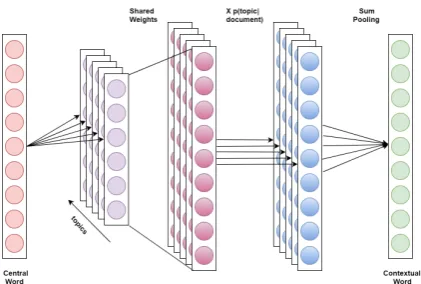
Figure 1: We feed our model a central word as input and predict the context word from it. First we learn separate word embeddings corresponding to each topic, Ewt,zi. Each of these embeddings are then multiplied
with global word embeddings,vg(w), weighed in
pro-portion to the topic distribution of the document from which the words have been chosen, and summed up to predict the neighboring context word.
probability distribution over words for each of the topics. Topic models based on Gibbs Sampling (Ge-man and Ge(Ge-man,1987) achieve this by computing the posterior for a word based on the topic pro-portion at document level coupled with how often the word appears together with other words in the topic. We use Gibbs Sampling based approach to compute the topic distribution for each document. We use the LDA implementation from MALLET topic modelingtoolkit (McCallum,2002) for our experiments.
3.2 Embeddings from Topic Models (ETMo)
In this section we present our baseline approach for training sense-specific word embeddings. We for-mulate our approach as follows. LetEw ∈Rk×n
represent the embedding matrix for wordw, where kis the number of topics(treated as number of word senses) andnis the dimensionality of embeddings. We represent the embedding of wordw correspond-ing to topiczi asEw,zi. Letvg(w) be theoutput vector representation for wordw, which is shared across senses, and enforces the embeddings of dif-ferent senses to be within the same vector space.
central wordwtfor a documentdas:
p(wt+j|wt, d) = k
X
i=1
p(wt+j|wt, zi, d)∗p(zi|d)
(1)
p(zi|d)represents the topic distribution of the
doc-umentd, obtained from the trained topic model. In the above equation, we reasonably make the as-sumption,p(zi|wt, d)=p(zi|d), owing to the fact
that the topic distribution is computed at the doc-ument level. Using Negative Sampling (Mikolov et al.,2013b), we reduce the first term in the above equation as:
p(wt+j|wt, zi) =
σ(Ewt,zi∗vg(wt+j)) +
X
w∈S
σ(−Ewt,zi∗vg(w))
(2)
Formally, given a large corpus of docu-ments, with size D, having a words sequence w1, w2, ..., wNd−1, wNd, whereNdis the number of words in documentd, skip-window sizec, num-ber of topicsk, the objective is to maximize the following log likelihood:
L=
D
X
d=1
Nd
X
t=1
c
X
j=−c
log p(wt+j|wt, d) =
D
X
d=1
Nd
X
t=1
c
X
j=−c
log
k
X
i=1
p(wt+j|wt, zi, d)∗p(zi|d)
(3)
As shown in Figure 1, we use a neural network architecture to compute the log likelihood. We feed the central word, in its BoW representation, as input to the model and compute the probability of the context word. Refer to the figure for detailed explanation.
During inference, we first compute the topic dis-tribution for the given document,p(zi|d), using our
pre-trained topic model. Finally, for a documentd and for each wordw, we infer the word embedding as:
vw,d= k
X
i=1
p(zi|d)∗Ew,zi (4)
Model avgSim globalSim
GloVe - 63.2
(Pennington et al.,2014)
Huang et al.(2012) 64.2 71.3
csmRNN - 64.58
(Luong et al.,2013)
GC-SINGLE 62.3
-(Jauhar et al.,2015)
NP-MSSG 69.1 68.6
(Neelakantan et al.,2015)
MSWE-I - 72.40
(Nguyen et al.,2017)
Gensense 54.0
-(Lee et al.,2018)
ETMo (Ours) 68.5 68.2
[image:3.595.306.521.61.272.2]ETMo + NP (Ours) 69.3 69.1
Table 1: Spearman’s correlationρ×100on WS-353
3.3 ETMo + Non-parametric
In this section, we substantiate the flaws in our baseline approach and present our non-parametric method to learn the embeddings.
Our previous approach assigns an embedding to every word corresponding to each topic. As one can see, this method would undesirably accumu-late a fair amount of noisy updates to those word embeddings that have minimal representation in a topic. Hence, we extend our model by exploiting the information from topic models to learn only those embeddings where the word has a strong cor-relation with the topic.
In particular, we train only those embeddingEwt,zi such thatp(wt|zi)> pthres, wherepthresis chosen
empirically, which we will explain later. For the words where none of the senses satisfy the above condition (might be the case for some monose-mous words), we chose the embeddingEwt,xto be trained, such thatx= argmaxzip(wt|zi).
4 Experimental Setup
embed-Model avgSim avgSimC
TF-IDF 60.4
-Huang et al.(2012) 62.8 65.7 Tian et al.(2014) - 65.4 Chen et al.(2014) 66.2 68.9 Cheng et al.(2015) - 65.9
GC-MULTI - 65.9
(Jauhar et al.,2015)
SENSEMBED 62.4
-(Iacobacci et al.,2015)
SaSA - 66.4
(Wu and Giles,2015)
TWE-I (Liu et al.,2015b) - 68.1
NP-MSSG 67.2 69.3
(Neelakantan et al.,2015)
SG+Greedy - 69.1
(Li and Jurafsky,2015)
MSWE 66.7 66.6
(Nguyen et al.,2017)
ETMo (Ours) 65.4 65.8
[image:4.595.321.512.61.145.2]ETMo + NP (Ours) 67.5 69.1
Table 2: Spearman’s correlationρ×100on SCWS
dings for a word using topic models and demon-strate the strength of our model empirically.
The raw dataset consists of nearly 3.2 million documents and 1 billion tokens. Training topic models on such a large and diverse corpus helps in obtaining clearly demarcated senses for each topic.
To tune the hyper parameters of our neural net-work model, we sample 20% of our corpus as val-idation data and chose those parameters that give the lowest validation loss. Later, we use these pa-rameter values for training on the entire corpus. For all our experiments, we use a skip-window of size 2, 8 negative samples, embeddings of dimension-ality 200, and fix the number of topics to 10. A detailed analysis on how we chose the number of topics, using perplexity score, can be found later in the analysis section. We initialize the embeddings using pre-trained GloVe embeddings to ensure all our target embeddings are in the same vector space. We choose the value forpthresas 1e-4 and give an
analysis on how we chose the parameter value in the results section.
5 Results
We evaluate our model on two tasks, namely, word similarity and word analogy. For word similarity evaluation, we evaluate our embeddings on stan-dard word similarity benchmark datasets including WS-353 (Finkelstein et al.,2001) & SCWS-2003 (Huang et al.,2012). WS-353 includes 353 pairs
Model Accuracy(%)
Word2Vec 67
Huang et al.(2012) 12
Neelakantan et al.(2015) 64
ETMo (Ours) 67
ETMo + NP (Ours) 66
Table 3: Results on Word Analogy task
of words and a human judgment score of the simi-larity measure between the two words. Similarly, SCWS-2003 consists of 2003 pairs of words, but, given with a context.
We note that our embeddings can capture only those senses that are represented by the extracted topics, and due to the restricted number of topics extracted, they might not be able to capture all the senses for a word. However, at a specific number of topics, our model is effective in capturing var-ious senses of words in standard word similarity datasets. We demonstrate this effect qualitatively and quantitatively in this section.
For each of the datasets, we report the Spearman correlation between the human judgment score and model’s similarity score computed between two wordswandw0. We followReisinger and Mooney (2010) to compute the following similarity mea-sures. For a pair of words w and w0 and given their respective contextscandc0, we represent the cosine distance between the embeddingsEw,iand
Ew0,j asd(Ew,i, Ew0,j).
globalSim=d(vg(w),)
avgSim= 1
N1∗N2
N1 X
i=1
N2 X
j=1
d(Ew,i, Ew0,j)
avgSimC =
N1 X
i=1
N2 X
j=1
p(zi|c)∗p(zj|c0)∗
d(Ew,i, Ew0,j)
(5)
N1 and N2 are chosen such that they satisfy
p(wt|zi) > pthres. vg(w) represents the output
vector for wordw, as mentioned in section3.2. We infer the probabilities,p(zi|c)&p(zj|c0)using our
pre-trained topic model.
[image:4.595.314.528.499.609.2]on the avgSimC metric as well.
5.1 Quantitative Results
We present the results of our approach in Tables1 and2. A higher Spearman’s correlation translates to a better model.
As can be seen in Table1, our non-parametric approach clearly outperforms other multi-sense em-beddings models using theavgSimmetric on WS-353. Further, though our method focusses on sense specific embeddings and not on the global word embeddings, for the purpose of completeness, we also report our results on theglobalSimmetric. Us-ingglobalSim, expectedly we obtain slightly lower results sinceglobalSimis more suited for global word embeddings.
In Table2, we compare our models on the SCWS dataset. UsingavgSim metric, our model obtain state-of-the-art results, outperforming other embed-dings model. Using theavgSimCmetric, we pro-duce competitive results and perform better than most of the models, includingNguyen et al.(2017) which also uses topic models.
These superior results indicate the usefulness of our method to accurately capture word represen-tations that can take into account different word senses. Additionally, our non-parametric approach consistently outperforms our baseline ETMo ap-proach, validating our hypothesis to threshold the topics.
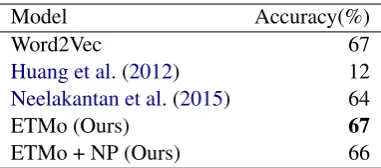
We also evaluate our model on the word anal-ogy task (Mikolov et al.,2013a). 1 Our answer is correct if this word matches the correct word given in the dataset. As can seen in Table3, our ETMo approach obtains similar results as the baseline word2vec model, and we beat other implementa-tions.
5.2 Qualitative Comparison
We show a qualitative comparison of some polyse-mous words in Table4, with the nearest neighbors of words in the table, for Glove embeddings and the embeddings trained from our model. For each of the words in Table4, we can clearly see that the different senses of words are being effectively captured by our model whereas Glove embeddings could only capture most frequently used meaning
1
The word analogy task aims to answer the question of the form:a is to b as c is to ?. To answer the question, we compute the word vector nearest to ‘vg(b)−vg(a) +vg(c)’, where
vg(w)represents theoutputvector for wordw, as mentioned
in section3.2.
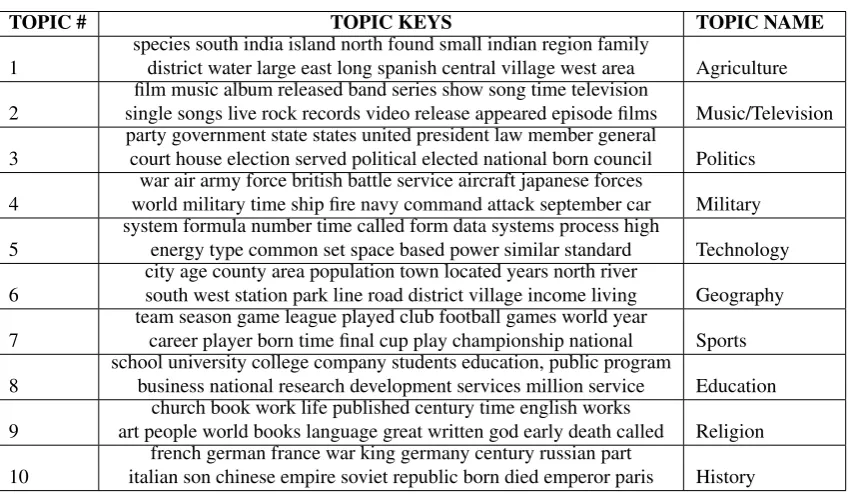
for the word. Moreover, each of these senses can be easily correlated with the topic that these embed-dings correspond to which can be seen from Table 5. Consider the word Play. The first sense for playcorresponds toMusic(topic 2). The second embedding corresponds toSports(topic 7).
An interesting qualitative result is shown for the word Network. The nearest neighbors to Glove embeddings show that they are only able to capture one meaning which is in the subject ofTelevision Network. However, our model is able to capture 3 different meanings for the word quite powerfully. The first one, which corresponds to topic 2, occurs in the context ofTelevision Networkwhich is the sense Glove was able to capture. The second sense, which corresponds to topic 5, occurs in the context of Computer Networks. The third sense, which corresponds to topic 6, remarkably relates to the contextGeography.
5.3 Number of Topics Analysis
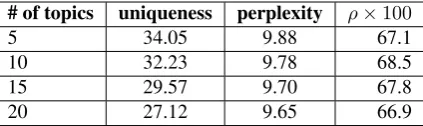
In this section, we perform a study on choosing the right number of topics(k) in Table 6. Here, topic uniqueness refers to the proportion of unique words in a topic, computed over the top words in the vocabulary. Higher the topic uniqueness score, more distinct are the obtained topics. We compute the Spearman correlation on theavgSimmetric us-ing the word pairs from RG-65 (Rubenstein and Goodenough,1965). With k = 10, we obtained a topic uniqueness of32.23, which dropped to27.12
for k=20 topics. Thus increasing the number of topics increases overlap which harms our model as the topic weight gets divided while training the embeddings. This effect can be clearly seen in the correlation coefficient which drops from 68.5to
66.9for 10 & 20 topics respectively. Using k=5 improved the topic uniqueness score to34.05, but the perplexity score (Blei et al.,2003) reduced, in-dicating that the topic model requires more degrees of freedom to fit the corpus. We also observed not very distinct topics at k=5 (i.e. a topic could be mixture of sports and history), resulting in reduced correlation coefficient of67.1.
5.4 Threshold Parameter Analysis
In this section, we study the effect ofpthreson the
Word Topic # Nearest Neighbors
Glove playing, played, plays, game, players, player, match, matches, games
play 2 played. performance, musical, performed, plays, stage, release, song, work, time 7 season, players, played, one, game, first, football, teams, last, year, clubs
Glove band, punk, pop, bands, album, rocks, music, indie, singer, albums, songs, rockers rock 2 metal, pop, punk, members, jazz, alternative, indie, folk, band, hard, recorded, blues
6 island, point, valley, hill, large, creek, granite, railroad, river, lake
Glove banks, banking, central, credit, bankers, financial, investment, lending, citibank bank 6 river, tributary, flows, valley, side, banks, mississippi, south, north, mouth, branch
8 company, established, central, first, group, one, investment, organisation, development Glove plants, factory, facility, flowering, produce, reactor, factories, production
plant 1 plants, bird, genus, frog, rodent, flowering, fish, species, tree, endemic, asteraceae 5 design, plants, modern, power, process, technology, standard, substance, production Glove wars, conflict, battle, civil, military, invasion, forces, fought, fighting, wartime war 4 combat, first, world, army, served, american, battle, civil, outbreak, forces
7 series, championship, cup, fifa, champion, chess, records, wrestling, championships Glove cable, channel, television, broadcast, internet, stations, programming, radio
[image:6.595.74.526.95.345.2]network 2 series, program, shows, bbc, broadcast, station, channel, aired, nbc, radio, episode 5 data, information, computer, system, applications, technology, control, standard, design 6 light, station, car, stations, railway, commuter, lines, rail, trains, commute
Table 4: Nearest neighbours of some polysemous words for Glove, and for each sense identified by our algorithm, based on the cosine similarility. We take only those senses corresponding to topics wherep(wt|j)> pthres.
TOPIC # TOPIC KEYS TOPIC NAME
1
species south india island north found small indian region family
district water large east long spanish central village west area Agriculture
2
film music album released band series show song time television
single songs live rock records video release appeared episode films Music/Television
3
party government state states united president law member general
court house election served political elected national born council Politics
4
war air army force british battle service aircraft japanese forces
world military time ship fire navy command attack september car Military
5
system formula number time called form data systems process high
energy type common set space based power similar standard Technology
6
city age county area population town located years north river
south west station park line road district village income living Geography
7
team season game league played club football games world year
career player born time final cup play championship national Sports
8
school university college company students education, public program
business national research development services million service Education
9
church book work life published century time english works
art people world books language great written god early death called Religion
10
french german france war king germany century russian part
italian son chinese empire soviet republic born died emperor paris History
[image:6.595.88.515.457.704.2]# of topics uniqueness perplexity ρ×100
5 34.05 9.88 67.1
10 32.23 9.78 68.5
15 29.57 9.70 67.8
[image:7.595.76.288.62.125.2]20 27.12 9.65 66.9
Table 6: effect of number of topics on Spearman corre-lation on 50 word pairs from WordSim-353
pthres ρ×100 senses captured fornetwork
1e-3 68.3 television, IT
1e-4 69.1 television, IT, transportation 1e-5 68.4 mixed senses
Table 7: Spearman’s correlationρ×100on 50 word pairs from WS-353 and the word senses captured for
network. The word senses are adjudged qualitatively.
of topic modeling, particularlyp(word|topic), and thus is independent of the this chosen subset, as can be seen in the results on other datasets. In Table 7, we can see that the optimal value forpthresis
1e-4 for the non-parametric model at which it can strongly differentiate between the different senses fornetwork. A higher threshold value of 1e-3 cap-tures a fewer number of senses. A lower threshold value of 1e-5 allows training of more than the ac-tual number of true senses leading to noisy updates, thus becoming ineffective in capturing any sense. The corresponding lower correlation coefficients in Table7confirm these effects quantitatively.
6 Conclusion & Future Work
In this work, we presented our approach to learn word embeddings to capture the different senses of a word. Unlike previous sense-based models, our model exploits knowledge from topic modeling to induce mixture weights in structured skip-gram approach, for learning sense specific representa-tions. We extend this model further by pruning the embeddings conditioned on the number of word senses. Finally, we showed our model achieves state-of-the-art results on word similarity tasks, and demonstrated the strength of our model in captur-ing multiple word senses qualitatively. Future work should aim towards using these embeddings for downstream tasks.
References
David M Blei, Andrew Y Ng, and Michael I Jordan. 2003. Latent dirichlet allocation. Journal of ma-chine Learning research, 3(Jan):993–1022.
Jos´e Camacho-Collados, Mohammad Taher Pilehvar, and Roberto Navigli. 2016. Nasari: Integrating ex-plicit knowledge and corpus statistics for a multilin-gual representation of concepts and entities. Artifi-cial Intelligence, 240:36–64.
Xinxiong Chen, Zhiyuan Liu, and Maosong Sun. 2014. A unified model for word sense representation and disambiguation. In Proceedings of the 2014 Con-ference on Empirical Methods in Natural Language Processing (EMNLP), pages 1025–1035.
Jianpeng Cheng, Zhongyuan Wang, Ji-Rong Wen, Jun Yan, and Zheng Chen. 2015. Contextual text under-standing in distributional semantic space. In Pro-ceedings of the 24th ACM International on Confer-ence on Information and Knowledge Management, pages 133–142. ACM.
Jacob Devlin, Ming-Wei Chang, Kenton Lee, and Kristina Toutanova. 2018. Bert: Pre-training of deep bidirectional transformers for language understand-ing.arXiv preprint arXiv:1810.04805.
Lev Finkelstein, Evgeniy Gabrilovich, Yossi Matias, Ehud Rivlin, Zach Solan, Gadi Wolfman, and Ey-tan Ruppin. 2001. Placing search in context: The concept revisited. InProceedings of the 10th inter-national conference on World Wide Web, pages 406– 414. ACM.
Stuart Geman and Donald Geman. 1987. Stochas-tic relaxation, gibbs distributions, and the bayesian restoration of images. InReadings in computer vi-sion, pages 564–584. Elsevier.
Eric H Huang, Richard Socher, Christopher D Man-ning, and Andrew Y Ng. 2012. Improving word representations via global context and multiple word prototypes. InProceedings of the 50th Annual Meet-ing of the Association for Computational LMeet-inguistics: Long Papers-Volume 1, pages 873–882. Association for Computational Linguistics.
Ignacio Iacobacci, Mohammad Taher Pilehvar, and Roberto Navigli. 2015. Sensembed: Learning sense embeddings for word and relational similarity. In
Proceedings of the 53rd Annual Meeting of the Asso-ciation for Computational Linguistics and the 7th In-ternational Joint Conference on Natural Language Processing (Volume 1: Long Papers), volume 1, pages 95–105.
Sujay Kumar Jauhar, Chris Dyer, and Eduard Hovy. 2015. Ontologically grounded multi-sense represen-tation learning for semantic vector space models. In
Jey Han Lau, Paul Cook, and Timothy Baldwin. 2013. unimelb: Topic modelling-based word sense induc-tion for web snippet clustering. In Second Joint Conference on Lexical and Computational Seman-tics (* SEM), Volume 2: Proceedings of the Seventh International Workshop on Semantic Evaluation (Se-mEval 2013), volume 2, pages 217–221.
Yang-Yin Lee, Ting-Yu Yen, Hen-Hsen Huang, Yow-Ting Shiue, and Hsin-Hsi Chen. 2018. Gensense: A generalized sense retrofitting model. InProceedings of the 27th International Conference on Computa-tional Linguistics, pages 1662–1671.
Jiwei Li and Dan Jurafsky. 2015. Do multi-sense em-beddings improve natural language understanding?
arXiv preprint arXiv:1506.01070.
Pengfei Liu, Xipeng Qiu, and Xuanjing Huang. 2015a. Learning context-sensitive word embeddings with neural tensor skip-gram model. In Twenty-Fourth International Joint Conference on Artificial Intelli-gence.
Yang Liu, Zhiyuan Liu, Tat-Seng Chua, and Maosong Sun. 2015b. Topical word embeddings. In AAAI, pages 2418–2424.
Thang Luong, Richard Socher, and Christopher Man-ning. 2013. Better word representations with re-cursive neural networks for morphology. In Pro-ceedings of the Seventeenth Conference on Computa-tional Natural Language Learning, pages 104–113.
Massimiliano Mancini, Jose Camacho-Collados, Igna-cio Iacobacci, and Roberto Navigli. 2016. Em-bedding words and senses together via joint knowledge-enhanced training. arXiv preprint arXiv:1612.02703.
Andrew Kachites McCallum. 2002. Mallet: A machine learning for language toolkit. Http://mallet.cs.umass.edu.
Tomas Mikolov, Kai Chen, Greg Corrado, and Jeffrey Dean. 2013a. Efficient estimation of word represen-tations in vector space.CoRR, abs/1301.3781.
Tomas Mikolov, Ilya Sutskever, Kai Chen, Greg S Cor-rado, and Jeff Dean. 2013b. Distributed representa-tions of words and phrases and their compositional-ity. InAdvances in neural information processing systems, pages 3111–3119.
Arvind Neelakantan, Jeevan Shankar, Alexandre Pas-sos, and Andrew McCallum. 2015. Efficient non-parametric estimation of multiple embeddings per word in vector space. arXiv preprint arXiv:1504.06654.
Dai Quoc Nguyen, Dat Quoc Nguyen, Ashutosh Modi, Stefan Thater, and Manfred Pinkal. 2017. A mixture model for learning multi-sense word embeddings.
arXiv preprint arXiv:1706.05111.
Maria Pelevina, Nikolay Arefyev, Chris Biemann, and Alexander Panchenko. 2017. Making sense of word embeddings. arXiv preprint arXiv:1708.03390.
Jeffrey Pennington, Richard Socher, and Christopher Manning. 2014. Glove: Global vectors for word rep-resentation. InProceedings of the 2014 conference on empirical methods in natural language process-ing (EMNLP), pages 1532–1543.
Matthew E Peters, Mark Neumann, Mohit Iyyer, Matt Gardner, Christopher Clark, Kenton Lee, and Luke Zettlemoyer. 2018. Deep contextualized word repre-sentations.arXiv preprint arXiv:1802.05365.
Mohammad Taher Pilehvar and Nigel Collier. 2016. De-conflated semantic representations. arXiv preprint arXiv:1608.01961.
Joseph Reisinger and Raymond J Mooney. 2010. Multi-prototype vector-space models of word mean-ing. InHuman Language Technologies: The 2010 Annual Conference of the North American Chap-ter of the Association for Computational Linguistics, pages 109–117. Association for Computational Lin-guistics.
Sascha Rothe and Hinrich Sch¨utze. 2015. Au-toextend: Extending word embeddings to embed-dings for synsets and lexemes. arXiv preprint arXiv:1507.01127.
Herbert Rubenstein and John B Goodenough. 1965. Contextual correlates of synonymy. Communica-tions of the ACM, 8(10):627–633.
C. Shaoul and Edmonton AB: University of Al-berta Westbury, C. (2010) The Westbury Lab Wikipedia Corpus. 2010. The west-bury lab wikipedia dataset. Data downloaded from http://www.psych.ualberta.ca/ westbury-lab/downloads/westburylab.wikicorp.download.html.
Fei Tian, Hanjun Dai, Jiang Bian, Bin Gao, Rui Zhang, Enhong Chen, and Tie-Yan Liu. 2014. A probabilis-tic model for learning multi-prototype word embed-dings. In Proceedings of COLING 2014, the 25th International Conference on Computational Linguis-tics: Technical Papers, pages 151–160.
Zhaohui Wu and C Lee Giles. 2015. Senaaware se-mantic analysis: A multi-prototype word representa-tion model using wikipedia. InTwenty-Ninth AAAI Conference on Artificial Intelligence.