Proceedings of NAACL-HLT 2018, pages 419–430
Comparatives, Quantifiers, Proportions:
A Multi-Task Model for the Learning of Quantities from Vision
Sandro Pezzelle∗, Ionut-Teodor Sorodoc∗†, Raffaella Bernardi∗‡ ∗CIMeC - Center for Mind/Brain Sciences, University of Trento
†Universitat Pompeu Fabra Barcelona
‡DISI - Department of Information Engineering and Computer Science, University of Trento ∗[email protected],†[email protected]
Abstract
The present work investigates whether differ-ent quantification mechanisms (set compari-son, vague quantification, and proportional es-timation) can be jointly learned from visual scenes by a multi-task computational model. The motivation is that, in humans, these processes underlie the same cognitive, non-symbolic ability, which allows an automatic estimation and comparison of set magnitudes. We show that when information about lower-complexity tasks is available, the higher-level proportional task becomes more accurate than when performed in isolation. Moreover, the multi-task model is able to generalize to un-seen combinations of target/non-target objects. Consistently with behavioral evidence show-ing the interference of absolute number in the proportional task, the multi-task model no longer works when asked to provide the num-ber of target objects in the scene.
1 Introduction
Understanding and producing sentences like ‘There aremorecars than parking lots’, ‘Mostof the supporters wear blue t-shirts’, ‘Twenty percent of the trees have been planted last year’, or ‘Seven students passed the exam’, is a fundamental com-petence which allows speakers to communicate information about quantities. Crucially, the type of information conveyed by these expressions, as well as their underlying cognitive mechanisms, are not equivalent, as suggested by evidence from lin-guistics, language acquisition, and cognition.
First, comparatives (‘more’, ‘less’), quantifiers (‘some’, ‘most’, ‘all’), and proportions (‘20%’,
‘two thirds’) express a comparison or relation be-tween sets (e.g., between the set of cars and the set of parking lots). Such relational information is rather coarse when expressed by comparatives and vague quantifiers, more precise when denoted by proportions. In contrast, numbers (‘one’, ‘six’,
‘twenty-two’) denote the exact, absolute cardinal-ity of the items belonging toone set(e.g., the set of students who passed the exam).
Second, during language acquisition, these ex-pressions are neither learned at the same time nor governed by the same rules. Recent evidence showed that children can understand comparatives at around 3.3 years (Odic et al., 2013; Bryant,
2017), with quantifiers being learned a few months later, at around 3.4-3.6 years (Hurewitz et al., 2006;Minai, 2006;Halberda et al., 2008). Cru-cially, knowing the meaning of numbers, an ability that starts not before the age of3.5years (Le Corre and Carey, 2007), is not required to understand and use these expressions. As for proportions, they are acquired significantly later, being fully mastered only at the age of9 or10 (Hartnett and Gelman, 1998; Moss and Case, 1999; Sophian,
2000).
Third, converging evidence from cognition and neuroscience supports the hypothesis that some important components of these expressions of quantity are grounded on a preverbal, non-symbolic system representing magnitudes (Piazza,
2010). This system, often referred to as Approx-imate Number System (ANS), is invariant to the sensory modality and almost universal in the an-imal domain, and consists in the ability of holis-tically extracting and comparing approximate nu-merosities (Piazza and Eger,2016). In humans, it is present since the youngest age, with6
-month-old infants being able to automatically com-pare sets and combine them by means of proto-arithmetical operations (Xu and Spelke,2000; Mc-Crink and Wynn, 2004). Since it obeys Weber’s law, according to which highly differing sets (e.g.
2:8) are easier to discriminate than highly similar
sets (e.g. 7:8), ANS has been recently claimed to
be aratio-basedmechanism (Sidney et al.,2017;
Matthews et al., 2016). In support of this, be-havioral findings indicate that, in non-symbolic
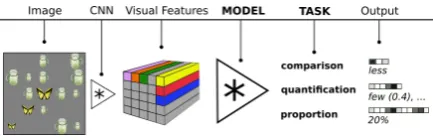
Figure 1: Toy representation of the quantification tasks and corresponding outputs explored in the paper. Note that quantification always refers to animals (target set).
contexts (e.g. visual scenes), proportional values are extracted holistically, i.e. without relying on the pre-computed cardinalities of the sets ( Fab-bri et al., 2012; Yang et al., 2015). Indeed, peo-ple are fairly accurate in providing the propor-tion of targets in a scene, even in high-speed set-tings (Healey et al.,1996;Treisman,2006). Sim-ilarly, in briefly-presented scenes, the interpreta-tion of quantifiers is shown to be best described by proportional information (Pezzelle et al.,under review).
Altogether, this suggests that performing (1)
set comparison, (2) vague quantification, and (3)
proportional estimation, which all rely on infor-mation regarding relations among sets, underlies increasingly-complex steps of the same mecha-nism. Notably, such complexity would range from ‘more/less’ judgements to proportional es-timation, as suggested by the increasing preci-sion of ANS through years (Halberda and Feigen-son,2008), the reported boundary role of ‘half’ in early proportional reasoning (Spinillo and Bryant,
1991), and the different age of acquisition of the corresponding linguistic expressions. Finally, the ratio-based operation underlying these task would be different from (and possibly conflicting with) that of estimating the absolute numerosity of one set. Indeed, absolute numbers are found to inter-fere with the access to proportions (Fabbri et al.,
2012).
Inspired by this converging evidence, the present work proposes a computational framework to explore various quantification tasks in the vi-sual domain (see Figure 1). In particular, we in-vestigate whether ratio-based quantification tasks can be modeled by a single, multi-task learning neural network. Given a synthetic scene depicting animals (in our setting, the ‘target’ objects) and artifacts (‘non-target’), our model is designed to jointly perform all the tasks by means of an ar-chitecture that reflects their increasing
complex-ity.1 To perform proportional estimation (the most
complex), the model builds on the representations learned to perform vague quantification and, in turn, set comparison (the least complex). We show that the multi-task model achieves both higher ac-curacy and higher generalization power compared to the one-task models. In contrast, we prove that introducing the absolute number task in the loop is not beneficial and indeed hurts the performance.
Our main contribution lies in the novel applica-tion and evaluaapplica-tion of a multi-task learning archi-tecture on the task of jointly modeling 3 different quantification operations. On the one hand, our results confirm the interdependency of the mech-anisms underlying the tasks of set comparison, vague quantification, and proportional estimation. On the other, we provide further evidence on the effectiveness of these computational architectures.
2 Related Work
2.1 Quantities in Language & Vision
In recent years, the task of extracting quantity in-formation from visual scenes has been tackled via Visual Question Answering (VQA). Given a real image and a natural language question, a VQA computational model is asked to understand the image, the linguistic query, and their interaction to provide the correct answer. So-called count questions, i.e. ‘How manyXs have the property Y?’, are very frequent and have been shown to be particularly challenging for any model (Antol et al., 2015; Malinowski et al., 2015;Ren et al.,
2015; Fukui et al., 2016). The difficulty of the task has been further confirmed by the similarly poor performance achieved even on the ‘diagnos-tic’ datasets, which include synthetic visual scenes depicting geometric shapes (Johnson et al.,2017;
Suhr et al.,2017).
Using Convolutional Neural Networks (CNN), a number of works in Computer Vision (CV) have proposed specific architectures for counting dig-its (Segu´ı et al.,2015), people in the crowd (Zhang et al.,2015a), and penguins (Arteta et al.,2016). With a more cognitive flavor,Chattopadhyay et al.
(2017) employed a ‘divide-and-conquer’ strategy to split the image into subparts and count the ob-jects in each subpart by mimicking the ‘subitizing’ mechanism (i.e. numerosities up to 3-4 can be rapidly and accurately appreciated). Inspired by 1The dataset and the code can be downloaded from
the same cognitive ability isZhang et al.(2015b), who trained a CNN to detect and count the salient objects in the image. Except Suhr et al. (2017), who evaluated models against various types of quantity expressions (including existential quanti-fiers), these works were just focused on the abso-lute number.
More akin to our work is Stoianov and Zorzi
(2012), who showed that hierarchical generative models learn ANS as a statistical property of (syn-thetic) images. Their networks were tested on the task of set comparison (‘more/less’) and ob-tained 93% accuracy. A few studies specifically focused on the learning of quantifiers. Sorodoc et al.(2016) proposed a model to assign the cor-rect quantifier to synthetic scenes of colored dots, whereasSorodoc et al.(2018) operationalized the same task in a VQA fashion, using real images and object-property queries (e.g. ‘How manydogs areblack?’). Overall, the results of these studies showed that vague quantification can be learned by neural networks, though the performance is much lower when using real images and complex queries. Finally, Pezzelle et al. (2017) investi-gated the difference between the learning of car-dinals and quantifiers from visual scenes, showing that they require two distinct computational oper-ations. To our knowledge, this is the first attempt to jointly investigate the whole range of quantifi-cation mechanisms. Moreover, we are the first to exploit a multi-task learning paradigm for ex-ploring the interactions between set comparison, vague quantification, and proportions.
2.2 Multi-Task Learning
Multi-Task Learning (MTL) has been shown to be very effective for a wide range of applications in machine learning (for an overview, seeRuder
(2017)). The core idea is that different and yet related tasks can be jointly learned by a multi-purpose model rather than by separate and highly fine-tuned models. Since they share representa-tions between related (or ‘auxiliary’) tasks, multi-task models are more robust and generalize better than single-task models. Successful applications of MTL have been proposed in CV to improve ob-ject classification (Girshick,2015), face detection and rotation (Zhang et al.,2014;Yim et al.,2015), and to jointly perform a number of tasks as ob-ject detection, semantic segmentation, etc. (Misra et al., 2016; Li and Hoiem, 2016). Though,
re-cently, a few studies applied MTL techniques to either count or estimate the number of objects in a scene (Sun et al.,2017;Sindagi and Patel,2017), to our knowledge none of them were devoted to the learning of various quantification mechanisms. In the field of natural language processing (NLP), MTL turned out to be beneficial for ma-chine translation (Luong et al., 2016) and for a range of tasks such as chunking, tagging, se-mantic role labelling, etc. (Collobert et al.,2011;
Søgaard and Goldberg,2016;Bingel and Søgaard,
2017). In particular,Søgaard and Goldberg(2016) showed the benefits of keeping low-level tasks at the lower layers of the network, a setting which en-ables higher-level tasks to make a better use of the shared representations. Since this finding was also in line with previous evidence suggesting a natu-ral order among different tasks (Shen and Sarkar,
2005), further work proposed MTL models in which several increasingly-complex tasks are hi-erarchically ordered (Hashimoto et al., 2017). The intuition behind this architecture, referred to as ‘joint many-task model’ in the source pa-per (Hashimoto et al.,2017), as well as its techni-cal implementation, constitute the building blocks of the model proposed in the present study.
3 Tasks and Dataset 3.1 Tasks
Given a visual scene depicting a number of ani-mals (targets) and artifacts (non-targets), we ex-plore the following tasks, represented in Figure1: (a) set comparison (hence, setComp), i.e. judg-ing whether the targets are ‘more’, ‘same’, ‘less’ than non-targets;
(b) vague quantification (hence, vagueQ), i.e. predicting the probability to use each of the9
quantifiers (‘none’, ‘almost none’, ‘few’, ‘the smaller part’, ‘some’, ‘many’, ‘most’, ‘almost all’, ‘all’) to refer to the target set;
(c) proportional estimation (hence, propTarg), i.e. predicting the proportion of targets choos-ing among17ratios, ranging from0to100%.
Tasks (a) and (c) are operationalized as classi-fication problems and evaluated through accuracy. That is, only one answer out of3and17,
Figure 2: Two scenes included in our dataset. The letf-most one depicts a ratio1:4(3animals,12artifacts,15
total items), the rightmost one a ratio2:3(6,9,15).
of Pearson’s correlation (r) between the predicted and the ground-truth probability vector (cf.§3.2), for each datapoint.2 The overallr is obtained by
averaging these scores. It is worth mentioning that we could either evaluate (b) in terms of a classi-fication task or operationalize (a) and (c) in terms of a correlation with human responses. The for-mer evaluation is straightforward and can be eas-ily carried out by picking the quantifier with the highest probability. The latter, in contrast, implies relying on behavioral data assessing the degree of overlap between ground-truth classes and speak-ers’ choice. Though interesting, such evaluation is less crucial given the discrete, non-overlapping nature of the classes in tasks (a) and (c).
The tasks are explored by means of a MTL net-work that jointly performs the three quantification operations (see§4.2). The intuition is that solving the lower-level tasks would be beneficial for tack-ling the higher-level ones. In particular, providing a proportional estimation (‘80%’) after
perform-ing vagueQ (‘most’) and setComp (‘more’) should lead to a higher accuracy in the highest-level task, which represents a further step in complexity com-pared to the previous ones. Moreover, lower-level tasks might be boosted in accuracy by the higher-level ones, since the latter include all the opera-tions that are needed to carry out the former. In addition to the MTL model, we test a number of ‘one-task’ networks specifically designed to solve one task at a time (see§4.1).
3.2 Dataset
We built a large dataset of synthetic visual scenes depicting a variable number of animals and ar-tifacts on the top of a neutral, grey background
2We also experimented with Mean Average Error and dot
product and found the same patterns of results (not reported).
[image:4.595.71.288.67.174.2]train val test total no. datapoints 11.9K 1.7K 3.4K 17K % datapoints 70% 10% 20% 100%
Table 1: Number and partitioning of the datapoints.
(see Figure 2). In doing so, we employed the same methodology and materials used inPezzelle et al.(under review), where the use of quantifiers ingroundedcontexts was explored by asking par-ticipants to select the most suitable quantifier for a given scene. Since the category of animals was always treated as the ‘target’, and that of artifacts as the ‘non-target’, we will henceforth use this ter-minology throughout the paper. The scenes were automatically generated by an in-house script us-ing the followus-ing pipeline: (a) Two natural im-ages, one depicting a target object (e.g. a butter-fly) and one depicting a non-target (e.g. a mug) were randomly picked up from a sample of the dataset by Kiani et al. (2007). The sample was obtained by Pezzelle et al. (under review), who manually selected pictures depicting whole items (not just parts) and whose color, orientation and shape were not deceptive. In total, 100 unique in-stances of animals and 145 unique inin-stances of ar-tifacts were included; (b) The proportion of tar-gets in the scene (e.g. 20%) was chosen by
se-lecting one among17 pre-definedratiosbetween targets:non-targets (e.g. 1:4, ‘four non-targets to
one target’). Out of17ratios,8were positive
(tar-gets > 50%), 8 negative (targets < 50%), and 1
equal (targets = 50%); (c) The absolute number
of targets/non-targets was chosen to equally repre-sent the various combinations available for a given ratio (e.g., for ratio1:4:1-4,2-8,3-12,4-16), with
the constraint of having a number of total objects in the scene (targets+non-targets) ranging from3
to20. In total,97combinations were represented
in the dataset, with an average of 5.7
combina-tions/ratio (min 2, max 18); (d) To inject some
variability, the instances of target/non-target ob-jects were randomly resized according to one of three possible sizes (i.e. medium, big, and small) and flipped on the vertical axis before being ran-domly inserted onto a5*5-cell virtual grid. As
re-ported in Table1, 17K scenes balanced per ratio
(1K scenes/ratio) were generated and further split
into train (70%), validation (10%), and test (20%).
we took the probability distributions obtained on a dataset of 340 scenes by Pezzelle et al. ( un-der review) and we applied them to our data-points, which were built in the exact same way. These probability distributions had been collected by asking participants to select, from a list of
9 quantifiers (reported in § 3.1), the most
suit-able one to describe the target objects in a visual scene presented for 1 second. In particular, they
were computed against the proportion of targets in the scene, which in that study was shown to be the overall best predictor for quantifiers. To il-lustrate, given a scene containing20% of targets
(cf. leftmost panel in Figure 2), the probability of choosing ‘few’ (ranging from 0 to 1) is 0.38,
‘almost none’ 0.27, ‘the smaller part’ 0.25, etc.
It is worth mentioning that, for scenes contain-ing either 100% or 0% targets the probability of
choosing ‘all’ and ‘none’, respectively, is around
1. In all other cases, the distribution of
probabili-ties is fuzzier and reflects the largely overlapping use of quantifiers, as in the example above. On average, the probability of the most-chosen quan-tifier across ratios is 0.53. Though this number
cannot be seen as a genuine inter-annotator agree-ment score, it suggests that, on average, there is one quantifier which is preferred over the others.
4 Models
In this section, we describe the various models im-plemented to perform the tasks. For each model, several settings and parameters were evaluated by means of a thorough ablation analysis. Based on a number of factors like performance, speed, and stability of the networks, we opted for using ReLU nonlinear activation at all hidden layers and the simple and effective Stochastic Gradient Descent (SGD) as optimizer (lr =0.01). We run each model
for100epochs and saved weights and parameters
of the epoch with the lowest validation loss. The best model was then used to obtain the predictions in the test set. All models were implemented using Keras.3
4.1 One-Task Models
We implemented separate models to tackle one task at a time. For each task, in particular, both a network using ‘frozen’ (i.e. pretrained) visual features and one computing the visual features in an ‘end-to-end’ fashion were tested.
3https://keras.io/
One-Task-Frozen These models are simple, 2 -layer (ReLU) Multi-Layer Perceptron (MLP) net-works that take as input a2048-d frozen
represen-tation of the scene and output a vector containing softmax probability values. The frozen represen-tation of the scene had been previously extracted using the state-of-art Inception v3 CNN (Szegedy et al.,2016) pretrained on ImageNet (Deng et al.,
2009). In particular, the network is fed with the average of the features computed by the last Con-volutional layer, which has size25*2048.
One-Task-End2end These models are MLP networks that take as input the203*203-pixel
im-age and compute the visual features by means of the embedded Inception v3 module, which outputs
25*2048-d vectors (the grey and colored box in
Figure1). Subsequently, the25feature vectors are
reduced twice via ReLU hidden layers, then con-catenated, reduced (ReLU), and fed into a softmax layer to obtain the probability values.
4.2 Multi-Task Model
The multi-task-prop model performs 3
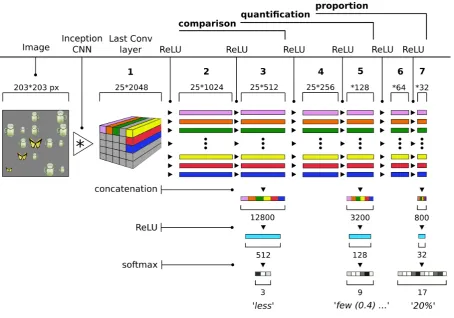
tasks at thesame timewith an architecture that re-produces in itsorder the conjectured complexity (see Figure3and its caption for technical details). The model has a core structure, represented by lay-ers1-5in the figure, which issharedacross tasks
and trained with multiple outputs. In particular, (a) layers1,2, and3are trained using information
regarding the output of all3tasks. That is, these
layers are updated three times by as many back-propagation passes: One on the top of setComp output, the second on the top of vagueQ output, the third on the top of propTarg output; (b) lay-ers4and5are affected by information regarding
the output of vagueQ and propTarg, and thus up-dated twice; (c) layers6 and7are updated once,
on the top of the output of propTarg. Importantly, the three lower layers in Figure3(concatenation, ReLU, softmax) are not shared between the tasks, but specialized to output each a specific prediction. As can be noted, the order of the tasks reflects their complexity, since the last task in the pipeline has
2more layers than the preceding one and 4more
than the first one.
5 Results
Figure 3: Architecture of themulti-task-propmodel jointly performing (a) set comparison, (b) vague quan-tification, and (c) proportional estimation. Given a203*203-pixel image as input, the model extracts a25*2048
representation from the last Convolutional layer of the Inception v3. Subsequently, the vectors are reduced twice via ReLU hidden layers to1024and512dimensions. The512-d vectors are concatenated and reduced, then a
softmax layer is applied to output a3-d vector with probability distributions for task (a). The same structure (i.e., 2hidden layers, concatenation, reduction, and softmax) is repeated for tasks (b) and (c). All the tasks are trained
with cross-entropy. To evaluate tasks (a) and (c), in testing, we extract the highest-probability class and compute
accuracy, whereas task (b) is evaluated viaPearson’s correlationagainst the9-d ground-truth probability vector.
in § 6.1). In setComp, all the models are neatly above chance/majority level (0.47). In particular, the one-task-end2endmodel achieves a re-markable0.90acc., which is more than10%
bet-ter compared to the simpleone-task-frozen model (0.78). The same pattern of results can be
observed for vagueQ, where the Pearson’s correla-tion (r) between the ground-truth and the predicted probability vector is around0.96, that is more than 30% over the simpler model (0.62). This gap
in-creases even more in propTarg, where the accuracy of the frozen model is more than40points below
the one achieved by the one-task-end2end model (0.21against0.66). These results firmly
in-dicate that, on the one hand, the frozen representa-tion of the visual scene encodes little informarepresenta-tion about the proportion of targets (likely due to the the different task for which they were pretrained,
i.e. object classification). On the other hand, com-puting the visual features in an end-to-end fashion leads to a significant improvement, suggesting that the network learns to pay attention to features that are helpful for specific tasks.
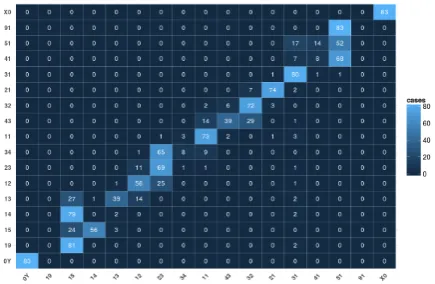
The most interesting results, however, are those achieved by the multi-task model, which turns out to be the best in all the tasks. As reported in Table2, sharing the weights between the various tasks is especially beneficial for propTarg, where the accuracy reaches 0.92, that is, more than 25
points over the end-to-end, one-task model. An almost perfect performance of the model in this task can be observed in Figure 4, which reports the confusion matrix with the errors made by the model. As can be seen, the few errors are between ‘touching’ classes, e.g. between ratio3:4(43% of
model setComp vagueQ propTarg nTarg accuracy Pearson r accuracy accuracy chance/majority 0.470 0.320 0.058 0.132
one-task-frozen 0.783 0.622 0.210 0.312 one-task-end2end 0.902 0.964 0.659 0.966
multi-task-prop 0.995 0.982 0.918 –
[image:7.595.168.430.61.138.2]multi-task-number 0.854 0.807 – 0.478
Table 2: Performance of the models in the tasks of set comparison (setComp), vague quantification (vagueQ), proportional estimation (propTarg), and absolute number of targets (nTarg). Values inboldare the highest.
differ by a very small percentage, we gain indirect evidence that the model is learning some kind of proportional information rather than trivial associ-ations between scenes and orthogonal classes.
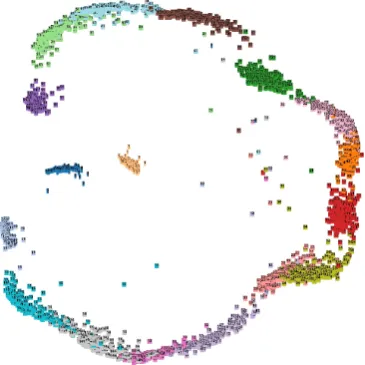
To further explore this point, one way is to in-spect the last layer of the proportional task (i.e. the 32-d turquoise vector in Figure 3). If the vectors contain information regarding the propor-tion of targets, we should expect scenes depicting the same proportion to have a similar representa-tion. Also, scenes with similar proportions (e.g.
40% and43%) would be closer to each other than
are scenes with different proportions (e.g. 25% and75%). Figure5 depicts the results of a
two-dimensional PCA analysis performed on the vec-tors of the last layer of the proportional task (the
32-d vectors).4 As can be noted, scenes
depict-ing the same proportion clearly cluster together, thus indicating that using these representations in a retrieval task would lead to a very high preci-sion. Crucially, the clusters are perfectly ordered with respect to proportion. Starting from the pur-ple cluster on the left side (90%) and proceeding
clockwise, we find83% (green),80% (turquoise),
[image:7.595.313.496.544.727.2]4We usedhttps://projector.tensorflow.org/
Figure 4: PropTarg. Heatmap reporting the errors made by themulti-task-propmodel. Note that labels refer toratios, i.e.14stands for ratio1:4(20% targets).
75% (brown), and so on, until reaching10% (light blue). Proportions0% (blue) and 100% (yellow)
are neatly separated from the other clusters, being at the extremes of the ‘clock’.
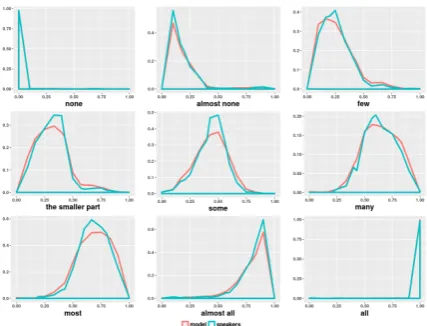
An improvement in the results can be also ob-served for setComp and vaqueQ, where the model achieves0.99acc. and 0.98 r, respectively. Fig-ure 6 reports, for each quantifier, the probabil-ity values predicted by the model against the ground-truth ones. As can be seen, the red lines (model) approximate very closely the green ones (humans). In the following section, we perform further experiments to provide a deeper evaluation of the results.
6 In-Depth Evaluation
6.1 Absolute Numbers in the Loop
As discussed in§1, the cognitive operation under-lying setComp, vagueQ, and propTarg is different compared to that of estimating the absolute num-ber of objects included in one set. To investigate whether such dissociation emerges at the compu-tational level, we tested a modified version of our proposed multi-task model where propTarg task
[image:7.595.72.287.559.702.2]Figure 6: VagueQ. Probability values predicted by themulti-task-propmodel against ground-truth probability distributions for each quantifier.
has been replaced with nTarg, namely the task of predicting the absolute number of targets. One-task models were also tested to evaluate the dif-ficulty of the task when performed in isolation. Since the number of targets in the scenes ranges from0to20, nTarg is evaluated as a21-class
clas-sification task (majority class0.13).
As reported in Table 2, the accuracy achieved by theone-task-end2endmodel is extremely high, i.e. around0.97. This suggests that, when
learned in isolation, the task is fairly easy, but only if the features are computedwithinthe model. In fact, using frozen features results in a quite low ac-curacy, namely0.31. This pattern of results is even
more interesting if compared against the results of themulti-task-numbermodel. When in-cluded in the multi-task pipeline, in fact, nTarg has a huge,50-point accuracy drop (0.48). Moreover,
both setComp and vagueQ turn out to be signif-icantly hurt by the highest-level task, and expe-rience a drop of around 14 and 17 points
com-pared to the one-task-end2end model, re-spectively. These findings seem to corroborate the incompatibility of the operations needed for solv-ing the tasks.
6.2 Reversing the Architecture
Previous work exploring MTL suggested that defining a hierarchy of increasingly-complex tasks is beneficial for jointly learning related tasks (see § 2.2). In the present work, the order of the tasks was inspired by cognitive and linguis-tic abilities (see§1). Though cognitively
implau-model setComp vagueQ propTarg accuracy Pearson r accuracy chance/majority 0.470 0.320 0.058
[image:8.595.76.290.61.224.2]one-task-frozen 0.763 0.548 0.068 one-task-end2end 0.793 0.922 0.059 multi-task-prop 0.943 0.960 0.539
Table 3: Unseen dataset. Performance of the models in each task. Values inboldare the highest.
sible, it might still be the case that the model is able to learn even when reversing the order of the tasks, i.e. from the conjectured highest-level to the lowest-level one. To shed light on this issue, we tested the multi-task-prop model after reversing its architecture. That is, propTarg is now the first task, followed by vagueQ, and setComp.
In contrast with the pattern of results obtained by the original pipeline, no benefits are observed for this version of MTL model compared to one-task networks. In particular, both vagueQ (0.32 r) and propTarg (0.08 acc.) performance
are around chance level, with setComp reach-ing just 0.65 acc., i.e. 25 point lower than the
one-task-end2end model. The pipeline of increasing complexity motivated theoretically is thus confirmed at the computational level.
6.3 Does MTL Generalize?
As discussed in§ 2.2, MTL is usually claimed to allow a higher generalization power. To investi-gate whether our proposedmulti-task-prop model genuinely learns to quantify from visual scenes, and not just associations between patterns and classes, we tested it with unseen combinations of targets/non-targets. The motivation is that, even in the most challenging propTarg task, the model might learn to match a given combination, e.g.
3:12, to a given proportion, i.e.20%. If this is the case, the model would solve the task by learning “just” to assign a class to each of the97 possible
combinations included in the dataset. If it learns a more abstract representation of the proportion of targets depicted in the scene, in contrast, it should be able to generalize to unseen combinations.
We built an additional dataset using the exact same pipeline described in§3.2. This time, how-ever, we randomly selected one combination per ratio (17combinations in total) to be used only for
validation and testing. The remaining80
[image:8.595.307.527.62.127.2]were balanced with respect to ratios, by randomly selecting scenes among the remaining combina-tions. The unseen dataset included around 14K
datapoints (80% train,10% val,10% test). Table
3 reports the results of the models on the unseen dataset. Starting from setComp, we note a simi-lar and fairly high accuracy achieved by the two one-task models (0.76and0.79, respectively). In
vagueQ, in contrast, the one-task-end2end model neatly outperforms the simpler model (0.92
vs. 0.55r). Finally, in propTarg both models are
at chance level, with an accuracy that is lower than
0.07. Overall, this pattern of results suggests that
propTarg is an extremely hard task for the sepa-rate models, which are not able to generalize to unseen combinations. Themulti-task-prop model, in contrast, shows a fairly high generaliza-tion power. In particular, it achieves0.54acc. in
propTarg, that is, almost 10 times chance level.
The overall good performance in predicting the correct proportion can be appreciated in Figure7, where the errors are represented by means of a heatmap. The error analysis reveals that end-of-the-scale proportions (0% and100%) are the
easi-est, followed by proportions75% (3:1),67% (2:1), 50% (1:1), and 60% (3:2). More in general, neg-ative ratios (targets<50%) are mispredicted to a
much greater extent than are positive ones. More-over, the model shows a bias toward some propor-tions, that the model seems ‘to see everywhere’. However, the fact that the errors are found among the adjacent ratios (similar proportions) seems to be a convincing evidence that the model learns representations encoding genuine proportional in-formation. Finally, it is worth mentioning that in setComp and vagueQ the model achieves very high results,0.94acc. and0.96r, respectively.
7 Discussion
[image:9.595.307.525.63.205.2]In the present study, we investigated whether ratio-basedquantification mechanisms, expressed in language by comparatives, quantifiers, and pro-portions, can be computationally modeled in vi-sion exploiting MTL. We proved that sharing a common core turned out to boost the performance in all the tasks, supporting evidence from linguis-tics, language acquisition, and cognition. More-over, we showed (a) the increasing complexity of the tasks, (b) the interference of absolute number, and (c) the high generalization power of MTL. These results lead to many additional questions.
Figure 7: PropTarg. Heatmap with the errors made by themulti-task-propmodel in the unseen dataset.
For instance, can these methods be successfully applied to datasets of real scenes? We firmly be-lieve this to be the case, though the results might be affected by the natural biases contained in those images. Also, is this pipeline of increasing com-plexity specific to vision (non-symbolic level), or is it shared across modalities, in primis lan-guage? Since linguistic expressions of quantity are grounded on a non-symbolic system, we might ex-pect that a model trained on one modality can be applied to another, at least to some extent. Even further, jointly learning representations from both modalities might represent an even more natural, human-like way to learn and refer to quantities. Further work is needed to explore all these issues.
Acknowledgments
References
Stanislaw Antol, Aishwarya Agrawal, Jiasen Lu, Mar-garet Mitchell, Dhruv Batra, C Lawrence Zitnick, and Devi Parikh. 2015. VQA: Visual Question An-swering. InProceedings of the IEEE International Conference on Computer Vision. pages 2425–2433. Carlos Arteta, Victor Lempitsky, and Andrew
Zisser-man. 2016. Counting in the wild. InEuropean Con-ference on Computer Vision. Springer, pages 483– 498.
Joachim Bingel and Anders Søgaard. 2017. Identify-ing beneficial task relations for multi-task learnIdentify-ing in deep neural networks. EACL 2017page 164. Peter Bryant. 2017. Perception and understanding
in young children: An experimental approach, vol-ume 4. Routledge.
Prithvijit Chattopadhyay, Ramakrishna Vedantam, Ramprasaath R. Selvaraju, Dhruv Batra, and Devi Parikh. 2017. Counting everyday objects in every-day scenes. InThe IEEE Conference on Computer Vision and Pattern Recognition (CVPR).
Ronan Collobert, Jason Weston, L´eon Bottou, Michael Karlen, Koray Kavukcuoglu, and Pavel Kuksa. 2011. Natural language processing (almost) from scratch. Journal of Machine Learning Research
12(Aug):2493–2537.
Jia Deng, Wei Dong, Richard Socher, Li-Jia Li, Kai Li, and Li Fei-Fei. 2009. Imagenet: A large-scale hi-erarchical image database. InComputer Vision and Pattern Recognition, 2009. CVPR 2009. IEEE Con-ference on. IEEE, pages 248–255.
Sara Fabbri, Sara Caviola, Joey Tang, Marco Zorzi, and Brian Butterworth. 2012. The role of numerosity in processing nonsymbolic proportions. The Quarterly Journal of Experimental Psychology 65(12):2435– 2446.
Akira Fukui, Dong Huk Park, Daylen Yang, Anna Rohrbach, Trevor Darrell, and Marcus Rohrbach. 2016. Multimodal compact bilinear pooling for vi-sual question answering and vivi-sual grounding. In
Conference on Empirical Methods in Natural Lan-guage Processing. ACL, pages 457–468.
Ross Girshick. 2015. Fast R-CNN. In Proceedings of the IEEE international conference on computer vision. pages 1440–1448.
Justin Halberda and Lisa Feigenson. 2008. Develop-mental change in the acuity of the “Number Sense”: The Approximate Number System in 3-, 4-, 5-, and 6-year-olds and adults. Developmental psychology
44(5):1457.
Justin Halberda, Len Taing, and Jeffrey Lidz. 2008. The development of ‘most’ comprehension and its potential dependence on counting ability in preschoolers. Language Learning and Development
4(2):99–121.
Patrice Hartnett and Rochel Gelman. 1998. Early un-derstandings of numbers: Paths or barriers to the construction of new understandings? Learning and instruction8(4):341–374.
Kazuma Hashimoto, Caiming Xiong, Yoshimasa Tsu-ruoka, and Richard Socher. 2017. A Joint Many-Task Model: Growing a Neural Network for Mul-tiple NLP Tasks. InProceedings of the 2017 Con-ference on Empirical Methods in Natural Language Processing (EMNLP). Association for Computa-tional Linguistics, Copenhagen, Denmark, pages 446–456.
Christopher G Healey, Kellogg S Booth, and James T Enns. 1996. High-speed visual estimation us-ing preattentive processus-ing. ACM Transactions on Computer-Human Interaction (TOCHI) 3(2):107– 135.
Felicia Hurewitz, Anna Papafragou, Lila Gleitman, and Rochel Gelman. 2006. Asymmetries in the acquisi-tion of numbers and quantifiers. Language learning and development2(2):77–96.
Justin Johnson, Bharath Hariharan, Laurens van der Maaten, Li Fei-Fei, C Lawrence Zitnick, and Ross Girshick. 2017. CLEVR: A diagnostic dataset for compositional language and elementary visual rea-soning. In2017 IEEE Conference on Computer Vi-sion and Pattern Recognition (CVPR). IEEE, pages 1988–1997.
Roozbeh Kiani, Hossein Esteky, Koorosh Mirpour, and Keiji Tanaka. 2007. Object category structure in re-sponse patterns of neuronal population in monkey inferior temporal cortex. Journal of neurophysiol-ogy97(6):4296–4309.
Mathieu Le Corre and Susan Carey. 2007. One, two, three, four, nothing more: An investigation of the conceptual sources of the verbal counting principles.
Cognition105(2):395–438.
Zhizhong Li and Derek Hoiem. 2016. Learning with-out forgetting. In European Conference on Com-puter Vision. Springer, pages 614–629.
Minh-Thang Luong, Quoc V. Le, Ilya Sutskever, Oriol Vinyals, and Lukasz Kaiser. 2016. Multi-task se-quence to sese-quence learning. InInternational Con-ference on Learning Representations (ICLR). San Juan, Puerto Rico.
Mateusz Malinowski, Marcus Rohrbach, and Mario Fritz. 2015. Ask your neurons: A neural-based ap-proach to answering questions about images. In
Proceedings of the IEEE international conference on computer vision. pages 1–9.
Koleen McCrink and Karen Wynn. 2004. Large-number addition and subtraction by 9-month-old in-fants.Psychological Science15(11):776–781.
Utako Minai. 2006. Everyone knows, therefore ev-ery child knows: An investigation of logico-semantic competence in child language. Ph.D. thesis, Univer-sity of Maryland.
Ishan Misra, Abhinav Shrivastava, Abhinav Gupta, and Martial Hebert. 2016. Cross-stitch networks for multi-task learning. In Proceedings of the IEEE Conference on Computer Vision and Pattern Recog-nition. pages 3994–4003.
Joan Moss and Robbie Case. 1999. Developing chil-dren’s understanding of the rational numbers: A new model and an experimental curriculum. Journal for research in mathematics educationpages 122–147.
Darko Odic, Paul Pietroski, Tim Hunter, Jeffrey Lidz, and Justin Halberda. 2013. Young children’s un-derstanding of “more” and discrimination of number and surface area. Journal of Experimental Psychol-ogy: Learning, Memory, and Cognition39(2):451.
Sandro Pezzelle, Raffaella Bernardi, and Manuela Pi-azza. under review. Probing the mental scale of quantifiers. Cognition.
Sandro Pezzelle, Marco Marelli, and Raffaella Bernardi. 2017. Be precise or fuzzy: Learning the meaning of cardinals and quantifiers from vision. In
Proceedings of the 15th Conference of the European Chapter of the Association for Computational Lin-guistics: Volume 2, Short Papers. Association for Computational Linguistics, Valencia, Spain, pages 337–342.
Manuela Piazza. 2010. Neurocognitive start-up tools for symbolic number representations. Trends in cog-nitive sciences14(12):542–551.
Manuela Piazza and Evelyn Eger. 2016. Neural foun-dations and functional specificity of number repre-sentations.Neuropsychologia83:257–273.
Mengye Ren, Ryan Kiros, and Richard Zemel. 2015. Exploring models and data for image question an-swering. In Advances in neural information pro-cessing systems. pages 2953–2961.
Sebastian Ruder. 2017. An overview of multi-task learning in deep neural networks. arXiv preprint arXiv:1706.05098.
Santi Segu´ı, Oriol Pujol, and Jordi Vitria. 2015. Learn-ing to count with deep object features. In Proceed-ings of the IEEE Conference on Computer Vision and Pattern Recognition Workshops. pages 90–96.
Hong Shen and Anoop Sarkar. 2005. Voting between multiple data representations for text chunking. In
Conference of the Canadian Society for Computa-tional Studies of Intelligence. Springer, pages 389– 400.
Pooja G Sidney, Clarissa A Thompson, Percival G Matthews, and Edward M Hubbard. 2017. From continuous magnitudes to symbolic numbers: The centrality of ratio. Behavioral and Brain Sciences
40.
Vishwanath A Sindagi and Vishal M Patel. 2017. CNN-Based cascaded multi-task learning of high-level prior and density estimation for crowd count-ing. In Advanced Video and Signal Based Surveil-lance (AVSS), 2017 14th IEEE International Confer-ence on. IEEE, pages 1–6.
Anders Søgaard and Yoav Goldberg. 2016. Deep multi-task learning with low level tasks supervised at lower layers. InProceedings of the 54th Annual Meeting of the Association for Computational Lin-guistics. volume 2, pages 231–235.
Catherine Sophian. 2000. Perceptions of proportional-ity in young children: matching spatial ratios. Cog-nition75(2):145 – 170.
Ionut Sorodoc, Angeliki Lazaridou, Gemma Boleda, Aur´elie Herbelot, Sandro Pezzelle, and Raffaella Bernardi. 2016. “Look, some green circles!”: Learning to quantify from images. InProceedings of the 5th Workshop on Vision and Language. pages 75–79.
Ionut Sorodoc, Sandro Pezzelle, Aur´elie Herbelot, Mariella Dimiccoli, and Raffaella Bernardi. 2018. Learning quantification from images: A structured neural architecture. Natural Language Engineering
page 1–30.
Alina G Spinillo and Peter Bryant. 1991. Children’s proportional judgments: The importance of “half”.
Child Development62(3):427–440.
Ivilin Stoianov and Marco Zorzi. 2012. Emergence of a ‘visual number sense’ in hierarchical generative models. Nature neuroscience15(2):194–196.
Alane Suhr, Mike Lewis, James Yeh, and Yoav Artzi. 2017. A corpus of natural language for visual rea-soning. In55th Annual Meeting of the Association for Computational Linguistics, ACL.
Maojin Sun, Yan Wang, Teng Li, Jing Lv, and Jun Wu. 2017. Vehicle counting in crowded scenes with multi-channel and multi-task convolutional neural networks. Journal of Visual Communication and Image Representation49:412–419.
Christian Szegedy, Vincent Vanhoucke, Sergey Ioffe, Jon Shlens, and Zbigniew Wojna. 2016. Rethinking the Inception Architecture for Computer Vision. In
Proceedings of the IEEE Conference on Computer Vision and Pattern Recognition. pages 2818–2826.
Fei Xu and Elizabeth S Spelke. 2000. Large number discrimination in 6-month-old infants. Cognition
74(1):B1–B11.
Ying Yang, Qingfen Hu, Di Wu, and Shuqi Yang. 2015. Children’s and adults’ automatic processing of pro-portion in a Stroop-like task. International Journal of Behavioral Development39(2):97–104.
Junho Yim, Heechul Jung, ByungIn Yoo, Changkyu Choi, Dusik Park, and Junmo Kim. 2015. Rotating your face using multi-task deep neural network. In
Proceedings of the IEEE Conference on Computer Vision and Pattern Recognition. pages 676–684. Cong Zhang, Hongsheng Li, Xiaogang Wang, and
Xi-aokang Yang. 2015a. Cross-scene crowd counting via deep convolutional neural networks. In Proceed-ings of the IEEE Conference on Computer Vision and Pattern Recognition. pages 833–841.
Jianming Zhang, Shugao Ma, Mehrnoosh Sameki, Stan Sclaroff, Margrit Betke, Zhe Lin, Xiaohui Shen, Brian Price, and Radomir Mech. 2015b. Salient ob-ject subitizing. InProceedings of the IEEE Confer-ence on Computer Vision and Pattern Recognition. pages 4045–4054.