http://www.scirp.org/journal/aar ISSN Online: 2169-0502
ISSN Print: 2169-0499
DOI: 10.4236/aar.2018.72002 Mar. 13, 2018 17 Advances in Aging Research
Testing the Mutation Accumulation Theory of
Aging Using Bioinformatic Tools
Abdullah Salah Elamoudi
Department of Internal Medicine, King Abdulaziz Medical City, Jeddah
Abstract
Objective: An interplay of many variant mechanisms is thought to underlie ag-ing or senescence. The Mutation Accumulation Theory proposes the accumula-tion of mutaaccumula-tions in proteins to engender their aging phenotype. Testing whether random mutations lead to the aging phenotype was never done and is deemed infeasible. Bioinformatic algorithms provide an a-priori approach that allows testing; they employ prior knowledge of well-studied proteins to predict the changes brought on by mutations. Here, the Mutation Accumula-tion Theory of aging is tested using such bioinformatic tools. Methods: This is a simulation study, conducted 2017, September, using algorithms with Web acces-sibility. Three well-studied proteins implicated in aging were chosen: Collagen, Beta-amyloid Precursor Protein (β-APP) and Low-density-lipoprotein-receptor (LDL-receptor). Random mutations were introduced to their native coding se-quences. Then, the mutated sequences were tested using three different predic-tion algorithms: SPpred for solubility, I-mutant for stability (delta-free ener-gy), SNP and GO for pathogenicity. The new mutated phenotype was then correlated to the aging phenotype of the protein; decrease in solubility for Collagen and β-APP; and accelerated atherosclerosis for LDL-receptor. Re-sults: 15 mutated variants for each protein (45 in total). For collagen and β-APP, the SPpred algorithm did not predict changes in solubility of the naked protein, but the I-mutant and SNP and GO definitely predicted changes that fit the aging phenotype. However, for LDL-receptors, none of the mutated variants when studied could account for the aging phenotype. Conclusion: for Collagen and Β-APP, it is shown here that random mutations and their accu-mulation could explain the aging phenotype of both proteins; backing the Mu-tation Accumulation Theory for aging.
Keywords
Aging, Senescence, Mutation Accumulation Theory
How to cite this paper: Elamoudi, A.S. (2018) Testing the Mutation Accumulation Theory of Aging Using Bioinformatic Tools. Advances in Aging Research, 7, 17-28.
https://doi.org/10.4236/aar.2018.72002
Received: January 25, 2018 Accepted: March 10, 2018 Published: March 13, 2018
Copyright © 2018 by author and Scientific Research Publishing Inc. This work is licensed under the Creative Commons Attribution International License (CC BY 4.0).
DOI: 10.4236/aar.2018.72002 18 Advances in Aging Research
1. Introduction
Not long after the settlement of early humans in small communities, forgoing the hunter-gatherer lifestyle, did the question of aging and mortality engross many aspects of our lives. Our awareness of our mortality and decay, a distin-guishing feature of our species among living organisms, dawned our collective mind with angst and became the drive of our mores, mythology and metaphysi-cal expression; it even became the subject of our art.
Historically, aging was likened to wear and tear accumulating with time. This view however came to change when the thermodynamic law of entropy took its formal shape. i.e., entropy is unidirectional; disorder is always increasing. Howev-er, biological systems are not closed systems and living beings take in free energy then release its entropy as waste. Living organisms reproduce and repair and there is no thermodynamic necessity for senescence (aging).
The turn of the twentieth century saw prominent biologists addressing the is-sue of aging. Ilya Ilyich Mechnikov, a prominent Russian biologist and a Nobel laureate for the discovery of phagocytes (macrophages) in 1908, was one of the first biologists to address the issue of aging and he is the one to coin the terms Geriatrics and Gerontology from the Greek word Geras for old age. Since then, many theories for aging were put forward. Some backed by more evidence than others. The free radical theory and DNA damage theory are two of the older ones. In the free radical theory, accumulative damage that underlies senescence is brought on by free radicals with time, hence, calorie restriction and the in-crease in consumption of anti-oxidant for an individual can be said to inin-crease longevity [1]. The DNA damage theory suggests breaks in the DNA and other mechanical damage to the DNA and what they ensue on the cellular machinery to be the main culprit of aging. Much evidence was put forward for other theo-ries to take shape; programmed longevity theory suggests aging to be a similar phenomenon to development where the expression of genes alters with time changing with it the phenotypic traits of the individual; the endocrine theory suggests hormonal changes to be a contributing factor to aging [2].
DOI: 10.4236/aar.2018.72002 19 Advances in Aging Research referenced here are three papers that did that [5] [6] [7].
It is easily understood why testing this theory was not done. It would be cum-bersome and unfathomable to test this theory in a lab; the number of possible mutations, the variance of the single mutation itself, and the addition of more mutations, etc. Not to mention the ensuing study of the expressed protein in different milieus, different conditions and different systems each with a great number of variables to account for. Bioinformatic tools are a-priori tools that use existent information on proteins to predict the outcomes of a change intro-duced.
For this project, the mutation accumulation theory will be tested; random mutations will be introduced into protein sequences. The effect of these mutations will be assayed using bioinformatics tools. This effect will then be correlated to the known aging phenotype of the chosen proteins.
2. Experimental Procedure
This is a simulation study; conducted September 2017, using accessible algorithms available online.
1) Choice of proteins: Firstly, the proteins have to be implicated in aging phenotypic traits. Secondly, the proteins chosen have to be well-studied since one of the algorithms will relate the mutated sequence to diseased phenotypes brought on by hereditary mutations. Also, the physiology where the protein is involved will help correlate the effects of mutations predicted by the algo-rithms to the aging phenotype that is known. Therefore, for this project, three proteins were chosen: Collagen, beta-Amyloid Precursor Protein (β-APP) and Low-density-lipoprotein-receptor (LDL-receptor).
Collagen is the most abundant protein in the body, forming the connective matrix for almost all tissues. Studies have been done to implicate collagen’s drop in solubility to aging phenomena; in the skin, lens, blood vessels, bones and car-tilage [7]. Β-APP is known to precipitate in Alzehimer’s and in aged individuals causing senility [8]. LDL-receptors mediate the deposition of atherosclerotic pla-ques that are known to accelerate with aging [9].
DOI: 10.4236/aar.2018.72002 20 Advances in Aging Research To accumulate multiple mutations in a single sequence, might seem a scarce phenomenon; since mutations occur with a frequency of 1/10,000,000 mutation per replication cycle. But, taking into account the number of replications, the number of different cells producing the protein and the life-span of the average human, accumulating two more mutations to the first mutated sequence me-rits the study. Every mutated sequence was then input in three different algo-rithms:
-SPpred (Soluble Protein Prediction): to predict the solubility of the protein. Support Vector Machine values (SVM) were output; a positive sign for soluble and a negative sign for insoluble; the absolute value is scalar for how soluble or insoluble the protein was predicted to be; this solubility algorithm was chosen for simplicity and not including expression systems as a required input.
-I-mutant: To predict the stability (delta-free energy) brought on by the mu-tation; a positive sign for an increase in the stability of the protein, a negative sign for a drop in stability. This algorithm was chosen after the recommendation by a review article that tested different stability algorithms and concluded two to be the best ones; I-mutant is one those two [10].
For the added mutations, delta-free energies were arithmetically added; exam-ple, delta-G of second mutant is the sum of delta-G of the first mutant + delta-G of the second mutant as a mutation in the first mutated sequence.
-SNP and GO: for predicting pathogenicity. It correlates the mutation intro-duced to the sequence to the known hereditary mutations and outputs a proba-bility to predict the diseased phenotype. This algorithm was also recommended by a review article that tested several algorithms for pathogenicity prediction [11].
The results were then correlated to the aging phenotype; this is done in the discussion part of this paper.
As a simulation study, no Ethical approval was required.
3. Results
All 45 mutants were run in the three algorithms, none was excluded. 1) Collagen:
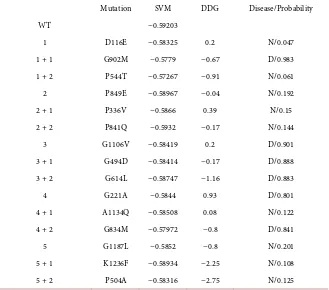
For collagen, the SPpred algorithm for solubility reported values that are comparable to the wild type (see Table 1). The I-mutant algorithm predicted a significant effect on stability; 8 out of 15 mutated sequences had a delta-free energy value above 0.5. Three of these 8 had a value above 1; this effect on stability was gradient for 100% of mutated sequences; increasing added mutations. The SNP and GO algorithm predicted 6 out of the 15 mutated sequences would have a diseased phenotype (see Table 1). Some mutations when added reversed the pa-thology predicted by the preceding mutation.
Here, Collagen sequences with a single mutation and those with multiple (added one or two) are predicted to have the aging phenotype.
2) Beta-Amyloid Precursor Protein:
DOI: 10.4236/aar.2018.72002 21 Advances in Aging Research Table 1. Output of the three algorithms for Collagen; SVM (SPpred) for support vector machine, DDG (I-mutant) for delta free energy, Disease/probability (SNP and GO) N for neutral and D for disease/the probability of disease. WT; wild type (unmutated sequence). Mere numbers in the rows are for the different initial mutations, +1 for the added muta-tion to the first mutated sequence, +2 for the second added mutamuta-tion to the sequence with two mutations.
Mutation SVM DDG Disease/Probability
WT −0.59203
1 D116E −0.58325 0.2 N/0.047 1 + 1 G902M −0.5779 −0.67 D/0.983 1 + 2 P544T −0.57267 −0.91 N/0.061 2 P849E −0.58967 −0.04 N/0.192 2 + 1 P336V −0.5866 0.39 N/0.15 2 + 2 P841Q −0.5932 −0.17 N/0.144
3 G1106V −0.58419 0.2 D/0.901 3 + 1 G494D −0.58414 −0.17 D/0.888 3 + 2 G614L −0.58747 −1.16 D/0.883 4 G221A −0.5844 0.93 D/0.801 4 + 1 A1134Q −0.58508 0.08 N/0.122 4 + 2 G834M −0.57972 −0.8 D/0.841 5 G1187L −0.5852 −0.8 N/0.201 5 + 1 K1236F −0.58934 −2.25 N/0.108 5 + 2 P504A −0.58316 −2.75 N/0.125
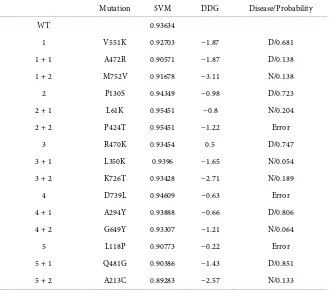
comparable to the wild type (see Table 2). The I-mutant algorithm predicts sig-nificant effect on stability; 14 out of 15 mutated sequences had a delta-free ener-gy value above 0.5. 9 of these 14 had a value above 1. This effect on stability was gradient for 100% of mutated sequences; increasing instability with adding mu-tations. The SNP and GO algorithm predicts that 6 out of the 15 mutated quence will have a diseased phenotype. However, 3 out of the 15 mutated se-quences could not be output with the SNP and GO algorithm and were output as “error” (see Table 2). Here, mutated sequences with single or multiple muta-tions led to the aging phenotype.
3) LDL-receptor:
DOI: 10.4236/aar.2018.72002 22 Advances in Aging Research Table 2. Output of the three algorithms for Β-APP; SVM (SPpred) for support vector machine, DDG (I-mutant) for delta free energy, Disease/probability (SNP and GO) N for neutral and D for disease/the probability of disease. WT; wild type (unmutated sequence) Mere numbers in the rows are for the different initial mutations, +1 for the added muta-tion to the first mutated sequence, +2 for the second added mutamuta-tion to the sequence with two mutations.
Mutation SVM DDG Disease/Probability
WT 0.93634
1 V551K 0.92703 −1.87 D/0.681 1 + 1 A472R 0.90571 −1.87 D/0.138 1 + 2 M752V 0.91678 −3.11 N/0.138 2 P130S 0.94349 −0.98 D/0.723 2 + 1 L61K 0.95451 −0.8 N/0.204 2 + 2 P424T 0.95451 −1.22 Error
3 R470K 0.93454 0.5 D/0.747 3 + 1 L350K 0.9396 −1.65 N/0.054 3 + 2 K726T 0.93428 −2.71 N/0.189 4 D739L 0.94609 −0.63 Error 4 + 1 A294Y 0.93888 −0.66 D/0.806 4 + 2 G649Y 0.93307 −1.21 N/0.064 5 L118P 0.90773 −0.22 Error 5 + 1 Q481G 0.90386 −1.43 D/0.851 5 + 2 A213C 0.89283 −2.57 N/0.133
4. Discussion
In this paper, three proteins were chosen that have a prominent role in aging; Collagen, β-Amyloid Precursor Protein and LDL-receptor. The aging phenotype of these proteins is well-known. Each native sequence has 15 mutated variants. For each, five had one mutation, five had two (one added to the first one), and five had accumulated three mutations. To accumulate multiple mutations in a single sequence, might seem a scarce phenomenon at first; since mutations occur with a frequency of 1/10,000,000 per replication cycle. However, taking into ac-count the number of replication cycles and the life-span of the average human being, accumulating two more mutations to the first mutated sequence merits the study. The Mutation accumulation theory suggests that mutations accumulating in these proteins would lead to the aging phenotype. For each of the forty-five muta-tions in total, three bioinformatics tests were run to each.
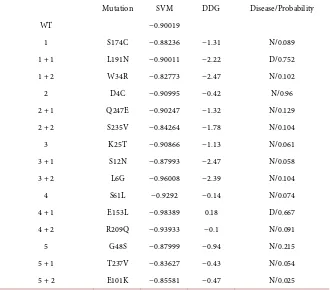
[image:6.595.211.540.152.442.2]DOI: 10.4236/aar.2018.72002 23 Advances in Aging Research Table 3. Output of the three algorithms for LDL-receptor; SVM (SPpred) for support vector machine, DDG (I-mutant) for delta free energy, Disease/probability (SNP and GO) N for neutral and D for disease/ the probability of disease. WT; wild type (unmutated se-quence) Mere numbers in the rows are for the different initial mutations, +1 for the add-ed mutation to the first mutatadd-ed sequence, +2 for the second addadd-ed mutation to the se-quence with two mutations.
Mutation SVM DDG Disease/Probability
WT −0.90019
1 S174C −0.88236 −1.31 N/0.089 1 + 1 L191N −0.90011 −2.22 D/0.752 1 + 2 W34R −0.82773 −2.47 N/0.102 2 D4C −0.90995 −0.42 N/0.96 2 + 1 Q247E −0.90247 −1.32 N/0.129 2 + 2 S235V −0.84264 −1.78 N/0.104 3 K25T −0.90866 −1.13 N/0.061 3 + 1 S12N −0.87993 −2.47 N/0.058 3 + 2 L6G −0.96008 −2.39 N/0.104 4 S61L −0.9292 −0.14 N/0.074 4 + 1 E153L −0.98389 0.18 D/0.667 4 + 2 R209Q −0.93933 −0.1 N/0.091 5 G48S −0.87999 −0.94 N/0.215 5 + 1 T237V −0.83627 −0.43 N/0.054 5 + 2 E101K −0.85581 −0.47 N/0.025
[image:7.595.209.539.152.442.2]DOI: 10.4236/aar.2018.72002 24 Advances in Aging Research cross-linking events are known to solidify collagen reducing its solubility [13]. These post-translational phenomenae alter Collagen’s solubility to a great de-gree; mutations can hinder these modifications or enhance cross-linking and therefore lower solubility through these indirect means that cannot be assayed here. The role played by these modifications is underscored by the fact that our wild-type collagen sequence had low solubility score that was comparable to those sequences housing one, two or even three mutations.
Another way for these mutations to alter collagen solubility is by the significant drop in stability predicted by the bioinformatics tool used here “I-mutant” (see
Table 1). Here, we note significant changes in the free energy of the protein
brought on by a single mutation at times. If this effect of these mutations were not masked by post-translational modifications, then it is safe to assume unsta-ble protein conformations that favor precipitation and interfere with collagen as a substrate for enzymes modifying it. In some instances, adding a mutation or two, caused even a more significant drop in stability “all groups of mutations except the third group”; this is also in check with the mutation accumulation theory of aging where accumulating mutations are believed to play a role as well.
Finally, the SNP and GO algorithm was run to all collagen sequences and for six out of 15 sequences, the algorithm predicted the introduced mutation or mutations to cause a diseased phenotype; as predicted, mutations that substituted glycine, an amino acid with no side chains, were almost consistently leading to the diseased phenotype; in collagen, these glycine residues are important for com-pacting the quaternary structure of Collagen [14]. Collagen hereditary diseases all have a feature in common; collagen losing its supportive role in tissues, for exam-ple, Alport Syndrome, Epidermolysis Bullosa Dystrophica, Ehlers-Danlos Syn-drome and Osteogenesis Imperfecta. Hence, it is safe to assume that these ran-dom mutations “six mutated sequences” can be chosen as predicted mutations that take place with aging; this should back up the Mutation Accumulation Theory as an important phenomenon that underlies the aging phenotype. Here however, accumulating mutations didn’t further the disease phenotype (see Ta-ble 1).
DOI: 10.4236/aar.2018.72002 25 Advances in Aging Research For beta-Amyloid Precursor Protein, the same number of mutations was produced randomly and similar bioinformatic runs were done to all mutated sequences. Β-APP is notorious for its role in senility and Alzehimer’s; this protein will precipitate in all individuals indiscriminately, however certain genetic variants and mutations will favor the early precipitation and early manifestation of Alze-himer’s symptoms starting with memory loss [15]. Therefore, it’s a reasonable first-step to test the solubility of randomly mutated sequences; here however, no significant differences were observed and the wild-type sequence had similar low solubility values (see Table 2). This is easily accounted for by the transmem-brane domain of β-APP. β-APP is a surface protein. Plus, it is the β-APP clea-vage product that precipitates and not the entire β-APP; we know that once β-APP is cleaved by beta-secretase, a product that precipitates is produced and allelic variants that favor this particular cleavage associate with a higher preva-lence and earlier onset of Alzehimer’s [8]. Therefore, these solubility values can be ignored at this point. As for the stabilities concluded from mutations, muta-tions lowered the stability of β-APP; all groups of mutamuta-tions had a significant negative effect on stability except the second group; these can be proposed as mutations that could underlie the aging phenotype; lowering the stability should interfere with enzymatic handling of the protein and therefore encourage its de-gradation; a higher turn-over of β-APP should mean greater cleavage product “cleavage is a degradation mechanism of the β-APP” [8].
Finally, the SNP and GO algorithm was run to all sequences; this algorithm should relate the mutations to known mutations and allelic variants favoring the diseased phenotype; in the case of β-APP it’s almost exclusively associated with se-nility and Alzehimer’s. The algorithm’s output predicted the diseased phenotypes for six mutated sequences out of twelve retrieved outcomes. Also the diseased phenotype was favored with high probabilities at times; 80.5% and 85.1% for the fourth and fifth groups respectively. This without question should underscore the role of these random mutations (50% of the time, 6 out 12) in producing se-nility in the aging individual; an important hallmark of aging.
In conclusion: for β-APP, solubility algorithms didn’t show a significant differ-ence but this could be accounted for by the cellular location of the protein and the fact that only part of β-APP is concerned with precipitation and disease. The sta-bility algorithms predicted significant drop in stasta-bility for most mutations which could raise the turn-over of the protein and therefore increase the degradation products; one of which is what precipitates and causes the aging/disease pheno-type. Finally, the SNP and GO algorithm concluded half of these randomly mu-tated sequences to produce a phenotypic change similar to that of Alzehimer’s. Therefore, these random mutations could just as well underlie the aging pheno-type validating the Mutation Accumulation Theory of Aging.
DOI: 10.4236/aar.2018.72002 26 Advances in Aging Research is the leading cause of mortality among men and women of old age (CDC, Heart Disease Facts). Here, we ran the same number of mutations in the same three aforementioned algorithms.
As predicted, no significant changes in solubility were observed since the pro-tein is a receptor with a significant part spanning the phospholipid bilayer (transmembrane). The stability algorithms concluded a drop in stability in the first three groups of mutations, and a stabilizing effect of the last two groups of mutations on LDL-receptors. For the SNP and GO algorithms, all mutations were neutral except two; and for these two the probability of disease was not that significant; 75% and 66%. Plus, both mutations were the second one added to the mutated sequence and were neutralized by the addition of the third random mutation. All these factors lead us to exclude any significant effect brought on by these random mutations to produce an aging phenotype (accelerated atherosclero-sis). Therefore, besides the destabilizing effect of some of the mutations, no signif-icant effect of random mutations was observed on the protein. These destabilizing mutations can however increase the turn-over of the receptor, but even here no pathology can be projected; the receptor acts to internalize LDL continuously and a high turn-over is a known trait of the protein [9]. Another reason why these algorithms might be poor in making predictions for LDL-receptor, is the fact that in atherosclerosis the LDL-receptor pathway is overly activated, there-fore processes that up-regulate the pathway or suppress its down-regulation, are ones that favor atherosclerosis; in Atherosclerosis, macrophages using their LDL-receptors uptake LDL from the blood and fail to be suppressed from doing so; with this over-uptake of LDL, the macrophages eventually die and deposit below the endothelium [17]. Therefore, looking for mutations that destabilize the protein go against the accelerated atherosclerosis assumption. Plus, in SNP and GO mutations are correlated to mutations in LDL-receptor that cause fa-milial hypercholesterolemias where LDL-receptor loses function. But, in aging, we expect the LDL-receptor to over-activate leading to accelerated atherolsclero-sis, a known phenotypic trait of aging.
In conclusion; for LDL-receptors, it was not possible to predict the aging phenotype of accelerated atherosclerosis using these bioinformatics tools. An important reason for that, is changes that accelerate atherosclerosis are ones that activate the pathway where LDL-receptors are involved. Plus, the SNP and GO al-gorithm which proved very useful with Collagen and β-APP count on hereditary diseases in LDL receptors to make predictions; in LDL-receptors the only heredi-tary diseases involving them are Familial hypercholesterolemias, where LDL-receptor-mediated uptake of LDL from the blood is down-regulated which is the opposite of what occurs in macrophages to produce atherosclerosis [18].
DOI: 10.4236/aar.2018.72002 27 Advances in Aging Research recommended by other authors. However, the alteration in protein expression with aging is well described and did not report significant changes in the pro-teins in terms of size, conformation, and no reference to truncation either [5]. This weighs more to hint at substitutions being the predominant mutations in these proteins as we age. No mutations were studied that involved the non-coding regulatory sequences either of for the same two reasons.
As for the number of accumulated mutations being small, considering the rate of mutagenesis in DNA being around 1/10,000,000, plus the proof-reading ma-chinery in our DNA, accumulating one or two mutation can be said to be ge-nerous. Another argument is that for Collagen and β-APP, the specific substitu-tion and the site of mutasubstitu-tion did not seem to factor much in the predicsubstitu-tions. The bottom line being that the bulk of mutations would lead more or less to the ag-ing phenotype. This would be a more significant limitation had that not been the case.
5. Conclusion
The mutation Accumulation Theory of Aging proposes that random mutations with aging underlie, to some extent, the aging phenotype; here three proteins were mutated randomly and the effect of mutations predicted using bioinfor-matics tools; these effects were then correlated to the aging phenotype. For Col-lagen and β-APP, randomly produced mutations had predicted effects that can easily be correlated to the aging phenotype and therefore, back up the mutation accumulation theory for aging. However, for LDL-receptors, although a good candidate protein to study for aging, it could not be correlated to the aging phe-notype; this can be attributed to the biological role LDL-receptors play in aging which is not analogous to established pathologies that the pathogenicity algo-rithm SNP and GO use for predictions. In conclusion, in this project, using bio-informatics tools, random mutations that incur with aging can produce the ag-ing phenotype, validatag-ing the Mutation Accumulation Theory. This was the case for Collagen and β-APP.
References
[1] Harman, D. (1992) Free Radical Theory of Aging. Mutation Research/DNAging, 275, 257-266. https://doi.org/10.1016/0921-8734(92)90030-S
[2] Jin, K.L. (2010) Modern Biological Theories for Aging. Aging and Disease, 72-74. [3] Kennedy, S.R., Loeb, L.A. and Herr, A.J. (2012) Somatic Mutations in Aging, Cancer
and Neurodegeneration. Mechanisms of Ageing and Development, 133, 118-126. https://doi.org/10.1016/j.mad.2011.10.009
[4] Sharov, V.S. and Schöneich, C. (2007) Proteomic Approach to Aging Research. Journal Expert Review of Proteomics, 4, 309-321.
https://doi.org/10.1586/14789450.4.2.309
DOI: 10.4236/aar.2018.72002 28 Advances in Aging Research https://doi.org/10.18632/aging.100698
[6] Grant, J.E., Bradshaw, A.D., Schwacke, J.H., Baicu, C.F., Zile, M.R. and Schey, K.L. (2009) Quantification of Protein Expression Changes in the Aging Left Ventricle of Rattus norvegicus. Journal of Proteome Research, 8, 4252-4263.
https://doi.org/10.1021/pr900297f
[7] Schnider, S.L. and Kohn, R.R. (1981) Effects of Age and Diabetes Mellitus on the Solubility and Nonenzymatic Glucosylation of Human Skin Collagen. Journal of Clinical Investigation, 67, 1630. https://doi.org/10.1172/JCI110198
[8] Selkoe, D.J. (1994) Normal and Abnormal Biology of the Beta-Amyloid Precursor Protein. Annual Review of Neuroscience, 17, 489-517.
https://doi.org/10.1146/annurev.ne.17.030194.002421
[9] Brown, M.S. and Goldstein, J.L. (1984) How LDL Receptors Influence Cholesterol and Atherosclerosis. Scientific American, 251, 58-66.
https://doi.org/10.1038/scientificamerican1184-58
[10] Potapov, V., Cohen, M. and Schreiber, G. (2009) Assessing Computational Methods for Predicting Protein Stability upon Mutation: Good on Average but Not in the Details. Protein Engineering Design and Selection, 22, 553-560.
https://doi.org/10.1093/protein/gzp030
[11] Thusberg, J., Olatubosun, A. and Vihinen, M. (2011) Performance of Mutation Pa-thogenicity Prediction Methods on Missense Variants. Human Mutation, 32, 358-368. https://doi.org/10.1002/humu.21445
[12] Kivirikko, K.I. and Prockop, D.J. (1967) Enzymatic Hydroxylation of Proline and Lysine in Protocollagen. Proceedings of the National Academy of Sciences of the United States of America, 57, 782. https://doi.org/10.1073/pnas.57.3.782
[13] Deshmukh, K. and Nimni, M.E. (1969) Chemical Changes Associated with Aging of Collagen in Vivo and in Vitro. Biochemmical Journal, 112, 397-405.
https://doi.org/10.1042/bj1120397
[14] Fratzl, P., Misof, K., Zizak, I., Rapp, G., Amenitsch, H. and Bernstorff, S. (1998) Fi-brillar Structure and Mechanical Properties of Collagen. Journal of Structural Biol-ogy, 122, 119-122. https://doi.org/10.1006/jsbi.1998.3966
[15] Holcomb, L., Gordon, M.N., McGowan, E., Yu, X., Benkovic, S., Jantzen, P., Wright, K., et al. (1998) Accelerated Alzheimer-Type Phenotype in Transgenic Mice Carrying Both Mutant Amyloid Precursor Protein and Presenilin 1 Transgenes. Nature Medicine, 4, 97-100. https://doi.org/10.1038/nm0198-097
[16] Bierman, E.L. (1978) Atherosclerosis and Aging. Federation Proceedings, 37, 2832-2836.
[17] Moore, K.J. and Tabas, I. (2011) Macrophages in the Pathogenesis of Atherosclero-sis. Cell, 145, 341-355. https://doi.org/10.1016/j.cell.2011.04.005