University of Warwick institutional repository:
http://go.warwick.ac.uk/wrap
A Thesis Submitted for the Degree of PhD at the University of Warwick
http://go.warwick.ac.uk/wrap/55723
This thesis is made available online and is protected by original copyright.
Please scroll down to view the document itself.
BAYESIAN
MODELS
AND REPEATED
GAMES
by
Simon Christopher Young, B. Sc.
This Thesis is submitted for the degree of Doctor of Philosophy at the University of Warwick
Department of Statistics University of Warwick
Coventry
TABLE OF CONTENTS
SUMMARY
... vi
1. INTRODUCTION
... 1
2. DISCUSSION OF VARIOUS TYPES OF GAMES
2.1 Types Of Games That We Are Considering
... 4 2.2 Solution Concepts and Classifications of Games ... 7 2.3 An Experimental Study
... 12
3. GAME THEORY LITERATURE
3.1 Introduction
... 16
3.2 Game Theory Literature
... 16
3.3 Experimental Game Literature
... 22 3.4 Conclusions
... 32
4. THE INFINITE REGRESS
4.1 Introduction
... 34
4.2 Example: Nuclear Disarmament
... 34 4.3 The Theory Of Metagames
... 36
4.4 Belief-Rational Strategies
... 41 4.5 Truncation of the Regress ... 44 4.6 Two Examples
... 54
4.6.1 A Prisoner's Dilemma Game
... 54
4.6.2 A Competition
... 57
4.7 Stability of the solutions ... 59 4.8 Conclusions
... 62
5. A REVIEW OF BAYESIAN GAME THEORY
5.1 Introduction
... 64
5.2 Review
... 64
5.3 Conclusions
... 76
6. REPEATED EXPERIMENTAL GAMES
6.1 Introduction
6.2 Assumptions and Notation ... 80 6.3 Bayesian Rationality in Repeated Games
... 82 6.4 A Pragmatic Solution To Modelling Games
... 88 6.4.1 An Advertising Model
... 88 6.4.2 A Bidding Problem
... 89
6.5 Rationality and Calibration in Symmetric Games
... 91
6.5.1 Example 1- Repeated games with known utilities ... 93
6.5.2 Example 2-A Model for the Prisoner's Dilemma
... 96 6.5.3 Example 3
... 98
6.5.4 Example 4
... 101
6.6 Diagnostics, Robustness and Beyond ... 102
6.6.1 Diagnostics
... 102
6.6.2 The stability of calibrated models and the efficacy of Al & A2 ... 103 6.6.3 Dominated societies and stability for rational games ... 103 6.7 Conclusions
... 104
7. DERIVING OPTIMAL STRATEGIES
7.1 Introduction
... 105
7.2 Wilson's Algorithm
.. .. . ... . .. ... . . 106 7.3 Form of the Optimal Solution
... 109
7.3.1 Case when p is known ... 115
7.3.2 Case when p is unknown ... 118
7.4 Determining Optimal Play
... 118
... . .. .. 5 Extensions
7 122
. ... . . .
... 7
.
5.1 Discount Factor 122
. ... .
7.5.2 Other Games
... 123
7.6 A Further Example
... 126
7.7 Testing the Appropriateness of the Model ... 129 7.8 Conclusions
... 130
8. SUBOPTIMALITY OF M-STEP BACK STRATEGIES
8.1 Introduction
... 131
132 8.2 Notation and Assumptions ...
8.2.1 Notation
... 133
134 8.2.2 Assumptions
... 8.2.3 Example 1
8.3 Results
... 139
8.4 Extensions and Implications
... 144 8.4.1 Extensions of the theorem
... 144 8.4.2 Example 2
... 146
8.4.3 Implications of dropping the calibration assumption ... 150
9. FURTHER RESEARCH
... 152
10. CONCLUSIONS
... 162
REFERENCES
ACKNOWLEDGEMENTS
I would like to thank my supervisor, Jim Smith, for his constant help and guidance. He was always full of ideas and enthusiastic about all aspects of my work, and it was enjoyable working with him. I would also like to thank the staff and research students of the Statistics department, particularly Gareth, Duncan and Jo, for helpful discussions and for providing a stimulting atmosphere during my three years there. Thanks are also due to Dennis Lindley for showing an interest in my work, and pointing out a few problems.
I would like to thank my parents for constant support in all respects during my studies. Special thanks are due to Karen for her understanding and encouragement, and for always being there when I needed her.
This research was supported by a Science and Engineering Research Council studentship.
DECLARATION
I declare that this thesis is entirely the result of my own research during the past three years apart from sections 6.3 and 6.5 which are the result of joint work with Dr. J. Q. Smith.
Personal Pronouns
SUMMARY
A game is a theoretical model of a social situation where the people involved have individually only partial control over the outcomes. Game theory is then the method used to analyse these
models. As a player's outcome from a game depends upon the actions of his opponents, there is some uncertainty in these models. This uncertainty is described probabilistically, in terms of a player's subjective beliefs about the future play of his opponent. Any additional information that is acquired by the player can be incorporated into the analysis and these subjective beliefs are revised. Hence, the approach taken is `Bayesian'.
Each outcome from the game has a value to each of the players, and the measure of merit from an outcome is referred to as a player's utility. This concept of utility is combined with a player's subjective probabilities to form an expected utility, and it is assumed that each player is trying to maximise his expected utility. Bayesian models for games are constructed in order to determine strategies for the players that are expected utility maximising. These models are guided by the belief that the other players are also trying to maximise their own expected
utilities.
It is shown that a player's beliefs about the other players form an infinite regress. This regress can be truncated to a finite number of levels of beliefs, under some assumptions about the utility functions and beliefs of the other players. It is shown how the dichotomy between prescribed good play and observed good play exists because of the lack of assumptions about the rationality of the opponents (i. e. the ability of the opponents to be utility maximising). It is shown how a model for a game can be built which is both faithful to the observed common
sense behaviour of the subjects of an experimental game, and is also rational (in a Bayesian
sense).
It is illustrated how the mathematical form of an optimal solution to a game can be found,
and then used with an inductive algorithm to determine an explicit optimal strategy. It is
argued that the derived form of the optimal solution can be used to gain more insight into the game, and to determine whether an assumed model is realistic. It is also shown that under weak regularity conditions, and assuming that an opponent is playing a strategy from a
given class of strategies, S, it is not optimal for the player to adopt any strategy from S, thus
1. INTRODUCTION
A game is defined to be a model of a group of players, each of whom is required to choose
a move from a set of possible moves. The outcome for a particular player depends not only
upon his choice, but also on the choices of all the other players of the game. There is therefore
an interdependence between the players of such a game, and this is what makes the subject
fascinating to study, but also complicated. Game theory is the collection of solutions to these
games, and has concentrated on either the search for equilibria in a game, or finding the optimal
actions for one particular player of the game. We shall concentrate on the latter of these.
In trying to find an optimal action for a player, we need to determine our beliefs about the
actions of the other players. It is assumed that these actions are unknown to the player under
consideration, or at least that he has some uncertainty about them, otherwise the problem is
trivial. In one player games (against nature) the problem is to determine an optimal action
against a random process. However, when considering games with two or more players (as we
do here), we have the problem of uncertainty as opposed to randomness.
The approach that we will take here is to model this uncertainty probabilistically. These
probabilities are assumed to be determined subjectively by the players. This approach is
referred to as the `Bayesian' approach, after- the Reverend Thomas Bayes, who showed that
for events A and B, the conditional probability
P(AIB) _ P(BIA)P(A) P(B)
This result makes it possible for extra information to be incorporated into the model, and
therefore the subjective probabilities of a player can be updated when he receives more in-
formation. For a detailed formulation of Bayesian statistical decision theory, see DeGroot (1970).
We then assume that for each outcome of the game, each player can define a utility -
a numerical value that describes the desireability of the outcome. These two concepts of
subjective probability and utility are combined to form expected utility. For an excellent
discussion of the use of expected utility to make decisions under uncertainty, see Lindley
(1985). From the expected utility function we can define Bayes optimality, where a player is
assumed to be maximising his expected utility, and also Bayes strategies, which are courses of
Throughout this thesis we shall consider the ability of the opponents in a game, and shall
mainly consider them also to be utility maximising (or `rational'). A truely subjectivist ap-
proach would assume that the subjective probabilities already incorporate all such information
about opposing players. However, this would trivialise the theory to a simple maximisation
problem. How the player's beliefs about the rationality of his opponents are incorporated into
the problem is a difficult and interesting problem that makes game theory such a stimulating
topic. These arguments are developed in chapter 6 below.
Also it is debatable whether a player should model his beliefs about his opponents' actions
on what a player should do, or on what players have been observed to do. There is a vast
literature that suggests that the two approaches do not give the same results. Our approach is
to determine what the opponents ought to do, but this is determined from beliefs about how
people have been observed to play in the past. So, a player is assumed to take into account
how his opponents are likely to actually play, in order to determine how he (the player) ought
to play. So, in some respects, we are incorporating both approaches to determine an overall
optimal approach.
We will incorporate the above features into the Bayesian models of games that we construct.
From these models we will be able to determine optimal play for a particular player of these
games. We shall discuss the approaches that have been considered in the past, and then extend
these approaches, and prove results to show how these approaches can be improved upon. I
shall now outline the areas that are covered, and the results that are obtained in the following
chapters of this thesis.
Chapter 2 discusses the types of games that we shall be considering. We briefly consider the
different types of games that have previously been analysed in the literature, and then state
which of these we are going to explicitly concentrate on. We also state the general assumptions
that we shall be making about the basic parameters-of the games. To illustrate these points,
an example of an experimental game is provided.
Chapters 3 and 5 provide a review of the extensive literature on game theory and experimen-
tal gaming. These literatures are extremely cross-disciplinary, and I apologise if I have missed
any pertinent references. Chapter 3 is divided into two sections - the first section reviews the
traditional game theoretic literature, and the second reviews the experimental gaming litera-
related to the work in this thesis.
Chapter 4 investigates the `infinite regress' that occurs in repeated games with incomplete information. Earlier work of another author (Howard) is discussed and then this work is
generalised by a novel approach. This new approach is also shown to relate to previous work by other authors. By adopting this approach, the conditions that are required to truncate the infinite regress can be determined.
Chapter 6 considers the discrepancy between the dictates of traditional game theory and the results of experimental games. Bayesian models for such games are developed, and it is
shown that the observed discrepancy exists because the traditional models do not have some
necessary features. The following chapter shows how a known algorithm for calculating optimal
next moves can be improved by the knowledge of the form of an optimal solution for a game. It is illustrated how this form of the optimal solution can be found, and how it enhances the
algorithm. From the resulting approach we can not only determine how a player should play on
all subsequent moves of the game, but we can also discuss the appropriateness of the assumed
model.
In chapter 8 we consider a class of strategies for a game that, at any time point, depend only
upon the previous m move pairs. We show that (under very unrestrictive conditions) when it is assumed that an opponent is playing such a strategy, it is never utility maximising for the
player to play such a strategy himself. In chapter 9 we consider some areas of future research
that there has been insufficient time to cover in the main body of this thesis. In chapter 10
2. DISCUSSION OF VARIOUS TYPES OF GAMES
2.1 Types Of Games That We Are Considering.
Before proceeding to analyse various games and the solution concepts that are applied to these games, we must first define the types of games that we are considering. The game theo-
retic literature has produced a vast array of different kinds of games and ways of representing them. We shall limit ourselves to only some of these.
It is common in the literature to dicuss various games in terms of their extensive form
representation. This is a representation of the game by means of a game tree, where the
vertices correspond to the choice points for the players and the branches represent the options
open to the players. The terminal points of the tree give the outcomes of the game. Also
information sets are given on these trees, which are the sets of vertices that a player cannot
distinguish between when he makes his move. These information sets are not required if the
game has perfect information, i. e. all previous moves that have been played are known by all
players. Therefore games such as Chess and Backgammon have perfect information, but not
Poker. Also, in all games in extensive form, the concept of a subgame can be defined. This is the game defined on the portion of the game tree starting at any point in the original game tree (other than a terminal point), and consists of all points and branches that can be reached from
this given starting point. For a fuller description of this representation of games see Thomas (1984).
However, any finite game (i. e. each player only has a finite number of choices at each time
point) in extensive form can be reduced to its normal form without losing any information.
The normal form of a game is simply a rectangular array of numbers that form a pay-off
matrix. Each row in this matrix represents a possible move for a player Pl and each column
represents a possible move for another player P2. The entry in the matrix corresponds to
the outcome of the game for the respective row and column choices by the players, and these
choices are made simultaneously. The games that we are considering are also non-cooperative.
By this we mean that no binding contracts or commitments can be made by the players, and
the only communication permitted is through the moves played. Work has been carried out
on various relaxations of this assumption, to determine the effect of communication, side-
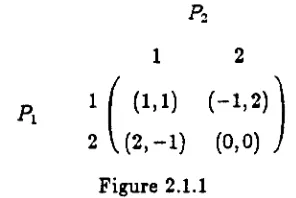
Consider the normal form of the game determined by the pay-off matrix given in Figure
2.1.1.
P2
12
Pl 1 (1'1) (-i'2)
2 (2, -1) (0,0)
Figure 2.1.1
The first entry in each outcome vector corresponds to the pay-off to Pi and the second entry
to P2. Occasionally only one entry in the matrix is required, due to symmetry or because
there is a relationship between the pay-offs to the players, but this will be made obvious by
the context of the example. We can see from Figure 2.1.1 that if both players make move 2
then they will both receive a pay-off of 0, whereas if Pl made move 1 when P2 made move 2,
then Pl would receive a pay-off of -1 and P2 would receive a pay-off of 2. The normal form is therefore an extremely simple representation of the game, and we shall concentrate on this
particular form.
The games that we are considering are almost exclusively two player games. Now this is
obviously a major restriction on the games that could be considered. However, a lot of the
ideas that we develop can be extended to games involving n>3 players, although the notation
becomes very messy. If the game being considered explicitly involves more than two players,
then the normal form of that game is less appropriate because many sets of matrices are
required. In this case the extensive form representation is more appropriate, but obviously the
game tree becomes more complicated. So as we are mainly considering two player games we
shall concentrate on the simpler normal form representation, and the players will generally be
labelled Pi and P2, as in Figure 2.1.1.
As we shall discuss in the next chapter, the theory of games was first developed for zero-sum
games, i. e. games where if PI received a pay-off of q from a particular outcome of the game,
then Pz would receive a pay-off of -q. Because of this it is only necessary to give the pay-off
to one player (by convention Pl) in the pay-off matrix. We are not going to restrict ourselves
to such games. Indeed most of the games that we consider will be non-zero-sum. The theory
that we shall develop will be applicable to these more general games and then zero-sum games
[image:13.518.172.320.86.185.2]the early literature are applicable to zero-sum games, but not to non-zero-sum games. Care
must obviously be taken when applying results from the specific case to the more general case,
and careless generalisations can produce inaccurate answers.
We shall consider the pay-off matrix to determine just that - the pay-offs. There seems to be some controversy as to whether the matrix determines the utility that a player gains from a particular outcome, or whether it simply determines the pay-off. If the matrix does
represent the utilities obtained, then this must take into account the complete utility from the
given outcome, including the outcome to the opponent and all aspects of the outcome in the
given game context. This will be achieved very rarely by a simple pay-off matrix, and different
people will then require different pay-off matrices. Also, this would appear to invalidate all
experimental studies as these provide pay-offs as the outcomes of the games, and do not allow
for any other ways that a player may obtain utility (e. g. receiving a higher pay-off than his
opponent, receiving the highest overall pay-off, etc. ).
Having to determine the utility function of the players then appears as a problem with the
approach that we are advocating. It is often assumed in the literature that utilities are linear
on pay-off (with perhaps a discount factor that discounts future pay-offs), but experiments
very rarely confirm this to be realistic. Therefore players must be allowed to have more general
forms of utility function. This is discussed further in chapter 6 of this thesis. Determining
one's own utility function can be a problem, but more of a problem is that of determining an
opponent's utility function, which is assumed to be unknown by the player concerned. This
therefore makes determining optimal moves a decision problem with incomplete information,
as the player is unsure about his opponent's utility function. The player is assumed to have
some beliefs about his opponent's utility function, and these beliefs can be used to determine
an optimal strategy. If, on the other hand, the player is assumed to know his opponent's utility
function, then the decision problem is simplified as it becomes a game of complete information.
The concept of complete information is distinct from, and should not be confused with, the
concept of perfect information mentioned above.
Also, as will be discussed in the next chapter, the classical approach to game theory con-
centrated on the stationary, one-play game. It was argued that the theory for this should be
determined before dynamic multi-play games were considered. In these multi-play games, we
that is repeated many times is referred to as a repeated game. Individual plays of the generating game are referred to as stages of the repeated games. The theory for one-play games rarely
carries over to multi-play games satisfactorily, and hence a new approach must be taken when
considering repeated games. Our theory is directed at these repeated games, and uses the fact that future interactions are likely to occur, to determine how to play the present stage of the
game. Having said this, our work can be used in the more specific area of games only played
once.
At each stage of this repeated game, each player has a choice between moves, as determined by the rows (or columns) of the pay-off matrix. A strategy for a player is a decision rule that determines a move for that player at every stage of the game, that depends on the move
sequence only through the previous outcomes of the game. A strategy that determines a specific
move at every stage of the game is referred to as a pure strategy. Strategies that are probabilistic
mixtures of these moves at any stage of the game are referred to as mixed strategies. Thus a
move will be determined by a mixed strategy by some independent event such as the outcome
of a toss of a coin, or the roll of a die. In games with complete information, a player may wish
to use a mixed strategy so that his opponent cannot determine the strategy being used, but
this may not be necessary for games with incomplete information. In some games, a particular
solution concept may determine the optimal strategy to be a mixed strategy, but we have the
following result.
THEOREM 2.1. (Harsanyi, 1977, pg. 102)
Let o be a mixed strategy for Pl that is a best reply to a strategy oa for P2 (i. e. no other feasible strategy obtains a higher utility against strategy 02). Then each pure strategy used
in a, with positive probability is also a best reply to 02, and so is any arbitrary probability
mixture of these pure strategies.
Mixed strategies can be used to determine equilibria and other solution concepts for various
games, as we shall see in the next section.
2.2 Solution Concepts and Classifications of Games.
The main solution concept that has been used in the literature is Nash Equilibria, and is
often given as the solution to any competitive game. An equilibrium is a pair of strategies,
neither player would have any reason to regret his strategy, if he found out the strategy of his opponent. Nash (see next chapter) proved the existence of such an equilibrium in all of the types of games that we are considering, but uniqueness is not guaranteed. In two player zero-sum games, the equilibria are easy to find by determining the saddle point - the element of the pay-off matrix that is the maximum in its row and the minimum in its column. Also in such games, the pay-off to both players from one equilibrium must equal the pay-off to both players from any other equilibrium, but such a result does not carry over to more general games.
Another concept common in the literature is that of a maximin strategy. The rnaximin strategy for a player is the strategy that maximises the minimum possible pay-off to that player. The strategy can be pure or mixed, and this maximum of minimum pay-offs is referred to as the player's security value. In two player zero-sum games, P2 can hold Pl to his (P1's) security
value by playing his (Pa's) maximin strategy. Therefore the maximin strategies determine an
equilibrium point, as neither can unilaterally do better than their security value. In more
general games, this result does not hold, as we can see from the following example.
P2
12
pl 1
((2,2)
(3,3)
2 (1,1) (4,4)
Figure 2.2.1
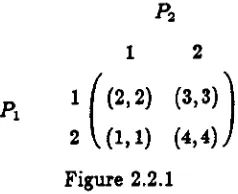
Consider the game determined by the pay-off matrix given in Figure 2.2.1. We can see from this that Pi's security value is 2 and is obtained by playing move 1. Also P2's security
value is 3 and is obtained by playing move 2. But the outcome when both players play their
maximin strategies is a pay-off to both players of 3, which is higher than Pi's security value.
The result is however not an equilibrium, as the only equilibrium for this game is where both
players make move 2, which results in a pay-off to both players of 4. This demonstrates that
in general cases, the maximum pair (i. e. when both players play their maximin strategies) is
not necessarily an equilibrium, and hence in this sense there is no obvious solution concept for
the game.
[image:16.515.192.311.353.450.2]Game Pay-off matrix Name (if any) Pure Strategy
... ... ... ...
[image:17.515.49.429.103.621.2]Equilibrium Points
...
1 4
2 1
3 - (1,1) and (2,2)
2 i
3) Trust (1,1) and (2,2)
3 (3
2) (1,1) and (2,2)
4 ( 4 ) (1ý1)
1 2
5 (3 4 2
1) Spite (1,1)
6 ( 4 3 ) (1ý 1)
2 1
7 (3
4 2)
1
Prisoner's Dilemma (2,2)
8 13 41 Convergence (1,1)
9 f3 i Chicken (1,2) and (2,1)
4 1
10 (2
1)
11 (2 3) Leader (1,2) and (2,1)
12 `2 4) Battle of the Sexes (1,2) and (2,1)
Figure 2.2.2
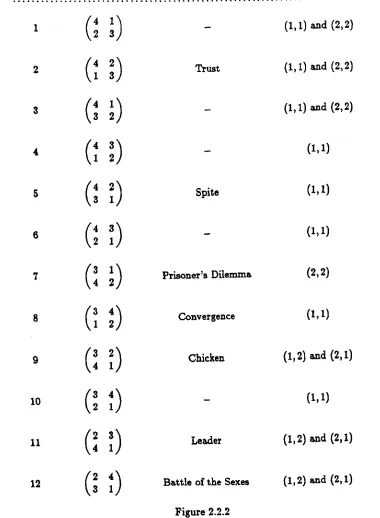
number of possible games. Figure 2.2.2 presents a classification of the distinct two player, two
move, symmetric games. A symmetric game is where the pay-off matrix for P2 is simply the transpose of the pay-off matrix for P1. Because of this we have only presented the pay-off matrices for P1. Also we have only ranked the pay-offs on a scale 1 (lowest) to 4 (highest) as this is sufficient to classify them.
Of these 12 games, eight possess either single equilibrium points, or equilibrium points that strictly dominate (obtain greater pay-off for both players) than all other equilibrium points,
and so are of only limited interest. The other four games (numbers 7,9,11 and 12) were described by Rapoport (1967) as the `archetypes' of the two player, two move games, and they have all attracted a lot of interest in the literature. The game that has attracted by far the
most interest in the game theoretic and experimental gaming literatures is game number 7
- the Prisoner's Dilemma game (PDG). This game is defined by the pay-off matrix given in
Figure 2.2.3, where C>A>D>B and 2A >B+C.
P2
12
P1 1AB
2CD
Figure 2.2.3
The name Prisoner's Dilemma comes from the following anecdote attributed to Albert Tucker. Two people have been arrested and charged with a serious crime. However the
police do not have any firm evidence with which to convict them unless one or other of the
accused confesses. The prisoners are held seperately and cannot communicate with each other. If neither confess (i. e. both make move 1) then they will both be charged with some minor
offence. If both confess (i. e. make move 2) then they will both be convicted and sent to jail
for a long time. However, if one confesses and the other doesn't, the person who confesses is set free and given a reward for giving Queen's evidence, whereas the other receives a very heavy jail scentence. So it is better for each prisoner to confess, irrespective of what the other
prisoner does, but if both refuse to confess, they both obtain a better outcome than if they
were to both confess.
game. An interesting background to the dilemma presented in this game is given in Rapoport & Chammah (1965). As we stated earlier, we shall be considering repeated games, and all
of the concepts discussed above are more applicable to one-play games. However, it would
appear that repetitions of the PDG would not produce any different results from those for the
one-play game, as one move dominates the other.
We say one move m in a pay-off matrix dominates another move m' for Pl, if for all strategies
available to P2, the pay-off from move m is greater than the pay-off from move m'. So we
can see that Defection (move 2) dominates Cooperation (move 1) in the PDG as C>A and
D>B. Also a stronger argument than this exists for using continual cooperation in a repeated
PDG. If the end point of the game is known, then Defection on the last move of the game
must be optimal. But the opponent is likely to do the same, and as mutual Defection will
therefore occur on the last move, Defection must be optimal for the penultimate move. This
process (called `extended rationality') can then be extended back throughout the game. Some
sociologists (for example, Hamburger, 1979) find this argument convincing enough to advocate
continual Defection at all stages of a repeated PDG. However, as we shall see later, players of
experimental repeated PDGs almost always obtain higher pay-offs than the continual mutual
Defection pay-off.
It has been argued (see the next chapter) that the key to effective play in repeated PDGs
is t6ielicit Cooperation in your opponent, so that mutual Cooperation can be achieved. One
of the most effective strategies for eliciting Cooperation has been Tit-for-Tat (TFT). This
strategy makes a Cooperative move on the first stage of a repeated game, and then simply
mimics the opponent's previous move on all subsequent stages of the game. It is claimed that
TFT does so well in repeated PDGs because it never Defects before its opponent does, both
Cooperation and Defection are immediately reciprocated, and it is clear to the opponent what
strategy is being used.
TFT would appear to be good at eliciting Cooperation from the opponent and maintaining
mutual Cooperation, but it does not take into account other effects such as the termination
time of the game. In most experimental studies, the end point of the game is assumed to be
unknown to the players and also to be independent of the choices of the players. Often the end
point is determined by a probabilistic procedure, with the probability of the game terminating
known, then various end-effects come into play. The effect of knowing the termination time of the game will depend upon the level of discounting of future pay-offs and the game conditions. As we shall discuss further in chapter 6 of this thesis, we shall make the assumption that the
end-point of the game is unknown, to avoid these end-point effects.
2.3 An Experimental Study.
To demonstrate the types of experimental games that have been performed, we shall briefly discuss one experimental study. In common with most experimental studies, the subjects used as players were all drawn from a particular population - in this case a group of undergraduate
students. These players were not allowed to communicate at all during the games, except to
indicate their chosen move at each stage of the game, which the two players did simultaneously. Again, as is generally done, the players were informed that an amount of money equal to
some increasing function of the sum of his pay-offs would be paid to each player when the
experimental study was over.
This study comprised two experimental games - labelled here G1 and G2. As we mentioned
above, in the majority of experimental games, the termination time of the game is unknown to
the players. However, in the games presented here all players were told that each game would
terminate after 20 stages. The subjects played the games facing their opponents, and so it was
obvious that they were playing against a fellow undergraduate, as opposed to any unknown
person, or indeed a computer. In between the games the players were changed around so that
all players had a different opponent for the second game to the one that they had for the first.
The first game played (G1) was the game defined by the symmetric pay-off matrix given in
Figure 2.3.1.
P2
1 2
1 2 -1
pl
2 3 0
Figure 2.3.1 - G1
players. However, in the experimental study, only one of the 18 players received a pay-off lower than 0, with most players receiving a significantly higher pay-off. This would suggest that the players managed to communicate (through their moves) their willingness to cooperate
with each other, rather than to continue with their dominating moves.
Another effect that has been previously discussed that is apparent in our example is a high
incidence of lock-in effects (see Rapoport & Chammah, 1965). This occurs when the players
seem to use a "training period" of only a few moves to learn about an opponent, and then play
future moves accordingly with long runs of either mutual Cooperation or mutual Defection
resulting. Many of the pairs that achieved a Cooperation lock-in, Defected on the last one
or two stages of the game, presumably applying the `extended rationality' argument outlined
above. This would suggest that the players were prepared to Cooperate with each other to
obtain a higher pay-off for themselves, but decided to Defect on the last couple of stages, either
to prevent being exploited themselves, or in response to a Defection on the previous move by
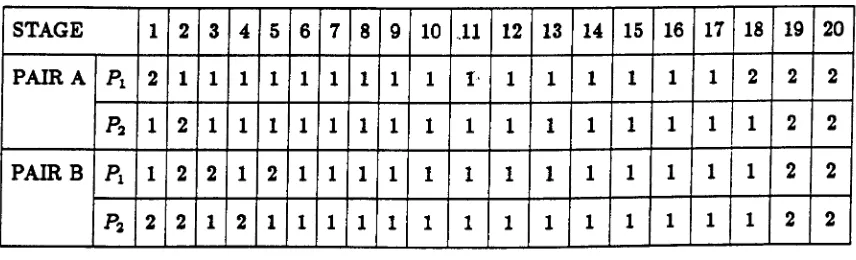
their opponent. Consider the results given in Figure 2.3.2 of two pairs of players playing this PDG.
STAGE 1 2 3 4 5 6 7 8 9 10
. 11 12 13 14 15 16 17 18 19 20
PAIR A Pl 2 1 1 1 1 1 1 1 1 1 1" 1 1 1 1 1 1 2 2 2
P2 1 2 1 1 1 1 1 1 1 1 1 1 1 1 1 1 1 1 2 2
PAIR B Pl 1 2 2 1 2 1 1 1 1 1 1 1 1 1 1 1 1 1 2 2
Pa 2 2 1 2 1 1 1 1 1 1 1 1 1 1 1 1 1 1 2 2
Figure 2.3.2
In both games the players had a training period of a few moves, far less for pair A than for pair B. After this, both pairs "locked-in" on mutual Cooperation, which was only broken towards the end of the game. Pair B both defected on the last two stages, therefore finishing
equal on points, whereas P, of pair A gained the upperhand by defecting on move 18, before P2.
The second game played (G2) was the game defined by the symmetric pay-off matrix given
[image:21.504.32.460.371.501.2]Pýl
1 2
1 4 3
p1
2 6 0
Figure 2.3.3 - G2
From Figure 2.2.2 we can see that this game is `Chicken', and has two pure strategy equilibria,
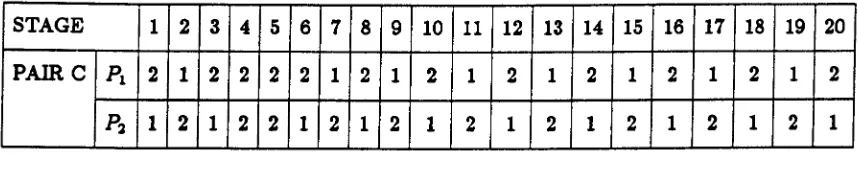
at (1,2) and (2,1). This game provided a good example of how tacit agreements can be made during a non-cooperative game. For instance, consider the results given in Figure 2.3.4 of a
pair playing this game.
STAGE 1 2 3 4 5 6 17 8 9 10 '11 12 13 14 15 16 17 18 19 20
PAIR C Pl 2 1 2 2 2 2 1 2 1 2 1 2 1 2 1 2 1 2 1 2
P2 1 2 1 2 2 1 2 1 2 1 2 1 2 1 2 1 2 1 2 1
Figure 2.3.4
In the above game, pair C settled into a run of alternating unilateral choices of move 1, after
a training period of 5 moves. This alternating strategy produces the highest mutual pay-off
of any feasible strategy. So in this game the players managed to "lock-in" to the alternating
strategy, but there was no incentive to break out of this at the end of the game, as this would
result in a loss in pay-off to the player who deviated.
It is interesting to note that the player who scored higher than all other players over both
games employed a strategy (in both games) that was very similar to the TFT strategy men-
tioned above. This strategy's effectiveness to elicit Cooperation from its opponent in G1, and
also its ability to maintain alternation in G2, enabled the player employing it to obtain higher
pay-offs than the other players. Several players managed at some point to find the optimal
mutual strategy combinations for the two games - mutual Cooperation in G1 and alternating
unilateral choice of move 1 in 02. Obviously not all players did as well as the pairs given as
examples above. These other players did not do so well for a variety of reasons - for example,
playing only their dominating move in G1, or playing seemingly randomly in G2.
Now from the `classical' game theoretic literature, it would seem unlikely that we would
[image:22.504.32.461.247.339.2]dominating move (move 2) in G1 and once one of the equilibrium pairs in G2 had been reached, there should be no reason to deviate from it. Yet this experimental study (and almost all others)
show that players can easily do better than the prescribed "good play". As we have stated, the `classical' game theoretic literature is mainly applicable to one-play, zero-sum games. The
games in this study are neither one-play nor zero-sum, and so it is perhaps not too surprising that we have obtained the above results. So the theory that we shall concentrate on will be applicable to the more general repeated, non-zero-sum games, and therefore to one-play,
zero-sum games as a special case.
In the next chapter we shall look more closely at the prescriptions of classical game theory,
3. GAME THEORY LITERATURE
3.1 Introduction.
Now we shall consider how the theory of decision making in these games, i. e. game theory, directs the players to the move that they should make at each stage of a game. We shall discuss the various `solution concepts' that have been proposed in the literature, and outline the goals that this theory has been directed towards. We shall also consider the results of the
experimental game literature, i. e. from actual plays of the games under consideration. These
games have been played by human against human, human against computer, and computer
against computer, and a wide range of results has been obtained. These experimental findings
can then be compared and contrasted with the recommendations of the game theory literature.
3.2 Game Theory Literature.
Game theory, as the mathematical approach to solving decision problems under conflict, be-
gan in the 1920s. Borel was perhaps the first to consider game theoretic problems, introducing
the notions of mixed and pure strategies. Just after this, von Neumann proved the minimax
theorem and created the theory of games with more than two players. These papers did not
receive much attention at all, until the publication of the classic von Neumann & Morgenstern
(1947) book. This lack of interest has been attributed to the high mathematical content of the
early papers. The von Neumann & Morgenstern book was less mathematical, and therefore
made game theory more available to other scientists and social scientists. It has also been
speculated that this new theory also provoked more interest because of its possible application
in the situations arising in the recent war.
Game theory was at this point considered to be a `panacea' to solve all human conflict
problems, and indeed researchers are still working on this `classical' approach to game theory
and determining new solution concepts. Luce & Raiffa (1957) was perhaps one of the earliest
works to stress the limitations of game theory, and since then game theory has been considered
to be a useful way of thinking about a given conflict problem. Research is now concentrated
on devising techniques for analysing these problems, and also determining why people make
the decisions that they are observed to.
for determining the solution of general n person zero-sum games, but also the theory of utility. This theory, although crucial to game theoretic solutions, is not explicitly part of game theory. A useful history of utility theory, and a full exhibition of the form of utility that we are
assuming here, is given in Savage (1954). Von Neumann & Morgenstern argued that equilibria
in static games needed to be determined before a useful dynamic theory could be developed. To initiate this they explicitly defined the complete concept of a game and then demonstrated the existence and method of determining a solution for all. zero-sum games.
The two player zero-sum game is solved by the minimax theorem, and the n player zero-sum
game (n > 3) is solved by considering a characteristic function.
THEOREM 3.1 - MINIMAX THEOREM. (von Neumann & Morgenstern, 1947)
In the domain of mixed strategies, every two player zero-sum game has at least one equi- librium pair, and where there are several, they are equivalent and the equilibrium strategies
are interchangeable. The common utility of the equilibrium pairs is known as the value of the
game.
An equilibrium pair in a game is a strategy pair where each player's equilibrium strategy determines an outcome that is the maximum entry in its column and the minimum entry in its
row of the pay-off matrix. The characteristic function is a real valued set function that satisfies
four simple conditions and determines the value of the game to various possible coalitions of
the players. Von Neumann & Morgenstern also extend these arguments to more general games by considering the decomposition of games into simpler games, and by extending the concept
of the characteristic functions to non-zero-sum games.
Luce & Raiffa (1957) parallels the work of von Neumann & Morgenstern, but from a less
mathematical slant, and so concentrate more on the concepts rather than on the solutions of
these games. Their work is presented from a social science point of view, and so they are mainly discussing the applicability of the mathematics as opposed to the mathematics itself. As well
as being the first work to present the ideas of von Neumann & Morgenstern (1947) in an easy
to follow style, Luce & Raiffa (1957) was amongst the first to consider a theory of repeated
plays of a game (a aupergame as they termed it), and also the importance of psychological
factors. They show that in a supergame correlated joint strategies can emerge, even including
dominated strategies. They also discuss what can be considered solutions to non-zero-sum
THEOREM 3.2. (Nash)
Every non-cooperative game with finite sets of pure strategies has at least one mixed strategy
equilibrium pair.
As a result of this theorem, equilibria in games are often referred to as `Nash equilibria'. It is clear that solutions to non-zero-sum games can be found by this approach if all equilibrium
pairs are interchangeable (i. e. have the same outcome for all of the players). Solutions can also be found if the equilibrium pairs are not interchangeable, by only allowing players to consider
strategies that are not dominated by any other strategy, and then determining equilibria for
this reduced game. Obviously in these non-zero--sum games, more factors have to be taken into account, as in these games an increase in pay-off to one player does not necessarily imply
a decrease in pay-off to another player, as it does in zero-sum games. Concepts that were
used in zero-sum games, such as maximin, can be extended to non-zero--sum games but the
corresponding results cannot always be directly applied to non-zero--sum games.
Two player, two move games have been classified (see Rapoport & Guyer, 1966 and the
symmetric classification in the previous chapter of this thesis), and whilst some specific named
games have been considered extensively, e. g. Prisoner's Dilemma (PDG), Chicken, Battle of
the Sexes, etc., others have not been considered in their own right at all. Of these named
games, the game that has been considered by far the most is the PDG, and we too shall
concentrate on this game. Often solutions have been determined for particular games, rather
than the whole class of 2x2 games, although claims are frequently made that the results easily
extend to the other games. One methodology that can extend across to the other games is that
of Howard's metagames. This is an approach that was briefly dicussed by von Neumann &
Morgenstern (1947) in terms of majorant and minorant games, and the theory was developed by Howard (1966a, 1966b, 1971) as discussed in chapter 4 of this thesis. A general discussion
of two player, two move games is given in Colman (1982), and also from a more psychological
aspect in Hamburger (1979).
When determining these equilibria, Shubik (1982) questions the use of mixed strategies in non-zero-sum games. Examples can be found where the players can obtain higher pay-
offs by deviating from their equilibrium strategies, if the opponent recognises the possibility
of this deviation. Therefore, the mixed strategy equilibria are not in general stable, and
cooperative solution concepts. Shubik also considers the possibility of correlated strategies in
non-cooperative non-zero-sum games. To be able to correlate strategies to mutual benefit,
players must be able to `communicate' with each other. As explicit communication is not
permitted, it can only be achieved through laws or social norms, or through threats in a
repeated game. We shall consider how a player can `communicate' and `learn' the strategies being employed, when developing our models.
The result of the minimax theorem can be extended to repeated zero-sum games, but the
extension to repeated non-zero-sum games is not obvious. Equilibria can be found in these
repeated games that obtain higher pay-offs than repeatedly playing the equilibria for the
generating game, and these equilibria in repeated games exist because of the threat of lower
pay-offs that each player has available. For example, in a repeated PDG, the mutual cooper-
ation outcome achieves a higher pay-off than the mutual defection outcome, but it is not in
equilibrium. It can be viewed as a sort of `repeated equilibrium' as the players are aware that
if they make a defection move, then their opponent is likely to respond with a defection, and
mutual defection is likely to result. This type of rationale is extended in the next chapter.
Aumann (1981) gives a survey of repeated games that is divided into games with complete
information and games with incomplete information. One important theorem for games with
complete information is what has been referred to as the "Folk Theorem".
THEOREM 3.3 - FOLK THEOREM.
The pay-offs to Nash equilibrium points in a supergame G* are the feasible individual
rational pay-offs in the generating game G.
In this theorem, pay-os are `feasible' if they are a convex combination of the pay-offs to pure
strategy n-tuples in G. This theorem therefore relates cooperative behaviour in a generating
game to non-cooperative behaviour in the associated supergame. One other approach to
multi-play equilibria is that of Selten (1975), which is termed perfect equilibria, and is based
on the possibility of a player trembling and making a different move to the intended move.
This is discussed in more detail in chapter 5 of this thesis, but its main characteristics are
that perfect equilibria cannot include any weakly dominated strategies, and the pay-o$'s from
perfect equilibria in the supergame are the same as repeated pay-offs from the Nash equilibria
in the generating game.
problem is that the actions of a player making use of his information can get mixed up with any
signals to his opponent. Therefore it is difficult for a player to determine the intentions of his
opponent from his opponent's moves, and so an infinite regress of the kind discussed in chapter 4 of this thesis is obtained. Taylor (1976) provides an interesting and amusing discussion of
repeated plays of a PDG with incomplete information. Taylor's main argument is against the
view that the only way to ensure mutual cooperation in such a game is to establish an authority that has enough power to make it in each player's interest to cooperate. He argues that mutual
cooperation can be achieved without any outside authority, and it is because subjects are used to living under such an authority, that they try to get away with as much as possible when this authority does not exist. That all this can be determined from a simple PDG is doubtful,
and there are problems with `ecological validity'. We will try to develop a method that can
take such factors into account, and this should be preferable to one that cannot.
An alternative angle of trying to achieve a resolution in conflict situations, i. e. trying to de-
termine ways for players to achieve the mutual cooperation outcome is considered by Rapoport (1974). He discusses his own experiences with the PDG and reviews some of the main fea-
tures of game theoretic reasoning. Rapoport claims that the effects of collective rationality
(as opposed to individual) can only be attained by either changing non-cooperative games to cooperative ones, or by completely abandoning individual rationality. He also argues that
the belief that the mutual defection outcome in a PDG is inevitable should lead people to
try to find agreements to turn the game into a cooperative one, and thus achieve the mutual
cooperation outcome. Rapoport's main concerns are that researchers should consider utility
maximisation rather than simply pursuing equilibria, and that questions of rationality in non-
zero-sum games should be considered as opposed to classical decision theory, and particularly
zero-sum mentality. The work presented here is in accordance with these concerns.
Another author who believes that game theory can be used to reduce tension in real world
problems is Osgood (1980). He puts forward a strategy named GRIT (Graduated and Recipro-
cated Initiatives in Tension-reduction), which is claimed to smooth a path toward negotiation. The strategy is specified by ten directives on the form of unilateral initiatives. These initia- tives are designed to induce unilateral responses by the opponent, and thus inducing further
rounds of reciprocations. Osgood claims that it was a strategy similar to GRIT that Kennedy
strategy could be used to achieve the ultimate goal of getting rid of all nuclear missiles from
the world. By using the players' beliefs, and knowledge of the problem, such strategies can be developed.
How these conflicts determine the evolution of species forms evolutionary game theory. The
main author in this field has been Maynard-Smith, with most of the relevant work summarised in Maynard-Smith (1982). The theory of evolution depends on the evolution being defined
upon the frequencies of the genes in the population, and that the frequency of a particular
gene increases if it increases the Darwinian fitness of its possessors. Here Darwinian fitness is defined to be the expected number of surviving offspring from a particular genotype.
The concept of an evolutionary stable strategy (ESS) is central to Maynard-Smith's approach,
which is a strategy such that if most of the members of a population adopt it, no mutant can
`invade' the population by natural selection. Maynard-Smith's achievement was to specify
this mathematically, and then determine the existence and characteristics of ESS's in different
populations. These models have stood up well to empirical evidence on a variety of animals and
insects (such as dung flies and digger wasps). Also of relevance is the work of Axelrod (1980b),
which proves the evolutionary stability of TFT in the tournaments that Axelrod organised.
It is clear that some games do not have an ESS and some have more than one. Work has
continued by other authors to find simple ways of determining whether or not a strategy is
an ESS. Bishop & Cannings (1978) showed that if a mixed strategy is an ESS, then all pure
strategy components of this mixed strategy obtain the same expected pay-offs as the ESS.
This proves very useful in the search for mixed strategy ESS. Haigh (1975) used the fact
that pay-offs can be expressed in matrix form to produce a simple algorithm for determining
whether a strategy is an ESS by simply checking the eigenvalues of a particular matrix. A
small mistake in this work is corrected by Abakuks (1980), and Bishop k Cannings (1976)
produce an essentially identical formulation.
ESS's in the first instance were set up in one-play games. However, there is obviously an
underlying dynamic game, as the population will develop over time. This leads to the concept
of dynamic equilibria in dynamic evolutionary games, and the stability of these equilibria (sta-
ble to perturbations of the strategies). It can be shown that in a continuous time evolutionary
game, every ESS is asymptotically stable (all close strategies tend to the equilibrium strategy),
der to determine stability and classify games up to topological equivalence. Zeeman also shows that elementary catastrophes can occur in these systems. Zeeman (1981) considers animal conflicts in such dynamic systems, and the effect of stability upon these. These evolutionary
stability concepts are related to the calibrated societies developed in chapter 6 below.
The concepts above form the classical approach to game theory, in terms of finding equilibria for mainly static games, although some work has been performed on dynamic, repeated games. Obviously there is a very wide and cross disciplinary literature on this subject and I have only
considered a few, hopefully pertinent, references. A further and rapidly growing literature on
a Bayesian approach to game theory, based on utility maximisation, is presented in chapter 5
of this thesis.
3.3 Experimental Game Literature.
After having discussed the literature on how people `ought' to play the types of games that we are considering, we now turn to how people have been observed to play these games.
Researchers have performed experiments to determine how people play several different sorts
of games, and these have been widely published. This has produced a vast and widely spread
literature with, as Rapoport (1974) points out, well over 200 experiments performed just on the PDG. These experiments have been performed for various reasons: to determine how different populations (e. g. sex) differ in play, responses to pre-programmed strategies, ability
to predict the play of the opponent, etc. Because of these different reasons, experiments have
been conducted in differing ways: in classrooms, in laboratories, or on computers, but the
underlying priciples are similar. We shall now consider some of these experimental games, and
point out their main conclusions.
Flood (1954a, 1954b) was one of the earliest authors to consider experimental games. His
work has mainly considered one player games against `nature' where a player makes a decision
at every stage of a repeated game, and is then informed whether this decision `won' or not.
Flood (1954a) shows that players have the ability to `learn' during such a game, and can therefore update and improve their strategies. This is comparable with the ideas of Wilson
(1986) that are extended in chapter 7 of this thesis. Flood (1954b) conducted two experiments to attempt to show that the behaviour of the subjects would be a pure strategy if the subject
there might be non-stationarity. The experimentation did not conclusively show this to be true or false, but offered more evidence in favour rather than in contradiction. Flood also
conducted several other experimental games (see Flood, 1958), and it is claimed that Flood
was the first person to experiment with the PDG.
Rapoport & Chammah (1965) gives an extensive study of repeated PDGs. They mainly
consider the changes in players' strategies during the game. They too are concerned with how
players learn as the game progresses, and consider various differing populations, the effects of differing games, and also of concealing the pay-off matrix. They discovered a tendency for the
rates of cooperation to decline initially, but then recover as the game continues. An interesting
result was that over 90% of the pairs playing these games had matched strategies (i. e. the same) by the end of the game. Unilateral responses were ruled out by the `. conversion' of the defector,
or the exploited deciding to give up hopes of converting the other. It was discovered that there
were significant differences between the sexes, but these differences almost disappear when a
male plays against a female. Rapoport and Chammah also claim that men are more prone
to the TFT strategy than women. Their results are however based on aggregate behaviour,
rather than trying to explain the reasoning of individuals. This thesis concentrates more on
how an individual attempts to maximise his expected utility.
Experimental games just involving computers have also been performed. For example, Ax-
elrod (1980a, 1980b, 1984) organised two tournaments in order to determine how to play a
PDG effectively. People were invited to send in computer programs and these came in from
researchers in many different disciplines. TFT won both of these tournaments, despite the fact
that it can at best only do as well as its opponent. Axelrod claimed that these experiments
show that a successful rule must be nice (never defect before the opponent), provocable (always
defect after an `uncalled for' defection) and forgiving (forgive defections on past stages of the
game). Axelrod (1980b) also considered the stability of the strategies in an evolutionary sense,
and Axelrod (1984) discusses collective stability (in terms of whether a group of strategies can
be `invaded' by another strategy). Rules for how to choose an effective strategy in a PDG in
such a setting, and how to promote cooperation in this PDG are also given.
The difference between the data generated by these competitions analysed by Axelrod and
most other experiments is that the programs were designed to achieve different aims to the
suggest that the programs were designed to play in a specific artificial environment, rather than in a general PDG. Therefore, the conclusions from the results of these competitions can not really be applicable to PDGs in general.
The aims of the programs were primarily to specify a strategy that would score more points than other strategies. The whole aspect of the two players collaborating to induce the mutual
cooperation outcome is lost, and the interaction between the two players does not lead to
an understanding of the other player, but merely how often the computer program chose to defect. Therefore, the players are not maximising utility on aggregate or even individual winnings, but on coming first in the tournament, and so a different form of rationality is in
operation. The programs were tailored for a computer tournament setting and, especially in the second tournament, contained features that would cope with events known to occur in the
competition. For example, a check to see whether the opponent was playing itself, or whether the opponent was in fact playing a random strategy - i. e. cooperating on each move with probability 0.5.
Because of these factors the results obtained in the tournaments do not appear to be typical
of the data obtained in other experimental games, where subjects playing the games were
human. From the results stated it seems that long runs of cooperation and defection were
apparent in these tournaments. The games between strategies that are both `nice' always
produced games of nothing but mutual cooperation. However, long ruts of continual defection
seem to be experienced by several programs when the opposing program was unresponsive to
cooperation, or appeared to be.
In contrast, whilst pairs of human subjects can maintain reasonably long runs of joint co-
operation occasionally and examples of joint defection are not impossible to find, much more typical are breaks in the sequences. If joint cooperation has been obtained, it is tempting for human players to try an occasional defection to see what happens, or what could be got
away with. Some programs were set up to do this, although they would not have led to a
new interaction learning position as humans typically do, but in most cases they led to mutual
defection. If two human players were in a state of mutual defection there would typically be
an occasional attempt to encourage the opponent to cooperate, which does not appear to be
a general feature of the computer programs.
niceness, forgiveness and provocability. Forgiveness and provocability are often features of how the human players tend to play such games, but less so is niceness. However, that these three factors are essential properties for general successful strategies is dubious and that there are only three is also doubtful. Axelrod's work provides an interesting discussion on what makes
a computer program that is designed to play another computer at a PDG successful. That it
says anything about how people ought to play a PDG is doubtful and therefore it is unlikely that it is a "primer" on how to play the PDG effectively, except in the given setting.
By extending Axelrod's comments a more general strategy could be determined that will do well in such a game setting. I believe that such a strategy would contain the three attributes
niceness, forgiveness and provocability, and also a fourth attribute: reciprocity, i. e. the ability to reciprocate the opponent's forgiveness (if any). These are all variable amounts, as they can be dependent on various lengths of past history, and effective for various numbers of future
moves. Therefore a player can determine his prior beliefs about the optimal amounts of these
attributes to maximise his utility. These can then be updated as more information is received.
This model is considered further in chapter 9.
Behr (1981) shows that the results of Axelrod's experiments are changed by altering what
a player's utility depends upon from best aggregate score to beating the opponent by the
most, on average. Also results are compared when the random strategy is taken out of the
analysis. TFT is no longer the best strategy, and in fact comes close to the bottom. Two non-
nice strategies appear to perform best, although the nice/non-nice effect is not significant.
Therefore correct specification of the utility function is crucial to the analysis of PDGs and
games in general, and we agree with Behr that the objectives of the players must be of primary
concern. So, realistic models must depend upon the game setting, and utility structure.
A comprehensive review of the literature on repeated PDGs and related games played by humans, is given in Colman (1982). This includes discussions on the proportions of players
using minimax strategies or achieving lock-in of defection or cooperation, the effects of varying
the relative magnitudes of pay-offs, the effects of circumstances of play, the effects of gender,
and the player's beliefs about his opponent. Colman claims that these results show that,
amongst other things, many players will reciprocate continual cooperation in a PDG, but
a large proportion will exploit it, and that TFT does not necessarily elicit more frequent