warwick.ac.uk/lib-publications
A Thesis Submitted for the Degree of PhD at the University of Warwick
Permanent WRAP URL:
http://wrap.warwick.ac.uk/106593/
Copyright and reuse:
This thesis is made available online and is protected by original copyright.
Please scroll down to view the document itself.
Please refer to the repository record for this item for information to help you to cite it.
Our policy information is available from the repository home page.
Construction, Characterisation and Utilisation of a Novel E. coll Expression Vector
by
STEPHEN P CHAMBERS
This thesis is presented for the degree of Doctor of Philosophy in the Department of Biological Sciences, University of Warwick.
This work was carried out between 1983-1987, while employed at the Biotechnology Division, Centre for Applied Microbiology & Research, Porton Down, Salisbury.
CONTENTS
List of Contents i
List of Figures viii
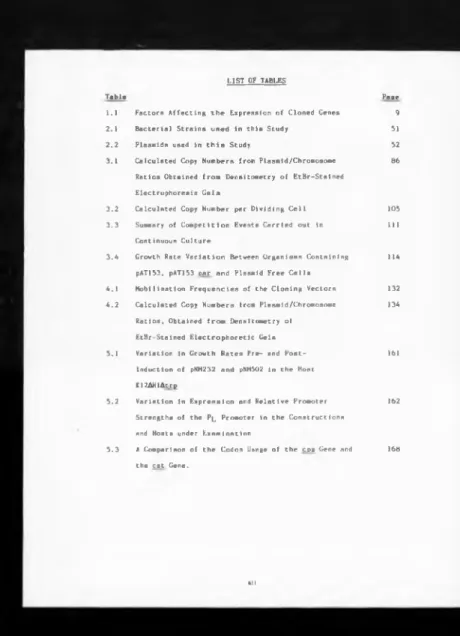
List of Tables xii
Abbreviations xiii
Acknowledgements xv
Summary xvi
CHAPTER 1 1
1 Introduction 1
1.1 Plasmids and Genetic Manipulation of E. coli 2
1.2 Plasmids as Cloning Vectors in E. coli 3
1.3 Plasmids as Expression Vectors in E. coli 6
1.4 High Expression of Cloned Genes 7
1.5 Promoters 8
1.5.1 Promoter Regulation 11
1.6 Translation Initiation Sequences 15
1.7 Plasmid Stability 16
1.7.1 Replication Control of the ColEl 16
Plasmids
1.7.2 Partitioning 21
l.R Plasmid Copy Number 25
1.9 Protein Stability 26
1.10 Host Physiology 29
1.11 Continuous Cultivation 30
1.11.1 Theory of Continuous Culture 30
1.12 Aims of Thesis 34
CHAPTER 2 3 7
2.1 Materials 3g
2.1.1 Chemicals 3g
2.1.2 Enzymes 3g
2.1.3 Media 3g
2.1.A Buffers 44
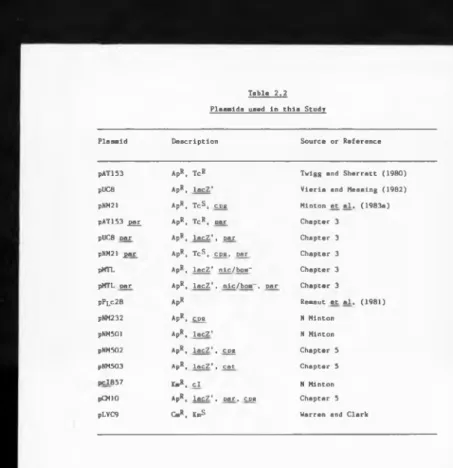
2.1.5 Bacterial Strains and Plasmids 5 1
2.2 Methods 5 3
2.2.1 Storage and Growth of Bacterial Strains 53
2.2.2 Beta-lactamase Plate Assay 53
2.2.3 Carboxypeptidase Plate Assay 54
2.2.4 Screening for Recombinants using X-Gal Plates 54
2.2.5 Transformation of E. coli Competent Cells 55
2.2.6 Small Scale Plasmid Preparations 55
2.2.7 Large Scale Plasmid Preparations 56
2.2.8 Isolation of Plasmid DNA by Centrifugation on a 57 CsCl Gradient
2.2.9 Plasmid Purification 5 7
2.2.9.1 Phenol Extraction of DNA 58
2.2.9.2 Precipitation of DNA 58
2.2.10 Treatment of DNA with Enzymes 59
2.2.10.1 Restriction Endonculease 59
2.2.10.2 T4 Polynucleotide Ligase 59
2.2.10.3 DNA Polymerase, Large Fragment (Klenow) 59
2.2.10.4 Alkaline Phosphatase 60
2.2.11 Agarose Gel Electrophoresis 61
Page
2.2.11.1 Vertical Gels 61
2.2.11.2 Mini Gels 61
2.2.11.3 Horizontal Gels 62
2.2.11.A Sizing DNA Fragments ¿2
2.2.11.3 Tracking Dye 5 2
2.2.12 Recovery of DNA from Agarose Gels 63
2.2.13 Quantitation of DNA ¿ 3
2.2.13.1 Spectrophotometric Determination of DNA 63
2.2.13.2 Diphenylamlne Assay 64
2.2.14 Sequencing with Chain Terminating Dideoxynucleotides 64
2.2.14.1 M13 Sequencing Vectors 64
2.2.14.2 Large Scale Preparation of Bacteriophage 66
2.2.14.3 Transfection 66
2.2.14.4 Preparation of Templates for Sequencing 66
2.2.14.5 Sequence Reactions 67
2.2.14.6 Acrylamide Gel Fraction 68
2.2.14.7 Running Conditions 68
2.2.14.8 Fixing and Autoradiography 69
2.2.15 Colony Hybridization 69
2.2.16 Carboxypeptidase Assay 70
2.2.17 Chloramphenicol Acetyl Transferase Assay 70
2.2.18 Beta-lactamase Assay 7 1
2.2.19 Protein Assay 7 1
2.2.20 Polyacrylamide Gel Electrophoreals 72
2.2.20.1 Linear Gel 72
2.2.20.2 Gradient Cel 72
2.2.20.4 Running Conditions 7 3
2.2.20.5 Staining and Destaining 73
2.2.20.6 Quantitation of Protein Components in 74
Gel Electrophoresis
2.2.21 Estimation of Copy Number 74
2.2.21.1 Measurement of Gene Dosage 74
2.2.21.2 Measurement of Plasmid/Chromosome Ratio 75
2.2.21.3 Definition of Plasmid Copy Number 75
2.2.22 Continuous Culture 77
2.2.22.1 Apparatus and Culture Conditions 77
CHAPTER 3 80
3. Effect of par Locus on Plasmid Stability, Copy Number 80
and Host Fitness
Introduction 81
Results and Discussion 82
3.1 Plasmid Stability under Continuous Cultivation 82
3.1.1 Stability of pAT153 82
3.1.2 Stability of pNM21 87
3.1.3 Stability of pATl53 £ar 91
3.1.4 Stability of pNM21 ¿ar 91
3.1.5 Stability of plJC8 91
3.1.6 Stability of pUC8 par 98
3.2 Can the Calculated Copy Numbers Account for the 98
Varying Instabilities of the Plasmids Examined?
3.3 Plasmid Copy Number Changes During Cultivation 106
3.4 Effect of par on Copy Number 108
Page
3.5 Effect of ¿ar on the 'Fitness' of Host 10b
Concluding Remarks 1 1 3
CHAPTER 4 H7
4. Construction snd Characterisation of a Series of Novel 117
Cloning Vectors
Introduction 1 1b
Results and Discussion 1 1b
4.1 Construction of the pMTL Backbone lib
4.2 Derivation of Novel Linker Regions 123
4.2.1 pMTL 20/21 123
4.2.2 pMTL 22/23 123
4.2.3 pHTL 24/25 129
4.3 Mobilisation of pMTL and pUC Vectors 129
4.4 Copy Number of pMTL and pUC Vectors 131
4.5 Sequence Variation Between pBR322 and pUCb 136
RNAI/RNAI1 Regions
4.6 Construction of pMTL par 13b
4.6.1 Stability of pMTL 20 £ar 138
Concluding Remarks 141
CHAPTER 5 147
5. Examination of P^ Promoter Systems 147
Introduction 148
Results and Discussion 151
5.2 Host Strains for Induction 153
5.3 Pl, Directed Expression of CPG2 in the Host 154
* 1 2 AHiAtrp
5.3.1 Effect of Copy Number on Expression 158
5.4 Pl Directed Expression of CPG2 in the Host W5445 163 5.4.1 What Effect Does Cloning the c £ Gene into 165
pNM502 Have on Induced Expression?
5.5 Pl Directed Expression of Chloramphenicol 166
Acetyl-transferase (CAT) in the Host W5445
5.6 Construction of pCMIO 170
5.7 Effect of Induction on Plasmid Stability 173
Concluding Remarks 177
CHAPTER 6 180
6. Scale-up of Production of CPG2 Utilising pCMIO 180
Introduction 181
Results and Discussion 181
6.1.1 Fermentation Medium 181
6.1.2 Seed Preparation 182
6.1.3 Fermentation 182
6.1.4 Harvesting 183
6.1.5 Monitoring of Culture 184
6.1.5.1 Culture Conditions 184
6.1.5.2 Biochemical Analysis 185
6.1.5.3 Genetic Analyais 185
6.2 15 1 Small Scale Culture 185
6.3 Large Scale Production Culture 190
vl
FlR
Page
1.1 The Origin of pBR322 5
1.2 A Schematic Representation of the Transcription 10
and Translation Processes
1.3 The Consensus Sequence and the -10 and -35 12
Regions of lac, t r p . PL, t a d and t a d I Promoters
1.4 Replication Control Region of ColEl 19
1.5 The pSClOl par Fragment 23
1.6 Nucleotide Sequence of c p r Gene 36
2.1 Standard Curve Used for the Determination of DNA 65
Concentrations
2.2 Estimation of Copy Number using the Plasmid/ 76
Chromosome Ratio
2.3 Flow Diagram of a Chemostat 78
3.1 Plasmid pBR322 83
3.2 Segregational Stability of pAT153 in the Host W 5 4 4 5 85
3.3 Plasmid pNM21 88
3.4 Segregational Stability of pNM21 in the Host W 5 4 4 5 89
3.5 Variation of CPG2 Expression and Segregational 90
Stability of pNM21 in the Host W5445 During Large Scale Fermentation
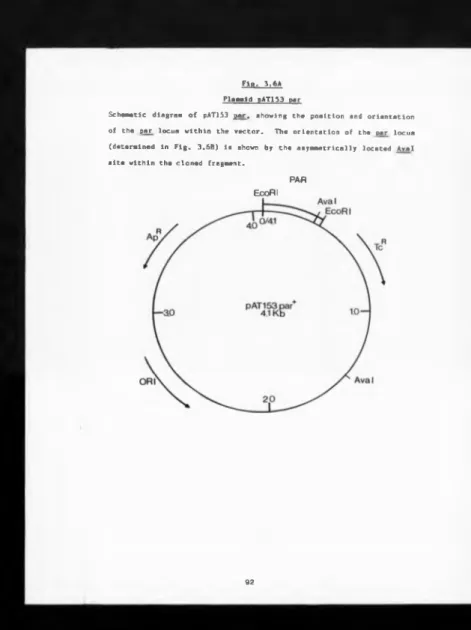
3.6a Plasmid pAT153 ¿ a £ 92
3.6b Determination of the Orientation of the par Locus 93
within pAT153 par
3.7 Segregational Stability of pAT153 par in the 94
Host W5445
3.8 Plasmid pNM21 ¿ar 95
LIST O F FIGURES
S * - fiu.
3.9 Segregational Stability of pNM21 par in the 96
Host W5445
3.10 Plasmid pUC8 97
3.11 Segregational Stability of pUC8 in the Host W5445 99
3.12 Plasmid pUC8 par 10 0
3.13 Segregational Stability of pUC8 ¿ar in the Host 101
W5445
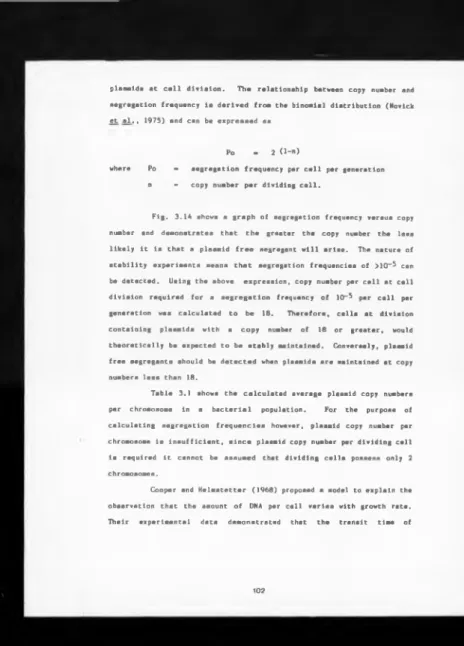
3.14 Copy Number and Segregation Frequency of Randomly 103
Partitioned Plasmids
3.15 Reduction in Copy Number of pAT153 During Continuous 107
Culture
3.16 Variation in Maintenance of pAT153 par and 112
pAT153 in a Population of W5445 at Steady State Under Phosphate Limitation Conditions
4.1 The pUC Series of Plasmids 1 1 9
4.2 The Relationship Between pBR322, pAT153 and 121
the pUC and pKTL Backbones
4.3 Construction of the pMTL Backbone 122
4.4 The Multiple Cloning Sites of the pMTL Vectors 124
and their Complementary Ml 3 Vectors
4.5 The Two Complementary Oligonucleotides used in the 125
Construction of the pMTL20 and pMTL21 Linkers
4.6 Restriction Digests of pMTL20 126
4.7 The Two Pairs of Complementary Oligonucleotides 127
F i ^ £§*£
4.8 The Construction of pMTL24 and pKTL25 130
4.9 Whole Cell Lysates Run on an Agarose Gel 135
4.10 DNA Sequencing Gel of the 3' Coding Sequence of the 137
RNAI/RNAII Region in pBR322 and pMTL/pUC
4.11 Segregational Stability of pKTL20 £ a r , pMTL20 and 140
pUC8 in the Host JM83
4.12 Nucleotide Sequence of pMTL20par 145
5.1 Expression of CPG2 by pNM830, when Regulated by the 149 Compatible plasmid pNM52 in the Host JM83.
5.2 Schematic Diagram of (a) pNM232 and (b) pNM502 152
5.3 Expression of CPG2 by pNM232 and pNM502 in the Host 156
K12AHlAtrp Carried Out in 1 1 Batch Cultures
5.3 Expression of CPG2 by pNM232 and pNM502 in the 157
Host K12AHlAtrp Carried Out in 5 1 Batch Cultures
5.4 Copy Number of pNM232 and pNM502 Pre- and 159
Post-Induction in the Host K12AHlAtr£
5.5 Expression of CPG2 by pNM232 and pNM502 in the Host 164
W5445 Carried out in 5 1 Batch Cultures
5.6 Expression of CPG2 by pNM502 cl in the Host 167
W5445 Carried out in 5 1 Batch Cultures
5.7 Construction of pCMIO 171
5.8 Expression of CPG2 by pCMIO in the Host W5445 172
Carried out in 5 1 Batch Cultures
5.9 Segregational Stability of pNM232 and pNM502 when 174
Induced in the Host K12AHlAt££
5.10 Segregational Stability of pNM232 and pNM502 with 176
pcI857 and pNM502 cl and pCMIO in the Host W5445
6.1 Fermentation Parameters of a 15 1 Small-Scale 187
Zi&i.
6.2 Levels of CPG2 Expression During Fermentation of IS 1 S m all Scale Culture
6.3 Segregational Stability of pCMIO in W5445 During 15 1 S m all Scale Culture
6.4 Fermentation Parameters of Seed Culture
6.5 Fermentation Parameters of Production Culture
6.6a Levels of CPG2 Expression During Fermentation of
Production Culture
6.6b Levels of CPG2 Expression During Fermentation of
Production Culture as Observed on an SDS PAGE 6.7 Segregational Stability of pCMIO in W5445 During
Production Culture
6 .8 Variation of Copy Number During Fermentation
Page 188
189
191 192
193
194
195
LIST OF TABLES
Table Page
1.1 Factors Affecting the Expression of Cloned Genes 9
2.1 Bacterial Strains used in this Study 51
2.2 Plasmids used in t h i s Study 52
3.1 Calculated Copy Numbers from Plasmid/Chromosome 86
Ratios Obtained from Densitometry of EtBr-Stained Electrophoresis G els
3.2 Calculated Copy Number per Dividing Cell 105
3.3 Summary of Competition Events Carried out in 111
Continuous Culture
3.4 Growth Rate Variation Between Organisms Containing 114
pAT153, pAT153 par and Plasmid Free Cells
4.1 Mobilisation Frequencies of the Cloning Vectors 132
4.2 Calculated Copy Numbers from Plasmid/Chromosome 134
Ratios, Obtained from Densitometry of EtBr-Stalned Electrophoretic Gels
5.1 Variation in Growth Rates Pre- and Post- 161
Induction of pNM232 and pNM502 in the Host K12AH1 At_rg
5.2 Variation in Expression and Relative Promoter 162
Strengths of the Pl Promoter in the Constructions and Hosts under Examination
5.3 A Comparison of the Codon Usage of the cpg Gene and 168
the cat Gene.
ABBREVIATIONS ccc kb bp kD R
S
Ap Tc Km CmOKI
KBS
SDKOP
nar mKNA X-Ca 11PTÜ
USA DTNbSUS
UTT Ll/I'AEt
Hr
CAT CPG2
£ M
covalently cloaed circular
kilo base base pair kilo dalton resistant sensitive ampicillin tetracycline kanamycin chloramphenicol origin ot replication ribosome binding site
Shine balgarno repressor of primer partition function
messenger KNA
5-bromo-4-chloro-3-indoyl-Betn-D-galactopyranoside
isopropyl-Beta-D-thiogalactoside
bovine serum albumin
5.5. dithio-bis-2-nitroben*oic acid
sodium dodecyl sulphate dlthlothreitol
ethylene diamine tetra acetic acid
ethldlum bromide
chloramphenicol acetyl tranmierase carboxypeptidase C2
bla tet lacZ cat PAGE APS ATP dNTP ddNTP CIP PEG TEHED OD UV V mA g nm kla DOT rpm LDW pai vvm w/v v/v ACGM
beta-lactamase gene tetracycline resistance gene beta-galactosidase gene
chloramphenicol acetyl transferase gene polyacrylamide gel electrophoresis
ammonium persulphate adenosine triphosphate deoxynucleotide triphosphate dideoxynucleotide triphosphate calf intestinal phosphatase poly ethylene glycol tetramethyl ethylene diamine optical density
ultra violet volts milli Amps
c e n t r i p e t a l f o r c e equal to g r a v i t a t i o n a l acceleration
nano meters
volumetric oxygen transfer coefficient dissolved oxygen tension
revolutions per min Lab. dry weight
pounds per square inch
volume of air/volume of culture/min weight to volume ratio
volume to volume ratio
Advisory Committee on Genetic Manipulation
ACKNOWLEDGEMENTS
I should like to thank my supervisors R Sharp, N M ann and N Minton who have provided help and advice during the course of this work. I am also particularly indebted to Professor T Atkinson for his
constant encouragement.
I would also like to thank Val Lancaster for typing this
SUMMARY
At the onset of this thesis the aim was to design and develop an expression system capable of producing high levels of expression of
carboxypeptidase (CPG2). The previous plasmid employed (pNM21)
delivered relatively low and variable levels of CPG2.
Plasmid segregational instability had been thought to be a potential cause of low yields of C P G2. The affect of the par locus on the stability of a series of related plasmids was examined. The utilisation of par within a vector did enhance its stability and fitness when examined under continuous cultivation. The par locus was therefore considered to be of significant value to an expression vector.
The par locus subsequently became an integral feature
incorporated into any vector to be constructed. The copy numbers of the series of plasmids examined for stability revealed that pUC8 exhibited a higher copy number than pAT153. To investigate more fully this anomaly, a vector was constructed which provided the backbone for a series of cloning vectors (the pMTL series) and allowed the copy number variation to be examined. Sequencing pAT153 and pUC8 revealed a single base change, which could account for the copy number variation. The increase in copy number of pl)C8 over pAT153 was incorporated in the pMTL series of vectors.
The induced expression of CPG2 was investigated using the Pl
promoter on a high copy number vector, exhibiting the aforementioned base change. Incomplete repression of the Pl promoter resulted when the c_I gene was located in the chromosome or on a co-resident low copy number vector. The high copy number of the vector and the Pl operator it carried, titrates out the effectiveness of the cl repressor molecule. This problem was overcome by incorporation of the £l gene into the Pl expression vector, elevating the gene dosage of the cl_ gene, sufficient to repress the Pl promoter.
The features investigated were combined in an expression vector pCMIO and used to express CPG2 in a series of small scale fermentations. The process was then scaled up to a 400 L fermentation, and a suitable process for large scale production developed.
INTRODUCTION
1.1 Plasmids and Genetic Manipulation in E. coll
Plasmids are autonomous, extrachromosomal genetic elements
found in a wide variety of Gram-positive and Gram-negative bacteria. Plasmids usually exist within cells as double stranded, covalently
closed circular (ccc) DNA molecules (Clewell and Helinski, 1969). They range in aize from 1 kb to greater than 200 kb. Plasmids often confer a wide range of biological functions on the host cell, which can be used as phenotypic markers when selecting cells containing the plasmid. Plasmids may also specify the ability to transfer themselves from the host cell (donor) to a recipient cell by conjugation, which involves direct cell to cell contact. A method known as transformation, has been developed whereby naked plasmid DNA can be introduced into E. coli c e lls (Mandel and Higa, 1970; Cohen et al.. 1972). The new phenotype conferred on the recipient by the plasmid (e.g., resistance to an antibiotic) allows a simple method of selection of cells which have
been successfully transformed.
Along with the ability to isolate and transform plasmid DNA from one bacteria strain to another, the discovery of site specific restriction endonucleases (Roberts, 1981), particularly type II enzymes
(Smith and Wilcox, 1970), made it possible to manipulate DNA molecules in vit r o . Type II enzymes cleave duplex DNA to produce fully double-
a l . . 1975) and transformed into E. coli cells. Blunt-ended DNA fragments can also be joined by the use of T4 p o l y n ucleotide ligase
(Heyneker e £ a l . . 1976). Further methods for joining together DNA molecules have been developed. The enzyme terminal-deoxynucleotidyl transf e r a s e ( C h a n g and Bollum, 1974) can be used to add homopolynucleotide tails to DNA fragments to be joined. After mixing and annealing such DNA molecules can then be used directly to transform E. coli where repair of single-stranded gaps occur ii> vivo (Hutchison and Halvorson, 1980). Synthetic DNA fragments (linkers) can also be used for linking together DNA molecules (Manlatis et a l . . 1978).
1.2 Plasmids a s Cloning Vectors in E. coli
To be useful as a cloning vector, a plasmid should possess several properties. It should have a low molecular weight, making the
plasmid more resistant to damage by shearing and therefore easier to handle. Also a large number of plasmid copies should be present in
the cell. High copy number plasmids, facilitate isolation and
manipulation of the plasmid DNA. It should also carry one or more selectable markers to allow identification of transformants and to maintain the plasmid in the bacterial population. Another requirement of a cloning vector is that it contains a single recognition site for one or more restriction enzymes in regions of the plasmid that are not essential for replication. Preferably, these restriction sites, into which foreign DNA can be inserted, should be located within the genes coding for selectable markers so that insertion of a foreign DNA fragment Inactivates the gene. Finally, the cloning vector should
Although some 'natural' plasmids have been used as cloning
vectors most cloning experiments now make use of 'purpose-built'
vectors which are themselves the product of in vitro gene
manipulations. ColEl is a naturally occurring plasmid which is the progenitor of many of the cloning vectors used. pBR322 is one of the more widely known cloning vectors, utilising the ColEl replicón while
substituting colicin El immunity and production (which are not
convenient genetic markers) w i t h the beta-lactamase (bla) and tetracycline resistance (tet) genes of RSF2124 and pSClOl respectively (Fig. 1.1) (Bolivar e £ a l . . 1977a, b). pBR322 exhibits many of the qualities required by a successful cloning vector, a low molecular weight (2.6 MD), with a relatively high copy number of 30 copies per cell, containing bla and tet genes as genetic markers and a number of convenient restriction sites within these marker genes.
A whole generation of cloning vectors have developed from
pBR322, improving on the basic requirements for a cloning vector achieved by pBR322. (for review see Baibas et .al., 1986). pAT153 was constructed by the removal of the H a e ll B and G fragments from pBR322, resulting in 3-fold increase in its copy number (Twigg and Sherratt,
1980). This additional advantage of increased levels of plasmid
content results in an increase in gene dosage of the plasmid specified
gene products. A further extension to the usefulness of cloning vectors has been made by inserting polylinkers, containing closely
spaced sites for several restriction enzymes, into non-essential
regions of the vector (Davison et al.. 1984; Heusteraprente and Davison, 1984; Heustersprente et^ a l . . 1985). Another development of
the cloning vector was made by Vieria and Messing (1982) who
The Origin of pBR322
The plasmid pBR322 was constructed from the his and tet penes of the
trsnsposon Tnl from RSF2124 and pSClOl respectively, combined with replication elements of a ColF.l-like plasmid.
7
W
U
3
i¥
H
0
3
from pBR322, provides the cloning vector with its replicon and the ampicillin resistance (ApR) antibiotic marker. In addition the pUC plasmids contain multiple restriction site polylinkers within the coding region of the alpha-peptide of the E. coli lacZ gene product (Langley e £ a l . , 1975). Cloning into the polylinker region results in inactivation of the lacZ', so that the plasmid in a suitable E. coli host produces white colonies on medium containing 5-bromo-4-chloro-3- indoyl-beta-D-galacto-pyranoside (X-Gal), in contrast to the parental
blue colour (Messing, 1983).
As with pBR322, the pUC series of plasmids have spawned a whole new generation of cloning vectors, each one slightly improving on the basic requirements of a cloning vector. An ever increasing number of unique restriction sites within the alpha-peptide coding sequence of lacZ' (Norrander et a l . . 1983) and various copy number derivatives have
also been developed (Stewart et al.., 1986a,b).
1.3 Plasmids as Expression Vectors in E. coli
Cloning vectors such as pBR322 and pAT153 can be employed as expression vectors, utilising the bla or tet gene promoters (Minton et. a l . . 1983a). Unfortunately these promoters are partially constitutive and therefore provide unregulated expression which can be lethal to the cell. The pUC series of plasmids can also be used to obtain expression of cloned DNA as lacZ fusions when joined in-phase with the reading frame of the alpha-peptide. The regulation of transcription can be achieved in strains that overproduce the lacl encoded repressor (laclQ) by the addition of an inducer such as lactose, or its synthetic analogue, isopropyl-beta-D-thiogalactoaide (IPTG).
products, the synthetic genes coding for the hormones somatostatin (Itakura et a l ., 1977) and the Insulin A and B chains (Goeddel et al., 1979b), utilised cloning vectors. Once the foreign gene was in the cloning vector, it was put under transcriptional control by cloning a DNA cartridge containing the regulatory regions of lac upstream of the
synthetic genes. The strategy for expression of heterologous or
foreign protein has subsequently become more sophisticated and now a wide variety of expression vectors are available, into which a gene can be cloned and expression regulated.
1.4 High Expression of Cloned Genes
Much of the interest surrounding .in vitro gene manipulation involves the commercial exploitation of bacteria to produce foreign proteins such as those from human, animal or viral sources. Detectable
expression is no longer sufficient to satisfy the demands of
production, high expression of the gene product is required.
Nature has provided us with many examples of the
overproduction of gene products by bacteria. In E. coli the ribosomal proteins are one classic example; the related protein elongation factor Tu, for instance, can accumulate to 5Z of the soluble cell protein. At the extreme, infection of E. coli with bacteriophages T4 or T7, leads
post-translational processing (Table 1.1). A failure to perform
correctly any one of these processes can result in the failure of a given gene to be expressed. It is the role of an expression vector to
maximise expression; this can be done at specific stages of the process and determines the components essential for an expression vector.
1.5 Promoters
To obtain high expression of a cloned gene transcription
should be maximised using a strong promoter. A promoter is a DNA sequence that directs DNA dependent RNA polymerase to bind to DNA and
to initiate RNA synthesis. Strong promoters cause mRNAs to be
initiated at high frequency; while weak promoters direct the synthesis
of rarer transcripts. A large number of promoters for E. coli RNA polymerase have been analysed (Hawley and McClure, 1983); comparison of
the sequences reveals two highly conserved regions, one located about 10 bp (-10 region or Pribnow box; Pribnow, 1975) and the other about 35 bp ( - 3 5 region) upstream from the point at which transcription starts (+1) (Rosenberg and Court, 1979) (Fig. 1.2). These two regions are thought to be important in determining promoter strength because mutations that decrease the frequency of transcription usually decrease the amount of homology with these conserved sequences. Other more moderately conserved regions of promoters may also contribute to
promoter strength. Also, the number of nucleotides that separate the conserved sequences is important for efficient promoter function.
Mutations altering the spacing between the -10 region and -35 region in a lac promoter (Stefano and Gralla, 1982), and in the beta-lactamase promoter (Jaurin et a l ., 1981), change the strength of the promoter. Hawley and McClure (1983) found that in all cases the promoter strength
Factors Affecting the Expression of Cloned Genes
Promoter strength
Translation initiation sequences
Codon choice
Transcriptional termination
Plasmid copy number Plasmid stability Protein stability Host cell physiology
an
d Tran
sl
at
ion
was stronger if the spacing was moved closer to 17 bp and weaker if moved further away from 17 bp. Of t h e three E. coli promoters, lac UV5, trp and the Pl promoter from coliphage lambda, most widely used in expression vectors, none shows absolute identity with the consensus sequence (Fig. 1.3). In terms of transcriptional strength yet more efficient promoters have been made which are hybrids of the trp and lac UV5 promoters. The two synthetic hybrid promoters tac I and tael I were eleven and eight times stronger than the lac promoter (deBoer et^ al_.,
1983).
Many E. coli genes are controlled by relatively weak
promoters, therefore the expression of such genes can be increased by placing them downstream from efficient promoters. Eukaryotic promoters function extremely poorly, if at all, in E. c o l i . and efficient expression of eukaryotic proteins has been achieved only when the
coding sequence is placed under the control of a strong E. coli
promoter.
The effect of introducing a strong promoter into a vector must a l s o be taken into account. Readthrough beyond the gene of
interest can be an unnecessary energy drain on the cell, producing transcripts coding for non-essential protein. Also transcription from the promoter may interfere with a n essential or regulatory gene (Stueber and Bujard, 1982). Transcription terminators at the end of the clo n e d gene will prevent the deleterious effects of readthrough
from a strong promoter (Gentz et a l . . 1981).
1.5.1 Promoter Regulation
The Consensus Sequence, and the -10 and -35 Regions of lac, trp. Pt„ tael and t e d i P r o c t e r s
F ia . 1 .3
-35 REGION -10 REGION
Consensus T T G A C
lac T T T A C
t££ T T G A C
T T G A C
tael T T G A C
taci I T T G A C
A T A T > H
A T A T A T T
A T T A A C T
A G A T A C T
A T A T A A T
A T T T A A T
constitutive expression was capable of producing human growth hormone (Goeddel et a l ., 1979a) and calf prochymosin (Emtage et a l ., 1983) as
5X of the cells soluble protein, various problems emerged. It was found that in the absence of any selection for plasmids expressing the desired gene product, plssmid-free cells frequently appeared (Imanaka «t al.. 1980; Steuber and Bujard, 1982; Skogman et al., 1983). Freed from the plasmid burden, these cells proved to have a growth advantage
over those carrying the expressing plasmid (Caulcott et a J L , 1985) and could therefore outgrow plasmid-bearing cells during a fermentation. As a result it is quite possible, during a production process involving several inoculum stages, for the proportion of cellular population
carrying the plasmid to fall considerably. The discovery of these problems led to a general appreciation of the fact that expression of
recombinant protein was a burden on the host cell (Carrier et a l . ,
1983).
An alternative solution to this problem would be to operate a biological or metabolic switch that would enable product expression to be turned on and off, dividing cell growth and cell biosynthesis into two distinct phases. The switching on of a promoter at a stage in growth when cell denaities are at their highest will result in the maximum protein synthesising capacity of the culture being achieved.
(Miller and Reznikoff, 1978). The tr£ promoter, regulated by the tr£
repressor, can be induced by the addition of 3— indolylacetic acid or 3- indoleacrylie acid to the medium (Morse et al., 1970). This promoter can also be regulated by the removal of a nutrient e . g . , tryptophan depletion; the trp promoter being induced by tryptophan starvation (Miller and Reznikoff, 1978).
Unfortunately, metabolic promoters on high copy number
plasmids have not proved very successful. In general, control of such systems is by a repressor protein synthesised from a single gene copy on the host chromosome. For example, in the absence of lactose, the lac repressor protein binds to the promoter region and switches off expression of any genes under its control. In the presence of lactose, it binds to the repressor protein, preventing it from binding to the lac promoter/operator. It has been shown that on high copy number
plasmids the lac operator cannot be solely controlled by the
chromosomal repressor gene (O'Farrell et a l .. 1978; Lee and Bailey, 1984) since there are insufficient repressor molecules. A similar situation occurs with the trp promoter system. Here the repressor protein is activated by tryptophan, and is then able to switch off the trp promoter. However, if present on a high copy number plasmid, the number of trp promoters in a cell would almost certainly titrate out the amount of trp repressor protein synthesized from the chromosomal
gene (Hallewell and Emtage, 1980).
Metabolically-controlled promoters have in general been
superceded by temperature controlled systems. Pl, the leftward
promoter of bacteriophage lambda, provides a strong promoter system
controllable by the temperature-sensitive lambda repressor gene
product, cI857 (Isaacs et a l . , 1965). T h i s gene product is denatured
at temperatures above 37°C, allowing initiation of transcription at the PL promoter when the culture is raised above 37°C. T h i s promoter has proved to be the most successful for expression vector systems (Remaut et al., 1981) and their commercial exploitation (Simons et al., 1984; Waldman et al., 1983; Liu and Milman, 1983).
1.6 Translation Initiation Sequences
The efficiency of translation can also be influenced by manipulating the secondary structure of the ribosome-binding sites
(RBS) (Gren, 1984). Efficient translation depends on ribosomes
recognising the initiation codon (AUG) at the start of a gene sequence. With most E. coli genes translation is initiated after a ribosome binds to the mRNA at the RBS. This is a region which i s 3-9 nucleotides long, located 3-11 nucleotides upstream from the initiation codon
(Shine and Dalgarno, 1975; Steitz, 1979) known as t h e Shine-Dalgarno (SD) sequence. It contains part of the sequence 5'-AGGAGGUG-3' which is complementary to the 3 ’ terminus of the 16S ribosomal RNA (- CACCUCCUAOH). Binding of the ribosome to mRNA i s thought to be promoted by base pairing between the SD sequence in the mRNA and the sequence at the 3'end of the 16S ribosomal RNA. The degree of complementation between these two sequences will therefore have a marked effect on the efficiency of translation of the mRNA. When
the initiation codon of the beta-interferon gene (Shepard et al_., 1982). T h e composition of the triplet immediately preceding the A U G
start codon also affects the efficiency of translation. F o r
translation of beta-galactosidase mRNA the most favourable combinations
of bases in this triplet are UAU and CUU. If UUC, UCA or AGG r e p l a c e UAU or C U U the level of expression was 20-fold less (Hui et al.. 1984). Consensus RBS sequences have been made from hybrid and synthetic constructions but have met with limited success (Crowl et a l ., 1985).
1.7 Plasmid Stability
Although sc®ational stability of plasmids is not
considered to be a problem at the laboratory scale, in large s c a l e production, however, plasmid instability can pose a very ser i o u s problem. The use of antibiotics at this scale is not desirable b ecause of effectiveness, cost and waste disposal considerations.
In order that plasmids are maintained within bacteria cells,
they must replicate at least once before cell division and be
accurately partitioned to ensure that each daughter cell receives at least one plasmid copy at cell division.
1.7.1 Repllcstlon Control of the ColEl Plasmids
Plasmid ColEl is a small (6 . 6 kb) multicopy plasmid w h o s e replication has been extensively studied both ^n vitro and jji v i v o
(Staudenbauer, 1978a). Since the ColEl replicon is the replicon u s e d in the vectors studied in this thesis, its replicstion properties a r e discussed (for reviews see Scott, 1984; Cessreni end Banner, 1985).
ColEl has been shown to replicate unidirectionally from a
fixed origin (Lovett et a l ., 1974) by Cairns-type replication
(Inselburg and Fuke, 1971) and more recent studies have demonstrated that initiation of ColEl DNA synthesis occurs at either one of 3 consecutive bases in the replication origin (Tomizawa et al,., 1977).
Electron microscopic analysis of intermediates of ColEl replication in the presence and absence of various DNA gene products led to the proposal of a two-stage model for ColEl replication (Staudenbauer, 1978b). DNA Polymerase I extends the DNA chain from the RNA primer for 500 nucleotides, whereupon DNA Polymerase III continues to synthesise DNA on both strands. This explains why ColEl, unlike many other plasmids has an absolute dependence on Poll for replication (Kingsbury and Helinski, 1973). The observation that ColEl plasmids
could replicate for 10 - 15 hours after the addition of
chloramphenicol, an inhibitor of protein synthesis, demonstrated that ColEl does not require any plasmid encoded proteins for replication
(Clewell, 1972). Moreover, since bacterial replication cannot
continue, the host proteins necessary for ColEl replication must be
stable.
ColEl replication is, however, sensitive to rifampicin, an RNA polymerase inhibitor, which first indicated that an RNA primer may be involved in the replication of this plasmid (Clewell, 1972). The first direct evidence that ColEl specified an RNA primer came from Itoh and Tomizawa (1980) w h o demonstrated ill vitro that an RNA transcript initiating 555 bp upstream of the defined origin, was cleaved by RNAase
H indicating that an RNA-DNA hybrid was formed. After cleavage, DNA polymerase I added deoxyribonucleotides to the primer RNA (RNA II).
a small RNA molecule RNAI (108 nucleotides), which is encoded within the region specifying the pre-primer RNAII (Tomizawa et a l . t 1981). In order for inhibition by the anti-sense RNA molecule to be effective, RNAI binding to the pre-primer RNAII must occur prior to the extension of RNAII to the replication origin (Tomizawa and Itoh, 1981). Both
RNAI and RNAII have the capacity to form three stem-loop structures (Morita and Oka, 1979) and the importance of secondary structure to RNAII processing has been demonstrated by replacing 'G' residues with inosine which weakly p a irs with 'C' residues, disrupting secondary
structure and inhibiting maturation of the primer.
Many in vitro experiments have suggested a mechanism for the binding of RNAI to the RNAII pre-primer (Tomizawa and Som, 1984) (Fig. 1.4). Inc mutations within any of the three single stranded loop
regions, which do not alter the secondary structure of RNAI but affect the binding rate of RNAI t o RNAII, demonstrated the importance of the loop regions to the binding process. Furthermore, the 5' end of RNAI
is involved, since its removal greatly reduced the binding activity of RNAI to RNAII although o n c e again the secondary structure of RNAI was
not altered.
From these observations the "stepwise pairing model" was proposed. Initially, RNAI and RNAII form stem-loop structures; the two molecules make transient contact, termed "kissing", at the single stranded loops. This contact facilitates pairing at the 5' end of RNAI, which then propagates along the entire length of RNAI/RNAII, forming stable binding. In addition to RNAI, ColEl specifies a second
product called ROP (repressor of primer) which is involved in
replication control. T h e construction of a ColEl deletion derivative exhibiting a higher copy number which could be reduced in trans by
ColK, first suggested that snother region of ColEl was involved in copy number control (Twigg and Sherratt, 1980). Later, Cesareni et a l .
(1982) suggested that the rop gene located between the ColEl
replication origin and mobility genes specified a 63 amino acid polypeptide (6.5 KD). This protein has subsequently been purified (Som and Tomizawa, 1983) and shown to inhibit transcription of the galK gene when it was fused to the primer promoter. Inhibition was strong when 135 bases of the primer region downstream of the promoter was fused to the galK gene but weak when only 52 bases were present, indicating that a region downstream of the first 52 bases was involved in the action of the ROP protein.
RNAI has been shown to be an absolute requirement for ROP mediated inhibitory action both in vitro (Lacatena et^ al.., 1984) and in vivo (Cesareni et^ a l . . 1984). 2ll vitro studies on pMBl, a derivative of ColEl, have shown that ROP affects primer formation in two ways, firstly by causing transcription termination to occur at nucleotide 2 2 0
in 10% - 20Z of the primer transcripts and secondly, by increasing the
ability of RNAI to inhibit RNAase H processing of the primer. Experiments carried out iji vitro have demonstrated that ROP
enhances the binding rate of RNAI to RNAII under physiological
conditions (Tomizawa and Som, 1984) by catalysing a stage which
precedes the propagation of stable pairing between the two molecules. Also, there is an inverse correlation between copy number and the rate of binding of RNAI to RNAII. The highest binding rste was observed for the wild type RNAI/RNAII species from ColEl, this was enhanced 2-fold by ROP. These results were substantiated by i£ vivo analysis of plasmid copy numbers. ROP- plasmids showed approximately a 3-fold
increase in copy number.
Thus, ROP enhances the inhibitory activity of RNA I, however, the exact mechanism of replication inhibition is unknown. It is generally accepted that binding of RNAI to RNAII prevents processing of the pre-primer by RNAase H, but inhibition of expression of fusion proteins between galK or lacZ and part of the pre-primer argues to the contrary. It has been suggested that binding of RNAI makes RNAII more sensitive to degradation by ribonucleases, supporting the finding in
another system involving binding of an RNA molecule to the
complementary region of the S' part of an mRNA (Coleman et al., 1984).
Recently, the structure of the ROP protein has been
determined and shown to be a small rigid dimer of exactly two-fold symmetry (Cesareni and Banner, 1985). They have proposed that each sub-unit binds to either RNAI or RNAII and positions them correctly for
the transient initial loop-loop interaction.
1.7.2 Partitioning
In order that plasmids are stably maintained, in addition to controlled replication, they must be partitioned accurately at cell
division so that each daughter cell receives at least one plasmid copy. The hereditsry stability of low copy number plasmids such as F, pSClOl and R1 can only be explained by accurate partitioning occurring at cell
division. Indeed, several low copy number plasmids have been shown to encode their own partition function (par) (Nordstrom et a l . . 1980;
on ColEl seem to be much less stable in comparison with their high copy number derivatives. Meacock and Cohen (1980) identified a 270 bp region of pSClOl which is responsible for efficient segregation and partitioning of replicated plasmid molecules to daughter cells at division. The par function is not essential for replication, it is cis acting and lacks coding potential, indicating that it is more than likely a site, which accomplishes active partitioning and may be analogous to the centromeres of eukaryotic chromosomes. In addition to stabilizing pSClOl par derivatives, it fully stabilizes an unrelated
multicopy plasmid pACYC184 indicating that par is not replicon
specific.
Fine deletion mapping analysis has delimited par to a 130 bp region within the conveniently clonable 372 bp EcoRl - Aval fragment of
pSClOl (Miller et al., 1983; Kalla and Gustafsson, 1984) (Fig. 1.5). Three discrete segments designated a, b and a' within this region are
directly involved in the activity of par and therefore have been termed "partition related". Segments a and a' are direct repeats and 14/16 bp are identical, while b is an inverted repeat of both, with 8/9 and 9/12 base matches respectively. The position and dyad symmetry of these segments are such that hairpin-loops could potentially form between the middle segment b and either a or a'.
Deletion analysis revealed that removal of any 2 of the 3
partition related segments resulted in a par~ phenotype, while removal of all 3 resulted in a "super-par-" phenotype, plasmids in this latter category being more unstable than the former category. Deletion of one segment produced a Cmp- phenotype although plasmids of this type were still stably maintained. The Cmp phenotype relates to the ability of a
sh
own
to
b
e
in
vol
ved
i
n
pa
r
function ar
e u
n
d
e
r
l
i
n
e
d
sh
own
to b
e
inv
ol
v
ed
i
n
pa
r
function are
u
n
d
er
li
ne
plasmid to transform a host strain already carrying an incompatible, wild-type pSClOl plasmid. These plasmids have a reduced transformation f r e q u e n c y which g r e a t l y exc e e d s t hat seen due to normal incompatibility, however, two Cmp~ plasmids can stably co-exist and
show normal incompatibility properties. The Cmp phenotype was
demonstrated to be associated with the replication system of the plasmid by the stable co-existence of a Cmp“ pSClOl derivative with a par pACYC184 plasmid (Tucker et a l . , 1984). It is possible, that the
Cmp phenotype represents an intermediate stage in par function.
Deletion of one segment may reduce the affinity of par for its binding site. If the replication enzymes are adjacent to this site, par+ plasmids may be preferentially replicated, rather than Cmp~ plasmids. The stable co-existence of two Cmp“ plasmid indicates that both have an equal probability of being replicated, while the stable co-existence of a Cmp“ pSClOl plasmid with a par* pACYC184 implies that there may be
different replication sites for unrelated plasmids. Furthermore,
"Super-par" and par“ pSClOl derivatives with copy number equivalents to the wild-type, exhibit segregation frequencies which are several fold lower and slightly lower, respectively, than the calculated copy
numbers of these plasmids. Also, temperature-sensitive pSClOl
replicons at the non-permisslve temperature for replication, are lost from cells at a rate consistent with the calculated copy number when they are par*, but when they are "Super-par", half of the cell
evenly to daughter cells. Moreover, the Cmp- phenotype, suggests that the plasmids containing par regions deleted for one or more partition- related segments a, b or a' are at replicative disadvantage in the presence of par+ plasmids.
It has been suggested that par functions by binding to some host encoded component of the chromosome partitioning system. Evidence for this theory is supported by Gustafsson et al. (1983) who has demonstrated an association between the pSClOl par region and the outer membrane of E. c o l i . Recent work by Wahle and Kornberg (1988) has shown that the par sequence is a specific binding site for DNA gyrase. The tight binding of DNA gyrase to one particular site (alone or in conjunction with other proteins) might serve in the intracellular
organisation of the DNA at cell division.
1.8 Plasmid Co p y Number
The simplest way of achieving high expression is by cloning the gene of interest on a high copy number plasmid. Using a high copy plasmid increases the gene dosage providing more mRNA transcripts, thereby overcoming a major rate limiting step in protein synthesis. A range of high copy number vectors have been derived from ColEl, all of them utilising the RNAI/II interaction as the basis of achieving high copy numbers (Twigg and Sherratt, 1980; Boros et al., 1984; Gayle et
a l . . 1986). Potentially more interesting are the temperature inducible runaway replication vectors developed by Uhlin et a l . (1979). These vectors, based on the i 3w copy number plasmid R1 (10 - 25 copies per chromosome), have lost the ability to control its copy number at increased growth temperatures. At temperatures above 35°C control of
replication is lost, resulting in an increase in copy number to more than 2,000 copies per chromosome. ColEl derived vectors have also been
employed in this way. Wright et al. (1986) have constructed a dual origin vector, comprising an inducible ColEl-derived origin controlled by the lambda Pr promoter, the cI857 temperature-sensitive repressor gene and the pSClOl origin with the par locus. Frey and Timmis (1985) obtained an elevated copy number, by employing ColD based vectors which
auto-amplify their own copy-number when the cultures enter the
stationary phase of growth. All these expression vectors overcome the
problems of metabolic burden and instability associated with
maintaining a high copy number, by maintaining a low copy number during the growth phase and then inducing a higher copy number with expression at the end of the growth prior to harvesting. However, few have been used in high expression work since the energy of the cell is directed
towards DNA rather than protein synthesis.
1.9 Protein Stability
A number of heterologous proteins expressed in E. coli have been reported as being unstable e . g . . somatostatin (Itakura et. a l .. 1977), human pre-interferon and interferon (Taniguchi et al., 1980). Not all recombinant proteins are unstable in E, coli. The variation in half life of 'normal' resident proteins is large; 7X of all proteina have a half life of less than 15 min, another 20-30* are not broken down unleaa under conditions of starvation, while the remainder are not turned over at all (Nath and Koch, 1971). The atructural features which determines the half life of proteina are not known, therefore it
ia not possible to predict which proteins will be unstable.
circumvented or reduced by changing the host strain or the cellular
location. E. coli mutant strains which have a reduced complement of intracellular proteases have been employed to stabilise heterologous
proteins. E. coll appears to have two proteolytic systems, one
involved in the slow turn over of normal cellular proteins and one
which rapidly degrades a labile fraction including abnormal proteins resulting from mutation, errors in translation, denaturation and may include heterologous proteins (Swarmy and Goldberg, 1982). An E. coli
mutant has been isolated which lacks the Ion protease, a DNA binding protein w i t h ATP dependent proteolytic activity, thought to have a role
in the degradation of abnormal proteins (Buell e £ a l . . 1985). An alternative approach to the problem of protease activity is to clone the anti protease gene of phage T4 into the expression vector. This phage gene product reduces proteolysis. Simon et al. (1983) found that fibroblast interferon, a labile eukaryotic protein cloned in E. c o l i . was stabilized in cells where the T4 antiprotease gene was expressed.
T h e classic solution to protein instability has been to produce fusion polypeptides. This involves the protection of the
recombinant protein, particularly small polypeptides which are
susceptible to proteolysis, by the whole or part of a host protein molecule fused to the N-terminus of the recombinant protein. Itakura et al. (1977) used beta-galactosldase to afford considerable protection for the low molecular weight polypeptide somatostatin, whose synthesis is undetectable without the fusion to beta-galactosidase.
By the addition of a leader sequence to a cloned gene the location of proteins produced within the cell can be directed into the periplasm. One of the major advantages of producing the products in the periplasmic space is the reduction in proteolysis. Swarmy and
Goldberg (1982) showed that of the 8 proteases Identified the distribution within E. coli is 5 in the cytoplasm, 2 in the periplasm and 1 distributed equally between the two. The distribution of these proteases is such that fusion of a signal peptide or leader sequence to a cloned gene product ensuring its secretion to the periplasm increases its stability to proteolytic activity. Talmadge and Gilbert (1982) demonstrated that preproinsulin molecules were 1 0 times more stable in the periplasm than in the cytoplasm. A range of bacterial, eukaryotic
or hybrid signal sequences have been used to direct heterologous protein out of the cytoplasm (Talmadge et al.. 1980; Gray et al., 1985; Ohsuye et a l ., 1983; Nagahari e £ a l . , 1985; Abrahmsen et al.., 1986) with varying degrees of success.
Cytoplasmic localisation of heterologous protein can also induce aggregation of the expressed protein into inclusion bodies. The 'packaging' of insulin into dense cytoplasmic inclusion bodies within
E. coli was originally observed by Williams et ¿1. (1982) and Paul et a l . (1983), although the accumulation of 'abnormal' proteins in E. coll into intracellular granules had been previously described (Prouty and Goldberg, 1972; Prouty et al., 1975). The formation of such aggregates provides a means of stabilisation for foreign proteins over-expressed in E. coli was demonstrated with an 'abnormal' beta-galactosidase construct (Cheng et al.. 1981; Cheng, 1983). This phenomenon has since been observed in the expression of several eukaryotic proteins in E^
case of all eukaryotic proteins studied to date, involves proteins normally secreted from their host eukaryotic cell but 'constructed' to be cytoplasmic products in E. coli. Such normally secreted proteins all have tertiary structure dependent on the formation of disulphide bridges. It appears that the redox system of E. coli is incapable of
fully oxidising such proteins since a large percentage of the
sulphydryl groups in these proteins are found in the reduced rather than the oxidised form (Marston et al., 1984). Although inclusions probably offer protection against proteases, they do present problems of extraction and purification. In most instances dénaturants (SDS or urea) have to be used to extract the protein. For proteins of pharmaceutical interest, the use of detergents is undesirable since it is difficult to remove them completely. The formation of inclusion
granules can provide a rapid means of purifying foreign proteins. Such granules have been isolated by a single step centrifugation in the case
of prochymosin (Marston et a l . . 1984). Regardless of the extraction method used, the protein will almost certainly have to be renatured, which may prove difficult, if not impossible.
1.10 Host Physiology
In spite of the many problems of expressing heterologous protein in E. coli. it is still the paradigm against which all other
systems are measured. While E. coli will not carry out
post-translational modifications, such as glycosylation of eukaryotic
proteins, it will express larger quantities of heterologous protein
compared to other systems available.
The choice of which E. coli host to be used to express the
heterologous protein can have a marked affect on its expression
(Atkinson et a l ., 1986). Less tangible is the physiology of the host cell. The choice of nutrients, the way in which they are supplied to
the culture (Cheng, 1983) and environmental parameters such as
temperature (Mizukami et a l . . 1986) and dissolved oxygen tension are all of particular importance to the expression of heterologous protein in E. coli.
1.11 Continuous Cultivation
Continuous cultivation was used extensively in this study to examine the segregative stability of plasmids. The advantages of using continuous culture over batch culture to.study the kinetics of plasmid loss are numerous. In batch culture the cells alternate between conditions of nutrient excess and nutrient starvation and, as a result, the degree of competition between plasmid containing and plasmid free cells may vary. In such circumstances kinetic analysis of the data is
impossible. Once cells reach the stationary phase in batch cultures the death rate of plasmid free and plasmid containing cells would not be the same. Batch cultures would therefore have to undergo repeated subculturing prior to stationary phase. Also the determination of the number of generations which the cells have undergone is not accurate.
C o n t i n u o u s c u l t u r e d o e s not suf f e r any of these disadvantages. The steady state environment achieved in continuous culture provides a means of quantitatively studying segregational
plasmid stability.
1.11.1 Theory of Continuous Culture
Here, no attempt will be made to cover all the theoretical and applied
aspects of this technique, instead the general theory, with reference to its role in the study of segregational stability, will be developed (for review see Tempest, 1969). The simplest and most straight forward theory of continuous culture, based on Monod kinetics as applied to a culture at equilibrium, was utilised in our study of segregation plasmid stability. Any cell in a medium suitable for growth will multiply at rates that are, overall, constant. Therefore, even though there may be a spread of individual generation times, the population density as a whole increases exponentially with time.
If the original population is xo cells, after n generations
the population is x cells. Then, x - xo.2n
Also, if the mean generation time is g and the overall population is
achieved after time t.
Here, n represents the number of doublings that have occurred after
some time interval t. Thus n - t/g.
It follows therefore, that the number of organisms present in a culture after t hours of incubation will be related to the initial population
by the equation
x - xo 2n
x - xo
2t/gx_ -
2 r / 8 XOand taking logarithms.
In ( x/xo) - (In 2)t/g.
(In x - In xo)/t 0.693/g
H
-1
. dx - In 2 - 0.693x dt g g
H
is called the specific growth rate constant. It is the rate ofincrease in cell numbers per unit of cell numbers.
The steady state environment necessary to study segregational plasmid stability within cells was achieved by the fact that the rate of change in each and every environmental parameter is linked directly to the rate of change of biomass concentration (that is, to the growth rate of the organism). Therefore, all one needs to do is add fresh medium to the culture at a rate sufficient to maintain the culture
population density at some prescribed submaximal value, thereby
replenishing nutrients that are being consumed and, simultaneously,
diluted out end-products that are accumulating at rates exactly
sufficient to ensure that the environment no longer varies with time. The culture was run as an open system, employing an overflow tube (or weir) into the culture so that excess culture can flow from the growth vessel at the same rate that the fresh medium was added, thereby maintaining the culture volume constant.
The construction of a fully defined medium whose composition allows one nutrient to be present at a concentration such that in a batch culture, it would become depleted before any other nutrient was
fully used up, has been achieved. Thereby the rate of supply of that nutrient, added along with the other essential nutrients in the fresh
Within such nutrient-limited cultures it would be the concentrstion of nutrients in the culture extrscellulsr fluids thst is actually limiting the rate of cell synthesis, since the rate at which such a substrate is taken into the cell will be a function of its concentration.
If the uptake process involves some enzyme-catalysed
reaction, then one might expect that the relationship between uptake rate (and growth rate) and concentration of limiting substrate would be
of the form of a Michaelis-Menton equation.
That is
V - Vmax or
M “ /¿max
where V - rate of penetration of substrate.
Vmax - maximum rate of substrate uptake S - concentration of substrate
Kg ■ saturation constant
¡1
■ specific growth rate/imax
■ maximum growth rateKg - saturation constant
Monod (1949) found experimentally that the above relationship did apply
to many culturea, and though it may not be valid under all
circumstances, it forms the cornerstone of much of the theory of
microbial growth in continuous culture, as applied to a chemostat. The change in concentration of the organism with time will depend on the balance between the growth rate
H
and the dilution rate D.Change ■ Growth - Washout
dx - x - Dx
dt
Therefore at equilibrium when dx - o dt
M - D
steady state conditions are ultimately established. Where the specific
growth rate (/4) and the dilution rate (D) are equal, with the dilution rate set below a critical value at which the organism express their
maximum growth rate.
Increasing the dilution rate will increase the specific growth rate of the organism. A point will be reached at which the
growth rate will no longer be able to keep pace with the dilution rate at
fimax,
this is termed the maximum specific growth rate and the pointat which washout occurs.
1.12 Aims of Thesis
The main aim of this thesis was to obtain high expression of the Pseudomonas derived enzyme carboxypeptidae G2 (CPG2) in E. coli and
scale up its expression for production.
CPG2 belongs to a class of enzymes which hydrolyse the C-
biochemical pathways has led to the folic acid molecule becoming a prime target in cancer chemotherapy (Bertino et. a l . . 1971). Folate
depletion has most commonly been achieved using the folic acid
antagonist methotrexate to inhibit dihydrofolate reductase (Bleyer, 1978), but may also be achieved directly using the carboxypeptidase G class of enzyme (Kalghatgly and Bertino, 1981). In addition, these
enzymes may be used in rescue therapy following high dosage
methotrexate regimes (Chabner et al., 1972). More recently an antibody - CPG2 conjugate has been shown to be cytotoxic to a choriocarcinoma
cell line in vitro (Searle et al., 1986), and to be selectively targeted to tumour tissue in a choriocarcinoma xenograft in nude mice (Melton et a l ., 1986). The potential of CPG2 in cancer chemotherapy
has brought forward the requirement for large quantities of purified protein for experimental and clinical testing. T o alleviate this situation the gene encoding CPG2 (cpg) was cloned in E. coli and its
entire nucleotide sequence determined (Fig.1.6) (Minton et al.. 1983a; Minton £ t al_., 1984). Expression was obtained in E. coli from a 2.03
kb BamHl fragment of the cpg gene subcloned into the BamHl site of pAT153. This construction in the host W5445 directed expression of CPG2 to between 1Z and 2.3Z of the cells soluble protein into the
periplasmic space. The relatively high level of expression, compared to the native promoter (0.2Z) was due to transcriptional read through from the promoter of the upstream tet gene. The expression vector
pNM21 in the host W5445, had exhibited plasmid segregational
instability during cultivation. This was therefore the starting point to improve CPG2 expression. Other factors affecting expression were also investigated; copy number and a temperature inducible promoter
system.
fl*» 1.6
Nucleotide Sequence of the cpg gene.
Dashed overlining represents an amino terminal sequence determination in an automated spining cup sequencer. Solid overlining represents elastase peptides which have been completely sequenced and fitted to
the translation DNA sequence. Solid-dotted overllning represents
peptides which have been fitted on the basis of the partial sequencing
(solid) and amino acid analysis (dotted). S.D. refers to the putative Shine-Dalgarno sequence (or ribosome-binding site). Possible promoter sequences (i.e. -35 and -10 regions) are indicated by the s o lid lines
above and below the relevent sequence. The signal peptide is indicated
by the heavy arrows, as subdivided into its hydrophillic and