0
Effects and mediators of web-based
Acceptance and Commitment Therapy
in patients with chronic pain-
a randomized controlled trial
The role of psychological inflexibility,
values-based living and mindfulness
in improving pain interference
-
Master thesis -
Vanessa Braun; s1002341
Mental Health Promotion
University of Twente
Enschede, 2013
Supervisors: Prof. Dr. S.M. Kelders and Dr. M.M. Veehof Department: Psychology Health and Technology
1
Abstract.
Background. Pain interference in daily life is a serious problem that chronic pain patients,
their social environment, their community, and our societies in general suffer from. Although CBT was shown to be effective in the treatment of chronic pain, it is not useful for all patients who suffer from chronic pain. Acceptance and Commitment Therapy (ACT), including mindfulness has shown to be effective in the treatment of chronic pain conditions. Through improving psychological flexibility, ACT aims at accepting pain and living in accordance with personal values instead of expending energy to reduce symptoms. Although the empirical support for treatments emphasizing ACT and mindfulness is growing, there is clearly a need for more outcome and process studies, especially randomized controlled trials.
Aim. This study examined the effects of a web-based ACT intervention on the outcome variable pain interference, and the three response styles of ACT, conceptualized of the process variables psychological inflexibility, values-based living and mindfulness in patients with chronic pain conditions. Furthermore, the proposed mediation role of these three response styles on pain interference was investigated.
Method. Participants were randomly assigned to the experimental condition (ACT), a control
condition receiving a minimal web-based Expressive Writing intervention (EW), or a Waiting list (WL). All participants completed measures at baseline/pre-test, after four, eight, and 12 weeks of intervention (end intervention), and at 3-month follow-up. Additionally, the ACT and EW group completed measures at 9-month follow-up.
Results. With repeated measures- and one way ANOVAs, it was shown that the web-based
ACT treatment is especially effective in improving psychological inflexibility and pain interference. Values-based living and mindfulness were also improved, but these effects were not specific for the ACT group. Effects specific for the ACT group occurred mainly after four to eight weeks of the intervention and were in general maintained over a 3- and 9-month follow-up period. Mediation analysed by PROCESS showed that changes in pain interference during the intervention were only mediated by changes in psychological inflexibility.
Conclusion. In sum, we concluded that a web-based ACT treatment could be effective in
2
Table of Contents
Introduction...3
- Chronic pain...3
- Acceptance and Commitment therapy...4
- Effectiveness of ACT- and mindfulness-based treatments……...6
- Web-based ACT treatments………..….……7
- The role of psychological flexibility in ACT………...…..…...8
- Purposes and Hypotheses………..……...10
Methods...11
- Participants...11
- Procedure...12
- Experimentalcondition: web-based intervention ‘Living with pain online’...15
- Control condition 1: web-based intervention “Expressive Writing”……….…...…16
- Control condition 2: Waiting list………...16
- Measures...16
- Statistical Analysis...19
Results...24
- Effects of the ACT intervention compared to the control groups (EW/WL)…………...…24
- Mediation effects of psychological inflexibility, values-based living, and mindfulness .………..…31
Discussion...33
3
Introduction
Chronic pain
In Europe 15-20 % of adults suffer from chronic pain (Breivik, Collett, Ventafridda, Cohen & Gallcher, 2006). Chronic pain is defined as pain which duration exceeds a period of three months or the usual duration of healing of tissue pathology (Turk & Okifuji, 2009). A substantial amount of disadvantages and impairments arising from chronic pain burden both the individual itself and the social economy. In the Netherlands chronic back pain alone generates costs of about 3.5 billion euro each year, mainly due to lost work productivity and increased morbidity and mortality rates in the society (Lambeek et al., 2011). A study concerning the activity of daily living (ADL) in patients with chronic widespread pain (CWP) showed that the majority of participants (95.6%) had an increased effort or fatigue when performing familiar and life –relevant ADL tasks. Furthermore, 41.6 % of participants showed inefficiency in task performance and places the individual at risk of need of support for daily life tasks. Finally, 20 % of participants had a definitive need for assistance at daily life tasks such as shopping, public transportation, housework, or home maintenance tasks (Amris, Ejlersen Wæhrens, Jespersen, Bliddal & Danneskiold-Samsøe, 2011). Other studies also showed that pain interferes substantially in functional daily activities of chronic pain patients (Turk, Wilson & Cahana, 2011; Breivik, Collett, Ventafridda, Cohen & Gallcher, 2006). Furthermore, impairments due to pain interference that burden the individual person affect not only functional abilities like daily activities, but also the emotional functioning, social life regarding family and marital relations, intimacy and social integration (Amris, Ejlersen Wæhrens, Jespersen, Bliddal & Danneskiold-Samsøe, 2011). In sum, it becomes obvious that chronic pain conditions interfere substantially in daily functioning of patients and that this is a serious problem for the individual person, their social environment, their community, and our societies in general.
4
and emotional functioning persist (Martin, Deyo, Mirza, et al., 2008). Several meta-analyses and systematic reviews of adult patients with chronic pain indicated that psychological treatments showed modest effectiveness not only in improving pain but also in enhancing physical and emotional functioning (Hoffman, Papas, Chatkoff & Kerns, 2007; Henschke, Ostelo, van Tulder, et al., 2010; Dixon, Keefe, Scipio, Perri & Abernethy, 2007). Most common psychological approaches to chronic pain are operant conditioning and cognitive-behavioral therapy, including acceptance-based and mindfulness based treatments. These approaches focus on the patients´ coping, adaptation, self-management, and reduction in disability due to pain, rather that treating only physical symptoms (Turk, Wilson & Cahana, 2011).
Cognitive-behavioral therapy (CBT) is a combination of cognitive (cognitive restructuring) and behavioral techniques (operant and respondent learning) and has shown to reduce chronic pain, when applied in a multidisciplinary setting (Hoffman, Papas, Chatkoff, & Kerns, 2007; Morley, Eccleston, & Williams, 1999). The main assumption of CBT is that thoughts and beliefs may change behavior by their direct influence on emotional and physiological responses (Turk, Meichenbaum & Genest, 1983). Concerning chronic pain conditions this means that CBT states that individuals think they are not able to function because of their pain. CBT aims at helping patients by providing them with skills to respond in more adaptive ways to their pain and by making them realizing that they are able to handle their problems. These skills often include techniques such as stress management, problem solving, goal setting, pacing of activities, and assertiveness (Turk, 2013). Nevertheless, it remains that this form of CBT is not effective for all patients who suffer from chronic pain (Turk, 2005; Vlaeyen & Morley, 2005). It is obvious that there is need for more research regarding effective alternative treatment options for chronic pain conditions. Although acceptance-based and mindfulness approaches are forms of CBT, these alternative treatments aim at accepting pain and trying to reduce pain interference in daily life, rather than treating symptoms of pain and trying to reduce them like in CBT. These alternative forms of CBT for chronic pain conditions are discussed in the following sections.
Acceptance and Commitment Therapy (ACT)
5
form of CBT that is described in the last section, ACT aims at accepting pain instead of expending energy to reduce symptoms. The main competence to reach this aim is psychological flexibility that is defined as the ability to live in accordance with personal values although negative events like pain are presented. Through improving psychological flexibility individuals are able to persist in and change behavior that serves their values, although it causes pain. In the model of ACT, psychological flexibility consists of six processes that are united in three different response styles (Hayes et al., 2012). In the present study, each of the three process variables, thus psychological inflexibility, values-based living and mindfulness, represent one response style of the model of ACT.
The first is the “open response style” that comprises the processes Acceptance and
cognitive defusion and represents the variable psychological inflexibility. These two processes enable the person to distance from negative experiences and looking at them in a nonjudgmental way, thus accepting them. This openness is a prerequisite to change the focus to values-based behavior. In the present study psychological inflexibility is seen as the opposite of psychological flexibility.
The second is the “engaged response style” that consists of the processes values and
committed action and represents the variable values-based living. These processes stand for learning to clarify what their personal values in life are and to live according to them.
Third, the “centered response style” composed of the processes present moment and
self-as-context and represents the variable mindfulness. These two processes enable the person to stay more fully and consciously in contact with the present moment. This helps them to persist in behavior that serves their values, although pain is presented (Hayes, Strosahl & Wilson, 2012). One way to reach the third response style is to obtain mindfulness. With the help of mindfulness exercises patients learn to be fully present in the moment and take distance from thoughts that are associated with pain. Thus, the person becomes able to act according to their personal values (McCracken, 1998; McCracken & Eccleston, 2003; McCracken & Vowles, 2006; Wetherell et al., 2011).
6
Effectiveness of ACT- and mindfulness-based treatments
In 2011, a systematic review and meta-analysis consisting of 22 studies suggested that acceptance-based and mindfulness-based therapies might be effective in the treatment of chronic pain by proposing that these techniques could be an alternative to CBT. An important limitation of this meta-analysis is that the number of randomized controlled studies is small (9). The other studies are non-controlled studies (8) and clinical controlled trials without randomization (5). Further limitations were that the number of acceptance-based studies was small. Only seven studies used an acceptance-based treatment and 15 studies a mindfulness based stress reduction-based treatment (MBSR-based). They found small but significant effects for pain intensity (0.37), depression (0.32), anxiety (0.40), physical wellbeing (0.35), and quality of life (0.41) when including all controlled studies (CCTs and RCTs). When including RTCs only, analyses showed small but significant effects for pain intensity (0.25) and depression (0.26). They concluded that in general patients with chronic pain respond reasonably well to acceptance-based treatments (Veehof, Oskam, Schreurs & Bohlmeijer, 2011). McCracken & Gutiérrez-Martínez (2011) showed that an ACT-based treatment significantly reduced levels of depression, pain-related anxiety, physical and psychosocial disability, medical visits, and pain intensity in patients with chronic pain at post-test and 3-month follow-up in a non randomized controlled trial. They also showed significant increments in each of the processes of psychological flexibility: acceptance of pain, general psychological acceptance, mindfulness, and values-based action. In a randomized, controlled trial of an ACT-based treatment chronic pain patients improved on pain interference, depression, and pain-related anxiety at post-test and six month follow-up (Wetherell et. al, 2011). In a three year follow-up study, that included the key processes acceptance of pain and
values-based action, Vowles, McCracken & O'Brien (2011) indicated that although there was no reduction in pain, the functioning of patients was improved compared to the start of the intervention and suggested that pain reduction is not necessary for effective functioning. In sum, these results of the effectiveness of effects of ACT-based treatments and follow-up measurements suggest that ACT-based treatments might be effective in improving pain condition and might have long term effects regarding the improvement of functioning of chronic pain patients. Moreover, ACT has been accepted as an empirically supported treatment for chronic pain and depression (APA, 2006/2011).
7
during the treatments was small and follow-up measurements often did not measure long-term effects beyond three month after the intervention. Third, all of the mentioned studies relied on face-to face treatments. It gets obvious, that there is a need for more studies concerning ACT-based treatments, especially randomized controlled trials. Furthermore, investigating the effects of interventions that do not rely on face-to-face treatments, but on web-based treatments is important, because these have several advantages over traditional face-to-face treatments. In the following section the importance and implications of delivering interventions online will be discussed.
Web-based ACT treatments
In this section the terms “treatments delivered online” and “web-based treatments” both stand for treatments that are not delivered face-to-face but via the internet. Delivering health care interventions online has a large number of advantages over traditional face-to-face treatment. Amongst the advantages are that it is more cost effective, allows the patients to work independently from the schedule of the therapist and on their own pace, reduces therapists` time and waiting lists and is available for a greater number of patients (Cuijpers, Straten & Andersson, 2008).
8
general population (Carlbring et al., 2013). Furthermore, Buhrman et al. (2013) investigated the effects of a guided ACT-based treatment that was delivered online for chronic pain. Results indicated improvements in activity engagement and pain willingness and reductions on pain-related distress, anxiety and depressive symptoms. Improvements were maintained over a 6- month follow-up period.
In sum, it becomes obvious that ACT-based treatments could be an effective method in the treatment of chronic pain conditions, also when delivered online. Limitations of ACT-based studies that were delivered online are the same as of face-to-face ACT-ACT-based treatments mentioned in the previous section. Additionally, there exist not many studies that investigated the effects of ACT-based treatments that were delivered online, especially for chronic pain patients and for improving pain interference in daily life Therefore, investigating the effectiveness of ACT-based treatments that are delivered online, especially in RCTs and with follow-up measurements beyond three or six month after the end of intervention is important to develop effective and cost-efficient treatments that are able to reach more people suffering from chronic pain conditions than face-to-face treatment.
As important as investigating the effectiveness of ACT-based treatments that are delivered online is discovering its underlying mechanisms of change to be able to develop interventions that aim at targeting these mechanisms. This should be investigated in order to enhance the effectiveness of these interventions. One of the variables that had shown to play an important role in the effectiveness of ACT treatments is psychological flexibility that is discussed in the following section.
The role of psychological flexibility in ACT
As described in the section “Acceptance and Commitment Therapy”, psychological flexibility
9
Hayes, Luoma, Bond, Masuda & Lillis (2006) proposed that psychological flexibility is an important process of change in improving mental illnesses during an ACT intervention. In 2010, he showed that changes in acceptance and values-based actions during treatment predicted changes in anxiety after an ACT-based treatment. Note that acceptance and values-based behavior are main processes of psychological flexibility (Hayes, Luoma, Bond, Masuda, & Lillis, 2006). Changes in psychological flexibility also precede improvements in social anxiety in a studiy by Dalrymple & Herbert (2007). Fledderus, Bohlmeijer, Fox, Schreurs & Spinhoven (2013) investigated psychological flexibility as a predictive process of change (mediator) for changes in mental illnesses in a randomized controlled trial. They investigated the role of psychological flexibility concerning psychological distress in a sample with mild to moderate depressive and anxiety symptoms in the context of a self-help ACT intervention. They showed that especially improvements in psychological flexibility in the last three sessions of the intervention were important for further reductions in anxiety after the intervention.
Regarding chronic pain patients, Wicksell et al. (2011) carefully suggested that variables related to psychological flexibility (pain impairment beliefs, pain reactivity) mediated the effects of ACT-based interventions that aimed at improving functioning. Outcome variables were pain interference and depression. Moreover, further studies supported the suggestion that psychological inflexibility may mediate the effects of an ACT treatment on pain-related disability and life satisfaction (Wicksell et. al, 2012).
Limitations of mentioned studies that investigated the underlying processes of change, especially the role of psychological flexibility, remain almost the same as mentioned for other studies in the last sections. Additionally, the number of studies that investigated mechanisms of change in ACT treatments is limited, especially in improving pain interference in daily life. According to our knowledge, none of these studies investigated the proposed mediation role of the three response styles “open response style”, “engaged response style”, and “centered response style” of the model of ACT in improving pain interference in daily life.
10 Purposes and Hypotheses
With respect to limitations of previous studies, the purposes of the present study were to investigate the effects of a randomized controlled web-based ACT treatment on pain interference in daily life, and the three response styles of ACT. Especially in which phase of the intervention these effects occurred and to what extent these effects are maintained at the long-term was examined. Furthermore, we aimed at investigating the proposed mediation role of the three response styles on pain interference that were measured with the variables psychological inflexibility, values-based living and mindfulness.
Concerning the experimental ACT group, we hypothesized that there are significant decrements in pain interference and psychological inflexibility and significant increments in values-based living and mindfulness. Hypothesis regarding the phases in which effects during the intervention occurred were based on the therapeutic content of modules of the intervention. Specifically, we hypothesized that interaction effects with significant higher decrements in pain interference and psychological inflexibility for the ACT group compared to the other groups were significant at T2 and T3. Furthermore, we hypothesized that interaction effects with significant higher increments in values-based living for the ACT group compared to the other groups were significant at T3 and that significant higher increments in mindfulness of the ACT group compared to the other groups were significant at T1, T2 and T3.
Concerning the first control group, that received the web-based “Expressive Writing” intervention, we hypothesized that there are significant decrements in pain interference and psychological inflexibility, but to a smaller extent than in the ACT group. In specific, we expected decrements in psychological inflexibility and pain interference for the EW group between T2 and T3. Additionally, we hypothesized that improvements of all variables are maintained at three - and 9-month follow-up for the ACT group and at three-month follow- up for the EW group.
Regarding the investigation of the proposed mediation of the three response styles, conceptualized in terms of psychological inflexibility, values-based living and mindfulness, we hypothesized that all three variables had mediation effects on pain interference during the intervention. We expected that mediation effects were specific for the ACT group.
11
For the present study data of a randomized controlled trial with three parallel groups was used. The three groups included one experimental group, receiving the web-based ACT intervention (ACT) and two control groups, receiving either a minimal web-based Expressive Writing intervention (EW), or were placed on a Waiting list (WL). The research design included six time measurements: one pre-test for baseline measurement (T0), two tests during the intervention, respectively after four weeks of intervention (T1) and after eight weeks of intervention (T2), one post-test after 12 weeks of intervention (T3) and two follow-up measurements, respectively after three (T4) and nine months (T5) after the intervention. The Waiting list was not measured at 9-month follow-up (T5)
Participants
Participants consisted of adult chronic pain patients of the general Dutch population. They were recruited through advertisements in national newspapers and magazines and via frequently attended chronic pain websites. Inclusion criteria were a minimum age of 18 years, chronic pain lasting longer than six month and minimum scores on pain intensity of four or higher, for four or more days a week, measured with the Pain Intensity - Numeric Rating Scale (NRS). The measurements of in- and exclusion criteria were performed during the baseline period at screening. Exclusion criteria were severe psychiatric problems, including severe anxiety and/ or depressive symptoms measured with the Hospital Anxiety Depression Scale (HADS) (Spinhoven et al., 1997) (more than 1 standard deviation above the mean of a population of chronic pain patients in a rehabilitation center) and psychological disorders, screened with the Web Screening Questionnaire (WSQ) (Donker, van Straten, Marks, & Cuijpers, 2009). If participants were screened with the WSQ as having a psychological disorder they were called to assess the Mini-International Neuropsychiatric Interview Plus
(M.I.N.I.-plus) (Sheehan et al., 1998) to ensure proper diagnostics, because the WSQ yields a high number of false positives (Donker et al., 2009). If severe psychological disorders were diagnosed by the M.I.N.I.-plus, people were excluded from the study and were advised to see their general practitioner. People who scored equal to or below the cut-off score of 26.4 points on psychological inflexibility, measured with the Psychological Inflexibility in Pain Scale
12
access to the internet at home and having no e-mail address, having not enough time or motivation to follow the intervention as well as reading problems, due to insufficient Dutch language skills or illiteracy.
Procedure
The advertisements in newspapers referred to the website www.Psychologievandelevenskunst.nl. On this website respondents were able to read the patient information letter and could apply to participate in the study. In total, 269 people responded to the recruitment and signed a written informed consent. After provision of written informed consent, participants were screened for in- and exclusion criteria. For screening, participants filled in the PIPS and the WSQ online. When still eligible, participants filled in a 7-day baseline period to assess pain intensity as further screening for eligibility. During the baseline period, participants daily filled out an email with their pain intensity rate for that day.
In figure 1, participant flow, time measurements, missing values and reasons for exclusion from the study are presented. After screening, 31 people were excluded from the study. Thereof, 15 people were excluded because of severe depressive symptoms, measured with the HADS. Others were excluded because their pain duration did not meet the minimum duration of six months (n=2), scored too low on pain intensity (n=2), currently followed other psychological treatments (n=3), had not enough time for participation (n=1), had no sufficient reading skills (n=2) or did not finish the baseline measures (n=6).
After controlling and screening for in – and exclusion criteria, 238 people remained and participated in the study. Throughout the study, missing values were highest for the ACT (26.2 %) and the EW group (27.7%) at 9-month follow-up (T5). The participants were randomly assigned to one of the three parallel groups: 1. Experimental condition: Web-based intervention ‘Living with pain online’, based on Acceptance & Commitment Therapy (ACT)
and mindfulness; 2. First control condition, minimal intervention group: Web-based intervention based on Expressive Writing (Pennebaker, 1997); 3. Second control condition, waiting list group: Participants were placed on a waiting list.
13
to be more effective than “Expressive Writing”, participants were advised to choose the first
one.
Figure 1. Study flow chart. Participant flow with number of participants completed measurements (n) and missing values (%). Time measurements before, during and at follow-up of the intervention for the three grofollow-ups: Acceptance and Commitment (ACT), Expressive Writing (EW), Waiting list (WL).
14
HADS > 24 (n=15) Screening / Pain < 6 month (n=2)
T0: Baseline measurement Not enough time (n=1) Other treatment (n=2)
Reading problems (n=2) Randomized (n=238) Pain < 3 days/week (n=2)
No baseline measure (n=6)
ACT EW WL (n=82) (n=79) (n=77)
T1: After 4 weeks of intervention T1: After 4 weeks ACT (n=70; 9.8%) / EW (n=65; 11.1%) WL (n=69; 6.7%)
T2: After 8 weeks of intervention T2: After 8 weeks ACT (n=67; 12.3%) / EW (n=57; 17.4%) WL (n=66; 8.5%)
T3: After 12 weeks/end intervention T3: After 12 weeks ACT (n=59; 18.9%) / EW (n=51; 22.1%) WL (n=62; 11.6%)
T4: 3-month follow-up T4: 3-month follow-up ACT (n=53; 23.8%) / EW (n=50; 23.9%) WL (n=64; 10%)
T5: 9-month follow-up WL Receives ACT intervention ACT (n=50; 26.2%) / EW (n=44; 27.7%)
Note. HADS, Hospital Anxiety and Depression Scale-Depression Subscale.
Experimental condition: web-based intervention ‘Living with pain online’ (ACT)
The main intervention in the present study was the web-based intervention ‘Living with pain online’. This intervention is based on the self-help book ‘Living with pain’ (Veehof, Hulsbergen, Bohlmeijer & Schreurs, 2010) and the intervention ‘Living to the full’
15
the central methods in this intervention. The intervention consists of nine modules that can be worked through in minimal nine and maximum 12 weeks, depending on the time participants need. The nine modules that the participants walked through during the ACT intervention are based on the three response styles of ACT described in the section “Acceptance and Commitment Therapy”.
In module 1, participants mainly got psycho-education on pain, were informed about the goals of the intervention and got acquainted with mindfulness exercises. Mindfulness exercises played an important role in each module and were part of daily practice of participants. Module 2 taught the participants about the aversive effects of experiential avoidance. This prepared them for further steps of ACT, namely to accept negative events like pain and to be open to focus on their personal values. In module 3 and 4, participants learned about these personal values. They got insight into their personal values and thought about how to apply these values in their daily life. Module 5 aimed at focusing on the possibility of acceptance of pain complaints. In Module 6 and 7, cognitive defusion and self-as-context were central. In these modules, participants learned to recognize unhelpful thoughts about their pain and the difference between the subjective (judging) and objective self. Module 8 took the social environment of the participant into account. In module 9 participants learned how to apply their personal values and goals in daily life and how to maintain these.
After the completion of a module, each participant wrote a reflection over his or her experiences with that module. Every Friday, the participants received feedback for this reflection from a counsellor via e-mail contact and could enter the next module. The feedback was a reaction to the participants' progress and could be used to discuss possible problems, questions and aims for supporting and guiding the participant through the process. An advantage of counselling was that participants who developed serious problems during the process could be recognized and advised to find help. Counselling was performed by psychologists, who studied at the University of Twente. Other functionalities that could be used during the intervention were experience stories of other people who followed an ACT- and mindfulness based intervention and a web-based diary.
Control condition 1: web-based intervention “Expressive Writing” (EW)
Participants assigned to the first control condition received a minimal web-based intervention based on ‘Expressive Writing’. This intervention was based on the method ‘Expressive Writing’ (EW) of Pennebaker (1997) that assumes that writing can help to give meaning to
16
the stressful event (Pennebaker, 1993). Participants were assigned the exercise to write daily or at least regularly about their negative emotions experienced during the day. The writing should take between 15-30 minutes per session. Every week, participants received feedback from a counsellor in the same way as described for participants in the experimental condition. Participants determined if and to what extend the counsellor was able to read their personal writings. The intervention aimed at giving a sensible but minimal intervention, and to be able to control if the supposed effects are specific for the ACT intervention.
Control condition 2: Waiting list (WL)
Participants assigned to the second control condition received no intervention and were placed on a waiting list. This was done in order to be able to check if supposed effects are specific for the interventions (ACT/EW). Participants in the waiting list group had the opportunity to get treatment as usual (TAU). The participation for this condition ends after the 3-month follow-up measurement (T4). After 3-month follow-up, participants in the WL group got the opportunity to follow a web-based intervention of their choice without feedback from a counsellor. If ‘Living with pain online’ would be superior to ‘Expressive Writing’, participants would have been advised to follow ‘Living with pain online’.
Measures
For the ACT group and the EW group, there were six time measurements, respectively at baseline measurement (T0), after four (T1) and eight weeks (T2) of intervention, at the end of intervention (after 12 weeks) (T3), and at follow-up after three (T4) and nine months (T5) after the intervention for the measurements of pain interference, psychological inflexibility and mindfulness. For the measurement of values-based living, there were four time measurements at T0, T3, T4 and T5 for the ACT group and the EW group. For the WL group, there was a maximum of five time measurements, respectively at T0, T1, T2, T3 and T4 for the measurements of pain interference, psychological inflexibility and mindfulness. For the measurement of values-based living, there were three time measurements at T0, T3 and T4 for the WL group.
17
alpha at baseline are shown in table 1. For the sample in the present study we found consistently high levels of internal consistency (Cronbach's alpha; α ≥ 0.8) at baseline in all scales.
Table 1. Questionnaires and variables of the intervention with Cronbach's alpha (α) at
baseline measurement (T0)
Questionnaire Variable α
Multidimensional Pain Inventory Pain interference 0.858 – subscale interference (MPI-interference)
Psychological inflexibility in Pain Scale Psychological inflexibility 0.862 (PIPS)
Five Facet Mindfulness Questionnaire Mindfulness 0.823 - Short Form (FFMQ-SF)
Engaged Living Scale (ELS) Values-based living 0.941
Note. α ≤ 0.6, low; α ≥ 0.7, medium; α ≥ 0.8, high.
Multidimensional Pain Inventory – subscale interference (MPI-interference) (Kerns, Turk & Rudy, 1985; Lousberg et al., 1999)
The MPI assesses various aspects of chronic pain and disability (Kerns, Turk & Rudy, 1985). For the present study the total score of the subscale pain interference was used to measure the interference in daily life due to pain perceived by the participants. Therefore, the outcome variable “pain interference in daily life” is conceptualized in terms of the subscale
interference of the MPI. The scale consists of 11 items measuring pain interference in daily life concerning work, housework chores and social activities. Items can be answered on a 7-point Likert scale. The total score ranges from 11 to 77 7-points. Higher scores indicate more interference due to pain. The MPI was translated into Dutch and was totally validated by Lousberg et al. (1999). In the sample of the present study the scale showed high internal consistency (Cronbach’s α= 0.858 at baseline).
18
The PIPS measures psychological inflexibility which is the main concept in ACT (Hayes, Luoma, Bond, Masuda & Lillis, 2006). The scale consists of two subscales and in sum 12 items. The subscales measure avoidance (eight items) and cognitive fusion (four items). In the present study, the process variable “psychological inflexibility” is conceptualized in terms of
these subscales and represents the “open response style” of the model of ACT that stands for acceptance of pain. Items can be answered on a 7-point Likert scale, ranging from “never true” (1) to “always true” (7). The total score ranges from 12 to 84 points. In the present
study, only total scores that were equal to or exceeded the cut-off score of 26.4 points on the PIPS were analyzed. Participants scoring below this cut-off score are excluded from the study. Higher scores indicate greater psychological inflexibility. Wicksell, Lekander, Sorjonen & Olsson (2010) showed good model fit and internal consistencies. The Dutch version of the PIPS also showed good validity and reliability (Trompetter et al., in preparation). In the sample of the present study the scale showed high internal consistency (Cronbach’s α= 0.862 at baseline).
Engaged Living Scale (ELS)
The ELS was developed and evaluated by Trompetter et al. (2013). They suggest a 16-item version of the ELS with two subscales, valued living (10 items) and life fulfillment (6 items). The subscale valued living refers to the recognition and knowledge of personal values and undertaken behavior congruent with these personal values. The subscale life fulfillment refers to the evaluation and sense of fulfillment in life as a consequence of recognizing and living in accordance with personal values (Trompetter et al., 2013). In the present study, the process variable “values-based living” is conceptualized in terms of these subscales and represents the “engaged response style” of the model of ACT. Items can be answered on a 5-point Likert
scale, ranging from 1 (completely disagree) to 5 (completely agree). For the present study the total score of the ELS was used. The total score of the ELS ranges from 16 to 80 points. Higher scores indicate a higher degree of values-based living. The subscales of the ELS showed good internal consistency and construct validity (Trompetter et al., 2013). In the sample of the present study the scale showed high internal consistency (Cronbach’s α= 0.941 at baseline).
Five Facet Mindfulness Questionnaire-Short Form (FFMQ-SF) (Baer, Smith, Hopkins,
19
The FFMQ-SF consists of 24 items and measures the five facets of mindfulness: observing (four items), describing (five items), acting with awareness (five items), non-judging (five items) and non-reactivity (five items). In the present study, the process variable “mindfulness” is conceptualized in terms of these items and represents the “centered response style” of the
model of ACT. Items can be answered on a 5-point Likert scale ranging from “never or rarely true” (1) to “very often or always true” (5). For the present study the total score of the
FFMQ-SF was used. The total score ranges from 24 to 120 points. Higher scores indicate a higher degree on mindfulness. The Dutch version of the FFMQ-SF has shown adequate validity and reliability (Bohlmeijer, ten Klooster, Fledderus, Veehof, & Baer, 2011). In the sample of the present study the scale showed high internal consistency (Cronbach’s α= 0.823 at baseline).
Statistical Analysis
In order to test the hypotheses of the present study, SPSS (Version 21.0; 2012, SPSS Inc.) was used. Prior to analyses, missing values of the measurements (T1-T5) of the ACT and EW group and on the measurements (T1-T4) of the WL group were imputed using the SPSS Missing Value Analysis with the expectation-maximization method. This method computes missing values based on maximum likelihood estimated using observed data in an iterative process (Dempster, Laird, & Rubin, 1977). This method was chosen in order to increase the degree of power. Despite drop out and missing values the sample size did not fall below the necessary size of 31 participants per group at 9-month follow-up (T5) we wanted to obtain a high degree of power. A minimum sample size of 31 is necessary to detect an effect size of .66 in the primary outcome (MPI – interference subscale) and to obtain a power of .80. This degree of power is necessary to find significant effects on pain interference in a two-sided test at α = .05.
20
Table 2. Characteristics of participants
Characteristic (in %) ACT (n=100%) EW (n=100%) WL (n=100%)
21
Female 76.8 75.9 75.3 Male 23.2 24.1 24.7
Age (M, SD) 52.9 13.3 52.3 11.8 53.2 12.1
Education
High 12.2 10.1 11.7 Middle 68.3 70.9 66.2 Low 19.5 19.0 22.1
Duration of complaints
3–6 month 0.0 0.0 1.3 6 month–1 year 8.5 6.3 3.9 1–2 years 14.6 6.3 10.4 2–5 years 18.3 17.7 23.4 <5 years 58.5 69.6 61.0
Diagnosis
No diagnosis 14.6 17.7 19.5 Back pain 9.8 13.9 14.3 Fibro 15.9 29.1 15.6 Joint pain 8.5 7.6 9.1 Rheumatic complaints 9.1 7.6 11.7 Neuropathic pain 11.0 6.3 9.1 Other diagnosis 30.5 17.7 20.8
Note. ACT, Acceptance and Commitment group; EW, Expressive Writing group; WL,
Waiting list.
22
follow-up (T4), including all three groups. The other four repeated measures ANOVAs (for each variable one ANOVA) were applied for the measurements from 3-month follow-up (T4) to 9-month follow-up (T5) including the ACT and EW group. In case that there was a significant interaction effect for a specific point of measurement one way ANOVAs with difference scores for this and the previous point of measurement with post hoc bonferroni tests were applied. This was done, to test which group differed significantly in mean scores from the other groups between the respective measurements. Additional, in case that there was a significant decrement in mean scores at follow-up measurements in values-based living or mindfulness, or a significant increment at follow-up measurements in pain interference or psychological inflexibility, repeated measure ANOVAs with simples contrast were applied. This was done in order to test if the proposed interaction effect remained significant at follow-up measurements compared to baseline measurement, although a significant deterioration was shown. For repeated measures ANOVAs the factor time was called “measurement” and the factor condition was called “group”.
[image:23.595.80.519.682.792.2]Effect sizes between groups (ACT vs. EW and ACT vs. WL) were calculated for the effects at post-test (T3), 3-month follow-up (T4), and 9-month follow-up (T5), compared to baseline measurement (T0) by using the difference scores of mean scores of T3-T0, T4-T0, and T5-T0. Difference scores are shown in table 3.
Table 3. Difference scores of mean scores of the three groups (ACT/EW/WL) from baseline
(T0) to post-test (T3), 3-month follow-up (T4), and 9-month follow-up (T5)
ACT EW WL
T3-T0 T4-T0 T5-T0 T3-T0 T4-T0 T5-T0 T3-T0 T4-T0
23
PIPS -15.20 -13.59 -16.13 -7.01 -8.01 -10.57 -5.07 -7.01 ELS 3.75 7.16 3.24 6.55 5.38 5.2 2.95 3.29 FFMQ-SF 6.15 5.71 3.24 5.79 7.52 5.71 2.78 2.14
Note. MPI- interf., Pain interference; PIPS, Psychological inflexibility; ELS, Values-based
living; FFMQ-SF, Mindfulness; ACT, Accaptance and Commitment; EW, Expressive Writing; WL, Wating list.
To test the second hypothesis, whether the effects of the “Living with pain online”
intervention on the outcome variable pain interference were mediated by changes in process variables, we applied a parallel multiple mediator model (see figure 2) for the mediation of psychological inflexibility, mindfulness and values-based living during the intervention (T0-T3). This mediator model was generated with PROCESS (Version 2.04 for SPSS) and created by Hayes (2013). PROCESS uses an ordinary least squares regression-based path analytical framework for estimating direct (c´) and indirect (a; b) effects (see figure 2) in multiple mediator models. Bootstrap methods are implemented for inference about indirect effects in mediator models (Hayes, 2013). We applied the multiple mediator model (model 4 in PROCESS) with three comparisons (ACT/EW; ACT/WL; EW/WL), to determine whether mediation of effects was specific for the ACT group. Therefore, for the multiple mediator model, we used the difference scores of the measurements at post-test and at baseline (T3-T0) of pain interference as dependent variable, the group (ACT/EW; ACT/WL; EW/WL) as independent variable and the difference scores at post-test and at baseline (T3-T0) (see table 3) of psychological inflexibility, mindfulness en values-based living as mediator variables. In order to estimate the direct and indirect effects (see figure 2), bias corrected bootstrap confidence intervals of 10,000 bootstrap samples were drawn with 95% confidence level of confidence intervals. In case that the confidence interval of the indirect effect of X (psychological inflexibility, living, mindfulness, values-based) on Y (pain interference) did not include zero, it was indicated that there was an indirect effect of the respective variable X on the outcome variable pain interference (Y) and therefore functioned as mediator.
Results
24
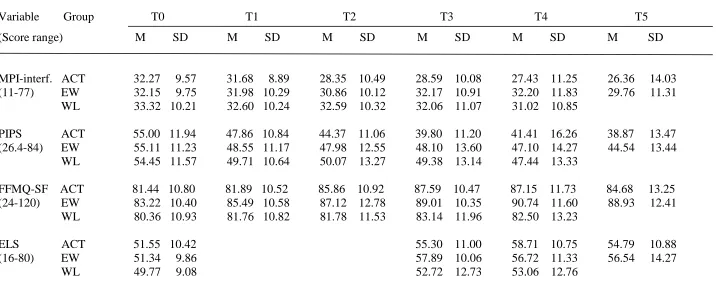
Descriptive statistics of the scores of the three groups are shown in Table 4. Regarding successful randomization mentioned in the section “Statistical analyses”, comparison of mean scores at baseline measurement (T0) shows that the three groups did not differ in degree of pain interference, psychological inflexibility, values-based living and mindfulness before intervention.
25
Table 4. Means (M) and standard deviations (SD) of Pain interference (MPI-interf.), Psychological inflexibility (PIPS), Mindfulness (FFMQ-SF),
and Values-based living (ELS)
Variable Group T0 T1 T2 T3 T4 T5 (Score range) M SD M SD M SD M SD M SD M SD
MPI-interf. ACT 32.27 9.57 31.68 8.89 28.35 10.49 28.59 10.08 27.43 11.25 26.36 14.03 (11-77) EW 32.15 9.75 31.98 10.29 30.86 10.12 32.17 10.91 32.20 11.83 29.76 11.31 WL 33.32 10.21 32.60 10.24 32.59 10.32 32.06 11.07 31.02 10.85
PIPS ACT 55.00 11.94 47.86 10.84 44.37 11.06 39.80 11.20 41.41 16.26 38.87 13.47 (26.4-84) EW 55.11 11.23 48.55 11.17 47.98 12.55 48.10 13.60 47.10 14.27 44.54 13.44 WL 54.45 11.57 49.71 10.64 50.07 13.27 49.38 13.14 47.44 13.33
FFMQ-SF ACT 81.44 10.80 81.89 10.52 85.86 10.92 87.59 10.47 87.15 11.73 84.68 13.25 (24-120) EW 83.22 10.40 85.49 10.58 87.12 12.78 89.01 10.35 90.74 11.60 88.93 12.41 WL 80.36 10.93 81.76 10.82 81.78 11.53 83.14 11.96 82.50 13.23
ELS ACT 51.55 10.42 55.30 11.00 58.71 10.75 54.79 10.88 (16-80) EW 51.34 9.86 57.89 10.06 56.72 11.33 56.54 14.27 WL 49.77 9.08 52.72 12.73 53.06 12.76
Note. ACT, Acceptance and Commitment; EW, Expressive Writing; WL, Waiting list; T0,pre-test/baseline measurement; T1,after four weeks of intervention; T2, after eight weeks of intervention; T3, post-test; T4,3-month follow-up; T5, 9-month follow-up; MPI-interf., Multidimensional Pain
26
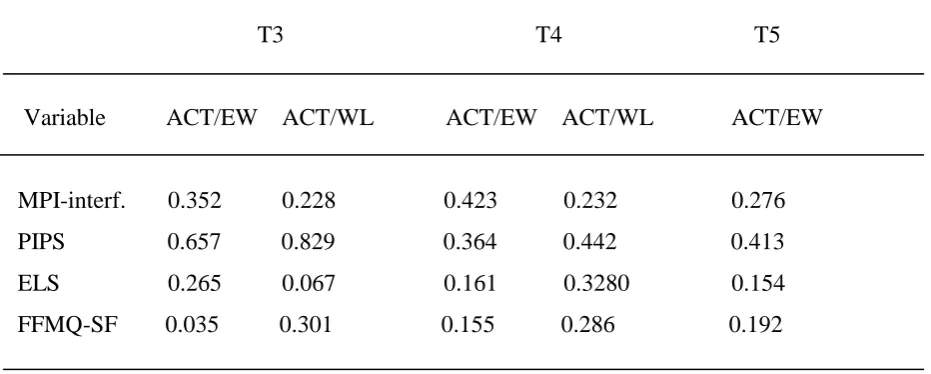
Table 5. Effect sizes (Cohen`s d) between groups at post-test (T3), 3-month follow-up (T4)
and 9-month follow-up (T5) of the ACT group compared to either the EW (ACT/EW) or WL (ACT/WL) group
T3 T4 T5
Variable ACT/EW ACT/WL ACT/EW ACT/WL ACT/EW
MPI-interf. 0.352 0.228 0.423 0.232 0.276 PIPS 0.657 0.829 0.364 0.442 0.413 ELS 0.265 0.067 0.161 0.3280 0.154 FFMQ-SF 0.035 0.301 0.155 0.286 0.192
Note. ACT, Acceptance and Commitment group; EW, Expressive Writing group; WL,
Waiting list; MPI-interf., Pain interference; PIPS, Psychological inflexibility; ELS, Values-based living; FFMQ-SF, Mindfulness.
Pain interference
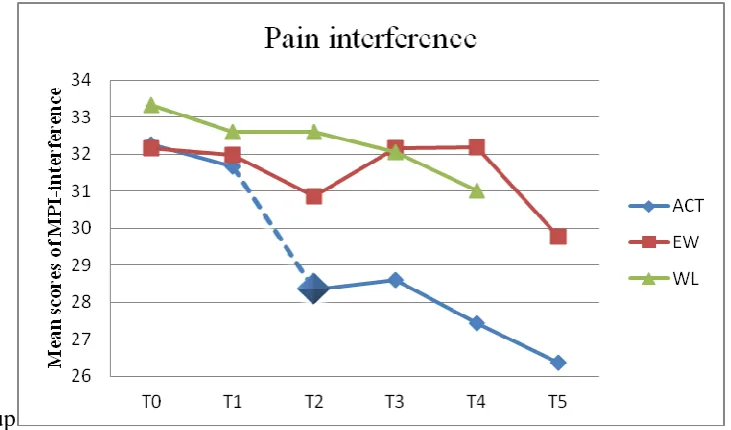
Overall, only the ACT group showed a significant decrement in mean scores from baseline measurement (T0) to post-test (T3). The ES and WL group showed no significant effects during these measurements.
27
Figure 2. Changes in mean scores of pain interference and interaction effects between the
factors measurement and group for the three groups during the intervention and at
follow-up
Note. MPI-interference, Multiple Pain Inventory-subscale interference; ACT, Acceptance and
Commitment group; EW, Expressive Writing group; WL, Waiting list group; T0, baseline measurement; T1, after four weeks of intervention; T2, after eight weeks of intervention; T3, post-test after 12 weeks of intervention (end intervention); T4, 3-month follow-up measurement; T5, 9-month follow-up measurement.
Psychological inflexibility
Overall, all groups showed significant decrements in mean scores from baseline measurement (T0) to post-test (T3).
[image:28.595.75.441.111.326.2]28
Figure 3. Changes in mean scores of psychological inflexibility and interaction effects
between the factors measurement and group for the three groups during the intervention and at follow-up
Note. PIPS, Psychological Inflexibility In Pain Scale; ACT, Acceptance and Commitment
group; EW, Expressive Writing group; WL, Waiting list group; T0, baseline measurement; T1, after four weeks of intervention; T2, after eight weeks of intervention; T3, post-test after 12 weeks of intervention (end intervention); T4, 3-month follow-up measurement; T5, 9-month follow-up measurement.
Values-based living
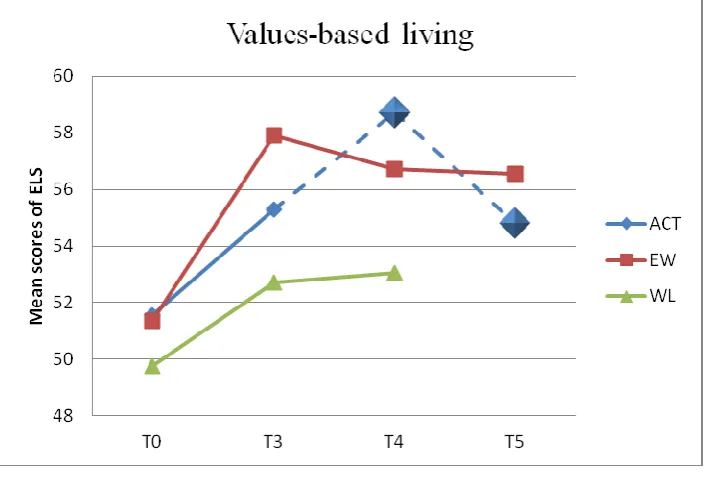
Overall, all groups showed significant increments in mean scores from baseline measurement (T0) to post-test (T3).
A significant interaction effect between the factors measurement and group was shown for the measurement T4 (F (2) = 7.165), p < 0.001), indicating that the three groups differed significantly in effects at 3-month follow-up (T4). Post hoc bonferroni test showed that the ACT group had significantly higher increments in mean scores compared to the WL but not to the EW group at T4. Mean scores of the EW and WL group remained stable at 3-month follow-up (T4).
[image:29.595.70.432.131.331.2]29
Figure 4. Changes in mean scores of values-based living and interaction effects between the
factors measurement and group for the three groups during the intervention and at follow-up
Note. ELS, Engaged Living Scale; ACT, Acceptance and Commitment group; EW,
Expressive Writing group; WL, Waiting list group; T0, baseline measurement; T3, post-test after 12 weeks of intervention (end intervention); T4, 3-month follow-up measurement; T5, 9-month follow-up measurement.
Mindfulness
Overall, all groups showed significant increments in mean scores from baseline measurement (T0) to post-test (T3).
A significant interaction effect between the factors measurement and group was shown for the measurement T2 (F (2) = 5.240), p < 0.006), indicating that the three groups differed significantly in effects after eight weeks (T2) of the intervention. Post hoc bonferroni test showed that the ACT group had significantly higher decrements in mean scores compared to the WL but not the EW group at T2.
30
Figure 5. Changes in mean scores of mindfulness and interaction effects between the factors
measurement and group for the three groups during the intervention and at follow-up
Note. FFMQ-SF, Five Facet Mindfulness Questionnaire-Short Form; ACT, Acceptance and
Commitment group; EW, Expressive Writing group; WL, Waiting list group; T0, baseline measurement; T1, after four weeks of intervention; T2, after eight weeks of intervention; T3, post-test after 12 weeks of intervention (end intervention); T4, 3-month follow-up measurement; T5, 9-month follow-up measurement.
31
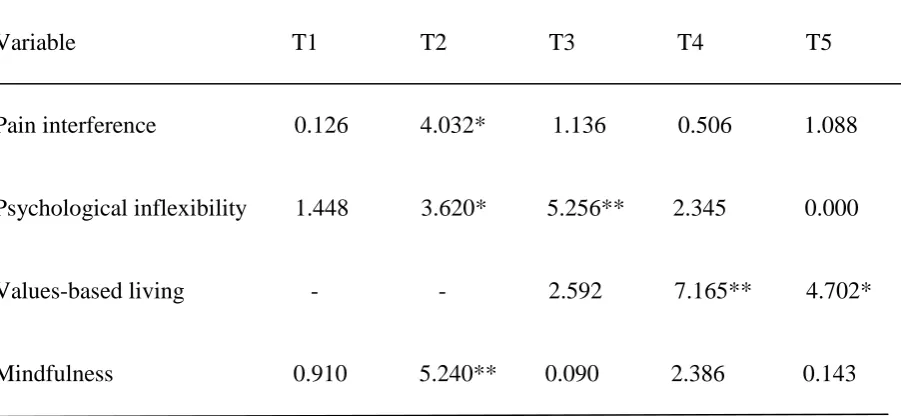
Table 6. Results from the repeated measures ANOVAs (Analysis of variance; F) with
repeated contrasts (T0 vs. T1; T1 vs. T2; T2 vs. T3; T3 vs. T4; T4 vs. T5) of the interaction effect between the factors measurement and group from four weeks of the intervention (T1) to 3-month follow-up (T4) for the three groups (ACT/EW/WL) and from three month follow- up to 9-month follow-up for the ACT and EW group
Variable T1 T2 T3 T4 T5
Pain interference 0.126 4.032* 1.136 0.506 1.088
Psychological inflexibility 1.448 3.620* 5.256** 2.345 0.000
Values-based living - - 2.592 7.165** 4.702*
Mindfulness 0.910 5.240** 0.090 2.386 0.143
Note. ACT, Acceptance and Commitment group; EW, Expressive Writing group; WL,
Waiting list group. The WL group was not measured at T5; Values-based living was not measured at T1 and T2. The interaction effect at T5 of values-based living is related to a significant decrement of the ACT group.
* p < 0.05, ** p < 0.01
Mediation effects of psychological inflexibility, mindfulness and values-based living
[image:32.595.74.525.181.389.2]32
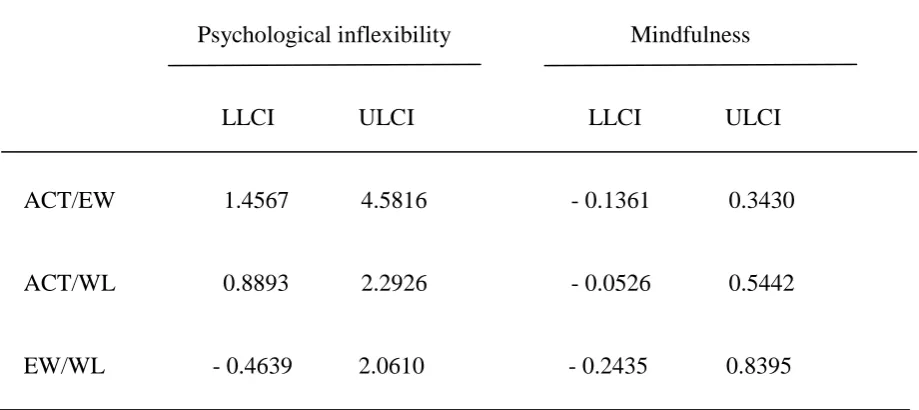
[image:33.595.59.519.247.452.2]Additionally, the confidence interval of the indirect effect of psychological inflexibility of the comparison of the EW versus WL group did include zero. Due to this, we concluded that only psychological inflexibility mediated the effects of pain interference and that this mediation was specific for the ACT group.
Table 7. 95% Confidence Intervals of the multiple mediation analyses of psychological
inflexibility and mindfulness for the three comparisons of the groups (ACT/EW; ACT/WL; EW/WL)
Psychological inflexibility Mindfulness
LLCI ULCI LLCI ULCI
ACT/EW 1.4567 4.5816 - 0.1361 0.3430
ACT/WL 0.8893 2.2926 - 0.0526 0.5442
EW/WL - 0.4639 2.0610 - 0.2435 0.8395
Note. ACT, Acceptance and Commitment group; EW, Expressive Writing group; WL,
Waiting list; LLCI/ ULCI, Bias-corrected bootstrap 95% confidence interval.
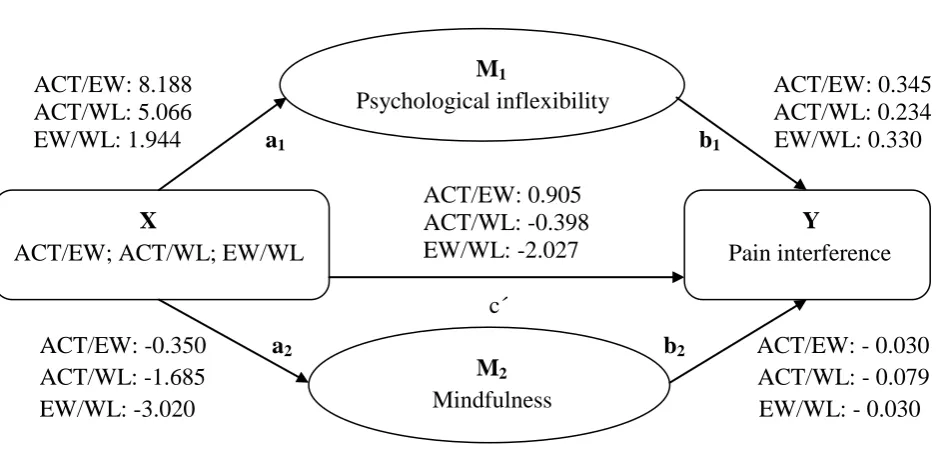
Values of direct effects of the comparisons of the three groups (ACT/EW; ACT/WL; EW/WL) on pain interference (c´) and indirect effects (a; b) of the proposed mediators psychological inflexibility and mindfulness on pain interference of the multiple mediator model are shown in figure 2. The model shows no significant direct effect of psychological inflexibility on pain interference of the comparisons of the three groups. Rather, the model shows a significant indirect effect of psychological inflexibility on pain interference, indicating that the influence of the ACT condition on pain interference depends on the mediation of psychological inflexibility. Furthermore, path coefficient b1 (figure x) of the
33
Figure 2. Multiple mediator model with the proposed mediators: Psychological inflexibility
(M1) and Mindfulness (M2). The three comparisons of the groups (ACT/EW; ACT/WL;
EW/WL) represent the independent variable (X), Pain interference the dependent variable (Y)
ACT/EW: 8.188 ACT/EW: 0.345
ACT/WL: 5.066 ACT/WL: 0.234
EW/WL: 1.944 a1 b1 EW/WL: 0.330
ACT/EW: 0.905 ACT/WL: -0.398 EW/WL: -2.027 c´
ACT/EW: -0.350 a2 b2 ACT/EW: - 0.030
ACT/WL:-1.685 ACT/WL: - 0.079 EW/WL: -3.020 EW/WL: - 0.030
Note. ACT, Acceptance and Commitment group; EW, Expressive Writing group; WL,
Waiting list; ax, effect of X on Mx; bx, effect of Mx on Y controlling for X and other Mx; c`,
direct effect of X on Y holding all Mx constant
Discussion
In the present study we examined the effects of a web-based intervention based on acceptance and commitment (ACT) and mindfulness on pain interference, psychological inflexibility, values-based living and mindfulness in patients with chronic pain. In order to determine in which phase the intervention is most effective and how long these effects are maintained, we aimed at investigating the effects of the intervention at several time measurements during the intervention and at follow-up.
Regarding pain interference, results showed a significant interaction effect with significantly higher decrements for the ACT group at the measurement after eight weeks of the intervention. Additionally, improvements in pain interference of the ACT group were maintained over a three- and 9-month follow-up period. These results are partly consistent with our predictions and findings by Wetherell et al. (2011). In 2011, they showed in a
M1 Psychological inflexibility M2 Mindfulness X
ACT/EW; ACT/WL; EW/WL
Y
[image:34.595.57.528.146.378.2]34
randomized, controlled trial of an ACT therapy that chronic pain patients improved on pain interference at post-test and six-month follow-up (Wetherell et al., 2011). Although they conceptualized pain interference in terms of the subscale interference of the Biref Pain Inventory Short Form (BPI) that measures the degree to which pain interferes with various aspects of life, including mobility and social activities (Cleeland & Ryan, 1994). We hypothesized that interaction effects on pain interference additionally were a significant at posttest. We cannot explain why this was only true for the measurement after four weeks of intervention.
Results also showed a significant interaction effect with significantly higher decrements in psychological inflexibility for the ACT group after eight weeks of intervention and at post-test. Improvements were maintained over a 3- and 9-month follow-up period. These findings are consistent with our predictions and with findings of McCracken and Gutiérrez-Martínez (2011). They showed that chronic pain patients, who were assigned to an ACT-based treatment, had significant increments in each of the processes of psychological flexibility: acceptance of pain, general psychological acceptance, mindfulness, and values-based action. Although we handled psychological inflexibility as opposite of psychological flexibility and in terms of avoidance and cognitive fusion related to pain, we found a similar effectiveness of the ACT and mindfulness treatment of our study.
35
and not applied therapeutic exercises. It could be that improvements of the ACT group were triggered by this information. It is possible that this information could make them aware of their unfavorable strategies of handling their pain complaints (aversive avoidance) and that they were provided with ideas how to focus on important things in life (personal values). Additionally, filling in the PIPS could also have had a positive effect on improvements in psychological inflexibility. The PIPS mainly consists of statements regarding avoidance of activities in daily life due to pain and attempts to control the pain. By thinking about how often these statements are true for them, it is possible that participants started to reflect about how the phenomenon of aversive avoidance is evident in their own life. If this triggering of self-reflection due to filling in the PIPS is true, it could also be an explanation for improvements in psychological inflexibility of the EW and WL group, although these participants were not provided with information of aversive effects of experimental avoidance during the second module.
36
follow-up, there was a significant decrement in mean scores of the ACT group. Nevertheless, for the ACT group mean scores at 9-month follow-up were still significantly higher that mean scores at baseline and four weeks after the start of intervention. Results were only partly consistent with our expectations. We hypothesized that interaction effects with significant higher improvements in scores for the ACT group were significant during the intervention at T1, T2 and T3 and that these improvements were maintained over a 3- and 9-month follow-up period. Other studies showed that people with chronic pain and patients with depression showed significant increments in mindfulness after an ACT-based treatment (McCracken & Gutiérrez-Martínez, 2011; Fledderus, Bohlmeijer, Pieterse & Schreurs, 2011).
It is unclear why this effectiveness was not specific for the ACT group, although mindfulness was only a core component in the ACT treatment. A possible explanation could be that the Expressive Writing treatment was as effective as the ACT treatment in improving mindfulness, because Expressive Writing on its own served as mindfulness exercise. This idea is rarely investigated. Brody and Park (2004) argued that writing repeated narratives may involve the process of mindfulness, because the writing process requires self-directed attention which could heighten the awareness of internal states. In 2009, Moore, Brody & Dierberger (2009) argued that writing repeated narratives may involve mindfulness. They investigated the effect of narrative emotional disclosure on mindfulness with one experimental group (narrative emotional disclosure) and a control group who wrote daily over unemotional events. They measured mindfulness with the Kentucky Inventory of Mindfulness Skills (KIMS), which conceptualized mindfulness in terms of four domains: observing internal and external stimuli, describing observed phenomena, acting with awareness, and accepting one´s experiences without judgment (Bear et al., 2004). They could not support their hypotheses that narrative emotional disclosure improved mindfulness. Rather, the control group who wrote on a daily basis over unemotional daily activities seemed to improve in one facet of mindfulness, respectively nonjudgmental acceptance of thoughts and emotions. More research is needed to clarify the concept of mindfulness and its relation to Expressive Writing- and narrative disclosure-treatments.
37
phase of the intervention the process “self-as-context” (module six and seven), an important
process of mindfulness, was introduced. Thus, it is possible that improvements in mindfulness in the ACT group are not mainly due to mindfulness exercises but in specific to the therapeutic content of the ACT-based treatment in this phase. If mainly mindfulness exercises were responsible for improvements, a more steadily development of effects in mindfulness would be more compatible. If this explanation was true, participants should repeat the “self as context” module on a regular basis after the intervention to maintain improvements in
mindfulness at the long-term. If Expressive Writing serves as mindfulness exercise and improvements in mindfulness of the EW group are due to Expressive Writing, participant should maintain writing on a regular basis to maintain improvements at the long-term. Furthermore, if Expressive Writing indeed could improve mindfulness, it should be incorporate in mindfulness-based interventions.
Other possible explanations could be that filling in the questionnaire measuring mindfulness (FFMQ-SF) influenced the participants, just like suspected for the PIPS and improvements in psychological inflexibility of the EW and WL group during the first four weeks of intervention. Thus, participants started to stay more fully and consciously in contact with the present moment just by answering questions regarding mindfulness and therefore dealing with the topic of mindfulness. This could also explain the improvements of mindfulness in the WL group. Furthermore, it could be that the FFMQ-SF did not asses the concept of mindfulness that was improved in the present study. Perhaps there is a difference between the theoretical concept of mindfulness measured with the FFMQ-SF and improvements due to the practical implementation of daily mindfulness exercises. This would also support the assumption that improvements in the ACT group were mainly due to the “self-as-context” module (6 and 7) rather than to practical mindfulness exercises.
38
effective in improving values-based living in chronic pain patients. We did not expect that all groups showed significant improvements at post-test, rather we expected that effects were specific for the ACT group. We hypothesized that interaction effects with significant higher improvements for the ACT group were significant at post-test and not at 3-month follow-up. Furthermore, we expected that improvements were maintained at 9-month follow-up. It is unclear why the ACT group did not remain stable during follow-up but showed a significant improvement after the intervention, followed by a decrement that was not significant. A possible explanation could be that improvement in values-based living is a consequence of changes in the participants' behavior. In the last module, participants learned how to apply their personal values in daily life. This was the last module before post-test. It is possible that behavior changes need more time to be successfully implemented in daily life and therefore occurred later than expected. If this was true, participants should repeat this module at 3-month follow-up to maintain improvements in values-based living. We did not expect that improvements of values-based living were not maintained over a 9-month follow-up period. It is possible that changes in values-based living were only maintained for a short time because changes in behavior are in general difficult to maintain on a long-term basis. Maintenance of changed behavior is only possible when someone’s behavior fits into a natural
reinforcement context or when relevant environments are designed to reinforce that behavior (Foxx, 1990). Therefore, the ACT- and mindfulness-based intervention should take the social environment as proposed reinforcement context into account. For example, the intervention could include exercises that participant should inform their social environment about their participation in the study, the goals of the study and that they will engage in more values-based behavior during the intervention and that they want to maintain this new behavior after the intervention. Due to this, the social environment could be able to recognize the new behavior of the participant and reinforce it.