
Variations of problem and project based learning in higher education
36
0
0
Full text
(2) 1.
(3) Variations of Problem- and Project Based Learning in Higher Education. SUMMARY This study identified variations of problem- and project based learning (PPBL) in higher education. Additionally the research aimed to evaluate ways to identify PPBL variations. In order to do so a qualitative case study has been performed at a Dutch university. The analysis of module handbooks with an innovation configuration map (ICM), which had been developed based on an earlier literature research, resulted in an improved description of several PPBL variations and identified eight new ones. Furthermore it has been established that module handbooks offer only limited insight into PPBL variations and alternative ways to identify them have to be validated. 1st supervisor: R. Bron 2nd supervisor: Dr. M.D. Endedijk. INTRODUCTION Quality in higher education plays an important role for the economic growth, as has been recognized by the Dutch “onderwijsraad” (education council). It is their view that higher education must be of good quality in order for the Dutch economy to be able to compete internationally (Onderwijsraad, 2011). This view is supported by Hanushek and Wößmann (2011) in their review on the relationship between the quality of education and economic growth, in which they conclude that a link exists between education within and economic growth of a given country. They further acknowledge that the quality of education is more predictive of educational growth than quantity. In order for the Dutch economy to grow and for the Netherlands to flourish, higher education in the Netherlands has to be of high quality. As a response to that, several Dutch universities, for example the Erasmus University Rotterdam (Kindermans, 2001) and the University Maastricht (van Breugel, Meng & Ramaekers, 2010), have changed their educational method from a teacher centered approach to a more students centered approach called project- and problem-based learning (PPBL). This development can also be found at the Univeristy of Twente where PPBL was introduced in 2013 in the form of four modules that combine a project with supporting courses which students have to complete each year. But even choosing a present-day teaching method does not guarantee success. Research shows that despite implementing the same educational innovations, differences in quality can occur, due to different variations of the innovation (Hall & Hord, 2006 in Wandersman, Chien & Katz, 2012).This variation in adoption is explained by several underlying assumptions, namely that change is an individual process, which makes the perceptions of and attitudes and feelings towards the innovation process crucial. Furthermore, individuals journey through their feelings and levels of use in their own individual time and manner (Hall & Loucks, 1978 in Tunks & Weller, 2009). In other work, Hall and Hord (2001 in Swain, 2008) argued that this variety in the way that innovations are implemented is also due to the fact that there are different stakeholders involved. These variations might be one way to explain the ambiguous findings of research on students’ performance in PPBL settings. While some studies show an increase in performance (Alessio, 2004; Chase, Pakhira & stains, 2013), others show that students perform about equally in PPBL. (Jimenez-Mejias et al., 2014; Marklin Reynolds & Hancock, 2010; McParland, Noble & Livingston, 2004). In order to link performance of students’ with the different variations of PPBL applied, one has to first map the variations of PPBL that exist in the literature and those universities put into practice. For that reason the aim of this research is such an overview of variations and to evaluate one instrument used to describe these variations. In order to do so a qualitative case study has been performed at one Dutch university. In this case study modules of PPBL were analyzed to determine combinations of variations of PPBL in higher education by means of the concept of innovation configuration maps. THEORETICAL FRAMEWORK Two of the teaching methods that have been increasingly more used, not only in primary and high school (Savery, 2006), but lately also in higher education, are problem-based learning (PbBL) and 2.
(4) project-based learning (PjBL) (Reid, Abrandt Dahlgreen, Petocz & Dahlgreen, 2011). Although the two teaching methods PjBL and PbBL originated separately, their characteristics are very similar to one another. Bedard, Lison, Dalle, Cote & Boutin (2012) identify the direction of learning activities, towards purely studying in PbBL and towards actually constructing a product in PjBL, as the only difference between the two approaches. It is not surprising therefore that in practice the two approaches are often used interchangeably or in an interconnected manner. It might be for that reason that some researchers even go so far as to combine them to one teaching method. This approach will also be applied in this research. Therefore a definition of PPBL has been constructed, based on definitions of both PbBL (Blumenfeld et al., 1991 in Helle, Tynjala & Olkinuora, 2006; Blumenfeld, Soloway, Marx, Krajcik, Guzdial & Palincsar, 1991 in Botha, 2010; Hanney & Savin-Baden, 2013; Powell and Weenk 2003, in van Hattum-Janssen & Mesquita, 2011) and PjBL (Savery, 2006; Skelin, Schlueter, Rolle & Gaedicke, 2008). PPBL is hereby defined as “a comprehensive approach to teaching which aims at interactive, self-reliant student learning through the use of authentic problems and projects in group settings”. PPBL ESSENTIALS In order for educational institutions to implement a course that is indeed made up of PPBL, it is vital that they not only implement any program under that name, but rather implement a program that contains certain components that are essential to all PPBL programs. The following section will answer the question which these essentials are. In 1991 six components were identified to be essential to PPBL (Blumenfeld et al., 1991 in Botha, 2010). The first of which is that problems and questions are central to all projects and form the starting point for learning, a view that is shared by many other researchers (Barrows, 1996;Edström & Kolmos, 2014; Helle, Tynjala & Olkinuora, 2006; Savery, 2006). Savery adds the necessity for problems to be ill-structured. A factor that is closely connected to the ill-structured nature of problems in PPBL is the fact that problems should be presented in a context that reflects the out of classroom world and should therefore be as authentic as possible (Blumenfield et al., 1991 in Both, 2010; Barrows, 1996; Edström & Kolmos, 2014). A third factor stressed by Blumenfeld et al. (1991 in Botha, 2010) is the fact that PPBL is a student centered approach. They state that students should determine the direction of their learning activities. Other researchers support this view and especially highlight that students have to take responsibility for their work and that learning is self-directed (Barrows, 1996; Edström & Kolmos, 2014; Helle et al., 2006; Savery, 2006). Resulting from this student-centered approach is a changing role for teachers. In PPBL teachers no longer are a source of information, but rather become facilitators to students’ learning process (Blumenfield et al., 1991 in Both, 2010; Barrows, 1996; Edström & Kolmos, 2014; Helle et al., 2006; Savery, 2006). A fifth essential mentioned by Blumenfeld et al. (1991 in Botha, 2010) is the social aspect of PPBL. It is researchers’ view that learning is a collaborative process (Barrows, 1996; Edström & Kolmos, 2014; Savery, 2006). Blumenfield et al. (1991 in Botha, 2010) finally emphasize that problems and projects should be worked on for an extended amount of time in order for learning to be effective and in-depth. While Blumenfield et al.’s (1991 in Botha, 2010) work has been considered key to PPBL, more recent research adds some aspects that are regarded to be fundamental to PPBL as well. Several researchers have drawn attention to the desirability for problems to not only be authentic and illstructured, but also to be interdisciplinary (Edström & Kolmos, 2014; Savery, 2006). Savery (2006) additionally stresses that PPBL should be central to the curriculum and not only be used as an aid in an otherwise teacher-centered teaching method. It is also his opinion that in PPBL, special attention has to be given to feedback and assessment, and especially highlights the possibilities of self- and peerassessment as valuable tools to support students in their learning process. These essentials and their variations, as they appear in both literature and practice, will be discussed in the following sections.. 3.
(5) Variations of Problem- and Project Based Learning in Higher Education VARIATIONS OF PPBL ESSENTIALS The analysis of the five studies that were used to define both PjBL and PbBL led to seven categories of PPBL essentials, namely problem settings, students-centeredness, role of the teacher, PPBL as a social-process, curriculum, teaching methods and assessment. The seven categories will be further elaborated, also with supporting literature, in the coming paragraphs. An overview of the established variations can be found in appendix I1. PROBLEM SETTINGS The first essential of PPBL are the problem settings. They form the base for all learning activities of the students. These problems are presented in a specific, authentic context. Furthermore, there are several sorts of problem statements, depending on the sort and range of the problem, students are required to solve. Both the context of the problem and the problem statement, together with the objectives stated in the problem description are considered to make up the problem setting in this research. Several studies have been found that each describe problem settings in PPBL in their own way, namely the manner to solve the problem (Barrows, 1986 in Johnstone & Biggs, 1998), the range of the problem (Edström & Kolmos, 2014), the environment in which the project is completed (Fortune & McKinstry, 2012) and the degree of structure and complexity (Barrett, 2010; Jonassen & Hung, 2008). For an overview of the various types of problem see appendix I2. Jonassen and Hung (2008) additionally stress the importance for authenticity. One way to do so is for the projects to be situated in companies. While most case studies on PPBL report that their projects take place at the higher education institution (e.g. Brundiers & Wiek, 2013; Fernandes et al., 2014; Kritikos, Woulfe, Sukkar & Saini, 2011; Papinczak, Young & Groves, 2007), the researchers Fortune and McKinstry (2012) report on a PBBL project where students work on problems developed by companies and are for a part of the duration of their project integrated in the company they work for. Authenticity, however, leads to complexity and an ill-structured nature of the problems. Problem statements can therefore have different degrees of structure and complexity, which leads to different categories of chaos of the learning process on PPBL (Barrett, 2010). The first is chaos which results from a lack of rules and guidance and leads to frustration, anxiety and confusion of students. The second one is order which is characterized by many fixed and severe rules. These rules result in boredom of students, which are then likely to display habitual behavior. Between chaos and order lies the desired state of the edge of chaos. In this category, PPBL is performed in a way that supplies support and guidance, while at the same time it does not inhibit students to go through the process in their own manner. When instructors are able to provide such a PPBL learning environment, students are likely to be creative, construct knowledge and work in a flow. Part of the problem statements are the objectives students are supposed to reach. Several studies show that students require clear objectives during PBBL (Garcia-Jardon, Bhat, Blanco-Blanco & Kwizera, 2011; Lacusta, Palacios & Fernández, 2009; Levia & Quiring, 2008). Therefore, one can reason that it is imperative that project descriptions contain clear goals for students to work towards. This effect can be increased if there is also a description of the assessment criteria and methods, as students have been identified as strategic learner, which is to say that students learn towards the goals set for them and their assessment (Al Kadri, Al-Moamary & van der Vleuten, 2009; Hall, Palmer & Bennett, 2012). If one pursues this line of reasoning the necessity for the assessment criteria and methods to be in line with the learning goals becomes apparent. STUDENT-CENTEREDNESS AND ROLE OF THE STUDENT The second essential of PPBL is the student-centered nature of the approach, which is to say that students are central, not peripheral to their own learning process. This also means that students have to take on different roles and responsibilities than in a traditional, more teacher-centered learning environment. While in traditional learning settings the teacher acts as a source of knowledge and has 1 2. Please contact the author for the complete research including the appendix. Please contact the author for the complete research including the appendix.. 4.
(6) complete power over the direction and pace of the learning process, in student-centered learning the student chooses the direction and pace of the learning process and makes use of the teacher as a guide rather than an information source (Altay, 2013). It has further been recognized that in order for an educational process to be defined as PPBL, students have to take initiative in their learning process and have to plan, monitor and evaluate their own learning process (Dolmans, DeGrave, Wolfhagen & Van Der Vleuten, 2005). One way to stimulate self-directedness is reflection. It has been identified by several authors as an important part of PPBL (Beringer, 2008, Chin & Chia, 2006; Dolmans, DeGrave, Wolfhagen & Van Der Vleuten, 2005; Furman & Sibthorp, 2013). There are several ways to support students in their reflection process, the first of which is that the teacher stimulates self-reflection through asking questions (Hmelo-Silver, 2004). Other ways to promote and support self-reflection are to ask students to keep a reflective journal in which students are free to write in any manner they feel right (Hmelo-Silver, 2004), the more structured portfolio where students fill in a template of what they have done and learned, or to use e-learning tools (Stewart, MacIntyre, Galea & Steel, 2007). The reasoning above makes it clear that not only the role of the student changes, as they are responsible for finding ways to gather study materials and decide on the quality and relevance of it and furthermore approach the teacher and their colleagues for help if needed (Dochy, Segers, van den Bosse & Struyven, 2005), but the role of the teacher changes as well (Lekalakala-Mokgele, 2010). ROLE OF THE TEACHER Just as with the students’ the role of teachers changes as well, but in the opposite direction. This change represents the third essential of PPBL and is due to the fact that in PPBL students are for instance responsible for what they are learning. One aspect that is stated by several researchers is that in PPBL, teachers do no longer (only) deliver the content to be learned by students, but rather act as a supportive assistant for their students’ learning journey (Dochy, Segers, van den Bosse & struyven, 2005; Piccinini & Scollo, 2006; Tongsakul, Jitgarum & Chaokumnerd, 2011). Dochy et al. (2005) state that promoting thinking skills in students is one of the two roles of a teacher in PPBL to encourage students’ learning process. The other task of a teacher, described by those authors, is to ensure the collaboration of students in a group. Furthermore, in his research, Ahern (2010) demonstrated that students, when first asked to gather information on their own, were not critical enough with the quality of their sources. Only after feedback from their teacher and peers they were more demanding on their sources and did they use scientific journal articles as the source for their knowledge. Also, Ahern (2010) describes frustration from students when they feel a lack of support of their supervisors. He mentions that teachers who are new to the concept of PPBL find it hard to balance supporting their students, while at the same time giving them enough freedom to direct their own process. This frustration with teachers in PPBL settings might also stem from the fact that students, even in PPBL, prefer teachers that are more directive as they feel that a more directive teacher will give them a better insight of what is expected of them (Dolchy, Segers, van den Bosse & Struyven, 2005). This is noteworthy because in PPBL, teachers are expected to take on a facilitative role, rather than a directive one (Dolchy et al., 2005). Another source for frustration with teachers might be changing teachers. As mentioned earlier, one of the roles of a teacher in PPBL is to guard the group-processes in a project. This might be made difficult by changing teachers, as utilized by the Belgian university in Dolchy et al.’s (2005) research. SOCIAL AND INDIVIDUAL PROCESS The fourth essential has been noted by several researchers, namely that PPBL is a social process, where learning occurs through the exchange and discussion of information (Barrows, 1996; Botha, 2010; Edström & Kolmos, 2014; Skelin, Schlueter, Rolle & Gaedicke, 2008). Garcia and Pacheco (2012) even go as far as to state that in PBBL working in a team is a key component in order to learn on an individual basis. Yew and Schmidt (2012) express a more moderate view when they state that collaborative learning in a group has a significantly higher impact on achievement in PPBL than individual learning. Working in a group can result in difficulties, though. Also, students report that the composition and resulting quality of the workgroup are more important in PBBL than for example the guidance of the 5.
(7) Variations of Problem- and Project Based Learning in Higher Education teacher and the individuals’ capabilities (Gavin, 2014). Due to this reason, case studies show that students are often supported, not only by their teachers, but also by some materials to scaffold group work, in order to ensure that the groups work efficiently and smoothly (e.g. Farrell & Cavanagh, 2014). Another way to counteract possible difficulties due to the compilation of the groups is to carefully consider how to form groups and to consider certain factors. The first of which are the various possible methods to form groups (Gavin, 2014). One is to randomly assign students to a group (e.g. Brodie, Zhou & Gibbons, 2008; Chujo & Kjima, 2006; Joham & Clarke, 2012). The second is to let the students form groups themselves (e.g. Jollands & Parthasarathy, 2013). A third option which might be recognized as the most preferable one, due to the significance of a well-functioning group in PPBL, is to identify different characteristics of students and assign students to these groups, based on those characteristics (Garcia & Pacheco, 2012). Another factor that influences students’ performance, next to the group composition, is group size. Lohman and Finkelstein (2000, in Dolmans & Schmidt, 2006) experimented with group sizes in a PPBL setting and found that students self-directedness increased in small (up to four members) and middle sized (up to six members) groups, but decreased in groups with many (nine) members. And although the collaborative aspect of PbBL and PjBL has been widely recognized, Dochy, Segers, van den Bosse and Struyven (2005) note that there is also an individual aspect to PPBL in form of evaluation and reflection. Students have to individually evaluate their work and reflect on the processes that they went through in order to make learning meaningful. They also note that already during the project work there might be individual work in the form of self-study. CURRICULA OF PPBL MODULES A truly PPBL curriculum is the fifth essential to the PPBL teaching method. Studies (e.g. Kivela & Kivela, 2005; Verkoeijen, Rikers, Winkel & van den Hurk, 2006) suggest that it is advisable for curriculum designers to start a higher education PPBL program with an introductory course to studentcentered learning techniques. In this courses students are supposed to get acquainted with studentcentered learning and get an inclination of what will be expected of them. There is also some variation in the way that PPBL is integrated in the curriculum. While some higher education institutions strife to implement a curriculum made up of only PPBL classes (Barge, 2010), others combine (one of) the teaching method with traditional teaching (e.g. Crostwaite, Cameron, Lant & Lister, 2006; Fernandes, Mesquita, Flores & Lima, 2014; Gavin, 2014). Research also shows significant differences in the duration of one PPBL unit. While some units were finished in a few days (e.g. O’Grady & Alwis, 2009; Verkoeijen, Rikers, Winkel & van den Hulk, 2006), another lasted up to several weeks (Crostwaite et al., 2006) and some even several month (e.g. Farrell & Canavagh, 2014; Fernandes et al., 2014; ; Marklin Reynolds & Hancock, 2010). These differences in curriculum may, to some extent, explain the differences in the way PPBL is taught. TEACHING FORMS Just as a PPBL curriculum, teaching methods need to be adapted to PPBL as well, which is the sixth PPBL essential. There are several different teaching methods that can be applied during a PPBL project, due to the broadly defined nature of the educational approach. These different methods, as found in the literature, will be further disclosed in the following. The first teaching method common in PPBL is the tutorial group with a limited number of students. It has been described by Dochy, Segers, van den Bosse and Struyven (2005) as a central characteristic of PPBL. Another variation of teaching methods is to oblige students to perform self-study activities (Dochy et al., 2005). These self-study activities can be done individually (Moust, Berkel & Schmidt, 2005; Verkoeijen, Rikers, Winkel & van den Hurk, 2006) or in a group (e.g. Woltering, Herrler, Spitser & Spreckelsen, 2009). And although PPBL is supposed to be as student-centered and as little directive as possible, many universities find is necessary to use lectures to teach students theoretical knowledge (e.g. Brodie, Zhou & Gibbons, 2008; Joham & Clarke, 2012; Panwong & Kemayuthanon, 2014). 6.
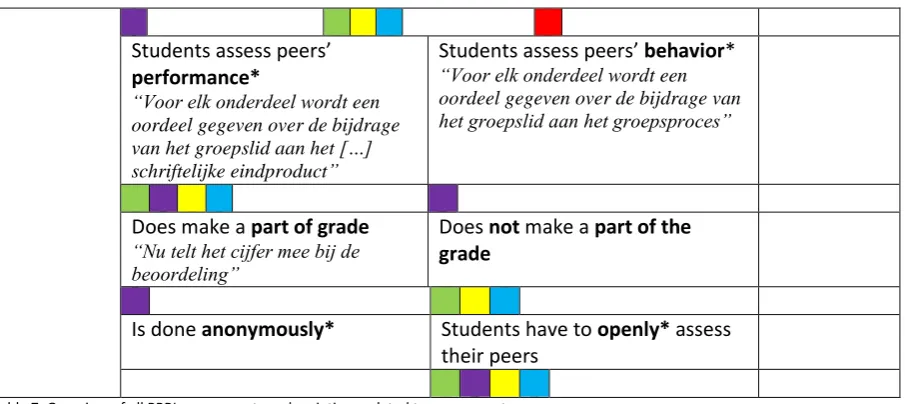
(8) ASSESSMENT Applying the appropriate assessment techniques in PPBL is very important, as the assessment should be in line with the task that is given to the students. The various ways in which students can be evaluated form the seventh and final essential of PPBL as found in the literature. A general distinction can be made between formative, summative, peer- and self-assessment. FORMATIVE ASSESSMENT AND FEEDBACK Formative assessment and feedback have been wildly recognized as essential components to highquality PPBL teaching (Farrell & Canavagh, 2014; Fernandes, Mesquita, Flores & Lima, 2014; Kolmos, 2009 in Coffin, 2013; Krause & Stark, 2010; O’Grady & Alwis, 2009). Formative feedback can not only be given by the teachers, though, but also by the students (Dolmans & Schmidt, 2006). There are also differences in the topics of formative feedback, as it can be focused on behavioral aspects, as is the case in Dolmans and Schmidt’s study or Acar’s (2004) study which reports on the formative feedback given by the teacher to the students on their attendance, organizational skills, their listening and communication skills and their punctuality. On the other hand research shows that teachers give formative feedback on students’ academic achievement (e.g. Farrell & Canavagh, 2014) SUMMATIVE ASSESSMENT Studies show multiple possibilities to assess students’ knowledge and performance in PPBL setting, but Gijbels, Dochy, Bossche and Segers (2005) state in their widely recognized research that they all should have six characteristics in common which are essential for valid assessment in PPBL. The first of which is the topic of assessment, namely that the assessment not only tests students’ problem solving skills, but also the organization of their knowledge base. Furthermore students should be assessed in an authentic manner, with authentic problems. Their third statement poses that the problems should be new to students, forcing them to transfer previously acquired skills and knowledge. Students should also be encouraged to use several different sources to support their ideas and solutions. This is also reflected in their fifth defined characteristic that emphasizes the fact that problems should integrate knowledge from different disciplines and therefore require students to integrate their knowledge in turn. Lastly the authors stress the need for students to apply their knowledge to problems frequently occurring in reallife situations. With these criteria in mind, students may be assessed individually (Brodie, Zhou &Gibbons, 2008; Kivela & Kivela, 2005), in groups of two (Brodie et al., 2008) or in groups of more students (Fernandes, Mesquita, Flores & Lima, 2014; Kivela & Kivela, 2005). There are also several possible ways in which to test students, namely final reports (Joham & Clarke, 2012; Kivela & Kivela, 2005; Acar, 2004), oral presentations (Fernandes et al., 2014; Kivela & Kivela, 2005; Acar, 2004), reflective journals (Joham & Clarke, 2012; Kivela & Kivela, 2005), final products (Fernandes et al., 2014) or exams (Brodie, Zhou & Gibbs, 2008;Fernandes et al., 2014; Acar, 2004). Two forms of assessment that have been shown to be valued in PPBL settings are self- and peerassessment (Gijbels et al., 2005; Liu, Carless, 2007; Mok, Lung, Cheng, Cheung & Ng, 2006; Papinczak, Young, Groves & Hayes, 2007). The frequent use of these techniques (e.g. Brundiers & Wiek, 2013; Fernandes et al., 2014; Kritikos, Woulfe, Sukkar & Saini, 2011; Papinczak, Young & Groves, 2007) makes it worthwhile to take a closer look at them. IDENTIFYING PPBL Though all the above mentioned variations of PPBL have been found in previous research, only few studies can be found that test ways to identify them in higher education. One concept to identify variations of innovations in general is that of innovation configurations (IC). This concept was first introduced by Hall and Loucks in 1977 (Hall, 2000). It is based on studies of the two researchers that showed that although teachers were describing the same innovation, their descriptions of that innovation and their usage of it varied immensely. The variations of the (usage of) the innovations were defined as configurations of the innovation. ICMs (innovation configuration maps) can be used to analyze these 7.
(9) Variations of Problem- and Project Based Learning in Higher Education different configurations as they “identify the major components of an innovation and describe a continuum of use, or variation, that range from “ideal implementation” to “non-use”.”(Langille, 2010, p. 5). Innovation maps consist of concepts, variations and configurations. Concepts are defined by Javeri and Persichitte (2007) as “major features of an innovation”, while they describe variations as “different ways in which components may be operationalized” and configurations as “operational patterns that result from selection and use of different innovation component variations”. But while the concept of ICMs seem valuable for an intensive study of variations of PPBL, not many studies on PPBL can be found that make use of IC mapping. In fact, only one recent research (Borrengo, Cutler, Tech & Prince, 2013) was found in this literature study that used an ICM to analyze PPBL and in that case it was used as an instrument to measure the occurrence of PPBL variations rather than enhancing the description of these variations. Research must therefore show whether ICMs are useful for the identification and improvement of variations of PPBL configurations. With this lack of literature in mind and the fact that some of the variations of the seven PPBL essentials discussed earlier have only been found in literature, but not necessarily in practice it becomes obvious that additional research is needed to analyze which of these variations can be encountered in higher education and in what manner. Thus this research aims to answer the following research question: What are variations in PPBL an how can they be identified in higher education modules? METHOD The following sections will first give a brief description of the environment the research was conducted in. Afterwards, a description of the derivation of the ICM that was used in this study will be given. This is followed by an overview of the sample that was used to map the variations of PPBL at the University of Twente and the method section will be closed off with a recount of the measure undertaken to ensure the reliability of the research at hand. SETTING THE SCENE The University of Twente (UT) is situated in the Netherlands and was founded in 1961 as a technical university though it does offer non-technical studies by now as well. It consists of five faculties, namely Behavioral Sciences (GW), Management and Government (MB), Engineering Technology (CTW), Electrical Engineering, Mathematics and Computer Science (EWI) and Science and Technology (TNW). As of July 2014 there are about 9000 students enrolled. Starting in September 2013 the UT introduced a new educational model for all the Bachelor’s programs, called the “Twents Onderwijsmodel” (TOM). Within TOM, students learn in so called modules, courses of 15 ECTS which combine projects with the underlying theoretical knowledge. Each of the three bachelor years consists of four such modules that have to be completed. It is characterized by several PPBL principles, such as the fact that students work in teams on projects and that students are responsible for their own learning. DESIGN OF THE STUDY In order to answer the research question a qualitative research has been performed. The qualitative approach has been chosen as it gives a more detailed insight into the variations of PPBL and allows for searching variations that are previously not yet known. Additional the way that variations are often combined can be observed. Within the scope of qualitative research a case study has been performed at a Dutch university, which will be described more elaborately in the following sections. INSTRUMENT The purpose of this research was to map the variations of PPBL in a higher education institution and to broaden the research on ways to identify these variations. In order to do so an ICM was used that had been developed earlier, following the first two steps to develop an ICM proposed by Donovan, Green and Hartley (2010). It started with a broad overview of components and variations that was, through various steps, further elaborated and refined. Due to time constraints, steps three to five were not performed. 8.
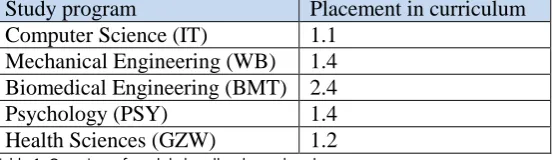
(10) STEP ONE Donovan et al.’s (2010) step-by-step plan begins with the identification of all components and variations of the ICM. Hereby components contain broadly described behaviors, while variations are behaviors of those categories that are defined in more details. In case of this research, though, the focus of analysis was not the variation of behavior of people, but the variation of design of PPBL modules. This step had already been performed in a previous literature research, which outlined the most important components of PPBL. It contained both findings from empirical research and descriptions of PPBL in practice, as they were found in several case studies. An overview of the established components can be found in the left column of the table in appendix I3. STEP TWO In the second step, the found components and variations were grouped into clusters. These clustered components and variations formed the first version of the ICM. This step, again, had already been performed in the preceding literature research and resulted in seven categories of PPBL essentials, namely problem settings, students-centeredness, role of the teacher, social-process, curriculum, teaching methods and assessment. This resulted in the first version of an ICM that was used in this research to analyze the usage of PPBL at the University of Twente. It can be seen in appendix I4. With this ICM a set of documents were analyzed to identify variations of PPBL practiced at a Dutch university. SAMPLE As it was the goal of this research to map as many variations of PPBL components in this higher education institution as possible, it was decided to choose a sample of documents with as much variety as possible as well. For that reason, five module handbooks, one from each of the five faculties of the university, were chosen for the analysis (for an overview of the chosen modules see table 1. Module handbooks are descriptions of the modules given out to the students previous to or at the beginning of a module. They provide students, amongst other things, with an overview of the learning activities, a description of the central project and an overview of what is expected of them. Unfortunately in case of the study program mechanical engineering (WB) at the time of the research, only the part of the module handbook that described the central project was available for analysis. All other module handbooks were complete. In order to further increase the generalizability of the findings from this study, it was aimed to obtain variety in the modules chosen with regard to the placement in the curriculum. Therefore, modules were chosen from the first, second and fourth quarter of the first year. Only one module has been analyzed from the second year (fourth quarter). Study program Computer Science (IT) Mechanical Engineering (WB) Biomedical Engineering (BMT) Psychology (PSY) Health Sciences (GZW). Placement in curriculum 1.1 1.4 2.4 1.4 1.2. Table 1: Overview of module handbooks analyzed. ANALYSIS These module descriptions, as stated above, were than analyzed. Starting point for the analysis was the ICM on variations of PPBL developed in the earlier done literature research. It contained components of PPBL education as both recommended in the literature and found in practice and formed the code descriptions used to analyze the sample of module descriptions. For an overview of the codes used see. 3 4. Please contact the author for the complete research including the appendix. Please contact the author for the complete research including the appendix.. 9.
(11) Variations of Problem- and Project Based Learning in Higher Education appendix I5. The analysis consisted of both open coding, in order to find new components or variations of components that had not yet been identified via the literature research, and closed coding, which resulted in an overview of the usage of the already established components and variations of PPBL at the University of Twente. Using both an inductive and a deductive approach ensured that all variations of PPBL were noted. The following steps were performed to analyze the module handbooks. In a first step, the handbooks were read through with a focus on text fragments that were in some way related to PPBL. Afterwards these gathered fragments were coded. As stated earlier, the previously developed ICM on PPBL and the containing descriptions of PPBL variations were used as a code. For each individual fragment it was checked which component it described and which variation thereof. If a fragment did not fit any descriptions of components it was given the code unknown component. If a fragment did fit a component, but none of the known variations thereof, it was given the code of the component with a sub-code that identified it as an unknown variation. Fragments that were identified as linked to PPBL, but not as a known component or variation were used to develop descriptions of new components and variations. Fragments that did match both a component and variation of PPBL were defined as examples of PPBL at the University of Twente. RELIABILITY In order to prove the soundness of the used variation descriptions, codes and analysis, one module handbook was analyzed by a second rater to identify the inter-rater reliability and therefore reliability of the analysis performed. To do so fragments of the module that were identified as related to PPBL were presented to a second rater, together with the ICM as used by the author of this study. The second rater was then asked to code the fragments at hand with the ICM. They were also given the opportunity to code fragments as “not a component in the ICM” or as an “unknown variation of a component in the ICM”, just as the first researcher. Cohen’s kappa was then calculated and, with a value of 0.78, found to be substantial. At the same time it has to be mentioned that the second rater was only given 39 fragments to analyze, which, with a code scheme of 131 codes, is considerably less that what would be needed to calculate a Cohen’s kappa that gives an indication of how reliable the analysis is. RESULTS The following section will present the findings of the above described analysis of module handbooks. Differences and similarities of all five modules will be described based on the earlier defined essentials of PPBL, namely problem settings, student centeredness, role of the teacher, PPBL as a social process, the curriculum and teaching methods, and finally assessment. The two categories of curriculum and teaching methods were combined, though, due to the overlap of results found. Within this categories it will also be discussed which variations were not recognized through the analysis of module handbooks with an ICM and which components and variations of PPBL were found with this analysis that had not yet been identified in the earlier performed literature research. PROBLEM SETTINGS The following section will list the findings concerning the problem settings of the PPBL modules analyzed. It shows which categories problems belong to and whether problems were authentic and multidisciplinary and indicates the findings on the learning goals that are stated in the module handbooks. For an overview of all found components and variations of PPBL please see the subsequent table 2.. Problem setting PPBL component. 5. PPBL variations Most desirable in PPBL. Least desirable in PPBL. Non PPBL variations. Please contact the author for the complete research including the appendix.. 10.
(12) Type of problem. Reiterative problembased * Students work in small groups on complex case, simulating reality. Students need to find additional information. After project completion, students reflect on and evaluate their own work. Teacher takes more leading role, gives also technical knowledge.. Problem-based* Students work in small groups on complex case, simulating reality. Students need to find additional information. Teacher takes more leading role, gives also technical knowledge. Modified case based * Students work in small groups on a complex, realistic case. Students have to search additional information. Teacher only ensures students’ understanding of the case is correct. “Voor beide benaderingen ga je onderzoeksinstrumenten ontwerpen, respectievelijk een interviewschema en een persoonlijkheidstest. Je verzamelt gegevens met deze instrumenten, gaat de gegevens analyseren en schrijft in je groep een verslag over de kwaliteit van elk van beide instrumenten.”. Problem project Problem situated in a multidisciplinary context “In de ondersteunende vakken – neurofysiologie, mechanica en biomedische regelsystemen – kunnen de benodigde kennis en vaardigheden verworven worden om dit model te bouwen en te valideren middels experimenten.”. More than two disciplines. Two disciplines. Relation between various disciplines is described*+. Relation between various disciplines is not described*+. Diagnosis-solution problem* Moderately illstructured, fairly complex problems. Students analyze situation and present solution based on analysis. 11. Decision making problem* Moderately illstructured, fairly complex problems. Students are given a context description and several solutions to choose from.. Situated case/ policy problem* Fairly illstructured and very complex problems. Students solve combination of diagnosis-solution and decision-. Discipline project Problem restricted to one certain discipline.
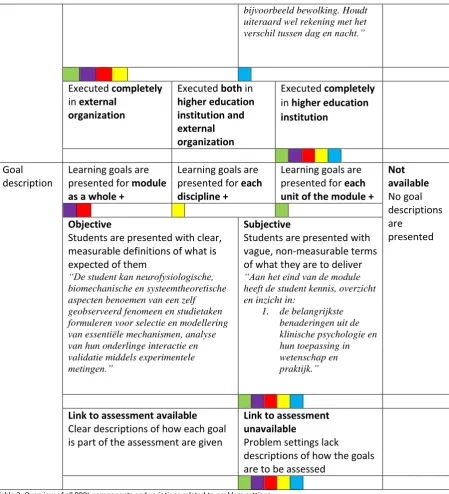
(13) Variations of Problem- and Project Based Learning in Higher Education. Chaos. “Ontwerp een installatie, gebaseerd op thermische zonneenergie, waarmee gedurende het hele jaar Aruba voorzien kan worden van elektriciteit. Houd hierbij rekening met dag en nacht. Lever daarnaast ook de benodigde elektriciteit en/of warmte voor de drinkwaterproductie op Aruba. Breng een gefundeerd advies uit over het type ontziltingsinstallatie dat Aruba het best kan inzetten.”. “Maak een gefundeerde keuze uit de concepten, werk de beste oplossing in detail uit. Maak een thermodynamische analyse van de gecombineerde water en elektriciteitsproductie en bekijk wat de effecten van de waterproductie zijn op het gemiddelde rendement van de installatie.”. making problems in their prospective future work places.. Edge of chaos Problem descriptions contain some rules and guidance, but leave room for students’ decisions and preferences. Team roles are presented but open for students’ interpretation. Chaos Problem descriptions contain no guidance or rules. No specific team roles are assigned. Order Problem descriptions contain fixe rules and rigid guidance procedures with little or no room for students’ decisions and preferences. Strict team roles are assigned. Authenticity One detailed description*+ of the context the problem is situated in is given. Several examples*+ of problem in future work settings given. “Het water en energiebedrijf van Aruba werkt aan een duurzame oplossing voor de water en elektriciteitsproductie van het eiland. De bestaande installatie is verouderd en afgeschreven en er zijn plannen om deze installatie te gaan vervangen door een nieuwe, duurzamere installatie. Voor dit probleem is in project Energie en Materialen al een analyse gemaakt.” (module handbook WB). “Deze vraag kom je in veel domeinen van de psychologie tegen. Als wetenschapper wil je vaak bepaalde kenmerken van een persoon onderzoeken om gedrag te kunnen voorspellen. In de klinische praktijk wil je een cliënt diagnosticeren om te bepalen aan welke psychische stoornis deze leidt en hoe die te behandelen is.” (module handbook PSY). The problem is not simplified in order to help students solve it +. The problem is simplified in order to enable students to solve it +. Not situated in real life context No or only little description of the context of the problem is given. “Bij het ontwerp van de installatie hoeft geen rekening gehouden te worden met het wegvallen van de zon door. 12.
(14) bijvoorbeeld bewolking. Houdt uiteraard wel rekening met het verschil tussen dag en nacht.”. Executed completely in external organization. Goal description. Executed both in higher education institution and external organization. Learning goals are Learning goals are presented for module presented for each as a whole + discipline +. Executed completely in higher education institution. Learning goals are presented for each unit of the module +. Objective Students are presented with clear, measurable definitions of what is expected of them. Subjective Students are presented with vague, non-measurable terms of what they are to deliver. “De student kan neurofysiologische, biomechanische en systeemtheoretische aspecten benoemen van een zelf geobserveerd fenomeen en studietaken formuleren voor selectie en modellering van essentiële mechanismen, analyse van hun onderlinge interactie en validatie middels experimentele metingen.”. “Aan het eind van de module heeft de student kennis, overzicht en inzicht in: 1. de belangrijkste benaderingen uit de klinische psychologie en hun toepassing in wetenschap en praktijk.”. Link to assessment available Clear descriptions of how each goal is part of the assessment are given. Link to assessment unavailable Problem settings lack descriptions of how the goals are to be assessed. Not available No goal descriptions are presented. Table 2: Overview of all PPBL components and variations related to problem settings. Variations that do not differ in the degree to which they are considered desirable in PPBL are marked with a star (*). Variations and components that derived only from the module handbook analysis and were not found in the earlier literature research are marked with a plus (+). Color codes underneath the variations indicate which module handbooks contained evidence for a variation: green = BMT, purple = GZW, red = IT, yellow = PSY, blue = WB.. When analyzing the module handbooks it became apparent that all study programs aimed to present students with multidisciplinary problems. What is more, all study programs provided students with a problem that forced students to combine knowledge from at least three disciplines. The IT module even covered as much as eight different disciplines. Therefore all central problems in the module handbooks were defined as problem projects. Differences were, however, found in the way that these various disciplines were linked. While most module handbooks provided students with a short description of these different disciplines and their relations to one another, the module description of BMT did not offer such an overview and left students to find that out for themselves. The multidisciplinary nature of the problems was often combined with a very authentic context. As stated in the module handbook of GZW this was due to the fact that graduates of this study program will be required to perform in multidisciplinary contexts as well. While one handbook offered authenticity in form of examples where 13.
(15) Variations of Problem- and Project Based Learning in Higher Education future graduates might encounter the problem, other module descriptions pictured elaborately the circumstances of the problem at hand. But while all study programs provided students with an authentic problem, one of them recognized the complex nature of authentic problems and allowed students to simplify matters in order for students to be able to solve the problem. Within this authentic context students in all examined study programs were asked to provide a solution to one central problem. Additionally there were often smaller sub-problems for the various disciplines related to the main project. In all module handbooks, the main problem was identified as a diagnosis-solution problem, as students were asked to analyze a certain situation and, based on that diagnosis, develop a solution to the presented problem. The main problem of PSY and BMT were additionally identified as reiterative problem based, as students were asked to evaluate their developed solution to the problem and teachers provided students with technical knowledge. The categorization of the sub-problems proved more difficult. While some were easily classified as e.g. diagnosis-solution or decision-making problems, others did not fit any of the categories established in the literature research: “Representeer de gevonden mechanismen wiskundig, bijvoorbeeld middels dynamische overdrachten, of nietlineaire relaties.”. But regardless whether the sub-problems presented fit in an established category or not, they provided students with some support and direction for their project. At the same time, student were often given some degree of choice with regard to the direction of the project and the way they wanted to solve the central problem. Therefore all PPBL units were identified as somewhere between edge of chaos and order. None of the problems left students complete freedom in their choice of direction with the problem. At the same time, none of the problems provided any team roles, which would result for them to be categorized as chaos. On the other hand, most study programs provided students with learning goals. The only exception was the WB module handbook which did not state any learning goals, this might be due to the fact that the analyzed document was only part of the module handbook. It is for that reason that this particular variation was not considered in the results at hand. The module handbooks that did contain learning goals presented them in different ways. Those of GZW and IT offered them combined for the module as a whole, while in the PSY handbook the learning goals were divided by the different disciplines of the module. In a different manner, the BMT handbook did not divide the learning goals by discipline, but instead made a distinction between learning goals related to the subject and learning goals concerning academic skills, therefore distinguishing them by the unit of the module. But while there were differences in the way that these learning goals were presented, one aspect that was the same for all study programs was that all learning goals were stated in a very structured manner with clear indications of what the student was expected to be able to do at the end of the module. In spite of these elaborate description of the learning goals, most were stated in a manner that was open for interpretation and were therefore deemed to be subjective, though. Only very few learning goals were stated in an objective and measurable manner. Furthermore, all descriptions of learning goals lacked a connection to assessment. STUDENT-CENTEREDNESS This section lists the results that indicate whether a module handbook showed to which degree a PPBL module was student-centered. That is to say to what extent the planning, monitoring and evaluation of the learning process and the hunt for literature was the responsibility of the students. Additionally the findings show whether or not students were allowed to choose a direction with regard to their central project. All findings have been summarized in table 3.. Student-centeredness PPBL variations. 14.
(16) PPBL Compon ent Student s choose directio n of problem. Student s’ tasks. 15. Most desirable in PPBL. Least desirable in PPBL. Completely No directions are given, the student can completely autonomous choose direction of the research or problem solution.. To some degree Students have some degree of choice in the direction of problem within a directed framework. E.g.: The topic of the research is given, but students can choose their own research question. Students do all the planning Students are not given any indication on what tasks they have to perform at what point in the project. All responsibilit y to plan activities before the project lies with the students. Students do some planning Students are given some directions as to what activities they have to do and/or at what time they have to finish these activities. Responsibility for planning before the project lies both with the students and with the teachers.. Suggestions about a direction are not made by module handbook or teachers +. Suggestions about a direction are made by module handbook or teachers + “onderzoek je wat de huidige mogelijkheden zijn voor preventie van een zelf gekozen aandoening. Je kunt hierbij denken aan hart en vaatziekten, aandoeningen van het bewegingsapparaat of nieuwvormingen omdat deze in pathofysiologie worden behandeld, maar de keuze is vrij”. “In deze eerste fase probeer je zo goed mogelijk te bepalen wat je in de rest van het project moet gaan doen. Je schrijft een onderzoeksplan om dit te realiseren.”. Non PPBL variations Marginal to not at all Students have little or no choice in the direction of the project, all direction is dictated by the problem setting or the teacher. Students do not have to plan Students are given a strict scheme of activities and deadlines to finish these activities. Responsibilit y to plan before the project lies entirely with the teachers “De begeleider […] is er voornamelijk om je te helpen met.
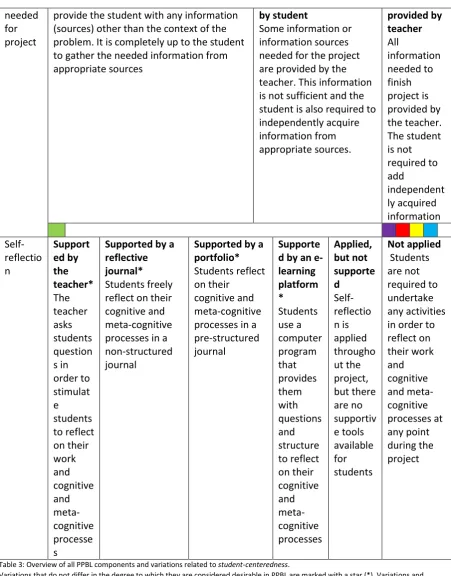
(17) Variations of Problem- and Project Based Learning in Higher Education project management: ervoor zorgen dat er op de deadline een acceptabel resultaat ligt.”. Students completely monitor their work process Students have the sole responsibilit y that their planning during the project is feasible, they finish their work in time and that they stay motivated. Teachers do not comment on that until the summative assessment. Students and teachers monitor the work process Both students and teachers have the responsibility that students’ planning during the project is feasible, they finish their work in time and that they stay motivated. Teachers give formative feedback throughout the project. Students have to evaluate own process throughout the project Students are during the duration of the project required to evaluate their planning, motivation and learning activities in order to improve. Informa tion. Students do not have to monitor their work process Students completely rely on their teachers’ assessment that their planning during the project is feasible, they finish their work in time and that they stay motivated.. “In het feedbackmoment in week 5 wordt in de tutorbijeenkomst, het functionere n van alle groepsleden beoordeeld middels een feedbackformulier. De studenten beoordele n voorafgaand aan de bijeenkomst hun eigen functioneren en het relatieve functio neren (beter, vergelijkbaar, slechter) van alle groepsleden.”. Students do not have to evaluate own process No evaluation activities are undertaken by students during the project. Is completely gathered by student The teacher or problem setting does not. Is completely. Is partly provided by teacher, partly gathered. 16.
(18) needed for project. provide the student with any information (sources) other than the context of the problem. It is completely up to the student to gather the needed information from appropriate sources. Selfreflectio n. Support ed by the teacher* The teacher asks students question s in order to stimulat e students to reflect on their work and cognitive and metacognitive processe s. Supported by a reflective journal* Students freely reflect on their cognitive and meta-cognitive processes in a non-structured journal. by student Some information or information sources needed for the project are provided by the teacher. This information is not sufficient and the student is also required to independently acquire information from appropriate sources.. Supported by a portfolio* Students reflect on their cognitive and meta-cognitive processes in a pre-structured journal. Supporte d by an elearning platform * Students use a computer program that provides them with questions and structure to reflect on their cognitive and metacognitive processes. Applied, but not supporte d Selfreflectio n is applied througho ut the project, but there are no supportiv e tools available for students. provided by teacher All information needed to finish project is provided by the teacher. The student is not required to add independent ly acquired information Not applied Students are not required to undertake any activities in order to reflect on their work and cognitive and metacognitive processes at any point during the project. Table 3: Overview of all PPBL components and variations related to student-centeredness. Variations that do not differ in the degree to which they are considered desirable in PPBL are marked with a star (*). Variations and components that derived only from the module handbook analysis and were not found in the earlier literature research are marked with a plus (+). Color codes underneath the variations indicate which module handbooks contained evidence for a variation: green = BMT, purple = GZW, red = IT, yellow = PSY, blue = WB.. In all of the analyzed modules students were given the freedom to choose the direction of their work at least to some degree. None of the modules offered students much choice, as all module handbooks contained strict guidelines and regulations for the directions students were to go with their work. The ultimate goal and final product for the module are in all cases predetermined by the module designers. However, students were given the choice of the subject of their project. For instance were psychology students allowed to choose the talent they want to test, the GZW module handbook offered students the 17.
(19) Variations of Problem- and Project Based Learning in Higher Education choice of sickness they wanted to research and the IT students were allowed to choose the target group they wanted to develop an app for. One variation that was observed with regard to students’ choice of direction was that two study programs provided students with suggestions of the direction they could take. One big exception with this was found in the module handbook of IT. In this module, students were given the choice to do an extra project (next to the one stated by the module designers) in case they were very much interested in one of the other discussed topics. However, the module handbook clearly points out that this is meant as an exception, not as the rule: “Voor projectgroepen die een bepaalde parel zeer interessant vinden, is het mogelijk om een tweede, parelspecifiek project te doen.”. This lack of student-centeredness was also observed in the amount of planning students had to do within a module. All module handbooks provided students with detailed schedules that informed students about the learning activities they were supposed to perform at any given moment and what work they were supposed to have finished. The only exception is the BMT module. Here students are provided with a schedule and the amount of time they should spend on the parts of the module, but they are also asked to develop a planning of what they want to do the rest of the project and what steps they have to perform in order to reach their goal. Little information was provided by the module handbooks as to the amount of monitoring students had to do throughout the project. On the contrary, one statement from the IT module handbook proved that it was seen as the task of the tutor to make sure that students stuck to their planning and were able to finish their work in time. Regarding another task that in PPBL should be the responsibility of students, namely the evaluation of their work, there was again little to be found in the module handbooks. Only one of the module handbooks contained any signs that the students were required to evaluate their progress throughout the module. The GZW students had several planned feedback moments where they were asked to evaluate their individual performance, both separately and relative to their fellow group members’ performance. A group discussion was held that resulted in an individual list of strong and weak points and some focus points for improvement. Other than this planned evaluation discussion, no evidence was found that students were required to evaluate their performance or their work, before a final evaluation at the end of the module. Furthermore, students were provided with a lot of information needed to solve the problems by their teachers and via prescribed reading material. The module handbooks did not specify outright whether this material was sufficient to solve the problem students were confronted with, but neither did they state that students were required to find additional reading material on their own. Only one statement hinted that students needed to find information on their own, but it is unclear whether this information can be found in the provided reading material or has to be found elsewhere: “Vervolgens verzamel je kennis over neurofysiologische en biomechanische mechanismen die een rol spelen bij menselijke balanshandhaving”. ROLE OF THE TEACHER As discussed earlier, due to the changing role of the students in PPBL, the role of the teacher is expected to change as well. The following passages aim to show results concerning this change in the role of the teacher and will provide information on which responsibilities lie with the teacher and which are taken on by other educators. See the adjacent table 4 for an overview of the identified variations and quotes that describe them.. Role of teacher PPBL PPBL variations Component Most desirable in PPBL. Least desirable in PPBL. Non PPBL variations 18.
(20) Teacher gives lectures. Less than half of the studentteacher contacts are lectures, the rest of the contact hours are filled with e.g. supervised selfstudy, tutorials or seminars. Half of the student-teacher contacts are lectures, the rest of the contact hours are filled with e.g. supervised self-study, tutorials or seminars. More than half of the studentteacher contacts are lectures, the rest of the contact hours are filled with e.g. supervised self-study, tutorials or seminars. Teachers’ task vs tutors’ task. The teacher is responsible for both project and supportive knowledge*. The teacher is responsible for the supportive knowledge, the tutor for the project*. The tutor is responsible for both project and supportive knowledge*. “De tutor is het eerste aanspreekpunt voor vragen over het project. Tijdens spreekuren van docenten kunnen vakinhoudelijke vragen gesteld worden.”. Teacher tasks. Encourage learning process* The teacher stimulates students to learn, monitors their progress and supports students in their learning processes, e.g. through feedback sessions and tutorials with these topics. Ensure collaboration process* The teacher monitors students’ group work and collaboration and intervenes if necessary, e.g. through feedback sessions and tutorials with these topics. Tutor tasks. Encourage learning process* The tutor stimulates students to learn, monitors their progress and supports students in their learning processes, e.g. through feedback sessions and tutorials with these topics. Ensure collaboration process* The tutor monitors students’ group work and collaboration and intervenes if necessary, e.g. through feedback sessions and tutorials with these topics “Tijdens een voortgangsbijeenkomst is er tijd om met de tutor te overleggen over de aanpak van het project of over de samenwerking binnen de groep.”. Contact with students. Educators meet with students. Educators meet with groups individually* “Elke week is er. 19. Educators meet with several groups at once*. Educators meet with class as a. All student –teacher contacts are lectures.
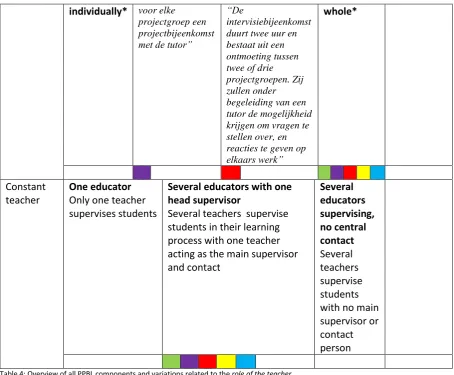
(21) Variations of Problem- and Project Based Learning in Higher Education individually* voor elke projectgroep een projectbijeenkomst met de tutor”. Constant teacher. “De intervisiebijeenkomst duurt twee uur en bestaat uit een ontmoeting tussen twee of drie projectgroepen. Zij zullen onder begeleiding van een tutor de mogelijkheid krijgen om vragen te stellen over, en reacties te geven op elkaars werk”. One educator Several educators with one Only one teacher head supervisor supervises students Several teachers supervise students in their learning process with one teacher acting as the main supervisor and contact. whole*. Several educators supervising, no central contact Several teachers supervise students with no main supervisor or contact person. Table 4: Overview of all PPBL components and variations related to the role of the teacher. Variations that do not differ in the degree to which they are considered desirable in PPBL are marked with a star (*). Variations and components that derived only from the module handbook analysis and were not found in the earlier literature research are marked with a plus (+). Color codes underneath the variations indicate which module handbooks contained evidence for a variation: green = BMT, purple = GZW, red = IT, yellow = PSY, blue = WB.. The afore mentioned change in the teacher role was difficult to prove with the module handbooks. In general it can be said that only few of them stated outright the tasks teachers were supposed to perform and responsibilities that were given them. Instead, many handbooks offered only an overview of the educators related to the module. This overview showed that all study programs enlisted several teachers responsible for students’ education and one module coordinator that served as a central contact for students. Moreover it was noticeable that next to teachers, all study programs also enlisted other educators with different functions. All modules made use of tutors additional to the teachers. While the teachers’ task was to give lectures and to answer students subject related questions, tutors were employed to support students with their project work and to answer questions related to that. In one case, the teachers were supported by student assistants whose task was to answer subject related questions during seminars. On the other hand, the tutor was occasionally given the additional task to supervise group dynamics. Consequently it can be said that the task of the teacher was primarily to encourage students’ learning, while that task of the tutor was that as well, but sometimes also encompassed to ensure the collaboration process of project groups. Information on the manner in which teachers and tutors met with students was scarce as well. It appeared that during lectures, teachers met with all students as one, while the tutorials were held with only several students, namely the members of one or several groups, at once. Additionally some study programs offered students the opportunity to ask their teachers questions during office hours. However it was unclear whether this was done on an individual, group or class level: 20.
(22) “De docenten zullen regelmatig tijd vrijmaken om vragen te beantwoorden, soms op hun werkkamer, maar mogelijk ook na een college”. PPBL AS A SOCIAL PROCESS The subsequent paragraph will provide results regarding the social and individual aspects of PPBL. The amount students worked individually or in groups and the various forms of group-work that occurred in the analyzed modules will be alluded. Table 5 serves as an overview of all identified variations and offers quotes from module handbooks to elaborate on those.. Social process PPBL Component. PPBL variations. Materials to scaffold group work. Yes Material to scaffold group work is provided e.g. reading material on role in a group or avoiding conflicts when working in a group. Most desirable in PPBL. Least desirable in PPBL. Non PPBL variations. No material is provided to scaffold group work. “Naast het onderwijs dat direct met de parels van doen heeft, krijg je in deze module ook […] en training in samenwerken in projectverband”.. Group forming. Group size – members per group Individual vs group work. 21. Randomly assigned* Students are assigned to groups in a manner that does not consider students preferences, learning styles, grades et cetera. Students choice* Students decide themselves with whom they want to work. Less than three*. All of the work is done in groups. Educator’s choice* Students are assigned to teams by their educators “De groepen worden ingedeeld door de modulecoördinator. Deze indeling is bindend.”. Based on personalities* Student groups are formed based on their personalities. Three to five*. More than half of the work is done in groups. Based on previous grades* The grades students received in previous courses act as criteria for group forming. More than five*. Half of the work is done in groups, half individually. Less than half of the work is done in groups. All work (for the final project, as well as for all in between tasks) is done individually.
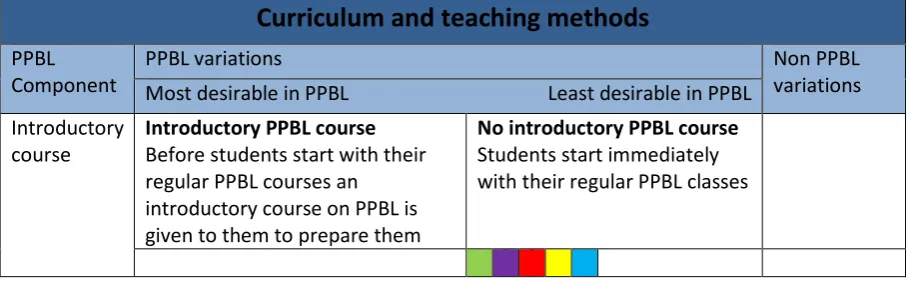
(23) Variations of Problem- and Project Based Learning in Higher Education Online platform. An online platform is available for students to interact with all students in a class +. No online platform is available for students to interact with all students in a class +. Table 5: Overview of all PPBL components and variations related to PPBL as a social process. Variations that do not differ in the degree to which they are considered desirable in PPBL are marked with a star (*). Variations and components that derived only from the module handbook analysis and were not found in the earlier literature research are marked with a plus (+). Color codes underneath the variations indicate which module handbooks contained evidence for a variation: green = BMT, purple = GZW, red = IT, yellow = PSY, blue = WB.. While working in the modules, students often worked in groups. All study programs required students to work at least partially together with their peers. This was especially true for the central project, which in all cases had to be worked on in groups. But there were differences notable with regard as to what the basis for group work was. While in some programs, only the central project work was done in groups, in one other students worked also in groups on problems that were not part of the central project. This resulted in a distribution of less than half of the time group work in the former and about 50% group and 50% individual work in the latter case. The groups in which students worked were made up of various sizes, varying between four and six members. Groups that were formed for work other than the central project were sometimes smaller (two people). Not all module handbook shed light on the way these groups were formed. Only one stated explicitly that students were to choose their own groups. Another stated that the coordinator of the module was responsible for dividing students into groups. No information, however, was given as to by which criteria this division was done. It also appeared that none of the groups were educated as to how to work efficiently in a group. Only one module handbook mentioned that students were supplied with materials or support for group work, namely in the form of a training session for working in a group. One special form of group work notable was observed in the BMT module. In this module students’ work was published on an online platform accessible for their peers. Via that platform students were able to read their colleagues papers and learn from their colleagues’ successes and failures. This was supposed to simulate an authentic research community: “Het Virtueel Symposium is een folder op de blackboard site. Hierin worden de producten van alle groepen gepubliceerd. Alle groepen mogen gebruik maken van de kennis en inzichten die hier gepresenteerd worden. Op die manier werk je als ‘onderzoeksgemeenschap’ samen.”. CURRICULUM AND TEACHING METHODS The analysis of the module handbook showed much overlap between the fragments that regarded the curriculum and those that regarded the teaching methods. For that reason those two essentials were combined in the following sections which will showcase the results regarding the way that PPBL is enforced in the curriculum and the way in which PPBL units and modules are connected to one another. An overview of the results can be found in table 6.. Curriculum and teaching methods PPBL Component. PPBL variations Most desirable in PPBL. Introductory Introductory PPBL course course Before students start with their regular PPBL courses an introductory course on PPBL is given to them to prepare them. Non PPBL Least desirable in PPBL variations No introductory PPBL course Students start immediately with their regular PPBL classes. 22.
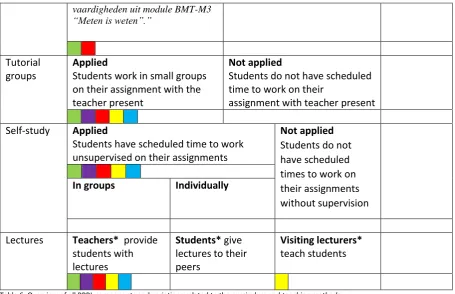
(24) Meetings for planning. The curriculum contains several meetings for students to plan and evaluate on their planning. The curriculum contains one meeting for students to plan their project. The curriculum contains no meetings for students to plan and evaluate on their planning. “In deze eerste fase probeer je zo goed mogelijk te bepalen wat je in de rest van het project moet gaan doen. Je schrijft een onderzoeksplan om dit te realiseren.”. Integration in curriculum. Only PPBL. More PPBL (e.g. tutorials, seminars, supervised selfstudy) than classical teaching. More classical (lecture based) teaching than PPBL. Duration of all integrated educational actions that make up one PPBL unit Academic skills part of curriculum. Several month. Several weeks. Several days. Connectivity between module units. Module units are connected with one another. Connectivity between various modules. Modules are connected to one another e.g. through knowledge that is needed and used again in a following module +. Academic skills are part of curriculum*+ “In het project wordt tevens aandacht besteed aan academische vaardigheden op het gebied van wetenschappelijk onderzoek en wetenschappelijke communicatie.”. Some module units are unconnected to one another. “De module vraagt daarom dat je gedurende de hele module actief met alle leerlijnen bezig bent! […]Het project integreert dus echt de stof uit de verschillende andere leerlijnen.”. “Ter voorbereiding op het volgende kwartiel is het vak medische elektronica opgenomen. Hierin wordt voortgebouwd op kennis en. 23. Academic skills are not part of curriculum*+. Modules are not connected to one another +. Only classical teaching methods.
(25) Variations of Problem- and Project Based Learning in Higher Education vaardigheden uit module BMT-M3 “Meten is weten”.”. Tutorial groups. Applied Students work in small groups on their assignment with the teacher present. Self-study. Applied Students have scheduled time to work unsupervised on their assignments. Lectures. Not applied Students do not have scheduled time to work on their assignment with teacher present. In groups. Individually. Teachers* provide students with lectures. Students* give lectures to their peers. Not applied Students do not have scheduled times to work on their assignments without supervision Visiting lecturers* teach students. Table 6: Overview of all PPBL components and variations related to the curriculum and teaching methods. Variations that do not differ in the degree to which they are considered desirable in PPBL are marked with a star (*). Variations and components that derived only from the module handbook analysis and were not found in the earlier literature research are marked with a plus (+). Color codes underneath the variations indicate which module handbooks contained evidence for a variation: green = BMT, purple = GZW, red = IT, yellow = PSY, blue = WB.. All modules had a duration of two month and contained a central project that students solve in several weeks. Furthermore, the distribution of classical teaching methods, which are mostly lecture based, and PPBL teaching methods, such as tutorials, seminar and self-study, did not vary much between the study programs. All three programs whose module handbooks contained information about the teaching methods used showed more PPBL teaching methods than classical teaching methods. Also, they all had in common that every module contained lectures, seminars and tutorials. Additionally some module handbooks indicated the usage of self-study sessions throughout the module. Another aspect that all modules had in common was that none of them contained an introduction to PPBL containing the specific teaching methods and expectations of students. What is more, only one module contained meetings for students to plan their project work, which is also regarded essential in PPBL modules. However, within one module, a whole phase, spread over 16 hours, was dedicated to the development of students’ planning. None of the other modules had planning sessions scheduled in the curricula. While analyzing the module handbooks, one thing that came to the attention of the researcher was the fact that all modules focused on academic skills and knowledge, next to the skills and knowledge purely related to the field of study. All modules paid attention in one form or another to students’ academic skills (such as academic writing and presentation skills). While some modules contained actual training in these skills, one only dealt with them in so far as they were parts of the assessment criteria. This inclusion of academic skills had not been mentioned in the literature on PPBL studied earlier. Another noteworthy aspect, also not encountered in the earlier performed literature study, was the relationship of the different units of the modules and the connectivity between different modules of one study program. All modules were made up of different units that were clearly separated from one another in the module handbooks. While some module handbooks stressed that these units were connected to one another, others do not explicitly state the relation of those units. But not only the units of one module were connected, also units of different modules of one study programs were interleaved. Several 24.
Figure
+4
Related documents
The second level of analysis was threefold: first involving reading/rereading for overall understanding in order to share the story taking place within the classroom; second,
There is much existing literature investigating current recruitment and retention initiatives and the factors that influence medical personnel to move to and work
But even if returning Mexican families face barriers to school enrollment, should we expect the same association in Mexico between duration of residence and school enrollment
ratio and concentration of catalyst poly toluene sulphonic acid (.PTSA) are considered as the factors and the. % FFA as the response in the esterification stage. Same
The main contribution of this study is to decrease income inequality in risk sharing network such as informal insurance through an analytical method, this study
ABSTRACT: The present study has used soil samples from Nigeria, contaminated with Brass crude-oil, to determine its biodegradation through enhanced biostimulation with cow
As reference material, the VTEC values derived from the IRI-2012 model (Bilitza et al. 2014), F10.7 solar flux index and sunspot number as ex- tracted from NASA/GSFC’s OMNI data
The impact of the tower blockage during the constant inflow conditions at t min and t max is visible in the radial distribution of rotor thrust and rotor torque (Fig.. 5 the
