Java Simulation of Au Diffusion in Si Affected by
Vacancies and Self-Interstitials: Partial Differential
Equations
Masami Morooka
Department of Electrical Engineering, Fukuoka Institute of Technology, Fukuoka, Japan. Email: [email protected]
Received July 25th, 2012; revised August 28th, 2012; accepted September 10th, 2012
ABSTRACT
A Java program in a GUI environment has been developed for the numerical solution of basic partial differential equa-tions and applied to Au diffusion in Si affected by vacancies and self-interstitials. Text fields of selected parameters for the calculation are set on the display, and the calculation starts by checking the start button after putting values on the text fields. The calculated results are plotted immediately after the finish of the calculation as the concentration profiles of substitutional Au, interstitial Au, vacancies and self-interstitials, and their diffusion can be presented immediately, resulting in the identification of the diffusion mechanism. By changing the values of the text fields, new results can be represented immediately. The diffusion of Au in Si can be simulated correctly and easily by this program. Results from the program for one set of conditions are shown, including images produced on the display.
Keywords: Numerical Solution; Partial Differential Equations; Simulation of Impurity Diffusion; Java; Simulation of
Partial Differential Equations
1. Introduction
Au atoms in Si occupy interstitial and substitutional sites, and the substitutional Au exists in three states depending on the heat treatment history [1]: high-temperature sub-stitutional Au, low-temperature subsub-stitutional Au, and ag-glomerations of substitutional Au. During the heat treat-ment, high-temperature substitutional Au diffuses very slowly itself and the change in its concentration is domi-nated by an interchange mechanism with interstitial Au and substitutional Au associated with vacancies [2] and self-interstitials [3]. In this case, the concentrations of substitutional Au, interstitial Au, vacancies and self-in- terstitials can be obtained from four partial differential equations [4,5]. The concentration of substitutional Au exhibits a diffusion profile depending on the relative contributions of vacancies and interstitial Si atoms [6]. The author has previously investigated Au diffusion us-ing Java programmus-ing by obtainus-ing a numerical solution to a single partial differential equation obtained from the above four differential equations under several approxi-mations. This approach was adopted because of the dif-ficulty of directly numerically solving the above four partial differential equations due to the limitation in the capacity of personal computers [7]. However, recently the capacity of personal computers has been progressing rapidly, and the author has been able to directly solve the
four partial differential equations involved in Au diffu-sion by Java programming. As a result, the diffudiffu-sion of Au in Si can be simulated correctly and easily using Java in a GUI (Graphical User Interface) environment.
2. Basic Partial Differential Equations for
Au Diffusion in Si
The basic diffusion equations for substitutional impuri-ties, interstitial impuriimpuri-ties, vacancies and self-interstitials in the interchange mechanism of interstitial and substitu-tional impurities associated with vacancies and self-in-terstitials are given as
s
Vr i V Ve s Ie i Si Ir I s ,
N
K N N K N K N N K N N
t
(1)
i
Vr i V Ve s Ie i Si Ir I s
2 i
i 2 iSS i0 i , N
K N N K N K N N K N N
t
N
D K N N
x
(2)
V
Vr i V Ve s Fe Si Fr V I
2 V
V 2 VSS V0 V ,
N
K N N K N K N K N N
t
N
D K N N
x
I
Ie i Si Ir I s Fe Si Fr V I
2 I
I 2 ISS I0 I ,
N
K N N K N N K N K N N
t
N
D K N N
x 4)
Si Ls s V.
N N N N (5)
Here, the terms caused by the internal sink-sources such as dislocations in Equations (2)-(5) based on the site conservation are added to the equations given in refer-ence [4]. In above equations, N, t, x, K and D are concen-tration, time, distance from surface, chemical reaction constant and diffusion constant. The subscripts s, i, V, I, Si, Vr, Ve, Ir, Ie, Ls, Fr, Fe, iSS, VSS, and 0 stand for substitutional
impurity, interstitial impurity, vacancy, self-interstitial, Si atom at a lattice site, vacancy recombination, vacancy emission, self-interstitial recombination, self-interstitial emission, lattice site, recombination of Frenkel pair, emission of Frenkel pair, emission and annihilation of interstitial impurity at internal sink-sources, emission and annihilation of vacancy at internal sink-sources, emission and annihilation of self-interstitial at internal sink-sources, and thermal equilibrium value. Each concentration is normalized by its thermal equilibrium concentration and the distance, x, is normalized by the specimen thickness,
L, for easier numerical calculation.
s
s1 i V Ve s s3 i Si s4 I s , C
a C C K C a C C a C C t
(6)
i
i1 i V i2 s i3 i Si i4 I s
2 i
i5 2 iSS 1 i , C
a C C a C a C C a C C t
C
a K C
(7)
VV1 i V V2 s V3 Si V4 V I
2 V
V5 2 VSS 1 V , C
a C C a C a C a C C
t
C
a K C
(8)
II1 i Si I2 I s I3 Si I4 V I
2 I
I5 2 ISS 1 I ,
C a C C a C C a C a C C
t
C
a K C
(9)
Si Si1 Si2 s Si3 V.
C a a C a C (10) Here, C is the normalized concentration and ξ is x/L. The coefficients are given as follows.
Vr i0 V0 s1
s0 , K N N a
N
(11)
Ie i0 Si0 s3
s0 , K N N a
N
(12)
s4 Ir I0,
a K N (13)
i1 Vr V0,
a K N (14)
Ve s0 i2 i0 , K N a N
(15)
i3 Ie Si0,
a K N (16)
Ir I0 s0 i4
i0 , K N N a
N
(17)
i i5 2,
D a
L
(18)
V1 Vr i0,
a K N (19)
Ve s0 V2 V0 , K N a N
(20)
Fe Si0 V3 V0 , K N a N
(21)
V4 Fr I0,
a K N (22)
V V5 2 ,
D a
L
(23)
Ie i0 Si0 I1
I0
,
K N N a
N
(24)
I2 Ir s0,
a K N (25)
Fe Si0 I3 I0 , K N a N
(26)
I4 Fr V0,
a K N (27)
I I5 2,
D a
L
(28)
Ls Si1 Si0 , N a N
(29)
s0 Si2 Si0 , N a N
(30)
V0 Si3 Si0 . N a N
(31)
3. Crank-Nicolson’s Implicit Method and
Gauss-Seidel’s Iteration Method
The partial differential terms in the equations are approxi-mated to the difference equations by Crank-Nicolson’s implicit method. Namely, an advanced differential-dif- ference approximation is used for the partial differential by time, ∂C/∂t, and a neutral differential-difference ap-proximation is used for the partial differential by distance,
neutral value for the function of C, f(C), according to Crank-Nicolson.
i,j+1 i,j1 , C C C t k
(32)
2i,j i,j i-1,j
2 2
i,j+1 i,j+1 i-1,j+1 1
2 2
2 .
C
C C C
h
C C C
(33)
s i V I Si
s i,j i( i,j V i,j I i,j Si i,j
s i,j+1 i i,j+1 V i,j+1 I i,j+1 Si i,j+1 , , , ,
1 , , , ,
2
, , , ,
f C C C C C
f C C C C C
f C C C C C
.
(34)
Here, k and h are the differences of t and ξ, respec-tively. We define C
,t C h k
i , j
C i, j , where i = 0, 1, 2, 3, ···, imax and j = 0, 1, 2, 3, ···, jmax. We use theWe obtain the value of Cs at t
j 1 ,
k Cs i, j 1 , by applying Equations (32)-(34) to Equation (6).
s1 i i,j+1 V i,j+1 i i,j V i,j s2 s i,j s3 i i,j+1 Si i,j+1 i i,j Si i,j 4 I i,j s i,j s i,j s i,j+1
s2 s4 I i,j+1 s2 s4 I i,j+1
( ) ( )
.
1 1
s
b C C C C b C b C C C C b C C C
C
b b C b b C
(35)
Here, bs1kas1 2, bs2kKVe 2, bs3kas3 2 and bs4kas4 2. We obtain Ci i, j 1 , CV i, j 1 and CI i, j 1 by
applying Equations (32)-(34) to Equations (7)-(9), respectively.
i1 i(i,j) V(i,j) i2 s i,j+1 s(i,j) i3 i(i,j) Si(i,j) i4 I i,j+1 s i,j+1 I(i,j) s(i,j) i i,j+1
i1 V i,j+1 i3 Si i,j+1 i5 i6 i1 V i,j+1 i3 Si i,j+1 i5 i6
i5 i i+1,j i i,j i i-1,j i
( + ) ( )
1 + +2 1 + +2
{( 2 ) (
b C C b C C b C C b C C C C
C
b C b C b b b C b C b b
b C C C C
i6
i+1,j+1 i i,j+1 i i-1,j+1 i i,j i i,j
i1 V i,j+1 i3 Si i,j+1 i5 i6 i1 V i,j+1 i3 Si i,j+1 i5 i6
2 )} (2 )
,
1 + +2 1 + +2
C C b C C
b C b C b b b C b C b b
(36)
V1 i i,j V i,j V2 s i,j+1 s i,j V3 Si i,j+1 Si i,j V4 V i,j I i,j V i,j+1
V1 i i,j+1 V4 I i,j+1 V5 V6 V1 i i,j+1 V4 I i,j+1 V5 V6
V5 V i+1,j V i,j V i-1,j V i+1,j+1 V i,j+1 V i-1,j+1
( + ) ( )
1 + +2 1 + +2
{( 2 ) ( 2 )
b C C b C C b C C b C C
C
b C b C b b b C b C b b
b C C C C C C
V6 V i,j V i,j
V1 i i,j+1 V4 I i,j+1 V5 V6 V1 i i,j+1 V4 I i,j+1 V5 V6
} (2 )
,
1 + +2 1 + +2
b C C
b C b C b b b C b C b b
(37)
I1 i i,j+1 Si i,j+1 i i,j Si i,j I2 I i,j s i,j I3 Si i,j+1 Si i,j I4 V i,j I i,j I i,j+1
I2 s i,j+1 I4 V i,j+1 I5 I6 I2 s i,j+1 I4 V i,j+1 I5 I6
I5 I i+1,j I i,j I i-1,j I i+1,j+1 I i,j
( ) ( )
1 + +2 1 + +2
{( 2 ) ( 2
b C C C C b C C b C C b C C
C
b C b C b b b C b C b b
b C C C C C
I6
+1 I i-1,j+1 I i,j I i,j
I2 s i,j+1 I4 V i,j+1 I5 I6 I2 s i,j+1 I4 V i,j+1 I5 I6
)} (2 )
.
1 + +2 1 + +2
C b C C
b C b C b b b C b C b b
(38)
initial values, for example C(i+1,j+1) = C(i+1, j+1). The cal-
(1)
Here, bi1kai1 2, bi2kai2 2, bi3 kai3 2,
i4 i4 2
b ka ,
2i5 i5 2
b ka h , bi6 kKiSS 2,
V1 V1 2
b ka , bV2 kaV2 2, bV3kaV3 2,
V4 V4 2
b ka ,
2V5 V5 2
b ka h , bV6kKVSS 2,
I1 I1 2
b ka , bI2 kaI2 2, bI3 kaI3 2 , bI4 kaI4 2,
culation is iterated until
1 i,j+1 i,j+1 i,j+1 n n n C C e C
, where e is
2I5 I5 2
b ka h and bI6 kKISS 2. We obtain a criterion value for the convergence, and Ci,j+1n1 is then
Si1 Si2 Si3
Si i,j+1 s i,j+1 V i,j+1.
C a a C a C (39) used as an approximate value of .
i, j 1
C from Equation (10).
4. Constants
Calculating the new value of a variable, such as Ci, j 1, involves using unknown values of variables such as
i 1, j 1 in Equations (35)-(38). Here, we use Gauss-
Seidel iteration method, in which the previously calcu-lated value is used as the initial value in the first calcula-tion of from i = 0 to i = imax, for example,
. We note the value obtained from the
C
i 1, j 1
C i, j 1 C
i 1, j C
The chemical reaction constants for the recombination reactions based on random diffusion to sinks are given by Damask and Dienes [8].
Vr 4πiV i V ,
K r D D
(40)
Ir 4πsI s I ,
K r D D (41)
first calculation as 1 . For the second calculation of
i,j+1
C
Fr 4πVI V I
.K r D D (42)
i, j 1
be-tween interstitial impurity and vacancy, substitutional impurity and self-interstitial, and vacancy and self-inter-stitial. The chemical reaction constants for the creation reactions are given from thermal equilibrium conditions as follows,
Vr i0 V0 Ve
s0
,
K N N K
N
(43)
Ir s0 I0 Ie
i0 Si0
,
K N N K
N N
(44)
Fr I0 V0 Fe
Si0
.
K N N K
N
(45)
The chemical reaction constants of the internal sink- sources, are given also by Damask and Dienes,
iSS 4πc i c,
K r D N (46)
VSS 4πc V c,
K r D N (47)
ISS 4πc I c,
K r D N (48) for spherical internal sink-sources with a capture radius of rc and a concentration of Nc, and as
iSS d i
c d
1
2π ln ,
π
K n D
r n
(49)
VSS d V
c d
1
2π ln ,
π
K n D
r n
(50)
ISS d I
c d
1
2π ln ,
π
K n D
r n
(51)
for cylindrical internal sink-sources with a density of nd.
We used a single atomic distance of 0.234 nm for the recombination distances and the capture radius, by as-suming that the recombination and the capture occur for the nearest neighbours. The thermal equilibrium concen-tration of substitutional Au in Si is given by Collins, Carlson and Gallagher [9]
22 3
s0
1.76
8.15 10 exp cm , N
kT
(52)
and the diffusion constant and thermal equilibrium con-centration of interstitial Au in Si is given by Willcox and LaChapelle [10]
24 3
i0
2.52
5.95 10 exp cm ,
N
kT
(53)
4 2
i
0.386
2.44 10 exp cm s . D
kT
(54)Values of the thermal equilibrium concentrations and diffusion constants of vacancies and self-interstitials dif-fer greatly between difdif-ferent authors, by as much as 6
orders of magnitude [11]. Therefore, it is difficult to choose particular values. On the other hand, compara-tively consistent products of the equilibrium concentra-tion and the diffusion constant are available [12]. The self-diffusion of host atoms is given by summing two vacancy and self-interstitial terms [11]. In our case [6],
Si0 self 0.5 V V0 0.7273 I I0,
N D D N D N (55) take into account the correlation factors. Here, Dself is the
self-diffusion constant of Si atom, whose value does not differ much among the authors [13], and we use aD times
value of the equation by Demond et al. [14],
2 self D0.45
25exp cm s ,
D a
kT
(56)where 0.1 ≤aD≤ 10. We chose the contribution rate of
self-interstitials, dIsd, as a constant related to the
concen-trations of vacancies and self-interstitials,
I I I0 Isd
self Si0 , f D N d
D N
(57)
where, fI is the correlation factor of the self-interstitials.
Then the contribution rate of vacancies, dVsd, is obtained as
V V V0
Vsd I
self Si0
1 f D N ,
d d
D N
(58)
where, fV is the correlation factor of the vacancies. In our
case, fI = 0.7273 and fV = 0.5. A value of either one of the
equilibrium concentrations or a diffusion constant is nec-essary in order to fix both of them from Equations (57) and (58). It is better to use a diffusion constant as it has a true physical nature, whereas fixing a equilibrium con-centration at some arbitrary value can cause difficulties, such as unrealistically small diffusion constant if that con-tribution is in reality very small. We use aV times value of
2 V V1.47
10 exp cm s ,
D a
kT
(59)by Masters and Gorey [15], and aI times value of
5 2
I I
0.4
10 exp cm s ,
D a
kT
(60)by Tan and Gösele [16], where 0.1 ≤aV≤ 10 and 0.1 ≤aI≤
10. NSi0 is obtained by Equations (6) and (58),
Ls s0 Si0 Vsd self V V . 1 N N N d D f D (61)
NI0 and NV0 are obtained by Equations (57) and (58),
respectively.
Isd self Si0 I0
I I
,
d D N N
f D
Vsd self Si0 V0
V V
.
d D N
N
f D
(63)
5. Selection of Parameters
The calculated results can be presented immediately as figures by changing the value of the text fields. We select
T, L, dIsd, crand jmax as the values of the text fields, where cr indicates the ratio of k to h, and
2 r .
2
c h
k (64)
Here, cr= 1 is the condition of convergence in the
ex-plicit method. Such a limitation for the convergence is not necessary in the implicit method, but the calculation does not converge in the Gauss-Seidel iteration if we use too large a value of cr. It is better to use a larger value of cr to provide a shorter computing time until a required
diffusion time is achieved and then it is better to choose a larger convergence value after a tentative calculation with a small jmax using several cr values.
6. Boundary and Initial Conditions
The surface concentration of impurities during heat treat-ment for impurity diffusion differs depending on the sur-face conditions [17]. Therefore, we adopt a sursur-face dition with sufficient impurities to put the boundary con-ditions of the surface into their equilibrium concentra-tions, and the surface concentrations of vacancies and self-interstitials should be at their equilibrium concentra-tions due to the presence of sufficient sink-sources of the surface. The boundary conditions at the other back sur-face are the same as the top sursur-face mentioned above, and we put i = imax at x = L/2 and the concentrations at max is equal to those at max . We use the
boundary conditions such as the thermal equilibrium con-centration at i = 0 and the same concon-centration at
and i i . i i 1
i i 1
i i 1
max max
The initial concentrations of impurities contributing to impurity indiffusion depend on the quality of the as- grown crystal, and we used 5 × 1010 cm–3 as the initial
concentration of substitutional impurities assuming the quality as 99.9999999999%. We used 5.0 × 10¹⁰ × N
i0/Ns0
cm–3 as the initial concentration of interstitial impurities.
The initial concentration of substitutional impurities con-tributing to out-diffusion can be set to the measured value after the pre-indiffusion of the impurities and that of in-terstitial impurities is set to the equilibrium concentration at the pre-indiffusion temperature. The initial concentra-tions of vacancies and self-interstitials in impurity indif-fusion depend on the growth rate and on the longitudinal temperature gradient near the crystallization front [18], and we used NV≤ 7.3 × 1012 cm–3, NI≤ 2.6 × 1013 cm–3
[11]. We used NV = a × 7.3 × 1012 cm–3 and NI = b × 2.6 ×
1013 cm–3 as the initial concentrations for impurity
indif-fusion, here, a ≤ 1 and b ≤ 1. Those for impurity out-diffusion can be set as the thermal equilibrium con-centrations at the temperature for the pre-indiffusion heat- treatment.
1
7. Java Simulation
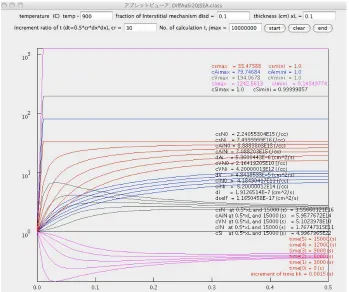
One example of the program used here is shown below. The function of the main part of program is written as a comment line. Five text fields for temperature T, thick-ness L, fraction of interstitial mechanism dIsd, the ratio of k to h, cr, and number of calculations (to determine the
time) jmax are set on the display, and the calculation starts
by checking the start button after putting the value in the text fields. The results are shown immediately as figures on the display after the end of the calculation, and the calculated results can be identified immediately. By changing the values of the text fields, the new results can be again be identified immediately. The distributions of the logarithmic concentrations of Cs, Ci, CV, CI and CSi
are plotted on the display automatically in the range from (xxmini,yymini) to (xxmax,yymax). Six distributions at j = 0, j
= jmax/5, j = 2 × jmax/5, j = 3 × jmax/5, j = 4 × jmax/5 and j =
jmax for each concentration are plotted in our case. One of
the computed results for the indiffusion process is shown in Figure 1 as animage on the display, and that for the
annealing is shown in Figure 2. The diffusion
mecha-nism based on the simulations will be investigated in another paper.
/* Numerical solution (Implicit and Gauss-Sedel method) of basic partial differential equations for Au diffusion in Si and graphics by Java (2012.05.25 M.Morooka) */
/*<applet code="DiffAuSi200JSEA.class" width=901 height=800></applet>*/
import java.applet.Applet; import java.awt.*; import java.awt.event.*;
public class DiffAuSi200JSEA extends Applet imple-ments ActionListener {
TextField txt1,txt2,txt3,txt4,txt5; Button btn1,btn2,btn3;
Label lb1,lb2,lb3,lb4,lb5; String moji;
double temp,dIsd,xL,cr; int jmax; public void init() {
lb1 = new Label("temperature (C) temp ="); add(lb1);
txt1 = new TextField(8); add(txt1);
lb2 = new Label("fraction of Interstitial mechanism dIsd =");
add(lb2);
lb3 = new Label("thickness (cm) xL ="); add(lb3);
txt3 = new TextField(8); add(txt3);
lb4 = new Label("increment ratio of t (dt=0.5*cr*dx*dx), cr =");
add(lb4);
txt4 = new TextField(8); add(txt4);
lb5 = new Label("No. of calculation t, jmax ="); add(lb5);
txt5 = new TextField(8); add(txt5);
btn1 = new Button("start"); btn1.addActionListener(this); add(btn1);
btn2 = new Button("clear"); btn2.addActionListener(this); add(btn2);
btn3 = new Button("end"); btn3.addActionListener(this); add(btn3);
}
public void actionPerformed(ActionEvent e) { moji = e.getActionCommand();
repaint(); }
public void paint(Graphics g) { if (moji=="start") {
lb1.setText("temperature (C) temp =");
lb2.setText("fraction of Interstitial mechanism dIsd =");
lb3.setText(" thickness (cm) xL =");
lb4.setText("increment ratio of t (dt=0.5*cr*dx*dx), cr =");
lb5.setText("No. of calculation t, jmax ="); try {
temp = Double.parseDouble(txt1.getText()); dIsd = Double.parseDouble(txt2.getText()); xL = Double.parseDouble(txt3.getText()); cr = Double.parseDouble(txt4.getText()); jmax = Integer.parseInt(txt5.getText()); }
catch (NumberFormatException ex) { lb1.setText("input error");
} int i,j;
// INPUT imax, i=0 at x=0, i=imax at x =0.5 (0---imax)
int imax; imax = 50;
double[] cs0 = new double[imax+2]; double[] cs1 = new double[imax+2]; double[] cs1Old = new double[imax+2]; double[] cAi0 = new double[imax+2];
double[] cAi1 = new double[imax+2]; double[] cAi1Old = new double[imax+2]; double[] cV0 = new double[imax+2]; double[] cV1 = new double[imax+2]; double[] cV1Old = new double[imax+2]; double[] cI0 = new double[imax+2]; double[] cI1 = new double[imax+2]; double[] cI1Old = new double[imax+2]; double[] cSi0 = new double[imax+2]; double[] cSi1 = new double[imax+2]; double[] cSi1Old = new double[imax+2]; // INPUT print out number between j=1 and jmax int jpn,jpm;
jpn = 5;
jpm = jmax/jpn;//interval of print out j=1 - jmax double[][] csOut = new double[imax+2][jpn+2]; double[][] cAiOut = new double[imax+2][jpn+2]; double[][] cVOut = new double[imax+2][jpn+2]; double[][] cIOut = new double[imax+2][jpn+2]; double[][] cSiOut = new double[imax+2][jpn+2]; double[] diftime = new double[jpn+2]; //diffusion time // INPUT constants cs0,dself,dV,aD
double cN0,k,kT,csN0,cAiN0,dAi,dself,dVsd,dV,fV, cVN0,fI,dI,cIN0,cSiN0;
cN0 = 4.9968e22; //density of site in Si k=8.617386e-5; kT=k*(temp+273.15); // INPUT surface concentration dVsd=1.0-dIsd;
csN0=8.15e22*Math.exp(-1.76/kT); //Ns0 by Collins
cAiN0=5.95e24*Math.exp(-2.52/kT); //Ni0 by Willcox
dAi=2.44e-4*Math.exp(-0.386/kT); //Di by Willcox
double aD; aD=10.0;
dself=aD*25.0*Math.exp(-4.50/kT); //Dself by Demond
fV=0.5; fI=0.7273;
double aV,aI; aV=10.0; aI = 1.0;
dV=aV*10.0*Math.exp(-1.47/kT); // DV by Masters
dI=aI*1.0e-5*Math.exp(-0.4/kT); // DI by Tan
cSiN0=(cN0-csN0)/(1.0+dVsd*dself/(fV*dV)); //NSi0
cVN0=dVsd*dself*cSiN0/(fV*dV); // NV0
cIN0=dIsd*dself*cSiN0/(fI*dI); // NI0
// INPUT initial value of cs,cAi,cV,cI,cSi at t=0 double csNi,cAiNi,cVNi,cINi,cSiNi;
double cs0i,cAi0i,cV0i,cI0i,cSi0i; double ai,abi,aVi,aIi;
ai=0.5;
csNi=7.5e16;//experimental varue at annealing csNi=ai*5.0e10;//at indiffusion
cs0i = csNi/csN0; abi=0.5;
cAiNi=5.95e24*Math.exp(-2.52e0/(k*(1150+273.15))); // at annealing (solid solubility at pre-indiffusion 1150C)
cAiNi=abi*csNi*cAiN0/csN0;// at indiffusion cAi0i = cAiNi/cAiN0;
cVNi=4.2e12;//at annealing (NV0 at pre-indiffusion)
cVNi=aVi*7.3e12;//at indiffusion cV0i = cVNi/cVN0;
aIi=1.0;
cINi=5.2e14;//at annealing (NI0 at pre-indiffusion)
cINi=aIi*2.6e13;//at indiffusion cI0i = cINi/cIN0;
cSi0i = (cN0-csNi-cVNi)/cSiN0;
// INPUT boundary values of cs,cAi,cV,cI,cSi at x=0 double c00,cs00,cAi00,cV00,cI00,cSi00;
c00 = 1.0;
cs00 = c00; cAi00 = c00; cV00 = c00; cI00 = c00;
cSi00 = (cN0-cs00*csN0-cV00*cVN0)/cSiN0; double h,r,kk,tmax;
h = 0.5/(double)imax; //increment of x/xL r=0.5*cr; kk=r*h*h; //increment of t, dt=kk
tmax=kk*(double)jmax; //j=0 at t=0, j=jmax at t=tmax double arcAi,aNc,aKAiSS,aNd,arcV,aKVSS,arcI, aKISS,arAiV,aKVr,aKVe,arsI,aKIr,aKIe,arVI,aKFr,a KFe;
// emission and anihiration of int.Au into/from sink- sources
arcAi=2.34e-8; //capture radius of int.Au // INPUT sink-source density aNc
aNc=0.0; aKAiSS=4.0*Math.PI*arcAi*aNc*dAi; // emission and anihiration of vacancy and int.Si into/from sink-sources
// INPUT dislocation density aNd (cm-2) aNd=20000.0;
arcV=2.34e-8; //capture distance of vacancy
aKVSS=2.0*Math.PI*aNd*dV*Math.log(1.0/(arcV* Math.sqrt(Math.PI*aNd)));
if(aNd<=0.1){ aKVSS=0.0; }
arcI=2.34e-8; //capture radius of int.Si
aKISS=2.0*Math.PI*aNd*dI*Math.log(1.0/(arcI*Math. sqrt(Math.PI*aNd)));
if(aNd<=0.1){ aKISS=0.0; }
// recombination rate of int.Au and vacancy arAiV=2.34e-8; //recombination distance aKVr=4.0*Math.PI*arAiV*(dAi+dV); aKVe=aKVr*cAiN0*cVN0/csN0; // recombination rate of subt.Au and int.Si arsI=2.34e-8; //recombination distance aKIr=4.0*Math.PI*arsI*dI;
aKIe=aKIr*cIN0*csN0/(cAiN0*cSiN0); // recombination rate of vacancy and int.Si arVI=2.34e-8; //recombination distance aKFr=4.0*Math.PI*arVI*(dV+dI); aKFe=aKFr*cIN0*cVN0/cSiN0;
// symplify of the constants
double as1,as3,as4,aAi1,aAi2,aAi3,aAi4,aAi5; as1=aKVr*cAiN0*cVN0/csN0;
as3=aKIe*cAiN0*cSiN0/csN0; as4=aKIr*cIN0;
aAi1=aKVr*cVN0; aAi2=aKVe*csN0/cAiN0; aAi3=aKIe*cSiN0;
aAi4=aKIr*cIN0*csN0/cAiN0; aAi5=dAi/(xL*xL); double aV1,aV2,aV3,aV4,aV5,aI1,aI2,aI3,aI4,aI5; aV1=aKVr*cAiN0; aV2=aKVe*csN0/cVN0; aV3=aKFe*cSiN0/cVN0;
aV4=aKFr*cIN0; aV5=dV/(xL*xL);
aI1=aKIe*cAiN0*cSiN0/cIN0; aI2=aKIr*csN0; aI3=aKFe*cSiN0/cIN0;
aI4=aKFr*cVN0; aI5=dI/(xL*xL); double a05,a06,a07;
a05 = cN0/cSiN0; a06 = csN0/cSiN0; a07 = cVN0/cSiN0;
// symplify of the constants 2
double bs1,bs2,bs3,bs4,bAi1,bAi2,bAi3,bAi4,bAi5, bAi6;
bs1=kk*as1/2.0; bs2=kk*aKVe/2.0; bs3=kk*as3/2.0; bs4=kk*as4/2.0;
bAi1=kk*aAi1/2.0; bAi2=kk*aAi2/2.0; bAi3=kk*aAi3/2.0;
bAi4=kk*aAi4/2.0; bAi5=kk*aAi5/(2.0*h*h); bAi6=kk*aKAiSS/2.0;
double bV1,bV2,bV3,bV4,bV5,bV6,bI1,bI2,bI3,bI4, bI5,bI6;
bV1=kk*aV1/2.0; bV2=kk*aV2/2.0; bV3=kk*aV3/2.0; bV4=kk*aV4/2.0; bV5=kk*aV5/(2.0*h*h);
bV6=kk*aKVSS/2.0;
bI1=kk*aI1/2.0; bI2=kk*aI2/2.0; bI3=kk*aI3/2.0; bI4=kk*aI4/2.0; bI5=kk*aI5/(2.0*h*h);
bI6=kk*aKISS/2.0; // boundary conditions cs0[0] = cs00; cs1[0] = cs00; cAi0[0] = cAi00; cAi1[0] = cAi00; cV0[0] = cV00; cV1[0] = cV00; cI0[0] = cI00; cI1[0] = cI00; cSi0[0] = cSi00; cSi1[0] = cSi00; for (j=0;j<=jpn;++j) {
csOut[0][j]=cs00; cAiOut[0][j]=cAi00; cVOut[0][j]=cV00; cIOut[0][j]=cI00; cSiOut[0][j]=cSi00; }
// initial conditions for (i=1;i<=imax+1;++i) {
cs0[i] = cs0i; cs1[i] = cs0i; csOut[i][0] = cs0i; cAi0[i] = cAi0i; cAi1[i] = cAi0i;
cAiOut[i][0] = cAi0i;
cI0[i] = cI0i; cI1[i] = cI0i; cIOut[i][0] = cI0i; cSi0[i] = cSi0i; cSi1[i] = cSi0i; cSiOut[i][0] = cSi0i; }
diftime[0] = 0.0;
// Crank Nicolson implicit method int jpd,jp; jpd = 0; jp = 0;
// INPUT maximum of iteration in Gauss-Sedel int mgs; mgs=100;
// INPUT convergence value in Gauss-Sedel double egs; egs=1.0e-10;
int igs; double
fs1,fs2,gs,fAi1,fAi2,fAi3,fAi4,gAi,fV1,fV2,fV3, fV4,gV,fI1,fI2,fI3,fI4,gI;
double ecm,ecs,ecsm,ecAi,ecAim,ecV,ecVm,ecI,ecIm, ecSi,ecSim;
ecm = 0.0;
for (j=0;j<=jmax;j++) { // Gauu-Seidel iteration igs=0;
do { igs=igs+1; if(igs>=mgs){
System.out.println("Gauss-Seidel dosn't converge, mgs = "+mgs+"egs = "+egs+"ecm = "+ecm);
System.exit(0); }
ecsm=0.0; ecAim=0.0; ecVm=0.0; ecIm=0.0; ecSim=0.0;
for (i=1;i<=imax;i++) { cs1Old[i]=cs1[i]; cAi1Old[i]=cAi1[i]; cV1Old[i]=cV1[i]; cI1Old[i]=cI1[i]; cSi1Old[i]=cSi1[i]; if(i==imax) {
cs1[imax+1]=cs1[imax-1]; cAi1[imax+1]=cAi1[imax-1]; cV1[imax+1]=cV1[imax-1]; cI1[imax+1]=cI1[imax-1]; cSi1[imax+1]=cSi1[imax-1]; cs1Old[imax+1]=cs1Old[imax-1]; cAi1Old[imax+1]=cAi1Old[imax-1]; cV1Old[imax+1]=cV1Old[imax-1]; cI1Old[imax+1]=cI1Old[imax-1]; cSi1Old[imax+1]=cSi1Old[imax-1]; }
fs1=bs1*(cAi1[i]*cV1[i]+cAi0[i]*cV0[i])-bs2* cs0[i];
fs2=bs3*(cAi1[i]*cSi1[i]+cAi0[i]*cSi0[i])-bs4* cI0[i]*cs0[i];
gs=1.0+bs2+bs4*cI1[i]; cs1[i]=(fs1+fs2+cs0[i])/gs;
fAi1=-bAi1*cAi0[i]*cV0[i]+bAi2*(cs1[i]+
cs0[i]);
fAi2=-bAi3*cAi0[i]*cSi0[i]+bAi4*(cI1[i]* cs1[i]+cI0[i]*cs0[i]);
fAi3=bAi5*(cAi0[i+1]-2.0*cAi0[i]+cAi0[i-1]+ cAi1[i+1]+cAi1[i-1]);
fAi4=bAi6*(2.0-cAi0[i]);
gAi=1.0+bAi1*cV1[i]+bAi3*cSi1[i]+2.0*bAi5 +bAi6;
cAi1[i]=(fAi1+fAi2+fAi3+fAi4+cAi0[i])/gAi; fV1=-bV1*cAi0[i]*cV0[i]+bV2*(cs1[i]+cs0[i]); fV2=bV3*(cSi1[i]+cSi0[i])-bV4*cV0[i]*cI0[i]; fV3=bV5*(cV0[i+1]-2.0*cV0[i]+cV0[i-1]+ cV1[i+1]+cV1[i-1]);
fV4=bV6*(2.0-cV0[i]);
gV=1.0+bV1*cAi1[i]+bV4*cI1[i]+2.0*bV5+ bV6;
cV1[i]=(fV1+fV2+fV3+fV4+cV0[i])/gV; fI1=bI1*(cAi1[i]*cSi1[i]+cAi0[i]*cSi0[i])-bI2* cI0[i]*cs0[i];
fI2=bI3*(cSi1[i]+cSi0[i])-bI4*cV0[i]*cI0[i]; fI3=bI5*(cI0[i+1]-2.0*cI0[i]+cI0[i-1]+cI1[i+1]+ cI1[i-1]);
fI4=bI6*(2.0-cI0[i]);
gI=1.0+bI2*cs1[i]+bI4*cV1[i]+2.0*bI5+bI6; cI1[i]=(fI1+fI2+fI3+fI4+cI0[i])/gI;
cSi1[i] = a05-a06*cs1[i]-a07*cV1[i]; ecs=Math.abs((cs1[i]-cs1Old[i])/cs1Old[i]); ecsm=Math.max(ecs,ecsm);
ecAi=Math.abs((cAi1[i]-cAi1Old[i])/ cAi1Old[i]);
ecAim=Math.max(ecAi,ecAim);
ecV=Math.abs((cV1[i]-cV1Old[i])/cV1Old[i]); ecVm=Math.max(ecV,ecVm);
ecI=Math.abs((cI1[i]-cI1Old[i])/cI1Old[i]); ecIm=Math.max(ecI,ecIm);
ecSi=Math.abs((cSi1[i]-cSi1Old[i])/cSi1Old[i]); ecSim=Math.max(ecSi,ecSim);
ecm=Math.max(ecsm,ecAim); ecm=Math.max(ecm,ecVm); ecm=Math.max(ecm,ecIm); ecm=Math.max(ecm,ecSim); }
if(ecm<egs) {
for (i=1;i<=imax+1;i++) { cs0[i]=cs1[i];
cAi0[i]=cAi1[i]; cV0[i]=cV1[i]; cI0[i]=cI1[i]; cSi0[i]=cSi1[i]; }
}
}while(ecm>=egs);
// Gauss Seidel iteration end
jpd=jpd+1; if(jpd>=jpm){ jpd=0; jp=jp+1;
for (i=0;i<=imax;i++) { csOut[i][jp]=cs1[i]; cAiOut[i][jp]=cAi1[i]; cVOut[i][jp]=cV1[i]; cIOut[i][jp]=cI1[i]; cSiOut[i][jp]=cSi1[i]; }
diftime[jp]=jp*jpm*kk; }
}
// Crank Nicolson end // graphics
// maxmum and minimum values
double xmini,xmax,y1mini,y1max,y2mini,y2max, y3mini,y3max,y4mini,y4max,y5mini,y5max,ymini,ym ax;
xmini = 0.0; xmax = 0.5;
y1mini = csOut[0][0]; y1max = csOut[0][0]; y2mini = cAiOut[0][0]; y2max = cAiOut[0][0]; y3mini = cVOut[0][0]; y3max = cVOut[0][0]; y4mini = cIOut[0][0]; y4max = cIOut[0][0]; y5mini = cSiOut[0][0]; y5max = cSiOut[0][0]; for (j=0;j<=jpn;j++) {
for (i=0;i<=imax; i++) {
y1max = Math.max(csOut[i][j],y1max); y1mini = Math.min(csOut[i][j],y1mini); y2max = Math.max(cAiOut[i][j],y2max); y2mini = Math.min(cAiOut[i][j],y2mini); y3max = Math.max(cVOut[i][j],y3max); y3mini = Math.min(cVOut[i][j],y3mini); y4max = Math.max(cIOut[i][j],y4max); y4mini = Math.min(cIOut[i][j],y4mini); y5max = Math.max(cSiOut[i][j],y5max); y5mini =Math.min(cSiOut[i][j],y5mini); }
}
ymini = Math.min(y1mini,y2mini); ymini = Math.min(ymini,y3mini); ymini = Math.min(ymini,y4mini); ymini = Math.min(ymini,y5mini); ymax = Math.max(y1max,y2max); ymax = Math.max(ymax,y3max); ymax = Math.max(ymax,y4max); ymax = Math.max(ymax,y5max); // Log(csOut),,,,,,
double[][] csOutLog = new double[imax+2][jpn+2]; double[][] cAiOutLog = new double[imax+2][jpn+2]; double[][] cVOutLog = new double[imax+2][jpn+2]; double[][] cIOutLog = new double[imax+2][jpn+2]; double[][] cSiOutLog = new double[imax+2][jpn+2];
for (j=0;j<=jpn;j++) { for (i=0;i<=imax;i++) {
csOutLog[i][j]=Math.log(csOut[i][j])/Math. log(1.0e1);
cAiOutLog[i][j]=Math.log(cAiOut[i][j])/Math. log(1.0e1);
cVOutLog[i][j]=Math.log(cVOut[i][j])/Math. log(1.0e1);
cIOutLog[i][j]=Math.log(cIOut[i][j])/Math. log(1.0e1);
cSiOutLog[i][j]=Math.log(cSiOut[i][j])/Math. log(1.0e1);
} }
double y1miniLog,y1maxLog,y2miniLog,y2maxLog, y3miniLog,y3maxLog,y4miniLog,y4maxLog,y5miniL og,
y5maxLog,yminiLog,ymaxLog;
y1miniLog = Math.log(y1mini)/Math.log(1.0e1); y1maxLog = Math.log(y1max)/Math.log(1.0e1); y2miniLog = Math.log(y2mini)/Math.log(1.0e1); y2maxLog = Math.log(y2max)/Math.log(1.0e1); y3miniLog = Math.log(y3mini)/Math.log(1.0e1); y3maxLog = Math.log(y3max)/Math.log(1.0e1); y4miniLog = Math.log(y4mini)/Math.log(1.0e1); y4maxLog = Math.log(y4max)/Math.log(1.0e1); y5miniLog = Math.log(y5mini)/Math.log(1.0e1); y5maxLog = Math.log(y5max)/Math.log(1.0e1); yminiLog = Math.log(ymini)/Math.log(1.0e1); ymaxLog = Math.log(ymax)/Math.log(1.0e1); // painting boundary
int xxmini,xxmax,yymini,yymax; xxmini = 100; xxmax = 850; yymini = 100; yymax = 700; // painting place
int[] xx = new int[imax+2];
int[][]yy1 = new int[imax+2][jpn+2]; int[][] yy2 = new int[imax+2][jpn+2]; int[][] yy3 = new int[imax+2][jpn+2]; int[][] yy4 = new int[imax+2][jpn+2]; int[][] yy5 = new int[imax+2][jpn+2]; double[] xt = new double[imax+2]; for (i=0;i<=imax;i++) {
xt[i] = xmini+(xmax-xmini)*(double)i/(double)imax; }
double xxa,yy1a,yy2a,yy3a,yy4a,yy5a; for (i=0;i<=imax;i++) {
xxa = (double)xxmini + (xt[i]-xmini)/(xmax-xmini)*( (double)xxmax-(double)xxmini);
xx[i] = (int)xxa; }
for (j=0;j<=jpn;j++) { for (i=0;i<=imax;i++) {
/(ymaxLog-yminiLog)*(double)(yymax-yymini); yy2a=(double)yymax- (cAiOutLog[i][j]-yminiLog) /(ymaxLog-yminiLog)*(double)(yymax-yymini); yy3a =(double)yymax- (cVOutLog[i][j]-yminiLog) /(ymaxLog-yminiLog)*(double)(yymax-yymini); yy4a =(double)yymax - (cIOutLog[i][j]-yminiLog) /(ymaxLog-yminiLog)*(double)(yymax-yymini); yy5a=(double)yymax- (cSiOutLog[i][j]-yminiLog) /(ymaxLog-yminiLog)*(double)(yymax-yymini); yy1[i][j] = (int)yy1a;
yy2[i][j] = (int)yy2a; yy3[i][j] = (int)yy3a; yy4[i][j] = (int)yy4a; yy5[i][j] = (int)yy5a; }
}
// painting
g.drawLine(xxmini,yymini,xxmini,yymax); g.drawLine(xxmini,yymax,xxmax,yymax); g.drawLine(xxmax,yymax,xxmax,yymini); g.drawLine(xxmax,yymini,xxmini,yymini); for (j=0;j<=jpn;j++) {
for (i=0;i<=imax-1; ++i) { try {
g.setColor(Color.darkGray);
g.drawLine(xx[i],yy3[i][j],xx[i+1],yy3[i+1][j]); g.setColor(Color.magenta);
g.drawLine(xx[i],yy4[i][j],xx[i+1],yy4[i+1][j]); g.setColor(Color.black);
g.drawLine(xx[i],yy5[i][j],xx[i+1],yy5[i+1][j]); g.setColor(Color.blue);
g.drawLine(xx[i],yy2[i][j],xx[i+1],yy2[i+1][j]); g.setColor(Color.red);
g.drawLine(xx[i],yy1[i][j],xx[i+1],yy1[i+1][j]); }
catch (ArrayIndexOutOfBoundsException ex) {} }
}
int[] sdiftime = new int[jpn+1]; //diffusion time for print
String[] s = new String[jpn+1]; for (j=0;j<=jpn;j++) {
sdiftime[j] = (int)diftime[j]; s[j] = Integer.toString(sdiftime[j]);
g.drawString("time("+j+") = "+s[j]+" (s)",xxmax-100, yymax-15-15-15*j);
}
String s1; s1 = Double.toString(kk);
g.drawString("increment of time kk = "+s1+" (s)", xxmax-200, yymax-15);
String scsmax,scsmini,scAimax,scAimini,scVmax, scVmini,scImax,scImini,scSimax,scSimini; float y1miniP,y1maxP,y2miniP,y2maxP,y3miniP, y3maxP,y4miniP,y4maxP,y5miniP,y5maxP;
y1miniP = (float)y1mini; y1maxP = (float)y1max; y2miniP = (float)y2mini; y2maxP = (float)y2max; y3miniP = (float)y3mini; y3maxP = (float)y3max; y4miniP = (float)y4mini; y4maxP = (float)y4max; y5miniP = (float)y5mini; y5maxP = (float)y5max; scsmax = Float.toString(y1maxP);
scsmini = Float.toString(y1miniP); scAimax = Float.toString(y2maxP); scAimini = Float.toString(y2miniP); scVmax = Float.toString(y3maxP); scVmini = Float.toString(y3miniP); scImax = Float.toString(y4maxP); scImini = Float.toString(y4miniP); scSimax = Float.toString(y5maxP); scSimini = Float.toString(y5miniP); g.setColor(Color.darkGray);
g.drawString("cVmax = "+scVmax+"cVmini = "+scVmini, xxmax-300, yymini+80);
g.setColor(Color.magenta);
g.drawString("cImax= "+scImax+"cImini = "+scImini, xxmax-300, yymini+95);
g.setColor(Color.black);
g.drawString("cSimax = "+scSimax+"cSimini = "+scSimini, xxmax-300, yymini+110);
g.setColor(Color.blue);
g.drawString("cAimax = "+scAimax+"cAimini = "+scAimini, xxmax-300, yymini+65);
g.setColor(Color.red);
g.drawString("csmax = "+scsmax+" csmini = "+scsmini, xxmax-300, yymini+50);
g.setColor(Color.black); String s21,s22,s23,s24,s25;
double csimaxjp,cAiimaxjp,cVimaxjp,cIimaxjp, cSiimaxjp;
csimaxjp = csN0*csOut[imax][jpn]; cAiimaxjp = cAiN0*cAiOut[imax][jpn]; cVimaxjp = cVN0*cVOut[imax][jpn]; cIimaxjp = cIN0*cIOut[imax][jpn]; cSiimaxjp = cSiN0*cSiOut[imax][jpn];
float csimaxjpP,cAiimaxjpP,cVimaxjpP,cIimaxjpP, cSiimaxjpP;
csimaxjpP = (float)csimaxjp; cAiimaxjpP = (float)cAiimaxjp; cVimaxjpP = (float)cVimaxjp; cIimaxjpP = (float)cIimaxjp; cSiimaxjpP = (float)cSiimaxjp; s21 = Float.toString(csimaxjpP);
g.drawString("csNat 0.5*xL and "+s[jpn]+" (s) = "+s21, xxmax-290, yymax-180);
s22 = Float.toString(cAiimaxjpP);
g.drawString("cAiN at 0.5*xL and "+s[jpn]+" (s)= "+s22, xxmax-290, yymax-165);
s23 = Float.toString(cVimaxjpP);
"+s23, xxmax-290, yymax-150); s24 = Float.toString(cIimaxjpP);
g.drawString("cIN at 0.5*xL and "+s[jpn]+" (s)= "+s24, xxmax-290, yymax-135);
s25 = Float.toString(cSiimaxjpP);
g.drawString("cSi at 0.5*xL and "+s[jpn]+" (s)= "+s25, xxmax-290, yymax-120);
String s31,s32,s33,s34,s35,s36,s37,s38;
float csN0P,cAiN0P,dAiP,cVN0P,dVP,cIN0P,dIP, dselfP;
csN0P = (float)csN0; cAiN0P = (float)cAiN0; dAiP = (float)dAi; cVN0P = (float)cVN0; dVP = (float)dV; cIN0P = (float)cIN0; dIP = (float)dI; dselfP = (float)dself; String s31i,s32i,s34i,s36i; float csNiP,cAiNiP,cVNiP,cINiP; csNiP = (float)csNi;
cAiNiP = (float)cAiNi; cVNiP = (float)cVNi; cINiP = (float)cINi;
s31 = Float.toString(csN0P);
g.drawString("csN0 = "+s31+" (/cc)", xxmax-290, yymax-375);
s31i = Float.toString(csNiP);
g.drawString("csNi= "+s31i+" (/cc)", xxmax-290, yy-max-360);
s32 = Float.toString(cAiN0P);
g.drawString("cAiN0 = "+s32+" (/cc)", xxmax-290, yymax-345);
s32i = Float.toString(cAiNiP);
g.drawString("cAiNi = "+s32i+" (/cc)", xxmax-290, yymax-330);
s33 = Float.toString(dAiP);
g.drawString("dAi= "+s33+" (cm^2/s)", xxmax-290, yymax-315);
s34 = Float.toString(cVN0P);
g.drawString("cVN0 = "+s34+" (/cc)", xxmax-290, yymax-300);
s34i = Float.toString(cVNiP);
g.drawString("cVNi = "+s34i+" (/cc)", xxmax-290, yymax-285);
s35 = Float.toString(dVP);
g.drawString("dV = "+s35+" (cm^2/s)", xxmax-290, yymax-270);
s36 = Float.toString(cIN0P);
g.drawString("cIN0 = "+s36+" (/cc)", xxmax-290, yymax-255);
s36i = Float.toString(cINiP);
g.drawString("cINi = "+s36i+" (/cc)", xxmax-290, yymax-240);
s37 = Float.toString(dIP);
g.drawString("dI = "+s37+" (cm^2/s)", xxmax-290, yymax-225);
s38 = Float.toString(dselfP);
g.drawString("dself = "+s38+" (cm^2/s)", xxmax-290, yymax-210);
// scale and label int xxp;
double xxpd;
xxpd = (xxmax-xxmini)/(xmax - xmini)*0.1; xxp = (int)xxpd;
g.drawLine(xxmini,yymax,xxmini,yymax-10); g.drawString("0.0", xxmini-10, yymax+20);
g.drawLine(xxmini+xxp,yymax,xxmini+xxp,yymax- 10);
g.drawString("0.1", xxmini+xxp-10, yymax+20); g.drawLine(xxmini+xxp*2,yymax,xxmini+xxp*2, yymax-10);
g.drawString("0.2", xxmini+xxp*2-10, yymax+20); g.drawLine(xxmini+xxp*3,yymax,xxmini+xxp*3, yymax-10);
g.drawString("0.3", xxmini+xxp*3-10, yymax+20); g.drawLine(xxmini+xxp*4,yymax,xxmini+xxp*4, yymax-10);
g.drawString("0.4", xxmini+xxp*4-10, yymax+20); g.drawLine(xxmini+xxp*5,yymax,xxmini+xxp*5, yymax-10);
g.drawString("0.5", xxmini+xxp*5-10, yymax+20); int symini,symax,syy,yyp;
symini = (int)yminiLog; symax = (int)ymaxLog; syy = symax - symini;
double yypd,yypa;
yypd = (yymax - yymini)/(ymaxLog - yminiLog); yyp = (int)yypd;
int[] ly = new int[syy+2]; int[] yypp = new int[syy+2]; String[] sy = new String[syy+2]; for (i=0;i<=syy;i++) {
ly[i] =symini+i;
sy[i] = Integer.toString(ly[i]);
yypa =(double)yymax - ((double)ly[i]-yminiLog)/ (ymaxLog-yminiLog)*(double)(yymax-yymini); yypp[i] = (int)yypa;
g.drawLine(xxmini,yypp[i],xxmini+10,yypp[i]); g.drawString(sy[i], xxmini-25, yypp[i]+5); g.drawString("10", xxmini-40, yypp[i]+15); }
}
else if (moji=="end"){System.exit(0);} if (moji=="clear") {
g.clearRect(0,0,901,800); }
Figure 1. An example of the computed result for the indiffusion of Au in Si of 1 mm thickness at 900˚C. The figure is shown as an image on the display.
[image:12.595.124.473.418.710.2]8. Discussion and Results
The author has numerically solved Equations (6)-(10) by Java programming and the distribution of each concen-tration can be simulated correctly and easily using a usual personal computer employing the GUI method of Java. Namely, simultaneous partial different equations can be calculated numerically under known boundary and initial conditions by this program, and the distribution of each unknown can be easily simulated. The time for the com-putation until the required diffusion time depends on cr,
the ratio of k to h, and its maximum value for the con-vergence depends on the constants in the equations. In our case (dIsd = 0.1 and xL = 0.1 cm), the maximum value
is about 300 for the indiffusion at 900˚C and about 40 at 1160˚C. It is better to choose the largest cr value by
ten-tative calculations with small jmax values.
REFERENCES
[1] M. Morooka, H. Tomokage, H. Kitagawa and M. Yoshida,
“Three States of Substitutional Gold in Silicon,” Japa-nese Journal of Applied Physics, Vol. 24, No. 2, 1985, pp.
133-136. doi:10.1143/JJAP.24.133
[2] W. C. Dash, “Gold-Induced Climb of Dislocations in
Sili-con,” Journal of Applied Physics, Vol. 31, No. 12, 1960,
pp. 2275-2283. doi:10.1063/1.1735538
[3] U. Gösele, W. Frank and A. Seeger, “Mechanism and
Kinetics of the Diffusion of Gold in Silicon,” Applied
Physics, Vol. 23, No. 4, 1980, pp. 361-368.
doi:10.1007/BF00903217
[4] M. Morooka and M. Yoshida, “Boundary and Initial
Conditions of Approximate Diffusion Equation for Gold in Silicon,” Japanese Journal of Applied Physics, Vol. 28,
No. 3,1989, pp. 457-463. doi:10.1143/JJAP.28.457
[5] H. Mehrer, “Diffusion in Solids,” Springer-Verlag, Berlin,
2007.
[6] M. Morooka and T. Kajiwara, “Indiffusion and
Out-Dif-fusion Profiles of Substitutional Au in Si Affected by Self-Interstitials and Vacancies,” Japanese Journal of Ap- plied Physics, Vol. 42, No. 6, 2003, pp. 3311-3315.
doi:10.1143/JJAP.42.3311
[7] M. Morooka, “Java Programming for Numerical Solution
of Nonlinear Diffusion Equation (Dissociative and Kick- Out Mechanisms), Research Bulletin of Fukuoka Institute of Technology, Vol. 35, No. 1, 2002, pp. 1-11.
[8] A. C. Damask and G. J. Dienes, “Point Defects in Metals,”
Gordon and Breach, London, 1963.
[9] C. B. Collins, R. O. Carlson and C. J. Gallagher, “Proper-ties of Gold-Doped Silicon,” Physical Review, Vol. 105, No. 4, 1957, pp. 1168-1173.
doi:10.1103/PhysRev.105.1168
[10] W. R. Willcox and T. J. LaChapelle, “Mechanism of Gold
Diffusion into Silicon,” Journal of Applied Physics, Vol. 35, No. 1, 1964, pp. 240-246. doi:10.1063/1.1713077
[11] W. Zulehner, “Oxygen-Related Defects and
Microde-fects,” In: M. Schulz, Ed., Impurities and Defects in Group IV Elements and III-V Compounds, Spring-Verlag, Berlin, 1989, pp. 391-396.
[12] W. Frank, U. Gösele, H. Mehrer and A. Seeger,
“Diffu-sion in Silicon and Germanium,” In: G. E. Murch and A. S. Nowick, Eds., Diffusion in Crystaline Solids, Aca-demic Press Inc., Orlando, 1984, pp. 129-134.
[13] M. Schulz, “Diffusion of Impurities,” In: M. Schulz, Ed., Impurities and Defects in Group IV Elements and III-V Compounds, Spring-Verlag, Berlin, 1989, pp. 250-262.
[14] F. J. Demond, S. Kalbitzer, H. Mannsperger and H.
Damjantschitsch, “Study of Si Self-Diffusion by Nuclear Techniques,” Physics Letters A, Vol. 93, No. 9, 1983, pp.
503-506. doi:10.1016/0375-9601(83)90641-2
[15] B. J. Masters and E. F. Gorey, “Photon-Enhanced
Diffu-sion and Vacancy Migration in Silicon,” Journal of Ap-plied Physics, Vol. 49, No. 5, 1978, pp. 2717-2724.
doi:10.1063/1.325193
[16] T. Y. Tan and U. Gösele, “Point Defects, Diffusion
Proc-esses, and Swirl Defect Formation in Silicon,” Physics and Astronomy, Vol. 37, No. 1, 1985, pp. 1-17.
[17] M. Morooka, Y. Nakabayashi and S. Matsumoto, “Effect
of Surface Condition on the Solid Solubility of Substitu-tional Gold in the Out-Diffusion of Supersaturated Gold in Silicon,” Defect and Diffusion Forum, Vol. 194-199, 2001, pp. 623-628.
[18] V. V. Voronkov, “The Mechanism of Swirl Defects
For-mation in Silicon,” Journal of Crystal Growth, Vol. 59, No. 3, 1982, pp. 625-643.