University of Warwick institutional repository: http://go.warwick.ac.uk/wrap
A Thesis Submitted for the Degree of PhD at the University of Warwick
http://go.warwick.ac.uk/wrap/60491
This thesis is made available online and is protected by original copyright. Please scroll down to view the document itself.
An Approach to Non-Linear Bayesian
Forecasting Problems with Applications.
by
Re1io dos Santos MIGON
Thesis submitted to the University of Warwick for the degree
CONTENTS
CHAPTER 1 INTRODUCTION
1.1 - General
1.2 - Outline of Thesis
1.3 - Terminology and Notation
CHAPTER 2 A REVIEW OF DLM AND ARIMA MODELS
2.1 - Introduction
2.2 - Normal Dynamic Linear Model
2.3 - Model Design
2.4
-2.3.1 - Introduction and Definitions
2.3.2 - Similar models and Reparameterization
2.3.3 - Canonical form Models
Constant DLM and Arima Models 2.4.1 - Arima Model
2.4.2 - The State Space Representation
2.4.3 - The Relationship between CDLM and Arima Models
CHAPTER 3 NORMAL DYNAMIC NON-LINEAR MODEL
3.1 - Introduction
3.2 - The Normal Discount Bayesian Model (NDBM)
3.2.1 - Normal Weighted Bayesian Model
3.2.2 - Normal Discount Bayesian Model
3.2.3 - Modified Normal Discount Bayesian Model
3.4
3.5
-Normal Dynamic Non-Linear Hodel
3.4.1 - The Updating Procedure
3.4.2 - Model Summary and Forecasting
3.4.3 - Normal Dynamic Non-Linear Model with Unknown Variance
3.4.4 - A Practical Procedure for Estimating the Observational Variance
The Seasonal Growth Multiplicative Model
3.5.1 - General
3.5.2 - Notation and Definitions
3.5.3 - The Multiplicative Model
3.5.4 - Examples
Appendix 3.1 - General moments for the multivariate normal distribution
Appendix 3.2 - Artificial data generation
CHAPTER 4 AN APPLICATION OF NON-LINEAR BAYESIAN MODELS TO TV-ADVERTISING.
4.1 - Introduction
4.2 - The Advertising Project
4.2.1 - Objectives of the Study
4.2.2 - The Measurements
4.3 - System Model - Basic Assumptions
4.3.1 - Facilities Required
4.3.2 - The Basic Assumptions
4.4 - Dynamic Linear Models
4.4.1 - Introduction
4.4.2 - Broadym Model
4.4.3 - The Local Linear Model
4.5
4.6
-Dynamic Non-Linear Models 4.5.1 - General
4.5.2 - The Assumed Relationship Between Awareness and Advertising
4.5.3 - Notation and Observational Model
4.5.4 - Non-Linear Model with Variable Half Effect
4.5.5 - Non-Linear Model with Fixed Half Effect
Examples
4.6.1 - General
4.6.2 - Examples
4.6.3 - Comparison
Appendix 4.1 - Memory decay of a population
4.2 - The initial setting for parameters
4.3 - Posterior distribution at the end of the data
4.4 - A comparison of the four models
CHAPTER 5 GENERAL NON-LINEAR MODEL
5.1 - Introduction
5.2 - A Review of Static Generalized Linear Model
5.2.1 - General
5.3
-5.2.2 - The Linear Model for Systematic Effects
5.2.3 - The Genear1ized Exponential Family
5.2.4 - Notation and Some Special Cases
5.2.5 - Comments
Dynamic Generalized Linear Models
5.3.1 - Introduction
5.3.2 - The Model Structure
5.4
-CHAPTER 6
6.1
6.2
6.3
6.4
-CHAPTER 7
7.1
7.2
7.3 7.4
7.5
-General Dynamic Non-Linear Model
5.4.1 - General
5.4.2 - The Guide Relationship
5.4.3 - Updating Recurrence for. the State Vector
5.4.4 - Examples
TRANSFER RESPONSE: MODELLING AND ESTIMATION
Introduction
Transfer Function Modelling and Estimation
6.2.1 - Classical Formulation
6.2.2 - The Box-Jenkins Modelling Procedure
Bayesian Stochastic Transfer Response
6.3.1 - General
6.3.2 - Transfer Response Hodelling
6.3.3 - Stochastic Transfer Response Estimation
Simulation Study
LONG TERM FORECASTING
Introduction
The General Modified Exponential Family of Curves
Characterising the Variation about Trend Curves
The Non-Linear Bayesian Model Applied to Growth Curves
7.4.1 - Trend Plus Random Shock
7.4.2 - The General Model with AR Disturbances
Applications
7.5.1 - General 7.5.2 - Examples
CHAPTER 8 - SUMMARY AND CONCLUSIONS
8.1
8.2
-Introduction
Abstract
This thesis is devoted to the analysis and modelling of time series
and it is concentrated on models and techniques which are of practical value.
In particular we developed a wide class of non-linear dynamic models which
are useful in the handling of real life problems.
Initially we review the basic principles of Bayesian forecasting and
the design of Dynamic Linear Models. The main body of the thesis attacks
the problem of Normal non-linear estimation and forecasting. Some applications
to the seasonal multiplicative model are exhaustively discussed. Following
this we present the results of an application of Bayesian transfer response
in Market Research. This application worked as the very first stimulus to
extend the non-linear models to the exponential family.
Finally we discuss the concepts of stochastic transfer response
modelling and associated sequential estimation, and we report some applications
Acknowledgements.
I should like to express my sincere gratitude to Professor P.J. Harrison
for his efforts in initiating this research, his continuous suggestions, guidance
and general support throughout the period of study.
I am also grateful to Dr. M. West for his discussions and comments and
to Dr. P. Walley for his kindness and attention.
Thanks are also due to Jean Lake, not only for her excellent typing skills,
but for her patience and cheerfulness.
I am deeply grateful to Mirna and the three Musketeers for their patience,
endurance, encouragement and many sacrifices during my period of study.
This research was funded by Conselho Nacional de Desenvolvimento
Cientffico & Tecnologico - CNPq - and I should like to thank the financial
To
Mirna
Marcio
Marcelo
Chapter 1: Introduction.
1.1 General.
This thesis is concerned with the analysis and modelling of time series
and it 1S concentrated on models and techniques which are of practical value.
It· was our decision to develop new models but emphasize the applied and
method-ological aspects of the problem rather than to look for theoretical results.
Time series models can be interpreted as models which are constructed
without drawing on any theories concerning possible behavioural relationship
between variables. This is a distinguishing feature of a time series, as opposed,
say to an econometric model. This field has received an enormous amount of
interest from workers in socio-economics studies, physical and engineering
sciences and in areas such as demography and medicine.
The classical models for time series have been developed since the 40's
and they are based on ARMA processes. A full strategy for time series analysis
was developed by Box and Jenkins in the 70's.
It is worth pointing out that they have started with results of Kolmogorov
and Wiener and are based on the hypothesis of derivable stationarity with
predictors as linear functions of the past observations and mean square error as
criterion of optimality.
The works of Harrison and Stevens (1971, 1976) on Bayesian Forecasting
overcome some of the restrictive hypotheses and opened a very new area for:
practical and theoretical investigation. The approach gives a logically
consistent description of the way in which a forecasting method should deal
with a wide class of situations.
The principle of superposition enables an easy way of building linear models
from separate components, which are structured and facilitates the meaning.
provides a rich and logical framework for mathematical modelling. This is, for
example, the natural way to blend subjective information with data in order to
produce inference. Furthermore, the combination of prior and experimental
information is rigorous and natural.
The Dynamic Linear Models and the Bayesian Forecasting of Harrison and
Stevens have been extended by Ameen and Harrison (1983). The introduction of a
class of Normal Discount Bayesian Models, founded upon the discount concept,
has overcome some difficulties found by practitioners. The innovation or
variance matrix is replaced by a set of discount factors which are invariant to
the measurement scale of the independent and the control variables. This
introduces conceptual simplicity and also removes much of the ambiguity.
The flexibility of these models and their potential as aid to understanding
physical systems as well as forecasting, suggests that more interest will be
centred on their application to diverse fields in the near future.
This thesis is devoted to the examination of a wide class of non-linear
models which, in particular, extends the work of Nelder and Wedderburn (1972)
in Generalized Linear Models. The appropriate sampling distribution should be
used as in West, Harrison and Migon (1983). Some direct application of the
non-linear dynamic models to the estimation of stochastic response is also
discussed.
1.2 Outline of the thesis.
Chapter 2 is concerned with a review of Dynamic Linear Model (D.L.M.)
design and the relationship between constant DLM's and ARIMA models. The main
point is concerned with the design of canonical models which produce desired
forecasting functions. These canonical models can be transformed using similar
linear operators in order to produce a convenient meaningful parametrization.
In Chapter 3 we present a class of non-linear normal dynamic models which
model and reformulates it in order to put forward the non-linear model.
Finally, we present an application to the linear growth seasonal model in a
multiplicative form which avoids transformations and so relates the parameters
in the original measurement scale which is preferred by practitioners.
Chapter 4 consists of a report on an application of Bayesian transfer
response modelling to a marketing problem. At the very beginning of our
study on transfer response, an opportunity to participate in a project involving
the Statistics Department at Warwick University and Millward-Brown Marketing
Research Co. arose. The models developed have been working successfully for
more than two years in their computers and an early practical evaluation can
be found in Colman and Brown (1983). Altogether we developed four models, being two linear and two non-linear. The basic linear model is a dynamic extention
of Broadbent's model (Broadbent (1979»). This fortunate application acted as the very first stimulus for the methodological developments presented in this thesis.
An extention of the Normal non-linear models is presented in Chapter 5.
This model can be viewed as a dynamic version of the generalized linear model
of NeIder and Wedderburn (1972).
The linear Bayes approach developed by Hartigan (1969) is extensively used. This method is appropriate to problems of inference when only the first two
moments of the prior distribution and the likelihood are specified. Some
applications for the log-normal and binomial cases are discussed and for
additional applications the paper of West, Harrison and Migon (1983) is recommended.
Chapter 6 considers the on-line estimation of transfer response. The concept
of stochastic transfer response is discussed and some parallels drawn with the
classical approach. The performance of the estimation method was assessed by
a simulation experiment.
forecasting method to the long-term forecasting problem. The low frequency or
trend is represented by a growth curve such as the modified exponential and
the high frequency as an autoregressive process of order p. The parameters are
estimated on-line and it ~s worth pointing out that the principle of superposition
is again used. This method was applied to some real data and the main results
are reported.
The paper of Harrison and Akram (1982) is recommended for a theoretical
discussion of the problem.
1.3 Terminology and Notation
In general we tried to keep the notation as close as possible to other
related works. Throughout the thesis all probability distributions are defined
via densities with respect to Lebesque measure, and they will be represented by
the generic symbol p(.). Some special densities are denoted as:
(i) N8(m,~) is the multivariate normal density of ~, with mean vector
m and variance matrix ~;
(ii) Ge(a,b) is the Gamma density for 8;
(iii) Be(r,s) is the Beta density for e; and
(iv) B(n,p) is the Binomial mass probability function.
The general exponential family has a density given as:
where ~>O and ~ is the natural parameter of the distribution. It includes as
special cases the Normal, Gamma, Poisson and Binomial distributions.
No distinction is made between random variables and their observed value
since, generally, the context will be clear. By x ~ p(.) we mean that x has
multi-variate normal density of x given z; and, in general, (x/z) ~ [~,~J means that
the conditional density is partially specified with mean m and variance matrix C.
All the vectors are underlined, as ~, for example; and matrices appear as
capital letters.
The following abbreviations represent the classes of models discussed in
this thesis.
DLM CDLM
NDLM
NDBM
NWBM
ARlMA
GLM
Dynamic Linear Models;
Constant Dynamic Linear Models;
Normal Dynamic Linear Models;
Normal Discount Bayesian Models;
Normal Weighted Bayesian Models;
Autoregressive integrated moving average models; and
Generalized Linear Models
Finally, it is worth remarking that the equations are numbered according
to the chapters and sections. For example: equation number 4.3.2 means
equation number two in section 3 of Chapter 4. Further notation will be
Chapter 2: A Review of DLM and ARIMA Models.
2.1 Introduction
This chapter is concerned with a review of the Dynamic Linear Model,
model design and the relationship between the class of constant DLM and ARIMA
models.
In Section 2.2 the Bayesian forecasting approach of Harrison-Stevens
(1971 & 1976) is discussed. A more suitable Bayesian formulation is presented. The concept of similar models which is very useful in model design is
introduced in Section 2.3, as well as a strategy to DLM modelling.
Finally in Section 2.4 we show the link between CDLM and ARIMA models.
The Box-Jenkins strategy is briefly discussed and a state space representation
is introduced.
2.2 Normal Dynamic Linear Model
The Bayesian forecasting approach developed by Harrison & Stevens (1976), a reference which we shall abbreviate HS(1976), is based on a complete parametric
description of the process, which is incorporated into a dynamic linear set of
equations describing:
(i) the process observation, and
(ii) the parameter evolution
The parametric structure reduces ambiguity in the model building and so
increases the meaning, which permits communication between the decision maker,
the forecaster and the forecast method in both directions. When building larger
models the forecaster is almost forced into model decomposition, and again
the structure has a great deal to offer.
The dynamics of the system is described by the evolution of the parameters
in time, both as a result of the inherent process and from random shocks as
In its general form the Dynamic Linear Model is stated in terms of an
ordered index which may be regarded as discrete points of time. Such a model
is defined by a quadruple {F,G,V,W} for each time index. The model may then be t
written:
observation equation:
system equation:
where: Y
-t is an mx1 vector
8
-t is an px1 vector F
-t is an mxp matrix
y - t
e
- t of of ofF 8 + \I -t -t -t
G 8 + W - -t-1 - t
observations
parameters at
at time t·
,
time t·,
independent variables, known at time
G is a known pxp matrix defining the parameter evolution;
'V is an mxl vector representing the observation noise; -t
~ is an pxl vector representing the parameter noise.
(2.2.1)
t;
In general ~ is assumed N(Q'~t) and_w
t is assumed N(Q, ~t) with each being a series of independent random vectors. We should emphasize that the DLM
can be generalized by allowing G to vary throughout the time and by considering
a non zero expected value for 'V and w .
- t - t
An alternative formulation.
Equation 2.2.1 can be rewritten in a more appropriate Bayesian statement for the DLM {F, G, V, W}t,as:
{
observation equation:
parameter relation:
Information
~
Ie
t) '" N[ It~t; ~t
](~tl~t-l)
'"N[~ ~t-l' ~tJ
(2.2.2)Definition 2.1: D represents all the available information at t-l. t-l
This includes all available data and subjective information.
However, unless otherwise stated D
t
=
{Dt_l , Yt' It}·it then follows that given the DLM a future joint forecast distribution can be
obtained for any required time. Further, on reception of the actual observation,
Bayes Theorem can be applied to obtain the posterior parameter distribution
Updating and Forecasting.
The Markovian nature of the model lends itself naturally to a sequential
estimation of -t8 , forecasting future Y k' k~l, and smoothing or filtering, -t+
Le. "forecasting" into the past values of ~t+k' k = -1, -2 ...
The two major operations in the sequential analysis are:
(i) Time update
(ii) Prior to posterior update
where D 1 is as in definition 2.1 and represents all the information up to
t
-and including time t-l.
If p(~tIDt-l) is a N(~~t_l' ~t) then once we observe !t
=
~t' theparameter posterior distribution at time t is obtained by applying Bayes
Theorem:-L(Yt
I
~t) is the likelihood function. This immediately gives (~tIDt) ~N(~t' ~t) with the following recurrence relationship for ~t and ~t:
-1
~t
=
R -1 + F' V F --t. - t -:....t - tm = G m + A e (2.2.3)
- t -t-l - t - t
where as usual in Bayesian Normal Theory e
t Yt - ! t ~~t-l is the one step ahead forecast error and At is the multiple regression vector of ~t on It'
(.!.-At !t) R t
or
c
=
R - A Y A' - t - t - t - t - t '(2.2.4)
where
l t = var(YtIDt_1)· The latter variance equation together with equation for
~t are often referred to as the Kalman filter recurrence equations [H.S.(1976)].
Forecasting distribution.
The predictive distribution is easily obtained, in an extrapolative way, as
soon as the posterior distribution of the parameter vector
e
at any time - tt~l is evaluated. The predictions are distributional in nature and derived
from the current parameters uncertainty, future observation noise ~t+k and
the disturbances W k' k=1,2 .•• -t+
From the DLM equation (2.2.1), a future observation variable is written
as:
Y = F
e
+ '" -t+k -t+k -t+k -t+ke
= Ge
+ w-t+k - -t+k-l -t+k (2.2.5)
Defining
~,t = E(!t+kIDt' !t+k)
~t
= var(Q.t+kIDt' .!t+k),
(2.2.6)C = C are known from the recurrence equations (2.2.3). -0, t - t
Then from (2.2.5) we obtain
~,t
=
G ~-l,
tC
=
G C G' + W~,t - ~-l,t -t+k (2.2.7)
with V k and W k known. -t+ -t+
The prediction mean and variance of the k-steps-ahead process are
written as
and two cases must be considered in order to calculate these values.
Case I: -t+ F k' k=1,2 ••. known
From (2.2.5) and (2.2.6) we get:
~
with m and
C
obtained recursively for k=1,2 •.• from (2.2.6).Case II: F k' k=1,2 ••• not known. -t+
(2.2.8)
Let F k be expressed by an expected value F plus a stochastic term
a!,
-t+where for simplicity we drop the suffix t+k.
Then using a result of Feldstein (1971) we get
~,t
~t
,
F,. t TIl. -r.., -K,t
~
~,t ~,t ~,t
+~t+k
+ Uwhere: U
=
(u .. ) is a pxp matrix with elements1.J
u .. = tr{4J .•
em.
t m.' t +e,. ]}
1.J 1.J -K, -1<., -r.., t
Finally we would emphasize the basic characteristics of the DLM,
some of which will be largely used in this thesis:
(i) its easy physical interpretation for the parameters, designed
to the requirements of the decision makers;
(ii) its probabilistic information on the parameters at any time;
(iii) its sequential nature which permits a description of systematic changes in the parameters of a system;
(iv) its freedom from stationarity which allows a better description of
"reality", and
(v) its distributional predictive nature.
To complete this section it should be mentioned some new theoretical and
methodological developments in the area of Bayesian Forecasting as the Normal
Discount Bayesian Model [Ameen and Harrison (1983)]; the Generalized Exponential
Weight Regression [Harrison and Akram (1982)]; and the work in robustification
of DLM [West (1981)], the non-normal steady state models of Smith (1979) and
Souza (1981). In the applications of DLM and Bayesian forecasting the papers
of Johnston and Harrison(1980) and Harrison et al (1977) are related with our
2.3 Model Design
2.3.1 Introduction and definitions.
The aims of this section are to show how to design models with a desired
forecast function. The meaning of forecast function is the expected value of
the forecast distribution and it is a local form description of the expected
process trajectory. It is clear that the forecast function is completely
determined by the evolution matrix G, assuming ~+k' k=I,2, ••• known.
A general Normal Dynamic Linear Model is denoted by {!, G, V, ~}t'
with parameterization
e,
where(e
ID ) ~ N[m , CJ.
Following the same- - t t - t - t
notational principals a Constant Normal Dynamic Linear Model is {~, ~, V, W}
In order to characterize a class of similar models we have to introduce
the concept of observability. Loosely a deterministic system
is said observable if knowledge of Yt'S over a finite period of time completely
determine the parameter~. Consequently for a constant D.L.M. one can think of
unobservable model as an over-specified model.
Definition 2.1: The deterministic model {~, ~,
Q, Q}
is said to be observablei f and only i f
1.
=<!,
!.G, ... F GP-1), is a pxp matrix of full rank p.The definition 2.1 is extended for a constant Normal DLM {~, G, ~, W}
in a natural way saying that the constant NDLM is observable if the associated
deterministic model is observable.
2.3.2. Similar Models and Reparametrization.
In practice it is very important to transform models in order to get a
meaningful parameterization, so that forecast and information are easily
understood, and subjective knowledge can be incorporated smoothly.
(i) G is similar to
Q.l'
i.e. there exist a full matrix H such that G1
= HGHl
(ii)~l
=!!
~
!!-l ,
=
F H-1where H ~s a full rank matrix such that H G H-1
= Q.l'
and(iii)
!l
Theorem 2.3: Let
e
be the parameterization of the model M andy
be that of model MI' Suppose that (6 ID ) ~ N[m , C J and (~ ID ) ~ N[m t' C tJ-t t -t -t -t t -1 , -1 ,
and that M and Ml are similar observable models. Then these models have the same
forecasting function if:
Proof:
!!!.1
,
t=
- - t ' H ro • with-1 -1
H
=
T T, T ,exist because Ml is observable- -1
(';)
...
!J.
-1 !!!.1, Gk t = F _ H-L-LH G H k -1J H mt =!.
G !!!.t' k :Yk~OCii) Because Ml is observable the inverse of !.l exists, and from (i) -1
we can write: T ~
=
2J.
~,t' Then follows that H = ~ T To complete this section we emphasize that having a modelM
withpara-meterization 8 we can reparametrize it through the transformation H: ~~
y,
obtaining the similar model M1
= {!
H-1, H G !!-1, V, H ~ !!-1} with parametrizationit
as stated in Ameen and Harrison (1983).2.3.3 Canonical form models.
The design of a DLM with some g1ven form to the forecast function, i.e. the
trajectory of the process, can be done in two steps:
(i) write down the canonical design with paramet~ization
!,
and(ii) reparametrize to any required parametrization, ~
=
g
y,
as discussed in section 2.3.2.For the model
{!.'
Q.,
~, ~} with parametrization (~tIDt) ~ N(ro , ~t) tassuming ~+k known, the forecast function
=
F Ok m- - - t t+k
Using the well known Jordan Decomposition theorem we find a non-singular
matrix~, such that
has p distinctive eigenvalues Xl ••• X
p' and the model
M
is similar to the modelMl - {!l G1 ~ ~l}· Hence these models have the same forecast function.
It is not difficult to show that:
=
F H-l Ak~~t
=
i
a. tX~
, with a. t =i=l ~,~ ~, m. ~, t
Now if ~ is of rank p and has r<p distinctive eigenvalues Xl ••• X
p
p
each one with multiplicity p., i=l, ••• ,r, with
~ L p. = p, there exist H
i=l 1
non-singular such that
A. (X.)
1 ~ A. ~ I o ••• 0
o
A. 1. •. 01
o
0 O ••• ft..1:
is a Jordan block of dimension P .•
1
In this case the forecast function is:
=
r
L
i=l
r
=
L P. t (k) X~
, where P. ti=O 1, 1 1,
is a polynomial of order p. in k, with degree p.-l.
1 1
Example: A simple cycle is characterized by a pair of distinct eigenvalues
iw -iw .
(e , e ). The model 1n canonical form is completely undesirable since the
the model in canonical form as M
~
{(I ,1);~
iw~ -i~;
V, W} with paramet r-ization ~, where (~tIDt) ~ N[~t' ~tJ follows that the forecasting function is:where:
F (k) = m eiwk t
a .b d
m
=
2"
+12
an m a 2 12'
b- -iwk + m e ,
The forecasting function can be rewritten as:
Ft(k)
=
a cos(kW) - b sin(kw) and it motivates the following model:- { Ccos (w)
M1 ::: (1,0); -S1n . ( ) w sin(w)l. cos (w)J ' V , -1 •
w}
Of course these models are similar and the transformation is defined as:
H
=
~
l
. . =
D
T -1 T.1 -1 - 1 - The new parametrization is
.it
=
He
- - t =
lee
1 , t +e
2 , t1
- i
e
1,t 2,t
and
Finally it is worth showing that the forecast function for the model
M
=
{I, ~, ~, w} can be written as a linear function of ~t = (Ft(O) ••• Ft(p-l»)'Let T
=
(F,I
G ••• F ~p-l), be of full rank p (the model is observable).Then Ft(O) ••• Ft(p-l) are linearly independent and Vk>O exist
~
=
(~O"'~P-l)k E ~p such that:Proof: S
=
T m implies m- t - - t - t
-1
=
T S.- t
Hence Ft(k)
=
F Gk T-1~t
=
~ ~t
p-l
Example:
E ~i,k Ft(i)
i=o
M = {(I,D);
flo
1 llll; V, W} and(e
ID )~
N(m ; C ).T =
n
~)
,
Gk =11
kl and St[Ft(O>] ,
-1G~
~.
HenceL9
lJ = T =F t (1)
Ft(k) F Gk T- 1 S
- - - -t
= F (0) +
k~
(l)-F (08t t t
=
m1 t + k m, 2, t as is well known.
2.4 Constant DLM and ARlMA Models.
2.4.1 ARlMA Models.
Since the developments of Wiener and Kolmogorov in 1940's many studies
have been done based in the hypothesis of stationarity or derivable stationarity,
with predictors as linear functions of the past observations and mean square
error as criterion of optimality.
Box and Jenkins in a series of papers and a book (1976) describe a full
strategy for the construction of linear stochastic difference equations
describing the behaviour of a time series. Briefly, they assume that the
given series Y can be reduced to stationarity by differencing a finite
t
number of times, i.e. by determining the stationary series Z as:
t
z
= (1-B)d Yt t with d>O integer
and B the backward shift operator in the time index of Y
t' i.e. B Yt
=
Yt-1An
ARMA
model is assumed for the stationary time series Zt and it iswritten as:
where:
(2.4.1)
at' t=1,2 ••• is a sequence of uncorrelated random variables
wi th E
[aJ
=
0 and Ya (B) = 0
2 is the auto covariance
generating function;
In terms of the original time series we can write:
(2.4.2)
where ~(B) and G(B) are polynomials in B of degree p and q respectively.
These models are the well known ARIMA(p,d,q).
It is worth mentioning the Box-Jenkina procedure to fit a model of the
above form (2.4.2) to a given set of data. It consists of a three steps
procedure:
(i) identification of the order of the model;
(ii) estimation of parameters, i.e. ~'s, e's and 02, and
(iii) a diagnostic check.
These three steps are used iteratively and the popularity of the method
is mainly based in the large quantity of software and relevant literature available.
It is straightforward to show that the mean square error forecast of Yt+k
from 2.4.2 is its conditional expectation. So rewriting 2.4.2 as ~(B)Yt+k-G(B)at
and taking conditional expectation noting that the conditional expectation
of Y
t , Yt- 1, ••• , at' at-I ••• are their known values at time t, and those for
a
t+k are zero, we get the forecasting as a step by step procedure, taking in turn k=1,2, •.•
2.4.2 The state space representation.
There is a simple and interesting way of obtaining a state space or
Markovian representation for the models described in sec. 2.4.1. The basic
ideas rest on the well known result that any finite order difference or
differential equation can be rewritten as a vector first order equation.
Thus we may rewrite 2.4.2 in an algebraically equivalent form:
e =
Ge
+r
uwhere: 6 is a vector (n+l)xl called the state space vector and _F, C
- t
and
r
are suitably defined matrices.It should be emphasized that the specific expressions for ~, G and
£
provide merely one way of writing the state space form. Even if we fix thedimension of
!,
we may still obtain an equivalent state space representation by making a similarity transformation as described in section 2.3.2.Following Harrison and Akram (1983) a canonical state space representation
for the model:
, where
~(B) and 8(B) are polynomial in B of degree p and q respectively, can be
constructed using:
F = (1,0 ••• 0)
6.=0 if j>q.
J
• G =
La:
11
.
, - - n '
° °
max(p,q) and ~.=O if i>p,
1
2.4. The Relationship between CDLM and AR1MA Models.
To complete this chapter we show that any closed Dynamic Linear Model
can be represented as an AR1MA model. The proof of the theorem 2.7 follows from a straightforward application of the following lemmas.
Lemma 2.5: If in the deterministic CDLM, i.e. {!,
Q,
0, O} , the matrix G has eigenvalues A1 ••• A not necessarily distinct nor necessarily non zero thenp
Proof:
P
II
i=l
(l-A. B) Y
=
01 t
(l-Ai B)Yt
=
F[C-A i IJ!t-l and hencef(x)
=
P II (X-A.) =°
is the characteristic equation of G and by the Cayley-1.i=l
Hamilton theorem f(G) = 0.
Lemma 2.6: Let E be independent identically distributed qxl random vector with - t
zero expectation and let ~. E Rq be (q+l) constant vectors, i=O,l, ••• q. Then
.-:1.
q
Zt
=
L Q" € •i=l -1. -t-1 (2.4.4)
and cov (Zt' Z )
t-q :f 0, then z t is a Hoving Average Process of order q and can be written
q
Zt e t + L b. e t-i' where i=l 1.
the e 's are i.Ld. random variables with zero expectation, and b. 's, i=1,2 ••• p
t 1.
are constants.
A proof of Lemma 2.6 is found in Harrison (1967).
The next theorem shows the representation of a CDLM in the ARMA form.
Theorem 2.7: Given an observable constant DLM
Y =F6 +\1
t - - t t
8
=
G 6 + W- t - - t - l - t
\I '" [0, V] t
w
t '" [O,,ill
with V>O, dim! = p and G with eigenvalues Al ••• A
p not necessarily distinct nor necessarily non zero
p P
II (l-A. B) Y = e + L b. e
t .
,
wherei=l 1. t t j=l J -J
the e 's
t are LLd. random variables with zero mean.
Comment: From sections
2.4.2
and2.4.3
follows that the class of DLM contains theARMA class. Since some of the A's can be zero and so can the b.'s, the class
J
Chapter 3: Normal Dynamic Non-Linear Model.
3.1 Introduction
The D.L.M.'s described in the previous chapter provide a comprehensive
framework for the modelling and analysis of a wide class of observed time series.
It is worth pointing out the great flexibility of these models as
components of structural forecasting systems and their potential as aids to
interpreting the observed behaviour of the process.
Although the Dynamic Bayesian Linear Models of HS(1976) have provided
a simple and elegant model formulation and extended the classical models by
offering a reformulisation which includes many facilities which are not
elegantly available in the classical formulation, they have still some
limit-ations.
Indeed, the N.D.L.M. provides a useful approximation to a more general
structure, perhaps after transforming the original data. The problem with
this approach are twofold. First we lose the interpretability of the
parameters, and secondly when transformations are used the requirements of
linearity, constant variance and normality may conflict. In such cases it
is desirable that the appropriate non-normal sampling distribution should be
used, and transformations avoided.
In this chapter we present a class of Normal Dynamic Non-linear Models
which provides a much wider class of applications of the dynamic models to
real life problems. The extension to the general case, i.e. non-normal
In section 3.2 we introduce the Normal Weighted Bayesian Model
[Ameen-Harrison (1983)J, which overcomes some practical
disadvantages associated with Dynamic Linear Models. A discount vector
replaces the DLM system variance matrix; introduces conceptual simplicity;
removes ambiguity and provides a system transition model which is invariant
to the measurement scale of independent and control variables.
As a basis for the development of Normal Non-linear Models in section
3.4, a reformulation of the Normal Discount Bayesian Models is discussed in section 3.3.
Finally, section 3.5 is concerned with the applications of Normal
Non-linear Models. The construction of models is briefly discussed and the discount
concepts used. Some examples of intervention are presented and practical
procedures for estimating the observation variance on-line are discussed; in
particular, slowly changing variances and variance power laws are presented.
3.2 The Normal Discount Bayesian Models (NDBM).
The Normal Dynamic Linear Models presented in chapter 2 require mode1lers
to be familiar with parametric modelling, state space stochastic difference
equations and the Normal probability representation of innovations. The
specification of the associated system variance matrices has proved a major
obstacle in the applications. In general, people have little quantitative
insight for the elements of these matrices. The aim of this section is to
introduce a class of Normal Dynamic Bayesian Models which replaces the
system variance matrix by a set of discount factors.
3.2.1 Normal Weighted Bayesian Model.
A
Normal Weighted Bayesian Model is defined by a quadruple{F, G, V,
~}tfor each integer t>O. Let D be the available data at time t-l and suppose t-l
that the posterior distribution for
e
~sThen the model is described by:
(ii) prior distribution:
where:
R
=
H C H' - t - t -t-1 - tIt follows that the predictive distribution is:
where
Further defining e t for !t is:
A
(Y ID t t-1) ~ N[y , t YtJ
Yt - t - t F G !!!.t-l
Y
t F - t -t -t R F' + V t
= y -y and A = R I~/Yt ' t t - t
(~tIDt) ~ N[m , C ]
- t - t
where ~t and ~t may be calculated recursively by
m = G m + A e - t - t -t-1 - t t
C
=
[I-A F ] R- t - - t - t - t
the posterior distribution
It is worth commenting that the class of Normal D.L.M. is contained in
the class of Normal W.B.M. To see this define
W
=
H C H' - G C G'-t -t -t-1 -t -t -t-1 -t·
If W
3.2.2 Normal Discount Bayesian Models.
A N.D.B.M. is defined by a quadruple {F, G, V, S} and is a particular
- - - t
N.W.B.M. where always H = B-! G = G' B-!. Interest will be centered on models
-t -t t
-structured such that
Qt = diag{Q.l···~} t has a block diagonal form.
I. - is an identity matrix of dimension p.;
1 1
8.
1 - are
H -t = B
-!
the
G '
- t
=
discount
~
B -!factors satisfying O<8.~1 ~i=l, ••• p , and
1
the NDBM is obtained.
We have used these ideas in our applications (section 3.5) and a full
account of these models is presented in Ameen and Harrison (1983).
3.2.3 Modified Normal Discount Bayesian Models.
A further class of NWBM's called Modified NDBM's is introduced in this section. The reason for introducing this model class is that there may be a
requirement that the system evolution for the different blocks G. be considered
- 1
as independent of one another. The information from the observation series
Y
t is distributed amongst the components of
!
introducing parameter covariances. However this does not signify that covariances should be developed over timeby discounting or by any other means.
In order to define the modified NDBM consider (~-l/Dt-l) '" N[~t_l ' £t-l]
where, corresponding to any diagonal block structure for G
=
diag{G1 ••• G },- - - p
at time t-1, the partitioned structure of C is {C •• }, of R is {R •• }.
-t-l -1J - t -lJ for i,j=1,2, ••• p, and B
t = diag{l:p
E.z •••
~}.Then a modified NDBM {F, G, V,
!l
t defines (~tI
D t-l) '" N(2,.
!!!.t-l' !t) wherebut R ..
=
G. C •. G! for i;j.3.3 Reformulation of the DLM.
In order to obtain an extension of the Normal DLM for the non-linear case
we commence by a reformulation of the standard normal analysis.
Suppose we write the NDBM as
(ii) Linear guide relationship: ¢t
= Fe,
wheree
1S a vector of- t - t - t
the underlying parameters.
(iii) Prior distribution for ¢t given the information up to and including
time t-l
(iv) Finally, the prior distribution for
e
given D- t t-l
(3.3.1)
If, in addition, we assume that the likelihood of Y
t given ~ and ¢t depends on
e
only through ¢t' then using Bayes theorem we obtain- t
(3.3.2)
Note that the product of the first two terms in the right hand side of (3.3.2)
is proportional to the posterior density of ~t' so
The posterior density of ¢t has the standard form
r
all
=
r+ V VOn the other hand the second term in the RHS of (3.3.3) is calculated from
the joint prior distribution for (~ ,8 ):
t - t
where:
cov(F
e ; e
In
)
=
F R -t -t -t t-l -t -tvar(F
e In
1)=
F R F'-t -t t- -t -t -t
Using the standard Normal theory it follows that the posterior for
e
- twhere:
r' ,..
~t = ~t +
=-
r [~ t -ljJ ]t
~t
=
~t - r' r /r (3.3.4)Now following West, Harrison and Migon (1983), we show that these updating relations coincide with the Kalman filter equations in the Normal linear case.
First we note that:
where:
r'
= e t + r+ V [y t -Yt ]
- t
Y
t
=
E[Y
tID
t-l]
(3.3.6)
r
Which are the Kalman filter recurrence relations with At
r+V-t
The main conclusions from this sort of analysis, which will help us in the
extension to the non-linear normal case are:
(i) the updating of the distribution of the underlying parameter vector
(ii)
e
follows from the use of Bayes theorem on ~t and from the filtering- t
back of information via the conditional distribution of - t
e
givene
and ljit;-t-l
from equation (3.3.4) it is clear that
e
-t: depends on D 1 onlyt-through the change in the mean of ljit' and similarly C depends only on
- t
D . t-l through changes in the variance of IjJ • t '
(iii) in the normal case the first and second moments completely characterise
the probability distribution;
(iv) finally the forecast distribution for (YtID t -1) depends on the prior
for !t only through the parameters of (IjJtIDt-l)·
In the coming section we present non-linear analogues for this model where
the prior and posterior for the underlying parameters are only partially
specified in order to obtain a tractable sequential analysis.
3.4 Normal Dynamic Non-linear Model.
Let
e
be a parameter vector with (~t_lIDt-l) "" N[mt _1 '£t-l J, and consider a specified dynamic model, which may be non-linear, applied to this posteriorLet tjJ be a parameter related to
e
through a stated "guide relationship".g-non-linear,
which may be deterministic or stochastic.
The joint prior distribution for (tjJ ,8 )' is then defined such that: t - t
(3.4.1)
where:
(3.4.2)
Comment: In general the marginal distribution of tjJt does not need to be
normal as we see in chapter 5, even though we consider only the normal
case in this chapter.
In many non-linear models the higher moments of
e
are needed and often wetake the marginal distribution of 8 as normal. In this way we can use the
- t
results about the general moments of products of normal random variables (see
appendix 3.1) in order to use a Taylor expansion including moments of higher
order.
Let the posterior mean and variance of (tjJtIDt) be:
The resulting updating equation derived from (3.4.1) are:
where:
(8
I
D ) 'V N[m ,C ]- t t - t - t
m - t
h
8 t + -r' (m-lji ) / r t
C
=
R - r' _r(r-011)/r- t - t
3.4.2: Model summary and forecasting
3.4.3
For reference purposes the full system of recursions is summarized here:
(i) observational model
(ii) The guide relationship
(iii) Prior distribution
(iv) Posterior distribution
(v) Underlying parameter updating
h
~
=
~t +E..'
(m-ljit)/r or ~t=
!t
+ r' r+V(vi) Underlying parameter evolution
8 = G m
-t --t-l
!t -~ G C G'
-~
= B B
-t
-
-t-l -tThe predictive distribution for Wt+k and Yt +k , k>O, for forecasting purposes,
are available in the following form:
(i) From a practical point of view (Ameen and Harrison (1983») it is most useful to approximate (~t+k/nt) by
(8 -t+k t In) ~ N[mt(k); Rt(k)], - - where:
~(k)
=
Q
~t(k-l), k>O(3.4.4)
"
(ii) Hence (Wt+k1nt) ~ N[Wt(k); rt(k)]; k>O, where:
"
Wt(O) = Wt and rt(O) = r.
" "
(iii) Finally p(Yt+kln t ) ~ N[Yt(k); Yt(k)], where:
A
wt(k); k>O; and
-3.4.3. Normal Non-linear Model with unknown variance
A simple modification of the model provides a tractable learning procedure
for unknown variance in the normal case. A number of approaches have been
adopted for estimating the observation variance as for example Smith (1977),
Smith and West (1983), Ameen and Harrison (1983).
It is assumed that the variance V
=
~-I
where~
is an unknown constant. The probability model may be rewritten as:
"-(ii) (wtIDt-l) '" N[w t , r/~J
. nt-J
, 2J
where the Gamma pdf has the kernel
n
t _1
log¢ 2
-It follows that the recurrence relationships for the updating procedure
and the predictive distribution are exactly as defined in 3.4.2 with the setting
V =1 and: t
(i) Joint prior for (\jJt'~)'
(ii) Posterior distribution for \jJ , ¢ and
e
t - t
(c)
---~
-a + e2 /
t-1 t (r+l)
Note that the point estimates of ~ or l/~ can then be calculated
ex
sequentially; for example
0
2=
~ is the posterior harmonict n
t
mean of the observational variance.
(~IDt ,<p) IV N[~t' ~/~J
( mt
...
=
e
+ r' [m-ljJJ/r
-t - t
l~
=
Rt - r'r(r-cr )/r2 - - 11
The marginal posterior of
e
can be obtained as amulti-- t
variate t-student using standard Bayesian analysis.
(d) Finally, the marginal predictive distribution is obtained
from the joint distribution (Y
,¢In)
integrating outt+1 t
~, given:
3.4.4 A practical procedure for estimating the observational variance.
Although the full Bayesian treatment given in 3.4.3 provides a tractable
learning procedure for unknown observational variance, practitioners would
appreciate some simple but effective robust procedure. In particular, slowly
changing variances and power laws are two important aspects in applications.
A number of approaches have been adopted for estimating the observational
variance, for example Smith and West (1983), Harrison and Stevens (1976),
For a NORMAL DLM (F,G,W,V) , as we have shown in Chapter 2, the predictive
- - - t
" " distribution is (YtIDt
-1) ~ N(yt,Yt), where:
"
Remembering the definition of ~, i.e. ~t
=
!
~'/Yt' it follows that:"
V
=
[1 - F A Jyt -t-t t 3.4.5
Using (3.4.5) a simple and effective procedure for variance learning can be
obtained.
an unknown constant V's natural estimate is
where:
x
=
x + d2t t - l t
n + 1
t - l 3.4.6
In order to robustify the procedure we suggest the practical method:
where k is generally
chosen in the interval [4,6J.
Initial values for (xo,n o) in (3.4.6) may be chosen such that Vo
is a point estimate for V and nO is the accuracy expressed in terms of a number
of degrees of freedom or of equivalent observations.
Cases in which it is suspected that V varies slowly over time, a discount
factor can be introduced so that
Since ¢t has a skew distribution it is wise to choose .95<8<1. Further,
if the initial prior of the parameters vector! is vague, then it is
recommended that variance learning commences at time (p+l) where p is the
vector dimension.
Stevens (1974) g~ves a theoretical basis for the popular empirical variance
law which is often applied in stock control. With positive observations, the
law is:
Empirically a value of b
=
.75 is often appropriate. An estimate of a, at' is then derived fromn
t = 8 n v t-1 + 1 z
t at = n
t
3.4.8
. f V V -- a"'t+k{E[Y
t+k\Dt]}1' .. 5 Future est~mates 0 are k
t+ If the power is
'" 2b unknown and the variance law written V
t
=
a Yt may be definedthe support for (a,b)
S(a,b\D )
=
S(a,b\Dt ) +t~
b - loga - 2 b 109;J/2t -1 2 t
aY t
The best supported values may be used as in Harrison and Pearce (1971).
Ameen and Harrison (1983) recommend that with such a method: '"
d~ = (l-!t~t) min(e~,4 Y
t), S~.98, and that strong prior support must be applied.
It is worth pointing out that in our case F ~s equal to the scalar
- t
r
1 and ~t is just r+ V
t
3.5. The Seasonal Growth Multiplicative Model.
3 • 5. 1 GeneraL
pointed out the importance of the multiplicative model formulation for analysing
seasonal data in forms of separate trend and seasonal components.
Our dynamic non-linear model, when applied to the seasonal growth
multi-plicative case, avoids the inconvenience of transforming the data. The
practitioners may operate with parameters relating to the current level, growth
rate and seasonal effects rather than to transformed mixtures of these
parameters. For example a linear growth on original scale cannot be easily
obtained when a logarithmic transformation is taken - the linear growth
component then produces an exponential growth in the original observations.
Another point we would like to focus on is the often recommended
trans-formation in order to apply stationary time series theory. The work with
X
t =
y~-p,
the transformed series is a clear case of mathematical convenienceleading the modeller to adopt an undesirable model whose meaning is not at all
clear to the decision maker. With the Bayesian approach there is no need to
operate with transformed variables nor to lose interpretability.
Furthermore, it seems to us a quite serious drawback to transfonmed
variables the fact that they may not be robust to departures in the assumptions
on which they are derived. For example if a logarithmic transformation is
taken and a zero or near zero observation occur then the value of x
t =logYt
is
_00.
This means that protection rules need to be introduced to guard againstsuch occurrences. In general there may be a danger of assigning the much
importance to small values, say at a seasonal trough, compared to the important
values which occur at seasonal peaks.
3.5.2 Notation and Definitions
Let the vector of the underlying parameter ~t be
~
=
[il t '
where:~t
=
[~lt
and~
=
(p,oooPr)'growth; and p ~s the vector of seasonal factors.
The guide relationship is defined as:
where: F
=
(1,0) and ~ (1,0,1,0, ••• ,1,0).We describe the system evolution by the structure:
(i) systematic evolution - let G be a (T+2) x (T+2) matrix.
where G
~
=diag{~l; ~2"" '~tTJ
}- +1
2
d G = [.:os (kw)
an -=1<+1
. -sin(kw)
rTl
=
~
for k=l,2, •.•
L2J;
w Tsin (kw>l
cos (kw)J
3.5.1
(ii) Let B be a (T+2) x (T+2) matrix of discount factors defined as:
B
=
diag{!l; ! 2 " " ' !rTJ }
LI
+1where:
matrix of dimension 2, with O<Bi~l, and often Bk+
1
=
B2 for all k=l, •••[~
3.5.3 The mUltiplicative model.
(i) Observational distribution
h "b ' h l ' d ' d '
were
V
(ii) Prior distribution for 8
- t
Given the information up to and including time t-l,
where:
e
- t'V
N[m ,C ]
-t-l -t-l
m
=
[ml] and C-t-l ~2 -t-l
are partitioned to represent the trend and seasonal components.
Let I
=
~ ~t-l ~I be in a corresponding partitioned form. Thendefine R ••
-11
-~
-!
B. I .. B. and, for i
I
j, R ..=
L •. (the modified NDBM).- 1 -11 - 1 -1J -1J
(iii) Let X
t F - - t IT and U t 1 + - - t H p , then it follows that:
where: x =
!.
~1u
= H m +1 and - -2!.
!.II F I ;=
F R HI=
V- -12 21
The joint prior distribution for (~,8) is
- t
where:
=
x u + vt t 12
r
=
v[~ID
]
=
V· +v v + v2 +x
2 v + u2 vII + 2x ~ vI2(iv) The updating
(a) The posterior distribution of
W
t iswhere:
l/it + r
m
=
r+V et, et
t Yt-Yt
all
=
_r_v r+V tt
and,
(b) The posterior for ~t:
where
3.5.4 Examples
(a) Artificial Data
" m =
e
+ r' [m-'" ]/r
- t - t - 'l't
c
- t - t R r' r
2. [r-011]/r
For an assessment of the effectiveness of the model an artificial
data series is used comprising 108 months observations. The generating
model, which is described in the Appendix 3.2, combines a linear trend
dynamic model and a 12 period seasonal effect derived from a single first harmonic.
The model is defined as:
sinew)
I}
with w=
ncos(w)l '
6
and S
=
diag{Sl Iz ' SZ IZ}' 61=
.99 and Sz=
.91 and V t A relatively vague prior specification was made:N[
450.0 10000 0 0jL
(~IDo) 'V
5.0 0 4.0 _ 1 - which
-0.0 0 I .1 I
1 2
0.0
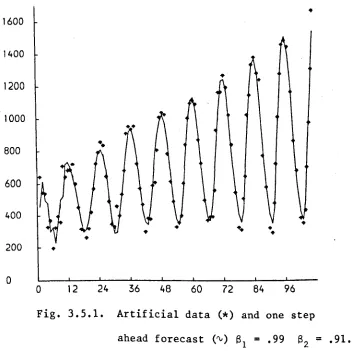
corresponds to a specification of no seasonal pattern! In figure 3.5.1
we can see the observations and the one-step-ahead forecast •
•
1600 1400•
1200 1000800
••
600
400
•
•
•
•
•
200
•
0
0 12 24 36 48 60 72 84 96
Fig. 3.5.1. Artificial data (*) and one step ahead forecast ('V) 8
1
=
.99 82=
.91.The performance in terms of the mean absolute desviation (MAD) for each
of the last six years is: year MAD 1 53.8 2 33.3 3 49.7 4 47.0 5 40.9 6 46.0
The observational variance was estimated sequentially given an estimate
of 2510.7. It is worth pointing out that no protection against outliers is
used in the variance estimation.
The final estimates for level and growth are
mean variance
[image:47.581.73.427.201.553.2](b) The Turkey Poult Data
The main characteristics of this data set are:
(i) There is clearly a growth in sales over the 10 years and an
annual seasonal pattern.
(ii) Many events, as discussed in Ameen and Harrison (1981) took
place, such as changes in feed price and some promotional
campaigns.
The desirability of incorporating informatiom on these events either by
modelling them or through intervention emphasizes the importance of a flexible
operational system. For illustration purposes an intervention on the level
was made at observation 29. The following seasonal linear growth was applied
to the original data:
F
=
(1,0) H=
(l,0 ... 1.0), G = diag{G1···G6}B
= diag(B1I2; 82 IIO}
~
1]G
cos kw sink~
w rr/6G 1 ' ~+l • -sin kw cos kw
,
k .. 1, ••• 6.The initial information was:
mean variance
level 80 400.0
growth 1.0 .0625
seas. compo 0.0 .18
The power law, with b=l, was estimated on line using a discount factor
B v
=
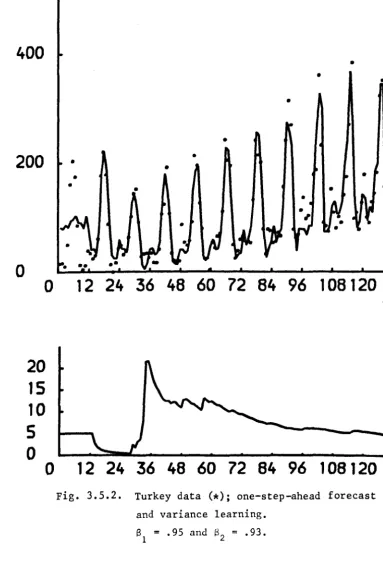
.98From Fig. 3.5.2 it is evident that, like most practical series, this data
is far from stationarity. Variables such feed price might beneficially be
introduced but they also need to be estimated. Many of the events which
contribute large variation could be anticipated but can only be subjectively
described.
The performance of the non-linear Bayesian model in this case was
quite good. In terms of the MAD for each year we have:
year 6 7 8 9 10 11
MAD 17.5 18.8 21.2 35.7 40.0 23.9*
*This figure is the mean for nine months
The average run length of errors with same sign is 2.16, the MSE for the
last 5 years is 1236.87 and the percentual MAD is 23.5%.
At observation number 29 we drop the level by 30 units and raise the
discount factor to some power in order to represent our extra uncertainty about
the new level. This means that the model is very adaptive with respect to the
trend, and in order to keep the seasonal block unchanged a modified discount
model was used.
Finally it is worth pointing out that the discount factors were not chosen
to optimise a performance criterion but are rounded figures which were thought
400
•
•
•
•
200
•
•
•
o
o
12 24 36 48 60 72 84 96 108120
20
lS
10
5
o
o
12 24 36 48 60 72 84 96 108120
Fig. 3.5.2. Turkey data (*); one-step-ahead forecast and variance learning.
Sl
=
.95 and ~2=
.93.(c) An example of transfer response: Champagne Data.
The main purpose to present this example is the opportunity to
•
introduce an application of transfer response. This data corresponds to the
monthly champaign sales of a French Company, in millions of bottles, from
[image:50.584.140.523.50.626.2]