Wright State University Wright State University
CORE Scholar
CORE Scholar
University Libraries' Staff Publications University Libraries
6-2014
eContent Quarterly - Volume 1, Issue 4
eContent Quarterly - Volume 1, Issue 4
Sue Polanka
Wright State University - Main Campus, [email protected]
Mirela Roncevic
Follow this and additional works at: https://corescholar.libraries.wright.edu/ul_pub Part of the Information Literacy Commons
Repository Citation Repository Citation
Polanka, S., & Roncevic, M. (2014). eContent Quarterly - Volume 1, Issue 4. eContent Quarterly, 1 (4). https://corescholar.libraries.wright.edu/ul_pub/177
This Journal Issue is brought to you for free and open access by the University Libraries at CORE Scholar. It has been accepted for inclusion in University Libraries' Staff Publications by an authorized administrator of CORE Scholar. For more information, please contact [email protected].
e
content
q u a r t e r l y
a publication of thein this
issue
-
The Copyright Conundrum: Or, Don’t Shoot Me, It’s the Law!
-
Negotiating with Content Vendors: An Art or a Science?
volume 1 / issue 4
e
Content
Quarterly
Volume 1, Number 4 June 2014 ISBNs: 978-0-8389-9669-0 (PDF) 978-0-8389-9670-6 (ePub) 978-0-8389-9675-1 (Kindle) American Library Association50 E. Huron Street Chicago, IL 60611-2795 USA Editors sue Polanka [email protected] @noshelfrequired Mirela roncevic [email protected] @MirelaRoncevic Managing Editor Patrick Hogan
Production and dEsign
Karen Sheets de Gracia Kimberly Thornton
advertising inquiries
Editorial inquiries
eContent Quarterly (ISSN 2329-6380) is published four times annually by ALA TechSource, an imprint of the American
Library Association (September, December, March, and June). To subscribe,
visit the ALA Store, alastore.ala.org, or call 866-746-7252. In the absence of a separate license agreement for eContent Quarterly, ALA Publishing follows the SERU guidelines, as published by the NISO SERU website:
www.niso.org/publications/ rp/RP-7-2012_SERU.pdf
ALA TechSource purchases fund advocacy, awareness, and accreditation programs for
library professionals worldwide.
alatechsource.org
Copyright © 2014 American Library Association
in this issue
From the Editors
3
The Copyright Conundrum:
Or, Don’t Shoot Me, It’s the Law!
5
A story of how at California State University, Long Beach, a one-librarian copyright awareness initiative was born and has taken hold. by Tracey Mayfield
Negotiating with Content Vendors:
An Art or a Science?
18
A senior executive documents the negotiation process between libraries and vendors, offering the rarely discussed “for profit” perspective. by Matt Dunie
Total Boox: A Time for a Shift
37
An emerging e-book vendor introduces a model that shifts the industry from “purchase-centric” to “reading centric.” by Yoav Lorch
Why Total Boox: A Librarian’s Perspective
47
Director of Westchester Library System (New York) offers thoughts on why implementing Total Boox makes sense for his library system, a consortium of 38. by Terry Kirchner
ProQuest: Maintaining
Entrepreneurial Momentum
49
Together, as part of ProQuest, EBL and ebrary aim to advance the e-book market. by Beth Dempsey
In addition, we reviewed a number of digital products from vendors and publish-ers, ranging from information literacy platforms like ResearchReady and interactive K–12 online resources like Core Concepts from Rosen Publishing. Each issue of the journal centered on an overarching theme: the September 2013 issue echoed the importance of partnerships in every corner of the industry (“the pressing need to cooperate rather than to quarrel”); the December 2013 issue zoomed in on the needs of the user (“placing the user at the center of all product development is paramount”); while the March 2014 issue featured articles by industry leaders anticipating a future in which reading continues to march in the direction of all digital (“a simple but per-sistent awareness that the future of reading, all reading, really is online”).
This June 2014 issue, completing volume 1, explores the complexities of copyright and information ethics in digital environments and the art (and science) of negoti-ating with vendors when choosing what to buy. It also provides a behind-the-scenes look at two very distinct vendor cultures: one is established and well known in the world of academic libraries (ProQuest) while the other is emerging and “disrupting” the standard business models in public libraries (Total Boox).
So what do the four articles in this issue have in common, having been written by four professionals with varied backgrounds, each exploring a distinct topic? At
From the Editors
Welcome to issue 4
of
eContent Quarterly.
The publication of this volume marks
the end of the first full year since we launched the journal at the American Library
Association in Chicago, so it seems fitting to take a quick trip down memory lane and
revisit the topics explored since June 2013. These included, among others, the
impor-tance of metadata, the versatility of children’s apps, and the benefits of user-centered
design. Previous issues also provided thorough, introductory overviews of e-formats
and e-reading devices for librarians overwhelmed by the complexities of the e-book
market. They also featured case studies pointing to various e-content initiatives at
several institutions, including New York University.
From the Editors
first glance, very little. The copyright article is written by a proactive academic librarian (Tracey Mayfield) with no formal training in law but with a passion for and an acute awareness of information ethics in academia. The article on negoti-ation is written by an industry executive (Matt Dunie) with a long list of accom-plishments in the LIS industry, shedding light on the negotiation process (both as it is and as it needs to be) between mission-driven institutions (libraries) and profit-driven organizations (vendors).
The third article introduces a new e-book service to public libraries, Total Boox, and is written by its founder, a writer-turned-entrepreneur (Yoav Lorch) who believes that the company’s “incremental purchasing” and “reading-cen-tric” model is the answer to the frustrations public librarians have been facing with e-books: lack of instant, simultaneous access and affordable pricing. Lastly, the article on ProQuest is written from the perspective of a marketing specialist for knowledge organizations (Beth Dempsey), who has witnessed firsthand the company’s rapid growth on the digital front. Although the combined collections of ebrary and EBL now make ProQuest the vendor behind what is likely the world’s biggest e-book platform in the academic market, this article serves as a reminder that ProQuest may be expanding but at its core remains a culture nurturing the entrepreneurial spirits of its leaders.
Indeed, these narrative-driven articles are quite varied, but here, too, a com-mon thread rises to the top: the value of true leadership. All of these articles are written by motivated individuals (or inspired by a group of individuals) who wouldn’t settle for the status quo when others would (or did). “Not fixing what isn’t broken,” maintains Dempsey in the article on ProQuest, “could be the single most defining difference between innovators and those who are content with the status quo.”
This makes sense: innovation starts and ends with great leadership, and in the world of e-content, as we see over and over again, it takes a leader willing to turn a concept on its head to make a great product (if you are a vendor) or provide great service (if you are a librarian). Library Journal recently featured a blog post by its longtime editor-at-large, John Berry, on this very topic: “Key strengths of great leaders are not command, control, or management skills, as so many top administrators misleadingly ‘teach’ us,” Berry writes, adding “while it is easy to state what makes a great leader, it is very difficult and even risky to practice great leadership.”
We hope this issue of eContent Quarterly does more than point to great lead-ers. We hope it points to what has made their efforts and risks both inspiring and transformative for the rest of us.
Sue Polanka [email protected] @noshelfrequired Mirela Roncevic [email protected] @MirelaRoncevic
The Copyright
Conundrum
Or, Don’t Shoot Me, It’s the Law!
by tracey Mayfieldcopyright isn’t sexy. It isn’t shiny, sparkly, fun, exciting, or easy to explain. It is, without a doubt, an audience killer. For a speaker, the anticipated boredom and apathy of an audience is overwhelming, akin to an avalanche of indifference. It is yet another example of a topic being vitally important to the academy, but few wanting to hear about it, and fewer thinking it pertains to them.
In an age of unprecedented budget cuts in academia, overwhelming teach-ing loads for faculty, administrators beteach-ing ordered to do more with far less, and a student population whose ethics can sometimes be seen as lacking, learning about and adhering to copyright law is about as popular as power outages during finals week or an outbreak of meningitis in the dorms.
For the unlucky few who are charged (or in some insane cases, volunteer) with being the voice of copyright awareness and compliance on a campus, the work is at the least challenging, and the best Sisyphean. Most faculty are woefully unaware of the basics of copyright law and even less aware of what they can and cannot (or should and should not) do in an online environment. The plethora of online resources and online teaching environments actually make the discussion more complicated instead of less so.
This article will discuss why there are currently problems with copyright in academia, focusing at the public institution level; how to make the most of the plethora of online resources available, and how at one institution (California
The Copyright Conundrum: Or, Don’t Shoot Me, It’s the Law!
State University, Long Beach—CSULB), a one-woman copyright awareness ini-tiative was born and has taken hold.
copyright Law in under a Minute
Copyright law, as we use it today, was codified in 1976.1 It is interesting to note
that copyright in this country dates to 1787, when it was added to the Constitu-tion. That addition to the Constitution was based on a statute in England, called the Statute of Anne.2
The purpose of the copyright law was to offer protection to authors and cre-ators and their original works. In addition, the law sought to offer definitions of when something could be copyrighted (the moment it is fixed in a tangible form) as well as the types of works that could be copyrighted.3
Since 1976, there have been two major changes to the original act: the Digital Millennium Copyright Act (DMCA), enacted in 1998, which sought to help move the initial copyright act into the digital age; and the Technology, Education, and Copyright Harmonization (TEACH) Act enacted in 2002, which sought to allow for use of copyrighted works in distance education and course management systems.4
The actual law of copyright is Title 17 of the United States Code. Within title 17, you will find section 107, which is on fair use. The provision of fair use asks four questions when you are using copyrighted works.5 These questions revolve
around:
• the purpose and character of the use, including whether such use is of a commercial nature or is for nonprofit educational purposes
• the nature of the copyrighted work
• the amount and substantiality of the portion used in relation to the copy-righted work as a whole and
• the effect of the use upon the potential market for or value of the copy-righted work6
Obviously, the law, the amendments to the law, and the provision of fair use are lengthy, and far more complex than should be covered in this very brief sec-tion. However, it is important to understand that the foundation of the law was to protect authors and their works.
so the problem is What?
So if copyright law has been in its present form since 1976, and its ancestors go back to 1787, why on earth is this an issue now? The answer is sad, but necessary and timely. In the last few years, there have been several legal cases dealing with copyright that affect the academy. This short but distinguished list includes the following:
“the ucLa case”
The actual court case is “AIME et al. v. Regents of UCLA et al.,” and it involved the Association for Information Media (AIME), a New York-based trade group, and AVP, an educational video publisher and one of AIME’s clients, which sued UCLA for streaming videos for student use. The case has been thrown out. Twice. Notable in this case is that AIME and AVP are not the copyright holders, and were found to not have legal standing in the court.7
“the georgia state case”
The actual court case is “Cambridge University Press et al v. Patton et al.,” and the heart of the case is about electronic reserves in libraries. The district court found mostly in favor of Georgia State and appeals have been filed.8
First sale doctrine
The official legal case is called “Kirtsaeng v. John Wiley & Sons, Inc.” and involved a USC graduate student who had his family buy low-cost Asian editions of text-books, and ship them to him here in the United States where he then sold them. The publisher of the textbooks sued. The case went all the way to the United States Supreme Court where they found in favor of the student.9
google Books
This highly publicized case (Author’s Guild et. al. v. Google Inc.) focused on a group of authors filing a lawsuit against Google regarding their project to digi-tize millions of books held in university libraries as well as books that are avail-able commercially. The authors felt it was infringement while Google main-tained it was fair use. The court sided with Google. The Author’s Guild has filed an appeal.10
Libelous Librarians
The words libel and librarian are not usually used together, despite the alliter-ation of the “L” sound. In the last two years, within months of each other, two librarians were sued or threatened with lawsuits for libelous actions. In both cases, librarians were commenting in their blogs about publishers they felt were either predatory or vanity-based. Interesting to note, huge amounts of support were lobbed (including a change.org petition!) at the librarians in question.11
What all these cases confirm is that we are in the middle of an extreme cli-mate of litigiousness between academic publishers and academic institutions. From an administrative perspective, there is no better time to conduct a cam-pus environmental scan to ascertain the level of awareness and compliance in our institutions. The fear as an administrator in the library is that we will find a general lack of awareness and understanding of basic copyright and fair use rules, and specifically a lack of understanding with most faculty regarding what they can do with their teaching materials, their own rights as authors of copy-righted materials, and how these rules shift when using copycopy-righted materials in an online environment. In addition, when there is a dearth of local/campus resources available, this can create a very precarious situation in our institutions.
The Copyright Conundrum: Or, Don’t Shoot Me, It’s the Law!
if the Work is already done for Me, Why do i Have to do this?
Luckily for copyright neophytes, every conceivable query, concern, or question related to copyright can be answered by the voluminous amount of online infor-mation available on the topic. Obviously, the United States government has the primary documents on the topic. They have the official legal code, but they also have wonderful resources available to help understand the legal codes.
In addition to the government sites, many academic institutions have created informational websites on the topics of copyright and fair use. Columbia, Pur-due, Duke, and Stanford12 are the sites I personally use the most. They are truly
stellar. The information is comprehensive in nature, factual, and offers a wealth of information on copyright, fair use, and intellectual property. Finally, several publications such as the Chronicle of Higher Education13 and Library Journal14
(while subscription-based publications, these have outstanding online sites and resources) publish regularly on the legal cases affecting academia and academic libraries.
The question then becomes, if these institutions, which are far more presti-gious than mine, have these amazing online resources, why is there an issue? The answer is, in working with the faculty on my campus and other campuses within my system, most faculty want something that is less comprehensive, and that simply answers their immediate questions such as:
• “Can I post this article to the Learning Management System?”
• “Can I send this article to a colleague?”
• “Can I post this book chapter on my website?” “How much of something can I post in my online class? Electronic reserve?”
• “Can’t I just pass this out to my students in class?”
• “I want to show a video from home in my class; is that okay or not?” In addition, the faculty I have worked with don’t want to have to do an exhaus-tive search across multiple sites to answer their singular question. In sum, in order for faculty to use the information, it has to be free of “legalese,” in laymen’s terms, in small, easily digestible chunks, and specific to their needs. In my con-versations with faculty, they are impressed by the academic sites, but they cannot find what they need easily or quickly. What they want is something local to them (i.e., on their own campus website) that is easy to use and navigate and that gives them information specific to their localized needs.
But Let’s start at the Beginning: the csuLB story
Full disclosure: I am not a lawyer, a law student, or a law librarian. I do, however, have some sort of psychological disorder that finds the area of information ethics endlessly fascinating. Information ethics is defined by me to be the umbrella under which intellectual property (IP), copyright, and plagiarism live.
Information ethics has enthralled me since I was a graduate student in the library and information science program at UCLA in the late 1990s. Most, if not
all of my work toward my master’s degree was focused on information policy and management.
CSULB, the institution at which I work, is a comprehensive public institution in the lovely locale of southern California. Part of the 23-campus California State University (CSU) system, we are a teaching intensive, research-driven institu-tion with more than 80,000 applicainstitu-tions per year and a student body of about 35,000.
the background
I became associate dean of the University Library at CSULB in 2009. As part of the transition from librarian to associate dean, I began looking closely at expen-ditures within the library as California’s state budget, and the budget of higher education within the state, were beginning to side down a very slippery and steep slope. One line item in our annual budget that struck me as particularly substantial was the amount of money we were paying for copyright clearances for interlibrary loan and electronic reserve services.
At the same time, as my focus on library services became broader, I began to note the large number of copyright-related questions the library received from the campus community, especially given that only I and our music librarian felt confident to field them.
Then at an associate dean’s meeting in November 2011, a discussion item that was centered on the Higher Education Opportunity Act (HEOA) turned on a dime to instructional materials and exactly what can be done with them legally in relation to using them in an online environment, that is, our course man-agement system. It was when all conversation stopped and everyone looked at me to give them the answer that it hit me; no one at the table except me had a definitive answer.
Shortly after that meeting, I was invited to two different department chair-level meetings to clarify copyright in regard to instructional materials. One meeting was in the sciences and one in the arts. After those meetings, I realized not only were my faculty colleagues lost when it came to copyright basics, but that building awareness of the issues would have to start at ground zero. This was an area that faculty simply were just not aware of. While this lack of infor-mation is not truly the fault of the faculty, it is their responsibility to understand copyright and fair use basics. Faculty are not exposed to the issues in their doc-toral programs, nor are copyright and fair use something they “picked up on the job,” or learned while teaching. While they skate near the topic in their research and scholarly activity, it is not something that is in the forefront of their minds. The tragedy about this situation is that copyright and fair use greatly influence all areas of faculty work, and ignorance of the law is not a defense.15
With this information in mind, I plunged into an investigation. I began by investigating the campus and CSU system resources on copyright and fair use. Campus resources were minimal and there was also a dearth of resources at the system level. The last official notification from campus administration to the faculty had been in 1994, shortly after the legendary “Kinko’s case.”16 The memo
The Copyright Conundrum: Or, Don’t Shoot Me, It’s the Law!
the faculty on notice that if they knowingly broke copyright law, the university would not indemnify them.
Next, I dove into the specifics regarding the legal cases that were currently affecting higher education; namely the cases involving UCLA and Georgia State (both mentioned above). Both cases were alarming on their merits, but one detail that jumped out at me was the subject of “state sovereign immunity,” which is the legal doctrine that says you cannot sue a state institution “without its con-sent.”17 What this means in laymen’s terms is, in my instance, that you cannot sue
“CSULB,” you would have to sue individuals at the institution. This is why the actual legal cases for UCLA and Georgia State have the names of individuals who work at the university, and not the university itself.
While I was conducting these investigations, I attended a workshop at UCLA with another library dean at a sister CSU campus, on a new set of best prac-tices on fair use for libraries that had been created by a partnership between the Association of Research Libraries (ARL), the Center for Social Media, and the Washington College of Law at American University.
It was at this day-long presentation that a plan crystallized. CSULB (and the rest of the CSU system) needed a campaign of awareness and education. They needed resources, and they needed a person who they could ask questions of. The plan took shape in the form of an initiative. The goal of the initiative could be explained easily: information + resources = compliance. The information piece would be an updated memo from campus administration. I could con-tinue to meet with the department chairs and faculty, but without the campus administration behind it, no one would listen. In addition, we needed to provide the faculty resources to understand their rights and responsibilities. When the memo to the faculty went out on my campus in 1994, it scared people more than informed them, and there was no comprehensive set of resources that gave the faculty more information or helped them make sense of the memo. In addi-tion, an effective communication plan was essential. Communication needed to be “pushed” to the campus. The easiest thing in the world would be for me to hold 310 seminars in the library and invite the campus and sit there alone when absolutely no one showed up. I was convinced that to get this word out, I had to pound the proverbial pavement and go from department to department to reach the faculty. In addition, the message needed to be shared in a way that was non-threatening. Egos would be bruised by telling faculty that they were making mistakes on a regular basis and that some were felons twice over. Furthermore, there are dichotomies of behavior that are particularly thought-provoking when working with the faculty. In discussing copyright with faculty members and with students, they shared specific situations of faculty preaching to students about the plague of plagiarism while bragging that they are presenting on ille-gally downloaded software. These dichotomies of behavior, while interesting, are something that is taking place and must be noted. Having the associate dean of the library provide the message was a non-threatening way to present the infor-mation, and the presentations needed a lighthearted approach while still being informative. In sum, our winning combination would be information, commu-nication, and resources, and with that, we would move forward.
The next step was to approach the appropriate campus administrator. I con-sulted with the dean of the library and vetted my plan. I wanted to approach the provost, whom I was pretty sure knew my name and could possibly pick me out of a police lineup, but whom I had not had much personal contact with, nor had I worked closely with him. The dean was completely supportive and very encouraging. With that support, I asked for a meeting with the provost.18
And so it happened that during one of California’s bleakest budgetary situ-ations, I sat down to lunch with the provost and somewhat nauseously pitched the plan. I explained the problem. I explained the possible consequences of the problem. Most importantly, I pitched the solution.
The provost (who is currently serving as interim president) listened patiently as I explained the problem as I saw it, and explained what I thought would be the solution. He quickly understood the scope of the problem, asked thoughtful questions, and then enthusiastically walked me through how we would imple-ment it. I could not have asked for a warmer reception, or a better outcome. One funny anecdote; in my hubris and absolute confidence that I was doing right, I explained quite vehemently to the provost that our campus needed a campus office for copyright compliance (à la Duke, Columbia, and Purdue) to which the provost replied “No, I think you can do it.”
At that lunch, the provost agreed that a new memo to the campus needed to be constructed and disseminated. He agreed to begin working on that. We also came up with a communication plan. We would meet with the chair of the campus Academic Senate, who would have me speak with the Senate Executive Committee, and then the full Academic Senate. The provost would also invite me to the Deans’ Council, and he would share the initiative with his senior staff. I would begin working on the resources piece, which meant a website. With those plans made, my informal title, “Countess of Copyright,” was born.
From a plan to action
With my new title in hand, the first step was to create a website. My first two attempts to translate the ARL guidelines into a website were both pretty hor-rible, with both the provost and the Senate chair commenting very kindly that they were too dense and no one was going to read them.
I had to rethink what I wanted the website to do. I wanted the site to be a bare-bones, practical site that was easy to navigate. I admired the sites at Colum-bia, Stanford, and Purdue (among others) greatly, but I needed something that would work in my environment and more importantly, work for my faculty col-leagues. I decided to get creative. I had already decided to use our LibGuides19
system to create the website and Springshare (the company that produces Lib-Guides) has a wonderful user community, including a “best of ”20 section where
users of the products can nominate LibGuides they think are best-practice sites to follow. I used that feature and hit the jackpot. There was a single “best of ” site on copyright at the time, and it was perfect. The guide had been created at NYU Poly by their web librarian, Ingrid Redman. I asked permission to copy it and she responded immediately that I was welcome to it. (See figure 1.)
The Copyright Conundrum: Or, Don’t Shoot Me, It’s the Law!
FigurE 1.
csuLB copyright for Faculty Website
At first, I thought I would only customize it to our specific needs; making changes to reflect our university name and information specific to our campus. A dear colleague helped me make those changes immediately. The more I thought about the project, the more I wanted to add, so the site grew considerably, add-ing tabs to include the lawsuits relevant to higher education and websites I fre-quented as well as my personal information for those who needed help.21
With a final blessing from the provost and the chair of the Senate, we were ready to present it to the Academic Senate Executive Committee. The commit-tee’s support was clear and abundant. The meeting with the Deans’ Council was just as successful, as was the meeting with the full Academic Senate. With each group, I presented the problem of our campus simply not understanding what compliance is, how to embrace it, and more importantly, where to get help. The solution I suggested was each of the university’s eight colleges to invite me to their department chair meetings and then for the chairs to invite me to depart-ment meetings—all sixty-two of them. The end goal: to get in front of the faculty. At this point in the process, I had been exposed to many eye-opening and stunning questions from campus personnel. I honestly didn’t think anything could shock me anymore, but I was wrong. I was in a meeting with a faculty member who asked me about the use of off-campus copy shops. Neither as a librarian nor a library administrator did I understand the question.
He explained that there are several copy shops off campus that faculty go to, literally the night before their classes start, to have coursepacks made. The rea-son being that some faculty do not want to utilize the campus bookstore as it takes longer (to make coursepacks legally) and they are worried the students have to pay more. This information sent me reeling. How could this be? There is
no way to get information cleared for copyright overnight. In addition, if a fac-ulty member did this, they were also not in compliance with the HEOA act. So they would be a felon twice over. This couldn’t be. Isn’t this exactly what Kinko’s was sued over? The answer is yes.22
I set out to find the truth. I did research on copyright legal cases involving independent copy shops. I found that there were quite a few in the mid-2000s but then they dropped off.23 It is my guess that there is not enough money in
going after the independents and there are too many of them to do it. It should be noted that obviously, not all independent copy shops are operating illegally, but it is up to the individual faculty members to perform due diligence and understand where they are taking their business and further understand what they are signing when they are using independent copy shops. Most importantly, I needed to add it to my presentations when I met with the faculty at the depart-ment level meetings.
These department-level meetings have been positive and extremely interest-ing. I have been impressed with how open they have been to the information I am sharing. The fears I had earlier about egos and how faculty would take being told they were doing things wrong, if not illegally, were completely unfounded. Intrinsically, they want to do the right thing and want to do right by their stu-dents. I came away from the meetings believing that, armed with the tools and information, they would use the materials in a legal and ethical way.
To date, I have been to the Deans’ Council twice and I have been to every department chairs meeting on the campus in all eight of our colleges. I have been invited to, and presented at, 10 of our approximately 60 departments to speak to the faculty. We have had a change in provosts, but our current provost is just as supportive as the previous one was. His current plan is to invite me annually to the Deans’ Council to give updates. For those meetings, I prepare a chart of which departments I have presented at, and that gives the deans lever-age to go back to their department chairs and remind them to invite me. He has also issued an updated memo to the faculty on copyright that is posted on the “Copyright for Faculty” website.24 In addition, the provost and I have
dis-cussed annual e-mail messages from his office reminding faculty of the campus resources, annual e-mails to students regarding their responsibilities regarding copyright and plagiarism, and information for new faculty at annual new faculty orientations.
I have experimented with different presentation mechanisms. I avoided Power Point and chose to either use an agenda via a word document projected to the group, or Prezi presentations.25 The latter has two advantages: first, Prezi
is a dynamic presentation software that was a new “hook” for most faculty, and second, because it is web-based, it is easily portable. All of the presentations I have created on Prezi are open-access and designated reusable, meaning anyone can use them should they like them and want to utilize them.26
The Copyright Conundrum: Or, Don’t Shoot Me, It’s the Law!
the continuing education oF yours truly
As mentioned already, I am not a lawyer. I know a few, and would love to get a law degree, but to do so I would be divorced, childless, and probably without a job. So I have to continue to educate myself in other ways. I have attended countless webinars, and three in-person workshops. The highlight was at the 2013 Association of College and Research Libraries conference in Indiana that pulled together the “rock stars” of academic copyright; Kenneth Crews (Colum-bia), Dwayne Buttler (University of Louisville), and Donna Ferullo (Purdue). I spent an entire day geeking out and engaging. It gave me the opportunity to ask experts the questions I had been stewing over. In addition, their presentations helped me make my own presentations more engaging. Donna Ferullo, espe-cially, gave wonderful examples of fair use from the non-library world that I not only have used, but further developed and added to.
Like the initiative itself, I will not ever be done with this project. To stay cur-rent on all things copyright, I need to continue to learn, grow, and stay abreast of what is happening. The law will continue to morph and change. When keep-ing up on the topic, I do not re-invent the wheel. There are wonderful online resources such as Kevin Smith’s blog at Duke,27 as well as the websites I have
mentioned earlier.
in the End, or at Least, Where We are now
This project and initiative have been far more successful than I ever could have predicted. It has brought about real change in the awareness and education of the campus in terms of using copyrighted materials legally and ethically. If noth-ing else, when questions arise, the word is out that you contact “Tracey in the Library” to get your questions answered.
The initiative has also moved beyond CSULB. As mentioned earlier, CSULB is one of a 23-campus consortium. I am working with key personnel in the Chan-cellor’s Office of the CSU as well as several other deans in the system to begin or strengthen copyright awareness initiatives at the other twenty-two campuses, beginning with the CSU Libraries. I have offered (with my campus’s blessing) to travel to each and every one of the other libraries in the system to present on the initiative at CSULB and how to adapt it at the other institutions.
Some challenges still exist. As mentioned previously, I have presented at 10 department-level meetings, less than 20 percent of all departments. I would like to see that number increase, but there are obstacles. One in particular is that not all departments have regular meetings, so arranging for an invitation to present will be difficult. We are still working on this.
One professional epiphany to share from the experience is where CSULB fits into the conversation of copyright in the academy. My goal initially, as I so naively shared with the provost at our initial meeting, was to be exactly like Columbia and Duke, but smaller and closer to the beach. What I have realized is that CSULB doesn’t have to be Columbia or Duke or Purdue. We are not an R1.
Our needs at CSULB (and in the CSU) are different, and therefore our thread in the conversation is different. It isn’t better, and it isn’t worse, it is just different, and there is room in the conversation for us.
From a personal perspective, this project has been one of the most fulfilling professional endeavors I have been involved in. To see an initiative from inspira-tion through to implementainspira-tion is tremendously gratifying. It has brought me in front of people I never would have met otherwise. While this enterprise has been in addition to my normal associate dean duties, it has been worth every minute and it has given me endless respect for (and envy of) others whose sole job this is. Lastly, I feel I am doing something worthwhile and giving back to the campus in a way that is unique.
The copyright initiative at CSULB is not finished. It will never be finished. As the laws are challenged with legal cases and possibly updated, there will be more work to do. There are also new areas to explore. I would like to add to the web-site sections on authors’ rights so that faculty think before they sign contracts on their work to be published and they understand what their rights and responsi-bilities are in their published research.
The copyright initiative has recently morphed into a larger project of updat-ing and renovatupdat-ing the IP policy for our campus. But that is an adventure for another time and another article.
about the author
tracey Mayfield is the associate dean of the University Library at California State University Long Beach, where she has worked for fifteen years. Her areas of professional and research interest are information ethics and the stereotypes of librarians in film.
notes
1. U.S. Copyright Office, “Copyright Basics,” www.copyright.gov/circs/circ01.pdf. 2. Teaching Copyright, “Law and Technology Timeline,” http://teachingcopyright.org/
downloads/tc_law_and_technology_timeline.pdf. 3. U.S. Copyright Office, www.copyright.gov/circs/circ01.pdf.
4. Teaching Copyright.org, “Law and Technology Timeline,” www.teachingcopyright.org/ download/tc_law_and_technology_timeline.pdf.
5. Columbia University, “What Is Fair Use?” http://copyright.columbia.edu/copyright/ fair-use/what-is-fair-use.
6. U.S. Copyright Office, www.copyright.gov/fls/fl102.html.
7. Chronicle of Higher Education, “Judge Throws Out Copyright Lawsuit Over UCLA’s Streaming of Videos to Students,” http://chronicle.com/article/ Judge-Throws-Out-Lawsuit-Over/135932.
8. Educause, “Georgia State Copyright Case: Resources,” www.educause.edu/focus -areas-and-initiatives/policy-and-security/educause-policy/issues-and-positions/ intellectual-property/georgia-state-copy and http://dockets.justia.com/docket/ georgia/gandce/1:2008cv01425/150651.
9. Los Angeles Times, “Supreme Court Sides with Book Reseller in Copyright Ruling,”
The Copyright Conundrum: Or, Don’t Shoot Me, It’s the Law!
and Jolt Digest, “Supreme Court Holds the First Sale Doctrine Applicable to Parallel Importation,” http://jolt.law.harvard.edu/digest/copyright/supreme-court -holds-the-first-sale-doctrine-applicable-to-parallel-importation.
10. Wired.com, http://www.wired.com/threatlevel/2013/11/google-books; New York Law Journal, “Finding Google Books ‘Transformative,’ Judge Rejects Lawsuit,”
www.newyorklawjournal.com/id=1202627824914/Finding-Google-Books-’ Transformative,’-Judge-Rejects-Lawsuit?slreturn=20140121233457; and CNET, “Authors Appeal Google Books Decision in Google Books Copyright Suit,” http:// news.cnet.com/8301-1023_3-57616380-93/authors-guild-appeals-decision-in -google-books-copyright-suit.
11. Edwin Mellen Press filed two lawsuits against McMaster University’s Associate University Librarian Dale Askey (see Library Journal, “Press Sues University Librarian for Libel,” http://lj.libraryjournal.com/2013/02/litigation/press-sues-librarian-over -negative-evaluation; and Chronicle of Higher Education, “Edwin Mellen Press Sues University Librarian for Libel,” http://chronicle.com/blogs/wiredcampus/edwin-mellen -press-sues-university-librarian-for-libel/42193). One lawsuit was dropped (see Infodocket, “Edwin Mellen Press Drops Lawsuit against McMaster Librarian Dale Askey,” http://www.infodocket.com/2013/03/04/edwin-mellen-press-drops-lawsuit -against-mcmaster-librarian-dale-askey). Within months of those lawsuits, the Canadian Center for Science and Education threatened “civil action” with a probable libel suit against University of Colorado Denver’s librarian Jeffrey Beall (see Inside Higher Ed, “Librarians and Lawyers,” www.insidehighered.com/news/2013/02/15/ another-publisher-accuses-librarian-libel; and Library Journal, InfoDocket, “Another Publisher Has Serious problems with a Blog Post Written by a Librarian,” www .infodocket.com/2013/02/15/another-publisher-has-serious-problems-with-blog -posts-written-by-a-librarian.
12. Columbia’s website: http://copyright.columbia.edu/copyright. Purdue’s website: https://www.lib.purdue.edu/uco.
Duke’s website: http://library.duke.edu/about/depts/scholcomm. Stanford’s website: http://fairuse.stanford.edu.
13. Chronicle of Higher Education, https://chronicle.com/section/Home/5. 14. Library Journal, http://lj.libraryjournal.com.
15. U.S. Legal Definitions, “Ignorance of Law,” http://definitions.uslegal.com/i/ ignorance-of-law.
16. Stanford University, “Copyright and Fair Use,” http://fairuse.stanford.edu/case/ basic-books-inc-v-kinkos-graphics-corp.
17. Cornell University, “Sovereign Immunity,” http://www.law.cornell.edu/wex/ sovereign_immunity.
18. I fully acknowledge that my campus is very unique in this respect. I understand that in some cases (if not most cases) an associate dean cannot just get on a provost’s calendar. This key component to the initiative was relationship-building. While my direct supervisor, the dean of the library, knew my track record of accomplishment, the provost did not and I had to prove that I could accomplish what I was proposing. 19. Springshare.com, “LibGuides,” www.springshare.com/libguides.
2 1. LibGuides, “Copyright for Faculty,” http://csulb.libguides.com/copyrightforfaculty. 22. Stanford University, “Basic Books, Inc. v. Kinko’s Graphics Corporation,” http://fairuse.
stanford.edu/case/basic-books-inc-v-kinkos-graphics-corp.
23. USA Today, “Photocopying for College Student ‘Coursepacks’ Draws Copyright Suit,”
http://usatoday30.usatoday.com/money/media/2006-02-08-copyshops-usat_x. htm?csp=34.
24. California State University at Long Beach, “Copyright and Fair Use for Faculty,” http:// csulb.libguides.com/content.php?pid=392519&sid=3215486.
25. Prezi.com, http://prezi.com.
26. Prezi.com, http://prezi.com/user/bouunrc4mlxt.
27. Duke University Libraries, Scholarly Communications, “Publishing Ironies,” http:// blogs.library.duke.edu/scholcomm.
eContentQuarterly
libraries spend millions of dollars to purchase huge amounts of content and sophisticated technology to fulfill their mission. Some deal with hundreds of vendors every year; others with only a few. All of these vendors are crucial to positive user experiences of library content and services. But the scale of library scope and budget do not necessarily impact the efficiency of the vendor nego-tiation process. This article examines the need for a more documented negoti-ation process, with specific review points and measurement concepts illustrat-ing the opportunities in makillustrat-ing vendor negotiations yield more value for the library organization. We will examine some of the economic value components and motivations from the vendor side of the negotiation process and how those drivers impact customers’ buying patterns but may also lead to opportunities. In addition, we will explore and explain at a high level some of the business models vendors employ and how they may impact sales price and, in turn, pur-chasing behavior. The article will take a “commercial approach” to the purchas-ing of library-oriented content and technology. It will examine business models, components of negotiations for content or technology, commercial drivers, and economic value arguments that are part of every negotiation but not always rec-ognized. My opinions are based on more than two decades of experience in the information industry as a line employee, senior executive, manager, and founder of various information and technology businesses.
Before we get into details about the business side, it is important to work from a common vocabulary. While the library and the vendor segments are more
Negotiating with
Content Vendors
An Art or a Science?
by Matt duniecollaborative than many industry markets, the vernacular used internally is not necessarily common. Throughout the article, there are terms that are standard commercial lingo, but not always standard in this customer base. In the interest of “speaking the same language,” let’s define some terms for the purpose of this article:
• Aggregator—An aggregator may be a publisher, but it produces large compilations of related material, generally curated with subject matter expertise-driven editorial policies. It may include creation of metadata used as finding and explanatory aides and licensed as well as unlicensed content.
• Commission—Variable compensation typically paid to revenue-produc-ing employees or a discount offered to sales agencies by manufacturers to compensate them for their efforts in selling the manufacturer’s products and services.
• Compensation Plan—The measurable documentation of the variable compensation or commission opportunities provided to sales staff and others
• Contribution—The amount, after expenses, a product provides to cover other company expenses. Sometimes people use another term, product line profit and loss.
• Cost Structure—The aggregate costs a department, function, or business has expressed relative to its operating functions.
• Distribution—Product and service distribution from manufacturer to customer. Distribution may be direct or indirect. Direct distribution is defined as a direct path from producer to customer with no third par-ties involved whatsoever. Indirect distribution is where a third party is involved in the distribution (selling, or product provision) function on behalf of the manufacturer.
• General and Administrative—These include functions like facilities maintenance, office rent, insurance, executive salaries, and some profes-sional expenses such as legal fees, and so on.
• Imperatives—Actions that must be completed.
• Incremental Cost—The cost to provide an incremental unit of a product to a customer. The incremental cost will likely be much lower than the total cost of the first unit delivered.
• Marketing Mix—Also referred to as the Four Ps (price, product, place, promotion). Product is defined by its features, benefits, and capabilities. Included in product are the aspects of packaging and design. Price is the cost of the product and the price model. Place is the point of delivery, how it is sold and how it will be delivered. Promotion, which includes all promotion, teaching, education, and so on, is the process of informing the market about the product. Promotion actually includes several compo-nents: sales, public relations, advertising, and marketing, among others.
• Market Segment/Sector—A defined section of an industry. The library market can be defined by types, sizes, focus, or geographic section. For
Negotiating with Content Vendors: An Art or a Science?
example, the academic library market is really a segment of the overall library market.
• Net Growth—Businesses measure growth. Net growth can be measured as growth in an existing account, or overall growth vs. a previous period, generally a quarter or year in duration.
• New Sales—New sales to a new customer or new sales of a product to an existing customer.
• Perpetual Rights License—A license to use content or software for per-petuity. This license does not provide ownership to a buyer, but rather, it provides the right for the buyer to use it as if they own the product. It typ-ically does not transfer ownership rights such as copyrights. The license specifically details the rights that are granted to the customer.
• Price Components—The individual components that make up a price such as royalties, technology fees, contribution, and so on.
• Product Management—The function of product creation from beginning to end. Product management includes inception, design, development, distribution, financial modeling, and performance measures.
There are a several environmental points of reference we must use:
• The library market segment, as a whole, is a slow-growth industry. It is almost a zero-sum game in financial terms. The cost of creating and dis-tributing information technology has declined dramatically over the past two decades.
• The migration of print to digital content and the evolution of digital first (or only) products have resulted in more products available and targeted to libraries than ever before.
Let’s look at some of details behind these statements. According to the Depart-ment of Education Academic Libraries Survey, expenditures for information resources continue to rise, growing 7 percent from the 2008 to 2010 academic years. In fact, most categories of electronic materials showed modest increases from the previous period. Imagine the joy that brings to publishers of business planning processes, and expenditures for bibliographic utilities, networks, and consortia also increased by 4 percent, again reason for excitement if you are in any of those businesses or provide products and technology through those mechanisms.
But something about these numbers does not mesh with what we hear in the marketplace. The anecdotal evidence suggests that budgets have been under severe pressure. Customers tell us: “If I want to add something to my collection, I have to figure out what has to be discontinued.” If you are selling technology products targeted toward libraries, you would have found the market to be espe-cially tight; budget dollars for expenditures for computer hardware were down just over 10 percent from the previous reporting period. But there is a big push in this category and new product announcements all the time. And this is a mature segment, almost fully saturated as total expenditures for academic libraries have
flattened since 2008, showing literally no growth. As table 1 shows, there was less than ½ of 1 percent growth from 2008 to 2010, and under 3 percent growth from 2010 to 2012. If we were to assume that prices increased over the same period equal to the rate of inflation, the total expenditures would actually be a decline in buying power of almost 6 percent.
taBLE 1.
total academic Library Expenditures
2008 2010 2012 Top 500 Academic Library
Aggregate Total Expenditures 4,981,437,070 5,003,854,991 5,143,780,237 Percentage Change Year to Year 0.45% 2.80%
Percentage Change 2008–2012 3.26%
Five-Year Inflation Rate 9.3%
Data-Planet by Conquest Systems, Inc. (2014). National Center for Education Statistics. Academic Library Statistics: United States: Total Expenditures | Country: USA – [Data-file]. Retrieved from
www.data-planet.com, Dataset-ID: 017-015-024. doi: 10.6068/DP1443140BCFA0.
Data-Planet by Conquest Systems, Inc. (2014). Bureau of Labor Statistics. Inflation rate: 3 Year | Country: USA | Consumer Item: All items – [Data-file]. Retrieved from www.data-planet.com, Dataset-ID: 002-010-002. doi: 10.6068/DP144755AAEB314
How are content and technology being paid for? Simple: other spending cat-egories are down. Among the catcat-egories that have declined since 2008: number of branches, number of librarians, number of paid staff, expenditures for preser-vation, and so on. Table 2 shows a sampling of line item reductions.
taBLE 2.
sample of High-Level trends from Most recent
three academic Library statistics surveys
2008 2010 2012 Librarians & Professional Staff Count 21,514 21,137 20,346
Total FTE Staff 60,070 56,733 54,418
Expenditures for Preservation $37,335,518 $28,084,930 $24,155,598
Data-Planet by Conquest Systems, Inc. (2014). National Center for Education Statistics. Academic Library Statistics: United States: Expenditures for Preservation | Country: USA – [Data-file], Retrieved from www.data-planet.com. Dataset-ID: 017-015-019. doi: 10.6068/DP144758AB8E816
Data-Planet by Conquest Systems, Inc. (2014). National Center for Education Statistics. Academic Library Statistics: United States: Staff Count - Total FTE Staff | Country: USA – [Data-file], Retrieved from www.data-planet.com. Dataset-ID: 017-015-007. doi: 10.6068/DP144332C8E6B80
Data-Planet by Conquest Systems, Inc. (2014). National Center for Education Statistics. Academic Library Statistics: United States: Expenditures for Preservation | Country: USA – [Data-file], Retrieved from www.data-planet.com. Dataset-ID: 017-015-019. doi: 10.6068/DP144332C9CDD81
Yet, even during severe economic periods, libraries continued to acquire con-tent at similar rates as they did in previous years. Some concon-tent categories grew
Negotiating with Content Vendors: An Art or a Science?
tremendously while the growth in others declined. Generally, year in and year out, libraries increase their collections by some amount. In recent years there have been large increases in acquisitions of e-books, for example.
If we were to work on the top line numbers alone, this industry appears to be stable and mature. Even during periods of great financial turmoil, the industry maintained a similar growth rate as in previous years, probably due to the advent of the print-to-digital and then digital-first content production impact. When you dig deeper into the numbers, you will find that some categories of new con-tent acquisition have declined significantly, and they have been replaced by other categories—more varied offerings of digital content. The shift to digital content has been obvious for more than twenty years, but it is continuing in new media types, such as audiovisual content and raw data. But the business terms for new forms and formats of content and the expertise necessary to negotiate the req-uisite contracts must evolve as well. Content delivered in multiple formats, via multiple technology platforms, which enable broader access, are licensed under different business models that are evolving constantly. For example, when a library acquires perpetual access rights to a content collection, are there specific technology rights that must be negotiated? What is the business model that is used to determine the real value of the sale to the provider and the customer? Perhaps there is a technology company which acts as a third party for distribu-tion and maintenance of the content. Or a third-party escrow holder for com-puter code and/or content. How are these items considered in the acquisitions process, or documented in the contract?
The market is much more complex than the top line numbers make it appear. It is a collegial and mission-driven marketplace where the customers must be able to adapt quickly to changing terms and new business requirements on an ever-expanding product base with few staff. Why not use the same tools and strategies the vendors use? The additional effectiveness in negotiations will result in greater competition, new product categories, and more innovative solu-tions for the customer base as well as growth opportunities for the vendors.
Price components and cost structure
The end result of any negotiation with vendors is a contract, license, or agreement for products or services and delivery of the same. As the industry has migrated to more technologically involved and curated content offerings, product business models changed, and clarity in pricing has become more infrequent. In fact, I would suggest that some pricing philosophies are more opaque intentionally. Yes, there are “price lists,” but there are also “price calculators,” intricate spread-sheets with multitudes of options with which salespeople must confer in order to develop a price proposal for a more complex offering. And when customers purchase as a consortium or through a buying group, vendors have a need to customize price modeling based on a myriad of factors.
Price can be determined by the producer in a number of ways, but generally, it depends upon a few components: product cost, labor, cost of promotion/sales,
target margin contribution. In the information industry, these items may look similar to the lists below:
Content Product
Editorial staff Content royalties
Technology development/licenses If printed: paper, printing, binding Cost of sales, service, and support Cost of distribution (technology/
shipping/distribution) General and administrative
Technology Product IT staff Technology licenses/royalties Project management Product management Marketing Cost of sales
General and administrative
While the cost structures in the information industry may look like most any business, there are some unique attributes to this industry, whether print or electronic:
• Once content is produced, it can be sold many times, thus creating a long-term revenue stream and releasing the content production function to create more content.
• Cost of distribution declines over time for electronic products.
• Cost of technology becomes less expensive over time, reducing overall technology costs for the provider. Exceptions: if the provider is a leading- edge technology company or if the company has a significant R&D com-ponent to its cost structure. See figure 1.
FigurE 1.
Basic cost of
technology
(to Perform the
same Function)
over time
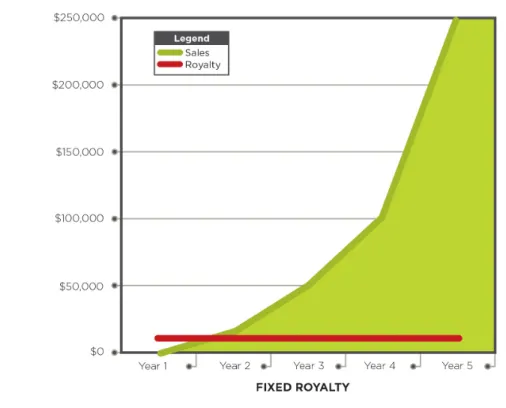
Similarly, certain costs go down as the business grows. There are many differ-ent types of royalties and royalty calculations: fixed royalty, minimum guarantee, unlimited rights, usage based, and so on. Let’s examine a simple royalty structure for a content product. We will call it a fixed price royalty: An agreement is made to pay an annual fee (or a one-time fee) for the rights to the content regardless of revenue associated with the product. In this case, as product sales amass, the royalty stays fixed, and no matter what the sales are for a particular product, the royalty will be fixed. In this case, we will use a number of $10,000, per annum.
Negotiating with Content Vendors: An Art or a Science?
And we will assume the product sales grow quickly, from zero to $250,000 over five years (see figure 2).
FigurE 2.
Fixed-Price royalty
If the royalty is not fixed, but variable based on a sales percentage, the chart would look different (see figure 3).
In either case, the vendor has a lot of margin to use in paying the other costs of the product, but also, very different profit opportunities. Similarly, a recurring revenue product builds in value for the provider, and product costs are lower for renewal in many categories. Costs that are reduced on renewals include cost of sales, incremental cost of development, distribution commissions, and incre-mental cost of distribution technology.
Businesses do much research and make projections based on market analysis, product costs, and the like. Included in those projections are target profit met-rics they look to achieve, along with revenue objectives for each component in their product mix. Various price analyses are considered to arrive at a price the company believes the market will pay for its products.
business models
There are lots of economic models vendors can present. Below are some that are popular:
• recurring revenue vs. one-time purchase
• bundle pricing
• time and materials
• evergreen (items reordered frequently, but not categorized as subscription) For the purpose of this discussion, we will concentrate on recurring revenue and one-time purchase models.
recurring revenue—annual subscription
There is no secret that recurring revenue can be a powerful force.
Assumption: product selling price is $1,000 per year, with a 90 percent renewal rate and a 5 percent price increase.
The customer looks at this as a $1,000 serial commitment, and may budget a price increase from year to year. It might look like this:
Yr 1 Yr 2 Yr 3 Yr 4 Yr 5 Yr 6 Yr 7 Yr 8 Yr 9 Yr 10
1,000 1,050 1,103 1,158 1,216 1,276 1,340 1,407 1,477 1,551
But the company looks at it a little differently. The vendor looks at this oppor-tunity in terms of the product’s total customer base. Table 3 shows several of the other factors a company takes into consideration relative to price. Thus, while a single customer may look at the product as a $1,000 annual obligation in the beginning, the vendor looks at this example as $50,000 initial product line rev-enue with the potential of generating more than $300,000 in the seventh year. A company selling a product for a price, say $1,000, which renews every year, is very different than a single purchase of $1,000. But, since the costs are lower for renewal sales than new sales, the out years are much more profitable than the first year for the company. And when you add a modest price increase every year (in some cases not so modest), then the $1,000 sale can become a sale valued at
Negotiating with Content Vendors: An Art or a Science?
more than $12,500 if renewed for nine years. This works the same for content products or technology products. However, technology products have differing recurring revenue calculations. Namely, there may be a premium charge on the first year with a ~20 percent annual maintenance fee on the out years.
First Year Purchase with annual Maintenance
The one-time purchase/maintenance model works exactly the same as above. However, the purchase/maintenance model is a little different. It may be less costly to the customer over time than the annual subscription model, but the company must depend on a longer product life cycle and greater annual sales volume or a much higher initial sales price to make up the difference. The solu-tion to this is to add new modules that fall outside the purview of maintenance. When the vendor adds a new module, it becomes part of the product, but for an additional cost . . . and then may or may not add onto the annual maintenance cost of the product as a whole.
one-time Purchase
When negotiating for content or technology products with vendors, it is import-ant to understand their business models in order to negotiate effectively. table 3.
simple subscription Product Pro-Forma
Annual Subscrip-tion Yr 1 Yr 2 Yr 3 Yr 4 Yr 5 Yr 6 Yr 7 Yr 8 Yr 9 Yr 10 Selling Price 1,000 1,050 1,103 1,158 1,216 1,276 1,340 1,407 1,477 1,551 Number of New Accounts 50 150 150 150 150 150 150 150 150 150 Total New Sales 50,000 105,000 110,250 115,763 121,551 127,628 134,010 140,710 147,746 155,133 Total Renew Sales 47,250 148,838 156,279 164,093 172,298 180,913 189,959 199,456 209,429 Total Sales 50,000 152,250 259,088 272,042 285,644 299,926 314,922 330,669 347,202 364,562 Cumula-tive Sales 202,250 411,338 531,129 557,686 585,570 614,849 645,591 677,871 711,764
Otherwise, you are negotiating against an unknown target, and price quotes are meaningless, as are the discounts offered in an indefensible price quotation.
A one-time purchase agreement where no additional modules are projected can be a great deal. Generally, the company will multiply the annual license price by five to arrive at the perpetual rights price. In addition, there may be an annual “access” fee that is required to enable access to the content. This model works well until the time comes where the aggregate “access fees” add up to the equiv-alent of the annual lease or until a new module of the product becomes available and it is another 5x premium on the base price.
What is frequently overlooked in this negotiation are the technical details of the content and the customer’s rights with regard to accessing the content under the terms of the license. Perhaps the customer wants to have a third-party technology partner load the content on a hosted platform and manage access on behalf of the customer. And to load that content on any platform of their choice. After all, the customer has paid for perpetual access rights to the content. In reality, some vendors place restrictions on this opportunity to preserve their technical interaction with the customer. Or maybe the customer did not ask for
Purchase Mainte-nance Yr 1 Yr 2 Yr 3 Yr 4 Yr 5 Yr 6 Yr 7 Yr 8 Yr 9 Yr 10 Selling Price 1,000 1,050 1,103 1,158 1,216 1,276 1,340 1,407 1,477 1,551 Number of New Accounts 50 150 150 150 150 150 150 150 150 150 Total New Sales 50,000 105,000 110,250 115,763 121,551 127,628 134,010 140,710 147,746 155,133 Total Renew Sales 10,000 31,500 33,075 34,729 36,465 38,288 40,203 42,213 44,324 Total Sales 50,000 115,000 141,750 148,838 156,279 164,093 172,298 180,913 189,959 199,456 Cumula-tive Sales 165,000 256,750 290,588 305,117 320,373 336,391 353,211 370,871 389,415 table 4.
one-time purchase
Negotiating with Content Vendors: An Art or a Science?
the source code, or content to be placed in a third-party repository or held in escrow, in the event there is a liquidation or the vendor’s systems are destroyed for some reason.
One-time purchase negotiations may be easier than annual licenses, but the final agreement does not always contemplate long-term access, escrows, multi-ple platform access, editorial or content fixes, or other items that may be import-ant to different customers.
the negotiation
Now that we know more about the company’s cost structure, we can start negotiating. When a customer is buying anything, it is making a purchase deci-sion based on a number of variables: budget availability, need, constituent pres-sure, relationships with vendors, and so on.
The library is a mission-centric organization, whereas the business is a finan-cial-centric organization. Regardless of the company mission statements and tag lines, tax status, or otherwise, it is in business for financial reasons. It has finan-cial goals and objectives as well as other “soft” objectives which cannot be met without first achieving the financial requirements of the business.
The ground rules, thus, are as follows:
• Information professionals are required to negotiate with an array of ven-dors for content, technology, equipment, terms and conditions, licensing, training, and price.
• If it is not documented, it cannot be measured.
• Successful negotiations will result in more budget dollars available for new products and services.
The sheer number of products and services offered to the library market is staggering. In addition to external organizations, libraries must also deal with internal organizations: government entities, shared service vendors, facilities departments, administration, political positions, development partners, and various other constituencies.
Vendors spend huge amounts on training and educating their sales staffs on negotiation skills. In recent research I have done, I learned that libraries rarely spend much, if anything, on negotiation skills for their staff. Yet, they are tasked with managing millions of dollars for product acquisition, technology imple-mentation, outreach, and community engagement and instruction.
According to an article in the Journal of Personal Selling and Sales Manage-ment from 1996, companies spend tens of thousands of dollars training and edu-cating each member of their sales staff. (Dubinsky, Alan J. “Some Assumptions about the Effectiveness of Sales Training.” The Journal of Personal Selling and Sales Management [1996]: 67–76) .
Companies also use sophisticated software to track all interactions with customers and prospects. This software tracks contact names, product inter-ests, notes, e-mails; almost every communication between customers and the
company can be entered into the system. In fact, vendors spend time and money on sales training, systems, and modeling before they ever make a presentation to a customer.
All of this expertise and expense in training commercial staff can be coun-tered to some extent by implementing a few concepts into regular product acqui-sitions workflow. In the end, a more effective negotiation will ultimately help all parties involved. Customers will be able to acquire more products and services in pursuit of their mission and vendors will be able to find customers for new products and services. Also, due to the increased complexity and size of library collections over the past decade, more process may make it more manageable for the smaller staff size to handle the increase in collection size.
objectives, timetables, team, and strategy
These are the four items that should be part of any planned negotiation:
• Team. The team is important. And the team has multiple members. It doesn’t matter if you are a large or small organization. There can be multiple teams, but the roles are going to be similar. And the team players can use each other at different points in the negotiation process. Team members include functional responsibilities:
• Organizer—the person who organizes the process for that particular negotiation.
• Financial Authority—the person responsible for financial calculations and possibly, financial approval recommendation.
• Technology Authority—the person responsible for vetting the technology and requirements thereof. This could be the lead of a technology team.
• Expertise—the person, subject matter, systems, or process expertise depending on the product or service under contemplation.
• Legal—the contracts person. May or may not be an attorney, but must have working knowledge and the ability to go to counsel when necessary.
• External—very important. There will be numerous external parties, faculty, community members, and so on who can be helpful to your nego-tiation. They can be used to do research or gain perspective on company performance.
Everybody on the team has a role, but not everybody must attend every vendor meeting. The key to the team is to delegate and utilize expertise at the appro-priate time. The key to utilizing the team is to keep the members abreast as to the status of the negotiation or project, so that everyone is working in sync with counterparts on the vendor side. Yes, the vendors also have the same team members, it is just they are typically represented by one or two vendor represen-tatives. Rest assured, they have the same expertise in their organization guiding their customer facing staff.