A Thesis Submitted for the Degree of PhD at the University of Warwick
http://go.warwick.ac.uk/wrap/1991
This thesis is made available online and is protected by original copyright. Please scroll down to view the document itself.
ELECTRONIC RELIABILITY PREDICTION: A
STUDY OVER 25 YEARS.
By
Jeffrey Alun Jones
A thesis submitted in partial fulfilment of the requirements for the
degree of Doctor of Philosophy by Publication in Engineering
Table of Contents
TABLE OF FIGURES ...III TABLE OF TABLES ...III ACKNOWLEDGEMENTS ... IV DECLARATION ... V ABSTRACT ... VI TABLE OF ABBREVIATIONS AND ACRONYMS... VII
1. INTRODUCTION...1
2. ELECTRONIC RELIABILITY PREDICTION – THE WORK IN CONTEXT...3
3. CONTRIBUTIONS TO THE FIELD OF RELIABILITY PREDICTION...16
3.1 MAJOR RESEARCH PROJECTS ...16
3.1.1 THECORD PROJECT[1984-1995] ... 16
3.1.2 THEPARAMETRICDRIFTMODELLINGPROJECT[1984-1987] ... 19
3.1.3 THEDIRAC PROJECT[1992-1993] ... 20
3.1.4 THEBSRIA PROJECT[1995-1997] ... 21
3.1.5 THEASPIRE PROJECT[1998-2004] ... 21
3.1.6 THEURAM PROJECT[1999-2004] ... 22
3.1.7 THEREMM PROJECT[1998-2004]... 23
3.1.8 THEPOLYNOEPROJECT[2008-2010]... 25
3.2 PRESENTED WORK. ...26
3.2.1 A COMPARISON OFELECTRONIC-RELIABILITYPREDICTIONMODELS... 26
3.2.2 A TOOLKIT FORPARAMETRICDRIFTMODELLING OFELECTRONICCOMPONENTS. ... 29
3.2.3 RELIABILITYBEHAVIOUR OFELECTRONICCOMPONENTS AS AFUNCTION OFTIME... 32
3.2.4 INVESTIGATION OF THEOCCURRENCE OFNO-FAULT-FOUNDS INELECTRONICEQUIPMENT... 34
3.2.5 ESTIMATION OFSYSTEMRELIABILITYUSING ANON-CONSTANTFAILURERATEMODEL... 37
3.2.6 USE OF AFIELDFAILUREDATABASE FORIMPROVEMENT OFPRODUCTRELIABILITY... 39
3.2.7 RELIABILITYENHANCEMENTMETHODOLOGY ANDMODELLING- THEREMM PROJECT. ... 40
3.2.8 ANEVENTBASEDDATABASE FOR THESUPPORT OF AHOLISTICRELIABILITYASSESSMENTTOOL... 42
3.2.9 DEVELOPMENT OF ANEXPERTSYSTEM FORRELIABILITYTASKPLANNING ASPART OF THEREMM METHODOLOGY. ... 44
3.2.10 THERELIABILITYCASE IN THEREMM METHODOLOGY... 46
3.2.11 USINGNEURALNETWORKS FORRELIABILITYPREDICTION... 48
3.2.12 ANANALYSIS OF THEEFFECT OF ARELIABILITYPARADIGMSHIFT ONLEADINGBRITISHAEROSPACE COMPANIES 50 3.2.13 THEUSE OF ADISCRETEEVENTSIMULATION TOMODEL THEACHIEVEMENT OFMAINTENANCEFREE OPERATINGTIME FORAEROSPACESYSTEMS... 52
4 CONCLUSIONS...54
5 REFERENCES...57
6 APPENDIX 1 – BIBLIOGRAPHIC INFORMATION...65
6.1 COMPLETE LIST OF THE AUTHOR’S PUBLISHED WORKS... 65
Table of Figures
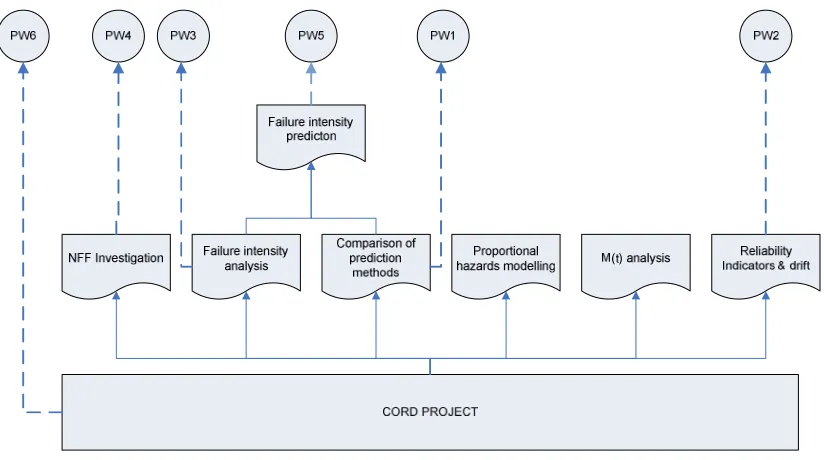
Figure 1: Relationships between Presented Work, Research and the CORD Project..18
Table of Tables
Acknowledgements
My thanks go to the sponsors of the various research projects that have made the
work described herein possible.
I am indebted to all the co-workers, and there are too many to list, throughout the
years for their contributions, criticisms and discussions whether they worked with
me at the universities or in the industrial partner companies. In particular I would
like to thank Professor David Campbell who started me on this path over 25 years
ago.
My thanks also go to my colleague, Paul Roberts, who has been very generous with
his time in reading and re-reading the draft and making useful suggestions to correct
spelling, grammar and structural problems. I also must thank him for his
contributions, in a number of discussions, about the overall direction that the thesis
should take.
Declaration
The work contained in this thesis is the candidate’s own work except for certain
sections where the work was carried out as part of collaborative research. This
collaborative work is evident from the text and the fact that the published work
presented herein contains the names of the collaborators. Statements about the
proportion of the work that was carried out by the author are supplied by the
collaborators where possible.
This work has not been submitted for any other degree at any other university
except where some of the published documents refer briefly to work on the setting
up and administration of a database carried out at Loughborough University which
formed part of a MPhil submission to that University.
Signed
Abstract
This thesis describes research work that the author has undertaken and published in the field of electronic reliability prediction techniques over the last 25 years. Reliability prediction is an important area since it has been part of the backbone of reliability engineering in one form or another for over fifty years.
The author has over 45 publications that are within the area of reliability prediction and 13 of these have been selected for review in this thesis. In order to show how the author’s work has contributed to the field of reliability prediction this document also contains information on the history of reliability prediction. This allows the author’s work to be placed in context with general developments in the field.
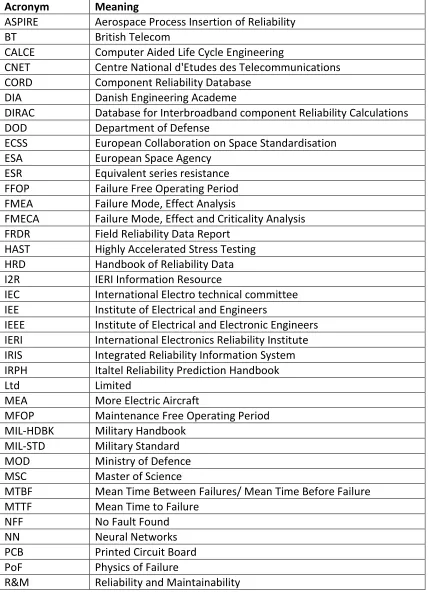
Table of Abbreviations and Acronyms
TABLE 1: Table of Abbreviations and Acronyms
Acronym Meaning
ASPIRE Aerospace Process Insertion of Reliability
BT British Telecom
CALCE Computer Aided Life Cycle Engineering
CNET Centre National d'Etudes des Telecommunications
CORD Component Reliability Database
DIA Danish Engineering Academe
DIRAC Database for Interbroadband component Reliability Calculations
DOD Department of Defense
ECSS European Collaboration on Space Standardisation
ESA European Space Agency
ESR Equivalent series resistance
FFOP Failure Free Operating Period
FMEA Failure Mode, Effect Analysis
FMECA Failure Mode, Effect and Criticality Analysis FRDR Field Reliability Data Report
HAST Highly Accelerated Stress Testing
HRD Handbook of Reliability Data
I2R IERI Information Resource
IEC International Electro technical committee IEE Institute of Electrical and Engineers
IEEE Institute of Electrical and Electronic Engineers IERI International Electronics Reliability Institute IRIS Integrated Reliability Information System IRPH Italtel Reliability Prediction Handbook
Ltd Limited
MEA More Electric Aircraft
MFOP Maintenance Free Operating Period
MIL-HDBK Military Handbook
MIL-STD Military Standard
MOD Ministry of Defence
MSC Master of Science
MTBF Mean Time Between Failures/ Mean Time Before Failure
MTTF Mean Time to Failure
NFF No Fault Found
NN Neural Networks
PCB Printed Circuit Board
PoF Physics of Failure
Acronym Meaning
RAC Reliability Analysis Center
RACE R&D in Advance Communications technologies in Europe
RADC Rome Air Development Center
RAMS Reliability and Maintainability Symposium
RCA Radio Corporation of America
RDF Recueil de Données de Fiabilité
REMM Reliability Enhancement Methodology and Modelling RIAC Reliability Information Analysis Center
SWOT Strengths, weaknesses, Opportunities and Threats TC Technical Committee, ( Only used as IEC TC/56)
UK United Kingdom
URA Ultra Reliable Aircraft
URAM Universal Reliability and Availability Modeller
US(A) United States(of America)
1. Introduction
This thesis describes a set of work that has taken place in the field of electronic
reliability prediction techniques since 1984. Reliability prediction is one of those
core tasks that have played a large part in the development of reliability engineering
over the last fifty years. It has moved from being leading edge, to being routine, to
being discredited and almost obsolete, and finally to resurgence using new methods
which again are leading edge but generally have little resemblance to those that
were used in the earliest days.
This document sets out the work carried out by the author in the reliability
prediction field, and shows how it fits into the overall development of that field. In
doing so via a comprehensive time-line it highlights the development of reliability
prediction techniques, the slow process of erosion by criticism that finally led to the
sweeping away of the ‘standard’ techniques of prediction and the development of
new ideas and metrics that are now used to give a measure of the future reliability
of systems.
Over the time this work was carried out the author has moved from being a research
assistant to a principal investigator, but throughout has usually been part of a team
that has worked together to develop the ideas, techniques and principles. The
“team” has varied in this time from supervisors, to people open for discussion of
collaboration. The make up of the team has varied from being all academic to being
all industrial, save the author, and all places in between.
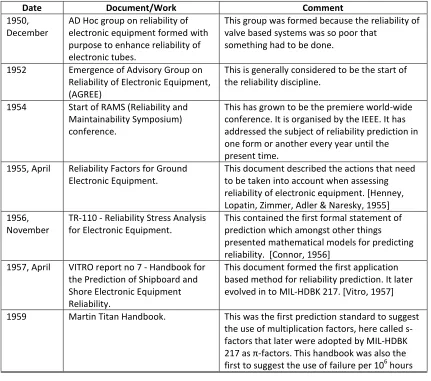
This document contains information on the history of reliability prediction,
presented as Table 2 in the beginning of Chapter 2. This table allows the author’s
work to be placed in context with general developments in the field of reliability
prediction. Chapter 3 presents the author’s contribution to reliability prediction
work; it describes projects the author has been involved with and the published
papers presented as evidence of contribution to knowledge. Chapter 4 draws this
work to a conclusion and the appendix contains a full bibliography of all the author’s
2. Electronic Reliability Prediction – The Work in Context
This section will attempt to put the various developments in reliability prediction
into a historical context and show where the work performed and presented as part
of this thesis fits in. It does this with the presentation of a time line, Table 2, which
contains important developments in the field of reliability prediction. This includes
publication and updates of handbooks (where significant), important papers by title
and citation [aaaa, xxxx], the author’s published work by title and number reference
[xxxx] (emboldened), the presented work (emboldened and enlarged), by title and
[image:12.595.107.538.390.771.2]citation [PWx], and projects the author worked on. (emboldened)
TABLE 2: Timeline of Major Events in Reliability Prediction
Date Document/Work Comment
1950, December
AD Hoc group on reliability of electronic equipment formed with purpose to enhance reliability of electronic tubes.
This group was formed because the reliability of valve based systems was so poor that
something had to be done.
1952 Emergence of Advisory Group on Reliability of Electronic Equipment, (AGREE)
This is generally considered to be the start of the reliability discipline.
1954 Start of RAMS (Reliability and Maintainability Symposium) conference.
This has grown to be the premiere world-wide conference. It is organised by the IEEE. It has addressed the subject of reliability prediction in one form or another every year until the present time.
1955, April Reliability Factors for Ground Electronic Equipment.
This document described the actions that need to be taken into account when assessing reliability of electronic equipment. [Henney, Lopatin, Zimmer, Adler & Naresky, 1955] 1956,
November
TR-110 - Reliability Stress Analysis for Electronic Equipment.
This contained the first formal statement of prediction which amongst other things presented mathematical models for predicting reliability. [Connor, 1956]
1957, April VITRO report no 7 - Handbook for the Prediction of Shipboard and Shore Electronic Equipment Reliability.
This document formed the first application based method for reliability prediction. It later evolved in to MIL-HDBK 217. [Vitro, 1957]
1959 Martin Titan Handbook. This was the first prediction standard to suggest the use of multiplication factors, here called s-factors that later were adopted by MIL-HDBK
217 as π-factors. This handbook was also the
as a standard metric and the use of the exponential distribution. [Lockhead Martin, 1959]
1961 Handbook for the Prediction of Shipboard and Shore Electronic Equipment Reliability – TR133-NAVSHIPS 93820.
This is an update of the 1957 Vitro publication and is the first military approach to performing reliability prediction. [Stokes, 1961].
1961 The Erles Report - Reliability
Application and Analysis Guide. This Report summarised the content of theTR133- NAVSHIPS 93820 for an academic audience. [Erles, 1961]
1962 MIL-HDBK 217 “Reliability Prediction of Electronic Equipment”.
This is the first publication of probably the most influential and important document in reliability prediction. This was based in part on the NAVSHIPS document of 1961. This document was a standard imposed by the military and was often used in specification and requirements documents for work in the military field and increasingly outside. The document was a collection of models for specifying the reliability of components under varying conditions and a methodology for combining the component rates into a rate for the overall system. [RADC, 1962]
1962 Failure Rates. This paper defined failure rate for technical equipment and then described the use to which such a metric could be put. [Erles & Edins, 1962] 1963 MIL-STD-756A - Reliability
Modeling and Prediction. This standard establishes procedures forpredicting the reliability of aircraft, missiles and related assemblies, including electronic equipment, throughout all the development phases. It was intended as a high level document to specify the use of MIL-HDBK 217 for use in specific areas. [US DOD, 1963] 1963 Component Fault Data from a Data
Processing Equipment. This document was the first UK based documentthat included failure rates from commercial equipment. [ATEC, 1963]
1966,
January Reliability in Linesman/Mediator, This document was a UK document thatcontained failure rates for military equipment. [Ashton, 1966]
1968 Reliability Prediction—Help or Hoax?
This was the first direct criticism of the reliability prediction process as defined in MIL-HDBK 217. [Codier,1968]
1974 MIL-HDBK 217B- “Reliability Prediction of Electronic Equipment”.
This update added a number of models for newer component types such as integrated circuits which was based on work carried out at Boeing, and added models that reflected new technology in other component types. A noticeable trend was the rise in complexity of the models that were in use but the most complex models, those of reliability physics or physics of failure (PoF) were not incorporated and models that leant too far in that direction were simplified before inclusion. [RADC, 1974] 1974 Siemens SN29500 ”Reliability
comprises separate parts, each of which is updated independently by different groups within Siemens and associated companies. [Siemens, 1974]
1974,
January Italtel Reliability PredictionHandbook (IRPH) Version 1. Italtel is the Italian national telecommunicationbody. This was the first European equivalent to MIL-HDBK 217.
This edition introduced the failure rate values in reference conditions (part count procedure). [Italtel, 1974]
1975 Bellcore TR-TSY-000332 ”Reliability Prediction Procedure for Electronic Equipment” – Version 1.
This document from Bell labs was originally developed by modifying MIL-HDBK 217 to reflect better the conditions of interest to the telecommunication industry. [Bellcore, 1975] 1976, June Italtel Reliability Prediction
Handbook (IRPH) Version 2.
This edition of the Italtel approach introduced the parts stress procedures. [Italtel, 1976] 1977, April British Telecom - Handbook of
Reliability Data for Components used in Telecommunications Systems – Version 1.
First release of handbook by the UK’s
Telecommunication company. [British Telecom, 1977].
1979 MIL-HDBK 217C - Reliability
Prediction of Electronic Equipment. This update added support for newertechnologies and the larger integration sizes of the older technologies. [RADC, 1979]
1979, March Italtel Reliability Prediction Handbook (IRPH) Version 3.
This edition introduced new classification of component categories.
1980, May British Telecom - Handbook of Reliability Data for Components used in Telecommunications Systems - Version 2.
Raw data grading quality revised. [British Telecom, 1980]
1980 The Failure Rate Function Estimated from Parameter Drift Measurements.
This paper suggested that the study of
parametric drift could provide useful insight into the reliability of systems. This was the basis of the later research project into this topic. [Møltøft,1980]
1982,
January MIL-HDBK 217D - ReliabilityPrediction of Electronic Equipment. An update of models and underlying data.[RADC,1982] 1982,
December Standard Reliability Table forSemiconductor Devices, Nippon Telegraph and Telephone Public Corporation.
The Japanese national Telecoms known as the NTT Standard. [NTT, 1982]
1982, July Bellcore TR-TSY-000332 ”Reliability Prediction Procedure for Electronic Equipment” – Version 2.
Version 2 rolls up a number of updates to version 1 which were issued between 1977 and 1982. [Bellcore 1982]
1983 Reliability Assessment and Screening by Reliability Indicator Methods.
This paper proposed an early version of prognostics, called here “reliability indicators”. These ideas fed into the CORD project. [Møltøft,1983]
1983,
January Recueil de Données de Fiabilité duCNET (RDF) This is the French national telecommunicationcompany’s reliability prediction handbook. It contains the most complex of the models to date and is partially based on the physics of failure of those devices. [National Centre for Telecommunications Studies, 1983]
1984, January
British Telecom - Handbook of Reliability Data for Components
used in Telecommunications
Systems - Version 3. Telecom, 1984] 1984,July Bellcore Technical Advisory
TA-000-23620-84-01, “ Reliability
Prediction Procedure for Electronic Equipment”.
This was a re-issue of the renamed Bellcore TR-TSY-000332 document. [Bellcore, 1984]
1984 Start of CORD Project at
Loughborough University. The Component Reliability Database or CORDproject was a data collection exercise for a variety of system types from military
communications to desktop computers. The purpose of the study was to identify the electronic component types that were causing failures in electronic equipment, to examine which environments led to these failures and to investigate the failure mechanisms. In order to carry this out this study undertook to build a component reliability database, (CORD). This database proved to be an enabler that allowed many forms of analysis and innovation to take place in this field. See Section 3.1 for further details.
1984 Start of Parametric Drift Project at
Loughborough University. This project was to take components whichwere identified as troublesome by the CORD project and investigate how their reliability could be modelled, with a particular focus on the development of reliability indicators. The author was employed to work on this project. See Section 3.2 for further details.
1986 Start of the Computer Aided Life Cycle Engineering (CALCE) Institute at the University of Maryland, USA
CALCE became the chief advocate for the Physics of Failure approach to reliability engineering. [Watson, 1992]
1986,
October MIL-HDBK 217E - ReliabilityPrediction of Electronic Equipment. A further update to underlying data and models.[RADC, 1986] 1986 Siemens SN-29500 “Reliability and
Quality Specifications Failure Rates of Components”.
An update to a number of sections of SN-29500. [Siemens, 1986]
1986 Reliability Indicators. This paper further developed the ideas of “reliability indicators”. These ideas fed into the CORD project. [Jensen & Møltøft, 1986] 1986 Reliability Prediction: A state of the
Art Review. This paper provided a review of the state of theart in reliability prediction and developed many arguments that O’Connor would use later to criticise the technique. [O’Connor & Harris, 1986]
1986 Formation of International Electronics Reliability Institute (IERI) at Loughborough University.
The component reliability projects at Loughborough had expanded sufficiently to allow the formation of a research institute. After this date the work done at Loughborough is attributed to IERI.
1986 The Highs and Lows of Reliability Predictions.
This paper addresses some of the problems of prediction. [Spenser, 1986]
1987 End of Parametric Drift Project. The parametric drift project finished and the author took over as manager of the CORD project.
January Reliability Data for Components used in Telecommunications Systems – Version 4.
added. Quality level definitions and some tables revised. [British Telecom, 1987]
1987, September
Italtel Reliability Prediction Handbook (IRPH) Version 4.
This edition introduced new models of integrated circuits and of component categories.[Italtel, 1987]
1987 The Organization of a Study of the Field Failure of Electronic
Components.
This paper described the organisation of the CORD project. It describes the procedures around the database and the reasons they were implemented. [Campbell, Hayes &
Hetherington, 1987] 1987 Reliability Behaviour of Electronic
Components as a Function of Time.
This paper described the parametric drift project and was focused on using early life measurements to predict the lifetime of capacitors. [RJ1]
1987 GJB/Z 299a – Chinese Military
Standard for Reliability Prediction. First Chinese military standard on prediction. Itis loosely based on MIL-HDBK 217 but has adaption for the Chinese environment and level of technology. [Chinese National Military Standard, 1987].
1988 Reliability Prediction: A
Constructive Critique of MIL-HDBK 217E.
This paper addressed some of the observed problems of MIL-HDBK 217 and suggested ways to correct and improve the shortcomings. [Blanks, 1988]
1988 A Critique of Mil-HDBK 217E
Reliability Prediction Methods. This paper examines the use of MIL-HDBK 217and highlights where it has failings. [Pecht & Kang, 1988]
1988 On US Mil-HDBK 217 and Reliability Prediction.
This paper was a critique of prediction in general and of MIL-HDBK 217 in particular. [Leonard, 1988]
1989 Failure Prediction Methodology Calculations can Mislead: Use Them Wisely, Not Blindly.
This paper attempts to advise users of MIL-HDBK 217 on how to best use it to avoid the potential problems in the data and procedure. [Leonard & Pecht, 1989]
1989 The Analysis of Electronic Component Reliability Data. Reliability Data Collection and Use in Risk and Availability Assessment.
This paper discusses the CORD database and presented a large number of constant failure rate statistics for different component types. [Marshall, J. Hayes, J, Campbell, D & Bendell A., 1989.]
1990 AT&T Reliability Manual. A general reliability procedures handbook that contains some failure rate data and prediction models. Unique in that it uses Weibull-based prediction for early failure periods. [AT&T,1990] 1990 An Analysis of the Field Failure of
Passive and Active Components.
This paper sets out the principles of analysis used in the CORD project. It provides some early data and analysis results. [Campbell &
Hayes,1990] 1990 What is Wrong with the Existing
Reliability Prediction Methods?
This paper describes what appears to be wrong with MIL-HDBK 217. [Wong, 1990]
1990 Reliability Prediction: Help or
had changed in the intervening years. [O’Connor, 1990]
1990 Electronic Component Reliability Data Generation, Collection and Analysis.
This paper described the new, updated organisation of the CORD project. It also outlined the analysis types. This paper was resented as a tutorial at the Uk based Component Engineering, Reliability and Test (CERT) conference. [RC2]
1991 New Methods for Specification and Determination of Component Reliability Characteristics.
This paper describes the M(t) approach to analysis of component lifetimes. [Møltøft,1991]
1991 MIL-HDBK 217F - Reliability
Prediction of Electronic Equipment. An update of MIL-HDBK 217E with newcomponent types added. [RADC, 1991]
1991 Start of DIRAC (Database for Interbroadband component Reliability Calculations) Project.
This project was funded by the European Union’s RACE project (R&D in Advance Communications technologies in Europe). It included as partners many of the
telecommunications companies in Europe, many of whom had their own prediction systems. DIRAC was an attempt at pooling the data that supported these separate handbooks and standardizing on a single prediction system across Europe. [RACE, 1992] See Section 3.3 for further details.
1991 Reliability Behaviour of Electronic Components as a Function of Time.
This paper reports the work done initially on failure intensity analysis. [RC3]
1991 Failure Intensity Analysis of
Resistors and Capacitors. This paper describes the failure intensityanalysis results for passive electronic components. [RC4]
1992, July MIL-HDBK 217F - Reliability Prediction of Electronic Equipment Notice 1.
Updates to a number of sections. [RADC,1992]
1992 Reliability Behaviour of Electronic Components as a Function of Time.
This paper readdresses the work carried out on failure intensities and extends it to all device types.[PW3, also cited as [RJ1]]
1992 British Telecom - Handbook of Reliability Data for Components used in Telecommunications Systems – Version 5.
This was the final version of the BT handbook. This was based on many of the principles learned on the DIRAC project and the data values published were based on data obtained from BT, CNET and Italtel using a data sharing agreement set up during the DIRAC project. [British Telecom, 1992]
1992 Bellcore TR- TSY-000332 ”Reliability Prediction Procedure for Electronic Equipment” – Version 5.
A roll up of minor updates. [Bellcore Labs, 1992]
1992 Failure Intensity Analysis of Electronic Components.
This paper presented the failure intensity analysis of capacitors and resistors to a specific audience at a conference related to the above devices. [RC5]
1992 The Comparative Reliability of Resistor Types under HAST.
1992 A survey of Reliability Prediction Procedures for Microelectronic Devices.
This paper survey the different reliability prediction models for microelectronic devices and compares the results. [Bowles, 1992] 1993 A Change in Direction for Reliability
Engineering is Long Overdue.
This paper focused on moving the reliability engineering industry away from prediction based practices. [Wong, 1993]
1993 End of DIRAC Project. This project finished for political reasons before the goal could be completed. A database was developed and procedures put in place but the database was never populated. This early curtailment of work meant that no publication was issued on this project.
1993, April Italtel Reliability Prediction
Handbook (IRPH) version 5. Complete revision, first public release. Thisdocument also used the shared data agreed by the DIRAC project. [Italtel, 1993]
1993 Recueil de Données de Fiabilité
(RDF) du CNET. Known as RDF’93. This document also used theshared data agreed by the DIRAC project. [National Centre for Telecommunications Studies, 1993]
1993 DEF-STAN –00-42 (part 3/1): Reliability and Maintainability (R&M) Assurance Guidance, Part 3: R&M Case.
This document describes the reliability and maintainability cases that are to be used in procurement. For MOD equipment [UK MOD, 1993].
1993 Evaluation of Reliability Prediction Methodologies.
This paper describes the initial work carried out to compare different prediction methodologies using the CORD data on systems. [RC7]
1993 Is It Time for a New Approach? This paper suggested that the entire approach to reliability engineering, based on prediction, was wrong and should be replaced by more logical systems. [Knowles, 1993]
1994 Perry Memorandum. This government memorandum had the effect of cancelling any future updates of MIL-HDBK 217. [US Secretary of Defense, 1994]
1994 Use of a Field Failure Database for Improvement of Product
Reliability.
This paper described the advantages of collecting very high quality data and the methods that can be used to achieve that. [RC8] 1994 Estimation of System Reliability
Using a Non-Constant Failure Rate Model.
This paper describes the early work on
attempting to use failure intensity analysis as a prediction method. [RC9]
1995,
February MIL-HDBK 217F Notice 2 -Reliability Prediction of Electronic Equipment.
Updates to a number of sections. [RADC, 1995].
1995 End of CORD project. The CORD project finished and the database was mothballed.
1995 Investigation of the No Fault Found Phenomena in Electronic Equipment.
This paper describes the early work looking at the No Fault Found problem. [RC10]
Section 3.4 for further details. 1996 IEC-601709–“Electronic
Components Reliability -Reference Conditions for Failure Rates and Stress Models for Conversion” standard.
This international standard is not about reliability prediction for systems rather it described some models for the transformation of failure rate at component level between environmental conditions. The author was part of the development committee for this standard [IEC 1996]
1996 R&M in an Era of Acquisition Reform [Reliability and Maintenance].
This paper describes in detail the effect the Perry Amendment had on reliability
engineering. [Caroli, Fennell, Gorniak & Reilly, 1996]
1997 Criteria for the Assessment of
Reliability Models. This paper describes how a reliability model, inparticular for prediction, should be selected. In doing so it shows many shortcomings with prediction methodologies. [Pecht, Shukla, Kelkar & Pecht, 1997]
1997 Use of a Field Failure Database for Improvement of Product Reliability.
This paper summarises the lessons learned on the CORD project. [PW6 Also cited as [RJ2]]
1997 Setting the Requirements for the Royal Air Force's Next Generation Aircraft.
This paper looks at the user based metrics that can be used for reliability work. In particular, it focused on the MFOP/FFOP metric. [Hockley & Appleton, 1997]
1997 Reliability Prediction Techniques
for Commercial Components. This paper describes the basic principles of theIEC61709 standard. [NC1] 1997 First Release of PRISM. PRISM was a repackaging by RADC of the
MIL-HDBK data with non-electronic data. This is a software based prediction system. [RAC, 1997], 1997 End of BSRIA Project. This project finished with the production of the
BSRIA guidance document.
1998 Release of GJB/Z 299b. This was an update to GJB/Z 299a – Chinese military standard for reliability prediction. [Chinese national military standard 1998] 1998 Dissolution of IERI. IERI closed at Loughborough University when
the author, who was the last active researcher, moved to Warwick University.
1998 Start of Reliability Enhancement Methodology and Modelling (REMM) Project.
The main objective of this project was to develop a methodology which provided pertinent reliability information to designers and programme managers at the time that they are best able to make use of it. The overall goal of REMM was to produce a holistic reliability assessment tool that could take input from all stages of the product life cycle to provide a reliability assessment. See Section 3.7 for further details.
1998 Start of Aerospace Process Insertion of Reliability (ASPIRE) Project.
was to identify best practice and to search for improvements. See Section 3.5 for further details.
1998 IEEE-1413-1998 - Standard Methodology for Reliability Prediction and Assessment for Electronic Systems and Equipment
A standard and the associated guide.
This standard and guide is a description of how IEEE thinks reliability prediction should be performed. It is a methodology firmly routed in the physics of failure approach since CALCE made a large contribution in its development. [IEEE 1998a] [IEEE 1998b]
1998 A Critique of the Reliability-Analysis-Center Failure-Rate-Model for Plastic Encapsulated Micro-Circuits.
This paper criticises the failure rate model used in MIL-HDBK 217 for a particular device
encapsulation type. [Sinnadurai, Shukla & Pecht, 1998]
1999 Maintenance-Free Operating Periods—The Designer's Challenge.
This paper described the MFOP metric and outlines how a designer might deal with using it. [Relf , 1999]
1999 A Comparison of Electronic-Reliability Prediction
Models.
This paper was an update of the work carried out on the comparison of prediction method and reported in [RC7]. [PW1 Also cited as [RJ4]] 1999 A Toolkit for Parametric Drift
Modelling of Electronic Components.
This paper was an update of the work carried out on the parametric drift project and reported in [RC1]. Here the work was extended and repackaged as a toolkit for general use. [PW2 Also cited as [RJ3]]
1999 Start of Universal Reliability and Availability Modelling Project (URAM).
The URAM project was started to develop a simulation tool for complex systems under complex operating and maintenance scenarios. The aim of the simulation was to be able to predict the availability of systems in order to test the ideas behind the MFOP/FFOP metric. See Section 3.6 for further details.
1999 Reliability Prediction Techniques
for Commercial Components. This paper was a description of the IEC61709standard aimed at space application for the European space agency. [NC2]
2000 Reliability Enhancement
Methodology and Modelling Tool. This paper outlines the principles of the REMMmethodology and describes the work to be done during the project. [RJ5]
2000 Norme UTE C80-810 (Août 2005) : Recueil de Données de Fiabilité Modèle Universel pour le Calcul de la Riabilité Prévisionnelle (Version Anglaise).
This is the RDF 1992 standard converted in to a French telecommunication national standard. [Centre National d'Etudes des
Telecommunications, 2000]
2000 Reliability Enhancement Methodology and Modelling,
2000 An Event Based Database for the Support of a Holistic Reliability Assessment Tool.
This paper describes principles behind the REMM events database. It outlines the theory behind the structure. [RC12]
2000 An Expert System for Constructing a Reliability Case.
This paper outlines the thinking behind using expert systems for delivering a reliability case. [NC3]
2001, May Telcordia SR-332 – version 1. This is a reissued Bellcore TR-332 Version 6. Renamed since SIAC bought Bellcore. [Telcordia, 2001]
2001 Investigation of the Occurrence of No-Fault-Founds in Electronic Equipment.
This paper revisits the NFF problem and summarises the work and findings to date. It is based on work reported as [RC10] in 1995. [PW4 Also cited as [RJ6]]
2001 Estimation of System
Reliability using a Non-Constant Failure Rate Model.
This paper revisits the failure intensity analysis work and describes how it can be used as a prediction methodology. It is based on work reported in [RC9] in 1994. [PW5 also cited as [RJ7]]
2001 The Use of a Discrete Event Simulation to Model the Achievement of
Maintenance Free Operating Time for Aerospace Systems.
This paper outlines the basics of the URAM simulation. [PW13 also cited as [RC14]]
2001 Understanding Reliability through Analysis of Event Histories – A Case Study from the Aerospace Industry.
This paper describes the sorts of analysis for which event based data can be used. [RC13]
2001 Reliability Enhancement
Methodology and Modelling. This paper describes the REMM methodologyand reports on progress. It is targeted at aerospace engine manufacturers. [NC4] 2001 Using the REMM methodology. This paper describes the REMM methodology
and reports on progress. It is targeted at the avionics industry. [NC5]
2001 State Space Representation Using
Path-sets. This paper describes the use of path sets forrepresentation of the state spaces within the URAM simulation. [NC6]
2001 Lessons in Distributing a Large
Simulation. This paper describes the issues in creating alarge simulation such as URAM. [NC7] 2001 Integrating Design and
Operational Models for Evaluating Logistics Systems.
This paper examines how to integrate design and operational models of systems to allow evaluation of logistics systems. [NC8]
2002 Reliability Enhancement Methodology and Modelling - The REMM Project.
This paper describes and summarises phase one of the REMM project. It outlines the methodology and
2002 Using Neural Networks for
Reliability Prediction. This paper describes the use of neuralnetworks to predict reliability of systems. [PW11 also cited as [NC9]] 2002 An Analysis of the Effect of a
Reliability Paradigm Shift on Leading British Aerospace Companies.
This paper describes an analysis of the effect of a reliability paradigm shift on leading British aerospace companies. [PW12 also cited as [RJ8]]
2002 Modelling of maintenance Within
Discrete Event Simulation. This paper describes how maintenance ismodelled within the URAM simulation. [RC15] 2002 Integrated Modelling of System
Functional, Maintenance and Environmental Factors.
This paper describes how systems function, environmental factors and maintenance actions are integrated within the URAM simulation. [RC16]
2002 Enhancing Product Reliability
using REMM. This paper describes how REMM can be usedfor enhancement of product reliability. [RC17] 2002 Maintenance Free Operating
Periods – A New Reliability Challenge.
This invited paper describes the use of MFOP and explains at a high level how it can be achieved. [NC10]
2002 A Methodology to Assess and Select a Suitable Reliability Prediction Method for EEE Components in Space Applications.
This paper describes the methodology used in the ECSS-Q-30-08A standard and describes A methodology to assess and select a suitable reliability prediction method for EEE components in space applications. [NC11] 2003,
February Italtel Reliability PredictionHandbook (IRPH). Complete revision of models and failure rates.[Italtel,2003]
2003 An Event Based Database for the Support of a Holistic Reliability Assessment Tool.
This paper revisits the work on the event database for the REMM project described in [RC12] and outlines the changes that had to be made to implement a theoretically sound database in a company based environment, [PW8 also cited as [RC19]]
2003 Development of an Expert
System for Reliability Task Planning as Part of the REMM Methodology.
This paper revisits the work on the experts system for the REMM project described in [NC3] and outlines what changes had to be made to implement the expert system in an industrial setting. [PW9 also cited as [RC18]]
2003 Start of FIDES project. This is a mainly French project funded by the French DRA that is to develop a standard approach to reliability prediction and associated tasks. [Charpenel et al, 2003
2003 Derivation of Technical Reliability and Maintenance Requirement.
This paper looks at how technical and maintenance requirements can be derived. [RC20]
2003 Representing Complex Systems
within Discrete Event Simulation. This paper looks at how complex systems can berepresented efficiently in simulations such as URAM. [RC21]
2003 A framework for Documenting and Analyzing Life-Cycle Costs using a Simple Network Based
Representation.
This paper looks at the trade offs between costs and benefit in reliability work. [RC23]
2003 How to Achieve Assured
Operation with Complex Systems. This RAMS tutorial describes how to achieveassured operation with complex systems. [RC24]
2003 REMM Workshop at RAMS 2003. REMM took over a session at the conference to promote the REMM approach. RAMS is the première reliability conference.
2004 End of Universal Reliability and Availability Modelling Project (URAM).
The URAM simulation was completed and was passed to QinetiQ for evaluation.
2004 The Reliability Case in the
REMM Methodology. This paper describes how the REMMexpert system allows the generation of a reliability case for a system. [PW10 also cited as [RC26]]
2004 End of Reliability Enhancement Methodology and Modelling (REMM) pProject.
The REMM project ended and the tools that were developed were passed to the industrial partners for evaluation and implementation. 2004 End of Aerospace Process
Insertion of Reliability (ASPIRE) Project.
The ASPIRE project finished and best practice guides were supplied to the industrial partners.
2004 IEC62380-TR – “Reliability data handbook – Universal model for reliability prediction of electronics components, PCBs and equipment” Technical report.
This is the international standard version of the CNET RDF2003 document. [IEC, 2004]
2004 How to Achieve Assured
Operation with Complex Systems. This RAMS tutorial describes how to achieveassured operation with complex systems and is an update of the previous years session [RC25] 2004 An Analysis of the Drivers in the
Philosophy of Reliability Practice over the Last 50 Years.
This paper was invited for the 50thanniversary of the RAMS conference. It identified some of the drivers that had caused change in the reliability engineering field over the last 50 years. [RC27]
2005 Perils and Pitfalls of Weibull
Life-Data Analysis. This paper looked at the perils and pitfalls ofperforming Weibull analysis on life and test data [RC28]
2005 Universal Reliability and
Availability Modelling (URAM). This invited paper for the ESRA newsletterdescribed the use of URAM for reliability improvements. [NC12]
2005 Publication of Fides Procedure. The Fides approach takes a partial physics of failure approach to prediction and is partially based on the models in UTE C80-810 It should be noted that the FIDES handbook also addresses some of the wider aspects of reliability practice, such as recommendations for reliability process control and audits. 2006 Prognostics and Health
Management of Electronics.
This paper proposes prognostics as a useful technique in the electronics field. [Vichare & Pecht, 2006]
methodology for MIL-HDBK 217, it supersedes the PRISM. [RIAC, 2008]
2006,
October Telcordia GR-332 – version 2. Revised tables of generic device failure ratesand 40 new devices have been added. Confidence limit calculation has been added. 2006 ECSS-Q-30-08A – Components
Reliability Data Sources and their Use
The space industry developed this standard to deal with the lack of MIL-HDBK 217. The approach was to recommend the handbook methods only as a last resort after field data and manufacturers’ data. It contained procedures for selecting prediction models that could be used to support a R&M case The author was part of the development committee for this standard. [ECSS, 2006]
2006 Practical Evaluation of the REMM Process.
This paper reported on the final outcome of the REMM project and described how many of the partners had implemented the system and what benefit they realised from it. [RC29]
2007 Discrete Event Simulation for Reliability Prediction, in Encyclopedia of Statistics in Quality and Reliability.
This book chapter described discrete event simulation and it use for reliability prediction. [BC1]
2007 Revision of IEC-61709 started for release in 2010.
This international standard is being updated as part of the IEC maintenance cycle. The Author is the IEC project leader for this document and is responsible for the updating of the technical content
2007 Start of Polynoe Project. This project is looking at the use of physics of failure models for the prediction of lifetime and reliability of MEMS devices. See Section 3.9 for further details.
2008 Formation of working group to produce the VITA 51 – reliability prediction standard.
This is an attempt to create a new version of MIL-HDBK 217 with new data and models. [Vita, 2008].
2008 Update of 217plus. This is the newest update to this software. [RIAC, 2008]
2008 No Fault Found in “Encyclopedia of Quantitative risk Assessment and analysis”.
3. Contributions to the Field of Reliability Prediction
This section sets out the author’s contribution to the field of reliability prediction. It
does this by first setting out the projects that author has worked on and then by
discussing the published works presented with this document.
3.1 Major Research Projects
Over the years covered by this document the author has worked on a number of
research projects that have led to the papers presented. This section gives details of
these projects, summarising what they did, why they did it and what the author’s
contribution was. It is worth noting that for completeness all the major projects that
the author has worked on are listed even if they did not produce relevant
publications.
3.1.1 The CORD Project [1984-1995]
The Component Reliability Database or CORD project was started in 1984 because a
number of concerns about reliability prediction were beginning to be made known
within the industry. The project was funded by the UK MOD and involved a number
of UK and Danish engineering companies from a variety of industries. It also included
the Danish Engineering Academe (DIA) as an academic partner.
Apart from the Codier paper [Codier, 1968] most of the concerns were anecdotal but
1. There was little faith in the failure rates that were being stated in the
handbooks. This was because they were only derived from real field data in a
few cases; many rates were from test data or from extrapolation from other
data sets. Even when they were derived from field data there was little
confidence that this underlying data was reliable.
2. There was some concern in the assumptions that were made. In particular
the assumption that failure rates were constant. Many engineers had
observed that for many components this was just not true.
3. There was a lack of confidence in the acceleration or π-factors used in the prediction methodology. These π-factors were used to convert between
environments and in some cases there was little or no evidence, or
theoretical justification the levels set. This was particularly noticeable for
plastic encapsulations where the π-factors were such that it was impossible
to use plastic parts in some military applications where MIL-HDBK 217 was a
prerequisite and yet these parts were observed to be very reliable in similar
non-military systems.
The CORD project set out to investigate these problems. Its remit was to collect
failure and population data for a large number of systems operating in different
environments and to produce a high quality set of failure rate figures for different
environments for as many components as possible. The project also had scope to
extend the analysis types available to reliability engineers, so the project was an
enabler that allowed other goals to be achieved such as the use of proportional
hazards models as documented by Marshall [Marshall, Wightman & Chester,1990]
In order to ensure that the data was high quality, very tight requirements for
traceability of parts, complete data validation for incoming data, and regular
re-screening of existing data were implemented. The major contribution of the core
CORD project to reliability engineering lies in this area. It has been a benchmark for
data collection exercises ever since.
The CORD project went through two phases. The first phase is described by Marshall
in her PhD thesis [Marshall, 1990], and during this phase the author’s contribution
was to the data analysis projects supported by CORD. Phase two of this project was
managed by the author and is described in the author’s MPhil thesis [Jones, 1984].
During this latter phase the data validation process was reviewed and extended by
the author to further improve the data quality and a number of new reporting
processes were constructed such as the development of a reliability prediction
[image:27.595.118.530.68.298.2]Microsoft Windows based system known as I2R (For IERI Information Resource) that
incorporated much of the data and results developed as part of the CORD project
and allowed prediction using the CORD data
3.1.2 The Parametric Drift Modelling Project [1984-1987]
This project was a parallel project to CORD and its remit was to examine component
drift failures and the use of reliability indicators. A reliability indicator is a parameter
of the component that can be measured early in its life that by various means can
then be used to predict when the device would fail [Jensen & Møltøft, 1986]. The
concept of these reliability indicators came from some work on an optocoupler
device in Japan [Takahashi, Todoroki & Mitani, 1979] and work done on Thick Film
Resistors [Pranchov & Campbell, 1984] and [Kasukabe & Tanaka, 1981]. In the
project it was hoped to be able to extend this to many other device types. This
project contribution to reliability engineering was to examine a number of
techniques for lifetime and failure prediction using reliability indicators and to
develop a statistical model for prediction. It should be noted that this project was
very much ahead of its time in that it was studying what are now called prognostics
measurements. The author’s contribution to this project was to run the underlying
experiments, which included designing test rigs and measurement software, to
select and implement, in software, the various drift models that were examined and
3.1.3 The DIRAC Project [1992-1993]
The Database for Interbroadband component Reliability Calculations or DIRAC
project was a project funded by the European Union’s RACE (R&D in Advance
Communications technologies in Europe) project. It included as partners many of the
telecommunications companies in Europe, such as a BT, CNET, Italtel, Siemens etc.
many of whom had their own prediction systems. DIRAC was an attempt at pooling
the data that supported these separate handbooks and standardizing on a single
prediction system across Europe [RACE, 1992]. The role of Loughborough University
in this project was to host and operate the database and to manage the data
collection and merging exercise in the first instance, and later when the database
was populated to develop new methods of reliability analysis using the data.
However, the project was terminated prematurely for political reasons, after the
database infrastructure had been built and before it was populated. The author’s
role in this was as data manager and as such was responsible for database design,
data coding, data validation design and all operational processes. Because of the
termination of this project there were no publications based on this work but the
major contribution to reliability prediction was in the data coding (in particular
component type coding) and data sharing agreement set up between the European
telecommunication companies as part of this project which led to changes in their
3.1.4 The BSRIA Project [1995-1997]
This project was jointly funded by the DTI and by the Building Services Research and
Information Agency (BSRIA). It was to examine the use of thermography for
prediction of failures in electrical switchgear so that maintenance could be
scheduled. It involved a number of UK switchgear manufacturers and building
operators. The work was done to produce a guidance document [BSRIA, 1997] to be
published by BSIRA and there was an embargo on further publication from this
project for ten years after project completion. The author’s role in this project was as
the main researcher.
3.1.5 The ASPIRE Project [1998-2004]
The Aerospace Process Insertion of Reliability or ASPIRE project was funded by the
DTI out of the Ultra Reliability Aircraft (URA) group, which itself was part of the
Society of British Aerospace Companies (SBAC). The purpose of the URA group was
to look at developing the reliability technology that would support the next
generation of aircraft [Bottomley 1999]. The purpose of the ASPIRE project was to
enable the UK aerospace industry to design more reliable equipment and systems,
predominantly mechanical, by finding innovative methods of using in service
reliability data.
The two most important areas where ASPIRE had the most influence were firstly, the
development of a business model for reliability and secondly, alternative reliability
building the business model and investigating the ways in which companies would
use MFOP.
3.1.6 The URAM Project [1999-2004]
In general terms a customer is interested in how much use he can make of a product
before it fails and has to be repaired. These needs can be encapsulated in the
metrics Failure Free Operating Period (FFOP) and Maintenance Free Operating
Period (MFOP). These metrics describe the time a system will operate, in the first
case for systems where no failure is permitted and in the second for systems that
can fail and be repaired. The Universal Availability and Reliability Modelling or URAM
project developed a discrete event simulation model that allows a system designer
to investigate whether or not a system can meet a defined MFOP specification. It did
this by taking into account the reliability of the system, the mission profile that the
system has been tasked with and the maintenance regime that has been
implemented to support the system. This simulation was the first, and still is the
only, simulation model to look at reliability with this level of detail. It made a major
contribution to reliability knowledge in two distinct ways. Firstly, when applied by
QinetiQ and the partner companies it allowed them to perform what-if analyses on
their design and maintenance regimes under a MFOP paradigm, and this is still not
possible with any other simulation. Secondly, it developed new methods of efficient
handling of reliability data in a discrete event simulation. The author’s role in this
project was to design and build the component failure models, the underlying
the environmental factor handling, the database access and the user interface. The
maintenance and operational leg scheduling were completed by a colleague.
3.1.7 The REMM Project [1998-2004]
The Reliability Enhancement Methodology and Modelling or REMM project was
sponsored by the UK DTI and involved a large number of industrial partners. Its
focus was to establish new methods and tools, and the interactions between them,
for the enhancement and estimation of electronics equipment reliability within the
aerospace field with particular attention to the More Electric Aircraft (MEA) project.
The MEA project was an attempt in the aerospace market to move to electrical
actuation of control surfaces and systems rather than hydraulics to save weight.
The main objective of the REMM project was to develop a system which provides
pertinent information to designers and programme managers. This system was
called IRIS for “Integrated Reliability Information System”. To carry out this task the
REMM project looked at diverse areas of reliability engineering with the intent of
integrating them to generate a holistic approach. REMM generated new knowledge
in each area addressed by providing new methodologies and techniques or by
providing best practice guidance on how to better carry out the technique. The
reliability areas examined in the REMM project included:
Overall REMM process development ( Production of demonstrator system)
Effective use of system reliability tools (Fault Tree Analysis and Failure Mode
Effect and Criticality Analysis)
Effective use of reliability enhancement testing (HAST), Environmental Stress
Screening (ESS), manufacturing process monitoring (MPM) and statistical
process control (SPC)
Data collection
Development of artificial Intelligence for decision making
Mechanical systems reliability
Systems that include software
Cost effectiveness
Investigation of no fault found (NFF) events on despatch reliability
The author’s contribution was to the data collection, development of artificial
intelligence and the overall REMM process development although contributions
were made to other areas, in particular, the system reliability tools and NFF areas.
The REMM project has been judged a great success. The work done within some
parts of it was ground breaking and the processes championed by it (the use of
expert judgement and previous results to predict reliability, and the justification
elements that feed a reliability case) have had a far reaching effect on the companies
that were involved, each company taking what they wanted from the project, but
none taking everything. The REMM approach is specified in various parts of the UK
MOD when dealing with reliability assessment, as in fact has been done in the
3.1.8 The Polynoe Project [2008-2010]
This project is looking at the reliability of MEMS devices. The focus of the project is
to be able to predict their reliability and lifetimes using physics of failure based
modelling approaches [Foucher, B, 2008]. The current approach is to use fault tree
analysis to build a top down reliability assessment and to build upwards from the
basic physics to meet this at appropriate points. Experimental work is also
proceeding to characterise the devices. The outputs of this work are to be fed into
the French Fides methodology and into the UK’s REMM based approach. This is an
ongoing a project at the time of writing (November 2008) and so far there are no
3.2 Presented Work.
This section describes the papers that are presented with this thesis.
3.2.1 A Comparison of Electronic-Reliability Prediction Models1
This paper describes work that was done as part of the CORD project to examine the
accuracy and repeatability of some of the more popular reliability handbook
prediction systems. This work was done because it was becoming anecdotally
obvious that there were problems with the prediction systems that were in common
use.
This led to a very important piece of work which examined the available prediction
handbooks to see how they compared against known good data. This was a
worthwhile exercise since the CORD team was absolutely confident that the data
contained in the database was of the highest possible quality and so it could provide
a benchmark against which other data handbooks could be tested. The author
limited the work to a small number of handbooks, mainly because these were easily
available and the CORD database contained data on equipments that were similar to
the data from which the handbook had been derived.
To do the analysis six pieces of equipment were chosen based on the ability of the
original data providers to provide the extra information required and the match with
handbook types. The methodology was to predict the reliability of the systems from
the handbooks and then to compare this with the observed failure rates seen from
the field.
This work showed that the handbook systems were not good at providing accurate
prediction. It had often been commented by the partners that this would be the
case, but that the state of affairs was satisfactory since it was known that certain
handbooks were either too pessimistic (predicting a higher than experienced failure
rate) or optimistic (predicting a lower than experienced failure rate) and so the
companies used adjustment factors to account for this deviation. However, the work
performed at Loughborough not only showed that the predictions were poor in
terms of accuracy but that in some cases a handbook might prove pessimistic and in
other cases optimistic, so a standard adjustment factor would not work.
The author then decided that further analysis was necessary and so another set of
work was done to explore the sensitivity of the different models to the various
factors that are used. This showed that the models were sensitive to different factors
in different, sometimes non linear, ways and so were not to be trusted in any event.
This work was first published as a conference paper [RC7] and then rewritten and
extended for publication as a journal paper [PW2].
The author’s role in this work was to direct the technical aspect of it. A programmer
wrote the code to extract data from the database and the associated lecturer
the methodology, selected the prediction models, performed the prediction and
3.2.2 A Toolkit for Parametric Drift Modelling of Electronic Components2.
This paper came out of the parametric drift project and is included because it
summarises the majority of the work done on this project and was an early
treatment of the use of prognostics, before the term was coined for what
traditionally were known as reliability indicators. The work is also about predicting
lifetimes and not just failure rates, a method that has also become more prominent
albeit from a physics of failure point of view rather than the statistical treatment in
this paper.
The work on parametric drift failures began by looking at a particular sort of
electrolytic capacitor where it had been reported [Rhoads & Smith, 1984] that
electrolytic capacitors’ equivalent series resistance (ESR) drifted with time and could
be linearised by taking the reciprocal. To generate data 5000 capacitors were put on
test at a number of different temperatures and measurements of ESR were carried
out regularly. Meanwhile work was undertaken to investigate a number of different
drift models. Many were examined but the choice of models taken forward was
driven by what the sponsor felt would be reasonable for use in a production
situation and that their engineers could understand and implement. This meant that
the simpler models were chosen. Each model was identified in the literature and
then converted into an algorithm that could be coded as software. The models
examined included a linear model, based on a least squares fit to the ESR data, which
was included because the sponsor felt that it could be implemented easily on a
portable calculator. The concept behind all the models was to look at early drift
measurements and by trending the data or by examining probabilities, decide when
the ESR value had exceeded some predefined failure limits. The linear model looked
solely at average trend while the probabilistic models tried to predict the probability
of exceeding the limits given the current and starting conditions. The most successful
model was the model developed by Professor Jorgen Møltøft whilst he was a visiting
research fellow at Loughborough in the years preceding the start of this study
[Møltøft, 1980]. The author also developed a model using the best elements of the
available models in combination and this model was the second best performer. This
latter model became known as the “Loughborough model” and was a good
compromise between prediction performance and solution time which met the
sponsor’s requirements.
Using modern reliability thinking, what had been developed in fact was a prognostic
measurement [Vichare & Pecht, 2006]. The tools that were developed here would
be easily transferable to the modern paradigm. Hence, the contribution to reliability
knowledge of this work is a series of methods that can be applied to prognostic
development.
The author’s contribution to this work was to design and run the experimental
phase, identify the candidate statistical models and, when the short list was agreed
presentation of the results and development of the Loughborough model was also
done by the author.
This work was originally written up as a conference paper [RC1] in the electronic
components sector where the focus was on the prediction of electrolytic capacitor
lifetimes. The work was generalised as a toolkit for prediction of component
3.2.3 Reliability Behaviour of Electronic Components as a Function of Time3
This paper came out of the CORD project. It was based on the idea that since good
quality data was available it was possible to look at one of the underlying
assumptions of a lot of prediction work, the constant failure rate. This was only
possible and credible because of the very high data quality of the data in the CORD
project. This paper is included since it reports on this ground-breaking work to
provide concrete evidence of non-compliance to the constant failure rate
assumption.
It has been known for many years that many components types do not have a
constant failure rate period: typical examples being mechanical and
electro-mechanical components, but it was generally assumed that most other components
did follow the model, at least approximately, and if they didn’t then it would only be
by a small variation that could easily be ignored or dealt with by some multiplier.
The work done at Loughborough would provide evidence that very few components
exhibited such a constant failure rate.
The applicability of constant rates was examined by looking at the failure intensity
(also known as hazard rate) of the component. Most analysis that uses this metric
does so by looking at it cumulatively, but in this case the work was to look very
closely at changes in the data and to make them more obvious when viewed by
3 D. S. Campbell, J.A.Hayes, J.A.Jones & A. P. Schwarzenberger,Quality And Reliability Engineering
engineers. It was found that for the vast majority of components the failure rate was
almost never constant [RC4], [Stennet & Hayes, 1991]. This demonstration had
profound implications for the future of reliability prediction since it demonstrated
that the premise of constant failure rate was not true and the variation from the
assumption was so great as to make any pretence that it could be ignored absurd.
This also led to the development of the M(t) analysis method [Møltøft, 1991] that
was spearheaded by the DIA who were partners in the project and which was to
become central to the DIRAC database analysis system.
The author’s contribution to this paper was the original idea to explore the failure
rate behaviour and to develop the methodology, specify the programming tasks for
3.2.4 Investigation of the Occurrence of No-Fault-Founds in Electronic Equipment4
This work was done as part of the CORD project. The paper is included here since it
was seminal in the analysis of the No Fault Found problem. The paper presented is a
rewrite of the earlier conference paper [RC10] and was further developed in the
REMM project [James, Lumbard, Willis & Goble, 2003] and finally adapted as a
chapter in the Encyclopedia of Quantitative Risk Analysis and Assessment which was
published in 2008 [BC2].
While examining the CORD database for failures of the systems that had been
predicted using the handbooks, it was noticed that the largest outcome class
following removal and repair for nearly all systems was in the No Fault Found (NFF)
class, termed a NFF event. A NFF event was defined by the CORD database as
occurring at three distinct levels; system, board or sub-system and component.
When all these NFF events were considered they accounted for between 50% and
60% of all failures for a system. In the majority of prediction systems NFF events are
not considered, but the author felt that NFF events should be analysed to see if any
pattern or cause could be found and a way of bringing them into reliability prediction
devised.
The principle behind the NFF event investigation was to validate some of the
anecdotal reasons for NFF event occurrence and to do that the author looked at
various constituent components of the boards that had displayed NFF events.