University of Warwick institutional repository: http://go.warwick.ac.uk/wrap
A Thesis Submitted for the Degree of PhD at the University of Warwick
http://go.warwick.ac.uk/wrap/3135
This thesis is made available online and is protected by original copyright.
Please scroll down to view the document itself.
Complete Noncompact CMC Surfaces
in Hyperbolic 3-Space
by
Thomas Cuschieri
Thesis
Submitted to the University of Warwick
for the degree of
Doctor of Philosophy
Mathematics Institute
Contents
Acknowledgments iv
Declarations v
Abstract vi
Chapter Breakdowns and Preliminaries viii
Chapter 1 CMC Immersions and the Isoperimetric Inequality 1
1.1 The Basic Models . . . 1
1.2 The Plateau Problem for H-Surfaces and the Isoperimetric Inequality . . . 4
1.3 Perturbation Results . . . 11
1.4 Concluding Remarks . . . 14
Chapter 2 The Asymptotic Plateau Problem for H-Surfaces 17 2.1 Regularity Theory . . . 17
2.2 Uniform Gradient Bound . . . 19
2.3 Construction of Barriers . . . 21
2.4 Compactness . . . 23
Chapter 3 Perturbation of Proper H-Harmonic Maps 26 3.1 The H-Harmonic Map Equation and its Linearisation . . . 26
3.2 Asymptotics ofH-Harmonic Maps . . . 28
3.3 Weighted Function Spaces . . . 33
3.4.1 Asymptotic Analysis for the Jacobi Operator . . . 38
3.4.2 Invertibility on L22(U2,P) . . . 42
3.4.3 Invertibility on H¨older Spaces . . . 44
3.5 The Perturbation Result . . . 54
Chapter 4 The Conformality Operator and Perturbation of Spherical Caps 56 4.1 The Conformality Operator . . . 56
4.2 The Perturbation Theorem . . . 62
Acknowledgments
First and foremost I would like to thank my supervisor, Dr. Mario Micallef for his support and
encouragement over the years. His passion and enthusiasm for the subject have been and will
remain a constant source of inspiration. I would also like to thank Prof. Peter Topping for
numerous helpful discussions and Prof. Rafe Mazzeo for taking the time to help me understand
the edge calculus.
A very special thank you to all the fantastic people who accompanied me along the way.
In particular: Anita, Stephen & Kath, Ay¸se & Thomas, Mirela & Matthew, Nicky & Tom,
Al & Maggie, Alberto, Masoumeh, Anestis “Arthur” Fotiadis, Jorge, Pavel, Shengtian & Nils,
Kostas & Georgia, Leo, Alvaro, Tim & Becca, Bob, Lu, Azadeh, Yang, Michael, Sarah & Neil,
Lorraine, Umar, Eleonora & Tim, Neha, Giuseppe, Sohail, Sara & Michele, Greg & Nici, Tom,
Eugenia, Sebastian & Tanja, Miho and Lee.
My deepest love and thanks go to CK, who keeps me from falling. You shine so brightly.
I would not have made it without the constant love, encouragement and support of my
Declarations
I declare that the work presented here is entirely my own except where acknowledged in the
Abstract
In this thesis we study the asymptotic Plateau problem for surfaces with constant mean curvature (CMC) in hyperbolic 3-space H3. We give a new, geometrically transparent proof of
the existence of a CMC surface spanning any given Jordan curve on the sphere at infinity ofH3,
for mean curvature lying in the range (-1,1). Our proof does not require methods from geometric measure theory, and yields an immersed disk as solution. We then study the dependence of the solution surface on the boundary data. We view the set ofH-surfaces (CMC surfaces with mean curvature equal to H) as consisting of the conformal H-harmonic maps. We therefore begin by showing smooth dependence on boundary data for H-harmonic maps (with |H|<1) which solve a Dirichlet problem at infinity. This is achieved by showing that the linearised
H-harmonic map operator is invertible as a map between appropriate function spaces. Finally we show smooth dependence on boundary data for H-surfaces which lie in a neighbourhood of the totally umbilic spherical caps {ΣH}. This is achieved by studying the mapping properties
Chapter Breakdowns and
Preliminaries
Chapter Breakdowns
Chapter 1 is introductory in nature. In it we survey the relevant results on constant mean
cur-vature (CMC) surfaces in the literature and place our new results in context. We identify the
role played by Yau’s isoperimetric inequality for negatively curved manifolds in the existence
theory for CMC surfaces in such manifolds. Finally we describe what we believe to be some
flaws in a paper which has some overlap with the present work.
In Chapter 2 we solve the (parametric) asymptotic Plateau problem for constant mean
curva-ture surfaces, using purely PDE methods. Our approach yields an immersion of the unit disk
as a solution.
In Chapter 3 we study the space of H-harmonic maps between hyperbolic 2-space H2 and
hyperbolic 3-space H3 that solve a Dirichlet problem at infinity. Using an implicit function
theorem-type argument we prove a perturbation result for such maps.
In Chapter 4 we prove a perturbation result for complete, noncompact CMC surfaces in H3
Preliminaries
We now set some sign conventions and give some basic definitions. Let (N, h) denote a Rieman-nian n-manifold, with associated Levi-Civita connection d∇, and covariant derivative ∇. Let Σ⊂N be an immersed hypersurface inN. At a pointp∈Σ we define the second fundamental form of Σ to be the symmetric bilinear mappingA:TpΣ×TpΣ→(TpN)⊥ defined by
A(X, Y) := (∇XY)⊥,
for X, Y ∈ TpΣ, and where ⊥ denotes projection onto the orthogonal complement of TpΣ in
TpN. We define the vector valued mean curvature of Σ in M at pto be
~
H(p) :=− 1
n−1trA,
where the trace is taken with respect to the restriction of the metric h to the subbundle TΣ. The (scalar valued) mean curvature H(p) of Σ is defined by the relation H~(p) = H(p)n(p), where n(p) is a unit normal to Σ at p. Σ is said to have constant mean curvature (from here onwards abbreviated toCMC) equal toH∈Rif H(p) =H for all p∈Σ.
Remark 0.1. With this definition of mean curvature, the geodesic spheres in hyperbolic 3-space
have constant mean curvature strictly greater than 1 with respect to theoutward pointing unit
normal.
We adopt the convention that the curvature tensorRof (N, h) at a pointq ∈N is given by
R(X, Y)Z :=∇Y∇XZ− ∇X∇Y − ∇[Y,X]Z,
for X, Y, Z ∈ TqN. Then for two linearly independent tangent vectors X and Y in TqN, the
sectional curvature of the 2-plane spanned byX andY is given by
K(X, Y) := g(R(X, Y)X, Y)
g(X, X)g(Y, Y)−g(X, Y)2.
We set the rough Laplacian ∆ associated tod∇to be
∆Z := trh∇2Z,
where ∇2 is the second covariant derivative, defined by ∇2Z(X, Y) := ∇
X∇YZ − ∇∇XYZ.
all be “geometer’s Laplacians”).
Now consider a smooth map u: (M, g)→(N, h) between Riemannian manifolds, where dimM =m, dimN =n. Let M have local coordinates x = (x1, . . . , xm). The energy density of uis defined to be the function on M given by
e(u)(x) :=
m
X
i,j=1
n
X
α,β=1
gij(x)hαβ(u(x))
∂uα
∂xi(x)
∂uβ
∂xj(x).
The tension field of u is the smooth section of the pullback bundleu∗T N defined by
τ(u)(x) := trgd∇edu,
whered∇e is the induced connection onT∗M
Chapter 1
CMC Immersions and the
Isoperimetric Inequality
We begin by motivating the work carried out in this thesis, and placing our new results in
context. We revisit the solution for the Plateau problem for CMC surfaces on the interior of
a negatively curved Riemannian manifold and show how Yau’s [52] isoperimetric inequality for
such manifolds lies at the heart of the existence result. Apart from describing the relevant
known results in the literature we also provide a critique of a paper [10] which has some overlap
with our present work, but appears to contain a number of serious flaws.
1.1
The Basic Models
The canonical examples of complete CMC surfaces in H3 can be grouped into four families
which we now describe. As a unifying principle we shall view each family as consisting of the
level sets of a specific function. We presently have the unit ball model of H3 in mind.
We begin with the compact surfaces: these are the geodesic spheres, the level sets of the
distance function to a point. Spheres of (hyperbolic) radiusRhave mean curvature everywhere equal to cothR > 1. If we start with a geodesic sphere and allow the radius R to tend to infinity, whilst simultaneously shifting the centre of the sphere off to the ideal boundary ofH3,
a unit-speed geodesic and have mean curvature everywhere equal to limR→∞cothR = 1. We
note that horospheres have a single point as ideal boundary. If we consider the level sets for
the distance function to a geodesic we obtain the hyperbolic cylinders. These have two points
as ideal boundary and mean curvature equal everywhere to 12(tanhR+ cothR) >1, where R
is the distance to the geodesic. Once again, if we let R → ∞, whilst simultaneously bringing the two points at infinity together we end up, in the limit, with a horosphere. Finally we
con-sider the class of complete, noncompact CMC surfaces arising as the level sets for the distance
function to a totally geodesic plane. These surfaces have mean curvature everywhere equal to
tanhR ∈[0,1), and ideal boundary given by a circle. We shall refer to these surfaces asspherical caps, and denote by ΣH the spherical cap with constant mean curvatureH. We remark that
this class of CMC surfaces has no Euclidean analogue: inR3 the surfaces equidistant to a plane
are again planes with zero mean curvature. We will see other examples of howH-surfaces with |H|<1 inH3 exhibit features which have no counterpart in Euclidean space (see, for example,
the remark immediately following Theorem 1.4).
With these basic models in mind it is perhaps natural to investigate whether we have
any “rigidity” results regarding CMC surfaces in H3. We now list some of the known results
in this direction. For the compact and embedded case, Alexandrov’s proof in the Euclidean
setting [3] goes through unchanged and we have that
The only compact, embedded CMC surfaces in H3 are the geodesic spheres.
More recently, Meeks & Tinaglia [37] showed that, furthermore
If Σis a simply-connected and embedded H-surface, with H >1, then Σ is properly embedded.
By results of Korevaar, Kusner, Meeks & Solomon [26] such a Σ must necessarily be compact,
and therefore a sphere by Alexandrov’s theorem. If we extend the class to allow immersions, we
again have a result akin to the situation in Euclidean space. We mention the work of Umehara
& Yamada [48], where they obtain CMC tori in H3 by deforming Wente’s construction in R3.
There exist immersed CMC tori in H3.
Note that by the maximum principle these tori must have mean curvature>1. We now turn to the family of horospheres. In their 1983 paper do Carmo & Lawson [15] prove a number of
Alexandrov-Bernstein type results, amongst them the following:
The only properly embedded CMC surfaces inH3with a single point as ideal boundary
are the horospheres.
Once again, the theorem is false if we allow immersions: counterexamples were constructed
by Gomes in his PhD. thesis [19]. We remark that 1-surfaces have been the subject of much
attention, especially since Bryant’s discovery of a Weierstrass representation for such surfaces [8].
In particular, one can construct (embedded) 1-surfaces with two points at infinity. Focusing
now on the family of cylindrical surfaces, we have the following relevant result of Korevaar,
Kusner, Meeks & Solomon [26]:
Let H > 1. The only complete, properly embedded H-surfaces with two ends in H3 are the surfaces of revolution.
Finally we turn our attention to the class of hyperspheres, with mean curvature satisfying
|H| <1. As we shall see, we have a much richer existence theory for this class of H-surfaces. Let us first recall Bernstein’s result for minimal surfaces, and a generalisation by Fischer-Colbrie
& Schoen [17] and also due to do Carmo & Peng [14]:
Theorem 1.1 (Bernstein). If Σ∈R3 is a minimal surface given by the graph of aC2 function defined on the whole of R2, then Σ is a plane.
Theorem 1.2 (Fischer-Colbrie & Schoen, do Carmo & Peng). If Σ ∈R3 is a stable minimal
immersion then Σis a plane.
In the 1983 paper cited above, do Carmo & Lawson also prove a form of analogue of
Bernstein’s original result, by showing that
If Σ ∈ H3 is a CMC surface which can be written as a (hyperbolic) graph over a
here by “hyperbolic graph” we mean with respect to the orthogonal projection given by the
exponential map. But what about analogues of the stronger Theorem 1.2? This is no longer
true in H3: Uhlenbeck [47] and independently Wang & Wei [51] give constructions that show
that
There exist complete, noncompact stable minimal surfaces inH3 that are not totally
geodesic.
We do, however, have the following result of da Silveira [13], which, for reasons explained below,
we feel is the natural analogue of do Carmo & Peng’s Bernstein-type result
Let H >1. If Σis a stable, complete and noncompact immersed H-surface, then Σ
is a horosphere.
The constructions of Uhlenbeck and Wang & Wei are carried out in a hyperbolic
3-manifold, and the minimal surfaces in H3 arise when one passes to the universal cover. The
ideal boundary of these surfaces is given by a Jordan curve on the sphere at infinity. Thus we are
led very naturally to an alternative method of construction, namely, by solving an asymptotic
boundary version of the classical Plateau problem:
(I)Given a Jordan curve Γ on the sphere at infinity of H3, does there exist a CMC
surface Σwhose ideal boundary ∂∞(Σ) is given byΓ?
The above problem shall form the focus of much of the work in the thesis. In the next section
we describe the approaches to tackling (I); we then go on to deal with the issue of continuous
dependence of the solution surface on the given curve at infinity.
1.2
The Plateau Problem for
H
-Surfaces and the Isoperimetric
Inequality
The systematic study of (I) was initiated by Anderson [5] in 1982, where he dealt with the
of H for which we can hope to solve, as can be readily seen by using the maximum princi-ple with horospheres as comparison surfaces. All of the works just cited employ the powerful
machinery provided by geometric measure theory. As is the norm with GMT methods one is
forced to forfeit control over the topology of the solution surface, and one needs to work harder
to assert the existence of a minimal or CMC disk. Anderson successfully constructs complete
embedded minimal disks asymptotic to a given Jordan curve at infinity in [6], by using the
approach developed by Almgren & Simon in [4], in which they constrained the Jordan curve to
lie on a convex set.
A different approach to the problem was employed by Nelli & Spruck [40] and Guan &
Spruck [21]. Here elliptic PDE methods were used to obtain graph-like solutions over the domain
bounded by Γ inS2
∞. Via this approach one can rather easily obtain solutions of the type of the
disk, but some of the conditions imposed on Γ are somewhat unnatural, from the hyperbolic
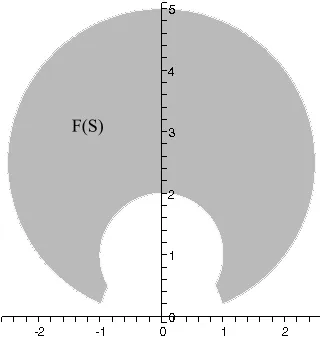
viewpoint. In particular, the requirement that Γ bound a starlike domain is a property which is
not invariant under a M¨obius transformation ofS2∞: consider, for example, the fractional linear
transformation given by
F :z7→ −1 z.
[image:16.595.352.512.510.681.2]See Figure 1.1: F maps the starlike domainS to the non-starlike domainF(S).
There is of course one very natural approach to the problem: consider a sequence of
boundary curves Γi ∈H3 converging to the given curve at infinity, solve the Plateau problem
for H-surfaces for each Γi, and then extract a limit out of the solution surfaces. Indeed, in
Chapter 2 we shall successfully employ this approach to prove the following:
Theorem A. Let H∈(−1,1) and suppose Γi ⊂H3 is a sequence of Jordan curves converging to Γ⊂S∞2 . Suppose ui:B→H3 is a sequence of conformal H-harmonic maps such that ui|∂B
is a parametrisation of Γi. Then, a subsequence converges uniformly on compact subsets of B to a conformal H-harmonic map u:B→H3 such that ∂
∞(u(B)) = Γ.
As a build up to this result, we now turn our attention to the Plateau problem for H -surfaces on the interior of a (strictly) negatively curved manifold, and identify the role played
by Yau’s isoperimetric inequality.
Our approach to constructing H-surfaces makes use of the fact that such objects have a variational characterisation: they arise as critical points for the functional IH(·) := A(·)−
2HV(·), where A denotes the area of the surface and V the “enclosed” oriented volume. If the surfaces under consideration have boundary, we enclose a volume by adjoining a reference
surface. We assume for the duration of this section that (N, h) is a complete, simply connected Riemannian 3-manifold of strict negative curvature, and denote by Bthe unit disk inR2 with
Cartesian coordinatesz= (x, y). We identify an “origin” o∈N. In this setting it is convenient to use as reference surface the geodesic cone over the boundary curve, formed by joining every
point on the curve to o via the connecting geodesic. The volume of the resulting domain can be readily calculated. Letu:B→N be given, and define a map F :B×[0,1]→N by
F(z, λ)7→expo(λ·exp−o1◦u(z)).
Then F(B×[0,1]) defines an oriented 3-chain, which call the geodesic cone over u(B), and its
volume is given by
V(u) =
Z
B×[0,1]
F∗(dV),
In the hope of applying the direct method we investigate whetherIH satisfies the crucial
properties such as boundedness from below, coercivity and lower semi-continuity. If we restrict
ourselves momentarily to bounded domains with smooth boundary, then in the setting of
man-ifolds with negative curvature the basic result is Yau’s isoperimetric inequality, which we now
state. We also give the simple proof of this result, as it will serve to motivate some of the later
discussion.
Theorem 1.3 (Yau, [52]). Assume N is complete, simply connected and with all sectional curvatures bounded above by -1. Then for any domain ΩinN with compact closure and smooth boundary we have
A(∂Ω)−2V(Ω)>0.
Proof. The result comes from integrating the well known estimate for the Laplacian of the
distance function r(x) :=d(o, x):
∆r>2 cothr >2.
Letν denote the unit outward normal to ∂Ω. Using the divergence theorem we obtain
A(∂Ω)>
Z
∂Ω
(∇r, ν)dA=
Z
Ω
∆r dV >2V(Ω).
Thus for all such domains, and forH ∈[−1,1],
A(∂Ω)−2|H|V(Ω)>0.
We shall attempt to promote the notion that the above result not only motivates the
study of H-surfaces in negatively curved manifolds, but also lies at the heart of any existence result. Furthermore, minimisers for the functional Area−2×V olume(i.e. H= 1) play a spe-cial role in H3, in that they are the borderline case, and we would expect some kind of rigidity
result - such as the aforementioned result of da Silveira [13]. In particular, the minimal (H = 0) surfaces here do not distinguish themselves - the area functional by itself in hyperbolic space
allows for an abundance of minimisers. Thus we see another, admittedly more heuristic, aspect
space (the rigorous correspondence is of course given by Lawson’s result [27] that every minimal
surface in Euclidean 3-space is (canonically) locally isometric to a 1-surface in H3). Finally, we
remark that the role of isoperimetric inequalities in existence proofs for H-surfaces has been highlighted before in the literature. We mention in particular the excellent survey article by
Steffen [41].
Analytically the Plateau problem forH-surfaces is formulated as follows: given a Jordan curve Γ⊂N and a real numberH, find a map u:B→N such that
(i) τ(u) + 2Hux∧uy = 0
(ii) (ux, ux)−(uy, uy) = (ux, uy) = 0
(iii) u maps∂B homeomorphically onto Γ.
Here (·,·) and∧denote respectively the inner product and cross product with respect to the ambient metric h, andτ(u) denotes the tension field ofu. Conditions (i) and (ii) together ensure that u(B) is an H-surface. The solution of Plateau’s problem for H-surfaces in a
Rie-mannian manifold with an upper bound (not necessarily negative) on the sectional curvatures
was obtained independently by Gulliver [22] and Hildebrandt & Kaul [23] in 1972.
We now revisit the proof of the result of Gulliver and Hildebrandt & Kaul in the setting
of a negatively curved manifold, and show how all the necessary estimates follow from a suitable
integration of the Laplacian of the distance function. Let e(u) denote the energy density of u, given by
e(u) := 1 2 |ux|
2+|u
y|2
,
where, for a tangent vector X,|X|2 = (X, X), and denote by
D(u) :=
Z
B
e(u)dxdy
the Dirichlet energy of u. We use the well established method of working with the Dirichlet functional rather than the area functional,
A(u) :=
Z
B
q
since the latter is invariant under any reparametrisation whereas D(·) is only invariant under conformal reparametrisations. We recall that A(u) 6D(u) for all admissable u, with equality if, and only if, u is conformal. Finally define
EH(u) :=D(u)−2HV(u).
Theorem 1.4 ([22],[23]). Let N be a complete, simply connected Riemannian 3-manifold with sectional curvatures all bounded above by -1. Let Γ be a curve satisfying the property that the
space of maps {v : B → N|v maps ∂B continuously and monotonically onto Γ and D(v) is finite} is non-empty. Then for all H ∈[−1,1] there exists a map u∈C2(B)∩C(B) satisfying
(i),(ii),(iii) above.
Sketch proof. We assume we have normal coordinates centred around o. We shall prove a pointwise estimate at a point p0 =u(z0), wherez0 ∈B. Let r0 =|u(z0)|=d(o, p0). We begin
by writingV(u) as an integral overB:
V(u) =
Z
B
ω(u)dxdy,
where
ω(u)(z0) := Z 1
0
λ2J(λr0)dλ u(z0)·ux(z0)×uy(z0),
and · and × denote respectively the inner and cross product with respect to the Euclidean
metric. J(λr0) denotes the Riemannian density in normal coordinates, evaluated at F(z0, λ).
By definition of∧we can write
ω(u)(z0) = Z 1
0
λ2J(λr0) J(r0)
dλ(u(z0), ux(z0)∧uy(z0)).
Now set
A(r0) := Z 1
0
λ2J(λr0) J(r0)
dλ >0,
so that
|ω(u)|(z0) =A(r0)|(u(z0), ux(z0)∧uy(z0))|6A(r0)·r0·e(u)(z0),
and by the estimate on the Laplacian of the distance function,
2A(r0)< Z 1
0
∆r(F(z0, λ))λ2
J(λr0)
J(r0)
Now let a denote the Riemannian density in geodesic polar coordinates. Then J and a are related byt2J(t) =a(t), and we can write
Z 1
0
∆r(F(z0, λ))λ2
J(λr0)
J(r0)
dλ=
Z 1
0
∆r(F(z0, λ))
a(λr0)
a(r0)
dλ.
But the Laplacian of the distance function is given by
∆r(F(z0, λ)) =
a′(λr 0)
a(λr0)
,
(see, for example, [9], Chapter 6), and therefore
2A(r0) <
1
a(r0) Z 1
0
a′(λr0)dλ
= 1
a(r0) Z r0
0
a′(ρ)dρ
r0
= 1
r0
.
We thus obtain|ω(u)|< 12e(u)(z0), and for anyH in the range [−1,1], we have
e(u)−2Hω(u)>0.
The lower semi-continuity of the integral follows via an application of a lemma of Morrey ([39],
Theorem 1.8.2) which reduces the issue to one of convexity of the integrand. It is easy to check
that in our case positivity of the integrand implies the convexity (see [23], Lemma 4). With
these estimates in place the rest of the proof proceeds via standard methods: one first fixes a
parametrisation of the boundary, and minimises EH within the Sobolev space of W1,2 maps
which agree (in a trace sense) with the given parametrisation on the boundary. This yields a
weak solution to theH-harmonic map equation, and one must then resort to regularity theory to deduce that the solution is in fact smooth. The regularity results needed are discussed in
more detail at the start of Chapter 2. Finally one varies the parametrisation of the boundary
to obtain a map which is also conformal, and which therefore defines anH-surface.
It is worth comparing this with the analogous result in Euclidean space: we can of
course attempt to integrate the expression for the Laplacian of the distance function, but this
now reads as 1/r. This in turn forces us to make the following restrictions on the values of
|H|61/R. Thus manifolds withsectN 6−1 distinguish themselves in that we can continue to
solve the Plateau problem for H-surfaces as the boundary curve Γ “tends to infinity”, for any
H in the range (−1,1). This fact provides much of the motivation for attempting to solve the asymptotic Plateau problem by limiting the Gulliver-Hildebrandt-Kaul solution.
The proof of Theorem A involves two main elements: the first is the control of the
conformal factor for a conformal H-harmonic map, which in turn leads to a uniform gradient estimate for such maps; this result holds in any manifold of strictly negative sectional curvature.
The second is the use ofbarrier surfaces to essentially “trap” the sequence ofH-surfaces within a subdomain of H3, and here we will be forced to restrict ourselves to the constant sectional
curvature case. The full construction is carried out in Chapter 2.
1.3
Perturbation Results
In Chapters 3 and 4 we focus our attention on the issue of continuous dependence of the solution
surface on the boundary curve. We continue to work in the parametric setting. Following the
work of Tromba [46] and Tomi & Tromba [44] on the global analysis approach to the Plateau
problem in R3, we view the set of H-surfaces with prescribed ideal boundary as lying inside
the set of properH-harmonic maps (defined below) which solve a Dirichlet problem at infinity. Thus we treat separately the issues of H-harmonicity and conformality, and begin by obtaining a perturbation result for H-harmonic maps into hyperbolic 3-space which solve a Dirichlet problem at infinity.
Perturbation of H-Harmonic Maps
Let (U2, g) and (U3, h) denote respectively the upper half space models for hyperbolic space in
2 and 3 dimensions respectively. A C2 map u:U2→U3 is said to be H-harmonic if
where τ(u) denotes the tension field of u and (e1, e2) is an orthonormal frame field on (U2, g).
We study the linearisation of τH(u), given by the Jacobi operatorJH,u:
JH,u:C∞(U2, u∗TU3) → C∞(U2, u∗TU2)
JH,u:φ 7→ ∆φ+ trgR(du, φ)du+ 2H(d∇φ∧du)(e1, e2),
where C∞(U2, u∗TU3) denotes the space of smooth sections of the pullback bundle, ∆ is the
rough Laplacian on u∗TU3, d∇ and
R denote the connection and curvature tensor of (U3, h)
respectively, and we have
(d∇φ∧du)(e1, e2) =d∇φ(e1)∧du(e2) +du(e1)∧d∇φ(e2).
Let (s, t), t > 0 denote the usual rectangular coordinates on U2. A simple calculation shows
us that in these coordinates JH,u takes the form of a uniformly degenerate operator, meaning
that it can be written as a system of polynomials in t∂s and t∂t whose coefficients are at
least continuous up to the boundary∂U2. Such operators have been often studied in the past,
and their mapping properties become apparent when one works in the setting of appropriately
weighted function spaces, where the weight is given by t raised to a power that reflects the degeneracy. We define these function spaces rigorously in Chapter 3, but for the time being it
shall suffice to think of the spaceCδk,αas consisting of sections ofu∗TUof the formtδφ, whereφ
is a section with locallyCk,α coefficients, equipped with an appropriate norm. The main result
of Chapter 3 is the following
Theorem B. Suppose u: (U2, g)→(U3, h) is a proper H-harmonic map with nowhere vanish-ing energy density on ∂U2. Then the Jacobi operator associated to u, J
H,u, extends to be an
isomorphism JH,u:Cδk,α→Cδk−2,α for all k≥2, and for all δ satisfying 0< δ <3.
This in turn leads to the desired perturbation result:
Theorem C.Assume |H| <1. Let u : (U2, g) → (U3, h) be a proper H-harmonic immersion that extends to be a Ck,α map from U2 to U3, for some k ≥ 2 and 0 < α < 1. Assume that the boundary map f0 := u|∂U2 : R → R2 has nowhere vanishing energy density. Then there
H-harmonic extension of f, uf ∈ Ck,γ(U2,U3), and furthermore the map f 7→ uf is Ck,γ
smooth.
Remark 1.5. The caseH = 0 here corresponds tou being a harmonic map fromH2 toH3. The
asymptotic Dirichlet problem for harmonic maps between hyperbolic spaces was studied by Li
& Tam in [31] and [32], though the issue of continuous dependence on the boundary data was
not addressed. In the current work we restrict ourselves to studying the H2 to H3 case since
we are ultimately interested in H-surfaces, but our methods extend to deal with perturbations of proper harmonic maps between hyperbolic spaces of any dimension. The details will be
available in a forthcoming publication [12].
The Conformality Operator and Perturbation of Spherical Caps
In Chapter 4 we prove the following result:
Theorem D.Let H ∈ (−1,1). There exists a neighbourhood η in H5(S1,R2) of the identity map id:S1 → R2 such that for every f ∈ N there exists a conformal, H-harmonic extension
uf satisfying uf|S1 =f.
This is achieved by studying the linearisation of the conformality operatork, defined by the action
k:u7→h(u∗∂z, u∗∂z),
where u is an H-harmonic map, and ∂z = 12(∂x−i∂y) is a section of the complexified tangent
bundleTCB=TB⊗C. h(·,·) here is the complex bi-linear extension of the hyperbolic metric on
U. Our approach is very much in the spirit of the aforementioned work of Tomi and Tromba: we
use methods from complex geometry to show directly that the linearisation of kat a spherical cap ΣH is an isomorphism.
The work in Chapters 3 and 4 has some overlap with recent results of Alexakis & Mazzeo
[2]. They prove the following structure theorem for embedded minimal surfaces in hyperbolic
Theorem 1.6. Let M be a convex, co-compact hyperbolic 3-manifold, and let Mk(M) be the
space of properly embedded minimal surfaces in M of genus k with asymptotic boundary curve a C3,α embedded, closed (but possibly disconnected) curve in ∂M. Let E denote the space of all
C3,α closed embedded curves in ∂M. Then Mk(M) and E are both Banach manifolds and the
projection map
Π :Mk(M)→ E
is Fredholm of index zero.
1.4
Concluding Remarks
Related Results
We now list some results which are related to our present work, whilst being of a slightly
different flavour. First we mention the work of Toda [42], who obtains an existence result for
closed H-surfaces in the homotopy class of a given immersion, in a closed 3-manifold of strict negative curvature. His approach uses a combination of variational and heat-flow methods. In
a more recent preprint [50], Wang uses the volume preserving mean curvature flow to show the
existence of a CMC foliation of a quasi-Fuchsian 3-manifold that contains a minimal surface
with principal curvatures < 1 in modulus. Finally, in other recent work Mazzeo & Pacard [35] construct CMC foliations (by compact hypersurfaces) in a neighbourhood of infinity in an
asymptotically hyperbolic manifold (M, g). They use perturbative methods to deform the level sets of the boundary defining function, obtaining an interesting relation between the existence
and uniqueness of such foliations, and the sign of the Yamabe invariant of the conformal infinity
(conformal class of metrics on ∂M) associated to the metric g. We remark that the method of perturbing level sets of a suitable function to obtain CMC foliations has its origins in the
pioneering work of Ye [53], [54], and has since been utilized to great success in a variety of
settings; we mention, for example, other work of Mazzeo & Pacard [36], as well as work by
Critique of a Paper of Coskunuzer [10]
Finally we wish to discuss briefly some work of Coskunuzer [10], who obtains a Banach manifold
structure result for properly immersed minimal surfaces inH3 with asymptotic boundary curve
on the sphere at infinity. We believe there to be some issues with the work, which we now
highlight.
(1) Differentiability of the identification map. The starting point, and indeed the overall
ap-proach in [10] is similar to our own: Coskunuzer views the proper minimal immersions as the
subset of the space of proper harmonic maps consisting of those maps which are also conformal.
Through the results of Li & Tam, Coskunuzer identifies every C1 map f : S1 → S2 with its
unique harmonic extension ˜f :H2 →H3, and considers the action of the conformality operator
k:
k:f 7→ ∂f˜
∂r · ∂f˜ ∂θ
!
S1
,
wherer andθare the usual radial and angular coordinates onBrespectively, and ·denotes the
Euclidean inner product. Thus, the space of minimal immersions is precisely the zero set of
k, and the structure of this space can be studied via the implicit function theorem. Our first objection is that the derivative of k involves differentiating the identification map Ψ :f 7→ f˜, so that we are forced to deal with the issue of the regularity of Ψ.
(2) The Hopf differential. An essential element in work of this kind is the fact that the Hopf
differential associated to a harmonic map is holomorphic. While it is true that a map into H3
is conformal with respect to the hyperbolic metric if, and only if, it is conformal with respect
to the Euclidean metric, the Hopf differential constructed with respect to the Euclidean metric
will not, in general, be holomorphic. In [10] the calculations are carried out with respect to
this “Euclidean Hopf differential”, and this point is overlooked. Furthermore, the compatibility
conditions of Li & Tam clearly show that a proper harmonic map with non-vanishing energy
density on the boundary is automatically “asymptotically conformal” with respect to the
Eu-clidean inner product, so in particular the conformality operatorkdefined in [10] is identically 0.
vector field φ arising from a variation of harmonic maps ut (i.e. φ = dtdut|t=0) satisfies the
equation
∆Hφ= 0,
where ∆H is the hyperbolic Laplacian on the unit ball. This is clearly incorrect, as the equation
satisfied is of course
Juφ= 0,
whereu=u0, and Ju is the Jacobi operator associated to u, as described above (withH = 0).
Thus the elliptic boundary value system studied in [10] in order to prove Fredholm properties
Chapter 2
The Asymptotic Plateau Problem
for
H
-Surfaces
In this chapter we prove a compactness result for sequences of solutions to the Plateau problem
for CMC surfaces on the interior of hyperbolic 3-space. As a consequence of this result we
obtain an immersed disk-like solution to the asymptotic problem. We begin by discussing the
regularity of weak solutions to theH-harmonic map equation. Then, in Section 2.2 we derive a uniform gradient estimate for conformal H-harmonic maps of the unit disk. In Section 2.3 we give the barrier surface construction, and conclude in Section 2.4 with the convergence result.
2.1
Regularity Theory
Letu:B→N be a (smooth) immersion of the unit disk into a Riemannian 3-manifold (N, h).
Assume we have coordinates (x1, x2) onB, and lethij denote the coefficients ofhin some choice
of local coordinates onN. Then theH-harmonic map foruin local coordinates takes the form
∆ul= 2H√hhlm(D1u∧D2u)m−ΓljkDαujDαuk, l= 1,2,3. (2.1)
Here DαX =∂X/∂xα, the summation convention is in place, and Greek indices run from 1 to
2, Latin indices from 1 to 3. Also √h = det(hij) and hij = (hij)−1. Assume now that (N, h)
way of defining the Sobolev spaces Wk,p(B, N) as subsets of the familiar Wk,p(B,R3).
We say a mapu∈W1,2(B, N) is aweak solution of (2.1) if for any smooth test function
with compact supportφ, we have
Z
B
DαulDαφldx=
Z
B
n
ΓljkDαujDαuk−2H
√
hhlm(D1u∧D2u)m
o
φldx. (2.2) It is straightforward to check that the map obtained during the “fixed boundary
parametrisa-tion” minimisation stage described in the proof of Theorem 1.4 satisfies (2.2). The transition
from weak W1,2 solutions to smooth solutions is essentially a three step process: because the right hand side of (2.1) is quadratic in Dw, one must first show H¨older continuity for the first derivatives before one can apply standard elliptic regularity theory and the usual
“bootstrap-ping” argument kicks in. We describe these steps below.
Remark 2.1. In the work of Gulliver and Hildebrandt & Kaul, the essential estimates on EH
(i.e. coercivity and lower semi-continuity) are obtained by working in a bounded region K of the ambient manifold N (in [23] K is referred to as a gauge ball). The minimisation process is thus carried out only amongst those maps whose image lies within K, and the minimiser w
need not, a priori, be a weak solution of (2.1). To surmount this difficulty, one must first show
continuity of w on B. This is achieved via Morrey’s celebrated Dirichlet Growth Lemma ([39],
Theorem 6.2). In the setting of strict negative curvature any sufficiently large ball will work as
a gauge ball, but the point is that in such a setting one does not need the notion of a gauge
ball at all (as we showed in our proof of Theorem 1.4). In particular we minimise amongst
all W1,2 maps into N, and our minimiser is automatically a weak solution to theH-harmonic
map equation. Furthermore, working within a bounded subdomainKintroduces the additional complication of requiring a inclusion principle that guarantees that the minimiser obtained also
lies entirely within K. Once again, in the case of sectN <0, this additional complication does
not arise.
Step 1 One first obtains H¨older continuity of the solution via an application of Morrey’s
at z.
Theorem 2.2 (Morrey, [39]). Let w ∈ W1, p(BR(z0)), 1 6 p 6 n. Suppose that for all
z∈BR(z0), and all r∈(0, ρ(z)], where ρ=R− |z−z0|, Z
r
(z)|Dw|pdx6Cp
r ρ
n−p+pδ
(2.3)
holds with δ ∈(0,1]. Then w∈C0,δ(Bs(z0)) for alls < R.
It can be readily shown that the weak solution obtained via the minimisation process
described in Theorem 1.4 satisfies the estimate 2.3 above.
Step 2 One then deduces C1,α regularity (α ∈(0,1)) by means of the following result of Tomi [43]:
Theorem 2.3 ([43]). Suppose that w is a continuous, weak solution for the system
∆w=f(z, w, Dw),
where f satisfies |f(z, w, Dw)| 6 µ(|w|)|Dw|2 for some monotonically nondecreasing function
µ. Then w∈C1,δ for allδ ∈(0,1).
Step 3 Having ascertained that our weak solutionuis inC1,δ, we define functions flby setting
fl := 2H√hhlm(D1u∧D2u)m−ΓljkDαujDαuk, l= 1,2,3.
By Tomi’s result,fl∈C0,α. We now apply standard elliptic regularity theory to the equation ∆ul=fl,
to conclude thatul ∈C2,δ. The bootstrapping argument now kicks in, since we now know that
fl∈C1,δ, which implies that ul∈C3,δ, and so on.
2.2
Uniform Gradient Bound
Assume now that sectN 6 −1. We now obtain a uniform gradient bound for conformal H
Lemma 2.4. Suppose |H|<1, and let u:B→N be a conformal,H-harmonic map. Then at any point z∈B we have
|∇u|2(z)< Cρ<∞,
where Cρ is some constant depending only on ρ=|z|.
Proof. Since u is conformal andH-harmonic, u(B) is an H-surface. By the Gauss equation we
have that
Ru =Ku+Rh
where Ru and Rh are the sectional curvatures of u(B) and (N, h) respectively, and Ku is the
extrinsic curvature (i. e. product of principal curvatures) of u(B). Ku and the mean curvature
H are related by the inequality
Ku 6H2.
Therefore, since |H|<1 andRh 6−1 we have
Ru 6H2−1<0. (2.4)
We set ǫ:=√1−H2, so thatR
u 6−ǫ2.
Now, sinceu is conformal we can write
u∗(h) =λ2|dz|2, (2.5)
for some positive functionλonB, where|dz|denotes the flat metric onB. In fact, λ2 = 1 2|∇u|2.
Set f = lnλ. Note that f is bounded on B, by definition. By the formulae for a conformal
change of metric we obtain the differential inequality
∆f ≥ǫ2e2f =:η(f).
We wish comparef with the solution to the differential equation
∆φ=η(φ),
given by
φ(z) = ln 2
Letψ:=f−φ. We claim thatψ(z) 60 for |z|<1. Indeed, supposeψ >0 at some point. We note thatψ→ −∞ as|z| →1, therefore ψ must take a positive maximum at some pointp∈B
with |p|<1. By continuity, ψ >0 on some neighbourhoodN of p. Therefore, on N, we have ∆(ψ) = ∆(f)−∆(φ)≥η(f)−η(φ) >0. Thus ψis subharmonic on N, contradicting the fact that it had a maximum at p. We conclude that
f(z)6ln 2
ǫ(1− |z|2),
so that λmust satisfy
λ(z)6 2
ǫ(1− |z|2),
and
|∇u|2(z)6 8
ǫ2(1− |z|2)2 =:Cρ.
2.3
Construction of Barriers
At this stage we are forced to restrict ourselves to the case N = H3. The reason is that our
barriers are constructed as surfaces equidistant from a totally geodesic surface - a
construc-tion which simply cannot be carried out in a space of variable curvature. Thus from now on
S∞2 =∂∞H3, the sphere at infinity of hyperbolic 3-space, and we assume that we are working
with the unit ball model. Given Γ, an (oriented) Jordan curved on S2
∞ we consider a sequence
Γi of (oriented) Jordan curves converging to Γ. For eachiwe solve the interior Plateau problem for H-surfaces to obtain a sequence ui(B) of surfaces of constant mean curvature H and with
∂(ui(B)) = Γi. We now show that if the sequence of curves {Γi} converges to Γ within some
special, fixed region ofH3, then the corresponding surfaces Σialso lie entirely within this region.
Similar constructions have previously been described by Alencar & Rosenberg [1], Tonegawa
[45] and most recently Coskunuzer [11].
We begin by noting that Γ separates S∞2 into two disjoint open disks. We fix and label
these two regions as Ω+ and Ω−. The given orientation on Γ combined with some fixed
H ∈(−1,1), we wish to span Γ by a CMC surface whose mean curvature isH with respect to this normal. We now take a circle U contained entirely inside Ω+, and we consider the totally geodesic surface spanning U. U also separates S2
∞ into two regions, and we label the region
contained entirely inside Ω+as Ω+U. Finally we construct the equidistant surface that has mean curvature|H|with respect to the normal that points towards Ω+U. With our convention (mean curvature = −12tr A, A = second fundamental form) this surface will be the one lying on the side towards Ω+U. We call these surfaces|H|-caps. In a similar manner we take a circle in Ω−,
set Ω−U to be that part ofS2
∞\U entirely contained in Ω− and take the cap of constant mean
curvature |H|with respect to the normal that points towards Ω−U. Each |H|-cap separates H3
into two regions. Modifying the terminology of [11] we call these regions|H|-shifted half-spaces, and if Γ is contained in one of these half-spaces then we say the half-space issupporting.
Finally we perform this construction for all circles lying inS∞2 \Γ, and make the following
definition:
Definition 2.5. The |H|-shifted convex hull of Γ is defined to be the intersection of all sup-porting |H|-shifted half-spaces, and is denoted byCH(Γ).
We claim:
Lemma 2.6. If a sequence of curves {Γi} converging to Γ lies entirely within CH(Γ), then so
too does the sequence of H-surfaces {ui(B)}, where ∂(ui(B)) = Γi.
We shall use the following maximum principle:
Lemma 2.7. Let Σ1 and Σ2 be two hypersurfaces in a Riemannian manifold that intersect
tangentially at a common point p. Let Hi be the mean curvature of Σi at p. If Σ1 lies on the positive side of Σ2 then H1> H2.
By positive side we mean the side opposite to the direction indicated by the chosen
reference normal atp. This is dictated by our convention for the mean curvature.
Remark 2.8. We note that since we are working with immersed surfaces, we cannot refine the
-after choosing a reference normal ν, say, one cannot know beforehand whether the surface one is trying to control has mean curvature +|H|or −|H|with respect toν.
Proof of Lemma 2.6: Let Γ0be a Jordan curve contained inCH(Γ), and let Σ0be theH-surface
with boundary Γ0. We must show that Σ0 does not intersect any non-supporting half-space.
Let W be a non-supporting half-space, i. e. W ⊂H3 and W ∩Γ =∅. Suppose Σ0 enters W.
We can foliate W by |H|-caps whose asymptotic boundaries lie in S∞2 . Since Γ0∩W =∅, Σ0
must intersect some|H|-capK tangentially at some pointp. We choose as reference normal at
p the normal νp that places (according to our convention) Σ0 on the positive side ofK. The
maximum principle then implies that the mean curvature of Σ0 must be strictly greater than
that ofK. Our construction ensures that with respect toνp,K will have mean curvature +|H|,
while Σ0 will have mean curvature either +|H|or −|H|. In either case we obtain a violation of
the maximum principle.
2.4
Compactness
Theorem A. Let H∈(−1,1) and suppose Γi ⊂H3 is a sequence of Jordan curves converging (in the Hausdorff distance) to Γ ⊂ S2
∞. Suppose ui : B → H3 is a sequence of conformal
H-harmonic maps such that ui|∂B is a parametrisation of Γi. Then, a subsequence converges
uniformly on compact subsets of B to a conformal H-harmonic map u : B → H3 such that
∂∞(u(B)) = Γ.
Proof. Let Ω be a compact subdomain of B. By the uniform gradient estimate there exists a
constant C such that
sup
z∈Ω|∇
ui(z)|2hyp < C <∞for all i, (2.6)
whereCdepends only on the domain Ω. Letz0∈Ω. From the barrier argument we may assume
that|ui(z0)|hyp <∞ for all i, so that by the mean value theorem and (2.6), we obtain
sup
z∈Ω|
ui(z)|< C <∞ for all i, (2.7)
Next, we again define functionsfl
i on Bby setting
fil:= 2H√h(ui)hlm(ui)(D1ui∧D2ui)m−Γljk(ui)DαuijDαuki, l= 1,2,3.
We apply Schauder theory to the equation
∆uli =fil
to obtain the estimate
|uli|C1,α(Ω′)6C
sup
Ω |
fil|+ sup
Ω |
uli|
, α∈(0,1),
for some Ω′ ⋐Ω. But, by definition,
|fl
i|is bounded above on compact subsets by a multiple of
|∇uli|2, which is in turn bounded above by some uniform constant, as described above. Therefore
we obtain a uniformC1,α bound forul
i, which in turn implies a uniformC0,α bound forfil. We
then use the estimate
|uli|C2,α(Ω′)6C
|fil|C0,α(Ω)+ sup Ω |
uli|
to obtain a uniformC2,αbound onuli, and so on. Thus for every multi-indexγ, the sequence of partial derivatives {|Dγui|}is uniformly bounded. We may now apply Ascoli-Arzela’s theorem
to conclude that a subsequence of {ui} converges to a mapumΩ′ inCm(Ω
′) for all m, and finally
using a diagonal process on an increasing sequence of relatively compact domains inBwe extract
a further subsequence converging to a map u in C∞(B) which is H-harmonic, conformal and
satisfies∂∞(u(B)) = Γ.
Remark 2.9. The closest result of this kind in the literature is Anderson’s Theorem 4.1 in [6],
where he proves the existence of complete, embedded, minimal surface of the type of the disk,
asymptotic to a given Jordan curveγ on the sphere at infinity ofH3. The initial steps are similar
to our own: he considers a sequence of C2 Jordan curves on the interior of H3 converging to
γ. Through the work of Almgren & Simon [4] he asserts the existence of a smooth, embedded minimal disk spanning each element of the sequence. By establishing appropriate bounds on the
mass (in the GMT setting) of the intersection of these disks with ever increasing geodesic balls,
result to conclude that Σ is first a regularly embedded minimal surface, and then that it is of
Chapter 3
Perturbation of Proper
H
-Harmonic
Maps
The main object of study in this chapter is the linear operatorJ that arises as the linearisation at an H-harmonic map of the H-tension field operator τH. We shall apply the implicit
func-tion theorem on Banach spaces to deduce a perturbafunc-tion result forH-harmonic maps between hyperbolic 2-space and hyperbolic 3-space, and for this we require J to be invertible between appropriate function spaces. J turns out to be a uniformly degenerate elliptic edge operator, and the analysis of its mapping properties requires the use of certain weighted function spaces,
which we define in Section 3.3. A simple indicial root analysis, carried out in Section 3.4, yields
a maximal interval for the weights on which we expect J to be invertible. The invertibility result is proved in Section 3.4.3 using a combination of basicL2 estimates and techniques from Mazzeo’s edge calculus [34].
3.1
The
H
-Harmonic Map Equation and its Linearisation
Ultimately our interest lies in the perturbation of maps from the Euclidean unit disk into
hy-perbolic 3-space. However for the purpose of our analysis, it will suit us to also introduce the
hyperbolic metric on the domain. The H-harmonic map equation (Definition 3.1) is confor-mally invariant, so we are free to do this. Furthermore, the calculations become particularly
and target. Thus let (U2, g) denote the upper-half space in R2, with coordinates (s, t), t > 0,
equipped with the hyperbolic metricg:= ge/t2, where ge denotes the Euclidean metric onU2;
(U3, h) will, as usual, denote the 3-dimensional upper-half space model.
Definition 3.1. LetH ∈R. For aC2 map u: (U2, g)→ (U3, h) we define the H-tension field
of u, denoted τH(u) by
τH(u) :=τ(u) + 2Hdu(e1)∧du(e2), (3.1)
whereτ(u) denotes the tension field ofu, anddu(e1)∧du(e2) denotes the cross-product ofdu(e1)
and du(e2) with respect to the metrich, where e1 =t∂t,e2 =t∂s. u is said to beH-harmonic
if τH(u) = 0.
We will study perturbations of solutions to the equation τH(u) = 0 by means of the
implicit function theorem. We therefore study the linearisation of theH-tension field operator
τH, linearised at an H-harmonic mapu:
JH,u(φ) = ∇∂t|t=0τH(ut) = ∆φ+ trgR(du, φ)du+ 2H(d ∇φ
∧du)(e1, e2), (3.2)
where {ut} is a variation of u satisfying ∇∂t|t=0ut = φ, ∆ denotes the rough Laplacian on
the pullback bundleu∗(TU3),d∇ and
R denote respectively the connection and the curvature
tensor of (U3, h), and
d∇φ∧du(e1, e2) =d∇φ(e1)∧du(e2) +du(e1)∧d∇φ(e2).
Definition 3.2. We callJH,u theJacobi operator, and solutions to JH,uφ= 0Jacobi fields.
Remark 3.3. Recall that when H = 0 our basic objects are examples of the familiar harmonic maps between Riemannian manifolds. The Jacobi operator in this case has been the subject of
much study, though primarily for situations with compact domain and target. As an example
of recent work in this direction we mention the work of Lemaire & Wood [29] onintegrable (i.e.
arising as the variation vector field through a 1-parameter family of harmonic maps) Jacobi
In terms of the local coordinates (s, t), the components of the H-tension field of a map
u= (a, b, c) : (U2, g)→(U3, h) are given by
τH1(u) =t2
¯ ∆a−2
c∇¯a·∇¯c+
2H
c (bsct−btcs)
(3.3)
τH2(u) =t2
¯ ∆b−2
c∇¯b·∇¯c+
2H
c (csat−ctas)
(3.4)
τH3(u) =t2
¯ ∆c+1
c |∇¯a|
2+|∇¯b|2− |∇¯c|2+2H
c (asbt−atbs)
(3.5)
where ¯∆, ¯∇, · and | · |e denote respectively the Euclidean Laplacian, gradient, inner product
and norm onU2.
In our current set-up, the “spherical caps” described in Chapter 1 take the form of
sur-faces equidistant to a totally geodesic copy ofU2 inside (U3, h). Their H-harmonic
parametri-sations are given by
ΣH : (s, t)7→
tH, s, tp1−H2, H∈(−1,1), (3.6)
where, if (x, y, z), z > 0, are coordinates on U3, the totally geodesic copy of U2 in (U3, h) is
defined by theyz-plane, and the ΣH have the y-axis as shared ideal boundary.
3.2
Asymptotics of
H
-Harmonic Maps
In this section we analyse a formal series solution to theH-harmonic map equation. This anal-ysis serves two purposes: it will allow us to construct a first approximate solution to τH = 0
(which we later perturb to an exact solution), and will also yield the asymptotic behaviour of
H-harmonic maps. This latter information will be important in understanding the nature of the degeneracy of the linearised operator JH,u.
We assume for the moment thatu: (U2, g)→(U3, h) is a properH-harmonic map that
is smooth onU2, and solves a Dirichlet problem at infinity. Let u(s, t) = (a(s, t), b(s, t), c(s, t)).
as formal power series:
a(s, t) = a0(s) +a1(s)t+a2(s)t2+a3(s)t3+O(t4) +. . .+O(tn)
b(s, t) = b0(s) +b1(s)t+b2(s)t2+b3(s)t3+O(t4) +. . .+O(tn)
c(s, t) = c1(s)t+c2(s)t2+c3(s)t3+O(t4) +. . .+O(tn)
(we know that c(s, t) = 0 when t= 0). Denote now by f0 = (a0, b0) :R→R2 the restriction of
u to the boundary, and bye(f0) the energy density off0, given by
e(f0) = ∂a0 ∂s 2 + ∂b0 ∂s 2 .
From now on we will use ′ to denote differentiation with respect to s. Assume that e(f0) is
nowhere vanishing onR, and that|H|<1. Substitution of the above series expansion into the
H-harmonic map equation yields a system of ODEs for the coefficient functions ai, bi and ci.
This can be done by hand, but is readily handled by a computer algebra system such as Maple.
For example, the first three equations, arising from equating to 0 the coefficients of the tterm in the series expansion of τH(u), are
−2a1+ 2Hb′0= 0
−2b1−2Ha′0= 0
1
c1
a21+b21+e(f0)−c21−2H(a1b′0−a′0b1) = 0
The resulting system of ODEs can easily be solved either by hand or again using software. It
turns out that a1, b1, c1, a2, b2 and c2 are all formally determined by a0 andb0. The coefficients
for the cubic termt3are formally undetermined by the equation, and all higher order coefficients depend ona0, b0, a3, b3 andc3. More precisely we have the following asymptotics for properH
-harmonic maps whose boundary maps have nowhere vanishing energy density:
a1=Hb′0, b1=−Ha′0, c1 = p
e(f0)(1−H2) (3.7)
a2 = 2e(1f0) a
′′
0(b′0)2{1−2H2}+ 2a′0b′0b′′0{H2−1} −(a′o)2a′′0
(3.8)
b2 = 2e(1f0) b
′′
0(a′0)2{1−2H2}+ 2b′0a′0a′′0{H2−1} −(b′o)2b′′0
(3.9)
c2= q
1−H2
e(f0)(a
′
In particular we note that ∂u ∂t · ∂u ∂s t=0
=a1a′0+b1b′0 = 0
∂u ∂t · ∂u ∂t t=0
= (a1)2+ (b1)2+ (c1)2 =e(f0)
∂u ∂s · ∂u ∂s t=0
= (a0)2+ (b0)2 =e(f0)
where · denotes the Euclidean inner product. Thus such maps are automatically “Euclidean
conformal” at the boundary (cf. Section 1.4).
We can actually derive the first order asymptotics for an H-harmonic map u assuming thatu extends to be merelyC1 onU2, and without resorting to a power series analysis. In the
caseH= 0 this result was obtained by Li & Tam [31]. We will need the following simple lemma from [31]:
Lemma 3.4([31], Lemma 1.2). Letp be aC1 function onU2 that is smooth onU. Lettdenote the Euclidean distance to the boundary∂U2. Then for any pointx∈∂U2 there exists a sequence
{xi} ⊂U2 with xi →x such that
lim
i→∞t(xi) ¯∆p(xi) = 0.
We now prove:
Lemma 3.5. Let H ∈ (−1,1). Suppose u = (a, b, c) : (U2, g) → (U3, h) is a proper H -harmonic map that extends to be a C1 map from U2 to U3. Assume that the boundary map
f0 :=u|∂U2 :R→R2 has nowhere vanishing energy densitye(f0). Thenusatisfies the following
first order compatibility conditions:
∂a ∂t t=0
=H ∂b ∂s t=0 , ∂b ∂t t=0
=−H ∂a ∂s t=0 , ∂c ∂t t=0
=pe(f0)(1−H2).
Proof. From (3.5) we have that
t2∆¯c+t
2
c |∇¯a|
2+|∇¯b|2− |∇¯c|2= 2Ht2
c ∂a ∂t ∂b ∂s − ∂a ∂s ∂b ∂t . (3.11)
We multiply (3.11) by c/t2 to obtain c
t
t∆¯c+ |∇¯a|2+|∇¯b|2− |∇¯c|2= 2H
Now let x ∈ R, and let {xi} be the sequence of points in B converging to x constructed in
Lemma 3.4. Evaluating (3.12) at xi and lettingi→ ∞we obtain that at t= 0
∂a ∂t 2 + ∂b ∂t 2 + ∂a ∂s 2 + ∂b ∂s 2 − ∂c ∂t 2
= 2H
∂a ∂t ∂b ∂s − ∂a ∂s ∂b ∂t . Now, ∂a ∂t ∂b ∂s 6 1 2 ∂a ∂t 2 +1 2 ∂b ∂s 2 ,
and similarly for ∂a∂s∂b∂t. Therefore
∂c ∂t 2 = ∂a ∂t 2 + ∂b ∂t 2
+e(f0)−2H ∂a ∂t ∂b ∂s − ∂a ∂s ∂b ∂t (3.13) > ∂a ∂t 2 + ∂b ∂t 2
+e(f0)−H ( ∂a ∂t 2 + ∂b ∂t 2)
−He(f0) (3.14)
= (1−H)
( ∂a ∂t 2 + ∂b ∂t 2)
+ (1−H)e(f0) (3.15)
>0.
Therefore ∂c ∂t t=0 6
= 0. (3.16)
Applying the same idea to the equation τ1
H(u) = 0, we obtain, at t= 0,
∂a ∂t
∂c ∂t =H
∂b ∂s
∂c
∂t, (3.17)
and since ∂c∂t 6= 0, we conclude that
∂a ∂t t=0
=H ∂b ∂s t=0 . (3.18)
Similarly, fromτ2
H(u) = 0, we obtain
∂b ∂t t=0
=−H ∂a ∂s t=0 . (3.19)
Finally, substituting (3.18) and (3.19) into (3.13) we obtain
∂c ∂t t=0
In particular we have that for such a mapu= (a, b, c),
lim
t→0
t c =
1
p
e(f0)(1−H2)
<∞ (3.20)
In fact, we have the following important corollary of Lemma 3.5, entirely analogous to
Corollary 1.4 in [31]:
Corollary 3.6. Assume H ∈ (−1,1). Let u be an H-harmonic map from (U2, g) to (U3, h) that extends to be a C1 map from U2 to U3. Suppose that f
0 := u|∂U2 has nowhere vanishing
energy density as map from R toR2. Then the hyperbolic energy density e(u) is bounded, and furthermore
lim
t→0e(u) =
2
1−H2. (3.21)
We now use the asymptotics (3.7)-(3.10) to extend an arbitrary boundary map to a map
of U2 whoseH-tension field vanishes to second order.
The Extension Operator E
Assume we have anH-harmonic mapu: (U2, g)→(U3, h) which extends to be at leastC2up to
the boundary, and assume, as always, that the boundary mapf0=u|U2 :R→R2 has nowhere vanishing energy density e(f0). Let f = (f1, f2) be some given map again satisfying e(f) 6= 0
everywhere onR, that lies in aC2,α(R,R2) neighbourhood off
0. We begin by extendingf to a
map ˜f = ( ˜f1,f˜2,f˜3) :U2 →U3, where the ˜fi are polynomials intof order 2 whose coefficients
are functions of f1(s) and f2(s) determined by the asymptotics (3.7)-(3.10). In the same way we extendf0 to ˜f0. Note that these extensions areC2 only on a neighbourhood of t= 0. Next
we pick a smooth cut-off functionχ which equals 1 on a small enough neighbourhood oft= 0, and define
E(f) :=χ( ˜f−f˜0) +u. (3.22)
For a section φ of the pullback bundle u∗TU3, let |φ|
e denote the Euclidean norm of φ. The
operator E has been specifically concocted to ensure that it extends an arbitrary boundary